Showing posts with label Guaranteeing Bondholders. Show all posts

Monday, April 6, 2009

The government should seize it, as it is already authorized — indeed, compelled — to do

TO BE NOTED: From the NY Times:

"
How to Clean a Dirty Bank

Chicago

COMMERCIAL banks in the United States are not subject to the bankruptcy statute — when they become insolvent they are simply acquired by the government. This is what banks sign on for in return for a charter, deposit insurance and direct access to the Federal Reserve lending window, which generally allow banks to prosper as long as they control risk.

Now Treasury Secretary Timothy Geithner wants to apply this same swift acquisition process to large insolvent “shadow banks” that risk doing damage to the financial system — big hedge funds, investment banks, insurance holding companies and the like — because bankruptcy proceedings move too slowly to allow these institutions to be quickly refinanced or restructured.

Secretary Geithner says the lack of a good mechanism to restructure Lehman Brothers contributed to that firm’s failure last fall. And it is why the Bush administration’s ill-designed overnight infusion of capital into American International Group turned out to be such a mess. The company avoided bankruptcy, but could not be properly restructured.

Mr. Geithner is right to want a rapid seizure system for shadow banks. What’s odd is that at the same time that he is proposing one, the government is failing to use powers it already has to restructure insolvent commercial banks. Instead, Mr. Geithner continues to suggest a variety of other actions that seem unlikely to solve the banks’ central problem — a lack of equity capital. Perhaps he fears what would happen if large bank holding companies were to default on their bonds, which are held by insurance companies and other institutional investors. But that is a problem that needs to be tackled head-on, not by propping up failing banks.

Consider what happens when the government acquires an insolvent bank. The shareholders and the debt holders of the bank’s holding company may be essentially wiped out — even as the bank itself is merged into another institution. That is what happened, for example, when JPMorgan Chase “acquired” Washington Mutual bank; its holding company promptly went bankrupt. This approach allows the market to properly discipline banks. The fear of loss gives investors the critical incentive to deny capital to those that take excessive risks. Also, when the price of a bank holding company’s stock and debt plummets, it is an early warning of trouble.

Treasury’s new plan, the Public-Private Investment Program, reduces that incentive by preserving shareholder and debt holder ownership of insolvent banks. It also injects capital into those banks in a roundabout, unproductive way. Under the program, the government will help private investors buy at auction the banks’ toxic assets (what Treasury now calls “legacy assets”). Private firms will use government funds, along with some money of their own, to buy the assets at prices above current market value.

The government will bear almost all the exposure to losses from these transactions, but earn only a small fraction of any profits. Another problem is that if the buyers of these assets harvest significant gains, they will have to worry that Congress might seek to recapture the money in the future, as it has threatened to in the recent bonus turmoil at A.I.G. This fear will lower the bids and therefore the amount paid for the toxic assets.

Even if it is successful, the program will add very little new capital to the banks — roughly only the amount paid for toxic assets that is over and above their current value.

There is a simpler, sounder and fairer way to recapitalize an insolvent bank. The government should seize it, as it is already authorized — indeed, compelled — to do. Then it could inject cash (in the form of Treasury notes) as equity in the bank and, at the same time, remove the toxic assets the bank holds. Bank regulators might perhaps swap Treasury securities for toxic assets “at par” — that is, in an amount equal to the original purchase price of the assets removed. This would be a fair transaction, and it would cost nothing, because the government would own both the bank and the bonds. The toxic assets could then be placed in the basement of the Treasury building while we wait to see what they turn out to be worth.

The government could then quickly — say within a month — auction off the bank. Speed would be critical: If Treasury were to hold a large bank for a long time, it would be difficult to retain the most talented employees, and it is the people, along with a clean balance sheet, that make a bank valuable.

If markets work at all (and if they don’t, Treasury’s new plan is doomed to fail), such an auction would produce a new privately owned “clean” bank, with ample capital to lend. It would also generate proceeds from the sale that would be at least as great as the value of the securities injected into the bank as equity — and likely greater.

If the recapitalized bank could not be sold at a price that amounts to (at least) the new cash injected, then the bank would be worthless, but not because of the toxic asset problem. It would be because the bank has been mismanaged or has other bad loans unrelated to the mortgage crisis, and such a bank should be allowed to fail.

If the sale succeeds, however, the government would have created a fully financed private bank at essentially no incremental cost to taxpayers, and Treasury would still hold the toxic assets on its books — to be sold whenever it becomes economical to do so.

This is a simple and fair plan. And unlike the Public-Private Investment Program, it would not reward bank investors for their folly or inject too little capital when more is needed.

Andrew M. Rosenfield is a senior lecturer at the University of Chicago Law School and the chief executive of an investment advisory firm.

Sunday, April 5, 2009

these kinds of things only work if creditors believe the government will have the guts to follow through with them when the time comes

From Mother Jones:

"
Eat the Creditors

When big financial companies go bust (or are bailed out), shareholders usually lose nearly everything. Which is as it should be. But how about creditors and other counterparties? So far, Uncle Sam has mostly been keeping them whole. It's not 100% clear to me why this is, but it appears to be motivated by a fear of domino effects (creditor banks would take huge losses, so they'd go bust and their creditors get wiped out, and before long the whole world is wiped out) combined with a fear that it will become impossible for banks to raise money if bondholders smell even a whiff of danger.

Maybe. But Tyler Cowen points out that one of the services creditors provide the economy is keeping companies honest. Regulators can only do so much, and creditors are the ones with an incentive to keep a gimlet eye on their investments and pull back when companies start looking like bad risks. But what incentive do they have to do that in the financial sector if the feds are always going to bail them out anyway?

This is the standard moral hazard problem, and the more it becomes institutionalized (after 30 years of bailing out Latin America, S&Ls, Mexico, Asia, LTCM, and AIG) the worse it gets. Tyler doesn't think bankruptcy will work, so he tosses out a couple of other ideas:

The key to effective regulatory reform is to find a credible means of imposing some pain on creditors.

Here is one possibility. The government has restricted executive pay at A.I.G. and banks receiving government funds, but this move fails to recognize that the richest bailout benefits go to creditors. Restricting compensation at these creditor firms would have more force — if it is done transparently, in advance and in accordance with the rule of law. A simple rule would be that some percentage of bailout funds should be extracted from the bonuses of executives on the credit or counterparty side of transactions.

Such a rule would make lenders more conservative, which would generally be a good thing. To make sure that this measure doesn’t choke off economic recovery, a workable plan would impose compensation restrictions only after the economy improves and banks are recapitalized.

Here is another option: Even in good times, when there is no threat of insolvency on the horizon, credit agreements should provide for the possibility of a future, prepackaged bankruptcy. Those agreements should require that the creditors themselves would suffer some of the damage — even if the government stepped in to bail out the afflicted firm.

There is a risk that these sacrifices will not be extracted when the time comes, but the prospect might still check the worst excesses of leverage.

The central issue here appears to be credibility: these kinds of things only work if creditors believe the government will have the guts to follow through with them when the time comes. So that means we need something like the equivalent of the guy who tosses his steering wheel out the window in a game of chicken. But what would it be? What could we do today that would credibly persuade creditors we're going to hold their feet to the fire tomorrow when systemic risk rears its ugly head again? Suggestions?"

Me:

We shift back and forth between utopia and reality

" No. Hold on. We shift back and forth between utopia and reality."

That's a quote from my hero Milton Friedman that I like to use. And, yes, I'm also a Democrat. Get over it.

Right now, the holders of these bonds, as concerns banks, are:
1) Insurers ( They'll be bailed out; no savings )
2) Pensions ( They'll be bailed out: no savings )
3) Foreign governments and investors ( They'll immediately demand much higher interest for business loans: no savings )
4) Holders of US debt ( At some point, they can hurt us by stopping their investment in the US: no savings )
That's the real world. I'm sure that these creditors are open to negotiations, but defaulting on them would hardly help us right now, and might continue a Debt-Deflationary Spiral.

Going forward, Utopia, we should restructure our financial system. I like narrow banking, a tax on bank size, and a self-insured, supervised, investment sector. But I'm getting whiplash moving from The Real World to Utopia on blogs, without the bloggers stating the assumptions that they are reasoning under.

It's hardly going to do us a lot of good applying moral hazard and then ending up in a deeper hole right now. How about the moral hazard involved in shooting yourself in the foot?

Saturday, April 4, 2009

So either we need to accept that creditors get a free pass this time, or we need to relax one of those constraints.

From The Baseline Scenario:

"What happened to the global economy and what we can do about it

with 5 comments

Tyler Cowen, co-author of a prominent independent economics blog, has an article in The New York Times explaining “Why Creditors Should Suffer, Too.”

What the banking system needs is creditors who monitor risk and cut their exposure when that risk is too high. Unlike regulators, creditors and counterparties know the details of a deal and have their own money on the line.

But in both the bailouts and in the new proposals [for financial regulation], the government is effectively neutralizing creditors as a force for financial safety.

I couldn’t agree more (except for the bit about the regulatory proposals, and that’s just because I haven’t read them closely). We need creditors who will pull their money or demand tougher terms from financial institutions that are doing things that are either too risky or just plain stupid; that’s theoretically a more efficient and cheaper enforcement mechanism than regulatory bodies.

Cowen also has an accurate read of the current situation:

This poses a very difficult public relations problem for the government, because the Federal Reserve and the Treasury do not want to discuss the importance of the creditors too publicly right now.

Why not? It would be bad precedent, and mind-bogglingly expensive, to promise to pick up all future obligations to major creditors. At the same time, any remarks that threaten to leave creditors hanging could panic the markets. So silence reigns.

Or, there’s an implicit expectation that creditors of large financial institutions will be protected, but that expectation periodically wears off and has to be bolstered by some confidence-boosting measure, but that measure can never be an explicit guarantee . . . and so on.

Cowen has some suggestions for how to fix this problem in future regulation. But what should we do right now? As long as the ongoing, ever-changing bank bailout leaves existing entities (a) under current ownership and (b) out of bankruptcy court, no force on earth can make the creditors suffer without their consent. So either we need to accept that creditors get a free pass this time, or we need to relax one of those constraints.

By James Kwak

Written by James Kwak

April 4, 2009 at 11:00 pm

Me:
  1. To the extent that the creditors are:
    1) Insurers ( We’ll bail them out )
    2) Pensions ( We’ll bail them out )
    3) Countries ( We’ll pay them much higher interest )
    4) Holders of large amount of US credit ( The might help cause a stop )
    we’re in a bind here. For now, I’ve said game over. At the very least, a huge haircut or default in the current situation would have real negative consequences.

    I’ve said we should move on and use our energy to reform the financial system going forward. If the opportunity arises, and we’re not shooting ourselves in the foot, I’d be the first person to favor the creditors eating the losses. Not because it won’t have negative consequences, but because taxpayers eating the losses has more negative consequences.

    I believe that William Gross takes the opposite view, and feels that it’s better for the taxpayers to take a hit in the long run than creditors, who are essential as investors in our markets. It’s a defensible position, but I disagree. I could also be misunderstanding him.

    Everything depends on the assumptions that you make. I assume that we can’t yet seize the large banks or put them in some kind of bankruptcy. After all, we seize banks.

    If we become majority shareholders and run the banks, I believe that we’ll then be on the hook to the creditors. I could be wrong.

    So, we’re in a bind. I’d prefer that we admit it and get on with it.

    By the way, if we’re going to have a Lender Of Last Resort, I don’t see any way to rule out intervention in a financial crisis. That’s why I favor narrow banking and a penalty for the increasing size of banks, and a very rigid application of Bagehot’s views, in which we apply moral hazard quickly and consistently. Of course, people have been saying that they’re committed to his views since he expressed them.

    Also, to the extent that bondholders are people who have loaned money to US businesses, I don’t think that it’s a great idea to call for their heads. It’s enough to remind them of the risks involved in investing. Oddly, I’d like investors to keep investing in the US. Oddly.

Again, it’s about assumptions. After Lehman, what I saw was a Calling Run, the first stages of Fisher’s Debt-Deflation Spiral. In order to stop it, the government needs to guarantee everything, hoping, of course, that the guarantees stop the panic and allow for an orderly unwinding of losses.

As near as I can tell, the government has been doing that without saying so explicitly. But only the government can stop a Calling Run, because only the government has the resources to be believed that it could backstop the run. It’s akin to FDIC stopping a bank run.

Short of those guarantees, investors will continue in the Flight To Safety, with no natural or predictable stopping point. Pure dread man.

guarantees that keep them whole even if, a priori, they had declared they wouldn't in order to avoid the negative fallout from such runs

TO BE NOTED: From the Economist's View:

"Why Creditors should Suffer Too"

Tyler Cowen:

Why Creditors Should Suffer, Too, by Tyler Cowen, Economic View, NY Times: The Obama administration’s proposals to reform financial regulation sound ambitious enough as they aim to bring companies like A.I.G. under a broader umbrella of government rule-making and scrutiny.

But there is a big hole in these proposals,... the new proposals immunize the creditors and counterparties of such firms by protecting them from their own lending and trading mistakes.

This pattern has been evident for months, with the government aiding creditors and counterparties every step of the way. Yet this has not been explained openly to the American public.

In truth, it’s not the shareholders of the American International Group who benefited most from its bailout; they were mostly wiped out. The great beneficiaries have been the creditors and counterparties at the other end of A.I.G.’s derivatives deals — firms like Goldman Sachs, Merrill Lynch, Deutsche Bank, Société Générale, Barclays and UBS.

These firms engaged in deals that A.I.G. could not make good on. The bailout, and the regulatory regime outlined by Timothy F. Geithner..., would give firms like these every incentive to make similar deals down the road. ...

What the banking system needs is creditors who monitor risk and cut their exposure when that risk is too high. Unlike regulators, creditors and counterparties know the details of a deal and have their own money on the line. ...

A simple but unworkable alternative is to let major creditors make their claims in the bankruptcy courts, as was done with Lehman Brothers. But that is costly for the economy and, after the fallout from the Lehman failure, politically impossible now. Instead, the key to effective regulatory reform is to find a credible means of imposing some pain on creditors.

Here is one possibility. The government has restricted executive pay at A.I.G. and banks receiving government funds, but this move fails to recognize that the richest bailout benefits go to creditors. Restricting compensation at these creditor firms would have more force — if it is done transparently, in advance and in accordance with the rule of law. A simple rule would be that some percentage of bailout funds should be extracted from the bonuses of executives on the credit or counterparty side of transactions.

Such a rule would make lenders more conservative, which would generally be a good thing. ...

Here is another option..., credit agreements should provide for the possibility of a future, prepackaged bankruptcy. Those agreements should require that the creditors themselves would suffer some of the damage — even if the government stepped in to bail out the afflicted firm.

There is a risk that these sacrifices will not be extracted when the time comes, but the prospect might still check the worst excesses of leverage. ...

This poses a very difficult public relations problem for the government, because the Federal Reserve and the Treasury do not want to discuss the importance of the creditors too publicly right now. ... The challenge isn’t easy, and we can’t start on it today, but one way or another a new regulatory plan has to move some risk back to creditors.

These seem like good ideas, but I'm not so sure that these options pose a threat that is credible enough to "check the worst excesses of leverage" as much as is needed. Given the propensity for bank runs in both the traditional and non-traditional banking sectors when depositors/creditors are threatened - they will want to get their money out of institutions that look to be headed for trouble, i.e. to stop being creditors, before the firm is declared insolvent and these restrictions cause them to incur losses that they would be protected from otherwise - would the government step in with guarantees that keep them whole even if, a priori, they had declared they wouldn't in order to avoid the negative fallout from such runs?

The possibility that the government would keep its word and enforce the losses, along with the possibility of being unable to get money out in time and then coming under the regulatory restrictions, ought to check behavior to some degree. But to get substantial effects we need to have a substantial probability that the government will keep its word about imposing losses. However, I'm not so sure that the belief that the government will keep its word is as widely held as is needed, particularly if too large to fail, politically powerful institutions are allowed to persist."

Tuesday, March 31, 2009

this authority can help solve the financial mess at minimal cost to the taxpayer (although there are no magic bullets or easy exits at this stage)

TO BE NOTED: From The Baseline Scenario:

"The Baseline Scenario

What happened to the global economy and what we can do about it

Will The Real Geithner Plan Please Stand Up?

with 3 comments

With all the material and moral support for U.S. mega-financial institutions currently on the table, why are bank holding company credit default swap (CDS) spreads at new highs? (For more on how and why you might want to think about CDS spreads, we have a basic guide.)

Bank CDS March 30, 2009

The most plausible explanation is that creditors - unlike equity investors - are spooked by the new resolution authority that is now sought by Treasury and the Fed. This would, after all, allow the government to manage something akin to (but potentially better than, from a social perspective) a bankruptcy process for our largest financial institutions.

These creditors are right to be worried; the authority, if granted, would almost certainly be pressed by events (and creditors’ self-fulfilling runs) into use.

But, if handled right, this authority can help solve the financial mess at minimal cost to the taxpayer (although there are no magic bullets or easy exits at this stage). The key - as always in any major crisis - is decisive action. Over on wsj.com this morning, Peter Boone and I outline one way forward.

By Simon Johnson

Written by Simon Johnson

March 31, 2009 at 9:24 am"

Me:

There are three related stories that deal with the rise in CDS spreads in the past few weeks:

1) China saying that it expects the US to honor its guarantees. Many people have missed the fact that they have been claiming this about their corporate bond holdings, especially the banks. Other foreign investors have said similar things, though more politely.
2) There have been a raft of stories about insurers and pensions needing a bailout.
3) Mexico passed a law allowing the US to own more than 10% of Banamex.
These stories all have connections with the defaults of the bank’s bonds, because these are the people that hold most of them. My guess is that they would accept less money ( a haircut ), but would find a default very unwelcome, and would, at the very least in the case of foreigners, tell us to expect to pay much higher interest on loans going forward. The insurers and pensions would just send their lobbyists to the Congress. In other words, the spreads reflect the real possibility of losses and the seriousness of the issue.

Geithner has been saying all the right things about all of this, doing a good job of balancing the anger of bondholders and the need for the US to seize a few large banks. I’ve been puzzled by the criticism, since it’s too early to tell what will happen. Just like the FDIC, we’re not going to announce such a move until it happens.

Citi has been selling assets. The problem with Citi might be that investors just don’t think that they can make it, even if they sell a lot of assets. They’re a good target of a seizure or lots more money, which would be hard to get.

So, although I’ve been for the Swedish Plan since Sept. 23rd, want to seize a few banks for moral hazard reasons, want bondholders to accept their risk, this seems to me to be the best option for now. In the meantime, PPIP is simply the best hybrid that could be agreed upon. Nothing more. Until this new law comes into existence, we’re stuck with PPIP, which is simply a more politically acceptable form of the original TARP, except for the FDIC involvement, I believe. But, if you want the FDIC to be able to seize large banks in the future, this involvement should be welcome, since they’re going to need more powers, staff, and funds. Just think of the Banamex problem.

Saturday, March 14, 2009

to China’s concerns about the safety of all of its investments in the US, not just its investments in US Treasuries

From Brad Setser:

"China has more to worry about than its Treasury holdings

Premier Wen knows how to get attention; all he has to do is raise a few doubts about China’s ongoing willingness to keep on buying US assets. The FT, the Wall Street Journal and the New York Times — not to mention the White House — all took note.

Wen’s comments generally have been interpreted as a warning that China might lose confidence in US Treasuries. But the quotes that I have seen refer to China’s concerns about the safety of all of its investments in the US, not just its investments in US Treasuries. The New York Times reports that Wen said:

“We have lent a huge amount of money to the U.S. Of course we are concerned about the safety of our assets. To be honest, I am definitely a little worried.” He called on the United States to “maintain its good credit, to honor its promises and to guarantee the safety of China’s assets.”

I don’t doubt for a second that China is starting to worry that the scale of US issuance of Treasuries will reduce what might be called the scarcity value of China’s existing Treasury portfolio; creditors, after all, generally think debtors should limit the amount of new debt they take on. But I am not convinced that Wen’s comments were driven entirely by China’s worries about its Treasury portfolio either.

Remember, that Treasuries account for only about half of China’s US portfolio. China likely has about $750 billion Treasuries. But it also has around $500 billion of Agencies. It could have about $150 billion of US corporate bonds. It probably has invested in a range of money market funds, not just reserve primary. And China had about $100 billion in US stocks in the middle of 2008 — though those stocks are now worth substantially less.

Wen’s comments, at least to me, seemed to echo the comments that a host of anonymous Chinese officials made to the Wall Street Journal in January. Their main concern? That the US government wouldn’t backstop bonds that China thought had the implicit backing of the US government. China wouldn’t mind at all if the US provided a full faith and credit guarantee to the Agencies — or to any other financial institution that China had lent money to — even if this meant a larger US government debt stock. Dean, Areddy and Ng of the Wall Street Journal :

“Leaders in China, the world’s third-largest economy, have been surprised and upset over how much the problems of the U.S. financial sector have hurt China’s holdings. In response, Beijing is re-examining its U.S. investments, say people familiar with the government’s thinking. … Chinese leaders have felt burned by a series of bad experiences with U.S. investments they had believed were safe, say people familiar with their thinking, including holdings in Morgan Stanley, the collapsed Reserve Primary Fund and mortgage giants Fannie Mae and Freddie Mac.”

….. The Reserve issue “is causing a lot of concern with a lot of financial institutions in China,” said the Chinese official. Some officials expected that the U.S. and its financial institutions would better protect China from loss. “If the U.S. is treating us this way, eventually that will be enough cause for concern in the stability of the [U.S.] system,” the official said

I hear echoes of those concerns when Wen speaks about the need for the US to “honor its promises and to guarantee the safety of China’s assets.” And nothing probably matters more to China than the promises the US made about the safety of China’s half a trillion dollar Agency portfolio. This is what I wrote back in January:

“One of China’s main criticism of US policy is simple: the government didn’t stand by institutions that China expected the US to support …. China’s leaders believed that China’s investments in the US financial sector would be protected … . They weren’t. At least not consistently. And that clearly has had a big impact on China’s leadership. And if I had to guess, I would guess that the CIC was not the only institutions in China that had a bit of direct exposure to Lehman. SAFE turned conservative at the same time as CIC.”

The available data — and the TIC data only goes through December — suggests that China has lost confidence in all the assets that it thought had the implicit backing of the US government, not in bonds backed by the full faith and credit of the US government. Treasuries are the one US asset that China is still buying. The following chart — which shows my best estimate* of China’s purchases on a rolling 3m basis — speaks for itself.

To me the real story is that China’s reserve managers sought — more than most central banks — to boost returns by taking on more risk. Above all they opted for Agencies rather than Treasuries, and at one point had more Agency bonds than Treasuries. But China also started to buy large quantities of US corporate bonds in 2005. And then in early 2007 it started to buy US equities. The big surge in Hong Kong’s purchases of US equities in the TIC data is almost certainly a reflection of the activities of SAFE’s Hong Kong office.

As a result, China was caught in an uncomfortable position this fall. And it responded by dramatically increasing its purchases of Treasury bonds. It clearly lost confidence in Agency bonds — and seems to have slowed its purchases of US corporate bonds and US equities as well.

I consequently interpreted Wen’s statement as a statement of concern about the health of China’s entire US portfolio, not just China’s Treasury portfolio.

Of course, the decisions China took last fall mean that China’s portfolio is now more concentrated in Treasuries. It consequently has more reason to worry about the safety of its Treasury portfolio than in the past. At the same time, China wouldn’t have bought as many Treasuries as it did in the past few months if it didn’t still think that Treasuries are the safest US asset.

Indeed, I suspect that Chinese policy makers are caught between a rock and a hard place — as Chinese policy makers cannot choose between different fundamentally conflicting objectives.

1) China both wants to maintain the RMB’s link to the dollar and avoid adding to its already large dollar exposure. Yet so long as China pegs to the dollar and runs a sizable current account surplus, it is hard to see how China can avoid adding to its dollar holdings.**

2) China is torn between its interest as a creditor and its interests as an exporter. China’s commercial interests would be best served by an even larger US stimulus, one that helped spur US demand for China’s goods. China’s reserve managers though worry that the US won’t be able to finance a large stimulus and thus are worried that a rise in Treasury supply would reduce the value of China’s existing Treasuries. Never mind that China is sitting on large mark to market gains on all the Treasuries it bought back when 10 year Treasury yields were above 4% …. and never mind that China’s reserve managers — though not its exporters — hav benefited from the dollar’s rally.

Wines, Bradsher and Landler of New York Times correctly observe:

“The conflicting financial currents pose a dilemma for Beijing. The smaller the United States stimulus, the less its borrowing, which could help prevent interest rates from rising. But less government spending in the United States could also mean a slower recovery for the American economy and reduced American demand for Chinese goods.”

If Wen wants the US to run a smaller fiscal stimulus, I rather doubt it will be able to hit his growth target and also brag that China’s fiscal deficit won’t top 3% of its GDP …

3) China is torn between its desire to avoid taking losses on any part of its portfolio and its concerns that it now has too much exposure to the one borrower that is almost sure not to default — the US Treasury. After several years of taking on credit risk and market risk in an effort to increase returns, whether by buying Agencies rather than Treasuries or by taking on a bit of equity market risk — China’s reserve managers have returned to classic reserve assets. But given the size of China’s portfolio, that means that they now hold a huge sum of Treasuries. And concentrating China’s portfolio in Treasuries has risks of its own; the US isn’t going to default on its Treasuries — but that doesn’t meant that holders of Treasuries aren’t exposed to other risks, not the least the risk that the dollar won’t maintain its value over time.

China’s desire to have the US government guarantee the safety of its holdings of Agencies and the bonds issued by US corporations is also somewhat at odds with its concerns about the rapid growth in the outstanding stock of Treasuries. Bailouts do have a fiscal cost.

China’s overall portfolio has actually held up fairly well in the crisis. China was only beginning to shift out of traditional reserves assets when the crisis struck. Its overall exposure to risky assets, setting the Agencies aside, remains small. A US pension fund that had China’s modest losses in 2008 would be thrilled. But the losses China took on its forays into riskier assets seem to have focused China’s attention on the cost of accumulating so many foreign assets in a very real way …

One final point:

No one forced China’s government to hold a $1.95 trillion reserve portfolio — a total that rises to over $2300 billion if the PBoC’s $184 billion in other foreign assets, the CIC’s foreign portfolio and the State banks foreign portfolio is added to the total. China’s huge foreign portfolio is function of China’s own decision not to allow its currency to appreciate even as China’s current account surplus soared and private money poured into China.

China long viewed its massive reserves with pride, as a symbol of China’s strength. But they are also a burden. In some sense, China is only now waking up to the costs of holding far more reserves than in really needs. China is likely to take losses on China’s reserves — as it in effect overpaid for foreign assets to hold its currency down. If it invests its portfolio unwisely, it may also take additional losses. That in some sense is the bill for using the exchange rate to support China’s exports; it is a cost that China’s taxpayers will have to pick up. I have long argued that the benefits (rapid export growth, lots of investment in the export sector) associated with China’s exchange rate policy were front-loaded while the costs (export dependence, losses on China’s reserves) were back-loaded. The bill for subsidizing China’s exports during the boom is just now coming due.

Ultimately, the only way China can reduce the risk in its reserve portfolio is to stop adding to its reserves. The main risk that China faces, after all, isn’t the risk that the US won’t honor its Treasuries, or even the risk that the US would walk away from the Agencies. It rather is the risk that the dollar and euro will eventually depreciate against the RMB, reducing the RMB value of China’s reserve portfolio.

* The methodology used to construct these estimates is described in the paper that I did with Arpana Pandey on China’s US portfolio. Our estimates are based on the TIC data and the survey data. We simply smooth out the jump in China’s holdings associated with the survey by re-attributing some purchases through London and Hong Kong to China. China’s holdings of corporate bonds don’t show up in the survey (even though large monthly purchases suggests that China has a significant portfolio). Here I have summed up flows to estimate China’s stock. The data presented here differs from the data in our paper because it has been updated to reflect the results of the last survey, which showed substantially fewer Chinese Treasury purchases from mid-07 to mid-08 than we has expected on the basis of the revisions in the June 07 survey. I also explained how I try to track China’s portfolio in this Planet Money interview with Adam Davidson.
** If China sold dollars for other currencies while pegging tightly to the dollar, other countries would argue that China’s reserve managers were intentionally driving the RMB down against their currency to give China’s exporters a competitive advantage. Moreover, it is a little hard to see how the global flow of funds would reach equilibrium — given the size of China’s external surplus and the size of the US external deficit –if China wasn’t directly buying lots of US debt."

Me:


  1. March 14th, 2009 at 4:59 pm
  2. Your comment is awaiting moderation.

    I agree with you, hence this exchange with Dean Baker:

    From Dean Baker:

    “Why Is China’s Prime Minister Complaining About the Risk of Holding U.S. Government Bonds?

    By all accounts China’s Prime Minister, Wen Jiabao, is an intelligent man. Therefore he knows that China will lose a substantial portion of its investment in U.S. Treasury bonds. This raises the question of why he is complaining about the risks in China’s holding of U.S. Treasury bonds, when he knows that there is no risk, the investment is a sure loser.

    The loss will come for two reasons.

    First, the United States is running a large trade deficit. The only way that this surplus can be sustained is if the Chinese government and other central banks continue to buy up ever more U.S. dollars, thereby preventing the currency from falling. If the Chinese government ever stops buying vast amounts of U.S. dollars, the dollar will fall in value against other currencies (as it did in the years 2002-2007) causing China large losses on its holdings.

    But, this loss is China’s decision, not the result of U.S. government policy. As long as China wants to spend hundreds of billions of dollars each year propping up the dollar, it can prevent losses on its prior holdings due to a fall in the value of the dollar, but there would be no reason for Mr. Wen to complain about a policy that he or his successor will decide.

    China will also lose money on its bonds because the interest rate on U.S. Treasury bonds will almost certainly rise as the economy recovers. The Congressional Budget Office projects that the yield on 10-year Treasury bonds will rise from 3.0 percent today to 4.8 percent in a few years. This would imply a loss of about 15 percent in the value of a 10-year Treasury bond.

    For these reasons, Mr. Wen knows that China will lose money on its Treasury bond holdings. The news reporting on his comments should be asking why he is complaining about the risk of losses that he knows are virtually certain.

    –Dean Baker
    Posted by Dean Baker on March 13, 2009 7:23 PM ”

    Me:

    Actually, that question was addressed:

    http://www.ft.com/cms/s/0/ba857be6-f88f-11dd-aae8-000077b07658.html

    “China to stick with US bonds

    By Henny Sender in New York

    Published: February 11 2009 23:33 | Last updated: February 11 2009 23:33

    China will continue to buy US Treasury bonds even though it knows the dollar will depreciate because such investments remain its “only option” in a perilous world, a senior Chinese banking regulator said on Wednesday.

    China has used the dollars it accumulates selling manufactured goods to US consumers to accumulate the world’s largest holding of Treasuries.”

    And:

    “Mr Luo, whose English tends toward the colloquial, added: “We hate you guys. Once you start issuing $1 trillion-$2 trillion [$1,000bn-$2,000bn] . . .we know the dollar is going to depreciate, so we hate you guys but there is nothing much we can do.”

    But remember this:

    http://blogs.cfr.org/setser/2009/01/29/read-dean-areddy-and-ng-on-the-ma...

    “It turns out that one of China’s main criticism of US policy is simple: the government didn’t stand by institutions that China expected the US to support. Lehman. Wamu. And the Reserve Primary Fund. Dean, Areddy and Ng:

    “Leaders in China, the world’s third-largest economy, have been surprised and upset over how much the problems of the U.S. financial sector have hurt China’s holdings. In response, Beijing is re-examining its U.S. investments, say people familiar with the government’s thinking. …

    Chinese leaders have felt burned by a series of bad experiences with U.S. investments they had believed were safe, say people familiar with their thinking, including holdings in Morgan Stanley, the collapsed Reserve Primary Fund and mortgage giants Fannie Mae and Freddie Mac.”

    Once again, I see them weighing in on the option of defaulting on the bonds on our large banks, and other such assets. They are saying that they assume that the government is on the hook for guaranteeing the bonds, not the banks.

    It’s one thing to pay a premium for safety and liquidity, it’s another to be completely defaulted upon. Also, the don’t like the default trend line.

Which one better approximates the incentives you want in a free market?

From The Baseline Scenario:

"Nationalization and Capitalism

with 18 comments

This is my last post on nationalization for at least a week, and hopefully a lot longer than that. I’m tired of writing about it. But I was listening to Raghuram Rajan on Planet Money, and things became a little more clear to me.

Rajan was saying that he had some concerns about nationalization and didn’t think it was necessary to fix the banking system. His concerns were sensible, I have counter-arguments for them, and I don’t want to get into a detailed debate here. More importantly, he agreed with the nationalizers that the system is broken, hasn’t been fixed, and needs to be fixed - he just thinks you could do it a different way.

We’ve talked and talked about it but never actually taken action. We need to take some of the bad assets off the balance sheet. We need to recapitalize the banks to the extent that is needed after that, and that might mean more and more government ownership, that’s a possibility. . . .

The real issue is the taxpayer, unfortunately, has to put more money into the system; hopefully much of it will be recovered. He has to put more money in in the short run, both in buying these assets off balance sheets, and recapitalizing the banks, so that the banks then have clean enough balance sheets such that they will begin to lend when the system recovers. . . . If you can clean up the system, my sense is whether you call it nationalization, or call it cleaning up by putting more money without nationalizing, cleaning up is the first-order thing.

I think there are three main positions in this debate:

  • A1: The banking system is broken. Banks need to get rid of their toxic assets and they need more capital. The solution is for the government to buy their toxic assets at a high price (or insure those assets) and to give them lots of cheap capital.
  • A2: The banking system is broken. Banks need to get rid of their toxic assets and they need more capital. The solution is for the government to take them over, transfer off their toxic assets, recapitalize them, and (when possible) sell them back into the private sector.
  • B: The banking system is basically sound and will recover if we give it some time. In the meantime, the government should give the banks just enough money and intervene as little as possible to keep them afloat until asset prices recover.

The big divide is not between A1 (Rajan) and A2 (Simon and me). In both cases, you end up with a healthy banking system, at significant taxpayer expense. (A2 should be somewhat cheaper because it wipes out the shareholders, but I agree with Rajan that it is dramatically cheaper only if the government is willing to restructure some of the liabilities.)

The big divide is between both of these and B, the position of the Bush and Obama administrations - both of which rejected aggressive measures in favor of just-in-time, just-big-enough bailouts. Now the government is conducting stress tests on an industry it has already said is adequately capitalized, and will follow that with a public-private asset-buying program that tries to split the difference between paying real market value and paying enough to keep the banks happy. I’ve quoted these exact words before, but here’s Krugman again: “The actual plan seems to be to keep the banks semi-alive by implicitly guaranteeing their liabilities and dribbling in money as necessary, all the while proclaiming that they’re adequately capitalized — and hope that things turn up.”

Now, let’s say you agree that something more needs to be done. Then you have to choose between A1 and A2. A2 is the one people typically call “nationalization.” But which is more consistent with a capitalist system: protecting the creditors who lent money to a failed bank, the shareholders who invested in a failed bank, and the managers who failed . . . or firing the managers, wiping out the shareholders, and maybe, if possible without triggering collateral damage, forcing some of the creditors to take some losses? Which one better approximates the incentives you want in a free market?

Written by James Kwak

March 13, 2009 at 11:12 pm"

Me:
“and maybe, if possible without triggering collateral damage, forcing some of the creditors to take some losses?”

I think that it’s really down to this. It’s a matter of sounding out these creditors and making the tough call. Unfortunately, China and the spreads have been arguing a tough stance. But, in private, maybe a deal could be worked out.

However, and here’s where I agree with John Hempton, the bondholders know that we’ve issued a complete guarantee, although implicitly, and, on this one, they’re willing to ride the wave.

As for not writing on this, good luck. Your blog has now become too important. Many of us feel the exasperation, which has long since passed over into stupefaction, but there’s still an argument to be won.

Truthfully, if you look back to September, many ideas that were anathema have become possible, and blogs have taken the lead. In that sense, a lot of progress has been made.

donthelibertariandemocrat

14 Mar 09 at 12:02 pm

Friday, March 13, 2009

Therefore he knows that China will lose a substantial portion of its investment in U.S. Treasury bonds

From Dean Baker:

"Why Is China's Prime Minister Complaining About the Risk of Holding U.S. Government Bonds?

By all accounts China's Prime Minister, Wen Jiabao, is an intelligent man. Therefore he knows that China will lose a substantial portion of its investment in U.S. Treasury bonds. This raises the question of why he is complaining about the risks in China's holding of U.S. Treasury bonds, when he knows that there is no risk, the investment is a sure loser.

The loss will come for two reasons.

First, the United States is running a large trade deficit. The only way that this surplus can be sustained is if the Chinese government and other central banks continue to buy up ever more U.S. dollars, thereby preventing the currency from falling. If the Chinese government ever stops buying vast amounts of U.S. dollars, the dollar will fall in value against other currencies (as it did in the years 2002-2007) causing China large losses on its holdings.

But, this loss is China's decision, not the result of U.S. government policy. As long as China wants to spend hundreds of billions of dollars each year propping up the dollar, it can prevent losses on its prior holdings due to a fall in the value of the dollar, but there would be no reason for Mr. Wen to complain about a policy that he or his successor will decide.

China will also lose money on its bonds because the interest rate on U.S. Treasury bonds will almost certainly rise as the economy recovers. The Congressional Budget Office projects that the yield on 10-year Treasury bonds will rise from 3.0 percent today to 4.8 percent in a few years. This would imply a loss of about 15 percent in the value of a 10-year Treasury bond.

For these reasons, Mr. Wen knows that China will lose money on its Treasury bond holdings. The news reporting on his comments should be asking why he is complaining about the risk of losses that he knows are virtually certain.

--Dean Baker

"

Me:

Actually, that question was addressed:

http://www.ft.com/cms/s/0/ba857be6-f88f-11dd-aae8-000077b07658.html

"China to stick with US bonds

By Henny Sender in New York

Published: February 11 2009 23:33 | Last updated: February 11 2009 23:33

China will continue to buy US Treasury bonds even though it knows the dollar will depreciate because such investments remain its “only option” in a perilous world, a senior Chinese banking regulator said on Wednesday.

China has used the dollars it accumulates selling manufactured goods to US consumers to accumulate the world’s largest holding of Treasuries."

And:

"Mr Luo, whose English tends toward the colloquial, added: “We hate you guys. Once you start issuing $1 trillion-$2 trillion [$1,000bn-$2,000bn] . . .we know the dollar is going to depreciate, so we hate you guys but there is nothing much we can do.”

But remember this:

http://blogs.cfr.org/setser/2009/01/29/read-dean-areddy-and-ng-on-the-ma...

“It turns out that one of China’s main criticism of US policy is simple: the government didn’t stand by institutions that China expected the US to support. Lehman. Wamu. And the Reserve Primary Fund. Dean, Areddy and Ng:

“Leaders in China, the world’s third-largest economy, have been surprised and upset over how much the problems of the U.S. financial sector have hurt China’s holdings. In response, Beijing is re-examining its U.S. investments, say people familiar with the government’s thinking. …

Chinese leaders have felt burned by a series of bad experiences with U.S. investments they had believed were safe, say people familiar with their thinking, including holdings in Morgan Stanley, the collapsed Reserve Primary Fund and mortgage giants Fannie Mae and Freddie Mac.”

Once again, I see them weighing in on the option of defaulting on the bonds on our large banks, and other such assets. They are saying that they assume that the government is on the hook for guaranteeing the bonds, not the banks.

It's one thing to pay a premium for safety and liquidity, it's another to be completely defaulted upon. Also, the don't like the default trend line.

But even if it had been Lehman that triggered the financial upheaval, that was then. This is now.

From Willem Buiter:

"
Don’t touch the unsecured creditors! Clobber the tax payer instead.
March 13, 2009 7:31pm

Good Bank vs Bad Bank

The Good Bank solution differs significantly from the Bad Bank solution as regards its distributional implications, its medium-term and long-term incentive effects and its immediate financial stability impact.

Under the Bad Bank approach, the authorities either purchase toxic assets from the banks that made the toxic investments/loans, or they guarantee (insure) these toxic assets. Toxic assets are assets whose fair value cannot be determined with any degree of accuracy. Clean assets are assets whose fair value can easily be determined. Clean assets can be good assets (assets whose fair value equals their notional or face value) or bad assets (assets whose fair value is below their notional or face value). When the authorities acquire the toxic assets outright, they establish a legal entity to manage these assets - the Bad Bank. The publicly-owned Bad Bank either sells these toxic assets as and when they cease to be toxic and a liquid market for them re-emerges, or holds them to maturity.

Under the Bad Bank approach, the legacy banks, either sans the toxic assets or with the toxic assets guaranteed by the state, live to fight another day. The presumption is that the state overpays for the toxic assets. The price it pays is certainly greater than the immediate liquidation value of the assets by their owners. It is also likely to exceed the present discounted value of the future cash flows of the assets, or their hold-to-maturity value. Similarly, the cost of any guarantees provided by the state in the case where the toxic assets continue to be held by the banks, is likely to be less than the fair value of these guarantees.

The rationalisation for the creation of Bad Banks and for toxic asset purchases by the state that was part of the original TARP proposal - it would serve as a price discovery mechanism for potentially socially useful financial instruments that had temporarily become illiquid - is no longer credible. Most of the toxic assets ought never to have been created and, with a bit of luck, will never be seen again. So the fundamental rationale for the creation of Bad Banks and for toxic asset purchases by the state is the provision of a subsidy to the banks that made the toxic loans and investments. These beneficiaries include the top management and board of these banks, the shareholders and the unsecured and non-guaranteed creditors.

The subsidies for the legacy banks inherent in the purchase by the state of the toxic assets and/or in the guarantees provided by the state for these toxic assets are further boosted by the myriad modalities of further official financial support for these banks. These can be additional capital injections, guarantees for new borrowing or guarantees for new loans and investments by the banks.

Under the Good Bank approach, the state creates a new bank, the Good Bank, which gets the deposits and the clean assets of the old banks. The old bank gets compensation equal to the difference between the (known) value of the clean assets it loses and the value of the deposits it gives up. The state may also inject additional public capital into the Good Bank, or it may invite in additional private capital. Government financial support is given only to new lending, new investment and new funding by the Good Bank. The legacy (ex-)bank has its banking license taken away and simply manages the existing stock of toxic assets. The legacy (ex-)bank does not get any further government support.

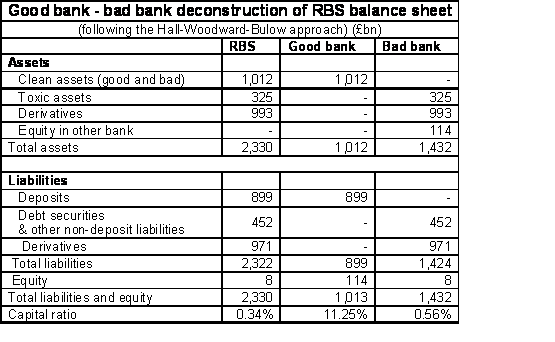
The Hall-Woodward-Bulow good bank solution

A particularly neat example of the Good Bank solution has been proposed by Robert E. Hall of Standford University and Susan Woodward of Sand Hill Econometrics. It can be found on the Vox website. They attribute the key idea to Jeremy Bulow. In what follows I merely adapt their numerical Citicorp example to the RBS Group.

The data for the Table below come from the Annual Report & Accounts 2008 of RBS. I am doing the exercise for the whole RBS Group. As it is unlikely that home country governments would be willing (or even able) to support the foreign subsidiaries of their banks, it might have been more appropriate just to consider the UK high-street banking units of the RBS Group. I leave that as an exercise for the reader.

Total equity of the RBS Group at the end of 2008 is reported on the balance sheet as just over £80bn. Market capitalisation is around £ 8bn. I therefore subtract £72 bn from the £2,402 total assets reported for the end of 2008, which leaves adjusted total assets at £2,330 bn. The tax payer has already put £45 bn into RBS. In addition, RBS has placed £325 bn of toxic assets in the government’s Asset Protection Scheme.

This means that RBS is a dead bank walking, a zombie bank, with its market capitalisation much less than past and present government financial support, let alone past present and anticipated future government financial support, which would also be reflected in today’s market capitalisation. I could have done the same type of exercise for Lloyds Banking Group, for Citicorp, for Bank of America or for UBS and many other zombie border-crossing banks.

On the asset side of RBS group are clean assets (good and bad, but with known fair values) and toxic assets (assets with unknown fair values and derivatives. On the liability side, I distinguish deposits, debt securities and other non-deposit liabilities, and derivatives. In the US, the derivatives on both the asset and liability sides of the balance sheet would have been netted, which would have reduced the size of the balance sheet by almost one trillion pounds.

I assume that the £325 bn worth of toxic asset insurance offered by the authorities to RBS equals the stock of toxic assets on its balance sheet. This leaves RBS with just over £ 1 trillion worth of clean assets (and the derivatives, just under £1 trillion). ‘Deposits’ is shorthand for guaranteed or secured creditors. The £899 bn worth of deposits on the RBS balance sheet is, however, larger than what is formally covered by UK deposit insurance (or by the applicable deposit insurance schemes of the foreign subsidiaries). Debt securities and other non-deposit liabilities are claims on RBS by unsecured and non-guaranteed creditors. They include all unsecured debt, including subordinated debt, other junior debt and senior debt. RBS had £452 bn of this unsecured and non-guaranteed debt (plus of course some non-guaranteed and unsecured liabilities included in ‘deposits’). Then there is just under £1 trillion worth of derivatives on the liability side of the balance sheet.

Equity - market capitalisation - is a mere £ 8 billion, giving a capital ratio (equity as a percentage of assets) of 0.34%. Even with all the government support it has received, RBS group is effectively worth nothing.

The Hall-Woodward-Bulow Good Bank - Bad Bank deconstruction of the RBS balance sheet requires one key condition to hold: the value of the clean assets of RBS has to exceed that of its deposit liabilities. This will be more likely the larger the amount of non-deposit funding RBS engages in.

We split RBS into a Good Bank and a Bad Bank by giving the deposits and the clean assets of RBS to the Good Bank, leaving everything else with the Bad Bank, and giving the Bad Bank all the equity in the Good Bank. (The derivatives on both sides of the balance sheet could be given to the Good Bank instead of to the Bad Bank, assuming they are clean). Since the value of the clean assets (£1,012 bn) exceeds that of the deposits (£ 899 bn), the good bank has equity of £114 bn (mind the rounding errors!). Its capital ratio is a healthy 11.25%. If I had used a more restrictive definition of ‘deposits’, the capital ratio could easily have been over 20% or even 30%.

The Bad Bank keeps the toxic assets and derivatives of RBS. It also has the equity in the Good Bank as an asset on its balance sheet. On the liability side it has just the unsecured and non-guaranteed debt securities and other non-deposit liabilities. Its equity is, of course, the same as that of RBS: £8 bn. Its capital ratio will therefore be higher than that of RBS, because the balance sheet of the Bad Bank is smaller. Neither the equity owners of the Bad Bank nor the unsecured and non-guaranteed creditors of the Bad Bank are worse off than, respectively, the equity owners of RBS and the unsecured and non-guaranteed creditors of RBS.

To achieve the deconstruction/decomposition of RBS into a Good Bank and a Bad Bank according to the Hall-Woodward-Bulow principles would require that RBS be put into temporary administration. The new Special Resolution Regime (SRR) introduced for the UK in February 2009 provides the ideal legal setting for this. It should not take long, a weekend at most. Basically, the Bad Bank just becomes a financial portfolio of toxic assets and derivatives, plus its stake in the Good Bank. It would not be allowed to invest in any new assets or to engage in any banking activities. It would manage the existing asset portfolio down and would cease to exist once the last asset has been sold or has matured. Among the clean assets the Good Bank buys would be the buildings, equipment etc. necessary for conducting the banking operations of the Good Bank.

If the UK government had not been daft enough to guarantee the £325bn worth of toxic assets on the balance sheet of the Bad Bank, there can be little doubt that the Bad Bank I have just constructed would have failed soon after coming out of the SRR. The Bad Bank, which is just a fund restricted not to invest in new assets, would be put into administration. The shareholders would be wiped out (more than 70 percent of RBS is now government-owned), and the unsecured and non-guaranteed creditors would determine what to do with the Bad Bank and its assets. Most likely there would be a significant debt-to-equity conversion and/or a large write-down of the debt.

The government would focus its financial support on the Good Bank, either by providing it with additional capital or by guaranteeing new lending and/or new borrowing by the Good Bank. Private capital could be attracted into the Good Bank too.

Distributional differences between the Good Bank and the Bad Bank solution

The Good Bank solution favours the tax payer. The Bad Bank solution favours the unsecured and non-guaranteed creditors of the zombie banks. ‘Tax payer’ includes those beneficiaries of public spending programmes that may have to be cut to meet the fiscal cost of purchasing or guaranteeing the toxic assets under the Bad Bank solution. It also includes those who lose as a result of future inflation or sovereign default, should either of these two solutions to dealing with the public debt created as a result of the Bad Bank solution eventually be adopted.

The Bad Bank solution also favours the shareholders of the zombie banks, but in the case of RBS, this is mainly the government and therefore the taxpayers. The amount of shareholder equity involved in the zombie banks is, in any case, negligible compared to the exposure of the unsecured and non-guaranteed creditors. The Bad Bank solution also saves the jobs and perks of the top management and the boards of the zombie banks - often the very people responsible for turning a once-healthy bank into a zombie bank.

There can be no doubt that, from a distributional fairness perspective, the Good Bank solution beats the Bad Bank solution hands down.

Incentive effects of the Good Bank and the Bad Bank Solution.

The Bad Bank solution creates moral hazard, because it rewards past reckless investment and lending. It also represents an inefficient use of public funds in stimulating new lending by the banks. To stimulate new lending, a subsidy to or guarantee of new lending is more cost efficient than the ex-post insurance of losses that have already been made on old lending, even though their true magnitude is not yet known. The Good Bank solution leaves the toxic waste with those who invested in it and with those who funded these activities, freeing government funds for reducing the marginal cost of new lending or increasing the expected return to new lending.

Both as regards moral hazard (incentives for excessive future risk taking) and as regards the efficient use of government funds (’new lending bang per buck’), the Good Bank solution beats the Bad Bank solution hands down.

Financial stability implications of the Good Bank and Bad Bank solutions: saving banking, without saving bankers or the existing banks

The holders of bank debt, with the possible exception of perpetual subordinated debt (which counts as tier one capital in some countries), have become the sacred cows of this financial crisis. Regulators, central bankers and Treasury ministers are quite willing to see shareholders wiped out. After the demise of WAMU and Lehman Brothers, however, the unsecured creditors have become inviolable. Somehow, those in charge of macro-prudential stability, notably the Fed, have bought into the notion that if there is either a further default on bank debt, or a restructuring involving a significant debt-to-equity conversion, or a signficant write-down of the claims of bank bond holders, this will be the end of the world.

I just don’t buy it. Fortunately, I am not the only one. Luigi Zingales, the Robert C. McCormack
Professor of Entrepreneurship and Finance at the Chicago Business School, has been advocating the case for mandatory debt-into-equity conversions, debt forgiveness and other up-tempo Chapter 11- style financial restructuring of banks and other defunct behemoths like GM, since the first days of the crisis (see e.g. (1) and his bookSaving Capitalism from the Capitalists, co-authored with Raghuram Rajan). Robert Hall and Susan Woodward also feel no need to pay any special attention to or lavish any public funds on the toxic assets, their owners and those who funded them (the unsecured and non-guaranteed creditors) once the Good Bank has been established and sent on its way.

Part of the reason there appears to be this widespread belief that you have to guarantee all bank liabilities is that this is what the Swedish authorities did during their 1991-1993 banking crisis (see e.g. Lans Jonung’s paper “The Swedish model for resolving the banking crisis of 1991-93. Seven reasons why it was successful” . First, Jonung lists seven criteria for ’successful’ resolution of a banking crisis. The paper does not demonstrate that this septet constitutes a set of necessary and sufficient conditions for success - if indeed the Swedish approach is deemed to have been a success. Second, success is in the eyes of the beholder. The Swedish banking system has been hard hit again in the current crisis by its overexposure (30 percent of annual GDP) to risky investments in Central and Eastern Europe, including the Baltics and Ukraine.

Every financial boom/bubble has been characterised by rising and ultimately excessive banking sector leverage, that is, by excessive lending to banks. If all the unsecured creditors of the banking system were made whole in the previous systemic crisis, it is not really surprising that the banks, and their creditors, are back for more.

In a more systematic study of the use of blanket guarantees of bank liabilitiesLuc Laeven and Fabian Valencia find the following:

“Using a sample of 42 episodes of banking crises, this paper finds that blanket guarantees are successful in reducing liquidity pressures on banks arising from deposit withdrawals. However, banks’ foreign liabilities appear virtually irresponsive to blanket guarantees. Furthermore, guarantees tend to be fiscally costly, though this positive association arises in large part because guarantees tend to be employed in conjunction with extensive liquidity support and when crises are severe.”

The proposition that the consequences of inflicting losses on holders of bank debt are awful beyond our wildest imagining is voiced incessantly and loudly by bankers and by those long bank debt, especially insurance companies and pension funds. And a vigorous campaign is underway to extend the no-default presumption to the debt of pseudo-banks like AIG.

The most over-the-top, ludicrous piece of attempted scare mongering about the systemic risk implications of default by any institution I have ever read is the internal memorandum “AIG: Is the Risk Systemic”, of 26 February 2009, which is now all over the internet. Just one small sample: “The failure of AIG would cause turmoil in the U.S. economy and global markets , and have multiple and potentially catastrophic unforeseen consequences”.

I would have thought that, on the contrary, markets have discounted the likelihood of default by many of the major border-crossing banks, and by AIG, pretty comprehensively by now. After the US authorities bailed out Bear Stearns in March 2008, letting Lehman go belly-up in September 2008 was a bad surprise. Even then, I don’t accept the interpretation that it was Lehman’s filing for bankruptcy protection that triggered the cardiac arrest in global financial markets in the second half of September 2008. Instead the financial sector convulsions of the last quarter of 2008 were caused by the realisation that (1) most of the US and European border-crossing banks were insolvent without government financial support, that (2) the rot extended to the shadow banking sector (AIG), and that (3) the US authorities (Treasury, Fed, SEC) were not on top of the issue and that Congress was bound to act irresponsibly.

But even if it had been Lehman that triggered the financial upheaval, that was then. This is now. Banks, counterparties, investors and policy makers have had 6 months to adjust to the new reality and prepare for the eventuality of default on zombie bank debt and even on AIG debt. The bonds of large zombie banks trade at spreads over government yields comparable to those of automobile manufacturers (600 - 650 basis points). Their CDS spreads put many of these banks well into the default danger zone. Their stock market valuations are consistent with those of institutions not a mile away from insolvency and default.

The fact that zombie banks or AIG are self-serving when they plead systemic risk as an argument for further government hand-outs does not mean that they are wrong. It does lead one to verify more carefully the logic of their arguments and the quality of the empirical evidence offered in support. Let me just consider the argument that the main investors in bank debt (and AIG debt) - pension funds and insurance companies - are too vulnerable and too systemically important to permit the banks (or AIG) to fail.

Pension funds don’t go broke with adverse effects on systemic stability. If they are funded, defined-contribution funds, a reduction in their asset value means that pensioners will get lower pensions. If they are defined-benefit schemes (including ‘final salary schemes’), the risk of investment surprises is shared by the sponsors and the beneficiaries. When the Dutch pension fund ABP took a big hit last year, my parents did not get any indexation of their pension benefit. In past years, pension benefits had tracked earnings inflation, and occasionally price inflation. Should coverage ratios decline enough, even nominal cuts in pension benefits can be implemented. This may cause hardship, but not financial instability. No reason to favour the pensioners over the tax payers.

As regards insurance companies, I doubt whether “Insurance is the oxygen of the free enteprise system”, as AIG would like us to believe. Certainly insurance companies like AIG are not the only suppliers of oxygen. Insurance is a regulated industry. Orderly restructuring following administration and insolvency need not interfere with the provision of any of the essential infrastructure services required for the proper functioning of a market economy.

Regulators, especially but not just in the US, have bought the ‘don’t touch the unsecured creditors’ argument. The Fed especially appears to have swallowed it hook, line and sinker. This cognitive regulatory capture has turned the Fed, with the enthusiastic support of the FDIC and the US Treasury, into the most powerful moral hazard propagation machine ever.

If a bank or an insurance company like AIG is at risk of failing but is truly too big or too interconnected to fail (rather than merely too politically connected to fail), and if a Good Bank solution is not feasible, then the institution in question should immediately be taken into public ownership or put into a special resolution regime, if one is available. From public ownership it can be put into administration. Once in administration or under a Special Resolution Regime, it can be restructured decisively through a mandatory debt-to-equity conversion or debt write-down. There is no case for sparing the unsecured creditors. "

Me:


1. The bondholders are:
1) Foreign Investors
2) Insurers
Let's start with 2. They're going to get a bailout in the US if they become untenable. Period. There's no way of saving money on this one by defaulting on insurers. It's better to guarantee them and hope that we don't have to pay them. If they become untenable, they'll get paid. Just take a look at whom they represent and their lobbying history.
About 1, they are countries like China. Contrary to what you are saying, China does think that Lehman's fall was a big deal, and expressed outrage about it because they believed that the US government had implicitly guaranteed them. They didn't make a big public stink about it, but they basically said that they wouldn't appreciate more defaults.
Now we come to Bank bonds. You're advising us to default on China again, along with other investors that we really need. That's why China has decided to more publicly express their displeasure. They would see our defaulting on these bonds as a clear indication that we prefer defaults to tough internal choices. Since the next stop on the default train would be US Treasuries, the Chinese don't like the trend line. That's what they're telling us. That's what the spreads have been telling us. These defaults would reflect on US intentions going forward.
Will we save money? No, because the next thing that will happen is China and other foreign investors demanding higher interest for loans.
Finally, since you are warning us about conditions that would cause foreign investors to stop lending money to the US, what could be worse than a clear pattern of preferring defaults?
No one would rather stiff these creditors than me. However, it's clear that investors are holding the US government responsible for these bonds, and not the banks any longer, and they are telling us that they will respond accordingly.

Although I do believe that letting Lehman fall was a disaster because it started a Calling Run, the beginning of Debt-Deflation, which didn't need to happen to such a disorienting extent, I agree that it wouldn't be as bad now. But it would be bad, could make things much worse going forward, and won't save us a dime. Guaranteeing the bondholders might also help seizing the big banks if we have to do so.

Since, in the case of Citi, the B of A, and AIG, all of their real profit is in foreign holdings, I'm not sure what problems that could cause if we seized them, or how that fits into the good/bad bank proposal. Just one citizens view.
Posted by: Don the libertarian Democrat

The public nature of the statement is the real news, not the supposed "worry" about the future value of their investments.

From Dean Baker:

"Since When Did China Get Worried About Losing Money on Its Dollar Investments?

The value of the dollar plunged by almost 50 percent against the euro in the years from 2002 to 2008 (it has since recovered part of these losses). China eagerly bought up U.S. government bonds during this period, even though it was consistently losing money on its investment.

This history makes its sudden expression of concern about losing money on its dollar holdings so peculiar. This public expression of concern presumably has a political motive rather than reflecting the actual views of Chinese leader, which would more typically be expressed privately to their counterparts in the United States.

The media should have pointed this history out to readers and noted how extraordinary it is that such a statement would be made in public. The public nature of the statement is the real news, not the supposed "worry" about the future value of their investments.

--Dean Baker

Me:

The comments were about guarantees for bonds. When Lehman was allowed to fail, China expressed annoyance that its assumptions about implicit government guarantees were incorrect. China holds US Bank debt. They are now making it clear, to everyone interested in the debate about defaulting on banks bonds, that they would not appreciate that move. To them, it would signal that we're tending towards defaults rather than tough political choices. They're saying that the next, and final issue on bonds, would be US Treasuries.

Of course, they know that we're in a symbiotic relationship with them, and so they're not going to blow themselves up. But, from their point of view, defaults will lead to losses that they will have to try and offset somehow. One way would be to demand much higher interest for loans in the future.

We're not getting out of this symbiosis any time soon, so we'd better get used to China reminded us about it every so often.

As Wen's comments reveal, China's great fear is that the value of its holdings will decline.

From Salon:

"The U.S. economy is freaking China out

The story of the hour in global financial circles: China's prime minister, Wen Jiabao, is "worried" about the value of his country's huge investment in United States Treasury bonds.

"President Obama and his new government have adopted a series of measures to deal with the financial crisis. We have expectations as to the effects of these measures," Mr. Wen said. "We have lent a huge amount of money to the U.S. Of course we are concerned about the safety of our assets. To be honest, I am definitely a little worried."

Of course he's worried. China owns about $1 trillion worth of Treasury bonds, and a collapse in the value of the dollar would be a devastating blow to China's foreign reserve portfolio. If Wen wasn't worried, you'd have to wonder about his acuity. A great deal is riding on whether Obama can steer the U.S. safely out of its current economic turmoil, and we're all pretty worried about it. But the main reason why Wen's comments are making news is that foreign leaders generally tend to be a little more circumspect when discussing such matters. The New York Times Wen's called his remarks a display of "unusually blunt concern."

So now the hunt is on to discern the hidden import. What's Wen really trying to say? Is this a shot across the bow, warning against any further attempts to label China a currency "manipulator?" Is it simple chest-beating? China's breakneck pace of growth has slowed and exports have fallen off the proverbial cliff, but the country is still in much better financial position, right now, than most of the industrialized nations in the world, nearly all of which are deep in recession.

Tea leaf readers will have a field day, but the only thing clear to me is how Wen's justifiable nervousness exposes the utter bankruptcy of the theory that China would ever be willing to threaten the United States by employing its so-called "nuclear option" of purposefully liquidating its dollar holdings.

As Wen's comments reveal, China's great fear is that the value of its holdings will decline. There would be no better way to achieve that than by dumping Treasury bonds on the market. In fact, just displaying tentativeness about buying more bonds in the future may be enough to spook markets. For China's own economic security, it needs the U.S. economy to recover. Which means, whether it spawns heebie-jeebies in the Middle Kingdom or not, China has to keep bankrolling Obama's efforts to end the recession.

Posted in: Economy, China"

Me:

  • China's Concern

    Right now, China's main concern is weighing in on the possible default of bank bondholders. They're telling us that it's not a good idea, because the next stop on that train is US Treasuries. They don't want us getting in the habit of defaulting, but rather to get in the habit of taking tougher actions.

    Of course they understand that were in a MAD embrace. They're trying to remind us about it. Don't worry, they get it.

It is unequivocal that a policy of “no more Lehmans” requires an effective guarantee of all the large US financial institutions.

From Bronte Capital:

"Financial chauvinism


There is a lovely comment on the last post accusing me of financial chauvinism – suggesting it is wrong to guarantee all bank liabilities.

This gets to the nub of the issue.

The current US policy is – pretty close to officially – that there should be “no more Lehmans”. Bernanke said it this week. Geithner has said similar.

It is unequivocal that a policy of “no more Lehmans” requires an effective guarantee of all the large US financial institutions. When one of them threatens to become the next Lehman it needs to be bailed out. The US government tips $30-300 billion in and gives us a Sunday evening press release – just for me to read in my Asian time zone before our local market opens!

Face it – the current policy is to issue the broad guarantee. That is what we have done. That is what “no more Lehmans” means. It means losses are covered when they are incurred by the taxpayer.

Once we have done that there is no real argument against a non-recourse funded troubled-asset program. That is just another form of non-recourse funded financial institution. The argument really is “how much capital should we demand the private sector put in, and on what leverage and confiscation terms?” It is the same argument for regulation of a bank.

But it is not universally accepted that the right policy is “no more Lehmans”. Chris Whalen (who I respect) thinks the right model for the dismantling of large financial institutions is Lehman. As he says the model is easy to determine – just go down to the Southern District of New York and talk to the trustee.

I think the consequences of allowing several uncontrolled large bank failures would be catastrophic – and the cost to the taxpayer of the effective guarantee will be huge (but probably less than a trillion dollars by the end of the cycle) – but lower than the cost of the great-depression event that would follow from a cycle of mega-bank collapses.

In Sweden the right policy was the guarantee – and selective nationalisation – precisely because the cost of the guarantee was not large. The institutions were not very insolvent. In Iceland the institutions were so large that the guarantee just was not feasible.

It is however very hard to tell what is insolvent in advance. Svenska Handelsbank was brimming with solvency and the market wrote it off for dead. It was a rapid 20 bagger when the crisis ended. If it were easy to tell how insolvent then there would be no big banks that were rapid 20 bagger stocks when financial crises end.

And it would be easy to tell the right policy.

The most important policy question is whether you issue the blanket Swedish guarantee. I think the answer is an unequivocal yes in the US – and a probable no in the UK. Krugman is edging towards a yes as he says in this post.

If it is a yes (open for debate) then the non-recourse finance model for the troubled asset funds does not pose any further problem.

The facts on the ground are that the policy is a de-facto guarantee – as officials regularly say that there will be “no more Lehmans”.

Krugman’s current position (probable yes on the Swedish position, blanket opposition to new capital on a non-recourse basis) is untenable.


John


PS. I have stated before - and it is reiterated in the comments

The problem with the ad-hoc guarantee is that nobody really thinks that it is a guarantee – and the generalised wholesale run on financial institutions will continue until they are sure. In other words we are effectively guaranteeing the liabilities without getting the policy benefit of that guarantee (which is the restoration of faith in the financial system).


Me:

Don said...

You've got it right. As soon as Debt-Deflation became a real possibility, we were stuck with a guarantee, but we hoped not everyone would notice, or, even sillier, that we could issue the guarantee to stop the run, and at the same time scare the bondholders into folding. This was my game, for sure.

Instead, these bondholders, including countries and insurers, keep calling my bluff. They're like the mortgage lenders and servicers, more than happy to play the hand out until the very end, betting we'll fold. And that's what we have to do.

China's telling us today that defaults aren't wise. If they go down, they'll take us with them. That's what all the bondholders have been saying. The spreads have delivered the message clearly and effectively. Enough with defaults and implicit guarantees. You've shown your hand. It's time to play it.

See, the bondholders are countries and insurers, the guys now calling for a bailout. We'll pay these insurers now or later, but we'll pay. As for the countries, they'll start demanding higher interests going forward if we default. They're going to get paid eventually as well.

Let's move on. Our one consolation is that, if we have to seize a few monsters, this should make it easier.

Just one more point. If you look at what the B of A, Citi, and even AIG have been saying, you'll notice that their "crown jewels" and profit centers are foreign holdings. Don't ask me how we keep them solvent without letting them keep these assets. Maybe somebody else can tell me.

Don the libertarian Democrat

March 14, 2009 6:07 AM