Showing posts with label Protectionism. Show all posts

Monday, May 18, 2009

politically driven effort to place obstacles in the way of an industry that is almost exclusively based in the US and the UK

TO BE NOTED: From the FT:

"
Europe’s classic exercise in closet protectionism

By Paul Marshall

Published: May 17 2009 19:19 | Last updated: May 17 2009 19:19

If opponents of the European Union are looking for evidence of political meddling and overreach, they could hardly find a better example than the new draft directive on alternative investment fund management. The proposal, aimed at imposing new regulation on hedge funds and private equity, is a politically driven effort to place obstacles in the way of an industry that is almost exclusively based in the US and the UK. It makes a mockery of any notion of subsidiarity – taking decisions at the lowest possible level – and is a classic exercise in closet protectionism.

I say this as a committed European and a member of the advisory council of Business for a New Europe (BNE), which strongly supports the UK’s active engagement in Europe. Indeed, BNE was set up to promote a reformed, enlarged and free-market EU.

The trouble with the draft directive is that it promotes no such thing. Instead, it proposes lifting authority for the initial authorisation, monitoring and supervision of alternative investment fund managers, as well as powers over the provision of services and marketing of funds, from the competent national authorities to the European Commission. The Commission may continue to delegate some of these powers to the countries, such as authorisation of managers. But the damage is done. The directive transfers ultimate powers to Brussels at the expense of national regulators.

It also has a strong protectionist element, since it would prevent fund managers in third countries – such as the US – from accessing the European market unless those countries adopted “equivalent” regulation. Try this as a sample of the language: “The key functions and activities which are likely to give rise to risks for European markets, investors or counterparties are required to be undertaken by EU-established entities, operating subject to harmonised rules.”

The content of the draft directive is a surprise to all those who have closely followed recent regulatory developments. Although hedge fund managers in the UK have always been regulated just like any other fund managers, the industry recognises that it needs to demonstrate to the outside world that it acts responsibly. That is why some of the leading funds, including Marshall Wace, joined together recently to promote tough voluntary standards – an approach endorsed by the recent gathering of leaders of the Group of 20 nations in London. The Commission’s draft legislation completely ignores the approach the G20 backed.

The Commission has also ignored in-depth analysis carried out by distinguished experts into the causes of the financial crisis and the measures needed to ensure it does not happen again. The De Larosière report carried out for the European Commission and the Turner report for the UK government both produced level-headed analyses of the failings of the global financial system. But neither could have led anyone to believe that the alternative investment industry was a dangerous source of risk, let alone the cause of the financial crisis.

Despite all this, the European Commission has steamed ahead without proper input from those most affected by its proposed measures – the investors and fund managers. It has also based its recommendations on an assessment of the risks posed by alternative investments that is at best debatable and at worst reveals a strong prejudice against this industry.

At a time when the overall reputation of the financial sector is so poor, it is hardly surprising that many people do not have a great deal of sympathy for the alternative investment industry. Most people do not really understand it or believe in its ability to create value for society as a whole, and I accept that it is up to us to explain ourselves better. But everyone can see what a misguided political project can lead to. This draft has been rushed through under extreme political pressure in a key electoral period, ahead of votes for the European parliament and in Germany. Is the EU really going to be built on such unashamedly protectionist initiatives, which marginalise the countries most affected?

Admittedly this is only the beginning of a long process. The final directive will have to be debated and approved. There will be the opportunity to modify it substantially and I hope the British government will take a lead in this. But the present draft is a very bad start. All it does is enhance the suspicions held by some in the UK that it is highly risky to engage with the continental Europeans on matters of crucial British interest.

The writer is chairman of Marshall Wace"

Saturday, April 18, 2009

“We couldn’t accept that because investments should be based on market practices,”

TO BE NOTED: From Bloomberg:

"China’s Wealth Fund to Consider Investing in Europe (Update2)

By Eugene Tang

April 18 (Bloomberg) -- China’s $200 billion sovereign fund will consider investing in Europe in 2009, after avoiding the continent last year because of trade barriers, said China Investment Corp.’s Chairman Lou Jiwei.

“Europe has started to welcome investments” without attaching conditions, Lou said today at the Boao Forum in southern China’s Hainan province. “During the world financial crisis, sovereign wealth funds have become more appealing” and less frightening, he said. Beijing-based CIC, whose investments have included stakes in Blackstone Group LP and Morgan Stanley, didn’t invest “a single cent” in European companies or assets last year, because the continent had put up barriers to limit the activities of sovereign wealth funds, he said.

The agency was founded to provide better returns for China’s foreign-currency reserves, the world’s largest at $1.95 trillion. The fund last year earned $10 billion from its investments, representing a 5 percent return, Radio Television Hong Kong reported on Feb. 24, citing a source it didn’t identify.

“There was rising protectionism against China last year, and the European Union had the worst” limits, Lou said today. “They allowed us to invest in no more than 10 percent of a company’s stakes and required us to give up our voting power” in management, he said.

“We couldn’t accept that because investments should be based on market practices,” he said. “With the removal of these conditions, we will seriously consider making decisive and prudent investments overseas this year, including in Europe.”

He declined to specify the European industries or companies he’s looking at investing in."

Thursday, April 16, 2009

double downward spiral involving the financial sector and balance sheets and asset prices on the one hand and the real economy on the other

TO BE NOTED: From The Growth Blog:

The financial system in the USA and much of Europe had a heart attack in September 2008. As in the case of a real heart attack, the highest priority has gone to the emergency response and to stabilizing the patient. Once that is done and the crisis is abating and even to some extent as it is going on, it will be important (economically and politically) for some to focus on two related issues: What created the rising risk of an attack? And what combination of actions post-crisis will reduce the risk of a repeat in the future.

There are related issues. Are there lessons in the current crisis (and past ones) or is each one sufficiently idiosyncratic so that reregulating with reference to the past does little to limit the potential future damage. Globally, what is the appropriate tradeoff between risk reduction on the one hand and higher costs of capital and lower growth on the other? Is the financial sector different from most others in that when it malfunctions, the rest of the economy malfunctions along with it, and if so should it be treated differently? Will investors learn from this crisis to a point that much of the “re-regulation” will come from adjusted investor behavior and risk assessment procedures? Or are there inherently large divergences between private and social objectives that need to be aligned through regulatory and oversight structures? Are the answers the same for domestic economies and financial systems and for the global aggregate, or are they fundamentally different?

In climate change there are issues of mitigation (prevention or risk reduction) and adaptation. Good policy is a mix of the two. Corner solutions are unlikely to be the right answer. A similar issue arises in the present case. Whether or not regulation and oversight are adequate depends upon the risks and the consequences of financial instability and distress and the latter depends on the existence and effectiveness of response mechanisms. We will need to talk about both in a coordinated way.

The Crisis of September 2008

Credit locked up, interbank lending stopped, and the payments systems' started to malfunction in the US and much of Europe. The TED spread (The interest rate differential between t-bill rates and LIBOR) and related measures of risk at the heart of the financial, payments and credit system rose from its normal 100 basis points to between 4 and 5 hundred basis points. Asset prices declined rapidly, balance sheets in the financial sector further deteriorated and the household sector experienced a massive wealth loss, triggering a reduction in consumption. The double downward spiral involving the financial sector and balance sheets and asset prices on the one hand and the real economy on the other accelerated and has only recently shown evidence of deceleration.

The financial crisis quickly became an economic problem and then a crisis. Asset price declines (equities globally lost $25-30 trillion or more in a four month period) and very tight credit caused investors and consumers to become extremely cautious, causing consumption to fall and the real economy to turn downward. There was no near-term bottom and few brakes to slow the downward momentum.

A complete credit lock-up (and a depression-like scenario in which businesses that rely on credit simply fail) was averted through rapid action by central banks using a growing variety of programs to increase liquidity or directly supply credit, thereby circumventing the normal channels that were damaged and not functioning. The balance sheet of the Fed more than doubled in size from less than a trillion to more than two trillion and with recent commitments is on its way to 3 trillion dollars.

There were two further issues of central importance. First, the markets in a variety of securitized assets stopped functioning. The shadow banking system through which a substantial portion of credit is provided in the US, froze up. Second, because of a combination of leverage and damaged assets, there was and is a potentially large solvency problem in a significant number of large and systemically important institutions. The solvency and related transparency issues continue to be with us today.

The effects on the developing world were immediately felt, though the awareness of the magnitude increased over time. The two important channels were aggregate demand (globally), and the availability and cost of credit and financing. A third channel, rapid shifts in relative prices apart from credit spreads, were important but on balance beneficial.

The financial channel was dramatic. Credit tightened pretty much instantly in the developing world as capital either rushed back to the advanced countries or stopped flowing out, to deal with damaged balance sheets and capital adequacy problems in the advanced countries. The currencies of all major developing countries except for China depreciated against the dollar. Developing countries with reserves used them to stabilize the net capital flows and to partially restore credit and financing. Trade financing dried up and other capital flows diminished or disappeared. The IMF intervened in several cases while financing and bilateral swap arrangements of a variety of kinds were made by the US and China. Credit remains tight and high priced and there is a continuing need for additional financing on a broad front. The IMF did not have the resources in the fall of 2008. Expanding those resources significantly was part of the G20 agenda. At the G20 summit in early April, an important commitment was made to expand IMF resources by over $1 trillion to restore the availability of trade and other forms of finance on an interim basis to developing countries that need it.

The second channel was aggregate demand and trade. As aggregate demand in the advanced countries dropped for the aforementioned reasons, global aggregate demand fell and with it trade: exports and imports. The trade data show a stunning drop in exports, considerably more than in aggregate demand. In many developing countries that rely on external demand and exports as an engine of growth, the immediate negative effect was lower growth, reduced employment and reduced consumption triggering the usual domestic recessionary dynamics.

Globally, the intent is to counter this loss of aggregate demand with coordinated fiscal stimulus programs in the advanced countries and in developing countries to the extent it can be done without jeopardizing fiscal sustainability. The latter capacity varies considerably across countries. There is dissension in the G20 as to what the right order of magnitude is. There are also issues of free riding and protectionism. It is understandable that citizens in various countries facing fiscal deficits and large future debt service obligations prefer to have the benefits of a stimulus program land domestically.

I have described this incentive structure elsewhere as akin to a prisoner’s dilemma with the non-cooperative dominant strategies being either stimulus with some protectionism or free-riding depending on the size and openness of the economy. One can think of that portion of the G20 effort, the part devoted to openness, as attempting to shift policies away from the non-cooperative Nash equilibrium. Evidently, from data on increases in protectionist measures, this will be only partially successful, but partial success is probably much better than no effort at all. Realistically we may not have the option of choosing the first best, coordinated stimulus with openness, but rather have to be satisfied with an effort at coordinated stimulus with some protectionism, as opposed to openness with feeble stimulus commitments.

More generally there is confusion and disagreement about the role of government in the context of a crisis. I have written at somewhat great length about this issue here [1]. This disagreement complicates the politics of timely and effective intervention and has to be factored into the risk assessments for policy makers and private investors and consumers alike. One thing is clear. Government has become a major player in the financial system and the economy. In the financial system it has morphed from regulator to regulator and participant. Predictability of government action has therefore become a major determinant of risk.

The third channel was relative price changes. The dramatic spike in commodity prices (especially food and energy) was reversed. This ameliorated a twin challenge in most developing countries of dealing with the impact of the commodity price spike on the poor and on inflation. Beyond that, at the country level, those who have gained and lost depends on whether a particular country is a net importer or exporter of commodities.

The commodity price spike and fall brought into focus an important policy issue. Large relative price swings have very important distributional consequences across countries and across subsets of the population within countries. These need to be addressed as part of creating a better managed and more stable global economic system that people will support. [for further reference, see part IV of the Commission on Growth and Development: The Growth Report [2]].

Where Are We Now?

On the real economy side, in the advanced countries and globally, growth has gone negative or slowed dramatically. Global growth is projected to be negative in 2009 for the first time since World War II. Trade has collapsed. While there are some signs that the downward momentum may be slowing, the real economies have not bottomed out and are unlikely to do so in 2009 and perhaps well into 2010.

The advanced countries financial systems have shown some recent signs of improvement, though they are still functioning on life support. There are signs that credit is easing and risk spreads are declining somewhat from very high levels. But that is certainly because the government and central banks have a major and expanding role in the financial system. It is too early to say that the system is starting to return to normal. In the US, the Fed and the Treasury have launched a series of initiatives designed to restart the markets in securitized assets, clarify values, remove the transparency fog surrounding the balance sheets of major financial institutions, and as necessary recapitalize banks and other systemically important institutions, probably by becoming a major (or the sole) owner of some of them. Progress on this front from a policy point of view is relatively recent and it is too early to tell the extent to which they will be sufficient to jump start the sequential healing process and a return to normal functioning.

The US savings rate is rising, a part of the disorderly unwinding of global imbalances. Asset prices remain volatile and it is too early to tell if they have stabilized. It is clear however, that the financial system and the real economy will not return to their previous configurations. Even absent major and likely changes in regulation and oversight, there will be a “new normal”. Global growth in the future will be driven by a different portfolio of saving and investment rates and levels across countries.

The Growth Commission Workshop Meeting And Supplementary Report On The Financial And Economic Crisis

The Commission on Growth and Development is meeting one more time in late April in conjunction with a two day workshop, to consider issues related to the financial and economic crisis and its aftermath. The intent is to produce a special report, additional to the Commission report [3] which came out in May 2008. This special report will likely deal with three broad sets of issues.

One set has to do with post-crisis, the challenge of creating more effective regulatory and oversight structures (domestically and internationally) that reduce the risk of instability and the likelihood that the instability spreads quickly to the entire global system. A second set of issues has to do with crisis response. Are there ways when instability and malfunction occur, to limit the damage and disrupt the transmission channels? Further, can some of this capability be created in advance so that it can be deployed quickly? There is obviously a third issue: are the conditions needed to bring the patient back to health and prosperity being met? And if not, what else do we need to do?

The Commission anticipates that there will be a process overseen by the G20 designed to develop proposals for a different global financial architecture, regulatory and oversight structure. Our intention is to have the augmented Commission report contribute to that process with particular attention to the needs and interests of developing countries, some of whom are represented in the G20 itself and most of whom are not.

As we approach the workshop and the Commission meeting and discussion of these issues, we invite broader comment, input and discussion on the BLOG.

Like many members of the Commission and participants in the workshop, I have been thinking and writing about the financial and economic crisis under the headings of causes, crisis dynamics and policy responses, and post crisis reform. A link to my articles will be published on this blog, and I look forward to your comments."

Tuesday, March 10, 2009

Many would say it's the thin end of a peculiarly ugly wedge.

From the BBC:

"
Nationalism may impoverish us
  • Robert Peston
  • 10 Mar 09, 07:58 AM

Many would say it's the thin end of a peculiarly ugly wedge.

I'm talking about a report in yesterday's Financial Times that Bank of America has withdrawn job offers from foreign graduates of US business schools.

What's the cause?

Bank of America signA Bank of America spokesman cites a stipulation by Congress on banks and businesses rescued with taxpayers' money that - if they're laying off US workers - they mustn't employ highly skilled immigrants.

Fair dos, you might say. What's wrong with "US jobs for US workers", to re-work an aphorism coined by our Prime Minister, at a time when jobs are scarce?

Well, financial globalisation was associated with a nation-blind and race-blind, meritocratic approach to recruitment that many would have described as making the world a more tolerant place, and therefore a more stable place.

Say what you will about the way that some big global banks, hedge funds and private equity firms have blown up our prosperity by their blind pursuit of short-term rewards.

But they were more culturally and racially eclectic than most other businesses.

What mattered to get to the top of one of these firms was brains and ruthless determination (oh, and it helped to be motivated by the prospect of making money beyond anyone's wildest dreams).

So their upper ranks were and still are filled with Indians, Chinese, African-Americans and a perhaps surprising number of French men (surprising because much of France's establishment took a rather sneering attitude to the Anglo-American approach to finance).

But for how much longer?

The global recession has prompted a rise in nationalism and protectionism.

For example, a Congressional committee is also this week expected to criticise US banks in receipt of state support for continuing to invest or lend in Asia and the Middle East.

This is dangerous stuff - because the less capital that flows across borders, the less money there will ultimately be for all of us.

The point is that when loans are withdrawn in a systematic way, there's a domino effect and a feedback effect, which ultimately cause the total contraction of credit to be much greater.

And although it was perhaps understandable that politicians were unaware of the poisonous impact of financial chauvinism in the 1930s, there's little excuse today (which is not to argue that protectionism caused the Great Depression - but simply to say that it didn't help).

Which brings me back to China - and the role that many would want it to play in reducing the severity of the global recession and in making the world a permanently safer place.

Our government, the US government and most of the developed world would like to see China consuming more of what it earns from exports.

In the short term, this should helpfully increase demand for our goods and services.

And in the longer term it would gradually reduce China's $2 trillion stockpile of foreign exchange - which many see as one of the main sources of the cheap capital that pumped up the credit bubble, whose bursting has done us so much harm.

But China, understandably, wants a tit for its tat.

China's Commerce Minister, Chen Deming, recently said this to me: "Our hope is that we can gradually reduce our financial surplus...The right way to do so is to consume our surplus abroad through our tourists or through our outbound investment activities".

This desire by China to own more of our productive capacity raises great alarm, especially in the US.

But if China is to consume more and save less, is it unreasonable for it to want to safeguard its future prosperity by acquiring businesses and real assets overseas, which will remit valuable dividends to it over the longer term?

Isn't this what the "imperialist" UK and US did at comparable periods of their economic development?

And is there a cost to us or a benefit if China were to provide our capital-starved businesses with the financial resources they need?

There's an argument that if we're to get through this recession in reasonable shape, we've got to become more relaxed - not less - about who owns what."

Me:

98. At 2:51pm on 10 Mar 2009, DonthelibertDem wrote:

Nationalism is the greatest problem that we face going forward. Thanks for attacking it wherever it's found.

Sunday, February 15, 2009

European leaders have woefully underestimated the crisis and possibly still do

TO BE NOTED: I'VE BEEN SAYING THAT BEGGARING THY NEIGHBOR HAS BEEN GOING ON ALL ALONG: From the FT:

"
Narrow-minded leadership hurts Europe

By Wolfgang Münchau

Published: February 15 2009 19:27 | Last updated: February 15 2009 19:27

“It is justifiable if a factory of Renault is built in India so that Renault cars may be sold to the Indians. But it is not justifiable if a factory ... is built in the Czech Republic and its cars are sold in France” – Nicolas Sarkozy, president of France.

This is a troubling statement indeed. But instead of launching a tirade against Mr Sarkozy, I would like to make an observation that is perhaps not immediately evident: his statement is entirely consistent with the way the European Union has reacted to the financial crisis.

To see the link between crisis management and the rise in protectionism, look at the initial policy response to last September’s financial shockwaves. European leaders have woefully underestimated the crisis and possibly still do. The European economy is now heading towards a depression, with German gross domestic product falling at an annualised rate of almost 9 per cent. The early misjudgment of the crisis resulted in stimulus packages with two defects. They were initially too small but, more importantly, they were not co-ordinated. One important aspect of the economic meltdown is the presence of strong cross-country spillovers, both globally and inside the EU. The policy response failed to take account of these spillovers.

For the bank bail-out programmes, the EU managed to set a minimum level of competition rules, but these programmes, too, were national and not co-ordinated. So how does the combined effect of these two unco-ordinated responses lead to protectionism?

If stimulus money is dispersed at national level, governments naturally try to make sure that the money stays inside their countries. The prospect that consumers might spend the money on imported goods was one of the reasons why eurozone governments were reluctant to cut taxes. Because of EU competition rules, the same logic also applies to government purchases. Under those rules, governments had to open public projects to EU-wide tenders. If you play by the rules, keeping the cash in your country is not easy.

Governments have since relaxed those rules. In other words, if you want to make sure that these programmes function in their warped way, you have to dismantle the single market. The same logic applies to the bank rescue packages. If the European Commission tried to block each uncompetitive bank rescue, it would be blamed for causing a financial collapse. Governments have found a way to circumvent the EU, by breaking so many rules at once, that the Commission cannot even begin to react effectively.

Expect to see three effects with progressively destructive force. The first is that the stimulus is much less effective than it could otherwise have been. When everybody tries to gain a competitive advantage over each other, the effects usually cancel out.

Second, the stimulus and bank rescue packages harm the single European market directly. The French subsidies are more blatant, as is the protectionist rhetoric of its president. But everybody in Europe plays the same game. It is not as though the single market is the default position for European commerce. Much of the service sector is exempted. Europe lacks an effective pan-European retail infrastructure and retail banking system. Reversing this programme long before it is completed would be a mistake.

Third, and most destructive, the combined decision on stimulus and financial rescue packages poses an existential threat to monetary union. A blanket loan guarantee to every bank, as most governments have granted, in combination with indiscriminate capital injections and a reluctance to restructure, will mean the transformation of private into sovereign default risk – aggravated further by the economic downturn. Some insolvent banks are now owned by the state, while the bulk of damaged, not-yet-insolvent banks are lingering on, hoarding cash. This programme is a drain of resources with no resolution in sight.

I would now expect several eurozone countries with weak banking sectors to get into serious difficulties as the crisis continues. There is a risk of cascading sovereign defaults. If this was limited to countries of the size of Ireland or Greece, one could solve this problem through a bail-out. But solvency risk is not a problem confined to small countries. The banking sectors in Italy, Spain and Germany are increasingly vulnerable.

When European leaders meet for their anti-protectionism summit on March 1, they will produce warm words to reaffirm their commitment to the single market. I suspect they will continue to misdiagnose the crisis. Protectionism is not the root of the problem. The protectionism we are experiencing now is caused by co-ordination failure. It is neither sudden, nor surprising.

The right course would be to solve the underlying problem – to shift at least some of the stimulus spending to EU or eurozone level and, ideally, drop those toxic national schemes altogether and to adopt a joint strategy for the financial sector, at least for the 45 cross-border European banks. But this is not going to happen. It did not happen in October, and it is not going to happen now. As a result of the extraordinary narrow-mindedness of Europe’s political leadership, expect serious damage to the single market in general and the single market for financial services in particular. As for the eurozone, I always argued in the past that a break-up is in effect impossible. I am no longer so sure"

Friday, February 6, 2009

Just two weeks after saying protectionism was under control

From Paul Kedrosky:

"
WTO Calls Emergency Meeting on Trade Barriers

barriers This is worrisome:

Just two weeks after saying protectionism was under control, the World Trade Organization is gathering nations in a special meeting Monday to discuss a fast-rising wave of barriers to commerce.

Dozens of measures have been enacted in country after country since early last month, in a scramble by governments to safeguard key industries -- often by damaging those of their neighbors.

More here.

Me:

From John Carney yesterday:

"Why anyone in the world would feel reassured by listening to Dodd is beyond us. You'd be better off asking your cat if Bank of America would survive. To take just one notorious example, Dodd was talking up the financial health of Fannie Mae and Freddie Mac as late as last summer.

"This is not a time to be panicking about this. These are viable, strong institutions," Dodd said at a Capitol Hill press conference in July. Two months later the federal government had to take over both of those "strong institutions."

You today:

"Just two weeks after saying protectionism was under control, the World Trade Organization is gathering nations in a special meeting Monday to discuss a fast-rising wave of barriers to commerce."

I could be wrong about this, and I wish I would have tagged these type of stories, but doesn't there seem to be a pandemic of immediate contradictions and about turns to reassuring statements? One theory could be that people don't want to prematurely panic the market. On the other hand, I'm beginning to immediately short reassuring statements with a BS CDS.

Wednesday, February 4, 2009

Forget the economic illiteracy. What an arrogant and naive view of the global economic system!

From Free Exchange:

"Way to go, America
Posted by:
Economist.com | WASHINGTON
Categories:
Trade

I STILL can't get over this passage in John Judis' defence of the Buy America provisions in the stimulus plan:

Of course, countries are going to complain--and some already have--but it's likely that they recognize that the U.S. has to do something like this to ensure that its spending doesn't simply disappear in a flood of imports. If they still insist, then the U.S. can have a talk with these nations about how to end global trade imbalances that have been caused in good measure by Asian countries pursuing export-led growth. In that respect, the Buy American provision will have been a useful negotiating ploy--call it a stimulus of a different kind--even if the American steel industry remains stuck in the doldrums.

Forget the economic illiteracy. What an arrogant and naive view of the global economic system! And again, if someone had written something analogous about foreign policy, writers on the left (though, to be fair, perhaps not the writers at the belligerent New Republic) would be apoplectic—yes, America is violating international agreements to pursue short-sighted and potentially dangerous military activities abroad, and yes, our allies will complain, but look, we'll just sit them down and have a talk, and let them know that this is what America has to do to protect its "interests".

Anyway, our allies are indeed upset. Europe is looking to see what laws America has broken and whether it has the right to retaliate. And Japan, an ally, which is currently producing the worst macroeconomic numbers of any developed nation ever, has little choice but to beg America to reconsider. Those who believed that America the bully was finished when that helicopter left the Capitol for Andrews Air Force Base on January 20 must accept that they might have been wrong."

Me:

I hate to say this, but I think that he's right. The administration is sending a trial balloon/message that, in order for the Saver-Export Country / Spender Country Symbiosis to continue ( Which I believe that the Saver- Countries actually want ) , one part of the solution should be an increase in the exports of Spender Countries to Saver Countries. It's that, or limiting imports. Which do you prefer?

I'm not agreeing. I'm saying that Judis has a good read on what's going on.

Depressions, and severe recessions, attract protectionism

From the Aleph Blog:

"Depressions Attract Protectionism

Depressions, and severe recessions, attract protectionism. It’s the nature of the beast. So long as political pressures are “to do whatever it takes to create prosperity” at home in the short-run, governments will target spending to domestic firms (an increasingly squishy concept in a global world). What politician would defend to local constituents a bailout package where foreign firms directly benefit from the expenditure of domestic tax dollars?

Though I did not vote for him, I appreciate the principled approach that President Obama is taking here. He is taking a longer view, and wants to avoid trade wars. Few politicians take the longer view; that is why they not statesmen.

By their nature, economic crises make people short-termers. They look to what will help themselves survive amid volatility. The long-term good of many would involve patience, and a willingness to not press for short-term advantage. Perhaps Kings could do that, though often they didn’t, but democratic officials are on a short leash from their electorates.

Even Authoritarian places like China tend toward protectionism, though. Their legitimacy is based on their ability to deliver continued prosperity. There is increasing unrest in China during this slowdown; expect the Chinese government to do what it can to appease its populace, including measures that protect local businesses.

That’s why I am not surprised at protectionist impulses at this time. They are short-term rational for politicians, while long-term irrational for economies. This is just another reason why we are foolish to trust in politicians to assure our economic well-being. Their short-term orientation is out of sync with what it takes to manage an economy.

We will be best off if after this crisis we realize that the government played a starring role in creating it, and mismanaging it. Were there businessmen to blame? Yes, but they took their cues from financial regulators that stopped regulating, and an accomodative monetary policy. The government did not do its job right, assuring the value of currency/credit.

=–=-=-==–=-=-=

Additional Notes:

1) Now Barney Frank wants to hand over oversight of systemic Risk to the Federal Reserve. As if they can do their current job well — the Peter Principle is in action here. I was joking about it last year, but why not create the Federal Office for Oversight of Leverage [FOOL]? After all, the tasks of monetary policy are considerably different from those of containing systemic risk, even though they are related.

2) Speed really benefitted us during the original passage of the TARP, right? No, it didn’t. So where does Timothy Geithner get off urging speed at this point? Speed does not eliminate bad debts. Speed does allow for many venal legislators to push their own pet projects, and use a crisis to disguise their efforts.

3) Read Yves Smith’s piece:The Bad Bank Assets Proposal: Even Worse Than You Imagined. Our government resists letting banks fail, and then letting the FDIC/RTC2 reconcile them. They would rather intervene to let marginal or defunct entities live."

Me:

  • Don the libertarian Democrat Says:

    I have a slightly different reading on this. There is a major problem with the Saver/Export Country /Spender Country Symbiosis. One way to ease this would be for the Spender Countries to increase exports to Saver Countries. I see this proposal as a trial balloon to see how this policy might go. In other words, we can export more goods to you, or you can export less goods to us. Which would you prefer?

  • Saturday, January 31, 2009

    The open and obvious aim of such a tariff policy is to improve the fortunes of the US

    From Adam Smith's Lost Legacy:

    "
    A Reckless Optimist Writes Pete Murphy posts on Five Short Blasts Forum HERE:
    His recent post is on “Clumsy Trade Policy” and it expounds a new theory of ‘safe’ protectionism by weighting tariffs on manufactured goods by an index of the population of a country – the larger a country’s population the more the imposed tariff. It's not difficult to work out who he is aiming at.

    His assurances are also predicated on a ‘hope’ and ‘assumption’, but not much more, namely that countries (I see Germany is included!) affected by a substantial fall in their exports to the USA would not retaliate.

    History shows that there is no fire-safe way in which imposing tariffs is ‘safe’ from retaliation, and retaliation is more likely when there is economic distress, of which all affected parties are aware. It called a ‘beggar thy neighbour’ strategy. Moreover, all US trading partners will be aware of the aims of the policy – they read the US press, watch Fox News and CNN, and their diplomats keep tabs of Congressional Debates.

    The open and obvious aim of such a tariff policy is to improve the fortunes of the US while necessarily worsening the economic performance of those upon which the weighted tariff policy would be applied.

    Pete Murphy includes these assertions in his post:

    The problem is that we’ve held fast to our free trade policy for decades, in spite of the mountain of evidence that something is wrong - culminating in global financial collapse, without ever questioning why. We’ve taken the 18th century theories of Adam Smith, David Ricardo and others, fathers of free trade theory, at face value without ever researching factors that may limit their application - like population density, for example. And without an understanding of what makes free trade work in some instances while producing horribly skewed results in others, we then have a tendency to lash out at all trade. At least the blunt force application of protectionism would restore a balance of trade, but the U.S. Chamber of Commerce is correct in warning of backlashes.”

    And:

    Any policy that moves us toward a balance of trade and restores manufacturing jobs is better than what we have now, but an elegant approach that’s rooted in logic can avoid the unnecessary collateral damage of a trade war that would only buttress arguments for a pendulum-like swing back to the opposite end of the clumsy trade policy spectrum.”

    Comment
    The trade policies of the US (which are not free trade) are not there because of what Adam Smith wrote in 1776 or David Ricardo wrote in 1817 (that gives far too much credit to them); they take their current forms because it is in the interests of the US to apply such policies.

    I should think that international trade policy is the most researched area of economics imaginable, from all sides of the arguments about it, from people of significant standing in the subject, plus not a few ‘scribblers’ who believe they have spotted some missing element the theory and practice of internation trade (I remember as a student almost only having time to read the titles of all the books and articles written on the topic, never mind their contents) backed by endless econometric analyses, in what thousands of these lifetime-scholars did not manage to spot, in two or more hundred years.

    International trade is highly political, and has been since medieval times. European countries went to war many times with neighbours over all kinds of issues, including the trivial and the momentous, and trade relations were often the cause of, first ‘jealousy of trade’, then angry resentment, and almost always in the spirit of mere speculation by scribblers about which side would ‘win’ as a result of the contest of arms, or a contest of those surrogate arms, called tariffs and retaliatory prohibitions. Trade wars are not a one round game.

    Pete Murphy describes his proposal as “an elegant approach that’s rooted in logic”, which he assures readers “can avoid the unnecessary collateral damage of a trade war”.

    It’s a safe bet he is wrong."

    And I comment:

    Don said...

    "His assurances are also predicated on a ‘hope’ and ‘assumption’, but not much more, namely that countries (I see Germany is included!) affected by a substantial fall in their exports to the USA would not retaliate."

    I think that he's on to something. The Spender Country / Saver ( Exporter ) Country Symbiosis is going to be hellishly hard to break apart without serious social dislocation and disruption. I expect to see some form of agreed upon default by the Spender Countries. The choices include:
    1) Let the Spender Countries export more
    2) Allow some debt cancellation
    3) Allow the Spender Countries to inflate their currency
    I'd like to be proven wrong, but getting the Chinese, savers who've just seen the negative consequences of spending to spend, is a difficult task.

    Don the libertarian Democrat

    Gavin responds:

    Blogger Gavin Kennedy said...

    Hi Don

    Apologies. I wrote a response but must have deleted it before posting. Ny PC has been on and off today as I have had family chores and I always switch it off when absent.

    I wrote something like this:

    I don’t think this is a runner, as my racing friends would say.

    The issue is any arrangement that worsens some trading partners at the expense of others is bound to provoke retaliation by edict, which once started becomes uncontrollable. This started the decline in world trade in the 1930s once the depression was underway, i.e., reciprocal ‘beggar thy neighbour’ trade wars, making the depression deeper and longer lasting.

    For ‘spenders’ to export more, the question is to whom are they exporting more and of what?

    Who allows what ‘debt cancellations’, for how much and for how long?

    Inflation is a monetary phenomenon – a currency is worth what I is worth in terms of other currencies.

    Chinese savers can act in China only; their government decides its exchange rates.

    I am inclined to think that there will be “serious social dislocation and disruption”, especially from what Pete Murphy proposes.

    The US is not a free-trade economy, neither is Europe, nor China and India, or Brazil. Becoming even less free is a high-risk ‘solution’ for which the precedents are not kind to optimists.

    Wednesday, January 21, 2009

    "That turned out to be spectacularly wrong. "

    Peston on BBC:

    "The Governor of the Bank of England didn't pull out the stops to cheer us up in his speech last night.

    What was particularly striking were his closing remarks, when he said that he was sure an economic recovery would come and that there would certainly be a positive outcome from all those interest rate cuts and the hundreds of billions of taxpayers' cash allocated to pumping up the wilting banking system and stimulating demand.

    Mervyn KingBut - and it's an important qualification - he couldn't be sure when the economy would turn. He said: "No one can know at what point the impact of all this stimulus will have a visible effect on activity; the lags in economy policy are notoriously long and unpredictable".

    Oh dear. If the economists we trust to steer us through this mess ever had a torch, the battery appears to be flat.

    Nor did I feel particularly reassured by his assessment of when the great cause of our woes will be fixed, the reduction in borrowing and lending by banks and other financial institutions.

    To remind those who don't live and breathe bankers' jargon, when Mervyn King talks about "leverage ratios" he means the relationship between a bank's debts and its capital resources. He said that the "leverage ratios of large banks remain at remarkably high levels and the required adjustment will not happen quickly... With fresh capital from the private sector difficult to obtain, banks have opted to reduce their lending and that is why the flow of credit to all parts of the economy, here and abroad, has been heavily disrupted."

    It's that stress on the leverage ratios of banks still being "remarkably high" that slightly surprises me. Not because it's wrong. But the Treasury and the Financial Services Authority have frantically been trying to reassure the banks that they have ample capital resources to finance their balance sheets - and Mr King does seem to be saying something different( TRUE ).

    Mr King went on to say that "banks are encouraged to run down their capital to enable them to absorb losses while continuing to lend, but in the long run they will need more capital".

    Again, this is not quite what the FSA is saying. The City watchdog's message - which it repeated loudly on Monday - is that our banks currently have enough capital to absorb the losses they'll incur as the recession causes increasing difficulties for borrowers. It says that their capital ratios will still be at acceptable levels even after the losses have been absorbed.

    But if the Governor is right that banks have inadequate capital for the long term, the markets will price that in today, in the form of lower share prices for banks and much more demanding terms for the credit they require( TRUE ).

    Considering the mullering of bank share prices in the past couple of days, it looks as though the Governor is right. But I doubt the Treasury or the FSA will thank him for pointing it out.

    It's not all gloomy news, according to King. He says that because so much of banks' excessive lending and borrowing has been with other financial institutions, there is "scope for a reduction in the leverage of banks without restricting lending to the 'real' economy".

    There are two things to say about this.

    First, as John Gieve, the Deputy Governor of the Bank of England, told me in an interview for my Panorama documentary before Christmas, the Bank of England was too sanguine during the boom years that there was some kind of cordon sanitaire around the debt and asset bubble, such that when the bubble was pricked it wouldn't infect the real economy too much.( TRUE )

    That turned out to be spectacularly wrong. It's therefore reasonable to question whether the non-financial sector (that's you and me, and "real" businesses) can be protected from the massive reduction of lending between financial institutions.( A FAIR POINT )

    Also, the way the Treasury is trying to protect the non-financial sector is by imposing formal quantitative targets for lending to businesses and households on those banks in receipt of financial support from taxpayers. As you've noticed, it's instructing the banks to lend considerably more to all of us.

    Which is all very well.

    But as I've pointed out before, if all countries forced their banks to concentrate their lending on domestic markets, that would lead to an even sharper fall in cross-border flows of funds and capital than is already taking place.

    It would amount to a kind of financial protectionism, a beggar-my-neighbour policy, that could impoverish us a lot more than would otherwise be the case.( ANOTHER GOOD POINT )

    So the Treasury should tread a little warily, I think, before forcing all our banks to do nothing but their patriotic duty.

    PS: Mervyn King is at pains to point out that he hasn't run out of all tools to revive lending and the economy.

    He confirmed that we're probably about to enter the relatively uncharted wilderness of "unconventional measures" to stimulate the flow of credit and money: what's called quantitative easing, or the creation of reserves at commercial banks by the Bank of England buying all manner of financial assets, in the hope that the banks won't just sit on these reserves but will convert them into loans to the private sector.

    It's reasonable to see this as the creation of new money. The big question is whether it would circulate and stimulate transactions - which is what the Bank of England would want - or would be hoarded.( YES )

    In fact, within a matter of weeks, we'll see the Bank take an imaginative first step in that direction, when it starts to buy up corporate debt (not for cash, but in exchange for Treasury Bills), in the hope that the liquidity of the market for corporate debt will be significantly improved and thus make it cheaper and easier for big companies to borrow.

    This may sound tediously technical. But it is big stuff. It represents the public sector, us as taxpayers, lending directly to companies( TRUE ) (even though the Bank will be buying this stuff on the secondary market). "

    It's wonderful capturing these moments of clarity and truthfulness by bankers. It has an almost sexual pleasure to it. Almost I said. Don't get carried away.

    Monday, January 12, 2009

    "Export subsidies do not diminish international commerce, they, um, subsidize it. "

    From Interfluidity:

    'Tis better to give than to receive.

    A nice sentiment, surely. But is it good economics? My takeaway from China's experience is that it is, or it can be. There are lots of ways to spin China's policy of limiting the appreciation of its currency in order to promote export-led capital formation and growth. One story is simply that the policy amounted to a export subsidy: Purchasing power was withdrawn from Chinese workers and transferred to dollar and euro spending foreign consumers.

    It's unmistakable that the policy "worked", in some sense. China's growth, along with the scale and pace of change in that country, have been remarkable.( TRUE )

    I've mulled over the question of subsidy before. Simple economic reasoning suggests that subsidies harm the subsidizers and help the subsidizees. Yet nations often do subsidize their exports, overtly and covertly. Instead of welcoming cheap goods with open arms, the recipients of the subsidized merchandise usually complain, and sometimes slap on "anti-dumping" tariffs to keep cheap goods from being too cheap. Economists often tsk-tsk at all this, blaming both the subsidies and the tariffs on rent-seeking politically connected manufacturers. It's all "protectionism", they say.

    A fair review of the history of "protectionism" would be much more mixed than the economic mainstream would like us to believe, with their stories of comparative advantage and expanding production possibility frontiers. (Thankfully, economists like Dani Rodrik and Paul Krugman weave more nuanced tales, but still "protectionism" rates somewhere just below coprophagia on the economic profession's list of distasteful things.) In some times and places, trade barriers have served to isolate and impoverish people. In other times and places, tariffs have protected infant industries that grew into powerhouses in countries (like the United States) that otherwise might have remained agricultural backwaters( IN THOSE DAYS, TAXES WERE MUCH LOWER OVERALL. ). That said, I think we should avoid tariffs, not in deference to economic pseudoscience, but because they are stultifying. Intercourse across borders is a per se good. A mixed-up, intermingling world is better than one made up of insulated national tribes( THAT'S FOR SURE ). We should avoid tariffs not because of their adverse economic consequences, but despite their potential economic benefits.( THEY DO HAVE ADVERSE ECONOMIC CONSEQUENCES. AGAIN, HISTORICAL COMPARISONS ARE OF VERY LITTLE USE. WE USE THEM FOR THEIR NARRATIVE EFFECTS, WHICH HELP US TELL OURSELVES STORIES ABOUT HOW THINGS GOT BETTER IN THE PAST, AND WILL DO SO HERE AS WELL. THIS IS, IN FACT, AN IMPORTANT PART OF THE RECOVERY PROCESS, WHICH DEALS LARGELY WITH HUMAN SENTIMENTS. )

    But subsidy is a different story. Export subsidies do not diminish international commerce, they, um, subsidize it. From a libertarian perspective, there is a strong case against tariffs. Trade restrictions prevent free people across borders from interacting as they wish. But subsidies restrict no one. Sure, libertarians might complain of the wealth expropriated to fund the subsidy, but that critique applies to nearly all functions of modern government. Until we abolish public schools and the NIH, there's no reason we shouldn't have export subsidies.( IT WOULD DEPEND UPON HOW USEFUL THEY WERE. )

    The more serious case against subsidies is that they are "distortionary". But for even the most ham-handed sort of subsidies, where governments favor particular firms or industries, it is not at all clear that this is so. Investment is not a "distortion", even though it involves accepting an up-front cost. When local governments offer tax abatements, free infrastructure, and other perqs to attract economic activity, there's a clear payoff from taxpayers to particular private parties. Yet sometimes( THIS IS TRUE ) these inducements do pay for themselves, in financial terms as growth increases the long-term tax base by more than the upfront costs, and in nonfinancial terms as residents reap direct and indirect benefits from prosperity of place. Sure, governments make poor investments sometimes, whether corruptly or out of innocent miscalculation. Firm managers also make bad investments( TRUE ), and sometimes their motivations in doing so are not aligned with the welfare of shareholders. Sometimes firms are large, and capable of investing on a scale that deters potentially superior upstarts from entering a market. But we don't prohibit corporate investment as "distortionary". In both the public and private sector, restricting investment implies preventing potentially welfare-enhancing projects from taking root. Subsidies, when they are not a form of corruption, are a form of investment( TRUE ). We should be very careful in designing public subsidies to private parties, since the potential for crooked dealing is obvious. But forbidding subsidy outright is prima facie welfare destructive. Preventing governments from internalizing the external benefits their communities would receive from economic development would itself be "distortionary". (I dislike the language of optimality and distortion favored by economists. But when in Rome...)

    The example of the United States is often held up as a model of a free-trade zone, as a reducto ad absurdiam. If protectionism is such a good idea, asks some supercilious hypothetical interlocutor, why shouldn't we have tariffs between Tennessee and Alabama? Of course we don't, and shouldn't. But Tennessee and Alabama can and do compete in bidding wars with firms deciding where they ought to put their factories. The "free trade" that has worked so well among the 50 United States is actually a trade regime involving ubiquitous and competitive subsidies. Maybe that's not a flaw, but a feature.( TRUE )

    At this moment, there's a fear that "Smoot-Hawley", "beggar-thy-neighbor" protectionism will take hold, condemning us to a depression more harmful than the one we already face. If insufficient aggregate demand is the problem, then competitive tariffs are a negative sum game: They not only confine demand within borders, but they eliminate demand that would otherwise exist for goods and services that could be provided internationally. So, the fear of tariffs is not misplaced.( GOOD )

    But competitive export subsidies are a different thing entirely. If the people from whom funds are borrowed or taxed would otherwise have saved, then export subsidies can increase effective aggregate demand. A trade war in which the nations of the world strive to outgive one another in order to help support their own industries would amount to a collaborative global stimulus. Angloamerican economists are tut-tutting over how "surplus countries"( SAVER ) aren't doing their part in stimulating domestic consumption. Instead, export-heavy nations are stimulating consumption elsewhere, by stepping up their export subsidies( TRUE ). If China wants to support American consumption, then why shouldn't America support Chinese consumption? Rather than digging holes again and filling them back in again, why not give the world's "bottom billion" perishable gift cards redeemable for US goods and services, and let the jobs follow?

    I don't think this is only a matter of "depression economics". It really is better to give than to receive, even in good times. But it is impolite to give but then refuse the gifts of others. And it is best to be up front about what you are doing. Making "loans" that are unlikely to be repaid is the worst form of giving. Everyone ends up unhappy when the inevitable comes to pass.

    I started with the example of China, and I'll end with it. A year or two ago, China looked unstoppable, but suddenly conventional wisdom is that chickens are coming home to roost. China has subsidized exports, but its subsidy has been synthetic, implicit and deniable, and therein lies its problem. As Brad Setser has described for years, in order to maintain a "crawling" currency peg, China's central bank has been forced to purchase US dollar assets on which it must expect an eventual loss in real terms. China's subsidy to foreign consumers has been hidden in this overpayment. China's policy of giving worked very well for it, but executing that policy by pretending to lend rather than to give has put the nation in a bind. The technocrats responsible for China's huge currency reserves must continually expand their losses by purchasing more dollars to keep the value of the dollar high and hide the costs of subsidies already granted. If they do not, the exposure of large financial losses might create a firestorm of domestic outrage. China's central bank might be able to hide reserve losses by engineering a large domestic inflation, so that its US dollar portfolio does not lose value in nominal terms. In either case, even though the development gains were almost certainly worth the financial cost of China's export support, China's leaders face a problem since they pretended there was no subsidy when in fact the subsidy was very large.( TRUE )

    It would have been better for China as well as for its trade partners (who face traumatic currency devaluations) if its policies had involved explicit, sustainable, and broad-based subsidies to foreign consumers. Explicit subsidies paid over time are more politically palatable than sharp losses suddenly revealed. China's covert, financial-engineered subsidies relied upon complex chains of financial intermediation, which eventually could not withstand the stress. China is still trying to subsidize, but lending to the US Treasury no longer translates to increased consumption by American consumers( IT WILL ). China's approach to subsidy contributed to instability in the financial arrangements of its customers, which has unsurprisingly boomeranged, creating economic instability in China.

    Here is my proposal for the WTO. I know it will be greeted enthusiastically. Explicit export subsidies in the form of time-limited direct-to-consumer vouchers redeemable towards substantially all of a country's domestically produced goods and services should be deemed permissible, and the inevitable bureaucracy should be created to quibble over the terms of the institutionalized subsidy. Nations may choose to opt out of the program, but if they wish to offer subsidies, they must accept all other nations' subsidies. (Nations may accept subsidies without offering them, though.) Each subsidizing nation then sets an annual lump-sum amount, which is distributed in the form of equal-valued vouchers to adults in all participating nations worldwide. (Goverments that cannot brook direct-to-consumer payments would be excluded both from offering or accepting subsidies under the program.) Vouchers would be transferrable, but redeemable only by non-residents of the issuing country, for delivery outside of the issuing country. (Yes, for electronically deliverable services that might be hard to enforce. But that's what we have bureaucracies for.) In particular, subsidy vouchers could be bought and sold on organized exchanges, so that recipients who need food more than imports could sell them, for example to entrepreneurs hoping to purchase foreign capital goods at a discount.

    I know this will grate on some of my "free-trade" luvin' readers, but please compare this proposal with the actual status quo rather than hypothetical optimization problem. Governments will subsidize, sometime corruptly, sometimes mistakenly, and sometimes because it is a good idea that they do so. This scheme does not directly address narrowly tailored subsidies (e.g. US farm subsidies), but it does provide an alternative and "less distorting" means by which nations can broadly support their tradable industries while picking winners and losers as little as possible. It will also provide an alternative to the current practice of synthetic subsidy via currency and financial market intervention, which has led us to the brink of depression and dramatically increased the likelihood of serious conflict, economic or otherwise, between major powers. Since governments will always subsidize, we should try to devise and institutionalize least-harmful-means by which governments can do what they will (and sometimes should) do. This proposal avoids government picking of winners and losers, encouraging governments to subsidize tradables very broadly defined but let markets fill in the details. It prevents governments from targeting and undermining tradables production in particular countries. It avoids the obscenity of the current decade, wherein the mechanics by which export subsides were arranged meant that the wealth transfer went primarily towards the consumption of the already wealthy (owners of real estate or financial assets). The aggregate demand required to mobilize China might have been generated by entrepreneurs building factories in Africa rather than homeowners buying lawn furniture in America. Also, the structure of the proposed subsidy means that poor countries can choose to accept it as a form of foreign aid whose direct-to-consumer requirement might limit corrupt misuse, and whose breadth renders the subsidy less harmful to domestic producers than, say, dumping underpriced grains onto the market in the name of charity.

    I think this is a pretty good idea. Tell me why I am wrong."

    But he's answered his own question. When some things are made explicit, they won't work. That's why they were done in the dark in the first place. China is not going to admit subsidizing the American consumer, or any other foreign consumers for that matter. On the contrary, allowing the US to default makes much more sense. China can argue it is our fault, and that there was nothing else that they could do. You might as well expect magicians to show how their tricks are done while they're doing them, as to expect China to openly declare their economic strategy.

    Friday, January 2, 2009

    "One very effective way to trigger global recession is trade protectionism"

    From Rybinski.eu:

    "Welcome to hell of protectionism in 2009
    » » » » » » » » »

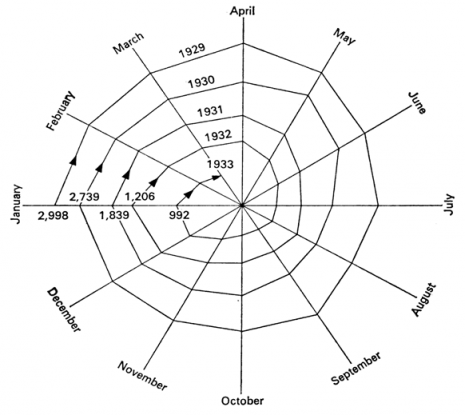
    What really scares economists about the present crisis? That despite spending more than 11 trillion dollars (including guarantees) by governments and central banks the crisis will spiral into global recession and deflation. One very effective way to trigger global recession is trade protectionism( I AGREE ), when countries trying to protect their troubled industries impose import duty or non-tariff barriers on offshore producers. When one country does this then other countries follow with retaliation and trade collapses, more jobs are lost which leads to recession. We have seen this happening in 1930s.

    See chart below (thanks go to David Wheelock from Fed St.Louis), which shows monthly value of imports in 75 countries between 1929 and 1933. Trade implosions happen, you have been warned.

    protectionism_1930s.png

    Economic theory does suggest that large country can effectively raise tariffs at the expense of other countries, see Wikipedia link which probably explains why China, USA, India, Indonesia, Russia and many others may wish to flirt with protectionism( OK ). There is vast literature explaining that trade has positive effects on incomes and standards of living, see old paper by Frankel and Romer for example and the largest living example is China, which successfully pursued export led growth model and reduced the extreme poverty by hundreds of millions, the only large and meaningful step towards fulfilling Millennium Development Goals, other parts of the world failed badly to reduce poverty, Sub-Saharan Africa is the stark example, despite receiving large aid from the World Bank and other donors.

    Economic theory, evidence and experience suggets that if world falls into protectionsm trap it will be very difficult to avoid global recession. Recent International Herald Tribune article presents evidence that many Asian countries launched policies to protect their producers from foreign competition, a quote:

    “In the last two weeks, Chinese officials have announced a series of measures to help exporters. State banks are being directed to lend more to them, particularly to small and medium-sized exporters. Government research funds are being set up. In Hong Kong, the chief executive plans to seek legislative approval by late January for the government to guarantee banks’ issuance of $12.9 billion worth of letters of credit for exports.

    Particularly noteworthy have been Beijing’s steps to help labor-intensive sectors like garment production — industries from which China had been trying to wean itself as part of a move to climb the ladder of economic development toward higher-wage, more-skilled activities. Now China has become much more reluctant to relinquish the bottom rungs of the ladder to countries with even lower wages, like Vietnam, Indonesia and Bangladesh.For instance, China has been restoring export tax rebates for the textile sector that it had been phasing out. Municipal governments have also stopped raising the minimum wage, which had doubled over the last two years in some cities, reaching a peak of $146 a month in Shenzhen. “China will resort to tariff and trade policies to facilitate export of labor-intensive and core technology-supported industries,” said Li Yizhong, the minister of industry and information technology, at a conference on Dec. 19.” […]

    “The third most populous country in Asia after China and India, Indonesia is already acting to limit imports of garments, electronics, shoes, toys and food — five large categories in which Indonesian producers are struggling to compete with China.Starting in the new year, importers of these products will have to be registered with the government, use only five designated ports for their shipments, arrange for a detailed inspection of goods before they are loaded on a ship or plane bound for Indonesia and then have every single container exhaustively inspected on arrival by Indonesia’s notoriously slow customs bureaucracy. The plan, designed to comply with WTO rules, was adopted after heavy lobbying by Indonesian manufacturers and labor unions.”

    It does not look good. Welcome to hell of protectionism in 2009. Knock, knock. Who’s there? Recession.

    Update

    Another example of protectionism - trains manufacture - FT article"

    I tend to agree that Saver/Export countries are tempted to do this because they do not want to change the Saver Country/Spender Country Symbiosis.

    Monday, December 22, 2008

    "But don't kid yourself that the sentiment might not spread. "

    Yves Smith on Beggaring Thy Neighbor:

    "Has Beggar Thy Neighbor Started? ( MY THESIS IS THAT IT IS HAS BEEN GOING ON ALL ALONG, ALTHOUGH NOT FULL BLAST, BUT MODERATED. I CONSIDER ENGLAND'S ACTIONS TOWARD ICELAND BEGGARING THY NEIGHBOR, OR, BETTER YET, BUGGERING. ALSO, CHINA , JAPAN ( WITH CURRENCY AND STIMULUS ISSUES ), AND GERMANY( WITH STIMULUS ISSUES ), HAVE PLAYED A MODERATE FORM. HOWEVER, ONE COULD ARGUE THAT THEY'RE SIMPLY BUYING TIME TO GET IN A BETTER POSITION TO DEAL WITH TOUGH ISSUES.)

    Listen to this article. Powered by Odiogo.com
    One of the ugly features of the Great Depression that in many (but not all) cases worsened the severity of the contraction was that countries adopted "me first" policies with little regard to their broader ramifications. The poster child of this pattern is Smoot Hawley. Although there is some dispute among economists as to whether it was as deleterious as sometimes claimed, the US increased tariffs to protect domestic employment. This proved to be short-sighted, since the US was the biggest exporter, and had a great deal to lose when other countries retaliated.

    Similarly, England left the gold reserve comparatively early, in 1931. Currency devaluation proved a great help in escaping the worst of the Depression. However, competitive devaluations also limited the benefits for any one player.

    We are now seeing what looks to be "devil take the hindmost" behavior. China has quietly gone back to a hard peg against the dollar (as opposed to letting the RMB do what it would otherwise do, appreciate). This is very detrimental, since it means that China is going to try to continue to rely on exports to see its way through this downturn, rather than use more aggressive fiscal stimulus( TRUE, BUT THEY HAVE A PROBLEM WITH THE STIMULUS BEING A SAVER COUNTRY ). It also means that China is trying to prop up the system of global imbalances (Chinese savings glut, US overconsumption and borrowing from China et. al.) that helped create this mess( THEY LIKE THE SYSTEM. I'VE ALREADY BLOGGED ABOUT THAT ). We need to collectively find our way out of this smoky airplane, but everyone seems to want to go back to their seats and strap themselves in.

    In a very good Financial Times piece, Wolfgang Munchau in passing mentions "unsynchronised monetary policies" and suggests that the Fed's aggressive move to quantitative easing (oh, we don't dare call it that, the Fed insists its flavor is different) will force the ECB to follow suit to a fair degree. Munchau does not consider this to be a plus( I HAVE POSTED ABOUT THIS POST ):
    I am sceptical about the benefits of the Fed’s new policy of quantitative easing. We do not have a liquidity crisis, but a solvency crisis, which expresses itself in large spreads and dysfunctional money markets. I cannot see how adding more and more liquidity to the system solves this problem.

    Instead of propping up each bank, and swamping the market with cash, we need to restructure and shrink the banking system, as a first step to a sustainable solution to this crisis. Quantitative easing without deep structural financial reform could cause lot of trouble in the long run.

    I think, however, there is a case for temporary interest rate cuts in Europe, but only on condition that this policy would be forcefully reversed once credit markets start to recover, and once the economy emerges from the slump.

    But we should not delude ourselves into thinking that monetary policy can save the world. It can play a useful role, especially since we do not have the stomach for an optimal fiscal policy response. But it will not prevent the worst slump of our generation.

    Ambrose Evans-Pritchard chronicles a rise in good old garden variety protectionism, so far limited to secondary and emerging economies. But don't kid yourself that the sentiment might not spread( VERY TRUE ).

    It is important to keep in mind that cartoon extremes often cloud the debate. How smart is it to advocate open trade when some countries stack the deck by having artificially cheap currencies? That is tantamount to an export subsidy( BY KEEPING THE PRICE OF THEIR GOODS LOW ), but we haven't done much except jawbone China very late in the game (and the yen has been awfully cheap until recently too, and Japan has remained an export powerhouse, but we never gave them a hard time due to the sorry state of their domestic economy). Similarly, we consider it completely reasonable to restrict exports of advanced military technology, and acquisition of strategic assets.

    Again, I am not saying trade is a bad thing, merely that we have often been faced with counterparties with mercantilist objectives, and our responses appear not to have served us well in the long term( TRUE ).

    From Evans-Pritchard:
    We are advancing to the political stage of this global train wreck. Regimes are being tested. Those relying on perma-boom to mask a lack of democratic or ancestral legitimacy may try to gain time by the usual methods: trade barriers, saber-rattling, and barbed wire...

    Russia has begun to shut down trade...It has imposed import tariffs of 30pc on cars, 15pc on farm kit, and 95pc on poultry (above quota levels). "It is possible during the financial crisis to support domestic producers by raising customs duties," said Premier Vladimir Putin.

    Russia is not alone. India and Vietnam have imposed steel tariffs. Indonesia is resorting to special "licences" to choke off imports...

    There have been street protests in Moscow, St Petersburg, Kaliningrad, Vladivostok and Barnaul. Police crushed "Dissent Marchers" holding copies of Russia's constitution above their heads in Moscow's Triumfalnaya Square.

    "Russia has not seen anything like these nationwide protests before," said Boris Kagarlitsky from Moscow's Globalization Institute....

    The omens are not good in China either...

    Exports fell 2.2pc in November. Toy, textile, footwear, and furniture plants are being closed across Guangdong, now the riot hub of South China. Some 40m Chinese workers are expected to lose their jobs. Party officials have warned of "mass-scale social turmoil".

    The Politburo is giving mixed signals. We don't yet know how much of the country's plan to boost domestic demand through a $586bn stimulus package is real, and how much is a wish-list sent to party bosses in the hinterland without funding.
    Shortly after President Hu Jintao said China is "losing competitive edge in the world market", we saw a move towards export subsidies for the steel industry and a dip in the yuan peg...

    Such raw mercantilism can only draw a sharp retort from Washington and Brussels in this climate.

    "During a global slowdown, you can't have countries trying to take advantage of others by manipulating their currencies," said Frank Vargo from the US National Association of Manufacturers. ( IT ISN'T GOOD, NO )

    It is a view shared entirely by President-elect Barack Obama. "China must change its currency practices. Because it pegs its currency at an artificially low rate, China is running massive current account surpluses. This is not good for American firms and workers, not good for the world," he said in October. The new intake of radical Democrats on Capitol Hill will hold him to it.

    There has been much talk lately of America's Smoot-Hawley Tariff Act.... The relevant message of Smoot-Hawley is that America was then the big exporter, playing the China role. By resorting to tariffs, it set off retaliation, and was the biggest victim of its own folly( TRUE ).

    Britain and the Dominions retreated into Imperial Preference. Other countries joined. This became the "growth bloc" of the 1930s, free from the deflation constraints of the Gold Standard. High tariffs stopped the stimulus leaking out.

    It was a successful strategy - given the awful alternatives - and was the key reason why Britain's economy contracted by just 5pc during the Depression, against 15pc for France, and 30pc for the US...

    This crisis has already brought us a monetary revolution as interest rates approach zero across the G10. It may overturn the "New World Order" as well, unless we move with great care in grim months ahead. This is where events turn dangerous( COULD BE ).

    The last great era of globalisation peaked just before 1914. You know the rest of the story." ( YES WE DO )

    Tuesday, November 18, 2008

    "these measures had inflicted by promoting capital flight from the developing world"

    Dean Baker with an important point about protectionism:

    "Protectionist measures can slow growth and they can be very harmful to developing countries. That is especially true of the protectionist measures that the wealthy countries recently implemented for their financial industries. Unfortunately, at the G-20 meeting, there was apparently no recognition of the damage that these measures had inflicted by promoting capital flight from the developing world. There was no recognition of this fact in the media coverage either."

    That reminds me of this earlier post about helping smaller companies retain capital:

    "
    Monday, October 27, 2008

    "Another benefit would have been to ameliorate currency crises in emerging markets and smaller countries"

    A very interesting post on Vox by John N Muellbauer:

    The current financial crisis will probably lead to a deep recession. This column suggests that European central banks, misguided by outdated econometric models, should have cut rates faster and deeper in a coordinated fashion. They should now scrap these models and agree on a large, coordinated cut of 2 percentage points.


    When future economic historians look back to trace the triggers for the October 2008 financial panic and the unnecessarily severe recession of 2009, they will likely put their fingers on two.

    • The failure to keep Lehman Bros functioning as a going concern.
    • The failure of the ECB and the Bank of England to use their interest rate setting firepower to organise a substantial globally co-ordinated interest rate cut (the 8 October 2008 cut was too timid).
    Read the post. On smaller countries, note this:

    "Another benefit would have been to ameliorate currency crises in emerging markets and smaller countries such as Denmark. Their exchange rates depend in part on interest rate spreads with the major currencies. A co-ordinated global interest rate cut would have widened spreads without these countries having to raise rates to support their currencies in the face of severe recessions. Moreover, as late as October 21st, many other central banks would have felt able to join a co-ordinated cut without exposing their currencies.

    More generally, the reduction in policy rates, and the prospect of more to follow, would have reduced returns on safe assets, such as government bonds, and induced investors at the margin to rebalance towards riskier assets, such as equity and corporate debt. The rise in such asset prices would eventually have helped to restore collateral values, slowing the spiral of rising bankruptcies.

    Following the panic beginning on October 22nd, the task of restoring confidence is far harder. With asset prices so much lower, the bad loan position of the banking system looks worse, and with it, the potential burden on tax payers. The damage for the UK looks particularly severe, with its debt and housing market vulnerability - reflected in the sudden decline in Sterling and in Treasury gilt prices."

    In other words, lower interest rates to deter people from moving money towards the big countries, in order to give them an incentive to keep money in the smaller countries.

    As well as this one
    :

    "
    Sunday, October 26, 2008

    ". At this stage, nothing should be off the table."

    Brad Setser with an excellent post on the IMF intervening to help the smaller countries:

    "Expanding the IMF would by contrast strengthen the voice of those countries with the biggest votes in the IMF. Right now that is the US and Europe. But the IMF’s voting structure also could be adjusted.

    The emerging markets’ sudden need for dollar and euro liquidity suggests an agenda for the new Bretton Woods conference (or G-20 Leaders meeting) that would goes beyond reaching agreement on the need for more counter-cyclical financial regulation and moving the trading of credit-default swaps and other over-the-counter derivatives to organized exchanges.

    More and more borrowers need dollars and euros to pay off maturing debts that they can no longer rollover – and finding those dollars and euros has been hard. Buying them on the market is an option, but that adds to the instability in the currency market. Supplying the needed liquidity is in some sense an alternative to further (competitive?) depreciation by major emerging economies. Consequently, it is in the enlightened self interest of the US, Europe and even China to lend emerging economies the funds needed to avoid a major fall in their respective currencies.

    * The IMF could do a “general SDR allocation” to increase the reserves of all its members. At this stage, nothing should be off the table."

    Please read it.

    What this not on the agenda at the G20 meeting?