Showing posts with label Rortybomb. Show all posts

Wednesday, May 20, 2009

It isn’t clear that they’ll have a lot of value added for the economy as a result of that 5-7 years of work

From:

"Rortybomb

Housing Bubble Leftovers

Posted in Uncategorized by Mike on May 20, 2009

We are in the middle of a Great Recession, but someday we will be out of it. It is very easy to focus on the losses, but what did we gain? James Surowiecki has a column where he says:

There have been three big banking booms in modern U.S. history. The first began in the late nineteenth century, during the Second Industrial Revolution, when bankers like J. P. Morgan funded the creation of industrial giants like U.S. Steel and International Harvester. The second wave came in the twenties, as electrification transformed manufacturing, and the modern consumer economy took hold. The third wave accompanied the information-technology revolution. Each wave, Philippon shows, was propelled by the need to fund new businesses, and each left finance significantly bigger than before. In all these cases, it wasn’t so much that the bankers had changed; the world had.

The same can’t be said, though, of the boom of the past decade. The housing bubble was unique, and uniquely awful. Each of the previous waves had come in response to a profound shift in the real economy. With the housing bubble, by contrast, there was no meaningful development in the real economy that could explain why homes were suddenly so much more attractive or valuable. The only thing that had changed, really, was that banks were flinging cheap money at would-be homeowners, essentially conjuring up profits out of nowhere. And while previous booms (at least, those of the twenties and the nineties) did end in tears, along the way they made the economy more productive and more innovative in a lasting way. That’s not true of the past decade. Banking grew bigger and more profitable. But all we got in exchange was acres of empty houses in Phoenix.

I think this is true. Look at the last boom, the internet one. A lot of people thought thinks like pets.com deserved a giant market share, and splurged accordingly. In the process, we got a lot of investment in broadband capabilities we are just now beginning to stress, as well as a workforce educated in programming and the web, as well as businesses now focused on the web. Employees out of that boom continued to innovate, producing new goods, and will continue to do so. These are good things, and will continue to provide value as we go forward.

I don’t think that is true now. People who were involved in the selling of mortgages, either at the local level or at the Wall Street level, aren’t any more trained, don’t have more productive human capital, than when they started. When people talk about the finance sector collapsing and unemployment being high, I think they tend to think of Wall Street MBAs – so they look at the graduate degree unemployment numbers. I think of some of the kids at my 10 year high school reunion 2 years ago, who started flipping commercial real estate contracts after completing a year or two of community college. It isn’t clear that they’ll have a lot of value added for the economy as a result of that 5-7 years of work. And that definitely aggregates up to the Wall Street kids who, in the words of a friend of Ezra Klein’s, spent “4-6 years driving CDO deals using someone else’s quant models.”

But what about the housing stock? What about it indeed. I want to show two things. A commenter on seekingalpha sent me this:

A video of two guys in Southern California look at some repossessed houses and show the huge damage previous people caused. That house they look at is only 18 months old and it is trashed. This is what I think of with The Exurbs as Nightmare which I mentioned in the previous post.
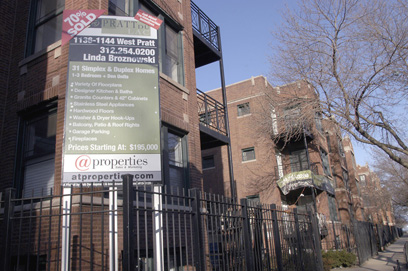
I also want to follow up with a This American Life episode Scenes From a Recession. It’s an excellent episode overall, but the first episode about the Chicago neighborhood Roger’s Park condo boom, and now bust, stands out.

They follow the plight of condo owners who moved into condo buildings as they were half sold, and the Realtor went bust or fled. So the empty units rot, their pipes freeze, animals and squatters life in the empty space, and they go unsold by the realtor but also unclaimed by the bank holding the lease (since they don’t want to pay the property taxes, they don’t challenge the owner). Orphan buildings. So the building rots, or to use the accountancy language depreciates, ruining the owner’s investment.

Rodger’s Park was not a very desirable place for people to live in the 2000s, if I remember. I knew a few hippies and artists who lived up there for the very cheap rent – people were insane if they thought they were going to flip that neighborhood. And if memory serves, I think about 5 people I knew up there had to move out of their apartments because they were being turned into condos in the ‘04-’06 time frame.

Add to this the huge amounts of investment in housing where people will no longer want to live when oil prices come back (which it already is). A lot of capital, human and housing, has been wasted this past decade as a result of this financial crisis. I hope it can find a better use handling the upcoming health and energy problems we have on our hands…"

Me:

  1. donthelibertariandemocrat said, on May 20, 2009 at 4:33 pm

    “It isn’t clear that they’ll have a lot of value added for the economy as a result of that 5-7 years of work.”

    The housing bubble was supposed to solve a problem: namely, providing for retirement. I don’t mean that people wanted a bubble, but that people were panicked about buying a house to provide for their retirement.

    There has been a twenty year barrage of bad news about social security, pensions, etc. Why did people focus on houses? Because they pay rent, which came to be seen as a sucker’s game. Since they already pay for housing, it made sense to them to try and turn this rent into an investment. There was a panic about buying a house for retirement, followed by a panic that people were going to be left behind. That was the story: Get in now, or be left behind.

    Many people really can manage to save much after they pay expenses. Consequently, it made sense for them to try and turn some of those wages into an investment. Sadly, there were told a story without a happy ending by people who took advantage of that panic and fear of a pauper’s old age and being left behind.

    There is no good investment reason for the housing bubble.

  2. donthelibertariandemocrat said, on May 20, 2009 at 4:34 pm

    Many people really can(not) manage …

Tuesday, April 21, 2009

I’ve thought about this a lot, and have come to a simple three word conclusion: “No prepayment penalties.”

From Rortybomb:

"Ban Mortgage Prepayment Penalties at the Federal Level, 1: Texas
Posted in Ban Mortgage Prepayment Penalties at the Federal Level by Mike on April 21, 2009

Prologue

So I’m glad Texas is making waves about seceding from the United States right now, since it leads nicely into my first ever weekly project here at Rortybomb. I don’t know the specific talking points of the Texas Teabaggers, but if they have a feeling that they did something right while everyone else was doing something wrong during the 2000s, they may have a point.

In 2007, when everyone first started to realize en masse how bad the housing landing was going to be for the country, I remember telling a friend “I bet Texas is going to be a giant crater when this is over.” From my mind, I’ve always associated Texas with the worst boom-and-bust cycles in everything, housing above all. The next day I checked the numbers and realized I was entirely wrong.

Let’s look at some data. Here’s the Case-Shiller numbers for the 20-city US index, Phoenix, Arizona, and Dallas, Texas, seasonally adjusted. (For some reason, Case-Shiller does Dallas instead of Houston. These numbers are generalizable though).

case_dallas

Now Phoenix and Dallas have a lot in common. And so does Texas and Arizona. Yet somehow Texas, which seemed perfectly engineered to replicated the problems of Nevada and Arizona, as well as California and Florida, avoided the fate of the “Sand States.” The value didn’t jump high then crash; they rose a nice 25% over the decade (it looks small on the chart, but only because it is overshadowed by the boom/bust).

From USA Today, we see Texas is right around the median of housing foreclosures, with a normal 1%; Arizona, Florida, California and Nevada all have 4% and above. When you start digging, you see all kinds of signs that the Texas market is fine - it is the first everyone expects to start going again.

So what gives? I’ve thought about this a lot, and have come to a simple three word conclusion: “No prepayment penalties.” Right there in their state law:

§ 343.205. PREPAYMENT PENALTIES PROHIBITED. A lender may not make a high-cost home loan containing a provision for a prepayment penalty.

And, in general, a consumer’s bill of rights:

No Balloons – a high-cost home loan may not provide for a payment that is more than twice as large as the average of earlier scheduled monthly payments within the first sixty months of the loan.
No Negative Amortization – a high-cost home loan may not provide for a payment schedule that may cause the principal balance to increase.
Borrower’s Payment Ability – the lender may not make high-cost home loans based on the collateral value of the property without regard for the borrower’s repayment ability, including current and expected income, current obligations, employment status, and other financial resources.
No Prepayment Penalty – a high-cost home loan may not contain a provision for a prepayment penalty.
No Charge for Service Not Received – a lender on a high-cost home loan may not charge a borrower for a service or product if the borrower does not receive it.

I think all these are good ideas to be brought back to the federal level. It was not always this way, determined at the state, or in a way friendly to whatever banker and consumers could agree on. As part of a wave of deregulation in the late 1970s and early 1980s, Congress passed AMTPA, which allowed the subprime market to be built. That wave of deregulation was a series of experiments; it is in the nature of experiments to sometimes succeed, and sometimes fail. It is our job to determine which is which among the wreckage, and my argument will be that these prepayment penalties created the worst incentives for banks.

I understand that we don’t want to regulate the previous crisis. The Democratic Party is busy with trying to fix the Recession and the banking crisis, while the Republicans are busy heroically fighting the One World Currency and the FEMA internment camps. During 2007, we heard from candidates Hillary Clinton and Chris Dodd that they would want to ban prepayment penalties. We haven’t heard it from President Obama; I would like to see pressure to do so, while Change is in the air.

So I’ll spend a few days talking about this in detail, from empirics, to financial theory arguments, to a model as to why this happened, hopefully accessible to any educated reader. Feel free to skip if you are already bored. I want to consider doing some policy wonk finance stuff here (and perhaps more generally with my life), and I’ll possibly try to expand into a formal paper, one which also keeps its finance and economic chops up - so please criticize away, even if you agree with me.

I also want to get away from the duality of thinking of the subprime crisis as evil banks looting homeowners or evil lenders tricking banks. With the genius of prepayment penalties, banks didn’t have to make money by lending loans to credible homeowners - they could form a de facto company with unqualified borrowers to bet on house prices rising. The prepayment penalty was the bank’s equity in this endeavor. Or another way to say it is that the banks found a way to hire a person to sit in a house they wanted to gamble on; this was a subprime loan with a prepayment penalty. More to follow."

Me:

donthelibertariandemocrat said, on April 21, 2009 at 11:25 am

There are two separate questions from my point of view:
1) Why are housing prices high?
2) Why were iffy loans given out?

On 1:

http://www.cato-at-liberty.org/2008/09/22/blame-urban-planning/

“So it all started with the bubble. But what caused the bubble? The answer is clear: excessive land-use regulation. Yet while many talk about re-regulating banks and other financial firms, hardly anyone is talking about deregulating land.

The housing bubble was not universal. It almost exclusively struck states and regions that were heavily regulating land and housing. In fast-growing places with no such regulation, such as Dallas, Houston, and Raleigh, housing prices did not bubble and they are not declining today.”

“We know that if the regulation is left in place, housing will bubble again — California and Hawaii housing has bubbled and crashed three times since the 1970s.”

Also, in California, the geography of the Central Valley in relation to urban centers is very important.

On 2, I would wait until the litigation involving Countrywide, for example, finishes, and we know how much of this was Fraud, Negligence, Collusion, and Fiduciary Mismanagement. We certainly know that fraud is still occurring in the marketing of help in renegotiating mortgages. You seem to believe that this is minor, while the current litigation, which even involves AIG, seems to present a portrait of systemic regulatory shopping and fraud at the retail level.

I’m all for changing laws, by I don’t like the idea of crimes, especially ones with consequences like these, going uninvestigated and not prosecuted, as happened in the S and L Crisis.

What if the true value of the asset is higher than what the market wants to pay for it though?

From Rortybomb:

"Marking to Markets.
Posted in Uncategorized by Mike on April 17, 2009

Banks Get New Leeway in Valuing Their Assets:

The change seems likely to allow banks to report higher profits by assuming that the securities are worth more than anyone is now willing to pay for them. But critics objected that the change could further damage the credibility of financial institutions by enabling them to avoid recognizing losses from bad loans they have made.

Here are two good summaries of why it is worthwhile to keep marking-to-market: from CAP and from Baseline Scenario. Mark-to-market versus mark-to-model is an incredibly esoteric and dorky thing to talk about, even for accountants and actuaries, but the underlining idea of the debate is easy to think about in other contexts - let me give you some in a less serious context for Friday.

The Baseball Card Bull Market of the Early 90s

So in the early 1990s, when I was in Junior High, there was a craze about collecting and trading baseball cards. Our classroom would have a corner during lunch where we’d all compare, with our binders and those 3×3 plastic containers for cards, who had what, and we’d trade back and forth accordingly. And of course we had our model, The Model, in fact, the Black-Scholes of our trading:

So while other kids were mowing lawns or delivering newspapers, I decided I was going to make my profit by arbitraging the volatile Frank Thomas rookie card market. I took a highly leveraged position in the Upper Deck Frank Thomas rookie card - I borrowed against future allowances, and bought several cards for $7 each from a kid who wanted to get out of collecting baseball cards in order to try hanging out with girls (loser!). Upper Deck is like the AAA of baseball cards. The guide said that these cards were worth $9. Buy at $7, sell at $9, instant money. My dad took me to the convention center, and I was all ready to make some cash money, when I found out that all the tables were only buying them for $5. Sensing my frustration (and also perhaps worried, since, like the FDIC or those with a savings account, he was providing all the leverage for me), he asked me, “wait, what are those cards worth again?”

I answered that they are worth $9. That’s what the guide, my model, says they are worth. No doubt those guide values are created by the most brilliant minds available. My dad, not in business or finance, was very clear in trying to explain to me “no son, they are only worth what someone is willing to pay you for them.” I responded that this card convention center was completely wrong in how they were valuing my baseball cards. I was but a little financial engineer back then; now I would have know to say “Dad, clearly the Soxs are having a bad season, and/or this isn’t the time in the year-long sporting cycle when demand is reasonable for baseball cards. I don’t feel I should get punished for the normal ups-and-downs of the baseball cycle.” I may have also noted that the flood of crap Fleer-brand baseball cards, the Mortgage Backed Security of its day, was destroying liquidity in the market, but that I had the trust of then Treasury Secretary Brady to start buying up those crappy baseball cards and get them transferred onto the government’s balance sheet.

So who was right? Me, with the model of the Baseball Collectors Guide and the excuse of the business cycle, at $9? Or my dad, who says they are worth whatever somone is willing to pay you in an open market, at $5? How you answer that question should color how you are disposed to to marking assets to the model, versus marking them to the market. Mind you, this was not just an academic exercise - at $5, my dad realizes I’ve made some terrible calls, and is probably going to make me start mowing lawns until I can pay him back. If I could convince him they were worth $9, I would not have to mow lawns (which I sincerely did not want to do) but instead could probably borrow some more…

Dorm Room Debates

I was chatting with a distinguished older businessman I was introduced to; educated with an MBA, brilliant business mind. He was complaining about Mark To Market.

Businessman (BM): The problem with Mark to Market is that the market can’t get the true value of an asset all the time.
Me: But isn’t the true value what the last person is willing to pay?
BM: Yes but what about assets that are longer than the business cycle, that are getting hammered over the short term? And isn’t it a backwards way of viewing things, from a risk-management perspective?
Me: I worry too that Mark-to-Market is pro-cyclical instead of anti-cyclical - it encourages risk-taking when things are good when solid risk-management requires leaning against the business cycle. I’m more than open to improvements there, but isn’t the general idea of marking to market the right basis?
BM: Not necessarily. What if the true value of the asset is higher than what the market wants to pay for it though?
Me: You keep saying true value, and I don’t know what that means in the context of assets outside of markets. I’m not actually sure if I know what it means for anything… [preparing to drop the Rorty bomb!]
BM: It means what it is actually worth, really worth, independently of markets and cycles.
Me: Wait, what? Is this like a Neo-Kantian thing?
BM: Wait, Huh? No, it is like any asset has a value, an essential value that it really hold outside of people, who may be confused or constrained or otherwise unable to acknowledge the value of the asset, bidding on it. The people holding that can know that better than the market sometimes.
Me: But isn’t the whole point of a market economy that commodities find their essential value within the bidding and trading mechanisms? Isn’t the informational aspect of markets like, the whole reason we have capitalism? Even if I grant your point, insider agents working with secretive ‘models’ shouldn’t be considered the best information agents here. Stocks and bonds valuations don’t, or shouldn’t, exist in an a priori plane; the fact that they go through the business cycle like everything else is factored into their valuation by markets.
BM: But what markets are wrong, because they are blinded by short term interests or their own illiquidity, to see the essential real value of the assets? What if they can’t understand the additional information, or ignore it, or don’t recognize it as information?

At this point, I almost expected him to say “the problem is that all we can see is the shadow of the assets projected on a wall, not the real Form of a bond comprised of $500k loans to junkies. If only we could see them outside the limited cognition of our cave, see these mortgage-backed securities in the light of the actual Sun….”

Want to know how I know your markets are fucked? Because distinguished men of business and finance sound like hipsters trying to make their way through a seminar on epistemology."

Me:

donthelibertariandemocrat said, on April 21, 2009 at 8:40 am

Your comment is awaiting moderation.

The way to determine a price is to appeal to agreed upon criteria while negotiating. That’s what auction records are for, for example. Without agreed upon criteria, prices would make no sense. You cannot have a private price.

It makes sense to argue that the truths of math and logic exist independently of human existence, but I don’t think that it makes quite as much sense to say that prices do.

One question to ponder is whether “What something is worth” and “What something can be exchanged for” mean the same thing.

Following Tarski, we can say that “The price of x is y is the true price” iff the price of x is y.