Showing posts with label Qualitative Easing. Show all posts

Sunday, January 11, 2009

"a deliberate denial of an obvious fact, perhaps because the words “printing money” have unfortunate Weimar or Zimbabwe connotations."

Buiter on Easing again in the FT:

"Quantitative and qualitative easing again
January 11, 2009

The UK Chancellor, Alistair Darling, has been busy repudiating the notion that the British government was planning to ‘print money’ to prevent deflation and stimulate the economy. He was reported in the Financial Times (January 9th, 2009) as saying :“Nobody is talking about printing money. There’s a debate to be had about what you do to support the economy as interest rates approach zero, as they are in the US. But for us that is an entirely hypothetical debate”.

This statement of the Chancellor either represents a major manifestation of profound ignorance about what central banks do and how monetary policy is conducted, or a deliberate denial of an obvious fact, perhaps because the words “printing money” have unfortunate Weimar or Zimbabwe connotations. Yet ‘printing money’ - that is, creating base money, either through the issuance of currency or by increasing the stock of commercial bank reserves held with the central bank - is what central banks do in a fiat money world. They do this not just in Zimbabwe, but also in the US, in the Eurozone and in the UK.( TRUE )

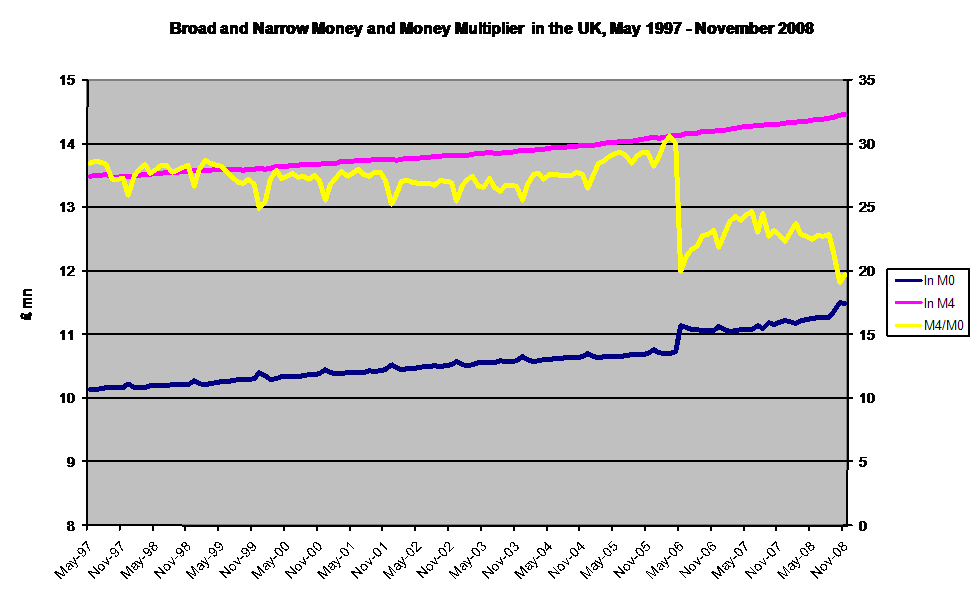
Even without the zero floor on the Bank of England’s official policy rate (Bank Rate) having been reached yet (it currently stands at 1.5 percent), the Bank of England has in fact be printing quite a lot of money. By no means enough in the period since September 2008, I would argue, but certainly quite a bit( TRUE ). This is clear from Charts 1 and 2 below, which show the behaviour of central bank money, also called base money or the monetary base, and its two components, currency (notes and coin held outside the Bank of England) and commercial bank reserves held with the Bank of England. Chart 2 also shows the behaviour of the monetary base, or narrow money, relative to a broad measure of money, M4, which includes sterling bank deposits held by the private sector and some close substitutes. The ratio of broad money to narrow money (here M4 to M0) is sometimes called the (base) money multiplier. Note that in Chart 2, both M0 and M4, but not the ratio of M4 to M0, are drawn on the log scale.

Chart 1

Chart 1

Chart 2

chart-2.gif

Until May 2006, UK monetary policy was unusual in that (a) there were no meaningful reserve requirements for banks (commercial banks only had to hold 0.25% of eligible reserves as non-interest-bearing reserves with the Bank of England under the Cash Ratio Deposit Scheme, an arrangement designed not for monetary policy purposes but to provide the Bank of England with another source of income) and (b) reserves in excess of this minimum required amount were subject to a financial penalty. Excess reserves did not earn interest at all until March 2005. From March 2005 until 18 May 2006 they earned Bank Rate minus 50 basis points. Since May 18, 2006, they earn Bank Rate.

You can see the effect of the May 2006 change in reserve arrangements clearly in Charts 1 and 2. The resulting increase in M0 reflected an increase in the demand for reserves by banks (holding constant everything except the interest rate on reserves). It was therefore not inflationary. The second rapid increase in reserves started in September 2008, when the UK banking system was on the edge of collapsing and, in the US, Lehman Brothers filed for bankruptcy protection on September 15, an event that triggered a state of cardiac arrest in most of the world’s money and capital markets( A CALLING RUN ). Again, this jump upwards in the stock of base money was driven by an increase in liquidity preference by banks. As long as the fear, risk-aversion, and partly irrational despondency that have the banks in their grip persist, the increase in M0 since September 2008 will not be inflationary( TRUE ). It reflects the central bank leveraging up to counteract the otherwise excessively rapid, sudden and destructive deleveraging( CALLING RUN ) of the commercial banks.

When fear and panic eventually desist, however, it is essential that the central bank stand ready to take back the injection of liquidity provided since September 2008( TRUE ). Indeed, as I hope and expect that the Bank of England will, during the rest of this year, engage in ‘printing money’ on a much larger scale than it has thus far( I AGREE ) , the need for an eventual massive contraction in the monetary base when the private financial sector rediscovers its poise and confidence( THAT WHAT THE SOLUTION IS ), will be paramount if the UK is to avoid a major burst of inflation a few years down the road( TRUE ).

How does all this connect with quantitative and qualitative easing? In an earlier post I offered the following definitions:

Quantitative easing is an increase in the size( AMOUNT ) of the balance sheet of the central bank through an increase it is monetary liabilities (base money), holding constant the composition of its assets. Asset composition can be defined as the proportional shares of the different financial instruments held by the central bank in the total value of its assets. An almost equivalent definition would be that quantitative easing is an increase in the size of the balance sheet of the central bank through an increase in its monetary liabilities that holds constant the (average) liquidity and riskiness of its asset portfolio.

Qualitative easing is a shift in the composition( TYPE ) of the assets of the central bank towards less liquid and riskier assets, holding constant the size of the balance sheet (and the official policy rate and the rest of the list of usual suspects). The less liquid and more risky assets can be private securities as well as sovereign or sovereign-guaranteed instruments. All forms of risk, including credit risk (default risk) are included.

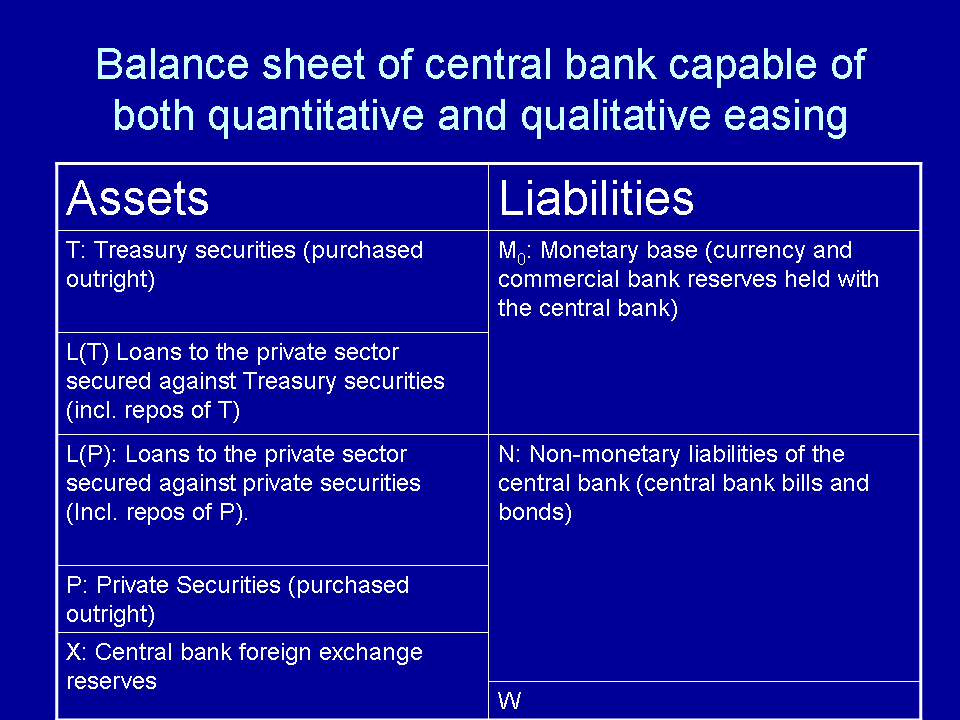
Let me expand on these two concepts with the help of the two central bank balance sheets in Tables 1 and 2.

Table 1
some-comments-on-quantitative-and-qualitative-easing.png

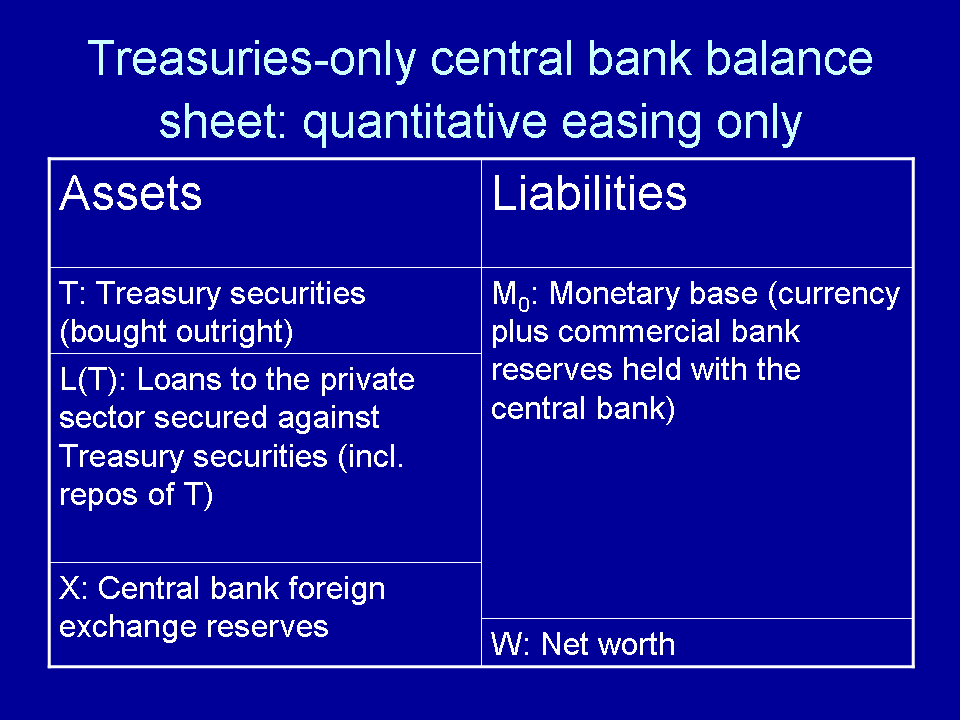
Table 2

table2.png

Table 1 shows the balance sheet of a central bank that today’s besieged central bankers can only dream of. Apart from foreign exchange reserves (X), it has on the asset side of its balance sheet only sovereign debt instruments (T, for Treasury securities) or loans and similar claims on the private sector collateralised against sovereign debt instruments, L(T). On the liability side of its balance sheet it has base money, M0 (currency plus commercial bank reserves) and net worth, W.

This central bank can engage in quantitative easing but not in qualitative easing: even when it lends to the private sector, it requires government securities as collateral, so it engages only in default risk-free lending (more precisely, in lending subject to default risk no greater than the default risk of the sovereign( TRUE )). Quantitative easing would mean expanding the monetary base by buying government securities, or by engaging in an increased volume of lending (or in an increased amount of repos of government debt) to the private sector.

The purpose of the exercise would be, presumably, to lower the interest rate on government securities of maturities longer than overnight. Bank Rate - the official policy rate - sets the risk-free overnight nominal interest rate. Longer-term risk-free nominal interest rates can be influenced by the central bank through two mechanism. The first mechanism is expectations of future official policy rates - of future values of Bank Rate in the UK. If arbitrage is possible on a sufficient scale, confident expectations that the future official policy rate of the central bank over, say, a 3-month horizon, will be equal to its current level, say 1.5 percent, will drive the 3-month risk-free nominal rate to 1.5 percent also. Only the equilibrium risk premia and term premia consistent even with fully efficient financial markets would stand between the expected value of the central bank’s future policy rates over a three month horizon and the 3-month risk-free interest rate (those of you who wonder about a risk-premium with risk-free interest rates should recall that risk is defined in terms of real consumption, or the utility of real consumption, while what the central bank sets is the risk-free nominal interest rate).

In principle, the central bank can, by credibly committing itself to keep the official policy rate at its current level for the next 10 years, bring down the risk-free 1o-year nominal interest rate to something close to the current value of the official policy rate. This does, however, require that arbitrage is possible on a sufficient scale. This is a necessary condition for efficient markets. Events since August 2007 should have convinced even the most foaming-at-the-mouth true believers in the efficiency of financial markets, that they have been worshiping a false god. The idol has feet of clay and has now been toppled so convingly, that the last believers are being whisked away by men in white coats making soothing noises.

So, if expectations and the reality or threat of arbitrage does not drive future risk-free rates down to a suitably weighted average of future expected official policy rates, the central bank can lend the process a hand by purchasing risk-free securities of the relevant maturities whose yields exceed the average expected future official policy rate over the relevant horizon( AS AN INCENTIVE ).

In the US, for instance, quantitative easing is not over until the nominal yield on all government securities of any and each maturity equals zero. But note that quantitative easing can, in principle, occur at any level of the official policy rate. It does not have to wait till the zero floor is reached. At the zero floor, of course, quantitative easing (and qualitative easing) are all the central bank can do.

Any central banker who argues, as some do, that “we set the overnight rate on reserves and we simply accommodate the demand for reserves at that (official policy) rate; therefore, until the official policy rate hits the zero floor there is no quantitative easing as a separate policy instrument” is delirious. This is because the demand for reserves depends not just on the official policy rate, but also on other interest rates and spreads (on public and private assets of different maturitities), some of which can be influenced by the central bank even when the official policy rate is kept constant. This is especially true during times when financial markets are illiquid and disorderly.

When markets are functioning properly, the central bank can really only set one nominal interest rate. When it pegs the risk-free overnight rate, it can influence longer-term risk-free rates only through expectations of its future policy rates( TRUE ). Term premia and default risk premia are not subject to monetary policy influence to any significant degree and liquidity premia are not a major factor. When markets are disorderly and illiquid, the arbitrage required for the expectations hypothesis to do its job cannot take place( MAKES SENSE. NO CLEAR FIGURES. ). There is a term structure of liquidity risk premia that can, in principle, be influenced by central bank liquidity injections (lending) at longer maturities. Liquidity premia and default risk premia are not independent, and central bank policy can even have a material influence on default risk.

All these factors also influence the demand for reserves and the stock of base money. A central bank can accommodate the demand for reserves at its official policy rate and influence that quantity demanded through the effect of its actions on other rates of returns and on market liquity at longer maturities and for a wide range of financial instruments.

Today’s central banks are, however, operating with a balance sheet more like the one shown in Table 2. The key difference is that on its asset side, the central bank now lends to banks (and perhaps to other private entities) against private collateral as well as against sovereign debt instruments; L(P) includes repos of private securities. The Bank of England was a late convert to this, but does now accept private debt instruments in repos and collateralised lending. The ECB always did, and so did the Fed, although it got out of the habit before August 2007.

In addition, the central bank can purchase private securities outright. This is the item P on the asset side of the balance sheet. The Fed does this on quite a large scale now, when it began to purchase commercial paper (CP) and Asset-Backed Commercial Paper (ABCP). If central banks make unsecured loans to private banks or other private sector entities, that too would be part of P.

The Fed’s proposed outright purchases of mortgage backed-securities issued or guaranteed by Fannie Mae, Freddie Mac and Ginnie Mae do not fall into this category, as Ginnie Mae is a government agency and both Fannie and Freddie are 100 percent government-owned( BUT ONLY IMPLICITLY GUARANTEED ). It is just a tiny bit silly to have one state entity (the Fed) acquire debt instruments issued or guaranteed by another state entity or state-owned entity. Much easier to slap a Federal guarantee directly on all these mortgage-backed instruments and leave the Fed to do monetary policy( I AGREE COMPLETELY ). But that would be too fiscally transparent and too easy( I AGREE ). Neither the Bank of England nor the ECB have thus far acquired private securities outright or lent unsecured to the private sector.

There is also a potential addition on the liability side of the central bank’s balance sheet. Central banks can issue non-monetary liabilities, instruments effectively the same as Treasury Bills or Treasury Bonds - let’s call them central bank bills and central bank bonds. In many developing countries and emerging markets this is a common practice. Quite often the credit of the central bank is better than that of the government, and open market operations are conducted entirely through the purchase and sale of central bank bonds and bills. We may see this emerging market phenomenon in the the submerging market economies of the West before long.

The balance sheet of Table 2 permits us to discuss various ways of implementing qualitative easing, and combinations of quantitative and qualitative easing.

Qualitative easing means the central bank either making loans to the private sector that are not collateralised against sovereign debt instrument (L(P) increases) , or lending unsecured to the private sector or purchasing private securities outright (P increases), but without changing the quantity of base money ((M0) is constant). This means that these loans or purchases are either financed by the central bank selling sovereign debt instruments it holds (T falls), or by the central bank reducing the amount of lending secured against sovereign debt instruments (L(T) falls) , or the central bank increasing its issuance of central bank bills and bonds (N increases).

By expanding its acquisition of private instruments or by lending to the private sector either unsecured or secured against private collateral, the central bank can directly target the spreads of these private debt instruments and private lending over the expected average future official policy rate (as measured, say, by the OIS rate - the Overnight Indexed Swap rate). Clearly, even in fully efficient markets these spreads will be non-zero because of equilibrium term premia, equilibrium inflation risk premia and equilibrium default risk or credit risk premia. But the liquidity risk premia, and the fear-and-panic premia could be much reduced or even eliminated.( I AGREE )

So I expect that our central banks will do quite a bit more quantitative and qualitative easing - expanding the size of their balance sheets, mainly by increasing the monetary base on the liability side, that is, by printing money, and on the asset side by increasing lending to the private sector secured against private securities (or unsecured) and increasing outright purchases of private securities.

The Fed is doing so already, and with gusto. It can do so without fear for its balance sheet, despite taking on a lot of private credit risk (default risk), because the Treasury explicitly guarantees the Fed’s outright purchases of private securities and other non-standard taking on of private default risk.

The Bank of England already has some credit risk on its balance sheet, through its repos of private securities. It has therefore engaged in qualitative easing. The sharp increase in the size of its monetary liabilities since September 2008 is evidence of considerable quantitative easing also. I expect it to increase the scale of its rediscounting of private securities and its repoing of private instruments during the coming year and beyond, until this crisis is over. I also expect it may have to lend outright and unsecured to banks and other private agents and that it will buy private securities outright and in volume before this is over.

Quantitative easing, through the acquisition of Treasury securities or through increased repos of Treasury securities and matching expansion of the monetary base, should be none of the Treasury’s business - it remains the province of the Monetary Policy Committee of the Bank of England. This is because the Bank of England does not take on any additonal credit risk other than that of the sovereign itself through these operations.

Qualitative easing or a combination of qualitative and quantitative easing does increase the credit risk the central bank is exposed to. Conceivably, the central bank could suffer a capital loss on its exposure to private securities that would be so large, that it could only restore its solvency without external assistance through monetary issuance of a magnitude that would threaten its price stability mandate( TRUE ). Indeed, if the exposure of the central bank were to foreign-currency-denominated securities, it might not be able to salvage its solvency through any amount of domestic currency issuance. In both these cases, the central bank (or its inflation mandate) would have to be rescued by the tax payer, through a non-inflationary recapitalisation by the Treasury. This means that qualitative easing, or any combination of qualitative and quantitative easing that increases the credit risk on the central bank’s balance sheet, should require the consent of the Treasury, and cannot be decided by the central bank alone( A GOOD POINT ).

I believe it would be best, operationally and to preserve central bank operational independence over monetary policy, if the Treasury were to set an upper limit to the amount of credit risk (by some metric) the central bank can take on, with the central bank being given the discretion to manage the composition and size of its balance sheet up to that limit.( A GOOD POINT )

Today, central banks and Treasuries appear to be conspiring to hide from the public the magnitude of the credit risk exposure they are taking on. In the UK, for instance, the SLS (the special liquidity scheme that swaps private securities like mortgage- backed securiteis for Treasury bills of less than one year maturity) is, as far as I can tell, neither on the balance sheet of the Bank of England nor on that of the Treasury. The Bank of England manages the facility as agent of the government, but does not carry the credit risk. Since the Treasury bills are of less than one year maturity, they are, for some obscure accounting reason, not counted as public debt in the UK. So I doubt they are recorded as Treasury liabilities - which of course they are. The assets, of course, are not counted either, but the liabilities are known and certain while the assets are illiquid, of unknown value and quite possibly dodgy( TRUE ). Accountability for the use of public resources is the first victim of a financial crisis( YES ).

I expect that we will see all three central bank, the Fed, the ECB and the Bank of England, continue to engage in qualitative and quantitative easing, expanding the size of their monetary liabilities (’printing money’) to finance acquisitions of private securities and to increase the scale and scope of lending to the private sector, both unsecured and secured against private securities. The Fed clearly has the bit between its teeth and is hot to trot further and farther. The Bank of England has not yet engaged in either unsecured lending to the private sector on in outright purchases of private securities, but I anticipate we will see both types of interventions before long.

The ECB/Eurosystem is the most interesting case. It has historically repoed against a wider range of private securities that the other two central banks, and it accepts a similarly broad range of private securities as collateral at its discount window - the marginal lending facility.

It is also, however, the central bank that appears to be most anxious about credit risk on its balance sheet. And one can appreciate the reason for that. Who, after all, backs the ECB/Eurosystem fiscally? The US Department of the Treasury backs the Fed. HM Treasury backs the Bank of England. Do the national Treasuries of the 16 member states that make up the Eurozone back the ECB/Eurosystem if it needs aggregate recapitalisation? Do the national Treasuries of the 27 EU member states whose national central banks (NCBs) are the shareholders of the ECB back the ECB/Eurosystem fiscally? There is a sharing rule among the 16 NCBs that, together with the ECB, make up the Eurosystem. But this sharing rule concerns only the sharing of losses incurred in the conduct of the common monetary and liquidity management policy. It does not change the total amount of capital of the Eurosystem, only its distribution.

This glaring hole in the construction of the ECB/Eurosystem - the absence of a clear, credible fiscal back-up for the ECB/Eurosystem - must be plugged forthwith. The long-term solution is an independent supranational Eurozone fiscal authority with independent tax and borrowing powers. The interim solution is a Fund of, say, €3 trillion, created by the governments of the Eurozone member states, that can be accessed, with the consent of a qualified majority of the Eurogroup member states, to recapitalise the ECB/Eurosystem, should its capital be depleted to the point that its ability to fulfill its price stability mandate is under threat. This Eurofund fund could be administered by the European Commission, or even by the European Investment Bank. The 16 Eurozone governments could seed the Eurofund with national sovereign debt, in proportion to their countries’ share of the ECB’s existing capital (normalised by the share of the Eurozone member states in the total capital of the ECB). Alternatively, the Eurofund could issue Eurozone debt instruments (Eurozone Bonds) guaranteed jointly and severally by the Eurozone national governments. During normal times, the profits from the Eurofund would be paid out to the governments providing the guarantees. If the guarantee is joint and several, the Eurofund should be able to borrow more cheaply than the most creditworthy national government, provided national sovereign defaults are not perfectly positively correlated).

Without a credible fiscal back-up for the ECB/Eurosystem, there is a material risk that the current crisis will expose the limitations of a central bank construction that does not underpin the ability of the central bank to act as market maker of last resort( LOLR ) with appropriate contingent fiscal support mechanism.

Let me be clear: there is no potential problem when a Eurozone NCB assists a private bank in its jurisdiction in a specific lender-of-last-resort operation. According to the Treaty, the NCB in question can only provide any financial support of this kind after the national Treasury involved has provided a comprehensive commitment to indemnify that NCB for any losses involved as a result of the lender-of-last-resort-operation. The problem arises when, as a result of ‘normal’ monetary policy or liquidity operations, the NCB (or even the ECB itself, were it to engage in such operations directly) incurs exposure to credit risk. The NCBs of the Eurosystem do so routinely. In the past, the credit risk involved - the probability of a joint default of the bank borrowing from the NCB and of the issuer of the collateral - was deemed small. That is no longer a safe assumption to make even in the case of repos of private securities. It certainly is not a safe assumption to make were the ECB to engage in unsecured lending or in direct purchases of private securities.

Unless a way is found soon to plug the fiscal black hole behind the ECB/Eurosystem, the ECB/Eurosystem may either have to take on excessive credit risk or it may have no choice but to abstain from participation in the next stage of quantitative and qualitative easing: direct unsecured lending by the central bank to the private sector and direct purchases of private securities by the central bank."

Saturday, December 27, 2008

"By this policy of ‘quantitative easing’ the central bank increases the money supply even when interest rates hit their zero-bound."

A couple of good posts on Quantitative Easing ( Love that name. It sounds like measuring a...well, you get it ). First, via Greg Mankiw:

"A Primer on Quantitative Easing

There is no doubt that buying disturbed assets can be viewed as an investment. However, for me, investing is what Graham, Buffet, Gross, Rogers, and Grant do. In other words, do a lot of research about a particular investment before buying it. When TARP and the Fed do this investing though, it reminds me of buying a grab bag or Japanese Lucky Bag, which always turned out to be a poor investment for me.

Now, via Emre Deliveli's Blog On Economics, from the FT:

"Central banks are worried about falling rather than rising prices. By early next year, it is possible that central banks’ target policy interest rates will all be reduced to their minimum possible level of zero( ZIRP). Does this mean that central banks will then have lost control over monetary policy and be unable to prevent a cumulative debt deflation( NO )?

Many, including Ben Bernanke, US Federal Reserve chairman, point out that central banks can then use further unorthodox tools( NOT GENERALLY NEEDED ) to further loosen monetary policy.

Once interest rates are at zero, the central bank is relieved of the responsibility for draining reserves to stop overnight interest rates falling below the policy target rate.

It loses control over interest rates but gains control of the quantity of reserves and can use this to increase its balance sheet to an almost unlimited extent( PRINTING MONEY ), buying securities( 1 ), matched by increases in both wholesale deposits with commercial banks and commercial bank reserves at the central bank. By this policy of ‘quantitative easing’ the central bank increases the money supply even when interest rates hit their zero-bound.

Here is an illustration. To conduct a quantitative easing, a trader employed by the central bank buys a government bond for £1000 from an investor such as a pension fund. To settle the trade, the pension fund’s cash account with a commercial bank is increased by £1000 from the central bank, and to settle this payment the commercial bank’s reserve with the central bank is in turn increased by £1000, matching the £1000 increase in central bank assets.

But it is doubtful if this particular transaction does much to increase bank credit( WHICH IS THE POINT OF QE ). The commercial bank has more short- term deposits, so monetary aggregates have increased, but it is unlikely to lend this money out, when as now banks have too many short-term liabilities and too many illiquid and undervalued long-term assets.

When quantitative easing was attempted in this way in Japan from 2001 until 2005, the main impact was to increase reserve assets rather than bank credit( NO GOOD ).

The central bank has, though, changed the composition of net public sector debt, broadly defined to include the debt of the central bank. There is less long-term and more short-term debt in the market and long-term interest rates fall somewhat( GOOD ).

The central bank is then likely to lose money, buying bonds at a premium high price and then, when the easing is unwound, selling them at a discounted low price( OK ).

This has economic effects because the loss-making trade subsidises( YES ) long-term borrowing by the private sector. The effect is similar to that achieved when government subsidises long-term borrowing.

Quantitative easing will be much more effective if the central bank uses its balance sheet to buy not government bonds but better quality illiquid and undervalued structured and mortgage-backed securities. This eases bank funding constraints and so directly expands the stock of credit. Moreover, as the economy recovers, credit spreads will fall and so the central bank can make a profit.( SINCE IT'S A SUBSIDY, YOU CAN SAY "WHO CARES WHAT THESE ASSETS ARE GOING TO BE WORTH"? FINE. SAY THAT. )

Quantitative easing will be more powerful still if the central bank takes pure credit spread exposures, using interest rate swaps to remove its exposure to fluctuations in nominal interest rates( A HEDGE ).

It can also conduct equivalent synthetic transactions, purchasing government bonds alongside an interest rate swap and the acquisition of negative net worth credit default swaps. Unlike a private sector participant, as the monopoly supplier of outside money it can always meet margin calls( THIS WAS THE PROBLEM WITH AIG AND OTHER INVESTORS. I'M CALLING IT A "CALLING RUN", WHICH IS SIMILAR TO A BANK RUN. BOTH LEAD TO A FLIGHT TO SAFETY, WHICH IS WHAT WE HAVE ) and so cannot be squeezed out of credit default swap trades.

Finally, to guide expectations( IMPORTANT ), it should set forward targets for credit spreads.

Perhaps the clearest way to present this point is to put the question in another way: what is the most appropriate alternative instrument of monetary policy, during the period when money market interest rates are reduced to their zero floor?

Aggregate bank reserves or money stock are poor choices, since in present circumstances they can increase by huge amounts without impacting credit or expenditure. A better choice is market credit spreads( THIS WOULD BE GOOD ). The Bank of England’s monetary policy committee can use its regular meetings to announce its preferred levels for average market credit spreads( RISK ). Bank monetary operations can enforce this decision.

By setting credit spreads at appropriate levels the bank will put a floor under market values( I AGREE ), restore credit market liquidity and economic activity and make a handsome profit to boot.

A potential problem is the transition back to positive nominal interest rates, but this can be handled by a more permanent but less generous government-backed scheme for systemic credit insurance, such as been proposed by Laurence Kotlikoff and Perry Mehrling and myself on this forum.

Alistair Milne is reader in banking, Cass Business School, City University, London"

I think that these are worth a try.

Saturday, December 20, 2008

"After one bubble bursts, the only way to get out of the resulting recession, and to avoid a depression, is to create another bubble."

Peter Coy on Business Week with a post I like:

"This is war. On Dec. 16, the Federal Reserve announced it was stepping up what amounts to a shock-and-awe campaign against the most dangerous economic downturn in decades. In an unprecedented move, the Fed cut its short-term interest rate target to essentially zero while committing to buy mortgage bonds and other assets on a massive scale. The goal: to provide cheaper credit to every part of the economy, starting with housing.

Fed Chairman Ben Bernanke initially underestimated the fast-moving crisis( TRUE ), but now he's deadly serious( TRUE ). As a student of the Great Depression, Bernanke does not want to go down in history as the Fed chairman who allowed the U.S.—and possibly the world—to slip into the worst slump since the 1930s( CORRECT ).

Will the new battle plan work? Most likely yes—eventually ( I AGREE ). The Fed's monetary weaponry, in combination with the fiscal artillery of the incoming Obama Administration, are so potent that if they are used to their full extent they can almost certainly generate an economic recovery, potentially starting in the second half of 2009 ( I AGREE ). The problem is that today's all-out attack on recession may well generate a surge of unwanted inflation in 2010 or after( A VERY REAL POSSIBILITY ). But the Fed seems to regard that as an acceptable price to pay to avoid disaster now ( IT IS ).

True, the Fed has finally reached the end of the line on cutting rates—they can't go below zero. But it remains essentially unlimited in how much it can stimulate the housing market and broader economy by buying up mortgage-backed securities, Fannie Mae (FMN) and Freddie Mac (FRE) corporate debt, and other assets ( TRUE ). The Fed's early efforts are already showing some success( TRUE ). Since it said in late November that it would buy such securities, 30-year mortgage rates have fallen to 5.2% from 6%, and refinance applications have more than tripled. The Dec. 16 announcement will greatly( MODESTLY ) expand these purchases.

What's more, starting in early 2009, the Fed will pump money into markets for student, auto, credit-card, and small-business loans in hopes of helping those parts of the economy. All told, the Fed's assets—a measure of how much the Fed has lent, directly and indirectly—could go as high as $5 trillion, says Ed Yardeni of Yardeni Research. That's up from $2.2 trillion now. And the range of assets the Fed is permitted to acquire in an emergency is almost unlimited( VERY TRUE ). "It could buy a herd of cattle in Texas if it so desired," says Paul Ashworth, senior economist in the Toronto office of consultant Capital Economics.

These moves are so sweeping that they almost overshadow what would ordinarily be the biggest news of all: the Fed's Dec. 16 cut in its target federal funds rate to a range from zero up to 0.25%, the lowest in its history. The funds rate is what banks charge each other for loans to meet reserve requirements. In fact, the Fed's target had become irrelevant in recent weeks because what banks actually charge each other for those loans had already fallen to almost zero ( TRUE ). That's because of the huge surplus of reserves that the Fed has injected into the financial system( TRUE ).

Critics of the Fed say the central bank is running unacceptable( ACCEPTABLE ) risks of losses by itself and ultimately by taxpayers while propping up an unsustainable reliance on debt. "It's 100% wrong. It's going to make the situation worse," says Peter Schiff of Euro Pacific Capital, a brokerage in Darien, Conn. "In the short run, it does postpone some of the pain, but the economy is going to be in worse shape a year from now. Eventually we will have hyperinflation, where the dollar loses almost all its value( THAT'S THE FEAR )."

That, however, is a minority view. Most economists think that inflation is the last thing the Fed needs to worry about right now( THEY SHOULD WORRY ABOUT IT ). According to New York University economist Mark L. Gertler, who collaborated with Bernanke on research during the Fed chief's Princeton years: "We are in an incredibly dangerous situation. Now is the time to be aggressive. There's no danger of inflation. It's almost insane that people are talking about it now." Even with all the Fed's heroic measures, predicts Merrill Lynch (MER) senior economist Drew Matus, "the recession is going to be a long one, and the recovery is not going to be a big one( WHO KNOWS? )."

One reason for optimism—mild optimism, anyway—is that Bernanke has learned from the mistakes committed by the Fed during the Depression and the Bank of Japan during that nation's Lost Decade of the 1990s. In 1999, when he could afford to be undiplomatic, Bernanke asked in a book he contributed to whether Japan's monetary policy was "a case of self-induced paralysis," and he praised President Franklin D. Roosevelt's "willingness to be aggressive and to experiment."

When the economy does begin to recover, perhaps in the second half of 2009 or possibly later, the Fed will have a very different problem on its hands: how to soak up all of the excess liquidity it has created so it doesn't stoke inflation or some new asset bubble ( TRUE ). In a Dec. 17 research note, Yardeni wrote: "After one bubble bursts, the only way to get out of the resulting recession, and to avoid a depression, is to create another bubble( SORT OF )." That's not what anyone wants, but it's certainly better than the alternative—a downturn that would rival the Great Depression( I AGREE ).

Coy is BusinessWeek's Economics editor.

Thursday, December 18, 2008

"The dollar's fall, however, is making it far harder for Europe and Japan in particular to export their way out of recession. "

I posted a graph showing the recent rise and decline of the dollar. From the Washington Post:

Washington Post Staff Writer
Thursday, December 18, 2008; Page A01

The dollar yesterday staged one of its biggest one-day drops against the euro and fell to a 13-year low against the Japanese yen as near-zero interest rates and the Federal Reserve's plan to print vast sums of cash dilute the value of the greenback.( Quantitative Easing )

The drops dramatically accelerated the dollar's reversal of fortune over the past three weeks after months of solid gains( THE FLIGHT TO SAFETY IN US BONDS ). The slide underscores the risks the Federal Reserve is taking to jump-start the U.S. economy through aggressive monetary policy( THERE ARE RISKS ).

On Monday, the Fed cut its target for the federal funds rate, at which banks lend to each other, from 1 percent to a target range of 0 percent to 0.25 percent, and effectively vowed to print as much money as it needs to try to pull the United States from a worsening recession ( I'M FOR THIS ).

While that policy may ultimately aid an economic recovery, it is robbing the dollar of value as investors anticipate less interest on their dollar-denominated investments and more bills in circulation, making each one worth a bit less. In response, investors are dumping the dollar and buying up other currencies ( I PREFER TO SAY THAT IF THEY BUY BONDS NOW, AND INFLATION ARISES, THEIR BONDS WILL BE WORTH LESS. ON THE OTHER HAND, SINCE THERE WILL BE MORE DOLLARS IN CIRCULATION, THE DOLLARS THEY ARE HOLDING NOW WILL BE WORTH LESS ( FROM QUANTITATIVE EASING ) ).

If the dollar's fall is unchecked, it could jeopardize the long-term faith of foreign investors in the value of the American currency and could cause foreign investors to dump U.S. stocks and other assets, whose value would be worth less in euros or yen( TRUE ). The Dow Jones industrial average fell 1.1 percent yesterday.

A sharp rise in the value of foreign currencies could slow economic recovery in Europe and Japan because it would make their exports more expensive in the United States ( TRUE ). A steep, sustained fall in the dollar could force the Fed to abruptly raise interest rates to prop it up( IN ORDER TO GIVE INVESTORS AN INCENTIVE TO BUY BONDS BECAUSE OF THE HIGHER INTEREST RATES, AND THEIR DOLLARS WOULD GAIN IN VALUE IF THE MONEY SUPPLY CONTRACTS ). That would drive up costs( BECAUSE IT WOULD BE PAYING MORE INTEREST ) for the U.S. Treasury as it seeks to raise cash for bailouts by issuing billions of dollars worth of new debt to investors.

"The risk is that the deceleration of the dollar could cascade, and push interest rates up as the rest of the world demands a higher return on U.S. investments," said C. Fred Bergsten, director of the Peterson Institute for International Economics.

But higher interest rates could weaken demand even more. The deteriorating economic outlook helped send oil prices down yesterday to $40.06 on the New York Mercantile Exchange, despite production cuts by the Organization of the Petroleum Exporting Countries, and the falling dollar, which should help drive up oil prices because they are denominated in dollars( AND SO WORTH LESS ).

The dollar shed about 3 percent against the euro yesterday, falling to $1.44. It lost 1.3 percent against the Japanese yen, dropping to 87.93, the lowest since July 1995.

The slide marks another turn on the dollar's roller coaster year, which it began at multiyear lows when the U.S. economy slowed even as much of the rest of world was still growing. But as investors began to grasp that Europe and Japan were facing recessions as bad, if not worse, than the one in the United States, the dollar staged a rally. Between July and November, the dollar climbed about 24 percent against a basket of six major world currencies( MAINLY THE FLIGHT TO SAFETY ).

The Fed's aggressive interest rate policy ( QUANTITATIVE EASING ), coupled with a sense that the United States may face dire problems in the auto industry( MORE EASING AND DEBT ), have erased about half those gains in the past three weeks. Up until recently, emerging market currencies were also losing ground against the dollar. The Chinese, analysts say, have been massively intervening in currency markets in recent months to weaken( KEEP IT CHEAP ) the yuan and make Chinese exports more competitive overseas( BY STAYING CHEAP ). But the yuan has jumped 0.7 percent against the dollar this month, despite continued Chinese intervention.

That is good news for U.S. exporters ( OUR GOODS ARE CHEAPER ). The cheaper dollar earlier this year had boosted overseas sales of American-made products from airplanes to soybeans, making exports a rare bright spot of the economy. In recent months, however, the export boom has faded as the dollar strengthened and the global economy waned. The suddenly weaker dollar may now help put U.S. exports back on track, just when the economy needs all the help it can get ( THEORETICALLY, EXPORTS SHOULD GO UP WITH A CHEAPER DOLLAR, AND, AT SOME POINT, AS THE ECONOMY DOES BETTER, THE DOLLAR WILL STABILIZE OR TURN AROUND ).

The dollar's fall, however, is making it far harder for Europe and Japan in particular to export their way out of recession ( THEIR GOODS ARE GETTING MORE EXPENSIVE FOR US ).

Japan, which already has near-zero interest rates, has little room to lower them further to weaken the yen. But analysts say Tokyo is likely buy more dollars ( THAT SHOULD STRENGTHEN THE DOLLAR, MAKE THE YEN CHEAPER ) in an attempt to drive the yen down in value.

The dollar's fall is putting particular pressure on the European Central Bank to follow the Federal Reserve and the Bank of Japan and dramatically cut interest rates ( WITH THEIR HIGHER INTEREST RATES AND RETURN, MONEY IS GOING THERE AND NOT TO THE DOLLAR ), according to analysts. The ECB has been reluctant to slash rates too deeply, partly because it fears that inflation will reemerge in major countries like France( THIS SHOULD BE EXPLAINED ) should rates fall too low.

Yet analysts say the weakened dollar may force the ECB to cut rates, fearing the steep climb in the euro could make it far harder for export-driven economies like Germany to stage a recovery. Some in Europe are responding aggressively. The Central Bank in Norway, which does not use the euro, dramatically slashed key interest rates yesterday by 1.75 percent to 3 percent.

"This really puts the Europeans in a corner," said Simon Johnson, former chief economist at the International Monetary Fund and an economist at the Massachusetts Institute of Technology. "They can't just sit there and watch the euro climb( EXPORTS WILL GO DOWN, HURTING THEIR ECONOMY )."

Other analysts argue that the dollar may surge again in the weeks ahead, particularly if the Fed's aggressive moves begin to show signs of lifting the U.S. economy ( IF QUANTITATIVE EASING WORKS ).

"I'm a little skeptical that this is the end of the dollar's rebound," said John Shin, currency strategist at Merrill Lynch in New York. "Investors are reacting to the anticipation and the actuality of the Fed's plan to flood the world with dollars. But the U.S. is not alone in its problems, and you're seeing particular stress on the European economy. You have to think that the Fed is ahead of the curve, and by the time the Europeans get there, the U.S. economy may be better positioned for recovery( OTHER COUNTRIES WILL END UP DOING WHAT WE'RE DOING, GIVING THEM NO COMPETITIVE ADVANTAGE WITH HIGHER INTEREST RATES, GIVING THE DOLLAR STRENGTH AGAINST THE OTHER CURRENCIES )."


The Dollar's steep rise was the Flight To Safety, the steep decline is Fear Of Inflation. Both are likely overreactions to actual conditions. I hope.

Wednesday, December 17, 2008

"As I've been boring you rigid with for months and months now, the cause of our economic woes is that we borrowed too much "

Robert Peston on BBC about the choice, if we have one, between Inflation and Deflation:

"The US Federal Reserve and the Bank of England regard the great threat right now as deflation. ( AS DO I )

Federal Reserve buildingIf they're right, deflation would be a disaster for our economies, for the reason set out in typically elegant fashion this morning by Martin Wolf in the Financial Times. ( ALREADY BLOGGED ABOUT )

As I've been boring you rigid with for months and months now, the cause of our economic woes is that we borrowed too much - or financial institutions lent us too much (to digress for a second: there's a resonant unresolved issue of accountability and responsibility in these two ways of seeing the debt binge). ( DR.JOHNSON BLAMES BOTH THE BORROWER AND LENDER )

The sum of consumer and corporate borrowing in the UK is equivalent to something like 240% of our annual economic output in the UK, while US household and business debt is closer to 300% of that country's GDP. In cash money, that's about $45,000bn - or one of those big numbers that induces vertigo. ( OR INCOMPREHENSION )

Which is quite a burden, and - as far as I can tell - a record-breaking mountain of debt for us to pay off. ( NOT IN TERMS OF PERCENTAGES, I BELIEVE )

The alarming and important point is that if deflation were to set in, if prices were to fall, the real burden of that debt would increase - thus prolonging and exacerbating the severe recessions that appear to be taking hold in both the US and the UK. ( VERY TRUE )

That's why the US Federal Reserve has set its policy interest rate as so close to bupkes or zero as makes no difference. ( OR NIL, NAUGHT, NADA, NOTHING,NULL )

But, of course, the interest rates that businesses and consumers actually pay is much higher. So the Fed has embarked on a mission to bring the interest rates that participants in the real economy pay to as close to zero as it possibly can.

The Fed is doing this by spending hundreds of billions of dollars buying up US government debt and also loans to companies and householders - which has the effect of forcing down yields or interest rates.

By the time the US central bank is finished, it will have pumped trillions of dollars into the US economy in this way.

Over here, the Bank of England is preparing to do something similar, for the moment when its Bank Rate falls to nil (which may never come - but it would be foolish of the Bank of England to assume the zero hour will not arrive).

This process has the ghastly name of "quantitative easing" ( OR PRINTING MONEY, OR DEBASING THE COINAGE ). And it's not dissimilar to running the money printing presses at quadruple speed, filling up choppers with cash and then showering the population with greenbacks. ( THE HELICOPTER CLUB )

It's supposed to encourage ( IT WILL ENCOURAGE THEM. WHETHER THEY DO IT OR NOT IS ANOTHER QUESTION ) businesses and consumers to spend rather than save, so that economic activity revives.

And it exposes the shocking paradox( BRAVO! IT IS A PARADOX! ) of our age: debt got us into this mess, but paying down that debt too quickly will only make the mess worse (or so the Federal Reserve and Bank of England believe - though I should point out that a growing number of economists are beginning to express fears ( WE ALL HAVE THEM ) that what the central banks are doing will prolong and exacerbate the crisis).

What is profoundly unsettling to central banks and governments is that growing numbers of businesses and consumers are opting to save rather than spend even as interest rates fall to these record lows.

Which is why those central banks and governments are taking ever more desperate steps to stimulate growth through increases in public spending and to make money as cheap as possible.

And that of course raises the question ( IS IT A PHILOSOPHICAL QUESTION? ) about whether the worst threat we currently face is deflation or inflation.

At the moment our economies turn, there's a genuine risk( TRUE ) that central banks won't be able to drain all this cheap money from the system quickly enough to avert quite a surge in the inflation rate.

Against that background, I conducted an unscientific poll of leaders of some of our biggest multinational businesses at a lunch( THE BASTARD WOULDN'T EVEN ALLOW US TO HAVE A BLOODY MEAL IN PEACE. HE EVEN POLLED ME IN THE LOO ) a few days ago.

I asked them to think about 2010, and whether they were planning for that to be a year of deflation or inflation.

To a man (this isn't me being sexist, it's that world: they were all men), they said they expected a sharp rise in the inflation rate ( I AGREE. PASS THE CONDIMENTS TRAY PLEASE ).

They said this in a resigned way, as though it was the bill for a party that had been far too expensive and had gone on far too long ( MAYBE THEY'D JUST SEEN THE LUNCH BILL. PESTON HAD SURF AND TURF ).

UPDATE, 09:44 AM:

The Bank of England's monthly agents' survey of business conditions contains disturbing evidence of businesses turning down profitable orders because they're unable to obtain either loans from banks to finance the increase in working capital or insurance from specialist insurers to cover the risk of non payment. ( BLOODY HELL THAT'S DISTURBING )

There's also an alarming trend of businesses conserving cash and deferring or cancelling capital expenditure." ( I'M ALARMED BY THE TIME. NEVER BOTHER ME UNTIL AFTER TEN )

"All that matters is that both currency and reserves represent ultimate, unquestioned liquidity. And they do."

Willem Buiter on the Fed move:

"The Fed has joined the Bank of Japan at the (near) zero lower bound on the overnight risk-free nominal interest rate; the Federal Funds target rate is set between zero and 25 basis points. The rather strange vagueness of the new target - a 25 basis points range rather than a point target - is unnecessary. It is the product of the inexplicable inability of central banks everywhere (US, UK, Euro Area) to fix the overnight rate at any level (including zero) by accepting deposits (reserves) at that rate in any amount at any time and to lend (against appropriate collateral) at that rate in any amount at any time.

Being willing to buy or sell any amount at a price is the definition of setting a price. Central bankers want to both set the price (overnight interest rate) and keep some control over the quantity (reserves held by banks with the central banks and/or the stock of secured overnight lending). Except for a fluke, they will be frustrated. The overnight rate will, quite unnecessarily, depart from the official policy rate (the Federal Reserve’s Federal Funds target rate, the Bank of England’s Bank Rate, the ECB’s Main refinancing operations Fixed rate). It’s an unnecessary slight operational blemish - a minor badge of operational incompetence.

But this minor deficiency in the genetic code of central bankers and central bank officials charged with setting the overnight rate should not obscure the fact that the Fed’s decision to head straight for the zero lower bound on short nominal interest rates was the right thing ( HEAR HEAR ). At worst it will not help much to bring down the cost of private borrowing and increase its availability. But it won’t hurt.

The Fed and the Bank of Japan will soon have company on the floor. The Bank of England should get Bank Rate to zero late spring or early summer and even the ECB, the ultimate gradualist procrastinator, will get there before the middle of 2009.

Then what? Quantitative easing and qualitative easing are next. Quantitative easing is the expansion of the balance sheet of the central bank keeping constant the liquidity and (credit) risk composition of its assets, by increasing the stock of base money. It does not matter whether the increase in the stock of base money takes the form of an increase in the stock of currency (bank notes) or an increase in the stock of reserves held by the banks with the central bank. Currency does not bear interest, while reserves may bear interest, positive or negative. For ’seigniorage’ the interest paid on base money matters; it is a key determinant of the profits of the central bank, the solvency of the central bank and the payments made by the central bank to the Treasury.

But as long as the solvency of the central bank, its capacity to pursue its its mandate and the solvency of the sovereign are not dependent on a particular level of seigniorage earned by the central bank, the fact that reserves are interest-bearing and currency is not does not matter for the central bank’s ability to use quantitative easing and qualitative easing to bring rates and spreads down. All that matters is that both currency and reserves represent ultimate, unquestioned liquidity. And they do.

Qualitative easing is a change in the composition of the assets on the central bank’s balance sheet towards less liquid and higher risk assets. The Fed has made it clear that it does not have great ambitions for bringing down the long-term risk-free nominal interest rates on US Treasury bonds. These long-term yields are already rather low. Instead its main ambition is to reduce the spreads between official rates and private lending and borrowing rates. It will do so by increasing the amount of private securities held on its balance sheet.

Some of this increase in the share of private sector assets in the Fed’s balance sheet will represent the Fed’s acceptance of a wider range of private securities as collateral in repos, at the discount window and in its steadily growing number of special facilities. Increasing amounts will be the result of outright purchases of private securities by the Fed, something I recommended in August 2007. The Fed has already purchased large quantities of commercial paper and asset-backed commercial paper. It is also increasing its purchases of residential mortgage-backed securities issued by or guaranteed by Fannie and Freddie. It is planning purchases of a wider range of asset-backed securities. It may end up emulating the Hong Kong Monetary Authority by investing in the stock market, say by purchasing a suitable index of listed stocks, like the Wilshire 5000 Total Stock Market Index. I made such a proposal when deflation and the zero lower bound last threatened, in 2003.

One thing the central bank needs in order to engage wholeheartedly in quantitative easing and especially in qualitative easing, is the full backing of the Treasury/ministry of finance. Greater central bank exposure to private sector default risk is an inevitable result of quantitative and qualitative easing, unless the entire expansion of the balance sheet of the central bank is achieved by purchasing sovereign debt instruments. If the default risk materialises, the Treasury has to recapitalise the central bank immediately. Such automatic indemnification is necessary if the central bank is to be able to pursue its regular macroeconomic objectives. If it is not automatic and unconditional, it threatens the operational independence of the central bank in its rate setting decisions.

The need for fiscal backing of the central bank for the central bank to be able, without endangering its price stability objective, to engage in quantitative and qualitative easing by raising its exposure to private securities subject to default risk means that the Euro Area suffers from a handicap. At least 15 national Treasuries (of the 15 Euro Area member states) and possibly as many as 27 national Treasuries (of the 27 EU member states - all 27 EU member states’ national central banks are shareholders of the ECB) may have to be involved in a recapitalisation of the ECB/Eurosystem if it were to suffer a material capital loss as a result of its monetary and liquidity operations.

That would be a huge organisational, logistic, technical and political problem. It can only be solved effectively by creating the beginning of a supranational EU fiscal authority, with independent tax and borrowing powers ( WOW ). The alternative, interim solution, would be to create an EU fund (containing, say, €2.5 trillion or €3 trillion) which could be used to recapitalise the ECB/Eurosystem at short notice.

What else can be done by the central banks?

The spreads between interbank rates (Libor, Euribor) and either Treasury securities of the same maturity or the market’s expectation of the official policy rate over the same horizon (as reflected in the overnight indexed swap (OIS) rate) have been coming in but still appear excessive. In addition, very little interbank lending appears to take place at these interbank rates.

I propose that the Fed, the ECB and the Bank of England set themselves up not just as providers of a clearing platform for interbank lending, but as a market maker or universal counterparty in the unsecured interbank market. The central bank would set, say, 3 month Libor as follows. The central bank would offer to accept deposits from eligible banks at the 3-month OIS rate minus, say, 50 basis points or 75 basis points, and it would be willing to lend unsecured to eligible banks at the 3-month OIS rate plus, say, 50 basis points or 75 basis points. The rates offered for loans could be made to depend on the central bank’s assessment of the borrowing bank’s creditworthiness, with 50 or 75 basis points being the benchmark for a bank with a AA or A rating. The amounts lent at these spreads over Libor would not be open-ended. These facilities would be offered for unsecured loans to and deposits from banks at any maturity between overnight and, say, 2 years. The OIS markets now stretch to a 30-year horizon and are sufficiently liquid to provide useful benchmarks for pricing the corresponding unsecured interbank markets."

All good points, but I agree with Nick Rowe:

"Quantitative and qualitative easing would be more effective if the Fed liabilities were NOT backed by the fiscal capacity of the Treasury. That way an increase in the money supply would be more likely to be seen as permanent, and thus more likely to increase expected inflation.

Helicopter money is theoretically equivalent to buying assets which turn out to be bad (because you are then just giving away money).

In other words, the helicopter would be more effective if the Fed publicly threw away its vacuum cleaner (or at least locked it up for 10 years). Indeed, in a liquidity trap, the helicopter won’t work at all if people expect the vacuum cleaner to be brought into play as soon as there is an excess supply of money.

There is a trade-off between the effectiveness of fighting deflation now and being able to control subsequent inflation if the Fed overdoes it.

Posted by: Nick Rowe | December 17th, 2008 at 3:32 pm | Report this comment"

Here's my, deflation effected, - 2 cents:

I think that Nick is right. I believe that everyone should read this paper:

http://www.nber.org/~wbuiter/helijpe.pdf

I actually thought that you agreed with Nick.

Posted by: Don the libertarian Democrat | December 17th, 2008 at 5:57 pm |

"In any case, the Fed’s move pushes us in the definite direction of higher global inflation. "

Simon Johnson is a member of the "Helicopter Club" on The Baseline Scenario":

"The Federal Reserve’s announcement yesterday makes it clear that we should see its leadership as radical incrementalists ( PRAGMATISTS ). They will move in distinct incremental steps, some small and some larger, but they will do whatever it takes to prevent deflation ( KITCHEN SINK ). And that means they will do what it takes to make sure that inflation remains (or goes back to being?) positive ( DEBASE THE CURRENCY ). If they need to err on the side of slightly higher inflation, then so be it. This is pretty radical (and a good idea, in my opinion.) ( SIR, I AM NOT A RADICAL )

What effect does this have on the rest of the world? Well, if your central bank now sits idly by, most likely you will experience an appreciation of your currency relative to the US dollar. (The caveat, of course, is that if you have a new major domestic disruption in your banks, or another member of your currency union runs into refinancing trouble, you could still experience a depreciation.)

Who is willing to experience a significant appreciation in a slowing global economy, with exporters everywhere already clamoring for assistance? Most central banks will be pressed hard to ease further, either with interest rate cuts or their own version of “quantitative easing” (known as printing money to you and me) ( THAT'S WHAT THEY SHOULD DO ). What happens within the eurozone will, in this context, be fascinating - who will support the Germans in arguing that monetary policy should remain relatively tight? ( DON'T GET ME STARTED ON GERMANY ) What happens if the Germans lose this argument at the level of the European Central Bank’s Governing Council? ( I BELIEVE THAT'S WHAT WE WANT )

In any case, the Fed’s move pushes us in the definite direction of higher global inflation. This is better than the alternative of falling wages and prices, but it comes with risks ( AGREED ). Will we be able to control this inflation now or in the near future? ( A ROUGH RIDE AHEAD. BUCKLE UP ) What are the consequences of inflation during a severe global recession - which seems unavoidable, even if the Obama Administration has all possible dimensions of expansionary policy firing on all cyclinders right away ( BLASTOFF! ) (this was the point in our latest baseline scenario)."

I've already said that, for this to truly work well, other countries should debase the currency as well, although how much will vary for each country as we go along.

Here's a clip from a movie that contains my favorite use of the word "Blastoff!". By the way, Slim Pickens is from my home town:

I Call For Debasing

On Bloomberg Video, one of my favorites, James Grant, says that we don't need an SEC. In fact, the SEC comforts investors into believing that the government is doing their Due Diligence for them. This is true, and Regulators will always fall short of the mark, which is why I prefer a more modest task like supervision. However, the SEC doesn't really exist only for investors. Average citizens need to know that, theoretically, at least, the very wealthy are not using their wealth and power to totally rig the system to their benefit, and there is someone out there watching out for them. It is like the minimum wage, in that, however effective it really is, it signals to average people that there is a bottom wage that employers can negotiate them into. In other words, they are largely symbolic in nature, serving to inspire confidence in the system. I agree that the SEC is not as effective as knowledgeable investors who could use the courts to get recompense for being wronged, but that moves us into the courts which also have a problem of lack of confidence. Casey Mulligan also misperceives how much confidence people have in the DOJ, for example. The SEC doesn't exist for James Grant, but for the average citizen.

I do agree with Grant that now is the time for investors, call them value investors, to be looking into buying into the market. If I'm right, you would be buying in a panic that has thrown fundamentals out for the time being, so that some bargains, in the form of under-priced stocks and bonds, should be available. Mind you, I am not qualified to actually give financial advice, but Grant is.

Finally, I disagree with Grant about debasing the coinage. Right now, we have to debase. No one enjoys debasing, but, if there ever was a time for debasing, this is it. Notice how the choice of terms, "quantitative easing", "printing money", "debasing the coinage", helps determine what a person thinks about the policy. Anyway, please watch the video:

http://www.bloomberg.com/avp/avp.htm?N=av&T=Grant Says SEC Irrelevant%3B Fed Moves to Retard Recovery&clipSRC=mms://media2.bloomberg.com/cache/v

Tuesday, December 9, 2008

"Before this crisis is over, the two largest European central banks will engage in both quantitative and qualitative easing on a much larger scale."

Willem Buiter with a keeper for explanatory purposes:

"A short post for once! I propose the following taxonomy for measures the central bank may take, other than changing the official policy rate (the short risk-free nominal interest rate), changing reserve requirements or changing the exchange rate (where this is an instrument of monetary policy).

Quantitative easing is an increase in the size of the balance sheet of the central bank through an increase it is monetary liabilities (base money), holding constant the composition of its assets. Asset composition can be defined as the proportional shares of the different financial instruments held by the central bank in the total value of its assets. An almost equivalent definition would be that quantitative easing is an increase in the size of the balance sheet of the central bank through an increase in its monetary liabilities that holds constant the (average) liquidity and riskiness of its asset portfolio.

Qualitative easing is a shift in the composition of the assets of the central bank towards less liquid and riskier assets, holding constant the size of the balance sheet (and the official policy rate and the rest of the list of usual suspects). The less liquid and more risky assets can be private securities as well as sovereign or sovereign-guaranteed instruments. All forms of risk, including credit risk (default risk) are included.

The Fed is engaged in aggressive quantitative and qualitative easing. The Bank of England is engaged in reluctant quantitative and qualitative easing. The ECB has done less quantitative easing (proportionally) than the Bank of England or the Fed, but has engaged in quite a bit of qualitative easing - not by buying risky and illiquid private securities outright, but by accepting them as collateral in repos and at the discount window (its marginal lending facility).

Before this crisis is over, the two largest European central banks will engage in both quantitative and qualitative easing on a much larger scale."

Nick Rowe with a comment:

"Risk and liquidity, yes, but also I think duration of assets is important. “Operation Twist” for example, where the Fed bought long bonds and sold short bonds (both very liquid, having thick markets and small bid/ask spreads), should be included as an example of qualitative easing. And with long rates much higher than short rates, and possibly part of the current problem, including duration in your definition would make it more useful. Posted by: Nick Rowe | December 9th, 2008 at 1:21 am | Report this comment"

Buiter again:

"I agree that changes in the duration of the asset side of the central bank’s balance sheet, such as operation twist, can be interesting. So can changes in the currency composition of the asset side of the balance sheet, including sterilised foreign exchange market intervention. But I would characterise neither of these as ‘easing’.

Qualitative easing and quantitative easing can both be quasi-fiscal operations. They can be so ex-ante (the risk-adjusted rate of return to the central bank is below the safe rate) and/or ex-post - whatever the ex-ante risk pricing of the operation, the central bank may end up making a loss, for which ultimately the tax payer may be responsible."

And Nick Rowe again:

"Suppose the central bank changes the mix of assets in its balance sheet, leaving the total quantity constant. Under what conditions would this be qualitative easing rather than qualitative tightening?

Proposed answer: it depends on the relative interest elasticities of investment (and savings) with respect to the two types of assets it buys and sells, and on the relative interest elasticities of supply of those two types of assets. “Easing” means that the investment increases. “Tightening” means that investment decreases.

For example, if investment elasticity is higher wrt risky than safe assets, (and the supply elasticity is the same) then buying risky and selling safe assets is quantitative easing, because the net effect will be to increase investment.

Similarly, if investment is more elastic wrt long rates than short rates, then operation twist would be easing.

Posted by: Nick Rowe | December 9th, 2008 at 5:41 pm | Report this commentPosted by: Willem Buiter | December 9th, 2008 at 7:25 am | Report this comment"