Showing posts with label TARP Terms Being Too Easy. Show all posts

Saturday, January 17, 2009

“We see TARP as an insurance policy,” he said.

From the NY Times:

"
Bailout Is a Windfall to Bankers, if Not to Borrowers

At the Palm Beach Ritz-Carlton last November, John C. Hope III, the chairman of Whitney National Bank in New Orleans, stood before a ballroom full of Wall Street analysts and explained how his bank intended to use its $300 million in federal bailout money.

“Make more loans?” Mr. Hope said. “We’re not going to change our business model or our credit policies to accommodate the needs of the public sector as they see it to have us make more loans.” ( THEN DON'T TAKE THE MONEY. THIS IS WHY WE MUST NATIONALIZE THE BANKS. A HYBRID PLAN IS A DISASTER. AS I'VE SAID, THE INTEREST'S OF THE GOVERNMENT AND BANKS AREN'T THE SAME. )

As the incoming Obama administration decides how to fix the economy, the troubles of the banking system have become particularly vexing.

Congress approved the $700 billion rescue plan with the idea that banks would help struggling borrowers and increase lending to stimulate the economy, and many lawmakers want to know how the first half of that money has been spent before approving the second half. But many banks that have received bailout money so far are reluctant to lend, worrying that if new loans go bad, they will be in worse shape if the economy deteriorates.

Indeed, as mounting losses at major banks like Citigroup and Bank of America in the last week have underscored, regulators are still searching for ways to stabilize the banking system. The Obama administration could be forced early on to come up with a systemic solution, getting bad loans off balance sheets as a way to encourage banks to begin lending, which most economists say is essential to get businesses and consumers spending again.( WE NEED TO STOP THE CALLING RUN WHICH IS BURNING AWAY THIS CASH )

Individually, banks that received some of the first $350 billion from the Treasury’s Troubled Asset Relief Program, or TARP, have offered few public details about how they plan to spend the money, and they are not required to disclose what they do with it. But in conversations behind closed doors with investment analysts, some bankers have been candid about their intentions.

Most of the banks that received the money are far smaller than behemoths like Citigroup or Bank of America. A review of investor presentations and conference calls by executives of some two dozen banks around the country found that few cited lending as a priority. An overwhelming majority saw the bailout program as a no-strings-attached windfall that could be used to pay down debt, acquire other businesses or invest for the future.( A DISGRACE )

Speaking at the FBR Capital Markets conference in New York in December, Walter M. Pressey, president of Boston Private Wealth Management, a healthy bank with a mostly affluent clientele, said there were no immediate plans to do much with the $154 million it received from the Treasury.

“With that capital in hand, not only do we feel comfortable that we can ride out the recession,” he said, “but we also feel that we’ll be in a position to take advantage of opportunities that present themselves once this recession is sorted out.”( A DISGRACE )

The bankers’ comments, while representing only a random sampling of the more than 200 financial institutions that have received TARP money so far, underscore a growing gulf between public expectations for how the $700 billion should be used and the decisions being made by many of the institutions that have taken part. The program does not dictate what banks should do with the money.( I SAID THIS IN OCTOBER )

The loose requirements in the original plan have contributed to confusion over what the Treasury intended when it abruptly shelved its first proposal — to buy up bad mortgages — in favor of making direct investments in individual banks in return for preferred shares of stock.

The Treasury secretary, Henry M. Paulson Jr., said in October that banks should “deploy, not hoard”( THIS IS WHY I CAN'T USE "DEPLOY" ANY MORE. ) the money to build confidence and increase lending. He added: “We expect all participating banks to continue to strengthen their efforts to help struggling homeowners who can afford their homes avoid foreclosure.”

But a Congressional oversight panel reported on Jan. 9 that it found no evidence the bailout program had been used to prevent foreclosures, raising questions about whether the Treasury has complied with the law’s requirement that it develop a “plan that seeks to maximize assistance for homeowners.”( NO )

The report concluded that the Treasury’s top priority seemed to be to “stabilize financial markets” by simply giving healthy banks more money and letting them decide how best to use it. The report also said it was not clear how giving billions to banks “advances both the goal of financial stability and the well-being of taxpayers, including homeowners threatened by foreclosure, people losing their jobs, and families unable to pay their credit cards.”( A DISGRACE. ALL PREDICTED. )

For the banks, fearful that the economic downturn could deepen and wary of risking additional losses, the question of what to do with the bailout money comes down to self-preservation.

Mark Fitzgibbon, research director at Sandler O’Neill & Partners, which sponsored the Palm Beach conference, said banks seemed to be allocating the bailout money for four general purposes: increased lending, absorbing losses, bolstering capital and “opportunistic acquisitions.” He said those approaches made sense from a business perspective, even though they might not conform to popular expectations( THE TAXPAYER'S MONEY ) that the money would be immediately lent to consumers.

“For the banking industry, this isn’t a sprint, this is a marathon,” Mr. Fitzgibbon said. “I think over time there will be pressure to lend that capital out and get a return for their shareholders. But they’re not going to rush out and lend all that money tomorrow. If they did, they could lose it.”( THEN GIVE IT BACK )

For City National Bank in Los Angeles, the Treasury money “really doesn’t change our perspective about doing things( THEN YOU DIDN'T NEED IT ),” said Christopher J. Carey, the bank’s chief financial officer, addressing the BancAnalysts Association of Boston Conference in November. He said that his bank would like to use it for lending and acquisitions but that the decision would depend on the economy.

“Adding $400 million in capital gives us a chance to really have a totally fortressed balance sheet in case things get a lot worse than we think,” Mr. Carey said. “And if they don’t, we may end up just paying it back a little bit earlier.”( GEE. THANKS. )

In addition to wanting more lending, members of Congress have said TARP should not be used to fuel mergers and acquisitions, although Treasury officials say the financial system would be strengthened if healthy banks absorbed weaker ones. To that extent, bailout money has been useful for improving capital( FOR STOPPING CALLING RUNS ) ratios — the amount of money available to absorb losses — for banks that merge.

On Friday, Bank of America said it would receive $20 billion more from the Treasury to help it digest losses it took on by acquiring Merrill Lynch, a process begun in September.

At least seven banks that received TARP money have since bought other companies, including one that had been encouraged to do so by federal regulators. That one, PNC Financial Services, took $7.7 billion from the Treasury and promptly acquired the struggling National City Bank for $5.2 billion in stock and $384 million in cash.

Among the others, PlainsCapital Bank of Dallas announced in November, not long after the bailout program began, that it planned to merge with a healthy investment bank, First Southwest. PlainsCapital received $88 million from the Treasury on Dec. 19, and the all-stock merger was completed two weeks later. PlainsCapital’s chairman, Alan B. White, insisted in an interview that the two events were not connected.

He said the bank had not yet decided what to do with its bailout money, which he called “opportunity capital.” Increased lending would be a priority, said Mr. White, who did not rule out using it for other acquisitions, adding that when regulators invited PlainsCapital to apply for federal dollars, there were no conditions attached. ( WHAT A DISGRACE )

“They didn’t tell me I had to do anything particular with it,” he said.

None of the bankers who appeared before recent investor conferences offered specific details about their intentions, but recurring themes emerged in their presentations. Two of the most often cited priorities were hanging on to the money as insurance against a prolonged recession and using it for mergers.( UNREAL )

At the Sandler O’Neill East Coast Financial Services Conference in Florida, bankers mingled with investment analysts at an ocean-front luxury hotel, where the agenda featured evening cocktails by the pool and a golf outing at a nearby country club.

During his presentation, John R. Buran, the chief executive of Flushing Financial in New York, said the government money was a way to up the “ante for acquisitions” of other companies.

“We can get $70 million in capital,” he said. “So, I would say the price of poker, so to speak, has gone up.”

For Mr. Hope, the Whitney National Bank chairman, “the main motivation for TARP” was not more loans( HE'S CRAZY ), but rather to safeguard against the “possibility things could get a lot worse.” He said Whitney would continue making loans “that we would have made with or without TARP.”

“We see TARP as an insurance policy( HERE IT IS!!! WHAT I'VE BEEN SAYING ALL ALONG. THE BANKS VIEW THE GOVERNMENT AS THEIR INSURANCE POLICY. ),” he said. “That when all this stuff is finally over, no matter how bad it gets, we’re going to be one of the remaining banks.”

This post makes it clear that the banks believe that it is the job of the government to save them in a financial crisis. You've read it now in plain English. This was their belief all along. Of course, this quote will go unnoticed. What a disgrace!!!

Saturday, January 10, 2009

“If Paulson was still an employee of Goldman Sachs and he’d done this deal, he would have been fired,”

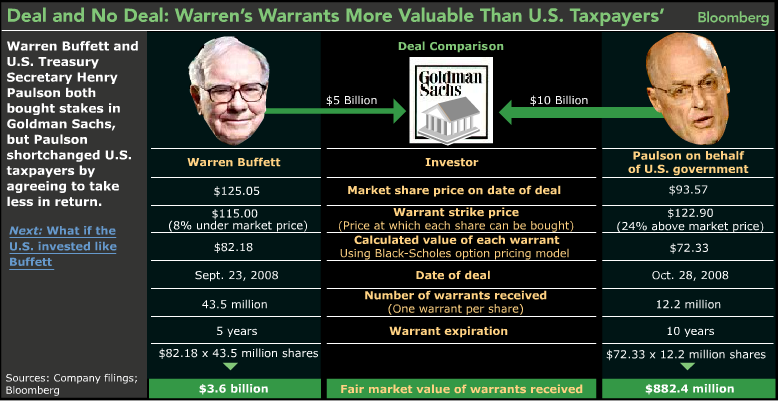
Back in October, I argued that it was incumbent that the taxpayers get a better deal than private investors. From Bloomberg:

"By Mark Pittman

Jan. 10 (Bloomberg) -- Henry Paulson’s bank bailouts, done under “great stress” during the worst financial crisis since the Great Depression, failed to win for U.S. taxpayers what Warren Buffett received for his shareholders by investing in Goldman Sachs Group Inc.( TRUE )

The Treasury secretary made 174 purchases of banks’ preferred shares that include warrants to buy stock at a later date. While he invested $10 billion in Goldman Sachs in October, twice as much as Buffett did the month before, Paulson gained certificates worth one-fourth as much as the billionaire, according to data compiled by Bloomberg. The Goldman Sachs terms were repeated in most of the other bank bailouts.( A DISGRACE )

Paulson’s decisions to prop up the financial system included purchasing shares in institutions from Goldman Sachs, the most profitable Wall Street firm last year, to Saigon National Bank, a Westminster, California, lender whose market value is $3.8 million.

“We were not looking to replicate one-off private deals” in the transactions, made under the $700 billion Troubled Asset Relief Program, Paulson said in a Bloomberg TV interview yesterday.( I ARGUE JUST THE OPPOSITE )

“The market was under great stress and the private sector was extracting very, very severe terms( IT WAS THE OTHER WAY AROUND! ). What we were attempting to do, which I think we did successfully, was design a program that would be accepted by a large group of healthy banks( ? ) with terms that would replicate what you would get in normal market conditions,” he said.

‘20-20 Hindsight’

“With 20/20 hindsight,” the bank-capital injections have achieved their objectives and the decisions on TARP will “prove to be the right ones,” the Treasury secretary said.( HUH? )

Paulson’s warrant deals may give taxpayers less profit from any recovery in financial stocks than shareholders such as Goldman Sachs Chief Executive Officer Lloyd Blankfein and Saudi Arabian Prince Alwaleed bin Talal, owner of 4 percent of Citigroup Inc., said Simon Johnson, former chief economist for the International Monetary Fund.

The transactions are “just egregious,” said Johnson, a fellow at the Peterson Institute for International Economics in Washington. “You want to do it the way Warren does it.”( OBVIOUSLY )

Paulson said “he had to make it attractive to banks, which is code for( COLLUSION ) ‘I’m going to give money away,’” said Joseph Stiglitz, who won a Nobel Prize in 2001 for his work on the economic value of information.

‘Giveaway’

“The worst aspect of this is that they were designed not to do what they were supposed to do,” he said in a telephone interview from Paris Jan. 7. “In many ways, it’s not only a giveaway, but a giveaway that was designed not to work.”( TRUE )

The Treasury would have held warrants for 116 million shares of Goldman Sachs under Buffett’s terms, which would be equivalent to a 21 percent stake when added to those currently outstanding. Instead, the dilution is 2.7 percent under the Treasury plan. Blankfein is the company’s biggest individual investor, with 2.08 million shares worth about $178 million today, according to Bloomberg data. His 0.47 percent interest would have declined to 0.36 percent under Buffett’s terms and would be 0.44 percent if the Treasury’s warrants were exercised.

Senator Judd Gregg, a New Hampshire Republican, estimated in a Jan. 4 Wall Street Journal opinion article that TARP investments have earned about $8 billion while recapitalizing the banking system.

Changes to TARP

Government agencies have committed more than $8.5 trillion to shoring up the financial system, including TARP, signed into law Oct. 3 by President George W. Bush. The program was sold to Congress as a way to buy securities that had fallen in market value. Paulson shifted his emphasis to direct capital injections to banks to prevent the financial sector from foundering.( NOT ACCEPTABLE. BAIT AND SWITCH. )

The House Financial Services Committee and TARP Congressional Oversight Panel plan hearings on how federal bailout money will be used during the administration of President-elect Barack Obama. The financial services panel scheduled its meeting for Jan. 13.

The oversight panel has contracted an independent analyst to examine the terms of TARP investments and is scheduled to deliver a report by Jan. 30, said Elizabeth Warren, chairwoman of the oversight panel, in an interview today. The question matters, Warren said, because shareholders are now being protected by taxpayer dollars.

“Supporting equity is such a profound shift in American economic policy that we must take a hard look at that decision( A GOOD IDEA ),” said Warren, a Harvard Law School professor who specializes in bankruptcy.

‘Something Worth Nothing’

Stiglitz said finance professionals at Treasury possessed expertise on warrant pricing that members of Congress didn’t. As a result, Paulson gave lip service to the lawmakers’ intent on TARP without gaining much value for taxpayers, said Stiglitz, a Columbia University professor who described the pricing mechanism as “a gimmick to make sure that they were giving away something worth nothing.”( I AGREE )

“If Paulson was still an employee of Goldman Sachs and he’d done this deal, he would have been fired,” he said.

A $5 billion U.S. loan last week to GMAC LLC, the Detroit- based finance affiliate of General Motors Corp., was made under the Treasury program and was part of $6 billion advanced to keep the automaker afloat.

In advancing the $5 billion, Paulson accepted warrants that reward taxpayers with an additional $250 million, or 5 percent of the stake. That compares with 15 percent on the 174 completed bank rescues as well as the 100 percent Berkshire Hathaway Inc. Chairman Buffett obtained on an investment in Goldman Sachs in September, Bloomberg data show. A warrant is a company-issued certificate that represents an option to buy a certain number of shares at a specific price by a predetermined date.

‘Stronger Terms’

“You’d certainly hope that the trend would be in the other direction, for stronger terms,” said Rep. Scott Garrett, a New Jersey Republican on the House Financial Services panel, in a telephone interview Dec. 26. “I don’t buy the methodology that they have to be circumspect to protect the parties involved. Ultimately their position has to be to protect the American taxpayer( CORRECT ).”

While the government has pledged to recover its investments, Congress provided little guidance on how to accomplish that. Legislation mandated that the Treasury receive warrants to acquire shares in companies tapping the program to potentially reward taxpayers. The law didn’t specify how many warrants or how they should be priced, factors that will determine how much money, if any, taxpayers get in exchange for their risk.

Buffett’s Warrants

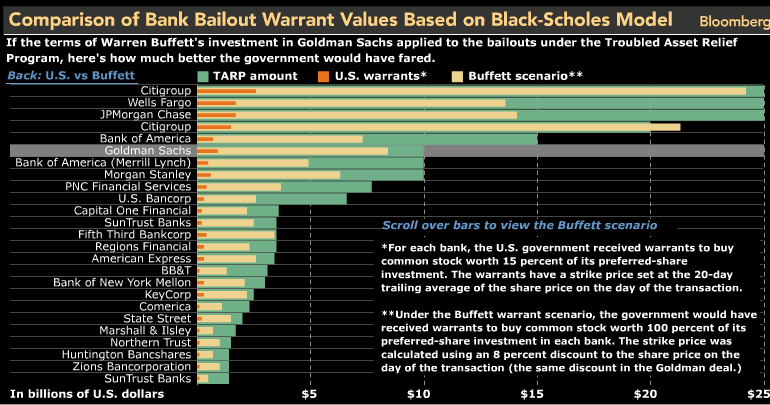
The government has received warrants valued at $13.8 billion in the 25 biggest capital injections from TARP, according to Bloomberg data. Under the terms Buffett negotiated for his $5 billion stake in Goldman Sachs, the TARP certificates would have been worth $130.8 billion.( PLEASE DON'T TELL ME THAT. )

Buffett received 43.5 million Goldman Sachs warrants valued at $82.18 apiece on the date of the transaction, or $3.6 billion, Bloomberg analytics show. Paulson, who served as the New York- based bank’s chief executive officer until 2006, injected twice as much taxpayer money into Goldman Sachs a month later and got 12.2 million warrants worth $72.33 each, or $882 million.

If the Treasury had received the same terms as Buffett, taxpayers would have become the biggest investors in most of the bailed-out banks and existing stakes( COLLUSION ) would have been diluted, Bloomberg data show.

No Confidence

“I halfway believed that the taxpayers would make money in September, but I really don’t believe it now,” Rep. Brad Miller, a North Carolina Democrat on the House Financial Services committee, said in a telephone interview last month.

“We have to have confidence in Treasury to run the program in a way that protects taxpayers, and there’s very little in the way they’ve run it that inspires confidence( TRUE ),” he said.

Congress left it to Paulson and his staff to decide how warrants would be priced and how many the U.S. would receive under the TARP, according to Caleb Weaver, a spokesman for the program’s oversight board. Treasury imposed identical terms for 140 capital injections. Thirty-four closely held lenders issued certificates to the government for preferred stock instead of common shares and one community development institution wasn’t required to issue warrants, according to the Jan. 6 Treasury report on TARP.

Bailouts for American International Group Inc., GMAC, GM and the second of two infusions into Citigroup were reported separately in the Treasury statistics.

‘Not Day Traders’

Paulson and former Goldman Sachs banker Neel Kashkari, who runs TARP as the interim assistant secretary of the Treasury for financial stability, have said the bank bailout will pay off.

“We’re not day traders, and we’re not looking for a return tomorrow( YOU SHOULD BE LOOKING FOR THE BEST DEAL GENIUS. ),” Kashkari told a Mortgage Bankers Association conference on Dec. 5 in Washington. “We are looking to try to stabilize the financial system, get credit flowing again, and over time, we believe that the taxpayers will be protected and have a return on their investment.”

Jackie Wilson, a spokeswoman for Omaha, Nebraska-based Berkshire Hathaway, didn’t respond to e-mail and telephone messages seeking comment. Goldman Sachs spokesman Michael DuVally declined to comment, as did Citigroup spokesman Michael Hanretta.

Paulson left money on the table in three ways, according to economist Johnson:( 1 ) accepting fewer warrants than Buffett did;( 2 ) setting the certificates’ price trigger, or strike, above market values; and( 3 ) receiving an annual yield on the preferred shares that is half of what Buffett will get for the first five years.

Dividend Payments

The government will forgo almost $48 billion over the next five years in preferred stock dividend payments from the 25 biggest TARP infusions, as compared with Buffett, according to the terms of the deals.

Buffett’s five-year warrants for 43.5 million shares of Goldman Sachs were valued at $82.18 each using the Black-Scholes option pricing model developed by Fischer Black and Myron Scholes to estimate the fair market value of such contracts. The model uses, among other data, the implied price volatility of the underlying security. The Treasury received 10-year warrants for 12.2 million Goldman shares priced at $72.33 on Oct. 28 using the same method.

The taxpayers’ certificates were set at the 20-day trailing average of the share price, which for Goldman Sachs was $122.90 on Oct. 28, when the company closed almost $30 cheaper at $93.57. The trailing average ensured a higher strike price, and lower value for the warrants, because bank stocks were plummeting.

8 Percent

By contrast, Buffett received an 8 percent discount to the market price at $115 a share on Sept. 23, when the stock closed at $125.05.

Taxpayers also acquired preferred shares as part of the bailout. These securities, which can’t vote unless the issue at hand is the creation of a more senior preferred stake, carry an interest payment of 5 percent that increases to 9 percent in five years. Buffett’s preferred shares in Goldman Sachs pay a 10 percent yield.

If Goldman Sachs rises to its five-year average price of $147, Buffett will be able to profit by $1.4 billion from exercising his warrants. The government warrants will be in the money for $294 million, or about a fifth as much for twice the investment.( COME ON )

TARP was set up to recapitalize banks and other financial institutions that lost money on subprime mortgages and commercial lending. It allocated $125 billion to nine of the largest banks and securities firms, and then invited all banks or savings and loans to apply for part of another $125 billion.

Saigon National

Recipients range from JPMorgan Chase & Co. in New York, which got $25 billion, to Saigon National, which received $1.2 million.

The government plans billions more in cash injections to companies including credit-card networks Discover Financial Services and American Express Co.

Under Buffett’s terms, the Treasury’s investment in Citigroup would also have brought greater potential for profit to taxpayers. The two cash infusions totaling $45 billion would have resulted in warrants for about 5.6 billion shares, which would more than double the 5.4 billion of existing shares. The Treasury’s warrants call for 464 million shares, or 8 percent of the number under Buffett’s terms.

None of the bank warrants for the biggest 25 capital injections from TARP funds can be exercised profitably now. Goldman Sachs closed in New York Stock Exchange composite trading at $83.92 yesterday, 32 percent less than its $122.90 strike price. Citigroup closed at $6.75, or 62 percent less than its highest exercise price of $17.85.

Exercising Warrants

Four of the 25 bank warrants could be exercised in the next year, based on Bloomberg surveys of analysts’ 12-month share- price forecasts. The average projection for Morgan Stanley at $26.46 is more than $3 higher than its strike price.

Analysts also expect American Express Co., Bank of New York- Mellon Corp. and the second capital injection for SunTrust Banks Inc. to rise above their strike prices, according to the surveys.

Congress may have another chance to get money back. The TARP legislation includes a requirement that lawmakers find a way in five years for taxpayer losses to be recouped from the financial industry.

To contact the reporter on this story: Mark Pittman in New York at mpittman@bloomberg.net."

I said at the time that it was a disgrace.

Now, in graphic form, from The Big Picture:

"Earlier this morning, we discussed how badly the Treasury department, along with Congress, had bungled the bailout monies.

These two graphics show exactly what an awful deal the taxpayer got for our monies.

Buffett’s Better Deal

click for much larger graphs

>

Source:
Paulson Bank Bailout in ‘Great Stress’ Misses Terms Buffett Won
Mark Pittman
Bloomberg, Jan. 10 2009
http://www.bloomberg.com/apps/news?pid=20601087&sid=aAvhtiFdLyaQ&"

Monday, November 3, 2008

"As we've argued, the long line for the bailout suggests we're giving away cash to cheaply. "

On Clusterstock, Joe Weisenthal sees that the terms of TARP are far from onerous:

"Socialist planners don't have price signals to go by, so historically they've been forced to use cruder measures, like line length. If the line for bread stretches around the block, maybe that means bread is priced too cheap. As we've argued, the long line for the bailout suggests we're giving away cash to cheaply. And it seems the line is growing

WSJ: Treasury and banking regulators say as many as 1,800 publicly held institutions could apply for government investments in coming weeks, out of concern that failing to do so could make them losers in a banking sector reshaped by the Treasury's $700 billion rescue plan.

Depending upon conditions still being crafted by Treasury, thousands more private banks could apply for government capital as well, a Treasury spokeswoman said Sunday."

Thursday, October 16, 2008

“This is the people’s money. They’re giving it out with no rules.”

It doesn't get clearer than this that TARP is off track. Via the NY Times:

"Bank of America said in a statement that the money “will add to our capital, which will increase our capacity to expand our balance sheet and make more loans.” It did not say if it was willing to increase its lending.

Indeed, observers point to the growing well of bank losses, deeper by the quarter, as reason to question whether the government funding will be used as a financial Band-Aid, instead of an engine to move forward.

“It is the government’s responsibility to set the terms and conditions on this money,” said David M. Walker, the former federal comptroller general and now president of the Peter G. Peterson Foundation. “This is the people’s money. They’re giving it out with no rules.”

Bank executives, meanwhile, said on conference calls this week that it was premature to discuss their plans. "

A credit stimulus package without the stimulus. Perfect.

Monday, September 22, 2008

Can A Bailout Be Punitive?

Meteor Blades on Kos posts the following:

"Democrats, in general, and Senator Barack Obama, in particular - as the new head of the Democratic Party - should trash this outrageous dictatorial bailout and stop listening to the advice of those who led us into this mess - including some fellow Democrats of prominence. They shouldn't tinker on the edges of the administration's proposal. Their substitute plan should put the pain on the pin-striped grifters where it belongs instead of on those Americans who have been repeatedly victimized by them."

Here's my response:

"
If It's A Bailout, How Can It Be Punitive? (0+ / 0-)

I'm just asking.

Trying to make the libertarian Democrat a reality

by Don the swing voter on Mon Sep 22, 2008 at 11:23:13 AM PDT"