From Willem Buiter:
"Negative interest rates: when are they coming to a central bank near you?
May 7, 2009 2:27am
The problem
I agree with Greg Mankiw[1] that it is time for central banks to stop pretending that zero is the floor for nominal interest rates. There is no theoretical or practical reason for not having the Federal Funds target rate and market rates at, say, minus five percent, if that is what your Taylor rule, or whatever heuristic guides your official policy rate, suggests.
Economics as a science and economic reality have never had problems with negative real (inflation-adjusted) interest rates. So what is the problem with nominal rates? In a word, it’s currency.
Financial instruments can be categorised as bearer instruments (bearer securities) or registered instruments (registered securities). Bearer instruments are instruments for which the issuer does not know the identity of the owner. So, unless you can prove the opposite (after a mugging say), the holder or bearer is the owner - possession is most of the law. Currency is an example of a bearer instrument. It is a negotiable bearer bond - it is transferable to another party by delivery. And it does not have to be endorsed by the party transferring it. Many bonds are bearer securities as well, but through a variety of arrangements (including clipping coupons in the old days) it has been possible to get over the problem of paying interest on these non-currency bearer instruments.
Registered securities or instruments are securities or instruments where the issuer knows the identity of the owner. Shares are an example, so are bank accounts and reserves held by banks with the central bank. Paying interest, negative or positive, on registered instruments is trivial. In many cases today interest payments are entries in some electronic ledger. When I get a positive five percent annual interest rate on my deposit account, I put in $100 and get out $105 a year later. When I get a negative five percent interest rate, I put in $100 and get out just over $95 one year later. The same holds for bonds. I issue a one-year zero-coupon bond with a minus five percent interest rate and a year later I repay my creditors just $95 for every $100 borrowed through bond issuance.
Central banks have no problem whatsoever paying negative interest rates on deposits (reserves) held by banks with them. Neither is it any more difficult to charge a negative interest rate on collateralised borrowing by commercial banks from the central bank than it is to charge a positive interest rate. If there are Millennium-Bug-style problems with programs and spreadsheets that take the logarithm of a nominal interest rate (rather than the logarithm of one plus the interest rate, as any sensible person would have coded it), it’s time to do some overtime correcting such silly ‘technical’ obstacles to negative interest rates. The brainless should not be in banking.
Currency is the only problem. Paying positive interest on currency is difficult because you don’t know the identity of the owner. The same note could be presented repeatedly to earn the interest due for a single period. To get around this problem, the instrument itself must be clearly identified as current or non-current on interest. Once interest has been paid, it is marked, traditionally by stamping it or by clipping a coupon off it.
With negative interest, the problem is not the owner turning up too often to claim his interest. It is getting him to turn up at all. Since the authorities don’t know I am the owner of the currency I own, why should I volunteer to pay the government money for the privilege?
It is this prima facie trivial obstacle of paying negative interest on currency that has prevented central banks from breaking through the lower floor (no stories about Switzerland, please).
Stricly speaking this story must be qualified in minor ways. If currency is the most liquid security, no other risk-free nominal instrument can earn less than it, net of carry costs (costs of storage, safekeeping and insurance). Carry costs for currency are higher than for Treasury bills or reserves with the central bank. The zero lower bound is therefore, strictly speaking a lower bound somewhat below zero. But not enough to achieve a minus five percent Federal Funds target rate.
Fortunately, it turns out to be extremely simple to remove the zero lower bound on short, risk-free nominal interest rates.
Solutions
There are three practical ways to implement negative nominal interest rates.
(1) Abolish currency. This is easy and would have many other benefits. The main drawbacks would be the loss of seigniorage income to the central bank. There may be a ‘millennium bug’ type transitional problem, if a lot of bad programmers have written code that blows up when the nominal interest rate hits zero (taking the logarithm of zero or of a negative number has interesting consequences), but all that means is a couple of wasted weekends at the office re-writing the relevant code.
Advanced industrial countries can move to electronic and bank-account-based means of payment and media of exchange without like problem. Negative interest rates on bank accounts and on balances outstanding on ‘centralised or networked electronic media’ like credit cards are as easy as positive interest rates. Debit cards simply transfer money between two accounts, both of which could pay negative interest rates and don’t pose a problem. You could even retain a measure of anonymity and have ‘cash-on-a-chip cards’, which, whenever the balance on the card is replenished by drawing funds from some account, calculate the average balance held on the cash card since the last replenishment and arrange for the appropriate interest rate (positive or negative) to be applied.
The only domestic beneficiaries from the existence of anonymity-providing currency are the criminal fraternity: those engaged in tax evasion and money laundering, and those wishing to store the proceeds from crime and the means to commit further crimes. Large denomination bank notes are an especially scandalous subsidy to criminal activity and to the grey and black economies. There is no economic justification for $50 and $100 bank notes, let alone for the €200 and €500 bank notes issued by the ECB. When asked why the ECB subsidises and encourages crime by issuing these large-denomination notes, the answer comes back that Spaniards like to make large transactions in cash, and that the ECB does not want to be responsible for an increased incidence or herniated discs, caused by people having to schlep large suitcases filled with small bills to make their next home purchase. There is an answer to that answer: kvatsch!
For foreigners in developing countries and emerging markets with high-inflation-prone monetary systems, the disappearance of the US dollar notes and the euro notes could be a setback, as these provide welcome stores of value when domestic inflation rages. It has been estimated that as much as 70 percent of all US dollar bills (by value) are held outside the USA (not all by people wanting to hedge against hyperinflation at home, of course) and that up to 50 percent of all euro notes (by value) are held outside the Euro Area. To those people I would say, I feel your pain, but this is the time to replace exit with voice. Go and create a polity that will support a government that does not abuse the printing presses.
As a concession to the poor, we could keep a limited number of 1$ and 5$ bills (1€ and 2€ coins and 5€ bills) in circulation. I cannot envisage banks and other big financial players would wish to store warehouses full of small bills). If the small bills were not supplied on demand, but had their quantity exogenously determined, my option 3 below would be likely to kick in. The remaining dollar bank notes would not exchange at par with dollar deposits, dollar cash-on-a-chip or other dollar e-money, but would trade at a varying relative price (exchange rate) vis-a-vis these other, negative interest-bearing means of payment and media of exchange. The depreciation of this exchange rate would make traders and portfolio holders indifferent between holding zero interest currency and negative interest bank deposits.
My good friend and colleague Charles Goodhart responded to an earlier proposal of mine that currency (negotiable bearer bonds with legal tender status) be abolished that this proposal was “appallingly illiberal”. I concur with him that anonymity/invisibility of the citizen vis-a-vis the state is often desirable, given the irrepressible tendency of the state to infringe on our fundamental rights and liberties and given the state’s ever-expanding capacity to do so (I am waiting for the US or UK government to contract Google to link all personal health information to all tax information, information on cross-border travel, social security information, census information, police records, credit records, and information on personal phone calls, internet use and internet shopping habits).
But given the fact that e-money that can pay positive or negative interest without any additional cost can now be made available to all, in the advanced (post-) industrial countries, and given that even traditional bank accounts, credit cards and debit cards can take care of most of the retail payment system without creating a zero lower bound constraint on nominal interest rates, we really don’t need cash to facilitate trade and commerce. It is a redundant, indeed dominated medium of exchange and means of payment for legitimate transactions. Do we really want to retain cash just because it (1) allows us to hide some of our legitimate financial transactions from the government (as insurance against government abuse of the information), and (2) is a source of revenue to the central bank? These arguments pro are surely dominated by the two arguments against currency, (1) that, as currently construed (but see my third way of removing the lower bound), currency imposes a zero lower bound on nominal interest rates and (2) that it subsidises the grey and black economies and makes life easier for the global criminal and terrorist fraternity.
Instead of abolishing currency altogether, we could only issue low denominations, say nothing larger than $5 or €5. The carry costs (safe-keeping, insurance and storage) for large amounts of cash are likely to become prohibitive if you have to do it all in fivers. The zero lower bound would be likely to shift to a significantly negative lower bound.
(2) Tax currency and ‘stamp’ it to show it is ‘current on interest due’. This is Silvio Gesell’s proposal, supported by Irving Fisher and re-introduced into the policy debate by Marvin Goodfriend and by myself and Nikolaos Panigirtzoglou.[2] When the interest rate on currency is positive, the currency must be marked (by stamping or clipping coupons) to make sure the (anonymous) bearer does not present it repeatedly for the payment of interest. When the interest rate is negative, the (anonymous) bearer must (a) be induced to come forward to receive his negative interest (i.e. pay interest to the central bank) and (b) must be able to demonstrate that the negative interest has been received. To ensure (b), the currency must again be stamped or marked (electronically tagged). To get the bearer to come forward to pay the negative interest we can either rely on honesty and a sense of patriotic duty, or we can impose sanctions for non-compliance. I am afraid penalties for non-compliance (fines, a day in the stocks) would be required to make negative interest on currency work. This would require random checks etc. It would be administratively costly and unpleasantly intrusive. This may well endear the notion to our governments.
(3) Unbundle currency from the unit of account. This ideal goes back at least to Eisler (1932), was drawn to my attention by Stephen Davies in 2004 and has been formalised by me in a couple of papers since then.[3] The basic idea is simple. In an economy where the dollar is the unit of account for price and wage contracts and most other market transactions, the fact that the currency is also the dollar (that is, the fact that X dollars worth of currency purchases X dollars worth of short-term nominal public debt (or X dollars worth of reserves with the central bank) establishes a zero lower bound on the nominal interest rate (what matters is that the exchange rate of currency and short nominal debt is constant, not that it is unity).
Now abolish the dollar currency and introduce a new currency, the rallod. The exchange rate between the rallod and the dollar is not constant. It can either be determined by the government or let by the market. In the first case, the government (central bank) supplies rallod on demand at the government-determined exchange rate; in the second case, the stock of rallod currency is exogenous (determined by the government but not available from the government in whatever quantity demanded at a given exchange rate. Since the rallod is the currency, there is a zero lower bound on the rallod interest rate on rallod-denominated securities (I am ignoring carry costs and assume that solution 2 is not applied to the rallod). However, since there no longer is dollar currency, the nominal interest rate on dollar securities can be negative as easily as it can be positive.
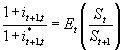
Let St be the spot exchange rate between the dollar and the rallod in period t (number of rallods per dollar), Ft+1,t the forward exchange rate between the dollar and the rallod in period t, it+1,t the one period interest rate on safe dollar securities and i*t+1,t the one-period interest rate on safe rallod securities. No arbitrage implies that these four variables are related through covered interest parity (CIP):

As long as the interest rate on rallod securities is positive, it does not matter what the spot and forward exchange rates between the dollar and the rallod are. Assume that we hold the spot exchange rate constant and keep the forward rate equal to the spot rate. This means, from CIP, that dollar interest rates are the same as rallod interest rates.
Now assume that both interest rates would have to go below zero if the monetary authority were to follow its Taylor rule, or whatever heuristic for driving the policy rate that floats its boat. The rallod interest rate is constrained to be non-negative and therefore equals zero. However, the dollar interest rate is set at whatever negative value the central bank thinks best - minus five percent, say. Can the dollar interest rate be - 0.05 and the rallod interest rate 0.00 without this creating opportunities for pure profits - a certain positive payoff without putting any money at risk? It can provided the forward price of the dollar in terms of the rallod is five percent higher than the spot price. This follows straight from the CIP condition above. With it+1,t = - 0.05 and i*t+1,t = 0.00, the no-arbitrage condition is satisfied provided St/Ft+1,t = 0.95. If the authorities announce a path for the future spot exchange rate that is perfectly credible, the forward rate will be equal to the expected (and actual) future spot rate. Let Et denote an expectation or anticipation formed at time t, then, with perfect credibility, Ft+1,t = EtSt+1 = St+1. In this case there is uncovered interest parity (UIP) as well as covered interest parity.

UIP
The monetary authority has three instruments in the rallod currency world: the interest rate on dollar securities (the central bank’s official policy rate), the spot exchange rate of the dollar and the rallod and the forward rate. Given these three, the interest rate on rallod securities follows (subject of course, to the non-negativity constraint on rallod interest rates.
The zero lower bound on dollar interest rates has been removed. It has been replaced by a zero lower bound on rallod interest rates, but these don’t matter, as it is the dollar general price level that matters, and the dollar is the numéraire/unit of account.
Those who want to work through these things will note that, if there is UIP, real interest rates (inflation corrected interest rates) will be the same on nominal dollar bonds as on nominal rallod bonds. This is because the law of one price implies that the dollar price level, P, say, is related to the rallod price level, P*, say, by the law of one price, that is
PS = P*
Even though dollar and rallod real interest rates are the same, the creation of the rallod and the unbundling of the medium of exchange/means of payment and the numéraire/unit of account makes a real difference to the behaviour of the economy and the effectiveness of monetary policy, whenever there is any probability that the zero lower bound would become binding in the dollar currency economy. In that case, in the rallod currency economy, dollar real interest rates and rallod real interest rates will be equal to each other, but they are different from what they would have been in the dollar economy.
What can go wrong? The only thing that can go wrong is that the dollar would cease to be the numéraire for key private contracts (especially wage and price contracts) when the dollar is replaced by the rallod as the currency. If that were to happen, if the numéraire ‘followed the currency’, the price level that matters is the rallod price level, not the dollar price level. We would be back in the dollar currency economy, simply having renamed the dollar the rallod. This would be a currency reform of the kind that replaced 100 old French francs with 1 new French franc.
The numéraire is not chosen by the monetary authority or by the government. It is the outcome of an uncoordinated social decision process. Sometimes multiple numéraire have coexisted. But while the authorities cannot legislate the numéraire, they can strongly encourage the use of a specific numéraire. In the rallod currency economy, the government can insist that all contracts in and with the public sector be denominated in dollars. They can require tax returns to be made using the dollar as numéraire, and they can insist that taxes be paid with dollar deposits or other dollar-denominated (non-currency) means of payment. They can discourage or ban the creation of checkable accounts denominated in rallods, etc. etc.
So I have little doubt that the rallod currency economy could be nudged towards retaining the dollar as the numéraire in systemically important contracts and transactions. So the zero lower bound that matters would have been removed.
After this good news, the better news. It isn’t even necessary to abolish the dollar currency and replace if by the rallod currency. You can keep the dollar currency. All that is required is that the authorities no longer maintain a fixed exchange rate (equal to 1) between bank reserves with the central bank and currency. Instead they let the exchange rate between dollar reserves with the central bank and dollar currency, St, be market-determined. The authorities of course can no longer supply dollar currency on demand (or take it back on demand) at a fixed exchange rate (currently 1) with bank reserves with the central bank. Instead they determine the stock of currency dollars exogenously.
So the authorities have two instruments in the floating exchange rate case: the dollar interest rate and the quantity of dollar (or rallod) currency it issues. The remaining degree of freedom has to be provided by a terminal condition for the exchange rate in the long run. Speculative bubbles could arise in this market, if the exchange rate is left to float.
With a floating exchange rate between the reserve dollar and the currency dollar, UIP will not in general hold. Instead we have an equilibrium relationship, shown below, that says, effectively, that the interest-rate differential between the reserve dollar and the currency dollar equals the expected proportional rate of depreciation of the reserve dollar vis-a-vis the currency dollar plus an exchange rate depreciation risk premium, as shown below.

So a reserve dollar would no longer automatically be worth a currency dollar. If that is confusing, call the currency dollar the rallod instead.
I gave a lecture on these issues at the Center for Financial Studies of the Goethe University in Frankfurt, Germany, today. Otmar Issing was in the audience. He listened carefully (he always does) and gave me quite a grilling during dinner afterwards. I don’t think I have convinced him yet of the merits of the case for breaking through the zero lower bound on nominal interest rates, but here’s to hoping! The Powerpoint slides of the presentation can be found here.
Conclusion
Removing the zero lower bound on nominal interest rates would represent a valuable addition to the policy arsenal of the central banks. We know something about how interest rates work. There is no reason to believe there would be any dramatic change in the effectiveness of policy rate cuts if these cuts to the rate level below zero. We know next to nothing about the effectiveness of the alternative policies that central banks are forced to adopt if they don’t just want to sit on their hand once the hit the zero lower bound: quantitative easing and credit easing, relaxing the collateral requirements for central bank lending etc.
All these alternative measures also blur the distinction between the responsibilities of the monetary and the fiscal authorities. It undermines central bank independence, something which, up to a point, I consider valuable.
There are at least three ways to remove the zero lower bound that are feasible: abolish currency, tax currency and ensure that currency is not the numéraire. Taxing currency may be awkward and intrusive, but abolishing currency is not just easy (just do it) but also has considerable advantages as a blow against criminality and terrorism. Unbundling currency and numéraire is something that can be done over the weekend.
I really don’t understand why central banks are not aggressively pursuing options for removing the zero lower bound. It is that they love the seigniorage so much? But they retain seigniorage revenue from currency issuance in the rallod economy. Is it hidebound conservatism and lack of imagination. Quite possibly. But if so, this is a costly mistake. Central banks should act to remove the zero lower bound on nominal interest rates now.
[1] N. Gregory Mankiw (2009)
“It May Be Time for the Fed to Go Negative”, in: New York Times April 18
[2] Goodfriend, Marvin (2000), “Overcoming the Zero Bound on Interest Rate Policy“, in: Journal of Money, Credit, and Banking, Vol. 32(4)/2000, S. 1007 - 1035.
Buiter, Willem H. and Nikolaos Panigirtzoglou (2001), “Liquidity Traps: How to Avoid Them and How to Escape Them”, with Nikolaos Panigirtzoglou, in Reflections on Economics and Econometrics, Essays in Honour of Martin Fase, edited by Wim F.V. Vanthoor and Joke Mooij, , pp. 13-58, De Nederlandsche Bank NV, Amsterdam.
Buiter, Willem H. and Nikolaos Panigirtzoglou (2003), “Overcoming the Zero Bound on Nominal Interest Rates with Negative Interest on Currency: Gesell’s Solution”, Economic Journal, Volume 113, Issue 490, October 2003, pp. 723-746.
[3] Buiter, Willem H. (2004) ,”Overcoming the Zero Bound: Gesell vs. Eisler; Discussion of Mitsuhiro Fukao’s “The Effects of ‘Gesell’ (Currency) Taxes in Promoting Japan’s Economic Recovery” . Discussion presented at the Conference on Macro/Financial Issues and International Economic Relations: Policy Options for Japan and the United States, October 22-23, 2004, Ann Arbor, MI, USA. International Economics and Economic Policy, Volume 2, Numbers 2-3, November 2005, pp. 189-200. Publisher: Springer-Verlag GmbH; ISSN: 1612-4804 (Paper) 1612-4812 (Online).
Buiter, Willem H. (2007), “Is Numérairology the Future of Monetary Economics? Unbundling numéraire and medium of exchange through a virtual currency with a shadow exchange rate”, Open Economies Review, Publisher Springer Netherlands; ISSN 0923-7992 (Print); 1573-708X (Online). Electronic publication date: Thursday, May 03, 2007. See “Springer Website”.
Davies, Stephen [2004], “Comment on Buiter and Panigirtzoglou”, mimeo, Research Institute for Economics and Business Administration, Kobe University, May.
Eisler, Robert (1932), Stable Money: the remedy for the economic world crisis: a programme of financial reconstruction for the international conference 1933; with a preface by Vincent C. Vickers. London: The Search Publishing Co."
Me:
"(2) Tax currency and ‘stamp’ it to show it is ‘current on interest due’."
I'm for Stamping. It was also defended and commented upon in the FT here:
http://blogs.ft.com/economistsforum/2008/11/the-case-for-negative-interest-rates-now/#more-259The case for negative interest rates now
November 20, 2008 12:35pm
by FT
By Brendan Brown
A conundrum has long been known to monetary economists, but only comes into the open during the once in a quarter-of-a-century type of recession apparently plaguing the global economy.
The quandary is how, in a conventional monetary economy, to bring interest rates down to the negative levels essential to speedy recovery during periods when there is a sharp decline in spending propensities.
If interest rates fall below zero, the public would simply seek to transfer their savings into hoards of banknotes.
The interest rate under discussion is the risk-free nominal rate as quoted on short-maturity government bonds, most obviously US T-bills or short-dated German government bonds.
Over the course of decades, particularly during the Japanese “lost decade” of asset deflation, suggestions have emerged as to how to solve the conundrum.
These include the periodic stamping (for a small fee) of banknotes (without the stamp they would not be valid). The idea is that by imposing a running tax on banknote hoarding, nominal risk-free rates could fall to negative levels.
In the age of the information technology revolution, surely the authorities could devise a simple and practical method of effective taxation of banknote hoards?...... "
Excellent comment by Martin Wolf:
" Martin Wolf: This is ingenious and would, no doubt, permit negative real interest rates. But I would prefer it if vigorous action were taken by the monetary authorities to sustain inflation, before deflation set it, in which case we would never need negative nominal interest rates in order to obtain negative real rates.
If it is already too late for this, I agree that this scheme would make it possible for the authorities to impose negative real short rates. Another justification for negative real rates is that it would reduce the danger of debt deflation - the rising real level of debt as the price level falls. It would be wildly unpopular, of course, among politically powerful savers. It would have to be pointed out that this loss is offset by the rising real value of nominal claims.
But would it work in the way Brendan suggests? I am not sure. Equity markets might rise a little. But I very much doubt whether companies would start to issue equity in order to invest in a substantial way, in the midst of a deep recession. The underlying logic is Hayekian. I have never been convinced of this theory of the credit cycle.
So is there an alternative? Yes. The central bank can lend directly to the government, which can spend on investment and public consumption or make transfers to consumers to spend. If real interest rates were negative, this would be even cheaper for the government. That would certainly add to the effectiveness of such a policy, in any case.
Posted by: Martin Wolf"
Both Nick Rowe and Scott Sumner have good points against Stamping, but I find it simple and effective. I'm less concerned on the method used, than on the use of the concept. Brad De Long has also commented on it recently:
http://delong.typepad.com/sdj/2009/04/silvio-gesell-and-stamped-money-another-thing-fisher-and-wicksell-knew-that-modern-economists-have-forgotten.htmlBut Silvio Gesell is the topic of part VI of chapter 23 of Keynes's flagship work, The General Theory of Employment, Interest and Money. And it's not just Keynes in his flagship work. There are 55,000 google hits for "Silvio Gesell." Patinkin (1993) reports that Irving Fisher advocated Gesell-based "velocity control" in his 1932 Booms and Depressions. Nobel prize-winning Maurice Allais was an advocate as well. Gerardo della Paolera and Alan Taylor are Gesell's biggest boosters today in their book Straining at the Anchor: The Argentine Currency Board and the Search for Macroeconomic Stability, 1880-1935, a University of Chicago Press book that is part of the NBER's series on "long term factors in economic development." Willem H. Buiter and Nikolaos Panigirtzoglou writing in the Economic Journal in 2003: "Overcoming the Zero Bound on Nominal Interest Rates with Negative Interest on Currency: Gesell's Solution."
This is, I think, yet another example of how much economics has lost by cutting itself off from its moral philosophical and historical roots. Something that Keynes and Fisher and the other founders of monetary economics seriously wrestled with is today seen as something unknown and new to be thought of by clever graduate students. Once again the answer to Olivier Blanchard's question "What Do We Know that Fisher and Wicksell Did Not?" is that Olivier is asking the wrong question: what did they know that we have forgotten?
Here is John Maynard Keynes writing in 1936, summarizing Silvio Gesell writing in 1916:
J.M. Keynes, General Theory of Employment, Interest and Money, chapter 23: It is convenient to mention at this point the strange, unduly neglected prophet Silvio Gesell (1862-1930), whose work contains flashes of deep insight.... [T]he English version (translated by Mr Philip Pye) being called "The Natural Economic Order". In April 1919 Gesell joined the short-lived Soviet cabinet of Bavaria as their Minister of Finance, being subsequently tried by court-martial.... Professor Irving Fisher, alone amongst academic economists, has recognised its significance. In spite of the prophetic trappings with which his devotees have decorated him, Gesell's main book is written in cool, scientific language; though it is suffused throughout by a more passionate, a more emotional devotion to social justice than some think decent in a scientist.... I believe that the future will learn more from the spirit of Gesell than from that of Marx.... Gesell's specific contribution to the theory of money and interest is... that the peculiarity of money, from which flows the significance of the money rate of interest, lies in the fact that its ownership as a means of storing wealth involves the holder in negligible carrying charges.... [H]e had carried his theory far enough to lead him to a practical recommendation, which may carry with it the essence of what is needed... the prime necessity is to reduce the money-rate of interest, and this, he pointed out, can be effected by causing money to incur carrying-costs just like other stocks of barren goods. This led him to the famous prescription of 'stamped' money, with which his name is chiefly associated and which has received the blessing of Professor Irving Fisher.... [C]urrency...would only retain their value by being stamped each month, like an insurance card, with stamps purchased at a post office. The cost of the stamps... should be roughly equal to the excess of the money-rate of interest (apart from the stamps) over the marginal efficiency of capital corresponding to a rate of new investment compatible with full employment. The actual charge suggested by Gesell was 1 per mil. per week, equivalent to 5.2 per cent per annum.... The idea behind stamped money is sound..."
It would be wonderful if this idea was seriously considered.
"Taxing currency may be awkward and intrusive"
This is easily the most effective proposal, since it fits into our system of government.
Posted by: Don the libertarian Democrat
And:
The point of stamping, in my view, is to give a disincentive to buying bonds in a Debt-Deflationary situation. In other words, when investors are driving down yields in a panic in the flight to safety and liquidity, you tempt them to put their money into other assets, like stocks or corporate bonds or helping a friend start a business.
It makes sense to me to invest in stocks when the market is low and you are getting nothing in return for buying bonds. Then, when bond yields go up, you buy bonds. That's why some inflation in the future is a good sign.
QE can work as well, and so read this:
http://ftalphaville.ft.com/blog/2009/05/07/55605/the-qe-stockmarket-effect/?source=rss"But, as Lewis also points out, QE may be having another, perhaps less expected, but nonetheless still very welcome effect - on equities. As he explains (our emphasis):
Possibly, the chief impact of QE will come through the equity market. If ‘other financial institutions’ see their bank deposits increasing, they may be inclined to commit some of these funds to equity investment. "
In my view, with low yields on short term bonds, and gradually increasing yields on longer term bonds, this result is expected.
Posted by: Don the libertarian Democrat


 As shown in Figure 1, over the past two decades, the Fed has set the federal funds rate, a key gauge of the stance of monetary policy, in a fairly consistent fashion relative to various economic indicators such as unemployment and inflation. (Figure 1 shows the quarterly average funds rate and unemployment rate, and the four-quarter inflation rate for prices of core personal consumption expenditures. See the related
  A rough guideline for setting the federal funds rate that captures the Fed's behavior over the past two decades is provided by a simple equation that relates the funds rate to the inflation and unemployment rates. This equation is obtained by a statistical regression of the funds rate on the inflation rate and on the gap between the unemployment rate and the Congressional Budget Office's estimate of the natural, or normal, rate of unemployment. The resulting empirical policy rule of thumb—a so-called Taylor rule—recommends lowering the funds rate by 1.3 percentage points if core inflation falls by one percentage point and by almost two percentage points if the unemployment rate rises by one percentage point. As shown in Figure 2, this simple rule of thumb captures the broad contours of policy over the past two decades. Differences between the recommended target rate from the estimated policy rule (the thin line) and the Fed's actual target funds rate (the thick line) are fairly small. Exceptions occurred during the mid-1990s and mid-2000s, when the funds rate was set somewhat higher or lower than the policy rule recommended. During 2007 and 2008, by this rudimentary empirical metric, the Fed's lowering of the funds rate by over five percentage points was roughly in line with its historical behavior.




 Posts
Posts


