Showing posts with label Housing Prices. Show all posts

Monday, May 11, 2009

zoning and other restrictions put a brake on competitive forces and keep housing prices up

TO BE FILED: From Slate:

Slate Magazine
everyday economics

Is Housing Too Expensive? Blame the Government

Maybe zoning laws are causing the real-estate bubble.

By Steven E. Landsburg

Elementary economics tells you that in a competitive environment, the price of a new house should equal:

the price of land + construction costs + a reasonable profit for the developer

But in most cities, that sum is not even close to what buyers are paying.

Take Dallas, for example. If you live in central Dallas, and if you could magically add a quarter of an acre to your lot size, you'd add (on average) about $2,200 to the value of your house. (We know this from comparisons of similar houses on different-sized lots.) Do the same in central Philadelphia, and your house value increases by $8,400; in central Houston, it's more like $17,600. In that sense, central Dallas land is just about the cheapest urban land you can find in this country. Among large cities, only Atlanta, Boston, and St. Louis rank lower. In theory, that should be great news for Dallas housing prices. But it's not. A house that costs $100,000 to build typically sells for $140,000 in Dallas, maybe $120,000 in Houston, and under $90,000 in Philadelphia.

Aha! say the commentators. Housing prices must be driven by something other than fundamentals. Speculators, of either the rational or the irrational variety, are the obvious culprits.

Here's what's wrong with that analysis: Housing prices have to make sense on both the demand side and the supply side. No matter what you do or don't believe about the ability of crazed demanders to bid up prices, you still have to explain why competitive suppliers don't bid those prices right back down. In other words, if the housing market is so tight that builders are making a fortune, they ought to be flooding the market with new houses—and driving down prices.

In fact, buyers' behavior is relatively easy to explain. Most of the recent explosion in housing prices has been in cities like San Francisco and Santa Barbara—in other words, in really nice places to live. It's not unreasonable to believe that, as Americans grow richer, and as technology makes us more mobile, more and more of us want to move to California. And it's not unreasonable to expect that this trend will continue, so that even a very expensive house in the Bay Area can look like a good investment.

The great mystery is on the supply side. Instead of the traditional formula "housing price equals land price + construction costs + reasonable profit," we seem to be seeing something more like "housing price equals land price + constructions costs plus reasonable profit + mystery component." And, most interestingly, the mystery component varies a lot from city to city.

Even in cities like San Francisco, where there's little room to build and land is consequently dear (on the order of $85,000 per quarter acre, compared with $2,200 for Dallas), you can't use land prices to explain away housing prices. The mystery component in San Francisco housing—that is, the amount left over when you subtract land prices and construction costs from house prices—is the highest in the country.

Edward Glaeser of Harvard and Joe Gyourko of the University of Pennsylvania have computed these mystery components for about two dozen American cities. They speculate that the mystery component is essentially a "zoning tax." That is, zoning and other restrictions put a brake on competitive forces and keep housing prices up. (Read one of their papers here.)

When you buy a house, you're not just paying for the land and construction costs; you're also paying for a building permit and other costs of compliance. You've got to get the permits, pass the zoning and historic preservation boards, ace the environmental impact statement, win over the neighborhood commission, etc. If Glaeser and Gyourko are right, that's the mystery component right there.

It's hard to test this theory directly, because it's hard to get good measures of compliance costs in various cities. But Glaeser and Gyourko did the next best thing: They measured a part of the compliance costs, namely the average length of time for a permit to be granted.

If the theory is correct, that length of time should be a good but imperfect predictor of the mystery component in housing prices. The data largely support this theory. About half of all cities are rated 2 (on a scale of 1 to 5) in terms of how long it takes to get a permit; these are, without exception, the cities with the lowest mystery component in housing prices. Cities rated 3, 4, and 5 all have higher mystery components. (A bit disconcertingly, so do the three cities—Minneapolis, Chicago, and Anaheim—that are rated 1. Peculiar as these exceptions are, there are at least only three of them, and we should expect some anomalies given that Glaeser and Gyourko's measure of zoning costs is rather crude.) You can talk all you want about crazed speculators and bubbles in housing prices, but you still have to explain why competitive forces don't bring prices right back down. According to Glaeser and Gyourko, it's ever-expanding zoning laws that get in the way. If you want to lower prices, that's the bubble you've got to burst.

Steven E. Landsburg is the author, most recently, of More Sex Is Safer Sex: The Unconventional Wisdom of Economics. You can e-mail him at armchair@troi.cc.rochester.edu."

Thursday, April 23, 2009

Tuesday, April 14, 2009

Since the economic collapse began in September 2008, the index shows a drop of 10.9%.

TO BE NOTED: From HousingWire:

"Housing Prices Yet to Stop Dropping

Posted By KELLY CURRAN
April 14, 2009 1:13 pm

By no surprise, U.S. housing prices continued on a downward slide in February. In a [1] report released Tuesday, Integrated Asset Services, LLC, a provider of default management and residential collateral valuations, reports a 3% month-over-month drop in home prices during the month.

U.S. house prices have now fallen 14.4% on a year-over-year basis and a whopping 17.9% since the height of the real estate bubble in 2006, according to IAS360 data. Since the economic collapse began in September 2008, the index shows a drop of 10.9%.

“We have seen no indication of a positive turn in the housing markets we track, if anything the rate of decline in some areas has increased,” says Dave McCarthy, president and CEO of Integrated Asset Services.

The IAS360 tracks home sales down to the neighborhood level, and then rolls up local totals in 360 counties, nine census divisions, four regions and the nation overall.

Among the four U.S. Census region levels, the Northeast reported a 12.8% decline across the last 5 months and 4.6% drop in February. Similarly, the South dropped 12.8% and 3% for the same respective periods. The West, for its part, was down 10.2% and 2.5%. The Midwest, though down, was the only region that did not experience double-digit declines, dropping a lesser 8.9%.

According to the index and its accompanying report, six of the ten largest metropolitan statistical areas (MSAs) in the U.S. have experienced double-digit declines since the economy’s downturn. “No markets seem to be completely immune from the housing crisis,” McCarthy says.

Boston, San Francisco, and Miami were the areas hardest hit, down 20.3%, 19.3%, and 18.1% respectively. The Boston area fell 10.3% in February alone. Within Boston’s metropolitan area, Essex, MA plunged at an astonishing rate of 22.8% in February, while Suffolk, MA followed closely, dropping 19.3%.

Write to Kelly Curran at [2] kelly.curran@housingwire.com.

Disclosure: The author held no relevant investment positions when this story was published. Indirect holdings may exist via mutual fund investments. HW reporters and writers follow a strict disclosure policy, the first in the mortgage trade."

Thursday, April 9, 2009

How could anybody believe that the price of anything could not go down as well as up? That is the nature of a price.

TO BE NOTED: From The American:

"
Did They Really Believe House Prices Could Not Go Down?

Thursday, April 9, 2009

A wise saying is, ‘Many things previously considered impossible nevertheless came to pass.’

We had a housing bubble and it was huge. (So did a number of other countries.) That is an indubitable fact. But it needs a theoretical explanation. The inflation of the U.S. housing bubble lasted six years or so. That is long enough for a lot of people to have made a lot of money from it. But simply to babble “greed” is not an explanation, greed being a constant in human affairs.

In an expanding bubble, belief or confidence in the profit potential of the rising price of some favored asset—this time houses and condominiums—seems to be confirmed by success on all sides. While the house prices keep rising, everybody wins—borrowers and lenders, brokers and investors, speculators and flippers, home builders and home buyers, credit-rating agencies and bond salesmen, title companies and appraisers, realtors and municipalities, and, far from least, politicians. The credit performance of mortgage loans is very good, with very low delinquencies, defaults, and losses. More debt seems better. So bubbles are notoriously hard to control.

You can see the bubble in the accompanying graph of the Case-Shiller national house price index. On this measure, U.S. average house prices increased by an enormous 90 percent from early 2000 to the peak in mid-2006. Since then, they have fallen 27 percent from the peak, back to about the level of 2003. This is not so bad if you bought in or before 2003 and did not do a cash-out refinancing, but pretty terrible if you bought in 2006 with 95 percent borrowed money.

Case-Shiller National Home Price Index

We are now two and a half years into the deflation of the housing bubble with accompanying defaults, foreclosures, and massive losses to both lenders and borrowers, as well as home builders, investors, and taxpayers. Note that national average house prices have gotten almost back to their longer-term trend line, also shown on the graph. As gravity pulls a thrown object back down, house prices are coming back to their trend: in retrospect, this hardly seems a surprise.

In popular explanations for the bubble it is said that Americans and Wall Street believed home prices would always go up. But is this true?

How could anybody believe that the price of anything could not go down as well as up? That is the nature of a price.

Indeed, how could anybody believe that the prices of houses do not go both up and down? For that matter, how could anybody believe that the price of anything could not go down as well as up? That is the nature of a price.

Yet, let’s also remember dot-com stocks. Nothing is more obvious than that the prices of stocks go down as well as up. But we also had a dot-com stock bubble. Its deflation was bad, though not nearly as bad as that of the housing bubble.

Edna St. Vincent Millay was talking about physical attraction in the following verses, but they can equally apply to the emotions of investing and borrowing for speculative capital gains:

So subtly is the fume of life designed

To clarify the pulse and cloud the mind.

The speculative pulse is likely to speed up and the mind become especially clouded in crowds. James Grant, that astute and acerbic chronicler of the foibles of financial markets, suggests that “in order to have a really big asset price bubble, a critical mass of human beings is all that’s required.”

But how about the professionals? Did the financial professionals of the mortgage originating and investing markets—or even more important, of the credit rating agencies who were rating mortgage-backed securities—believe house prices could not go down? No, they did not.

Professionals knew very well that painful housing busts had occurred and assumed that they would continue to happen—on a regional basis.

They were well aware that in the last three decades there have been notable housing and mortgage busts, with house prices of formerly hot markets falling, followed by high defaults and losses on mortgage loans. These occurred in Texas and the other “oil patch” states after the implosion of the oil bubble of the 1970s and early 1980s, in Detroit in the industrial recession of the 1980s, in New England after the end of the technology miracle, and in Southern California in the early 1990s.

In fact, the severe “oil patch” default and loss experience became a key stress test the rating agencies used in analyzing mortgage pools. The professionals knew very well that the path of house prices is a key determinant of the credit performance of mortgage loans and the securities made out of them. They knew very well that painful housing busts had occurred and assumed that they would continue to happen—on a regional basis.

But it was thought that this would not, and perhaps could not, happen on a national average basis. The United States is a truly big country, with an even bigger economy, including a great variety of regions and economic characteristics. Oh, people said, national average house prices could go sideways for a number of years, while general inflation reduced them in real terms, but not actually fall in nominal terms. After all, it was commonly argued, they had not since the 1930s.

Yes, even the mortgage finance professionals by and large thought that house prices would not fall on a national basis, let alone by 27 percent. But they did.

A wise saying is, “Many things previously considered impossible nevertheless came to pass.” Then we wonder why we considered them impossible. Now to many the recovery of housing and mortgage markets, the banking system, and the general economy may seem impossible, but that too will come to pass.

Alex J. Pollock is a resident fellow at the American Enterprise Institute. He spent 35 years in banking, including twelve years as president and chief executive officer of the Federal Home Loan Bank of Chicago.

FURTHER READING: Pollock recently wrote “Out With the Old Banks, In With the New” for The American, arguing for “the creation of new banks to increase the availability of credit.” He participated in “The Deflating Bubble, Part V: Forecast and Policy Recommendations for the Next Six Months,” an event on the outlook for the economy held at AEI in March."

Wednesday, February 4, 2009

it's much harder to stimulate housing than many people think because you have to take into account the rental market

From Alex Tabarrok:

"
The difficulties of a housing stimulus

Ed Olsen, one of the nation's foremost housing experts, points out that it's much harder to stimulate housing than many people think because you have to take into account the rental market.

The primary effect of many proposals directed at the housing market would be to decrease the demand for rental units by about the same amount as they would increase the demand for owner-occupied units. This would be the effect of the proposed tax credits or loans at below-market interest rates to new homebuyers.

...The impact of preventing foreclosures on housing prices is overstated for the same reason. The overwhelming majority of families who default on their mortgages move to another unit that they do not share with others. Therefore, preventing foreclosures would have little effect on the total demand for dwelling units and hence little overall effect on market prices.

...Subprime mortgages did induce some people to buy houses beyond their means, and foreclosures would decrease the demand for the types of houses bought by these people. This would decrease the prices of similar houses. However, when they default on their mortgages, the families involved move to more modest houses or apartments, thereby increasing the demand for other types of units in other locations and the prices of units of these types. Preventing foreclosures would lead to higher prices for some properties and lower prices for others.

Read the whole thing (doc).

Posted by Alex Tabarrok on February 4, 2009 at 03:24 PM in Economics | Permalink"


Me:

"...Subprime mortgages did induce some people to buy houses beyond their means, and foreclosures would decrease the demand for the types of houses bought by these people."

This is, in my opinion, the problem in the Central Valley in California where I'm from. Oddly, many of the worst loans were at the height of the bubble. In other words, the buyers, who were going to have a hard time in any case, were buying at the top of the market. I have no idea how low the prices on many of these houses will have to go before people would buy them again.

In the meantime, renting allows you, in a downturn, the possibility of getting a cheaper place a lot easier than having a mortgage. In the Central Valley, we could be talking about a very long time for a housing recovery. Maybe I'm wrong.

Wednesday, December 24, 2008

"All this raises questions about how long and how much the federal government can mitigate the mortgage crisis. "

Robert Reich on the Housing Market:

"
The Housing Bubble Continues to Burst

The National Association of Realtors said today that home prices have now dropped to the point where they've wiped out all the gains in housing prices since 2004. 2004, not incidentally, was when interest rates last hit bottom, and the Feds looked the other way( THIS IS NOT A SIMPLE POINT ) while mortgage bankers began shoving money out the door to anyone who could stand up straight and many who could not. In other words, 2004 marked the start of the housing bubble.

Should we take comfort from this? A bit, except for the fact that housing still has a way to fall because boomers will be cashing in their homes over the next few years -- buying smaller condos or, if necessary, rentals, for their retirement years( I'M NOT SO SURE, ESPECIALLY IF THEY REMAIN WORKING ). (Even though fewer and fewer boomers will be able to retire, they'll need all the cash they can get). That means still more homes on the market, including all those bigger ones that were built when the boomers were having families. And more homes on the market means still lower prices. ( MAYBE )

In truth, home prices first began to rise more rapidly than rental prices in the 1980s, when boomers hit the housing market big time. So, demographically speaking, there may be even a longer way to go before the housing market hits bottom. ( NATIONALLY, BUT IT DEPENDS ON EACH MARKET )

Meanwhile, younger people who might otherwise consider buying a home are waiting on the sidelines. Either they can't get a mortgage loan (the banks continue to hoard) or they assume housing prices will continue to fall and are prepared to wait ( THIS MIGHT TURN OUT TO BE A MISTAKE ).

All this raises questions about how long and how much the federal government can mitigate the mortgage crisis. Obviously, it can do much more than it's doing now( IT'S NOT OBVIOUS, AND YOU DO HAVE THE FANNY AND FREDDIE INFUSION TO MAKE MORTGAGES MORE AFFORDABLE ) -- which is remarkably little, given the $350 billion that Hank Paulson has already burned through( THAT'S A MESS ) . But as housing prices continue to deteriorate, the number of home owners who are under water -- owing more on their homes than their homes are worth -- continues to rise. A portion of them will walk away from those homes, dragging down home prices around them( TRUE, BUT WE DON'T KNOW HOW MUCH ).

It's another mess Bush is leaving at Obama's front door( THAT'S AN UNDERSTATEMENT )."

Reich does give some reasons for the continuing decline going forward:
1) Baby boomers selling homes and then not buying another home.
2) Houses are too big for the current crop of buyers.
3) Demographics trending home sales downward.
4) Younger buyers can't get a mortgage.
5) Younger buyers are waiting for lower prices.
6) Because of the recession, there will be more foreclosures.

These are all problems, but I'm still bothered about how well people can predict where housing prices should go. It seems that we should all be chastened about predicting exactly where any trend is heading and how fast.

As to how the handle the price decline at the government level, that is a terribly complicated problem, which Reich wisely leaves unanswered.

Monday, December 22, 2008

"What it doesn't have is experience bringing the economy out of a deep recession or a depression. "

From Casey Mulligan, the following post that I agree with:

"Inflation article in yesterday's Tribune

Click here.

IMO, it somewhat overstates the benefits, but I agree in spirit. The article is exactly right that inflation is the only housing price stimulus plan that would not add further to the housing glut.

One of the great achievements of our time has been the conquest of inflation. In the 1970s, it ravaged our savings, raised our taxes and kept the economy on a roller coaster. So it is a measure of our current economic crisis that the return of inflation might be the best thing that could happen( I AGREE ).

Over and over during the postwar era, the Federal Reserve has decided that overcoming inflation was worth suffering a recession. This time, it ought to recognize overcoming a deep recession is worth enduring some inflation( I AGREE ).

The existing downturn already looks certain to be the most severe since 1981-82, when unemployment soared to nearly 11 percent. There is even a real risk of a painful deflation( TRUE ). The World Bank fears we are entering the worst period since the Great Depression.

Faced with that looming catastrophe, the federal government has been considering or doing things that were once unthinkable: partly nationalizing banks( THEY SHOULD HAVE NATIONALIZED SOME, THEN SOLD THEM ), buying up debt, bailing out automakers( FOR SOCIAL AND IMMEDIATE ECONOMIC REASONS ), spending hundreds of billions of dollars on infrastructure( SOME. I DON'T HAVE A FIGURE ) and doubling or tripling the budget deficit( TRUE ).

It's possible these measures can restore the economy to health. But only possible. What is certain is that they will produce a government that is bigger, more expensive, more overextended and more involved in the operations of private businesses. That result, rest assured, will live on after the crisis is over( HERE I DISAGREE. NOTHING IS WRITTEN ).

So some economists have concluded that expanding the money supply is the worst option except for the others( THAT'S ABOUT IT. IT'S CALLED AN EXISTENTIAL DECISION ). Kenneth Rogoff of Harvard University writes that "a sudden burst of moderate inflation would be extremely helpful ( I AGREE )." Casey Mulligan of the University of Chicago says, "Inflation will alleviate some economic problems; prolonged deflation will aggravate them( I AGREE )."

Gregory Mankiw, who was chairman of the Council of Economic Advisers under President George W. Bush, urges the Federal Reserve to abandon price stability and commit itself to modest inflation ( I AGREE ). David Henderson of the Hoover Institution says that if the choice is more federal spending or rising prices, he prefers the latter( I AGREE ).

It's not hard to see why. Most of our problems stem from the bursting of the housing bubble. That sent home prices plunging, which reduced the value of mortgages and mortgage-backed securities, which caused losses at banks( OR THE NEED TO ADD CAPITAL ), which forced a cutback in lending( I SAY THAT LEHMAN CAUSED THIS. IN OTHER WORDS, UNCERTAINTY ABOUT THE GOVERNMENT GUARANTEES AND RESPONSE ), which squelched consumer spending( THE FEAR AND AVERSION TO RISK AND ACCOMPANYING FLIGHT TO SAFETY SPREAD TO THE ECONOMY ), which brought the economy to a halt. Which started the whole miserable cycle over again( LIKE THE ETERNAL RETURN OR FINNEGANS WAKE? ).

But if the crisis stems from declining real estate values, why not stop them from declining( IT DEPENDS ON HOW )? A spell of inflation would arrest the slide by pushing up the price of everything. As home prices stabilize, mortgage-backed securities would regain value, banks would get financially stronger, and loan officers would stop hiding in the vault( WE HOPE ).

Consumer spending would also revive. In the first place, those who want to buy new cars or remodel their kitchens would be able to borrow money to do so( WE HOPE ). In the second, people whose money is eroding in value would be motivated to spend today rather than tomorrow, the opposite of the incentive when prices are falling, as they are today( I AGREE ).

Unlike measures to bail out homeowners, inflation wouldn't spawn a new bubble by stimulating overinvestment in real estate. Home prices might rise, but other prices would rise still more, pulling investment away from the housing sector until the current glut subsides ( WE HOPE ).

The best part of inflation is that it avoids the need for the government to embrace vast spending initiatives and micromanage capitalist enterprises it is not equipped to run( WE HOPE ). And unlike government programs, inflation doesn't last forever( WE HOPE ).

One of the historic evils of inflation is that by reducing the value of debt, it rewards borrowers while punishing lenders. But this time, both sides may gain from a rising consumer price index—borrowers because their properties will be worth more than they owe, and lenders because their customers will find it easier to meet their obligations( THAT'S POSSIBLE ).

Once inflation has performed its useful role, it will have to be tamed( TRUE, AND IT WON'T BE EASY ). But the Fed has a lot of experience doing that( THIS IS WHAT I'VE BEEN SAYING ). What it doesn't have is experience bringing the economy out of a deep recession or a depression( THIS IS KEY ).

Inflation is not a good thing, any more than powerful, toxic, nausea-inducing chemotherapy drugs are a good thing. But when you have cancer, the one thing scarier than the cure is the disease.

Steve Chapman is a member of the Tribune's editorial board. E-mail: schapman@tribune.com"

I basically agree, but doubt that government spending can be avoided. However, the trick is to make sure that the money spent is spent on programs that:
1) Are easily assessable
2) Easy to get out of
3) Not easily available to the influence of lobbyists
4) Don't lose the taxpayers money if possible
5) Have some kind of proven track record
From the Fed's point of view, Inflation is easier to deal with than Deflation. In fact, the only proven method of getting out of deflation is to spur inflation, as I understand it.

Saturday, December 13, 2008

"how do we explain an increase in optimism? "

Here's another take by Lawrence H. White on Casey Mulligan's notion of Optimism causing the Housing Bubble:

"If I understand him rightly, I don’t much disagree with Professor Mulligan. We agree that Federal Reserve policy acted to promote the housing price boom by lowering real interest rates. The difficult question is: what share of the boom can we attribute to monetary policy, and what share to other independent sources? Applying Professor Mulligan’s way of computing the impact of lower real interest rates alone on the present discounted values of houses, correct anticipation in 2002 of real T-bill rates — which were about to go 200 basis points lower for the next three years — can account for only around a six percent rise in house prices. Thus the milder-discounting effect by itself accounts for only a fraction of the actual run-up in prices observed, assuming correct anticipations. The present-value calculation is straightforward.

We can get a bit more impact out of lower interest rates by noting that the lowering of mortgage lending standards implied an even larger drop in risk-adjusted mortgage rates than in risk-free Treasury rates. Market participants did not have any clear basis in historical time series for anticipating that this drop would reverse itself soon.

Still, I agree that the joint hypothesis “real interest rate anticipations were correct and they alone fully explain the rise in house prices” is untenable. Of course, we already knew that anticipations of house prices could not have been correct, given that nobody would pay $300,000 for a house in 2006 that he knew would be worth only $200,000 two years later. "

I agree with this. No Spigot Theory.

"Professor Mulligan reasonably proposes to attribute the bulk of the rise in house prices to some kind of ex-post-mistaken (but not necessarily irrationally exuberant) anticipations, offering the hypothesis that “it was optimism that raised housing prices, not much of anything tangible during the boom. Whether it was optimism about future interest rates, future tastes, or future technology is more of a quibble.” Optimism about “tastes” here includes optimism about the future growth of demand in particular local housing markets. Something like that would seem to be required to explain why the house price boom was so highly concentrated in a few states. We can’t explain such concentration by appealing only to optimism about technology or national economic policy variables.

An appeal to optimism, of course, doesn’t really explain events but simply gives us a reframed question: how do we explain an increase in optimism? I suggest that optimism (regarding whatever) during this period was not independent of the rising rate of aggregate nominal income growth that was being fueled by Fed policy. Expansionary monetary policy may have (at least cyclically) effects on relative prices and real variables, like the real demand for houses, through income channels, not only through its effect on the real interest rate. I anticipate, and agree, with Professor Mulligan’s likely response that more needs to be done to quantify these other effects."

There seems good reason to believe that their was such an overabundance and overly magnified aspect of Wishful Thinking in this current situation. However, for the explanation, we need to understand the presuppositions, assumptions, and context of this explosion of Wishful Thinking. I believe that a lot of it comes down to an overestimation of what government can do, and simply thinking of the actors in this drama as free market adherents misses the true nature and assumptions of their belief system, which includes plenty of government intervention when it's in their interest.

Friday, December 12, 2008

"that it was optimism that raised housing prices, not much of anything tangible during the boom."

I often find myself agreeing with Casey Mulligan, although I'm not sure why. But once again, I agree with his basic point:

"Professor White showed that one-year real interest rates were low during the housing boom. That’s a good starting point because, if the Fed can affect anything real, it is the short-term interest rate. Now let’s use that information to demonstrate that the impact on housing prices is minimal.

Since I will demonstrate that the housing-price impact is small, I will assume that the supply of housing is fixed; an elastic supply of housing would only reduce the price impact below what I calculate here.

Each house in place today produces services for a number of years. To a good approximation, we can assume that each house lasts forever, except that it depreciates exponentially (but slowly). The market value of the house is the present value of those services. Low interest rates can raise housing prices (although not much), because future services are discounted less.

Suppose that annual real interest rates were going to be one percentage point (100 basis points) lower for a year. Then the cost of buying a house, holding it for a year, and then selling it would be essentially one percent less. The low one-year interest rate would not affect the selling price at the end of the year because, by assumption, the reduction lasted only for a year and the next buyer will be back to normal interest rates. So the source of benefit from the low rate is that the initial buyer reduces the carrying cost for a year.

A 100-basis-point-lower interest rate for one year would justify paying about $202,000 for a house that would ultimately be worth $200,000. A 100-basis-point-lower interest rate for two years would raise purchase prices by about two percent. (Actually, it would be less, because of the discounting of the second year, not to mention the supply response.) A 200-basis-point reduction for two years would raise purchase prices by less than four percent, etc.

Thus, interest-rate reductions for a short horizon do raise housing prices, but not much by the standards of this recent housing boom when housing prices were tens of percentage points higher (according to Case-Shiller, practically 100 percent higher). A house that would ultimately be worth $200,000 was actually selling for something in the neighborhood of $300,000.

Perhaps Professor White would argue that market participants expected short term interest rates to remain low for much longer than a couple of years. If so, he is on shaky ground. First, such a claim is at odds with long-term interest-rate data. As I indicated in my article, long-term mortgage rates were not low during the housing boom. It’s not hard to find commentary from those years recognizing the low short-term rates were not expected to last."

I agree with this. The low interest rates do not explain this crisis. At best, they are a necessary condition.

"Second, such a claim gets closer to my hypothesis: that it was optimism that raised housing prices, not much of anything tangible during the boom. Whether it was optimism about future interest rates, future tastes, or future technology is more of a quibble."

What does optimism mean?

1. a disposition or tendency to look on the more favorable side of events or conditions and to expect the most favorable outcome.
2. the belief that good ultimately predominates over evil in the world.
3. the belief that goodness pervades reality.
4. the doctrine that the existing world is the best of all possible worlds.

It would seem that it is 1 that he means. The most favorable outcome in:
1) Interest Rates
2) Future Tastes
3) Future Technology

I prefer "wishful thinking":

interpretation of facts, actions, words, etc., as one would like them to be rather than as they really are; imagining as actual what is not.

I prefer this phrase because I believe that people knew that they were taking risks, but chose to ignore them. There was a real disposition to ignore reality and history and even common sense.I'm not quite sure that they were optimistic. There was too much uncertainty in the world and too little faith in the Bush Administration for optimism. I hope that I'm making the difference clear.

I believe that much of this malady has to do with a general belief in the incompetence of the Bush Administration. So, my views, they don't qualify as a theory, predict that there will be a major change in the perception of our situation after we have left President Bush behind. The swearing in of President Obama should lead to more optimism, if you will, than we see now. I don't like how many predictions I've given on this blog. Perhaps it's time to sign off.

Thursday, December 11, 2008

"we should expect a subsequent collapse in prices when rates return to more normal levels. "

In saying that I was opposed to the Fannie/Freddie infusion, I mentioned that I thought that a better plan was to let housing prices drop at least another 5 % and see if that encouraged buying. I also said that I thought that would be a better deal for the home-buyer, assuming that interest rates on mortgages remained about the same or declined slightly. This Dean Baker post supports my position, I believe:

"USA Today tells us that James Lockhart, the head of the agency that oversees Fannie Mae and Freddie Mac, thinks that the Fed could push mortgage interest rates below 4.0 percent in order to boost home sales.

Wow, what a fantastic idea!!!! Maybe, the Fed can even push mortgage rates down to 3.0 percent, that should really provide a boost to the housing market.

If USA Today had talked to anyone who knows any economics, this person would have told them how ungodly stupid this plan is. We will not have 3.0 percent or even 4.0 percent mortgage rates forever. At some point, the economy will recover and we will see mortgage rates in a more normal 6.5 to 7.5 percent range. If these extraordinarily low rates helped to support prices now, then we should expect a subsequent collapse in prices when rates return to more normal levels.

To put numbers here, let's assume that pushing mortgage rates down below 4.0 percent will raise prices to a level that is 15 percent higher than when rates are at more normal levels. That means that a person paying $200k for the median house can expect to see a loss of $30,000 when she sells it five years later in a more normal interest rate environment.

For most families, $30,000 will be a very large chunk of their accumulated wealth. In other words, this would be a really big hit. Unfortunately, USA Today readers will for the most part not know about this side of the story because the paper only saw fit to present Mr. Lockhart's plan, not the views of anyone who considered the consequences of this proposal.

--Dean Baker

I'm not sure of his figures, but, if true, his post does seem to support the idea that it would be better for home-buyers if prices fell instead of interest rates.

Saturday, November 1, 2008

"This led me to correctly predict that as the housing bust picked up steam in the U.S., the trade deficit would peak as a percent of GDP."

From Calculated Risk, an interesting chart:

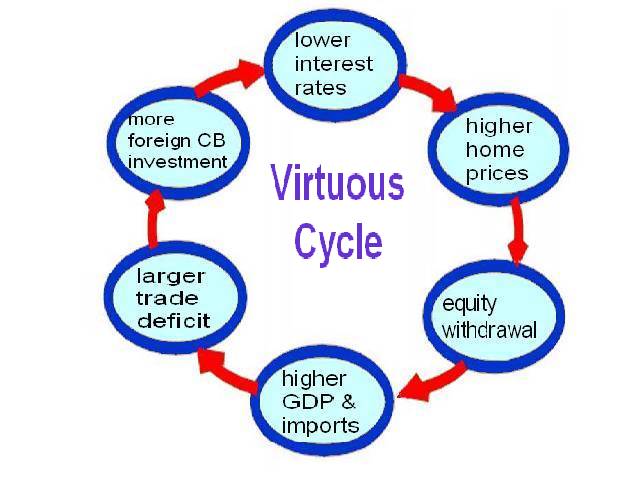
"Perhaps we have seen a Virtuous Cycle as depicted in the following diagram:
Virtuous Cycle Click on graph for larger image in new window.Starting from the top ... lower interest rates have led to an increase in housing prices. And those higher housing prices have led to an ever increasing equity withdrawal by homeowners. ... it is reasonable to assume that a large percentage of this equity withdrawal has flowed to consumption, increasing both GDP and imports over the last few years. ... it appears mortgage equity withdrawal has been a meaningful contributor to the ever widening trade and current account deficits.

To finance the current account deficit, foreign Central Banks (CBs) have been investing heavily in dollar denominated securities. Some analysts have suggested that these investments have lowered interest rates by between 40 bps and 200 bps (Roubini and Setser: "Will the Bretton Woods 2 Regime Unravel Soon? The Risk of a Hard Landing in 2005-2006")

If these analysts are correct, and foreign CB intervention is lowering treasury yields, then this has also lowered mortgage interest rates ... and the cycle repeats. The result: a Virtuous Cycle with higher housing prices, more consumption and lower interest rates.

As a result of the rapidly increasing housing prices, we are now seeing significant speculation, excessive leverage and poor credit quality of new homebuyers; all the signs of an overheated market. ... What happens if the housing market cools down? "

It's very informative, and there's a counterclockwise one as well called the Vicious cycle.

It's truly informative as to the what and why, but not the who. Here's my comment:

Don the libertarian Democrat
writes:

Are there any human agents in these cycles, or is this like a mechanism? At what point do individual human decisions pass over from possible to inevitable in this schema, or do humans even matter? Or only the movement of money and other financial products?

Friday, October 31, 2008

"in Baghdad, home prices have nearly doubled since last year. "

Freakonomics on the Iraqi housing boom:

"So who buys a luxury home in northern Iraq? Government officials, oil executives, wealthy Kurds from abroad. But the homes are selling slowly, and only time will tell whether the subdivisions of Erbil can avoid the fate of this Seattle subdivision, which the American housing crisis has turned into a ghost town."

Here's my comment:

I live in Tacoma, and I don’t even know where this place Stevenson is.

Anyway, I think that this is like the Bay Area where housing prices are down in S.F. and the hub area, but in outlying areas like the far suburbs and Central Valley, they’re way, way down.

So, I suppose, it depends on where Erbil fits into this map. Is it a hub, or an outlying area? Baghdad prices might remain pretty high even after a downturn.

— Posted by Don the libertarian Democrat

Saturday, October 11, 2008

Another Free Market Approach

Luigi Zingales with a free market approach. I like it, in the same way I liked Mankiw's plan and Randazzo's plan:

"
Tomorrow is too late

The United States (and possibly the world) is facing the biggest financial crisis since the Great Depression. There is a strong quest for the government to intervene to rescue us, but how? Thus far, the Treasury seems to have been following the advice of Wall Street, which consists in throwing public money at the problems. However, the cost is quickly escalating. If we do not stop, we will leave an unbearable burden of debt to our children.

Time has come for the Treasury secretary to listen to some economists. By understanding the causes of the current crisis, we can help solve it without relying on public money. Thus, I feel it is my duty as an economist to provide an alternative: a market-based solution, which does not waste public money and uses the force of the government only to speed up the restructuring. It may not be perfect, but it is a viable avenue that should be explored before acquiescing to the perceived inevitability of Paulson’s proposals."

You need to read the post which is quite detailed. Here's a part with a good explanation:

"Suppose that you bought a house in California in 2006. You paid $400,000 with only 5% down. Unfortunately, during the last two years the value of your house dropped by 30%; thus, you now find yourself with a mortgage worth $380,000 and a house worth $280,000. Even if you can afford your monthly payment (and you probably cannot), why should you struggle to pay the mortgage when walking away will save you $100,000, more than most people can save in a lifetime? However, when the homeowner walks away, the mortgage holder does not recover $280,000. The foreclosure process takes some time during which the house is not properly maintained and further deteriorates in value. The recovery rate in standard mortgage foreclosures (which will not take place in the middle of the worst crisis since the Great Depression) is 50 cents per dollar of the mortgage. I am generous in estimating that under the current conditions it might recover 50 cents per dollar of the appraised value of the house; right now, it is only 37 cents per dollar of the mortgage, which given a house appraised at $280,000 equals only $140,000 for the mortgage holder. In other words, foreclosing is costly for both the borrower and the lender. The mortgage holder gains only half of what is lost by the homeowners, due to what we economists call underinvestment: the failure to maintain the house."

Please read on.

My problem with these approaches is that they are simply not going to be considered. Nothing less than total government intervention is going to work this time, because of the assumptions that have been made prior to this crisis. Since, again, Zingales knows more than I do, I hope that I am wrong.