Showing posts with label Dungu. Show all posts

Sunday, June 14, 2009

they turned the celebrating village into a killing field

TO BE NOTED: From Enough:

Joseph Kony's Revenge in Faradje

Printer-friendly version
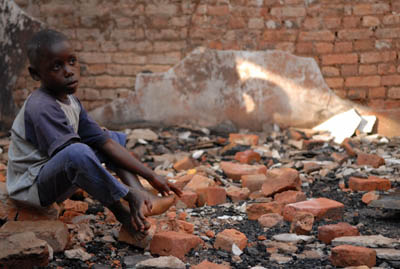
A boy sits in the ruins of a home destroyed by the Lord’s Resistance Army in Faradje, Congo. USHMM/Michael Graham

A team from the U.S. Holocaust Memorial Museum recently traveled to eastern Congo, where they collected testimonies from survivors of the ongoing conflict. In a powerful recent post on World Is Witness, Michael Graham profiled Joseph, a Congolese teenager who was abducted and enslaved for six months by the Lord’s Resistance Army. Joseph told Michael his story, which is described in this second post of a two-part series. Click here to read the first post.

The pilot dips the plane’s wing under the horizon as we circle Faradje to get a better look at the destruction below. Dozens of blackened huts line the road cutting its way across the forest from Dungu, empty circles scorched black inside.

It is at the Catholic Parish here in Faradje where I first meet Joseph, a 19 year old Congolese teenager captured by the Lord’s Resistance Army (LRA) near Dungu six months ago. He sits quietly across from me in a wooden chair and continues the story that began with him being captured and taken to Joseph Kony’s base in Garamba National Park. Today Joseph is free; the last time he was in Faradje was as a slave to the LRA, and an unwilling witness to the horrors that were brought to a quiet village on Christmas day.

In the aftermath of the operation against the LRA at their base in Garamba Park on December 14th, Kony ordered his soldiers to send a message to the world and the Congolese people, who he accused of supporting the attacks against him. The message was simple. If you want war, we will do it on our terms. We will bring it straight to the people.

A group of a hundred rebel soldiers and a dozen porters including Joseph marched east from the park until they came to the outskirts of Faradje. The rebels split up and fanned out, moving towards the center of town, burning homes and killing quietly as they went. They used machetes and clubs to save bullets and maintain the element of surprise. It was here on the outskirts they tried to kill Roger, a farmer and carpenter with dull scars on the top of his head, who described to me the moment he saw the LRA enter the village:

At about 4:00PM I was at my house and saw a column of soldiers splitting up into groups, one going on the road and the other arriving right behind my house. A soldier knocked on the door. I came out and said hello, asking them what they wanted.

He hit me in the head with wood from behind my house until they thought I was dead. A neighbor saved me, crying out “stop, you have already killed him!” They left after hitting my father and also leaving him for dead.

When the LRA arrived to the center of the town, while Joseph and the others were tied together under guard, they turned the celebrating village into a killing field.

Click here to continue reading.

To learn more about Joseph Kony's Lord's Resistance Army and find out how you can take part in helping to end the LRA's long and brutal reign, visit Enough's special page."

Friday, May 29, 2009

Following the introduction of the historic LRA Disarmament and Northern Uganda Recovery Act last week

TO BE NOTED: From Resolve Uganda:

"
Weekly Roundup for May 23-29: UN peacekeepers unable to prevent LRA attack on major Congolese town
Following the introduction of the historic LRA Disarmament and Northern Uganda Recovery Act last week, we're beginning to see unprecedented attention from US policymakers. In just the last few days, numerous Members of Congress have spoken out on the conflict and the need for increased leadership from the US to achieve peace. (If you're interested in finding out more, you can download the new brief we released this week that outlines what the bill does).

We've set a goal of raising $10,000 by the end of today to help keep this momentum going and to make sure this legislation gets passed.
If you can, will you take just a moment and donate $25 to help us meet our deadline?

Now onto the news....

The Good: The UN announced that the first of 3,000 troop reinforcements will arrive in the DR Congo as early as next month to boost the embattled peacekeeping force there.

The Bad: The LRA launched a
bold attack on the Congolese town of Dungu last weekend, just miles away from where a contingent of UN peacekeepers are stationed.

The Ugly: The Ugandan government continues to torture prisoners and undermine press freedom with impunity, according to a human rights report
issued this week by Amnesty International.

Regional Security


Situation in Northern Uganda

  • Decades of war and government neglect have left northern Uganda the most marginalized region of Uganda, according to research done by Uganda's Independent magazine. Northern Ugandans are woefully underrepresented at senior levels of the Ugandan government and have dramatically higher poverty levels and school drop-out rates than other parts of the country.
  • Amnesty International released a report highlighting the precarious state of human rights in Uganda, highlighting the Ugandan government's continued interference with press freedom, abuse of prisoners, and failure to prosecute violence against women and girls as a criminal offense.


International Response

  • Resolve Uganda Senior Policy Analyst Paul Ronan (yup, that's me) spoke yesterday to Voice of America about the LRA Disarmament and Northern Uganda Recovery Act and how its passing could spark unprecedented efforts by the US government to stop LRA violence and support sustainable peace in northern Uganda. (Click here to read our new brief about the legislation.)

Tuesday, February 17, 2009

have sought safety in South Sudan since attacks by the rebel Lord's Resistance Army (LRA) last year has now surpassed the 15,000 mark.

TO BE NOTED: You know it's bad when you're fleeing to Sudan:

"Influx of Congolese refugees into South Sudan continues

This is a summary of what was said by UNHCR spokesperson Ron Redmond – to whom quoted text may be attributed – at the press briefing, on 17 February 2009, at the Palais des Nations in Geneva.

The number of Congolese refugees who have sought safety in South Sudan since attacks by the rebel Lord's Resistance Army (LRA) last year has now surpassed the 15,000 mark.

UNHCR staff late last week accompanied local South Sudanese authorities to Lasu, a sparsely populated village in Central Equatoria State where they found the population of Congolese refugees had swelled from 2,000 to approximately 6,000. Most of them fled from the DRC town of Aba, which has been attacked several times since January, the latest last week. Lasu is 45 km from the border with the Democratic Republic of the Congo (DRC).

There had been fears of a mass influx of refugees from Aba after last week's LRA attack. Refugees interviewed in Lasu by our team confirmed that Aba, with an estimated population of 100,000, was deserted. Earlier reports of large numbers of displaced people moving towards Central Equatoria in South Sudan appear to have been unfounded and it is now believed they have moved to the south based on accounts from the new arrivals in Lasu.

Meanwhile, unconfirmed reports from local residents indicate that LRA are also active in South Sudan, looting property and abducting 21 people in the village of Neuf, 9 km from Lasu.

Our team reports that refugees in Lasu are generally in good health but are in need of emergency assistance. They are living in the open, with only one well to share with the local population and no food. There are a dozens of unaccompanied and separated children, separated from their parents during flight. Aid agencies are coordinating assistance, including the provision of clean water and the emergency construction of latrines to improve the sanitation situation. WFP is sending food from Juba today (Tuesday) and UNHCR began a verification of refugees on Saturday. The relief effort is also being supported by UNICEF (water and sanitation), and MSF-Belgium and MEDAIR (health care).

Meanwhile, in South Sudan's Western Equatoria State, the registered population of Congolese refugees who fled LRA attacks in the Dungu area of north-western DRC in January has reached 9,139. The majority are in Ezo (2,258) near the Sudan's border with the Central African Republic, while others temporarily settled around Yambio in Gangura (2,451), Sakure (910) and Yambio itself (1,813). An additional 1,707 are scattered in seven villages in Yambio and Maridi Counties near Sudan's border with DRC. UN agencies are collaborating with local authorities to provide security and assistance to these populations.

It is critical to move all of these refuges away from border areas both for security reasons and to facilitate distribution of aid. Access to the refugees will soon become impossible when the seasonal rains begin in April and roads become impassable. Work is underway in other camps away from the border. Demarcation of plots at Makpandu camp, north of Yambio, is completed and construction of shelters is ongoing alongside installation of water and latrines. About 400 of the planned 2,000 shelters are completed. The transfer of those who are willing to move began in mid-December, with more than 1,000 relocated to date.

Story date: 17 February 2009
UNHCR Briefing Notes

Monday, January 19, 2009

"hundreds of civilians were burned to death on Saturday by the Lord’s Resistance Army rebels. "

From Peter Eichstaedt:

"Death toll climbs

According to a story in the New Vision newspaper in Kampala, Uganda, hundreds of civilians were burned to death( PLEASE DON'T TELL ME THAT ) on Saturday by the Lord’s Resistance Army rebels.

The rebels set ablaze a church called Bima in the Democratic Republic of Congo at midnight as the faithful prayed, according to the New Vision. ( TOO CRUEL )

It is not yet known how many were in the church at the time, according to Radio Okapi, the UN's radio network in Congo. The rebels reportedly attacked others with axes and knives, slitting throats and crushing skulls.

The massacre occurred in the towns of Tora and Libombi, and two nearby mining communities located 130km from Dungu, the base of operations for the Ugandan military which is chasing the LRA.

According to the president of the civil society of Dungu, Felicien Balani: “The LRA entered around midnight. They surprised the faithful of the church who were in a prayer vigil. They burned them in the church,” said Balani.

The rebels also burnt several houses at the gold mine town of Tora. So far recorded are five deaths and six injured.

Civil society organisations working in Dungu said over 100 people had fled the area by yesterday.

“In Doruma, it was really awful. They had killed at least 300( 300 ) people. We were in a village where there are only six survivors, all the others were killed,” said Anneke Van Woudenberg, of Human Rights Watch.

“One of the few survivors, a 72-year-old man who arrived late for Christmas lunch, hid in the bushes and watched in horror as his wife, children and grandchildren were killed,” Woudenberg told New Vision.

After the massacre, the rebels “ate the Christmas feast the villagers had prepared, and then slept among the dead bodies before continuing on their trail of destruction and death” through another 12 villages.

Another 86 people were massacred in the most recent incidents.

Saturday, January 17, 2009

"People live in fear in the forest. Many of them are unable to move, as they fear that the LRA is going to attack them."

Although we see signs of peace in the Congo, the LRA is still on the loose. From the UNHCR:

A young girl injured in an attack on Duru village in Orientale province. © UNHCR/D.Nthengwe

Survivors of Lord's Resistance Army attacks urgently need assistance

DURU, Democratic Republic of the Congo, January 16 (UNHCR) – UNHCR members of a joint United Nations team expressed shock Friday at the physical condition of civilians who have survived repeated attacks in recent months by Ugandan rebels on their village in the northern Congolese province of Orientale.

The UN team flew by helicopter to Duru on Wednesday and reported that this once vibrant village was deserted and overgrown with vegetation after attacks by the Lord's Resistance Army (LRA).

First attacked by the LRA in September, Duru was again targeted by the rebel group earlier this week, leaving four people dead and the village a virtual ghost town. Back in September, the village had some 6,000 inhabitants. Now, less than 1,000 people remain.

Some of the survivors remaining in the vicinity came out of hiding to meet the visitors. They were traumatized and in urgent need of assistance. Many were clad in rags and looked famished and weak after spending nights in the bush without blankets or shelter. "We are hungry and we are poor," said one man. ( GOOD LORD )

The UN refugee agency field officers heard accounts of atrocities carried out by the LRA fighters when they raided Duru on Monday and Tuesday, killing four people, injuring an infant girl and abducting a nine-year-old boy. "I feel sad for my daughter," said the mother of the four-year-old shot in the leg. "She has lost her father," added the woman, who has two other children.

More than 560 ( 560 )civilians have been killed since the LRA began its campaign of violence last September in an area of Orientale province near the Democratic Republic of the Congo's borders with Uganda and South Sudan. This UNHCR estimate includes the victims of reported attacks this week on Duru and Diagbe, further to the north. More than 115,000 people are believed to have been forcibly displaced by the violence and the figure is likely to grow.

The villagers in Duru told UNHCR that the rebels looted and torched their houses, forcing residents to flee into the forest. Some of them made their way towards Dungu, a regional centre some 90 kilometres to the south where UNHCR has a team. Another 2,000 have crossed into Sudan.

The survivors seen in Duru told UNHCR that they did not feel safe, fearing new assaults, rape and abductions. There are no medical personnel in the village and no medicine. The villagers also said it was not safe to drink water from the wells. ( AWFUL )

Aid agencies face enormous logistical challenges reaching communities affected by the LRA attacks. Duru, for example, can only be reached by helicopter with a security escort of UN peace-keepers. Limited physical access, insecurity and impassable roads are hampering both the delivery and the distribution of relief supplies.

Aid is, however, coming to other parts of Dungu district. On Tuesday, a UN convoy carrying 70 tonnes of food and aid items provided by UN humanitarian agencies, including UNHCR, reached Dungu. The trucks spent 10 days on the road after picking up the World Food Programme and UNHCR aid in Goma, the capital of neighbouring North Kivu province.

In the coming days and weeks, the UN refugee agency and its partners hope to reach some 100,000 displaced people in locations such as Duru, Faradje, Doruma, Watsa and Isiro, which have not received any assistance since September. More joint missions are planned to threatened areas this weekend to assess the scale of the displacement and needs of the population.

By David Nthengwe
in Duru, Democratic Republic of the Congo

By Margarida Fawke
In Dungu, Democratic Republic of the Congo"

From Peter Eichstaedt:

"Condemnation, but no action( GREAT )

The United Nations Security Council has once again condemned the atrocities that are currently being committed by the Lord's Resistance Army.

On Friday, the UNSC issued a press statement, read aloud by the Council President Jean-Maurice Ripert of France, which chairs the council this month.

Here it is:

"The members of the Security Council strongly condemned the recent attacks carried out by the Lord's Resistance Army (LRA), which have resulted in over 500 dead and over 400 abducted, as well as the displacement of over 104,000 people. The members of the Council expressed their grave concern at the scale of these atrocities and emphasized that those responsible must be brought to justice.

"The members of the Security Council reiterated the statement of the President of the Security Council 22 December 2008. The members of the Council expressed their deep concern that the Council’s previous calls for the LRA to cease its attacks, and recruitment and use of children, and to release all women, children and non-combatants, have not been heeded.

"The members of the Security Council demanded that the members of the LRA cease all attacks on civilians immediately, and urged them to surrender, assemble, and disarm, as required by the Final Peace Agreement."

Does the world need yet another strongly worded statement? It seems that the LRA, and its leader Joseph Kony, the self-proclaimed prophet and spirit medium, has committed enough atrocities in the past twenty-two years( 22 YEARS ) to warrant more than grumbling from the UN's guiding council.( TOO TRUE )

The French like to present themselves as the bastion of "liberty, fraternity, and equality," but they're disinclined to do much to enforce those values. ( THEY DID A GREAT JOB IN RWANDA )

It's not as though France couldn't.

As I stated last week during a interview on BBC radio's The World Today show, putting an end to Kony and the LRA's endless rampages will take more than letting the Ugandan army wander around the jungles of northeastern Democratic Republic of the Congo.

It will take a well-trained and well-equipped force authorized by the UN and composed of international troops with the specific goal of capturing or killing Kony.

This is not without precedent. It's been done before in other African countries, including eastern DRC when the inept horde of UN peacekeepers there, which number an astounding 17,000 soldiers, were unable to keep the peace. The UN authorized a limited European Union force to enter the country, settle the situation, then pull out. It worked.

Such a force is sitting very close by. It's called European Force, or Eufor, and is about 5,000 EU troops, mostly French, who are in eastern Chad on the border with Sudan.( THEY'VE DONE A GREAT JOB HELPING OUT IN SUDAN )

They're positioned as a deterrent to any further invasions by the Sudan-backed rebels who attacked the Chad capital of Ndjamena last February. And, some speculate that the force may be there to help protect Chad's oil fields( YES. THEY'RE NOT THERE TO STOP GENOCIDE. BETWEEN RWANDA AND SUDAN, FRANCE DOESN'T HAVE A RECORD OF CARING ABOUT GENOCIDE. ), which are pumping out crude that is piped to the west coast of Africa via Cameroon.

But, there's not much for them do these days. Why can't the UN send them in for one-month mission? It's clear the Ugandan army needs help, as does South Sudan and the Central African Republic, where most say the LRA is headed.

The Sudan People Liberation Army (SPLA), which is South Sudan's army, has found dozens of body of people believed to be killed by the Ugandan Lord Resistance Army (LRA) after being abducted.

And, the BBC reports that rebels attacked a village in the DRC this week, killing four people, including a girl of four and abducting a boy of nine. A bishop in South Sudan says two men had their hands and legs chopped off and were beaten to death, as boys watched.

The BBC noted that the LRA now operates in at least four countries in the region, and that the CAR has sent troops to its border with DR Congo in an effort to push back the rebels.

The survivors of the LRA attacks told a UN agency that the rebels looted and torched their houses, forcing them to flee into the forest.

"What we saw was shocking," David Nthengwe, UNHCR spokesman for eastern DR Congo, told the BBC. "People live in fear in the forest. Many of them are unable to move, as they fear that the LRA is going to attack them."

Clearly the Ugandan army is not making much progress. Yet, the Eufor sits there in Chadian desert, just an hour away by air.( GOOD LUCK WAITING FOR THESE HUMANITARIANS )

Friday, January 16, 2009

"If this lasts another six months or a year, they'll start looking for better equipment, and we risk a Mai Mai phenomenon,"

From Stop The War In North Kivu:

"
OCHA humanitarian info on North Kivu In From the field on January 16, 2009 at 1:22 pm

I have just received a report from the Office for the Coordination of Humanitarian Affairs (OCHA) on the information meeting they hold this morning in Goma.

For anyone interested, all their information can be found here."

Let's check in on the Congo. From Reuters:


1 of 1Full Size

By Joe Bavier

DUNGU, Congo (Reuters) - Congolese villagers are forming self-defence groups to protect homes and families from Ugandan LRA rebels.( CAN YOU IMAGINE HAVING TO WORRY ABOUT THE LRA SHOWING UP IN YOUR NEIGHBORHOOD? )

LRA rebels have killed 567 people( 567 ) and displaced 115,000 in northeast Democratic Republic of Congo's Oriental province since September, U.N. refugee agency UNHCR says. Attacks surged after Ugandan forces spearheaded an anti-LRA offensive in December.

In silence broken only by the buzz of insects and the crunch of earth under their plastic sandals, eight men file through the cool night, hunting rifles in hand, scanning the darkness for those who killed their neighbours and burned their homes.

Elsewhere in the areas surrounding the town of Dungu, dozens more like them stalk the forest, mostly farmers and internal refugees armed with locally made guns or bows and arrows.

"This is very necessary for me, first and foremost, for the town, and for the people who are suffering in the bush, who have done nothing and who are dying," said Pascal Kalemba, the bottom half of his boyish face hidden by an airline sleeping mask.

Lord's Resistance Army rebel fighters attacked Dungu in September, as efforts to negotiate a peace deal to end their two-decade bush war against the Ugandan government broke down.

"They just walked straight into town. They started to burn houses and kill people," Kalemba said.

At the time, not a single Congolese soldier was deployed in the town of 57,000 inhabitants, located near Garamba National Park, the LRA's stronghold since it fled to Congo in 2005.

On December 14, a Ugandan-led multinational force, including Congolese and South Sudanese soldiers, launched an offensive aiming to capture the rebels' reclusive leader Joseph Kony.

Instead, the operation splintered the rebels into smaller groups that are now attacking villages, slaughtering civilians, raping women and kidnapping children for use as sex slaves and child soldiers. The U.N. death toll may be conservative.( UNREAL )

New York-based Human Rights Watch says three days of raids alone, starting on Christmas Day, killed at least 600 people. Most were beaten to death with clubs or hacked with machetes.

ARMY "RUNS AWAY"

The head of Dungu's self-defence force, former chief Etienne Dalafata, said despite the deployment of over 3,500 government troops to the area, villages must defend themselves.

"We've already gone on operations with the army, but when we go into the bush they get scared and run away. They are city soldiers," he said.

Dalafata said his force enjoys the town's support and that militias have sprung up across Congo's northern borderlands.

All of this worries Felicien Balani, president of Dungu's local civil society association.

"Our army must make them unnecessary. They find their justification in its ineffectiveness. If this lasts another six months or a year, they'll start looking for better equipment, and we risk a Mai Mai phenomenon," he said.

Mai Mai ethnic militias sprang up across eastern Congo in the 1990s during invasions by Rwanda and proxy rebel groups.

Like Dalafata's men, the Mai Mai initially said they took up arms to protect their communities. But they became notorious for bloody massacres of civilians, rape, and ritual cannibalism.( PLEASE NOT AGAIN )

Since September, the Dungu militia has taken just three LRA prisoners from a number of clashes with the Ugandan rebels.

All, they said, were turned over to the army.

But this week a self-defence patrol in Nzope village on the eastern edge of Garamba caught two LRA suspects. It mutilated and killed one before handing the other over to the authorities.

In Dungu, Kalemba said he feels no hatred for these latest invaders. He simply wants them to go home.

"Why are they persecuting us? Why?" he said.

"If it comes to a battle, we will die together."

I truly believe that indifference allows this to happen. Shame on us! Including me.

Wednesday, January 14, 2009

"Another 408 people have been kidnapped by the LRA since the outbreak of violence in September last year"

From the UNHCR:

"UNHCR concerned about displaced Congolese and continuing LRA attacks


DUNGU, Democratic Republic of the Congo, January 13 (UNHCR) – The UN refugee agency on Tuesday expressed mounting concern about the plight of more than 100,000 Congolese civilians force to flee their homes to escape attacks by a rebel Ugandan force in the northern province of Orientale.

"We are increasingly concerned about the humanitarian situation and continuing attacks by ... the Lord's Resistance Army (LRA)," said UNHCR spokesman Ron Redmond, adding that the death toll in the Democratic Republic of the Congo (DRC) province bordering Uganda and South Sudan is now estimated at 537 people.

"Another 408 people have been kidnapped by the LRA since the outbreak of violence in September last year, including victims abducted in attacks over the past four days," said the spokesman, citing figures gathered by UNHCR staff in the town of Dungu.

Rough estimates of the number of forcibly displaced in this part of the DRC have now surpassed 104,000. Many of these internally displaced people (IDP) are still hiding in the bush, particularly in areas around the town of Faradje, which was heavily hit during the Christmas period. Out of an estimated 37,000 people who escaped from Faradje, some 16,000 have been registered so far in Tadu and surrounding villages south of Faradje. More than 10,000 of them are children.

In the Dungu area, which was attacked by the LRA last September, the local Red Cross has just completed the registration of displaced in the town and 27 nearby villages. Out of 54,777 IDPs registered, more than 27,000 are women and nearly 15,000 are children under the age of five.

The Congolese, Sudanese and Ugandan armed forces began a joint military operation against the LRA in mid-December.

The latest series of LRA attacks targeted villages and settlements south-west of Faradje. The village of Tomati, 57 kilometres south-west of Faradje, was reduced to ashes on Saturday. LRA attacks Friday and Sunday on Sambia, a mining village some 75 km from Faradje, left at least seven people dead.

"Throughout the region, sightings of LRA rebels are causing panic and new displacement. Our staff in Dungu reported this morning that there are considerable, ongoing population movements in the direction of Faradje and areas south of Dungu. In addition, 2,000 people have reportedly arrived in Ezo in neighbouring South Sudan," the spokesman said.

The UN refugee agency is extremely concerned about civilians who are caught in a conflict zone near the borders of the DRC, the Central African Republic and Sudan. According to local health authorities, the population in the Doruma area is about 56,000 people. In the Faradje district, also the scene of frequent clashes over the past few weeks, there are some 350,000 residents.

The displaced population is in dire need of food, shelter, medicine, clothes and other aid items. The area, which by itself poses immense logistical challenges due to the lack of decent roads, remains highly volatile. Safe humanitarian access remains a key challenge for UNHCR and other agencies as they strive to bring assistance.

By Margarida Fawke
In Dungu, Democratic Republic of the Congo"

Add this to the previous post, and you have some idea how bad things are getting in an already dismal situation.