Showing posts with label Freakonomics. Show all posts

Monday, May 11, 2009

opposition voters in Venezuela paid a price for their opposition

TO BE NOTED: From the NY Times:


By Freakonomics May 11, 2009, 9:40 am

The Cost of Opposing Hugo Chávez

An important new working paper by Chang-Tai Hsieh, Edward Miguel, Daniel Ortega, and Francisco Rodríguez examines whether Hugo Chávez opposition voters in Venezuela paid a price for their opposition. Between late 2002 and August 2004, more than 4.7 million Venezuelans signed petitions in favor of a recall election for Chavez despite widespread threats that signers would be punished. After Chavez’s victory in the August 2004 recall election, a list of supporters of the final petition was distributed throughout the public sector in a simple software package. Using data from household surveys, the authors determine that opposition voters experienced a 5 percent drop in earnings and a 1.5 percent drop in employment rates after their names were released. The authors also conclude that the retaliatory measures may have cost Venezuela up to 3 percent of G.D.P. due to misallocation of workers across jobs. (HT: Marginal Revolution)"

Saturday, April 18, 2009

I don’t agree with her that aid is useless

TO BE NOTED: From The Bottom Billion Blog:

"
Freakonomics: Paul Collier answers reader questions

The New York Times ‘Freakonomics’ blog has a Q&A with Paul around African Development Issues. Read the full article here.

What activities/goods/services are cheap in the first world but expensive in Africa, and why? Please answer this question from both a consumer’s perspective and from a business owner’s perspective.
William Cross

Answer

Anything that is imported because of tariffs and monopoly distribution channels. Many services are badly organized such as retail distribution. On the other hand, some e-services are very good value in Africa.

Question

What impact will the current recession have on the poorest/bottom billion? What policy intervention by Western/poor-country governments would make a significant difference and is realistic to expect?
Rachel Eden

Answer

Recession: very different transmission channels, remittances down hit ordinary households, and the drop in commodity prices hits government revenues. But it is not all doom and gloom; Africa will still grow, unlike the U.S. and the U.K.

Policy intervention: a really easy one would be to require our banks, plus the tax-haven banks, to be as transparent about corrupt money deposited in them as about money linked to terrorism.

Question

What do you think of Dambisa Moyo’s argument that foreign aid to Africa should be reduced because it engenders dependency and undermines entrepreneurship? — Frank

Answer

Dambisa was my student, and I am delighted that young Africans are no longer prepared to have their continent defined by victimhood. They recognize that Africans can shape their own future. However, I don’t agree with her that aid is useless. Especially with the drying up of private finance, now is the hour for public international money; it is needed. It is, however, often badly used.

Question

As an American citizen, what actions can I take to improve conditions for the bottom billion? Is there federal legislation I can advocate for or a charity I can donate to? — Kathleen Lisson

Answer

Legislation: extend the Africa Growth and Opportunity Act. Charities: Kiva and lots of exciting social enterprise. WorldVision is pretty sensible in my experience."


By Stephen J. Dubner March 24, 2009, 11:25 am

Bring Your Questions for “Bottom Billion” Economist Paul Collier

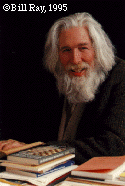
INSERT DESCRIPTIONPaul Collier

Paul Collier, an award-winning Oxford University economist, is a self-described Africanist who researches the effects of civil war, aid, and the “problems of democracy” in societies that have lots of resources but low incomes.

He is so far best known as the author of The Bottom Billion; his latest book, Wars, Guns, and Votes, has just been published. And he blogs here.

Both of Collier’s parents left school when they were 12, and his father ran a small shop that kept the family “just about afloat,” Collier recalls. “His frustration at limited opportunities has, for me, been the spur to working on Africa. I do not see Africa as romantically different — some magical ‘other.’ I see it as a place where millions of ordinary people are not able to realize their potential and, like my father, lead frustrating lives.”

In just the past two years, Collier has been senior adviser to Tony Blair’s Commission for Africa, addressed the General Assembly of the U.N., and met with Condoleezza Rice on her U.K. visit. He has also completed the first external review of I.M.F. operations for the board of the I.M.F.

Collier is a good person to ask about development economics, poverty, population growth, and just about anything else you can think of in that realm. So fire away in the comments section below. As with past Q&A’s, we will post his answers here in a few days."

Wednesday, April 15, 2009

our huge budget deficits, which have greatly added to the costs and the inflation risk of the immense federal expenditures on recovery

TO BE NOTED: From the NY Times:


By Dwyer Gunn April 14, 2009, 11:01 am

A “Spasmodic, Improvisational Response”: Richard Posner Tackles the New Depression

Please welcome to our corps of in-house bloggers Dwyer Gunn, a young writer who has studied economics at Wellesley, worked in finance, and been a research assistant at the Becker Center on Chicago Price Theory.

“The biggest economic crisis since the Great Depression,” as described by Richard Posner, began in December of 2007 amidst plunging housing prices and reached its climax in September of 2008 as Lehman Brothers filed for bankruptcy, Fannie Mae and Freddie Mac were placed into conservatorship, and American International Group (A.I.G.) received a government bailout. Throughout the crisis, people all over the country have struggled to understand the causes of the meltdown and the complicated policies the government is pursuing to restore the economy to health.

In his new book A Failure of Capitalism: The Crisis of 2008 and the Descent into Depression, Richard Posner provides a definitive primer on the subject suitable for experts and amateurs alike. He analyzes the underlying causes of the crisis, the government’s policy responses so far, and offers some thoughts on the future of our financial system. Along the way, Posner also explains why he believes the crisis is indeed a depression, disputes the popular idea that investors and banks who bet on rising housing prices were behaving irrationally, and points out the (small) silver lining to the crisis.

Posner is a judge of the United States Court of Appeals for the Seventh Circuit and a senior lecturer at the University of Chicago Law School. He has written a number of books, blogs regularly with Gary Becker, and will soon blog weekly on the financial crisis at a blog called A Failure of Capitalism at TheAtlantic.com.

We mentioned Posner’s new book earlier, and now he has agreed to answer some of our questions about it and the financial crisis.

Question

What caused the financial crisis? Was it the government’s fault?

Answer

The government was the facilitator of the crisis, in the following sense. Banking (broadly defined to include all financial intermediation) is inherently risky because it involves borrowing most of one’s capital and then lending it, and the only way to create a spread that will pay the bank’s expenses and provide a return to its owners is to take more risk lending than borrowing — for example, borrowing short (short-term interest rates are low, because the lender has little risk and great liquidity) and lending long (so the lender has greater risk and less liquidity). The riskiness of banking can be reduced by regulation. But as a result of a deregulation movement that began in the 1970’s, the industry was largely deregulated by 2000. Then the Federal Reserve mistakenly pushed down and kept down interest rates, which led to a housing bubble (because houses are bought with debt) and in turn to risky mortgage lending (because mortgages are long term and there is a nontrivial risk of default); and when the bubble burst, it carried the banking industry down with it. The effect on the nonfinancial economy was magnified by the fact that Americans had little in the way of precautionary savings built up. Their savings were concentrated in risky assets like houses and common stock. When the value of those savings fell steeply, people’s savings were inadequate, so they curtailed their personal consumption expenditures, precipitating a fall in production and sales, a rise in unemployment (which made the still-employed want to save even more of their income, lest they lose their jobs too), and, in short, the downward spiral we’re still in.

The banking collapse occurred last September. The government’s unpreparedness (for which Greenspan and Bernanke, successive chairmen of the Federal Reserve, and academic economists bear a large part of the responsibility because of their failure to spot the housing and credit bubbles and their mistaken belief that a depression, as distinct from a mild recession, could never again happen in the United States) and its resulting spasmodic, improvisational responses allowed the crisis to deepen, precipitating the depression we’re now in. Contributing factors, besides the dearth of “safe” savings, were our huge budget deficits, which have greatly added to the costs and the inflation risk of the immense federal expenditures on recovery. Indeed, it is those costs and that risk that justify calling the present downturn a depression rather than just a recession; for the costs of a depression/recession include not only the loss in output and employment during the depression period, but also include the costs of recovery.

Question

In your book, you dispute the notion that irrational behavior by market participants is to blame for this crisis. Can you explain how rational behavior could result in such a painful outcome?

Answer

Business firms attempt to maximize profits within the constraints set by regulation (including the Federal Reserve’s monetary policies, which strongly influence interest rates). We want them to do that, as it is the key to an efficient allocation of resources. Part of maximizing profits, however, is taking a certain risk of bankruptcy; it does not pay for a firm to reduce that cost to zero. Banking occupies a strategic role in the economy because of the importance of credit to economic activity; borrowing to spend increases consumption — it is how we shift consumption from future to present.

Moreover, banking is the main instrument by which the Federal Reserve creates money, and by doing so reduces interest rates (provided inflation is not anticipated; for if it is, long-term interest rates will rise), which in turn spurs economic activity. By buying government bonds, it pours cash into banks, both directly, when it buys the bonds from banks, and indirectly, when it buys the bonds from private owners but the owners deposit the cash they receive from the purchase into their bank accounts.

When banks start to hoard cash because their solvency is impaired, the money they receive from the Federal Reserve’s purchasing activity does not spread into the rest of the economy. That is why a cascade of bank bankruptcies is far more serious than a cascade of, say, airline bankruptcies. But a rational businessman does not, indeed cannot afford to, consider the cost of bankruptcy to the economy as a whole as distinct from the cost to his firm. So the rational banker will take more risk than is optimal from an economy-wide standpoint. That is the logic of profit maximization, as explained long ago by Adam Smith: the businessman cares about his costs and his revenues, but not about the costs and revenues incurred or received elsewhere in the economy. He is not an altruist. The responsibility for preventing the collapse of the banking system is the government’s, and it has been shirked, with extremely serious consequences.

Question

There is some debate among economists about the role securitization played in the recession. Do you think securitization is to blame?

Answer

It was a factor, perhaps mainly because it brought a lot of foreign capital into the U.S. housing market. Foreign investors would not want to deal directly with American homebuyers, but they were happy to buy the triple-A-rated tranches (slices) of securitized debt, for that was the equivalent of buying bonds. The flood of foreign capital not only reinforced the Federal Reserve’s unsound policy of depressing interest rates, but also spread the housing bubble and the eventual consequences for bank solvency to the rest of the world. The result was to make the depression worldwide, which, incidentally, reduced American exports, which has contributed to the fall of U.S. output and the rise in unemployment.

Question

What is the Federal Reserve trying to accomplish with its quantitative easing program?

Answer

The term refers to buying bonds and other debt instruments other than short-term Treasury bonds.

Generally the Fed influences interest rates by buying and selling short-term Treasury bonds; if it buys, it puts cash into the banks, as I explained earlier, and if it sells, it pulls cash out. In the first case, the supply of money expands, and in the second it contracts. Although the interest rates directly affected are short term, there is an indirect effect, in the same direction, on long-term rates. The reason is that the lower the interest rate at which banks can borrow money, the lower the competitive interest rate at which they lend the money; and this will stimulate borrowing and hence economic activity. But if banks don’t want to lend — because their solvency is impaired and because the risk of lending rises in a depression and the demand to borrow falls — they will sit on any new cash they receive rather than lend it. This is true even if the short-term interest rate falls to zero. The Fed’s hope is that by buying other forms of debt it will encourage lending, not only because it will be pumping more money into the economy, but also because, to the extent that its purchases are of debt that pays higher interest rates than short-term Treasury securities, their incentive to lend will increase because they will want to replace that interest. For example, if the Fed buys credit-card debt that pays 10 percent interest, the lender from whom it has bought that debt may decide to issue additional credit-card credit with the cash it receives in order to preserve its stream of income.

Question

Do you believe the government’s new public-private partnership to purchase toxic assets will be successful in healing the major banks?

Answer

It is too early to tell. It depends on how much of that overvalued bank capital is bought, and at what prices. The program is very complex and many of its details have not been worked out. Some buyers will be deterred by fear that receiving federal subsidy (it is essentially a program of subsidizing, albeit indirectly, the purchase of these assets) invites intrusive regulation by the Treasury and denunciation by demagogic legislators. There is also some doubt as to how many banks will want to sell these assets at the prices offered, because the sales prices may reveal how little the assets are worth and therefore how undercapitalized the banks are, which would invite further regulation. Probably, the government can coerce the banks to play ball. But the effect on lending is indirect — having a healthier-looking balance sheet does not compel a bank to lend — and will be small if few private investors can be induced to buy, and the banks to sell, the overvalued bank assets.

Question

Is there any “silver lining” to this crisis?

Answer

Yes, the silver lining is primarily the fact that the longer the housing and credit bubbles had been allowed to expand, the worse the consequences of the eventual crash would have been. Had the Federal Reserve raised interest rates sharply in 2004, the housing bubble would have burst before house prices had reached the heights they did — heights from which they fell such a long distance that they caused a catastrophic fall in the value of mortgages, which was the fall that precipitated the banking collapse. In addition, the personal savings rate, and the preference for safe savings over risky assets like stock and housing, will now rise; and while that will retard recovery from the depression, once we do recover, if the greater propensity for saving persists, it will make it easier for the nation to finance the support of the elderly out of private savings without need to keep increasing the amount of the national income that goes to public support of the elderly mainly through the Social Security and Medicare programs.

Question

You’ve titled your book A Failure of Capitalism, and the U.S. and other governments are considering new regulations on banks, hedge funds, and certain financial instruments. What do you think the future looks like for our capitalist financial system?

Answer

There will be more regulation of financial institutions, and that is probably a good thing, though most of the goals of tighter regulation could probably be achieved just by more assiduous enforcement of existing regulations; regulatory laxity was a particularly marked characteristic of the Bush administration’s economic philosophy. The United States was capitalistic when banks were tightly regulated, and it will still be capitalistic if they are again tightly regulated. My fear is that the rush to re-regulate will produce more than the usual quota of dumb regulations. Since there is not going to be another housing and credit bubble in the next year, I would urge that the proposal of new regulations be deferred for a year, to provide time for a calm and thorough appraisal of the regulatory options.

Particularly in need of sober second thought is the popular idea of a “systemic” regulator — a regulatory body charged with preventing the financial industry from taking risks that could precipitate another financial crisis similar to the current one. Such a body would be excessively powerful and would be prone to overregulate because its only responsibility would be to prevent a crisis. In contrast, the Federal Reserve has the dual missions of maintaining price stability and employment; having to balance the two goals encourages sensible tradeoffs, although the Federal Reserve’s recent history in making these tradeoffs is not encouraging. But at least it has to worry that if it pushes interest rates too low it will create excessive inflation (in fact its interest-rate policies in the early 2000’s created asset-price inflation rather than the more common CPI or WPI inflation, but that was just as bad or worse), while if it pushes them too high it will create excessive unemployment by curtailing current economic activity too much."

Monday, February 16, 2009

It is time to take strong capitalist action — and that requires wiping out the existing owners of the insolvent banks

From Freakonomics:

"
Time for the Government to Stop Subsidizing Shareholders of Insolvent Banks

That is what Andrew Rosenfield argues for in this extremely cogently argued piece, and I agree with him. He makes a number of points about the bailout that I hadn’t heard before.

Rosenfield ends the article with the following sage words:

The present practice of subsidizing shareholders and debt holders of large insolvent bank holding companies is unprecedented, improper, and unwise. It is time to take strong capitalist action — and that requires wiping out the existing owners of the insolvent banks and giving the system much needed new equity capital, which, at this time, can come only from the government.

Me:

The only real moral hazard the banks and shareholders fear is nationalization. As well, the current arrangement merely continues the relationship between the financial sector and government that got us into this mess. Since that’s what’s been going on since September, I’m a little worried that people are just figuring this out. It indicates a serious misunderstanding of how our system works.

— Don the libertarian Democrat

Sunday, January 11, 2009

our fear circuitry kicks in and panic ensues, a flight-to-safety leading to a market crash. This is where we are today.

From Freakonomics:

"
This Is Your Brain on Prosperity: Andrew Lo on Fear, Greed, and Crisis Management
INSERT DESCRIPTIONAndrew Lo


Andrew W. Lo
is the Harris & Harris Group Professor at M.I.T. and director of its Laboratory for Financial Engineering. (Here are some of his papers.)

To my mind, he’s one of the most fluent guides to the state of modern finance in that he combines the rigors of a quant with a behavioralist’s appreciation for human intricacy( HUMAN AGENCY EXPLANATION ). He has agreed to write a guest post here (hopefully not his last — please encourage him!), an insightful look at how “extended periods of prosperity act as an anesthetic in the human brain,” lulling everyone involved into “a drug-induced stupor that causes us to take risks that we know we should avoid( WISHFUL THINKING ).”


Fear, Greed, and Crisis Management: A Neuroscientific Perspective
By Andrew W. Lo
A Guest Post

The alleged fraud perpetrated by Bernard Madoff is a timely and powerful microcosm of the current economic crisis, and it underscores the origin of all financial bubbles and busts: fear and greed( TRUE ).

Using techniques such as magnetic resonance imaging, neuroscientists have documented the fact that monetary gain stimulates the same reward circuitry as cocaine — in both cases, dopamine is released into the nucleus accumbens. Similarly, the threat of financial loss activates the same fight-or-flight circuitry as physical attacks, releasing adrenaline and cortisol into the bloodstream, which results in elevated heart rate, blood pressure, and alertness.( OK )

These reactions are hardwired into human physiology, and while some of us are able to overcome our biology through education, experience, or genetic good luck, the vast majority of the human population is driven( INFLUENCED ) by these “animal spirits” that John Maynard Keynes identified over 70 years ago.

From this neuroscientific perspective, it is not surprising that there have been 17 banking-related national crises around the globe since 1974, the majority of which were preceded by periods of rising real-estate and stock prices, large capital inflows, and financial liberalization. Extended periods of prosperity act as an anesthetic in the human brain, lulling investors, business leaders, and policymakers into a state of complacency, a drug-induced stupor that causes us to take risks that we know we should avoid( I AGREE THAT WISHFUL THINKING IS VERY IMPORTANT. HOWEVER, THOSE RISKS TAKEN INCLUDE CRIME, AND THE COMPLACENCY INCLUDES GOVERNMENT GUARANTEES AND EFFECTIVENESS. ).

In the case of Madoff, seasoned investors were apparently sucked into the alleged fraud despite their better judgment because they found his returns too tempting to pass up. In the case of subprime mortgages, homeowners who knew they could not afford certain homes proceeded nonetheless, because the prospects of living large and benefiting from home-price appreciation were too tempting to pass up. And investors in mortgage-backed securities, who knew that the AAA ratings were too optimistic given the riskiness of the underlying collateral, purchased these securities anyway because they found the promised yields and past returns too tempting to pass up.( SOME OF THIS IS CRIMINAL OR NEGLIGENT BEHAVIOR. )

If we add to these temptations a period of financial gain that anesthetizes the general population — including C.E.O.’s, chief risk officers, investors, and regulators — it is easy to see how tulip bulbs, internet stocks, gold, real estate, and fraudulent hedge funds could develop into bubbles. Such gains are unsustainable, and once the losses start mounting, our fear circuitry kicks in and panic ensues( I AGREE ), a flight-to-safety leading to a market crash. This is where we are today.( I AGREE COMPLETELY )

Like hurricanes, financial crises are a force of nature that cannot be legislated away, but we can greatly reduce the damage they do with proper preparation.( I DISAGREE. GOVERNMENT GUARANTEES AND BAGEHOT'S PRINCIPLES CAN RID US OF THIS PESTILENCE. )

Because the most potent form of fear is fear of the unknown, the most effective way to combat the current crisis is with transparency and education. In the short run, one way to achieve transparency is for our president-elect to convene a “crisis summit” once in office, in which all the major stakeholders involved in this crisis, and their most knowledgeable subordinates, are invited to an undisclosed location for an intensive week-long conference( NO ).

During this meeting, detailed information about exposures to “toxic assets,” concentrations of risky counterparty relationships, and other systemic weaknesses will be provided on a confidential basis to regulators and policymakers, and various courses of action can be proposed and debated in real time( NO. COLLUSION CENTRAL. ). Afterward, a redacted( YES. OF MEANING. ) summary of this meeting should be provided to the public by the president, along with a specific plan for addressing the major issues identified during the conference. This process would go a long way toward calming the public’s fears and restoring the trust and confidence that are essential to normal economic activity.( NO. GOVERNMENT GUARANTEES WILL. JAWBONING IS OF LIMITED, ALTHOUGH SOME, USE. )

In the long run, more transparency into the “shadow banking” system; more education for investors, policymakers, and business leaders; and more behaviorally oriented regulation( FINALLY. YES. ) will allow us to weather any type of financial crisis( I AGREE ). Regulation enables us to restrain our behavior during periods when we know we will misbehave; it is most useful during periods of collective fear or greed and should be designed accordingly( YES ). Corporate governance should also be revisited from this perspective; if we truly value naysayers during periods of corporate excess, then we should institute management changes to protect and reward their independence.( HOW ABOUT THEIR EFFECTIVENESS.)

If “crisis is a terrible thing to waste,” as some have argued, then we have a short window of opportunity — before economic recovery begins to weaken our resolve — to reform our regulatory infrastructure for the better. The fact that time heals all wounds may be good for our mental health, but it may not help maintain our economic wealth."
I disagree. Poor regulation and legislation result in a crisis. However hard and counterintuitive it is, we must address these issues in calmer times. This is no harder for a human to do than value investing.

Sunday, November 23, 2008

"whether the New Deal and World War II are good examples of Keynesian stimuli."

He sounds like a Wodehouse character, but Freakonomics vouches for his credentials:

"Economic historian Price Fishback, who recently guest blogged about the original Home Owners’ Loan Corporation, is back for an encore. This time, he tackles the issue of whether the New Deal and World War II are good examples of Keynesian stimuli.

I always thought they were; but using data, Fishback makes a simple and compelling case that they are not.

I learned a lot from his piece, and I suspect many of you will as well. In my opinion, this sort of writing is exactly what academic economists should be doing to help shape the public debate."

Where's it being held?

"What Do the New Deal and World War II Tell Us About the Prospects for a Stimulus Package?
By Price Fishback
A Guest Post

Everybody is talking about the stimulus package, and many are citing the New Deal and World War II as classic examples of successful stimulus programs. In punditry history, the federal government spent large amounts of money on works projects in the 1930’s and munitions in the 1940’s, and these were important stimuli to the American economy. Readers should beware, because the history is more complicated than the two-line descriptions."

Readers should also beware of long winded descriptions. They often signal that the author doesn't know what they're talking about.

"The New Deal

Federal spending rose from 4 percent to 8 percent of G.D.P. during the New Deal in the largest peacetime expansion in federal outlays in U.S. history. Yet this was not an example of Keynesian stimulus to the economy. Economists and economic historians have known this for the past 70 years, yet the myth lives on. The accompanying chart, which measures everything in real 1958 dollars for the 1930’s, shows why. The definitive analysis is more complicated, but the figure is a good shorthand way to show this.

INSERT DESCRIPTION

The chart shows federal-government outlays, the budget deficit, and the difference between G.N.P. in that year and G.N.P. in 1929. The problem to be resolved was to reduce the huge gap in annual real G.N.P., which had fallen 33 percent below the 1929 level.

The graph shows that federal spending comes nowhere close to replacing that gap. Once we take into account the taxation during the 1930’s, we can see that the budget deficits of the 1930’s and one balanced budget were tiny relative to the size of the problem."

I love graphs. He's right. Nowhere close.

"John Maynard Keynes published an open letter to Franklin Roosevelt in major American newspapers saying more spending was not enough; the government needed to run larger deficits. As Keynes’s arguments were fleshed out after the 1930’s, various scholars ranging from Abba Lerner to E. Cary Brown to Claude Pepper have re-examined the New Deal budgets. They all agree that the New Deal cannot be described as a Keynesian stimulus program. We can only hope that the word will finally spread widely enough now to correct the myth."

Excuse me, there are still people who don't even know who shot Liberty Valence. So, it wasn't big enough to be called a Keynesian stimulus program. How about a John Mayn stimulus program?

"If not Keynesian policy, what was the New Deal? It was a broad-ranging mix of spending, regulation, lending, taxation, and monetary policies that can best be described as “See a problem and try to fix it.” In many situations the fix for one problem exacerbated other problems."

Brilliant. You've discovered government action in the real world. I commend you. Most people can't seem to find it.

"As people invoke the W.P.A. and F.E.R.A. work relief projects as templates for modern stimulus programs, they do not really understand how they worked.

While it’s true that the F.E.R.A. and W.P.A. built many roads, buildings, and public works, they were designed as “relief” programs with work requirements. The goal was to help families reach a minimum level of income, and the average payment per hour on these programs was roughly 40 percent of the wage being paid on the non-relief public works projects described below.

The pay was so low because the unemployment rates between 1933 and 1939 ranged between 14 percent and 25 percent, Roosevelt was trying to keep budget deficits in check, and the administration was trying to help as many people as possible reach a basic standard of living.

This focus on providing a basic standard of living contributed to an improved situation on several socio-economic dimensions. Recent studies of the relief programs in the largest cities suggest that spending an additional $2.5 million in year-2008 dollars (about $200,000 in 1935) on relief was associated with a reduction of 1 infant death, 1 suicide, 2.5 deaths from infectious and parasitic diseases, 1 death from diarrhea, and 21 property crimes.

Despite this success, my sense is that most people are not interested in recreating a system where people are paid such low wages to contribute to building public works for the rest of the society. The modern social-insurance structures of unemployment insurance and a wide variety of health, nutrition, and welfare programs are already in place to help resolve these types of problems."

I sure don't. Can I ask if you could document some of these people you're talking about? That's got to be easier than figuring out the Depression.

"The New Deal programs that better fit what the stimulus proponents have in mind are less well known and include the Public Works Administration (P.W.A.), the Public Roads Administration (P.R.A.), and the Public Buildings Administration (P.B.A.). There was also the Civil Works Administration (C.W.A.) that paid full wages but ran as a relief program employing 4 million people during four months of the winter of 1933/1934.

These programs built dams, sewers, bridges, roads, and buildings, as did the W.P.A. and F.E.R.A. The difference was that the programs contracted with private contractors, who then hired workers at the typical wages paid in the construction industry.

How successful were they at stimulating the economy? As yet, the only estimates we have are for the combined effects of the public works and relief programs. Studies that examine their success at the county level suggest that an additional grant dollar per person distributed to a county for public works and relief during the period of 1933 to 1939 contributed to a rise in in-migration and an increase in income per person in the county of about 80 cents in 1939. We should remember, however, that this was during a period when there were huge numbers of unemployed workers available for work. Even during this period, some studies find evidence of crowding out of private employment. Today, with unemployment rates below 7 percent, it is likely that such public-works spending would crowd out a significant amount of private construction."

As yet. What are we waiting for? Androids to help us?

"My own recommendation would be to evaluate the modern public-works programs more on the basis of the specific productivity of the programs rather than as stimuli to the economy. We know that we have an aging infrastructure of roads, bridges, and dams. The costs and benefits of the replacements would be my focus in evaluating whether to spend the money or not."

Sorry for being a smartass. It turns out I agree with you.

"One sign that Keynesian budget deficits were not the key to bringing the U.S. out of the Great Depression is what happened after the war. Every Keynesian predicted that the private economy would go into a recession because the large government budget deficits would be eliminated and so many men would be returning from the war jobless. Instead, as government deficits receded, private consumption and investment boomed. Resources were no longer allocated to producing munitions and instead were devoted to production of typical consumer goods and services.

Some people might misconstrue this discussion as saying that the U.S. should not have fought the war. The point here is that World War II was a period of sacrifice when many Americans experienced deprivation on par with what they experienced in the latter stages of the Great Depression. Vast budget deficits were not a stimulus in the normal sense of the word because the U.S. was a command economy devoted to an all-out war effort. William Tecumseh Sherman famously stated, “War is hell.” We should add the phrase, “even when financed by large budget deficits.”

That seems like a more complicated story, but I don't like the war brought us out of the Depression explanation anyway.

As for Keynesian budget deficits, I certainly can't see them as a positive in normal circumstances.

Friday, October 31, 2008

"in Baghdad, home prices have nearly doubled since last year. "

Freakonomics on the Iraqi housing boom:

"So who buys a luxury home in northern Iraq? Government officials, oil executives, wealthy Kurds from abroad. But the homes are selling slowly, and only time will tell whether the subdivisions of Erbil can avoid the fate of this Seattle subdivision, which the American housing crisis has turned into a ghost town."

Here's my comment:

I live in Tacoma, and I don’t even know where this place Stevenson is.

Anyway, I think that this is like the Bay Area where housing prices are down in S.F. and the hub area, but in outlying areas like the far suburbs and Central Valley, they’re way, way down.

So, I suppose, it depends on where Erbil fits into this map. Is it a hub, or an outlying area? Baghdad prices might remain pretty high even after a downturn.

— Posted by Don the libertarian Democrat