Showing posts with label Harford. Show all posts

Sunday, January 11, 2009

He met the mathematicians at the heart of the City - and found out why some say they are to blame for the financial crisis.

Via Alea, another excellent BBC post:

"
The maths of the credit crunch

Tim Harford (image copyright: Fran Monks)
BBC Radio 4 and iPlayer
Subscribe to the podcast
As the downturn takes hold, BBC Radio 4's More or Less programme looks at the maths behind the credit crunch.

Since 2007, presenter and economist Tim Harford( HE'S VERY GOOD IN THE FT ) has been exploring and explaining the numbers which have contributed to - and have characterised - the global economic downturn.

He met the mathematicians at the heart of the City - and found out why some say they are to blame for the financial crisis.

He uncovered the flaws of the bankers' bonus system, and discovered a mathematical error which might have led the banks into trouble.

He interviewed quantitative finance expert Paul Willmott and The Financial Times journalist Gillian Tett.

And he met the guardians of what could be the financial world's most important number.

You can listen to all of Tim's reports here.

PAUL WILMOTT, QUANTITATIVE FINANCE EXPERT

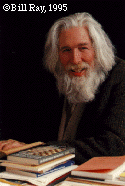
Paul Wilmott is a lecturer in financial mathematics and runs the profession's most popular website. ( HE'S TERRIFIC )

Paul Wilmott

He is a fan of quantitative finance( AS AM I ) - but he thinks that its misuse( YES ) has played a part in creating the current banking crisis.

In November 2007, More or Less asked whether the financial mathematicians known as "quants" - short for quantitative analysts - were to blame for what was then being termed "the credit squeeze".

WHO ARE THE QUANTS?
Paul Wilmott discussed his concerns with Professor William Perraudin of the Tanaka Business School at Imperial College London.

Tim Harford chaired the discussion.

The risks of risk management

In December 2008, Tim invited Paul Wilmott back to talk about the problems in more detail.

Banks and hedge funds rely on highly-paid mathematicians and economists - "quants" - to evaluate risk.

So why did they not they see the credit crunch coming?

Paul Wilmott says some mathematicians have a tendency to get fixated on the numbers, failing to think about the big picture.

RISKY RISK MANAGEMENT

He posed a scenario.

Imagine you are at a magic show. The magician takes an ordinary pack of 52 playing cards, and gives it to a man in the audience to shuffle. He then asks a volunteer to think of a card. "The ace of spades," she replies.

The magician turns to the man with the pack of cards and removes a single card from the deck. What is the probability that the card is the ace of spaces?

To hear the answer listen to the interview, or read Paul Wilmott's article on the risks of risk management.

A fundamental mathematical error

Paul Wilmott says an additional cause of the credit crunch is that people simply got their sums wrong.

GETTING THE SUMS WRONG
He told More or Less these errors might have contributed to the mispricing of financial derivatives, and thus to the travails of the banks, the credit crunch, and the economic downturn.

The maths of the bonus system

Many traders were paid bonuses if they made money.

And yet, collectively, their trades bankrupted some banks and nearly bankrupted many more.

THE TRADER'S DILEMMA
Why did traders, paid for performance, all make the same mistake at the same time?

Paul Wilmott set out the trader's dilemma.

AT HOME WITH THE QUANTS
In October 2007, Tim Harford got a glimpse into the world of the quants.


William Hooper
The most successful of these talented mathematicians will come up with mathematical formulae that make them and their bank or hedge fund employers millions of pounds per year.

They are highly secretive about their work, not wanting others to know the details of their systems.

MEET THE QUANTS
But one of them, William Hooper, invited Tim Harford into his beautiful London home.

Read more about quantitative analysts

A trader's apology

William Hooper has since left the world of finance to start his own business.

He has been reflecting on the global economic problems and the question of who is to blame - read A trader's apology.

GILLIAN TETT, THE FINANCIAL TIMES
Gillian Tett is an assistant editor of the Financial Times and oversees the global coverage of the financial markets.( SHE'S VERY GOOD )


Gillian Tett
Five years ago, she was shocked to discover what she says could best be described as an iceberg in the middle of the City.

The role of the media

She was studying media coverage of the City and began to realise journalists were doing lots of stories on stocks and shares, mergers and acquisitions, but nothing on what had become a much bigger part of finance - the credit and derivative markets.

She says business journalists were simply not covering the City in a representative way.

THE FINANCIAL ICEBERG

You had a small part of the financial system bobbing above the water but a vast shadowy mass of activity pretty much hidden beneath the waves.

And hidden not just from ordinary people, but hidden from politicians, from many regulators, and unfortunately from much of the media too.

UNDERSTANDING LIBOR

The London Interbank Offered Rate - LIBOR - has been dubbed the financial world's most important number.

A view of the City

Published each day in the UK, it is the rate at which the banks lend to each other and it influences over $150 trillion (£100 trillion) of funds worldwide.

The Libor number is compiled by putting together the estimates of the cost of borrowing from at least eight banks, and then discarding the highest and lowest of the sample to leave an average rate which then becomes the daily 'Libor Fix'.

LIBOR

But the figure's validity is being questioned, with critics dubbing it "the rate at which banks won't lend".

Tim Harford was granted exclusive access to the operations centre where the daily rate is compiled.

More or Less is broadcast on BBC Radio 4. To find out more, visit the programme website, or subscribe to the More or Less podcast."

Saturday, January 10, 2009

The Tarp auction is a fiendishly difficult design problem, but it looks solvable

It was to be expected that when TARP The Second didn't seem to work that well, people would wonder whether we should have tried the original TARP. From the FT:

"
My advice to the US Treasury? Go back to Plan A

By Tim Harford

Published: January 10 2009 02:29 | Last updated: January 10 2009 02:29

Imagine an auction in a looking-glass world, with the auctioneer offering cash to the highest bidder and the participants frantically outbidding each other with a jumble of assorted assets. Should a million dollars be sold to the man in the front row for his bundle of 2006-vintage toxic mortgage securities? Or the lady behind him, for her 2005-vintage offering?

That was the auction the US Treasury was hoping to hold until it abruptly changed its plans in November. It was going to spend up to $700bn – the “Tarp” (toxic asset relief programme) fund – buying a variety of toxic assets from banks. The idea made sense: by establishing a market price for these dubious assets, the auction would have improved transparency and helped solvent banks to prove that they really were solvent.

The Tarp fund was then cannibalised to recapitalise banks (probably a good idea) and then dole out suitcases of cash to all-comers (a less good idea). But the original auction concept should be resurrected, because it solves a problem that has not gone away. ( BUT TOXIC ASSETS ARE BEING BOUGHT )

And yet – how could the looking-glass auction work without the US Treasury overpaying for junk? Holding a single auction with a single price would be a disaster: only the most worthless assets would have been offered for sale. To do the job properly and establish realistic prices, the auction needs to distinguish between different assets: some good, some bad and some ugly.

But simply holding many different auctions is not much better. Once finished, a bank might be surprised by the prices, wishing it had sold more of one kind of asset at a generous price, and fewer of its others. Not only would the banks have acted differently with hindsight, but the Treasury would want them to, in the interests of higher revenue and more price transparency.

So two economists from the University of Maryland, Larry Ausubel and Peter Cramton, proposed a dynamic design that would have allowed banks to adjust their bids as the auction proceeded, shifting their emphasis to compete more aggressively wherever prices seemed tempting. The auction was tested to destruction by graduate students and seemed to work well. But there is a flaw: each auction would take a day, with the auction prices affecting financial markets and the markets affecting the auction prices.

However, a solution was already being developed to answer a similar problem for the Bank of England. Paul Klemperer, one of the economists behind the 3G mobile spectrum auctions in the UK, has published a paper explaining how the Bank might auction off loans secured against different qualities of collateral.

He suggests having banks simultaneously submit combinations of bids. Each bank would be considering different scenarios – one in which loan rates were high and it preferred to borrow the absolute minimum; another in which rates were low and it happily offloaded collateral to the Bank of England.

The same approach could work for a Tarp auction, too; Klemperer and three economists from Stanford have been working out the details. A computer would compile bids from both sides, with both the banks and the US Treasury saying in advance what they would be willing to buy or sell at different possible prices. The computer would calculate the result. Because each bidder submitted bids to cover each eventuality, the auction should be efficient and nobody would regret having told the computer the truth.

Whether the US Treasury will relent and return to an auction remains to be seen. The Tarp auction is a fiendishly difficult design problem, but it looks solvable( I'M NOT SURE ). At the time of writing, it seems that the Treasury prefers to spend the cash ad hoc( POORLY ). Shame.

Tim Harford is author of ‘The Logic of Life’"

This plan attempts to better the original idea of a Reverse Auction. It seems complicated as hell, and has one real problem: If the Toxic Assets can't be valued or priced, how can anyone bid on them? And why would they? It sounds like a grab bag.

The original problems remain, and the idea that government has to intervene in order to create a market for Toxic Assets is belied by the fact that they are being sold and bought, and that the price went down when the government failed to intervene. This is really an idea for the benefit of the holders of the Toxic Assets. It's not that they can't be priced, it's that the owners of the assets don't like the prices they're being offered. As I said, this response was predictable.