Showing posts with label Good Banks. Show all posts

Friday, March 13, 2009

But even if it had been Lehman that triggered the financial upheaval, that was then. This is now.

From Willem Buiter:

"
Don’t touch the unsecured creditors! Clobber the tax payer instead.
March 13, 2009 7:31pm

Good Bank vs Bad Bank

The Good Bank solution differs significantly from the Bad Bank solution as regards its distributional implications, its medium-term and long-term incentive effects and its immediate financial stability impact.

Under the Bad Bank approach, the authorities either purchase toxic assets from the banks that made the toxic investments/loans, or they guarantee (insure) these toxic assets. Toxic assets are assets whose fair value cannot be determined with any degree of accuracy. Clean assets are assets whose fair value can easily be determined. Clean assets can be good assets (assets whose fair value equals their notional or face value) or bad assets (assets whose fair value is below their notional or face value). When the authorities acquire the toxic assets outright, they establish a legal entity to manage these assets - the Bad Bank. The publicly-owned Bad Bank either sells these toxic assets as and when they cease to be toxic and a liquid market for them re-emerges, or holds them to maturity.

Under the Bad Bank approach, the legacy banks, either sans the toxic assets or with the toxic assets guaranteed by the state, live to fight another day. The presumption is that the state overpays for the toxic assets. The price it pays is certainly greater than the immediate liquidation value of the assets by their owners. It is also likely to exceed the present discounted value of the future cash flows of the assets, or their hold-to-maturity value. Similarly, the cost of any guarantees provided by the state in the case where the toxic assets continue to be held by the banks, is likely to be less than the fair value of these guarantees.

The rationalisation for the creation of Bad Banks and for toxic asset purchases by the state that was part of the original TARP proposal - it would serve as a price discovery mechanism for potentially socially useful financial instruments that had temporarily become illiquid - is no longer credible. Most of the toxic assets ought never to have been created and, with a bit of luck, will never be seen again. So the fundamental rationale for the creation of Bad Banks and for toxic asset purchases by the state is the provision of a subsidy to the banks that made the toxic loans and investments. These beneficiaries include the top management and board of these banks, the shareholders and the unsecured and non-guaranteed creditors.

The subsidies for the legacy banks inherent in the purchase by the state of the toxic assets and/or in the guarantees provided by the state for these toxic assets are further boosted by the myriad modalities of further official financial support for these banks. These can be additional capital injections, guarantees for new borrowing or guarantees for new loans and investments by the banks.

Under the Good Bank approach, the state creates a new bank, the Good Bank, which gets the deposits and the clean assets of the old banks. The old bank gets compensation equal to the difference between the (known) value of the clean assets it loses and the value of the deposits it gives up. The state may also inject additional public capital into the Good Bank, or it may invite in additional private capital. Government financial support is given only to new lending, new investment and new funding by the Good Bank. The legacy (ex-)bank has its banking license taken away and simply manages the existing stock of toxic assets. The legacy (ex-)bank does not get any further government support.

The Hall-Woodward-Bulow good bank solution

A particularly neat example of the Good Bank solution has been proposed by Robert E. Hall of Standford University and Susan Woodward of Sand Hill Econometrics. It can be found on the Vox website. They attribute the key idea to Jeremy Bulow. In what follows I merely adapt their numerical Citicorp example to the RBS Group.

The data for the Table below come from the Annual Report & Accounts 2008 of RBS. I am doing the exercise for the whole RBS Group. As it is unlikely that home country governments would be willing (or even able) to support the foreign subsidiaries of their banks, it might have been more appropriate just to consider the UK high-street banking units of the RBS Group. I leave that as an exercise for the reader.

Total equity of the RBS Group at the end of 2008 is reported on the balance sheet as just over £80bn. Market capitalisation is around £ 8bn. I therefore subtract £72 bn from the £2,402 total assets reported for the end of 2008, which leaves adjusted total assets at £2,330 bn. The tax payer has already put £45 bn into RBS. In addition, RBS has placed £325 bn of toxic assets in the government’s Asset Protection Scheme.

This means that RBS is a dead bank walking, a zombie bank, with its market capitalisation much less than past and present government financial support, let alone past present and anticipated future government financial support, which would also be reflected in today’s market capitalisation. I could have done the same type of exercise for Lloyds Banking Group, for Citicorp, for Bank of America or for UBS and many other zombie border-crossing banks.
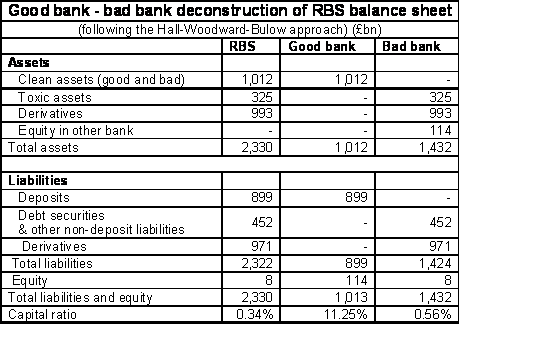
On the asset side of RBS group are clean assets (good and bad, but with known fair values) and toxic assets (assets with unknown fair values and derivatives. On the liability side, I distinguish deposits, debt securities and other non-deposit liabilities, and derivatives. In the US, the derivatives on both the asset and liability sides of the balance sheet would have been netted, which would have reduced the size of the balance sheet by almost one trillion pounds.

I assume that the £325 bn worth of toxic asset insurance offered by the authorities to RBS equals the stock of toxic assets on its balance sheet. This leaves RBS with just over £ 1 trillion worth of clean assets (and the derivatives, just under £1 trillion). ‘Deposits’ is shorthand for guaranteed or secured creditors. The £899 bn worth of deposits on the RBS balance sheet is, however, larger than what is formally covered by UK deposit insurance (or by the applicable deposit insurance schemes of the foreign subsidiaries). Debt securities and other non-deposit liabilities are claims on RBS by unsecured and non-guaranteed creditors. They include all unsecured debt, including subordinated debt, other junior debt and senior debt. RBS had £452 bn of this unsecured and non-guaranteed debt (plus of course some non-guaranteed and unsecured liabilities included in ‘deposits’). Then there is just under £1 trillion worth of derivatives on the liability side of the balance sheet.

Equity - market capitalisation - is a mere £ 8 billion, giving a capital ratio (equity as a percentage of assets) of 0.34%. Even with all the government support it has received, RBS group is effectively worth nothing.

The Hall-Woodward-Bulow Good Bank - Bad Bank deconstruction of the RBS balance sheet requires one key condition to hold: the value of the clean assets of RBS has to exceed that of its deposit liabilities. This will be more likely the larger the amount of non-deposit funding RBS engages in.

We split RBS into a Good Bank and a Bad Bank by giving the deposits and the clean assets of RBS to the Good Bank, leaving everything else with the Bad Bank, and giving the Bad Bank all the equity in the Good Bank. (The derivatives on both sides of the balance sheet could be given to the Good Bank instead of to the Bad Bank, assuming they are clean). Since the value of the clean assets (£1,012 bn) exceeds that of the deposits (£ 899 bn), the good bank has equity of £114 bn (mind the rounding errors!). Its capital ratio is a healthy 11.25%. If I had used a more restrictive definition of ‘deposits’, the capital ratio could easily have been over 20% or even 30%.

The Bad Bank keeps the toxic assets and derivatives of RBS. It also has the equity in the Good Bank as an asset on its balance sheet. On the liability side it has just the unsecured and non-guaranteed debt securities and other non-deposit liabilities. Its equity is, of course, the same as that of RBS: £8 bn. Its capital ratio will therefore be higher than that of RBS, because the balance sheet of the Bad Bank is smaller. Neither the equity owners of the Bad Bank nor the unsecured and non-guaranteed creditors of the Bad Bank are worse off than, respectively, the equity owners of RBS and the unsecured and non-guaranteed creditors of RBS.

To achieve the deconstruction/decomposition of RBS into a Good Bank and a Bad Bank according to the Hall-Woodward-Bulow principles would require that RBS be put into temporary administration. The new Special Resolution Regime (SRR) introduced for the UK in February 2009 provides the ideal legal setting for this. It should not take long, a weekend at most. Basically, the Bad Bank just becomes a financial portfolio of toxic assets and derivatives, plus its stake in the Good Bank. It would not be allowed to invest in any new assets or to engage in any banking activities. It would manage the existing asset portfolio down and would cease to exist once the last asset has been sold or has matured. Among the clean assets the Good Bank buys would be the buildings, equipment etc. necessary for conducting the banking operations of the Good Bank.

If the UK government had not been daft enough to guarantee the £325bn worth of toxic assets on the balance sheet of the Bad Bank, there can be little doubt that the Bad Bank I have just constructed would have failed soon after coming out of the SRR. The Bad Bank, which is just a fund restricted not to invest in new assets, would be put into administration. The shareholders would be wiped out (more than 70 percent of RBS is now government-owned), and the unsecured and non-guaranteed creditors would determine what to do with the Bad Bank and its assets. Most likely there would be a significant debt-to-equity conversion and/or a large write-down of the debt.

The government would focus its financial support on the Good Bank, either by providing it with additional capital or by guaranteeing new lending and/or new borrowing by the Good Bank. Private capital could be attracted into the Good Bank too.

Distributional differences between the Good Bank and the Bad Bank solution

The Good Bank solution favours the tax payer. The Bad Bank solution favours the unsecured and non-guaranteed creditors of the zombie banks. ‘Tax payer’ includes those beneficiaries of public spending programmes that may have to be cut to meet the fiscal cost of purchasing or guaranteeing the toxic assets under the Bad Bank solution. It also includes those who lose as a result of future inflation or sovereign default, should either of these two solutions to dealing with the public debt created as a result of the Bad Bank solution eventually be adopted.

The Bad Bank solution also favours the shareholders of the zombie banks, but in the case of RBS, this is mainly the government and therefore the taxpayers. The amount of shareholder equity involved in the zombie banks is, in any case, negligible compared to the exposure of the unsecured and non-guaranteed creditors. The Bad Bank solution also saves the jobs and perks of the top management and the boards of the zombie banks - often the very people responsible for turning a once-healthy bank into a zombie bank.

There can be no doubt that, from a distributional fairness perspective, the Good Bank solution beats the Bad Bank solution hands down.

Incentive effects of the Good Bank and the Bad Bank Solution.

The Bad Bank solution creates moral hazard, because it rewards past reckless investment and lending. It also represents an inefficient use of public funds in stimulating new lending by the banks. To stimulate new lending, a subsidy to or guarantee of new lending is more cost efficient than the ex-post insurance of losses that have already been made on old lending, even though their true magnitude is not yet known. The Good Bank solution leaves the toxic waste with those who invested in it and with those who funded these activities, freeing government funds for reducing the marginal cost of new lending or increasing the expected return to new lending.

Both as regards moral hazard (incentives for excessive future risk taking) and as regards the efficient use of government funds (’new lending bang per buck’), the Good Bank solution beats the Bad Bank solution hands down.

Financial stability implications of the Good Bank and Bad Bank solutions: saving banking, without saving bankers or the existing banks

The holders of bank debt, with the possible exception of perpetual subordinated debt (which counts as tier one capital in some countries), have become the sacred cows of this financial crisis. Regulators, central bankers and Treasury ministers are quite willing to see shareholders wiped out. After the demise of WAMU and Lehman Brothers, however, the unsecured creditors have become inviolable. Somehow, those in charge of macro-prudential stability, notably the Fed, have bought into the notion that if there is either a further default on bank debt, or a restructuring involving a significant debt-to-equity conversion, or a signficant write-down of the claims of bank bond holders, this will be the end of the world.

I just don’t buy it. Fortunately, I am not the only one. Luigi Zingales, the Robert C. McCormack
Professor of Entrepreneurship and Finance at the Chicago Business School, has been advocating the case for mandatory debt-into-equity conversions, debt forgiveness and other up-tempo Chapter 11- style financial restructuring of banks and other defunct behemoths like GM, since the first days of the crisis (see e.g. (1) and his bookSaving Capitalism from the Capitalists, co-authored with Raghuram Rajan). Robert Hall and Susan Woodward also feel no need to pay any special attention to or lavish any public funds on the toxic assets, their owners and those who funded them (the unsecured and non-guaranteed creditors) once the Good Bank has been established and sent on its way.

Part of the reason there appears to be this widespread belief that you have to guarantee all bank liabilities is that this is what the Swedish authorities did during their 1991-1993 banking crisis (see e.g. Lans Jonung’s paper “The Swedish model for resolving the banking crisis of 1991-93. Seven reasons why it was successful” . First, Jonung lists seven criteria for ’successful’ resolution of a banking crisis. The paper does not demonstrate that this septet constitutes a set of necessary and sufficient conditions for success - if indeed the Swedish approach is deemed to have been a success. Second, success is in the eyes of the beholder. The Swedish banking system has been hard hit again in the current crisis by its overexposure (30 percent of annual GDP) to risky investments in Central and Eastern Europe, including the Baltics and Ukraine.

Every financial boom/bubble has been characterised by rising and ultimately excessive banking sector leverage, that is, by excessive lending to banks. If all the unsecured creditors of the banking system were made whole in the previous systemic crisis, it is not really surprising that the banks, and their creditors, are back for more.

In a more systematic study of the use of blanket guarantees of bank liabilitiesLuc Laeven and Fabian Valencia find the following:

“Using a sample of 42 episodes of banking crises, this paper finds that blanket guarantees are successful in reducing liquidity pressures on banks arising from deposit withdrawals. However, banks’ foreign liabilities appear virtually irresponsive to blanket guarantees. Furthermore, guarantees tend to be fiscally costly, though this positive association arises in large part because guarantees tend to be employed in conjunction with extensive liquidity support and when crises are severe.”

The proposition that the consequences of inflicting losses on holders of bank debt are awful beyond our wildest imagining is voiced incessantly and loudly by bankers and by those long bank debt, especially insurance companies and pension funds. And a vigorous campaign is underway to extend the no-default presumption to the debt of pseudo-banks like AIG.

The most over-the-top, ludicrous piece of attempted scare mongering about the systemic risk implications of default by any institution I have ever read is the internal memorandum “AIG: Is the Risk Systemic”, of 26 February 2009, which is now all over the internet. Just one small sample: “The failure of AIG would cause turmoil in the U.S. economy and global markets , and have multiple and potentially catastrophic unforeseen consequences”.

I would have thought that, on the contrary, markets have discounted the likelihood of default by many of the major border-crossing banks, and by AIG, pretty comprehensively by now. After the US authorities bailed out Bear Stearns in March 2008, letting Lehman go belly-up in September 2008 was a bad surprise. Even then, I don’t accept the interpretation that it was Lehman’s filing for bankruptcy protection that triggered the cardiac arrest in global financial markets in the second half of September 2008. Instead the financial sector convulsions of the last quarter of 2008 were caused by the realisation that (1) most of the US and European border-crossing banks were insolvent without government financial support, that (2) the rot extended to the shadow banking sector (AIG), and that (3) the US authorities (Treasury, Fed, SEC) were not on top of the issue and that Congress was bound to act irresponsibly.

But even if it had been Lehman that triggered the financial upheaval, that was then. This is now. Banks, counterparties, investors and policy makers have had 6 months to adjust to the new reality and prepare for the eventuality of default on zombie bank debt and even on AIG debt. The bonds of large zombie banks trade at spreads over government yields comparable to those of automobile manufacturers (600 - 650 basis points). Their CDS spreads put many of these banks well into the default danger zone. Their stock market valuations are consistent with those of institutions not a mile away from insolvency and default.

The fact that zombie banks or AIG are self-serving when they plead systemic risk as an argument for further government hand-outs does not mean that they are wrong. It does lead one to verify more carefully the logic of their arguments and the quality of the empirical evidence offered in support. Let me just consider the argument that the main investors in bank debt (and AIG debt) - pension funds and insurance companies - are too vulnerable and too systemically important to permit the banks (or AIG) to fail.

Pension funds don’t go broke with adverse effects on systemic stability. If they are funded, defined-contribution funds, a reduction in their asset value means that pensioners will get lower pensions. If they are defined-benefit schemes (including ‘final salary schemes’), the risk of investment surprises is shared by the sponsors and the beneficiaries. When the Dutch pension fund ABP took a big hit last year, my parents did not get any indexation of their pension benefit. In past years, pension benefits had tracked earnings inflation, and occasionally price inflation. Should coverage ratios decline enough, even nominal cuts in pension benefits can be implemented. This may cause hardship, but not financial instability. No reason to favour the pensioners over the tax payers.

As regards insurance companies, I doubt whether “Insurance is the oxygen of the free enteprise system”, as AIG would like us to believe. Certainly insurance companies like AIG are not the only suppliers of oxygen. Insurance is a regulated industry. Orderly restructuring following administration and insolvency need not interfere with the provision of any of the essential infrastructure services required for the proper functioning of a market economy.

Regulators, especially but not just in the US, have bought the ‘don’t touch the unsecured creditors’ argument. The Fed especially appears to have swallowed it hook, line and sinker. This cognitive regulatory capture has turned the Fed, with the enthusiastic support of the FDIC and the US Treasury, into the most powerful moral hazard propagation machine ever.

If a bank or an insurance company like AIG is at risk of failing but is truly too big or too interconnected to fail (rather than merely too politically connected to fail), and if a Good Bank solution is not feasible, then the institution in question should immediately be taken into public ownership or put into a special resolution regime, if one is available. From public ownership it can be put into administration. Once in administration or under a Special Resolution Regime, it can be restructured decisively through a mandatory debt-to-equity conversion or debt write-down. There is no case for sparing the unsecured creditors. "

Me:


1. The bondholders are:
1) Foreign Investors
2) Insurers
Let's start with 2. They're going to get a bailout in the US if they become untenable. Period. There's no way of saving money on this one by defaulting on insurers. It's better to guarantee them and hope that we don't have to pay them. If they become untenable, they'll get paid. Just take a look at whom they represent and their lobbying history.
About 1, they are countries like China. Contrary to what you are saying, China does think that Lehman's fall was a big deal, and expressed outrage about it because they believed that the US government had implicitly guaranteed them. They didn't make a big public stink about it, but they basically said that they wouldn't appreciate more defaults.
Now we come to Bank bonds. You're advising us to default on China again, along with other investors that we really need. That's why China has decided to more publicly express their displeasure. They would see our defaulting on these bonds as a clear indication that we prefer defaults to tough internal choices. Since the next stop on the default train would be US Treasuries, the Chinese don't like the trend line. That's what they're telling us. That's what the spreads have been telling us. These defaults would reflect on US intentions going forward.
Will we save money? No, because the next thing that will happen is China and other foreign investors demanding higher interest for loans.
Finally, since you are warning us about conditions that would cause foreign investors to stop lending money to the US, what could be worse than a clear pattern of preferring defaults?
No one would rather stiff these creditors than me. However, it's clear that investors are holding the US government responsible for these bonds, and not the banks any longer, and they are telling us that they will respond accordingly.

Although I do believe that letting Lehman fall was a disaster because it started a Calling Run, the beginning of Debt-Deflation, which didn't need to happen to such a disorienting extent, I agree that it wouldn't be as bad now. But it would be bad, could make things much worse going forward, and won't save us a dime. Guaranteeing the bondholders might also help seizing the big banks if we have to do so.

Since, in the case of Citi, the B of A, and AIG, all of their real profit is in foreign holdings, I'm not sure what problems that could cause if we seized them, or how that fits into the good/bad bank proposal. Just one citizens view.
Posted by: Don the libertarian Democrat

Sunday, February 8, 2009

Nationalising the dodgy banks would not solve the problem of how much to pay for the banks

From Buiter:

"
Good Bank/New Bank vs. Bad Bank: a rare example of a no-brainer

February 8, 2009 8:41pm

The truth of a proposition is independent of how many people believe it to be correct. The merits of a proposal are likewise not enhanced by the number of people supporting it or making similar proposals. Still, humans, like other pack animals, thrive on companionship. It is therefore comforting that the logic behind my proposal (January 29, 2009) for one or more new ‘good banks’ to be established, capitalised with public money and with additional financial support from the state for new lending and new funding, while the toxic assets of the old banks are left with the owners and creditors of the ‘legacy banks’, is being echoed in proposals from Joseph Stiglitz (February 2, 2009), George Soros (February 4, 2009) and Paul Romer (February 6, 2009), to name but a few. I claim no authorship or originality for the ‘good bank’ proposal. The idea is obvious and no doubt was floating around the blogosphere and elsewhere as soon as the magnitude of the insolvency disaster in the banking sector became apparent.

The various proposals differ in detail. Romer’s proposal is essentially the same as my own. Stiglitz argues, according to the British Daily Telegraph that “the government should allow every distressed bank to go bankrupt and set up a fresh banking system under temporary state control rather than cripple the country by propping up a corrupt edifice”.

Soros proposes not to remove the toxic assets from the banks’ balance sheets (which would require them to be valued, which is not possible) but instead put them into a “side pocket”. The necessary amount of capital — equity and unsecured debentures — would be sequestered in the side pocket. Soros’ ‘side pocket’ is effectively the same as my ‘legacy bad banks’. Soros notes that about $1.5 trillion is likely to be required to recapitalise the existing banks properly. This money could be leveraged a lot more effectively if most of it were injected into the new good banks, unencumbered with the toxic waste of the existing banks.

Under the Soros proposal, some additional capital might have to be injected into the ‘side pockets’, presumably by the state. Under my new good banks proposal, the new good banks would take on the (guaranteed or insured) deposits of the legacy bad banks (which would lose their banking licenses) and would buy the good assets of the legacy banks. Should deposits exceed good assets, the state would have to make up the difference initially with government debt on the balance sheet of the new good banks. Should deposits be less than good assets, the new good banks would be able to borrow from the sovereign to finance the acquisition of the good assets from the legacy bad banks. This would cleanse bank balance sheets and transform them into good banks but leave them undercapitalized. Soros suggests that $1 trillion of the estimated $1.5 trillion required to recapitalise the existing banking system should be directed to the cleansed banks. Soros believes or hopes that some of the money required to capitalise the new, cleansed banks could come from the private sector. Under my proposal, and that of Stiglitz, the state would initially capitalise the new banks on its own.

A common logic

The logic is simple. Many (probably most, possibly all but a handful) high-profile, large border-crossing universal banks in the north Atlantic region are dead banks walking - zombie banks kept from formal insolvency only through past, present and anticipated future injections of public money. They have indeterminate but possibly large remaining stocks of toxic - hard or impossible to value - assets on their balance sheets which they cannot or will not come clean on.

This overhang of toxic assets acts like a tax on new lending. Banks are required, by regulators or by market pressures, to hoard capital and liquidity rather than engaging in new lending to the real economy. The public financial support offered in the form of capital injections (in the US mainly through preference shares and other non-voting equity), guarantees for assets and for liabilities (old and new), insurance of toxic assets (as provided to Citigroup by the US sovereign) and possibly in the future through direct purchases by the state of toxic assets (using TARP money in the US) and the creation of one or more publicly owned ‘bad banks’ has been a complete failure.

The bad bank proposals the Obama administration and other governments are considering are non-starters, for the simple reason that they require the valuation of assets whose true value (even on a hold-to-maturity basis) can only be guessed at. The good bank proposal only requires the valuation of those assets on the balance sheets of the existing banks that are easy to value: transparently valued assets. The toxic stuff is left on the balance sheet of the existing banks, which become the legacy bad banks.

Offering to pay enough to the existing owners of the toxic assets to induce these owners to sell them would require paying over the odds. That might not leave enough fiscal resources to support the new lending activities that are so urgently needed. It would also be an unfair and moral-hazard-maximising bail out of the existing owners and creditors of the banks. Nationalising the dodgy banks (or even the entire cross-border universal banking sector) would only solve the valuation problem of the new owner (the state) after nationalisation. The toxic assets could be transferred into a bad bank at any valuation, including zero. The owner of the bad bank and of the cleansed bank are the same. Nationalising the dodgy banks would not solve the problem of how much to pay for the banks, however, because that would depend in part on the valuation of the toxic assets. The good bank proposal creates new, publicly owned banks which only purchase good assets from the legacy bank. There is no valuation issue involving toxic assets for the tax payer.

Crisis fighting, moral hazard and fairness

The existing packages of support measures in the US, the UK and elsewhere have failed to get lending to the real economy going again. In the US especially, but also to some extent in the UK, It has been a shameful boondoggle for the banks that are at the heart of the financial mess - bank CEOs and other top managers, bank shareholders, holders of unsecured bank bank debt (subordinated, junior and senior) and other creditors.

The US, the UK and several other continental European countries are at risk of emulating Ireland, where the government first guaranteed all the liabilities of the banks (other than equity) and only after that began to nationalise the banks. This leaves the Irish government today in the not too enviable position of having to choose between sovereign default and bleeding the tax payer and the beneficiaries of normal public spending to make whole all the creditors of the banks.

Bailing out the holders of existing bank debt and other bank creditors would be outrageously unfair: they did the lending and made the investments, they should eat the losses. In addition, many of the creditors are likely to be much better off, even after they write down/off their claims on the banks, than most of the tax payers and public expenditure beneficiaries that pay for the bail out. Bailing out the existing creditors would also create dreadful incentives for excessive future risk taking by banks.

Especially in the US, the disdain for moral hazard displayed since the beginning of the crisis by regulators and by the fiscal and monetary authorities has been shocking. It has been justified with the claim that you cannot afford to worry about medium- and long-term incentives for appropriate risk taking when your house is on fire. That argument is logically flawed.

Two things are systemically important. The first is to restore the operation of key financial markets that have become illiquid. The Fed is doing a reasonable job in that regard. The second is to restore bank lending to the real economy. Neither objective requires that the existing banks be saved, let alone that their existing shareholders and creditors receive any financial support from the state. We can save banking without saving the banks or the bankers. The ‘good bank’ proposal demonstrates how to do this.

Regulators, central bankers and policy makers should be pursuing three key objectives. The first is to get lending by the banks to the real economy, especially to the non-financial enterprise sector, going again. The second is to minimize moral hazard by creating the right incentives for future risk taking by banks, their creditors and their customers, by ensuring that the losses incurred by the failed banking system are born first and foremost by those who invested in the banks in any capacity. For reasons that are partly sensible (protecting small unsophisticated savers from financial ruin and forestalling inefficient attempts by financial illiterates to monitor complex financial institutions) and partly populist pandering, most retail deposits have ended up insured or guaranteed by the state (often at least in part ex-post). Moral hazard should be stopped, however, beyond the magic circle the state has drawn around retail depositors. The third objective is to pursue justice in burden sharing.

The legacy bad banks would, under their existing ownership and with whatever balance sheet they end up with after shedding their insured/guaranteed deposits and after selling their good, easily valued assets, have as their sole activity the management of their existing assets. No new investments would be undertaken, no new loans made and no other new exposures incurred. Their liabilities and other funding decisions would be managed in the interests of the existing shareholders. No doubt many of them would fold. Chapter 11 or Chapter 7 would be ready and waiting for them.

Conclusion

By focusing scarce fiscal resources on supporting flows of new lending and new funding to support new lending, rather than on supporting stocks of existing bad assets and/or toxic assets assets and on guaranteeing or insuring stocks of existing liabilities, the state meets its three key objectives. First, its short-run economic stabilisation and crisis-fighting objective; second, its medium and long-term banking sector incentive-enhancing, moral-hazard-minimising objective; and third, its fairness objectives: the polluter pays or, you break it, you own it.

Establishing legal and institutional clear water between the legacy bad banks and the new good banks is a necessary condition for fulfilling the economic imperative to support flows of new lending and borrowing rather than to protect existing stocks of toxic assets and their owners."

Me:

6. "Nationalising the dodgy banks (or even the entire cross-border universal banking sector) would only solve the valuation problem of the new owner (the state) after nationalisation. The toxic assets could be transferred into a bad bank at any valuation, including zero. The owner of the bad bank and of the cleansed bank are the same. Nationalising the dodgy banks would not solve the problem of how much to pay for the banks, however, because that would depend in part on the valuation of the toxic assets. The good bank proposal creates new, publicly owned banks which only purchase good assets from the legacy bank. There is no valuation issue involving toxic assets for the tax payer."

I'm trying to understand this:
1) Everybody agrees that the new banks will be good banks.
2) We loaned money to LBBs. We also own stock. What's to become of this?
3) Following from 2, who says that we're going to have to pay anything for the TAs?
4) If the banks go bust, the FDIC seizes them. Right? Isn't that nationalization?
5) Can the LBBs continue to lobby? Don't write them off if they can?
6) As for moral hazard, it is better to rule a LBB than be nationalized.
7) Even though the TAs are probably crap, wouldn't it be better for us to have control of the ones that turn out to be worth something?
I understand, I think, the benefit of just going ahead and creating a good bank now. But, again, since we have loaned money to these banks, own stock in them, and will have to deal them when they explode, I don't see the point of waiting, unless that will somehow save us money and aggravation. Leaving these LBBs wandering in a kind of financial limbo seems an unnecessary risk, and one likely to get worse before ever getting better.
Posted by: Don the libertarian Democrat

Friday, February 6, 2009

It's simpler and safer to start entirely new banks.

From the WSJ:

"
Let's Start Brand New Banks

A clean slate would keep TARP money away from bad banks.

By PAUL ROMER

Everyone agrees that the United States urgently needs a few good banks. Turning bad banks into good banks is a difficult and risky way to get them. It's simpler and safer to start entirely new banks.

In this context, "good" means a bank with assets and liabilities that are easy to value using market prices. At a good bank, officers, regulators and investors can be confident about the value of the bank's capital.

The government has $350 billion in Troubled Asset Relief Program (TARP) funds that it can use to encourage new bank lending. If this money is directed to newly created good banks with pristine balance sheets, it could support $3.5 trillion in new lending with a modest 9-to-1 leverage. Right out of the gate, the newly created banks could do what the Fed has already been doing -- buying pools of loans originated by existing banks that meet high underwriting standards.

If the TARP funds go to existing banks, much of them will end up stuck in financial institutions that are still bad after the transfer. We know from the previous round of TARP that giving more capital to bad banks generates very little net new lending.

Proposals for turning existing banks into good banks -- recapitalizing them, nationalizing them, transferring the toxic assets off their balance sheets, or insuring the toxic assets -- require prices for all these hard-to-value assets or, worse still, prices for derivative contracts on the toxic assets. (Calling the derivatives "insurance" doesn't make them any easier to price.) Without reliable market prices for the hard-to-value assets, any proposal for turning bad banks into good banks could lead to huge transfers of wealth between taxpayers and bank shareholders.

If the government lets new banks provide the new lending that the economy needs, it could return to clearly stated and familiar policies for bank regulation. The government could announce that it will not invest any new capital in a troubled bank that it hasn't yet taken over. Nor will it offer troubled banks any transfers or implicit subsidies. It can stick to a policy of assigning accurate values to assets as new information comes in. It can follow the usual FDIC procedures for protecting depositors and taxpayers and for deciding when to take over a distressed bank, and managing careful workouts that avoid the turmoil that a Lehman-style bankruptcy proceeding can cause.

With a return to a clearly articulated and familiar pattern of bank regulation, investors from the private sector could invest in the banking sector without fear that they will be competing with zombie banks that receive ongoing subsidies and transfers from taxpayers. Provided that the government accelerates the approval process, investors from the private sector can quickly create the new banks that the government backs. Over time, they can also buy the government's shares in these banks. Investors from the private sector can also invest in existing banks that truly are good banks.

The government should move first and signal unambiguously that new banks with at least $350 billion worth of capital will enter the market quickly. Over time, the private sector will deliver on this commitment. The government's role is merely to act as a temporary bridge.

There are, to be sure, risks of political interference from government involvement in banking, but all of the current proposals for increasing lending require more government involvement. The challenge is to find one that increases lending and does the least harm.

If the government starts as a shareholder in new, healthy banks that eventually end up entirely in the hands of the private sector, the political risks start small and diminish. If instead the government combines open-ended and opaque financial support for troubled banks with promises of tight supervision and punishment for bad behavior, the risks are large and grow over time.

The brewing backlash against the existing players from the financial sector is almost certain to burn hotter as the recession wears on, and new election campaigns get underway. If the new administration ties its fate to the existing players, it could lose its room to maneuver on countercyclical policy and be put under political pressure to intervene in bank decisions in ever more intrusive ways.

Because they can and will borrow, new banks will be much more effective in leveraging TARP funds. They will undertake more total lending, bring more trading to financial markets, and do more to limit the depth of the recession. As a result, investing the TARP funds in new banks will do more to help the troubled but potentially viable existing banks than giving funds directly to them.

Banks that are not viable, the ones with liabilities that substantially exceed their assets, will lobby vociferously against a return to historical patterns of bank regulation. They will say anything to postpone a looming FDIC takeover. The administration should not listen to threats and pleas from these doomed banks. It does not have to rely on them to get new lending going quickly and on a large scale. New entrants could give us a few good banks. That, plus an FDIC that can do its job, is all we need.

Mr. Romer is a senior fellow at the Stanford Institute for Economic Policy Research."

Me:
Post Post subject: Re: Let's Start Brand New Banks I'm puzzled about what's supposed to happen to the wounded banks who would be left out in the cold. Presumably, if they go ahead and fail, the FDIC will step in. How is that different than nationalizing? Is it simply a better procedure in your opinion? If the government nationalizes these banks, presumably they would create just the sort of banks that you advocate. Again, what's the difference?

Thursday, January 29, 2009

Finally, which politician would not prefer to be associated with the creation of a good bank rather than with the creation of a bad bank?

Buiter on the FT:

"
The ‘Good Bank’ Solution


January 29, 2009

In its January Global Financial Stability Report Market Update (published January 28, 2009), the IMF has raised their estimate of credit losses from bad assets originated in the US and held by US and European banks to $2.2 trillion (from $1.4 trillion estimated in November). It also estimates the combined need of US and European banks for new capital at $0.5 trillion. Finally, the Fund recommends that the authorities take the distressed assets from the banks’ balance sheets through ‘bad bank’ arrangements.

Note that we are no longer just talking of ‘toxic’ assets, that is, assets whose value cannot be assessed with any degree of certainty because of their complexity. We are now talking about bad or impaired assets that include the toxic stuff but also a large chunk of plain vanilla assets (real estate loans, simple mortgage products, consumer loans, corporate debt) that have become impaired because the borrowers/issuers are at risk of going belly-up the old-fashioned way. With a long and deep recession still ahead of us, the quantity of ‘conventional’ bad assets on the books of the banks will escalate.

There is a problem with creating a government-owned and government-funded bad bank that acquires the bad assets from the existing banks and manages the portfolio of bad assets, unconstrained by liquidity and short-term profitability considerations, either by selling them if and when the markets for these assets recover or by holding them to maturity. The problem is that the bad assets have to be valued. Some bad assets are transparently bad. If there is a liquid market for these assets there is no problem in valuing them. If there is no liquid market and can be valued using reverse auctions or model-based techniques. But much of the toxic stuff is so obscure, so heterogeneous and held by so few parties that they are virtually impossible to value. An auction would become a bilateral negotiation.

The favoured solution of the banks and other institutions holding these toxic assets is that the state pay them over the odds - preferably face value. That would be unfair and costly from a budgetary point of view. It would also represent a massive example of moral hazard by creating incentives for future excessive risk taking in the confident expectation that Mother State will bail you out.

Valuing the most toxic asset is not a problem if the banks that hold the bad assets are all in full public ownership. In that case the price paid for the assets as they are shifted from the books of the state-owned banks to the books of the state-owned bad bank is irrelevant - the payment goes out one pocket of the tax payer and into the other. This provides another powerful argument for temporary nationalisation of all banks with toxic assets and solvency-impairing amounts of other bad assets on their portfolios.

But there are some countries where outright nationalisation of the key banks would be politically difficult. Could the US political system work itself into a state of fear and/or indignation sufficient to take into full public ownership the likes of Citigroup, Bank of America, JPMorgan-Chase etc.? It’s possible, but not yet likely. Were it to happen it would no doubt be called something different: Temporary Public Stewardship, Time-Limited State Trusteeship, Patriotic Conservatorship or some such thing.

The ‘Good Bank Model’

There is an alternative solution to the problem of valuing the toxic assets. It would not involve nationalising the existing banks. Instead the state would create one or more new ’good’ banks - all state-owned and state-funded to begin with. Effectively, some or all of the existing banks would become bad banks. The good banks would acquire the deposits and the good assets of the bad banks or legacy banks. The good assets are, by definition, easy to value. The creation of multiple good banks may be desirable to encourage competition. One could even create a good bank for every existing bank: New Citi, New RBS, New ING etc.

New lending business, indeed all new business activity would be undertaken only by the new good banks. To address the credit crunch, government guarantees or insurance could be provided for new loans and investments made by the good banks. No further guarantees should be extended to existing assets, either in the good banks or in the legacy bad banks. The good banks would receive their capital from the state. Other funding would be provided by the transfer of the deposits from the bad legacy banks, through loans from the state or through the sale of bonds by the new good banks to the state. The state could also guarantee new loans to the new good banks from the private sector or bonds issued by the new good banks and purchased by the private sector.

As regards the the legacy bad banks, the easiest and cleanest way to proceed is to stop them from doing any new business on the asset side of their balance sheets: no new lending and no new investment. They would also not be permitted to take new deposits. A simple way to ensure this is to take away their banking licenses. They would exist only to manage and ultimately to run down the portfolio of bad and toxic assets they hold on their balance sheets. Maturing liabilities could be refinanced if that made more sense than accelerating the sale of the assets.

Taking away the banking licenses of most of the existing large universal banks in Europe and the USA would be appropriate because recent developments have demonstrated that the existing institutions, managements and boards are not fit for purpose. They have failed as banks, even if they have not (yet) failed in the technical, legal sense of becoming insolvent. For most of them the past, present and anticipated future financial support of the state is the only thing that stands between them and bankruptcy.

The bad banks (i.e. the existing banks minus their deposits and good assets (and including the compensation for the difference between these two) could retain their existing ownership structure. They would not receive any further financial support from the state, whether through capital injections or through guarantees of their assets or liabilities. They would be left to swim or sink on their own, without any further financial support from the state. If they were to become insolvent, they would go into the normal insolvency procedures for non-bank financial institutions. The existing unsecured creditors could, in reverse order of seniority, be converted into shareholders of the insolvent company, thus ensuring that the incentives for prudent lending to banks will be stronger in the future than they have obviously been in the past.

The new good banks would initially be wholly state-owned and either state-funded or privately funded but with a sovereign guarantee to begin with. They should, however, be managed commercially - at least at the micro level, that is, at the level of the selection of individual investments and the making of individual loans. I think it is unavoidable and even necessary in the current credit crunch, that the new good banks be set aggregate targets for lending, but only at the most aggregative level, e.g. so much to the non-financial enterprise sector, so much to the household sector and no more than so much to the financial sector. Falling short of the quota or exceeding it would result in the forfeit of the shortfall/excess. If the performance criteria for executive remuneration were structured properly, the individual project and loan selection could still be long-term profit maximising (or loss minimizing) but subject to an aggregate lending constraint.

The aggregate lending target would be dropped as soon as credit markets normalised.

To minimise the risk of political micro-management of lending and investment decisions, management should be incentivised to act commercially by having in their remuneration package a large bonus component (!) that depends on long-term profitability. A fiercely independent and qualified board would have to be appointed, instead of the old duffers and cronies that make up most bank boards today. The CEO could not be a member of the board, let alone its chair.

In my proposal, the existing banks would become the bad banks and retain their existing ownership structure. No government resources would be wasted propping up the valuations of existing assets. All government financial support would go to the new state-owned good bank. Even there, government guarantees would only be provided for new bank borrowing (if this is from the private sector) and for new bank lending and investment. There is no point here either in propping up the valuation of existing assets.

It is possible that the legacy bad banks would initially have balance sheets that are much larger than the balance sheets of the new good banks, which would contain only the good assets bought from the legacy bad banks and any new assets built up since the new good banks were created. The combined balance sheet of the legacy bad banks in the USA could easily run into multiple trillions of US dollars (probably somewhere between $3 trillion and $5 trillion, depending on how strictly you apply the criterion that the good banks only purchase easy-to-value assets). But with all new lending and investment performed by the new good banks and with the balance sheets of the legacy bad banks shrinking by construction, the new good banks would be growing relative to the legacy bad banks. With a bit of luck, they could grow into bad banks again!

As credit markets normalise and the economy recovers, the aggregate lending targets and the government guarantees for new lending and for borrowing from the private sector would be eliminated. In due course, but probably not before the third year of their existence, the privatisation of the new good banks could be contemplated.

Conclusion

The ‘good bank’ model with its state-owned and funded good bank(s) and its legacy bad banks that retain their current ownership structure is superior to the ‘bad bank’ model in which the state owns the new bad bank(s) and the legacy banks (now good banks since the removal from their balance sheets of the toxic assets) retain their current ownership structure. First, the good bank model only requires the good assets to be valued, which is a lot easier than the bad bank model. Second, the good bank model concentrates government financial support on new lending and investment flows and on new bank borrowing, and does so through an institution owned by the tax payers and where the tax payers have a chance of some upside when the banks are privatised in due course.

Finally, which politician would not prefer to be associated with the creation of a good bank rather than with the creation of a bad bank?"

Not Buiter:

My main problems, other than favoring nationalizing the banks, are:
1) We’ve already given them a lot of money. I don’t feel good simply leaving it with them.
2) Nationalizing seems a better precedent, since we’re going to have to have a rule going forward for a bailout. Namely, we take over.
3) I don’t like leaving members of the banking lobby out there like wounded bears. I feel that they’ll manage to get some government treatment somehow or claw us from behind.
4) This is going to be portrayed as a government beast anyway you name it.
5) I’ve been arguing for nationalization since September. Having come this far, I’ll be damned if I give up just yet.
Still, it’s damned clever. Good work.

Posted by: Don the libertarian Democrat | January 30th, 2009 at 4:26 am | Report this comment