UNHCR steps up emergency response in Sri Lanka as new displacement tops 63,000
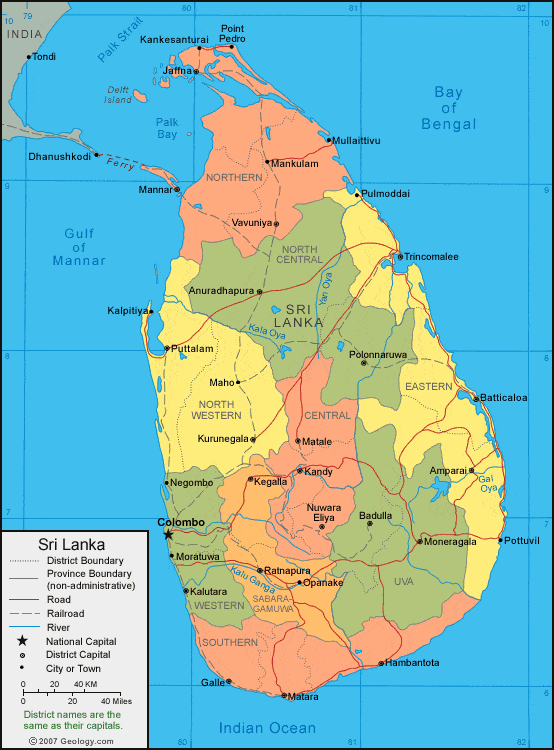
COLOMBO, Sri Lanka, April 17 (UNHCR) – UNHCR has stepped up its emergency response in the north of Sri Lanka, where more than 63,000 people have so far been displaced by heavy fighting between the military and the Liberation Tamil Tigers of Eelam (LTTE).
The displaced people fleeing the conflict zone in the north-eastern coastal pocket are being accommodated at several transit and internal displacement sites in the districts of Vavuniya, Jaffna and Mannar.
UNHCR – together with the government and other partners – is responding with massive shelter support and regular distribution of non-food aid items while carrying out protection monitoring. The aid distributions have so far been focused on Vavuniya, where a majority of the internally displaced people (IDPs) are being accommodated.
The agency has so far distributed some 36,000 plastic mats, over 22,000 bed sheets, 32,000 mosquito nets, more than 46,000 articles of clothing, 9,000 kitchen sets and thousands of hygiene kits.
The construction of shelter units by UNHCR's partners at government-designated sites is also progressing as planned. Despite formidable challenges, work on one site in Vavuniya with a capacity of up to 27,000 people is scheduled to be completed by Monday. The agency has asked the government to provide more land, including in the district of Mannar, to help alleviate overcrowding at current sites and to relieve pressure on services in Vavuniya.
"UNHCR welcomes positive steps by the government to address several protection concerns at the sites in Vavuniya," agency spokesman Ron Redmond told reporters in Geneva on Friday. "Short visits by friends and relatives to the sites are now allowed. UNHCR monitored the first round of visits on Monday [April 13]."
He added that telephone, telegramme and mail services are now operating in almost all sites in the district. Meanwhile, Redmond said, "approximately 1,800 IDPs with special needs, particularly the elderly, have been released from the sites, and some 1,345 separated families have so far been reunited, according to the government."
While commending these initiatives, Redmond said UNHCR was also urging the government to accelerate progress on other outstanding protection concerns, including maintaining the civilian character of the IDP sites and the separation of ex-combatants from the civilian population; expediting the screening process in IDP camps; and subsequently allowing freedom of movement. UNHCR has made a number of concrete suggestions on how best to proceed and will continue to work closely with the government to ensure that minimum international standards are met at all sites, he said.
The spokesman said UNHCR believed the ultimate objective of the government should be the safe and voluntary return of the displaced to their villages of origin by removing obstacles to return.
"Chief among them is the challenging task of demining," Redmond said. "We urge the international community to provide the government with technical and financial support to carry out mine clearance in areas of return."
He said UNHCR remains deeply concerned about the plight of the civilian population still trapped inside the conflict zone. "Those fleeing into government-controlled areas provide similar accounts of the dire humanitarian conditions prevalent inside the area," the spokesman noted. "The situation has worsened due to the ongoing heavy rains and winds, with most families living in flooded areas under damaged tarpaulin tents and beneath trees."
The refugee agency also called on the LTTE to immediately allow people caught in the conflict zone to move to areas where they feel safe.
"We also urge both parties to the conflict to adhere to international humanitarian law and ensure that the safety of the innocent civilian population is the top priority," Redmond said."
 | |


















 Posts
Posts