Showing posts with label Merkel. Show all posts

Monday, June 8, 2009

But the Fed attributes most of the increase in yields to investors abandoning the safety of Treasuries for riskier investments as economic optimism ri

TO BE NOTED: From The Economist:

"Central banks' exit strategies

This way out
Jun 4th 2009 | WASHINGTON, DC
From The Economist print edition


The Federal Reserve weighs plans to unwind its unconventional stimulus

Illustration by S. Kambayashi


A FIREFIGHTER’S first rule of survival is “know your way out”. The same can be said of financial firefighting. Though it has no intention of exiting soon, the Federal Reserve is planning its path out from the extraordinary measures it has taken to free credit markets and boost demand.

With other central banks, the Fed is under growing pressure to explain its exit strategy in order to allay fears that its policies will produce inflation. On June 2nd Angela Merkel, the German chancellor, launched an astonishing attack on the Fed, the Bank of England and the European Central Bank (ECB) for their loose monetary policies. Mrs Merkel’s outburst, which trampled on a German political tradition of not commenting on the actions of independent central banks, makes life awkward for the ECB, which was due on June 4th to announce details of a plan to buy €60 billion ($86 billion) of covered bonds. But her most pointed barbs were aimed elsewhere. “I am very sceptical about the extent of the Fed’s actions and the way the Bank of England has carved its own little line in Europe,” she said.

The Fed did most to unsettle Mrs Merkel and its other critics when it said on March 18th that it would buy $300 billion in Treasuries by September, plus $200 billion in bonds issued by Fannie Mae and Freddie Mac, America’s two housing-finance giants, as well as $1.25 trillion of their mortgage-backed securities by December. The purchases are meant to drive down long-term interest rates, and at first they did. Ten-year Treasury yields fell to 2.5% from 3%. But by June 3rd they were back up to 3.5%.

Some of this increase is indeed down to higher inflationary expectations. Inflation-protected bonds now imply future inflation of 2%, up from close to zero late last year, according to Barclays. On June 3rd Ben Bernanke, the Fed chairman, put some of the increase in yields down to concern about surging government borrowing.

But the Fed attributes most of the increase in yields to investors abandoning the safety of Treasuries for riskier investments as economic optimism rises. By itself, that is not a reason for the Fed to step up bond purchases, an option it has kept open. “The aim of the programme was mostly to bring down mortgage rates and generate another wave of refinancing, which it did,” says William Dudley, president of the Federal Reserve Bank of New York*. “That said, if the choice were to keep mortgage rates lower for longer or have a recovery, I’d pick the latter.” But there may be a case for the Fed to schedule extra, smaller purchases to avoid a sharp rise in yields when the current programme ends.

The Fed has financed its loans and securities purchases in the past year by creating new reserves for the banking system (in effect, printing money). Reserves have rocketed, to almost $900 billion now from an average of $11 billion in the year to September. Many analysts see these excess reserves as a pool of inflationary fuel just waiting for the match of credit demand.

The Fed considers this analysis flawed. It sees excess reserves as a problem only if they overwhelm its ability to raise the federal funds rate when need arises. That risk has shrunk since the Fed received authority in September to pay interest on reserves, as other major central banks have long been able to. That in theory should put a floor under the Fed funds rate. Banks should not lend excess reserves at, say, 1%, if they can earn 2% from the Fed.


That said, the Fed cannot be certain that paying interest will work as planned, so it would also like to be able to soak up some reserves. Some were created by the Fed’s myriad loans to banks, issuers of commercial paper and others to unfreeze the credit markets. Those liquidity facilities charge borrowers a penalty rate which makes them less attractive as private credit returns. That is now happening, and the liquidity facilities have begun to shrink (see chart). The Fed could hurry that process up by raising the penalties.

Managing its growing securities holdings will be tougher. The Fed could simply sell them but that would create waves. “The day you sell will be a big market event,” says Mr Dudley. “Historically, the Fed has been buy and hold.” Since the average maturity of the Fed’s bond holdings is five to ten years, the Fed will have to find a way to mop up, or “sterilise”, the related bank reserves for a long time. The usual approach is to conduct reverse-repurchase agreements, borrowing from one of its 16 primary dealers for short periods of time in order to finance the assets on its balance-sheet. But dealers may not have the necessary capacity for the task.

The Fed is currently absorbing reserves by having the Treasury issue more debt than it needs. When dealers purchase the debt, cash shifts from their reserves accounts to Treasury deposits at the Fed, where they remain, unspent. But the Treasury itself is constrained by the debt ceiling set by Congress, and an independent central bank should not rely on the fiscal authority for one of its tools.

A better solution would be for the Fed to issue its own bills, as other central banks do. It could rely on a wider variety of investors, not just primary dealers, to manage its balance-sheet. It would restrict the maturity of such bills to less than 30 days to avoid interfering with Treasury’s longer-dated issuance. The hitch is that Congress has to authorise it. It may come to that. “As long as people are worried about whether we have adequate tools, it makes sense for us to get more tools even if we don’t think we need them,” says Mr Dudley.


* Excerpts from the interview can be read online at www.economist.com/dudley"

Saturday, June 6, 2009

the role Egypt should play, as an important ally of Sudan, in resolving the conflict

TO BE NOTED: From Enough:

President Obama: World Has "Obligation to Act" To Stop Genocide

Printer-friendly version
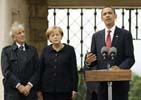
Obama delivers remarks at Buchenwald

Following up on his speech in Cairo yesterday, President Obama, speaking at the Nazi Concentration Camp Buchenwald, today addressed the genocide in Darfur and his administration's behind-the-scenes work to address Sudan's immediate humanitarian needs and broader, long-term efforts to end the conflict.

In a response to a reporter's question, here's what the president said:

…On the issue of genocide, I think “never again” means that the international community has a obligation, even when it’s inconvenient, to act when genocide is occurring. So on the issue of Darfur, for example, I didn’t simply mention it in a speech yesterday before a Muslim audience, talking about genocide that’s taking place within a majority Muslim country, but I also raised it in discussions with President Mubarak of Egypt, who has strong diplomatic relations with the country of Sudan.

And I’ve assigned one of my closest national security advisors, General Scott Gration, as a special envoy who has been traveling throughout the region trying to not only solve the immediate humanitarian crisis that exists and that was made worse when President Bashir kicked out many of the international non-governmental organizations that have been providing humanitarian assistance. We’ve been working diligently to solve that immediate problem and get humanitarian assistance back on the ground. But what we’ve also been doing is to try to reactivate the possibilities of a peaceful — a peace settlement between Khartoum and some of the rebels in Darfur that would allow the internally displaced people from Darfur to start returning to their homes.

So we’ve been very active on this issue. It may not have received the attention in the press that some of the other issues have, but we are spending a lot of time trying to make sure that we make progress and that the people of Darfur are able to return to their homes and live in peace.

It is promising to see that President Obama knew it was insufficient to address ongoing genocide in just one line of his speech; it was imperative that President Obama discuss with Egyptian President Mubarak the role Egypt should play, as an important ally of Sudan, in resolving the conflict. Coming on the heels of a high-profile speech, with international headlines still buzzing about what the president did and didn't say, the public is more tuned into his subsequent remarks, which is helpful for keeping a spotlight on Sudan. It’s also noteworthy that while the president avoided using the word ‘genocide’ yesterday to describe the conflict in Darfur, today he didn’t shy away. Against the backdrop of the site of unimaginable suffering, the president's words are a powerful call to action.

But as we have been saying, along with editorial boards, activists, and U.S. leaders, President Obama's strong rhetoric must be followed up with concrete action. This high-profile verbal commitment to ending the genocide in Darfur is very welcome, but we -- and certainly the people of Darfur and Sudan as a whole -- are waiting to see the tangible results.

N.B.: To listen to a powerful radio broadcast by Edward Murrow from 1945, reporting on the liberation of Buchenwald, click here.

Photo: President Barack Obama delivers remarks at Nazi concentration camp Buchenwald, alongside German Chancellor Angela Merkel and Holocaust survivor Elie Wiesel. AP/Ina Fassbender"

From the WSJ:

"President Barack Obama called “for all of us to redouble our efforts” toward separate Israeli and Palestinian states. Alongside German Chancellor Angela Merkel one day after his trip to the Middle East, Obama said: “The United States can’t force peace upon the parties.” But he said America has “at least created the space, the atmosphere, in which talks can restart.” Here, the remarks from their news conference in Dresden.

10:30 A.M. (Local)

CHANCELLOR MERKEL: (As translated.) We are delighted to have the American President here this morning with us, after having met the last time at the NATO summit. We will visit a little bit of Dresden and later on we go on to Buchenwald, to the former concentration camp. I think that this is, indeed, a trip of a highly symbolic nature. Let me just remind all of us of the visit to Buchenwald that we will take later in the day. It is so important that the American President, Barack Obama, makes his first stop here in Dresden. This is a highly symbolic city. It is a city that was almost completely destroyed during the Second World War, was then rebuilt after Germany unification. It has again turned out to be a jewel of German culture and civilization. The people here are so glad that you’ve come to see them because it shows that you also pay tribute to the tremendous efforts they made in those 20 years after the fall of the wall.

We have made very good use of that time, talking about the political agenda, pressing issues. President Obama yesterday gave a very important speech in Cairo, which I think will be an ideal basis for a lot of action of a positive nature, particularly as regards speeding of the peace process in the Middle East. We also talked about a possible time frame for possible progress to be made. I said on behalf of the Federal Republic of Germany that we would like to try and be helpful in this peace process to the extent that this is possible to us. We need a two-state solution; we need a viable Palestinian state and a viable state of Israel, side by side. And whatever we can do in order to constructively accompany this along the way we will gladly do.

The status of negotiations with Iran on the nuclear program was also at the very top of our agenda. Here, too, we agreed to work closely together. Germany will try its utmost with its contacts, with its expert knowledge to give a positive contribution to this issue.

We also obviously debated the situation on world markets. We exchanged views on the different stimulus programs that we pursue in our countries. And we also talked about what we feel is necessary in order to prepare the next G20 meeting, then also the upcoming G8 meeting. What is important is to implement what we decided on in London. The European states are now doing that; the United States are doing that. You have a very ambitious plan that you outlaid. So we will keep a close eye on developments. And then in the autumn when we meet at G20 we will also state very clearly that strengthening the multilateral system is also one that we consider to be important.

This year negotiations on climate change, on a post-Kyoto regime are also on the agenda. We very much welcome the very, very hard work that the United States has done in order to see to it that the necessary answers are found for this phenomenon of climate change. We know that it’s very much an uphill battle; we’re very familiar with that from the debate that we have here in our country. And we are keeping a close eye on legislation that is passed. We, I think, are at one in saying we need an ambitious program, we want to have successful negotiations in Copenhagen, and we want to make the best possible use of our time leading up to this.

Once again, a very warm welcome to you, sir, and we are so glad that you and the members of your team have taken the trouble to come here.

PRESIDENT OBAMA: Well, thank you very much, everybody. Good morning. It is wonderful to be in the beautiful city of Dresden, which obviously is steeped in history and, as Chancellor Merkel discussed, has overcome great tragedies and is now this beautiful city full of hope. And so I’m very grateful to not only Chancellor Merkel but to the German people for their hospitality.

Germany is a close friend and a critical partner to the United States, and I believe that friendship is going to be essential not only for our two countries but for the world if we are to make progress on some of the critical issues that we face, whether it’s national security issues or economic issues or issues that affect the globe like climate change.

Chancellor Merkel, as she mentioned, and I had a very productive discussion. We continue to work closely together to confront the global economic crisis and to restore growth and prosperity for our people. The downturn knows no borders and it will take some time and sustained action by all of us to move forward.

At the G20, we successfully laid out the parameters for collective action. And we’ve seen, I think on both sides of the Atlantic, some progress in stabilizing the economy, but we’re far from done in the work that’s required. I mentioned to her that, in the United States, we are working diligently to strengthen financial regulations to ensure that a crisis like this doesn’t happen again, and it’s going to be very important to coordinate between Europe and the United States as we move to strengthen our financial regulatory systems. We affirmed that we are not going to engage in protectionism. And as all of us do what’s required to restart our economy, we have to make sure that we keep our borders open and that companies can move back and forth between the United States and Europe in providing goods and services to our respective countries.

I’m very pleased to see the resolution of the Opel situation here. We are very sympathetic towards each other, that it’s not easy to help auto companies restructure, and it’s not always popular, but it’s also, we are convinced, the right thing to do. And I’m hopeful that not only are we going to see these companies stabilize, but also that they’re going to emerge even stronger and more competitive in the international marketplace.

Chancellor Merkel and I discussed a range of security challenges. Germany has been a very strong NATO partner. As all of you know, we have great challenges in Afghanistan and increasingly in Pakistan, but our collective commitment to making sure that we are not seeing the kinds of terrorist bases that could pose harm to all of our people, that we maintain that commitment.

We also discussed the issue of Iran — and not in isolation, but in a broader context of avoiding a nuclear arms race in the Middle East that could be profoundly dangerous. And I’ve said publicly that I’m committed to engaging in serious dialogue and negotiations with Iran. That can’t be done in isolation, it has to be done in conjunction with the P5-plus-1 or the E3-plus-3 process, and Germany is going to be a critical partner in that process.

Later in the summer I will be traveling to Russia to discuss how we can reduce U.S. nuclear stockpiles and Russian nuclear stockpiles. And so as I said, our concern is not just Iran, but a broader effort to strengthen nonproliferation so that the threat of nuclear weapons is greatly reduced in our lifetime.

And as the Chancellor mentioned, we discussed my recent trip to the Middle East and the need for all of us to redouble our efforts to bring about two states, Israel and a Palestinian state, that are living side by side in peace and security. I think the moment is now for us to act on what we all know to be the truth, which is that each side is going to have to make some difficult compromises; we have to reject violence. The Palestinians have to get serious about creating the security environment that is required for Israel to feel confident. Israelis are going to have to take some difficult steps. I discussed some of those in the speech.

Ultimately, the United States can’t force peace upon the parties. But what we’ve tried to do is to clear away some of the misunderstandings so that we can at least begin to have frank dialogue. And we’re not going to be able to do that by ourselves; we’re going to require strong partners like Germany in that process. And I know that Chancellor Merkel is very much committed to that.

So, again, it is a great pleasure to be here. It is a great pleasure to be with my friend once again, who I always seek out for intelligent analysis and straight talk. And I’m looking forward to continued partnership between our two countries to deal with the wide range of issues that we confront at this time.

So thank you very much.

CHANCELLOR MERKEL: Well, I believe you have the possibility to ask questions. Maybe we ought to — do we start with a German question?

Q Christiane Meier, from the First German Television. Mr. President, did you have the opportunity to also address the issue of Guantanamo and do you feel sufficiently supported by Europe and here, in particular, by Germany, in accepting prisoners, former prisoners? And does this perhaps overshadow your relationship with the Chancellor or perhaps not — there has been certain mild, sometimes even wild speculation over the course that your trip took, that you left certain venues open until the end and that this had something to do with your relationship with the Chancellor.

And Chancellor, did you make an offer or were you actually able as regards Guantanamo to give certain assurances to the President and accommodate him?

PRESIDENT OBAMA: I think your characterization of wild speculations is accurate — they are very wild and based on no facts. The truth of the matter is, is that the relationship not only between our two countries but our two governments is outstanding. Most of the speculation around my schedule here in Germany doesn’t take into account simple logistics: traveling, trying to get from one place to the other, coming off a Middle East trip, having to go to Normandy tomorrow. There are only 24 hours in the day. And so there’s nothing to any of that speculation beyond us just trying to fit in what we could do on such a short trip. That’s all that there was.

So stop it, all of you. (Laughter.) I know you have to find something to report on, but we have more than enough problems out there without manufacturing problems.

In terms of the issue of Guantanamo, look, this is a very difficult issue. It’s difficult in my country; it’s difficult internationally. We have a facility that contains some people who are very difficult to deal with. Some of them probably should not have been detained in those facilities in the first place. They should have been processed and tried and convicted. If they weren’t convicted, then they should not have been languishing in a facility like that, that became a symbol for many around the world of us not sticking to our ideals and our traditions and rule of law.

But it was done. And that’s the past. And now we have to move forward. We have spoken to the European Union about the possibilities of working with us and helping us in managing the closure of Guantanamo. Chancellor Merkel has been very open to discussions with us. We have not asked her for hard commitments, and she has not given us any hard commitments beyond having a serious discussion about are there ways that we can solve this problem. And I don’t anticipate that it’s going to be resolved anytime in the next two or three months. I think it’s going to be a longer process of evaluation.

But I’m very appreciative of the openness, not only of Chancellor Merkel but other European countries to work with us, because I think they recognize that we have a shared interest in battling extremists and terrorists at the same time as we have a shared interest in upholding broader principles of international justice; and that those things are compatible, but it’s going to take some time.

We’ll be looking at individual cases; seeing are there people who can safely be transferred; if they are safely transferred, where would they be transferred to. And this is a conversation we’re not just having with Germany but the broader European Union. And I very much appreciate the constructive manner in which Chancellor Merkel has approached the issue.

CHANCELLOR MERKEL: Allow me, if I may, to, as regards that one part of the question, say that it’s fun to work together with the American President because very serious, very thorough analytical discussions very often lead us to draw the same conclusions. And I think we proved that in London, we proved that on previous meetings. I think that’s part of our job, isn’t it, that you exchange views, different views that you may have also. And wherever it was necessary, we have come to common solutions. So I very much look forward to our future cooperation.

On Guantanamo, Germany has always come out in favor, in particular my government, for closing down this facility. This has been a long-standing issue. We very purposefully at the time accepted Mr. Kurnaz, who has some sort of relation to Germany. And we also said that when there is a solution in the offing we will constructively contribute to it. Now there are talks going on of the Minister of the Interior with the American side, very intensive discussions, which we wish to continue. And at the very end I am absolutely confident that we will find a common solution.

I believe a question from the American side maybe.

PRESIDENT OBAMA: Just pick on somebody or —

Q Mr. President –

PRESIDENT OBAMA: You know, Jennifer has got the mic; sorry, Jake. (Laughter.)

Q He handed it to me, so I’m going to keep it.

PRESIDENT OBAMA: There you go.

Q Thank you, Mr. President. You challenged — on Mideast peace, you challenged all the parties yesterday and again here in your opening remarks to take actions. The Israelis, the Palestinians, the Arab states, things they’ve been asked to do for years, actually agreed to do, but still today remain even — perhaps even more unwilling or unable to do them. What are your specific next steps to try to break this stalemate? And why do you think your approach is realistic?

And then to Chancellor Merkel, if I could, you talked about a timeline that the two of you discussed on Mideast peace. Can you be more specific about that, please?

PRESIDENT OBAMA: As I said at the outset of my speech, yesterday was just one speech and it doesn’t replace all the hard work that’s going to have to be done — that was done before the speech and is going to have to be done in the years to come in order to solve what has been a 60-year problem. And I’m under no illusions that whatever statements I’ve put forward somehow are going to supplant the need to do that work.

I think that what is different now is, number one, you’re seeing a U.S. administration and American President engage this issue almost on the day that I took office. We’ve only been in office five months, and yet we’ve seen extraordinary activity already on this issue. And that’s sent a signal to all the parties in the Middle East that we are serious. I’ve assigned George Mitchell, my special envoy, who has met repeatedly with all the players in the region and who is going to be going back next week in the wake of my appearance in Cairo to follow up with each of the individual parties on a whole host of negotiation points and potential confidence-building measures that can be taken.

And I’ve already met with Prime Minister Netanyahu. Our governments are in close contact and communication about how we can move forward on some of the items that might be inhibiting restarting talks. I’ve had Abbas in the White House to do the same.

And so you’ve probably seen more sustained activity on this issue in the first five months than you would have seen in most previous administrations. The reason we are doing that is because not only had talks ground to a halt, but there was a sense that all sides were getting so dug in and so cynical that you might reach a point where you could never get the parties back at the table. And I think given what we’ve done so far, we’ve at least created the space, the atmosphere, in which talks can restart.

Now, I just have to say one more time, the United States can’t solve this problem. The United States can be a partner in solving the problem, but ultimately the parties involved are going to have to make a decision that the prosperity and security of their people is best served by negotiations and compromise, and we can’t force them to make those difficult decisions. What we can do is to provide them a framework and a forum and the support for such an outcome to be achieved.

And I’m sure that — one of the things I very much appreciate was Chancellor Merkel’s willingness to put the prestige and the resources of the German government behind that same effort. I think the entire international community is going to have a responsibility to help these parties achieve a hard-won peace that will ultimately be good for everybody’s security interests.

CHANCELLOR MERKEL: Well, I believe that with the new American administration, with President Barack Obama, there is actually a unique opportunity now to see to it that this peace process — or let’s perhaps be more careful — this negotiation process to be revived again.

Yesterday’s speech in a way opened up also the door to the Arab world again. And in the way that it was described just now you have sort of made steps along the way. And when steps are made along the way then we feel as Germans we can perhaps be helpful to accompany this. For historical reasons we have a very close and very special relationship with Israel. We have a very great interest in the safety and security of Israel. And on the other hand we also have a very fervent wish a Palestinian state be built.

This agenda needs to be worked on step by step, but it is certainly true the parties, themselves, have to show a readiness, a willingness to do something for the peace and security of the world as a whole. I see this as a core issue, and an essential and crucial issue. And this is why we all have the wish and the willingness to bring this matter forward. The historical opportunity I think is there, even though looking at many, many countries in the Arab world — even looking at many countries in the Arab world, they have a very great interest in progress there because for the economic development as well they need peace there, they need security. And we should have every interest in seeing this bring about and we will give our contribution to it.

Q You will later on, Mr. President, visit the former concentration camp, Buchenwald. Tell me now already, if possible, what is your personal motivation, what drives you to this? We were told here in Germany that because you know Elie Wiesel, the Nobel Peace Prize Winner so well, because he told you about his periods in the camp where he suffered great hardship that this sort of made you do it.

And another political issue, if I may. Madam Chancellor, climate change. Germany, Europe are putting concrete targets on the agenda, concrete reduction targets. Will America in the post-Kyoto process be willing to commit itself to concrete reduction targets? Or are you pursuing a different kind of approach, Mr. President, similar to you predecessor in office?

PRESIDENT OBAMA: Well, first of all, one of the main reasons for me being in Europe this week is to commemorate the 65th anniversary of the landing in Normandy. And this is a moment that obviously is of great importance to the United States, so many lives were lost during this period; it marks the beginning of the end of World War II, and many of the veterans of World War II are in the sunset of their years. And so having an opportunity to acknowledge them once again and the sacrifices they made was very important to me.

As part of that trip we thought it was very important for me to visit Buchenwald. First of all, I’ve never traveled to one of the concentration camps, but this one has a personal connection to me. It’s not only that I know Elie Wiesel and have read about his writings, it’s also that — and I’ve stated this before — that my grandfather’s — my grandmother’s brother was one — was part of the units that first liberated that camp. And I’ve talked about this before in the United States, perhaps not in Germany, the shock for this very young man — he couldn’t have been more than 19, 20, 21 at the time, was such that he ended up, when he returned, having a very difficult time readjusting to civilian life, and it was a memory that burned in him for quite some time.

And that, you know, was something that I learned about as a young person, and for me then to be able to come and reflect on this very difficult history and to not only reflect on the dangers of when peoples are in conflict and not acknowledging a common humanity; but also to celebrate how out of that tragedy you now have a unified Europe, a Germany that is a very close ally of Israel, and the possibilities of reconciliation and forgiveness and hope. All those things I think are part of why this visit is very important to me.

In terms of climate change, ultimately the world is going to need targets that it can meet. It can’t be general, vague approaches. We’re going to have to make some tough decisions and take concrete actions if we are going to deal with a potentially cataclysmic disaster. And we are seeing progress in Congress around energy legislation that would set up for the first time in the United States a cap and trade system. That process is moving forward in ways that I think if you had asked political experts two or three months ago would have seemed impossible.

So I’m actually more optimistic than I was about America being able to take leadership on this issue, joining Europe, which over the last several years has been ahead of us on this issue.

As I told Chancellor Merkel, unless the United States and Europe, with our large carbon footprints, per capita carbon footprints, are willing to take some decisive steps, it’s going to be very difficult for us to persuade countries that on a per capita basis at least are still much less wealthy, like China or India, to take the steps that they’re going to need to take in controlling carbon emissions.

So we are very committed to working together and hopeful that we can arrive in Copenhagen having displayed that commitment in concrete ways.

CHANCELLOR MERKEL: Allow me, if I may, to say, as to a visit to Buchenwald, that this is for me deeply moving, to see an American President, in this case President Barack Obama, as a visitor in Buchenwald. And he talked about his personal background as regards this question.

Look at Buchenwald. Buchenwald is one example of these horrible concentration camps, liberated by American troops. Later on it was turned during the Soviet period again, and it also, in the time when Germany was divided, it again became somewhat symbolic. People in that part of the country were not able to enjoy freedom and security.

Now, after the end of the Cold War, we go there after Germany has been reunited, after Europe has been reunited, now that we also enjoy freedom and democracy, as the United States does. That is very moving, and it shows you that actually history makes things possible if a sufficient number of people believe in the dream of freedom.

Q Thank you, Mr. President. A couple questions, one just to follow up on Jennifer’s. What are some of the gestures of good faith that you’d like to see from the Israelis and Palestinians? But then regarding your visit to Buchenwald, since the Holocaust, a constant refrain in the United States has been “never again,” but U.S. President after U.S. President has sat back and let genocides happen over and over, whether Cambodia or Rwanda. What does “never again” mean to you as a U.S. President, especially given the fact that genocide is going on right now in Darfur? There were accusations of genocide in Sri Lanka a few weeks ago. What does it mean to you? And are you doing everything you can to make sure “never again” is not a hollow refrain?

And then for Chancellor Merkel, does Germany not have an extra obligation to take action to prevent genocide from happening in other parts of the world? Thank you.

PRESIDENT OBAMA: With respect to confidence-building measures or next steps, again, I’m going to be sending George Mitchell back into the region next week. He’s going to be meeting with all the various parties involved. I think I’ve said publicly and I repeated in the speech some things that are going to have to be done.

You know, a lot of attention has been given to my statement that the Israelis need to stop settlement construction, and I recognize that it’s received a lot of attention in Israel, as well. Keep in mind that all I’ve done there is reaffirm commitments that the Israelis themselves had already made in the road map. And I recognize the very difficult politics within Israel of getting that done, and I’m very sympathetic to how hard it will be.

But as Israel’s friend, the United States I think has an obligation to just be honest with that friend about how important it is to achieve a two-state solution — for Israel’s national security interests, as well as ours, as well as the Palestinians. And that’s an area where steps can be taken.

They’re not the only steps, by the way, that Israel can take and will need to take in order to advance movement towards peace. And I mentioned some of the other issues that I’ve discussed with Prime Minister Netanyahu’s office, for example, increasing freedom of movement within the West Bank, dealing with the humanitarian crisis in Gaza and allowing reconstruction to proceed more aggressively.

What’s been interesting is that less attention has been focused on the insistence on my part that the Palestinians and the Arab states have to take very concrete actions. When it comes to the Palestinians, we know what they’re supposed to be doing. They have to continue to make progress on security in the West Bank.

They have to deal with incitement issues. There’s still a tendency, even within — among Palestinians who say they are interested in peace with Israel, to engage in statements that are — that incite a hatred of Israel or are not constructive to the peace process. Now I think, to his credit, President Abbas has made progress on this issue — but not enough.

We still have not seen a firm commitment from the Palestinian Authority that they can control some of the border areas that Israel is going to be very concerned about if there were to be a two-state solution. There are still problems of corruption and mismanagement within the Authority that have to be addressed.

So there are going to be a whole set of things having to do with the Palestinians’ ability to govern effectively and maintain security. And if they’re not solved, Israelis are going to have trouble moving forward.

And the Arab states, what I’d like to see is indicators that they are willing, if Israel makes tough commitments, to also make some hard choices that will allow for an opening of commerce, diplomatic exchanges between Israel and its neighbors.

Now, all these things are going to take time. They’re not going to happen immediately. But I’m confident that if we stick with it, having started early, that we can make some serious progress this year.

On the issue of genocide, I think “never again” means that the international community has a obligation, even when it’s inconvenient, to act when genocide is occurring. So on the issue of Darfur, for example, I didn’t simply mention it in a speech yesterday before a Muslim audience, talking about genocide that’s taking place within a majority Muslim country, but I also raised it in discussions with President Mubarak of Egypt, who has strong diplomatic relations with the country of Sudan.

And I’ve assigned one of my closest national security advisors, General Scott Gration, as a special envoy who has been traveling throughout the region trying to not only solve the immediate humanitarian crisis that exists and that was made worse when President Bashir kicked out many of the international non-governmental organizations that have been providing humanitarian assistance. We’ve been working diligently to solve that immediate problem and get humanitarian assistance back on the ground. But what we’ve also been doing is to try to reactivate the possibilities of a peaceful — a peace settlement between Khartoum and some of the rebels in Darfur that would allow the internally displaced people from Darfur to start returning to their homes.

So we’ve been very active on this issue. It may not have received the attention in the press that some of the other issues have, but we are spending a lot of time trying to make sure that we make progress and that the people of Darfur are able to return to their homes and live in peace.

CHANCELLOR MERKEL: Well, first, experience — part and parcel of our history, of our past experience here in Germany is obviously the Shoah. And out of that comes an everlasting responsibility for the safety and security of the state of Israel. If you like, this has been the (inaudible) of every German government, ever since the Federal Republic came into being, and it will always be that case.

As regards genocide all over the world, we have an international responsibility that we need to shoulder here. And here, too, we work very closely together. We, all of us, have made the experience I think along the way that this quite often takes much longer to resolve than one would like it to be and can be satisfied about.

But military intervention alone, without any political framework that we put on these issues, is also not always successful. We’ve made that experience, as well. This is why the European Union — actually during the EU-Africa Summit established very close links with the African Union, trying also to win over African countries to shoulder their responsibility or helping them shoulder their responsibility, for example by providing them with the necessary material, the equipment, but also through political discussions.

I think that due to the experience we’ve made over the years as European Union members that we were able after the Second World War to live together peacefully. We have an obligation not only to create peace within Europe, because we’ve been able to do that, but to actually share with others the knowledge how we managed to get that to happen. Dignity of man is inviolable. This is what is inscribed in the German constitution. And this goes not only for the Germans, not only for the Europeans, but for every human being all over the world. It means we can solve problems of this kind. We as Germans, after the Second World War, have made an experience that was certainly not a matter of course. The Allies actually extended a helping hand to us, to our neighbor France, the United Kingdom, but also the United States of America. We need to share this experience in order to prevent further cases of tragedy occurring. And we will always be at your side, at the side of the Americans.

Thank you very much.

PRESIDENT OBAMA: Thank you.

END 11:12 A.M. (Local)

Source: The White House"

Saturday, April 11, 2009

The plan distinguishes between “toxic” securities, which should fall on the shoulders of banks and their shareholders, and “illiquid” ones

TO BE NOTED: From Bloomberg:

"Steinbrueck Drafts German ‘Bad Bank’ Financial Rescue Plan

By Patrick Donahue

April 11 (Bloomberg) -- German Finance Minister Peer Steinbrueck drew up a plan to remove toxic assets from bank balance sheets, based on government funding for financial institutions to set up so-called bad banks.

The Finance Ministry submitted the program to Chancellor Angela Merkel, and administration and finance-industry officials will decide on the details on April 21, the German government said in an e-mailed statement today.

Under the plan banks would create separate units, backed by 200 billion euros ($264 billion) in government funds, into which they’ll be able to transfer assets they can’t sell, Steinbrueck told the Frankfurter Allgemeine Sonntagszeitung in an interview.

Steinbrueck has come under pressure to develop a plan emulating those in the U.S. and U.K. to try to jumpstart lending. Six months before a federal election, the unity of the ruling coalition is being strained after Steinbrueck, a Social Democrat, drafted legislation to seize lenders, and the problem of toxic assets remains unsolved.

Steinbrueck has resisted earlier proposals to set aside funds for toxic assets, since it would require a sale of bonds. The finance minister told the newspaper he rejected the idea of a centralized “bad bank.”

The plan distinguishes between “toxic” securities, which should fall on the shoulders of banks and their shareholders, and “illiquid” ones, which the government will take over, and sell when markets improve, Steinbrueck told the newspaper.

Germany responded to the financial collapse in October by pushing a 500 billion-euro bank-rescue package through parliament in a week.

To contact the reporter on this story: Patrick Donahue in Berlin at at pdonahue1@bloomberg.net."

Wednesday, April 1, 2009

“It is not something we even want to change.”

TO BE NOTED: From the FT:

"
Why G20 leaders will fail to deal with the big challenge

By Martin Wolf

Published: March 31 2009 19:10 | Last updated: March 31 2009 19:10

Ferguson illustration

The summit of the Group of 20 leading high-income and emerging countries in London on Thursday seems set to achieve progress. But achievement must be measured not just against past performances, but against “the fierce urgency of now”. Unfortunately, it will come up short.

The Organisation for Economic Co-operation and Development now forecasts a 4.3 per cent contraction in the economies of advanced countries this year, followed by stagnation in 2010. In advanced member countries, joblessness may rise by 25m by 2010. Meanwhile, the International Monetary Fund forecasts that the global economy will shrink by between 0.5 and 1 per cent this year. This would be an increase in the “output gap” (gap between actual and potential output) of some 4 per cent.

Will the G20 rise to  these exceptional challenges? No, is the answer. What is needed is a large increase both in aggregate demand and a shift in its distribution, away from chronic deficit countries, towards surplus ones. On both points, progress will be far too limited.

The OECD argues that the discretionary stimulus measures taken by governments in response to the crisis will on average boost gross domestic product by just 0.5 per cent in 2009 and in 2010. In addition, the extra demand is coming at least as much from deficit as from surplus countries. This is not a recipe for resolution of global imbalances, but for their indefinite prolongation.

Unfortunately, no consensus exists on the underlying causes of this crisis or on the best ways to escape from it. The US and UK agree that the excesses of the financial sectors have their roots not just in deregulation, but also in the massive excess supply of surplus countries, of which China, Germany and Japan (with respective current account surpluses of $372bn, $253bn and $211bn in 2007) are the most significant. But China and the continental European countries, led by Germany, argue it is all the fault of profligate deficit countries. Yet China also hopes that the world will soon be able to absorb its excess supply again.

In last week’s FT interview with Angela Merkel, the German chancellor said that: “The German economy is very reliant on exports, and this is not something you can change in two years.” Moreover, “It is not something we even want to change.” To paraphrase: “The rest of the world needs to find a way of absorbing our excess supply, but sustainably, please.” Yet what happens if that cannot be achieved for the excess potential supply of all surplus countries together? In 2007, the three countries ran current account surpluses of $835bn (€629bn, £585bn). Logically, counterpart deficit countries must spend that much more than their incomes. Yet today deficit countries have run out of willing and creditworthy private borrowers.

That change is what this crisis is all about, as the charts show. Between 2007 and 2009, the crisis-hit private sectors of the US, UK and Spain will, on these forecasts, shift their financial balances (the difference between their incomes and expenditures) massively towards surplus, as savings rise and spending is cut. In Spain, the shift is forecast to be 11.7 per cent of GDP. The main offsets in these deficit countries will be huge jumps in fiscal deficits, although the current account deficits are also, inevitably, shrinking.

Surplus countries, which relied on the private sectors of deficit countries to do their irresponsible borrowing for them, show a very different pattern: their private sector balances will change rather little and, in all cases, will be in large surplus throughout: big current account surpluses nearly always mean private sector excess savings. But, as their external surpluses shrink, fiscal deficits will grow, partly because of deliberate policy but also because of the automatic consequences of recessions.

So fiscal positions are deteriorating and current account surpluses and deficits are dwindling everywhere, as the private sectors of deficit countries cut back their spending dramatically. But the expected fiscal deterioration is bigger in the deficit countries than in the surplus ones. With the exception of Japan, the fiscal deficits will also be bigger in the deficit countries. The small size of the expected shift in China’s fiscal deficit, the modest level of its 2009 fiscal deficit and the persistence of the massive surpluses of its private and state-owned enterprise sector is striking. This is a country expecting (or at least hoping for) a recovery in external demand.

What this analysis is telling us is quite simple: next to no adjustment in underlying structural imbalances is occurring. In particular, the non-fiscal sectors of the three big surplus countries are expected to continue to run huge surpluses. The change – temporary, the surplus countries surely hope – is that domestic fiscal expansion is modestly offsetting the decline in demand coming from deficit countries with over-leveraged private sectors. But that decline in private demand is also offset by massive fiscal boosts in deficit countries.

This is not a path towards a durable exit from the crisis. It is a path on which the fiscal deficits needed to offset persistent current account deficits, and collapsing private spending in external deficit countries, continue indefinitely. Unless and until surplus countries recognise that this cannot continue, no durable escape from the crisis will be achieved. Understandably, but foolishly, they are unwilling to do so.

So what is to be done? That must be a central agenda item of the next G20 summit. The world economy cannot be safely balanced by encouraging a relatively small number of countries to spend themselves into bankruptcy. The answer lies partly in changing the policies of surplus countries. But it lies as much in rethinking the international monetary system. The case for sizeable and ongoing allocations of special drawing rights – the IMF’s reserve asset – is powerful, as, among others, Zhou Xiaochuan, governor of the People’s Bank of China, has argued in a fascinating recent paper*. I hope soon to return to this huge challenge and opportunity. In the meantime, the G20 summit is largely dealing with the immediate symptoms of the illness. Finding a longer-term cure for chronic global excess supply still lies ahead.

* Reform the International Monetary System, www.pbc.gov.cn/english

martin.wolf@ft.com"

Saturday, December 20, 2008

"almost four times the first one that was much derided by Germany's EU partners, including Britain."

I predicted that Merkel would eventually be for a bigger stimulus, which is why I'm bringing this post up. From the Guardian:

Germany and France, the eurozone's two biggest economies, are sinking deeper into recession and preparing to adopt further stimulus packages.

Chancellor Angela Merkel announced that Germany would pump more into the struggling economy and signalled a supplementary budget for 2009. ( AS I PREDICTED )

Spiegel-Online reported that her government's second package would amount to €40bn (£37.31bn) or almost four times the first one that was much derided by Germany's EU partners, including Britain. ( BINGO! )

The magazine said the new package, far bigger than even the UK's, would give a fiscal stimulus of up to 2% of GDP compared with the average of 1.5% sought under the EU's €200bn total package endorsed at last week's summit. ( YOU DON'T SAY )

It said the bulk of the package would be spent on roads, schools, universities and sports facilities as well as internet networks. But it would also comprise lower income tax bands and bigger federal contributions to sickness insurance. ( ESSENTIALLY WHAT I RECOMMEND: TAX CUTS, INFRASTRUCTURE INVESTMENT, AND SOCIAL SAFETY NET SPENDING )

In France fresh evidence also emerged today from Insee, the national statistics agency, that the economy will shrink this quarter by 0.8% and by another 0.4% in the first three months of next year – a genuine recession.

With German business confidence at a 25-year low and the economics ministry predicting a 3% contraction in 2009, Merkel admitted her government would be forced to borrow more money to meet "extraordinary challenges". ( YEP )

Her finance minister, Peer Steinbrueck, the fiercest opponent of increased spending to reboot the economy ("crass Keynesianism"), acknowledged that the country's economy would sink deeper into the mire this quarter. ( DID HE NOW ? )

Both have come under exceptional pressure from other EU governments to adopt more drastic measures than foreseen so far under the €12bn stimulus package as exports wilt and unemployment is set to rise.

Merkel said in a newspaper interview that any extra spending would be destined for infrastructure projects. Her grand coalition government is expected to announce the scale of its second package late in January but is under pressure to act earlier.

Current budget planning envisages net borrowing of €18.5bn in 2009, assuming growth of 0.2%. But media reports suggest the borrowing could be as high as €40bn as the economy deteriorates rapidly.

The federal government is expected to borrow up to €323bn next year to finance its expanded budget and the bank rescue scheme as reduced tax yields and higher spending on the jobless alone cost it €9bn. Federal debt, already at €1.5tn or more than 60% of GDP, will rise.

With French business confidence at a 15-year low, according to Insee today, the government is under pressure to pump in more than the €26bn programme announced by President Nicolas Sarkozy last month. France is among several eurozone countries demanding that the EU limit of 3% on budget deficits be formally suspended. ( WISE MOVE )

Insee said the business climate had clearly worsened again and the outlook remained below its historic minimum, with order books emptying and considered very thin.

The latest surveys, against a background of a soaring euro, put renewed pressure on the European Central Bank to slash interest rates in line with its US, UK and Japanese counterparts. But hawks, led by Germans, are demanding a return to fiscal discipline and warning that excessive spending threatens the single currency's stability. ( A WARNING IS PRUDENT )

Sunday, December 14, 2008

She is sceptical of strategies aimed primarily at boosting consumption, given Germany’s high savings rate and low unemployment."

Let's start the German Problem with Willem Buiter in the FT:

"Confessions of a crass Keynesian
December 13, 2008

The German federal minister of finance, Peer Steinbrueck, does not like anything that increases government deficits. He does not like them, Sam-I-Am. I believe he is wrong - very wrong and dangerously wrong. In the interest of Anglo-German harmony and ever-closer cooperation, I have written this post.

It explains that there are bad deficits and good deficits. Or, in the words of Ecclesiastes: “To every thing there is a season, and a time to every purpose under the heaven:” a time to cut taxes and a time to raise taxes, a time to borrow and a time to refrain from borrowing.

Today is a time, even Ecclesiastes would agree, made for increased government borrowing, provided a few key conditions are satisfied.

Mum, the government are running a deficit again!

Government deficits have to be financed by selling assets, by borrowing from the domestic private sector, from the rest of the world or from the central bank. Asset sales by the government can be ignored as a financing option for the governments of the USA, the UK and the nations that constitute the Euro Area. Quite the opposite has been happening lately, with governments acquiring large stake in domestic banks and other financial institutions.

Borrowing from the central bank

Borrowing from the central bank (selling Treasury debt to the central bank) requires the central bank either to increase its monetary liabilities (currency or bank reserves held with the central bank), or to increase its non-monetary liabilities, or to run down its stock of official foreign exchange reserves or other central bank assets. The USA, the Euro Area and the UK all have floating exchange rates, and foreign exchange market intervention has not been a significant pastime for the monetary authorities of these countries. Under current economic circumstances, financing the acquisition of additional Treasury debt by running down central bank holdings of private securities would not make sense. True non-monetary liabilities of the central bank (Central Bank Bills or Central Bank Bonds) are common in developing countries and emerging markets but have not been a common sight on the balance sheets of the Fed, the ECB and the Bank of England - until recently.

The Federal Reserve System today holds a large amount (more than $400 bn) of Treasury deposits on its balance sheet , the result of the Treasury selling Treasury securities to the public and depositing the money with the Fed. The Fed has used these funds to acquire additional private securities. Instead of borrowing from the Treasury (through the Treasury’s deposits with the Federal Reserve System), the Fed is currently considering the possibility of issuing non-monetary, interest-bearing securities directly to the market. Assuming Treasury and Fed securities of the same maturity are perfect substitutes for private investors, this would give the Fed another, economically equivalent mechanism for expanding its balance sheet without increasing the monetary base. Why the Fed would want to increase the size of its balance sheet by issuing non-monetary liabilities rather than monetary liabilities is unclear to me. Liquidity preference remains unbounded from above. Further quantitative easing is not inflationary for as long as current economic conditions last.

Once the official policy rate is at its zero floor, quantitative and qualitative easing are the main instruments of monetary policy, which becomes inextricably intertwined with liquidity management. By acquiring longer-dated government securities and financing these purchases by expanding the base money stock, central banks can bring down the risk-free nominal rate of interest at longer maturities than overnight. Such purchases of longer-maturity government securities reinforce the expectations mechanism - long-term risk-free nominal yields are tied to current expectations of future overnight rates, give or take a term premium. By acquiring private securities, including illiquid private securities, whether through outright purchase or as collateral in repos or at the discount window, the central bank can influence a range of term spreads and liquidity spreads on these private securities.

For simplicity and to put the issue as sharply as possible, let’s assume that when the government (the Treasury) borrows from the central bank, the central bank monetises its acquisition of the Treasury securities, that is, it increases the sum of currency and banks’ deposits (reserves) with the central bank. In practice, the increase in base money is likely to take the form mainly of larger bank reserves with the central bank.

As long as the economy is in the doldrums, with a large (or even large and growing) amount of spare capacity and extreme risk-averse behaviour of banks, other financial institutions and individual investors, the increased quantity of central bank money will be absorbed willingly at the current price level and at the current (near zero) level of the short-run nominal interest rate. Fear and loathing in the financial markets have created a near unbounded liquidity preference - a willingness to hold a humongous quantity of real base money. Such injections of base money are therefore not inflationary.

When the economy recovers, as it will, and private investors recover their bottle, the demand for real base money normalises and the private sector finds itself with excessive real base money balances at the current official policy rate and price level. The private sector will try to reduce its holdings of real money base money balances partly by switching their portfolio allocation towards non-monetary assets and partly by spending them. In the aggregate, of course, the private sector cannot reduce the nominal stock of base money, unless the central bank plays ball and de-monetises the public debt it had monetised earlier. If it does not do so, monetary equilibrium will have to restored through a higher general price level.

This de-monetisation of the public debt (the reversal of the earlier monetisation) will be automatic if, when the economy recovers, the official policy rate rises again above its zero lower bound and quantitative easing comes to an end. When the official policy rate is set (pegged) above its lower bound, the demand for real base money balances becomes finite again. With the general price level pre-determined (given/sticky in the short run because the world is crass-Keynesian in the short run, that is, in real time), the nominal base money stock becomes endogenous. Given the central bank’s balance sheet, the counterpart of the endogenous (and lower) stock of base money is the endogenous (and lower) stock of Treasury securities held by the central bank.

When the economy normalises, the public debt issued by the Treasury to finance any deficits incurred during the slump leaves the central bank and comes back home to mama. Mama will have to convince the markets (the domestic private sector and/or the rest of the world) that it wants to hold this public debt. If the interest rates at which the markets are willing to hold that debt are high, or if there is no interest rate level, however high, at which the markets wish to hold the additional public debt spewed out of the central bank’s balance sheet, we have a problem. Either the government forces the central bank to hang on to the Treasury debt or the economy will have to live with very high interest rates or, in the most extreme case, with default on the public debt.

The first scenario - permanent monetisation of public debt issuance - means that, when the economy recovers, the central bank is forced to engage in whatever amount of monetary issuance may be required to finance the government deficit. The result will be inflation, when the economy recovers - quite possibly inflation in excess of the explicit or implicit inflation target of the central bank

While it is therefore true that the government can always, if it has the power to tell the central bank what to do, monetise the outstanding stock of government debt and any amount of new issuance of government debt, no matter how large, as long as the debt is denominated in domestic currency, there is a limit, for most base money demand functions, to the amount of real resources the government can extract though the inflation tax. This implies that there is a limit to the real value of the government deficit that can be financed through the inflation tax and also to the amount of index-linked government debt and foreign-currency-denominated government debt that can be monetized and inflated away.

The nastiest alternative is that the real value of the government deficit is larger than the real value of the additional issuance of money balances that the private sector is willing to absorb at any constant rate of inflation: the maximum long-run inflation tax at a constant rate of inflation is less than the real value of the government deficit. In that case hyperinflation will result.

It is a long way from the current threat of deflation (negative inflation) to hyperinflation, but it is never to soon to start worrying about the next crisis.

Borrowing from the market

Now consider the case where the government deficit is financed by borrowing from the markets rather than from the central bank. Like every other economic agent, the government is subject to an intertemporal budget constraint. A government is solvent if the value of its net stock of outstanding debt does not exceed the present discounted value of its current and future primary surpluses. The government’s primary surplus is its conventional financial surplus plus net interest paid on its outstanding stock of debt. Since the government here excludes the central bank, among the government revenues that are included in the government’s primary surplus are the taxes paid by the central bank to the Treasury. These contributions of the central bank to the government budget are not usually referred to as ‘taxes’.

Central bank operating profits (net interest income and other income minus the cost of running the show) are usually split between a contribution paid into the government budget and an addition to the central bank’s reserves. The contribution of the central bank to the government budget (called taxes on the central bank in the previous paragraph) increase one-for-one with any increase in interest paid by the government to the central bank on the central bank’s holdings of government securities. At the margin, therefore, borrowing from the central bank is free to the government.

As regards the solvency of the central bank, it makes no difference whether base money is non-interest-bearing (the case of currency) or interest bearing (often the case with banks’ reserves with the central bank). Ultimately, the central bank can settle any domestic-currency denominated claim on itself by paying in currency, which is both non-interest-bearing and irredeemable.

When the government violates its ex-ante intertemporal budget constraint or solvency constraint (its outstanding debt is larger than the present discounted value of its planned/expected primary surpluses) there are but three options for closing this ‘solvency gap’. (1) it cuts current and/or future public spending; (2) it raises current and/or future tax revenues; or (3) it defaults on part or all of the sovereign debt.

When will the future spending cuts or tax increases have to be implemented? The solvency constraint and intertemporal budget constraint are silent on this matter. They only assert that the present discounted value of current and future spending cuts and tax increases has to be at least equal to the solvency gap. It does not tell you when this has to happen. So could we wait until the years 3125 before spending is cut or taxes are increased? Market realities imply the answer is no. Markets are doubting Thomases. To them seeing is believing. They want to put their fingers in the wounds. In practice, spending will have to be cut and/or taxes will have to be increased as soon as this is sensible from a conjectural or cyclical point of view. As soon as a tax increase or public spending cut would be counter-cyclical rather than pro-cyclical, it will have to be implemented. Failure to do so at the first opportunity would weaken the credibility of the government. Markets will entertain steadily stronger doubts about the sustainability of the fiscal-financial programme of the government. Default risk premia will be added to the interest rates at which the government borrows. As the perceived likelihood of a sovereign default increases, the default risk premia will rise and, ultimately, the government will be rationed out of the primary debt markets: it will become impossible to add to the government’s net indebtedness and even to roll over maturing debt.

So is Steinbrueck right in condemning proposals for deficit-financed fiscal stimuli in Europe and elsewhere to counteract the contraction of effective private demand? This question has two parts: (1) does a temporary tax cut or spending increase, followed by a future tax increase or spending cut that restores government solvency stimulated demand? Can governments credibly commit themselves to raise future taxes or cut future public spending by enough to maintain government solvency if they deliver an immediate tax cut or public spending increase?

Does a temporary tax cut boost consumer spending?

For the moment, let’s assume that the answer to the second question is ‘yes’ and let’s address the first. I will focus on a temporary tax cut. Will a temporary tax cut today resulting in a larger budget deficit and increased government borrowing stimulate demand, if future government taxes are raised again by the same amount, in present discounted value, as the current tax cut? Or, in other words, does postponing taxes, holding constant their present discounted value, boost demand?

I will focus on cuts in household taxes, like the personal income tax or VAT. The argument that deficit-financed tax cuts don’t boost consumption demand is known as Ricardian equivalence or debt neutrality. For it to be true, the aggregate consumption demand of consumers has to behave in the same way as would the consumption of a representative infinite-lived consumer with perfect foresight. This consumer knows, when his taxes are cut, that he will pay higher taxes in the future and that the present value of current and future taxes has not changed. His permanent income or wealth have not changed. He will not feel better off as the result of the tax cut. He will save all of the tax cut to pay the higher future taxes.

The demographics of the Ricardian equivalence model are not convincing. People are born, live for a while and die. While they are alive, they overlap with earlier generations (the old) and with generations born since their own generation arrived (the young). Postponing taxes will therefore shift the burden of paying the taxes from the older generations to the younger generations, and possibly even to the (as yet) unborn. The usual life-cycle arguments suggest that the old (who have fewer remaining years to live) will have a higher marginal propensity to consume out of a temporary tax cut than the young. The old certainly will have a higher marginal propensity to consume than the unborn. So cutting taxes today and raising them again in the future by the same amount in present discounted value raises aggregate consumption demand.

It is important that the current tax cut and the future tax increase don’t affect the same people equally in both periods. For the fiscal stimulus to work through a life-cycle mechanism, the current tax cut would primarily have to benefit today’s old and working generations. The future tax increase would be paid mainly by today’s young and working generations, or by those who today are still unborn (future generations). This will be the case if the tax is a tax on labour income or a capitation or head tax. It would not be true if the future tax increase were on the income from an asset that is already in existence and fully owned today (land or physical capital). In that case, both the current tax cut and the future tax increase will be reflected in the value of the assets, which will not change. Taxes on future labour income are not, however, capitalised in the value of any asset owned by anyone currently alive. This is because we have abolished hereditary slavery: the human capital of future generations is not owned by anyone currently alive today. Postponing labour income taxes therefore redistributes resources from the young and the unborn to the old. The life-cycle For life-cycle reasons, the old have a higher marginal propensity to consume than the old, and the unborn don’t consume at all.

If current generations care about their descendants, they may be planning to leave bequests for them. Should the government then try, by cutting taxes today and raising them in the future, to redistribute towards parents and grandparents and away from their children and their grand children, the parents and the grand parents would simply offset this involuntary intergenerational redistribution by the government with voluntary intergenerational redistribution towards their descendants. Lower taxes today would be saved and left as increased bequests. Since most people don’t leave bequests in the first place (most retirement wealth is annuitized), this ingenious argument in favour of Ricardian equivalence even in a world of overlapping generations with finite life spans, is a theoretical curiosum, not a useful empirical benchmark.

In addition to life-cycle reasons for current tax cuts boosting aggregate consumption, there are liquidity reasons. If some consumers are liquidity-constrained (unable to borrow more or sell assets) a cut in current taxes will relax a binding liquidity constraint on current spending, even if the consumer were to be fully aware that he would have to pay higher taxes in the future. Of course, not all households can be liquidity-constrained, otherwise there would be no-one to purchase the securities the government is issuing to finance the increased government deficit.

In the current liquidity crunch there is bound to be a significant increase in the number of liquidity-constrained households. If they could be targeted through the tax cuts, the consumption effects would be strengthened. Liquidity constraints are especially likely among those with large debts, no liquid assets and no collateralisable assets who suffer a temporary interruption in their labour income, due to unemployment, say. They are also likely to affect those with rising age-earnings profiles who have few liquid and collateralisable assets. This would include yuppies and other upwardly mobile groups.

It is hard to believe that, provided a government has the fiscal-financial credibility to be able to commit itself to future tax increases or public spending cuts when it implements immediate tax cuts or public spending increases, that this would fail to stimulate aggregate demand through the usual life-cycle effects and liquidity constraint effects.

The VAT cut rubbished so emphatically by the German minister of finance is in fact quite a clever tax cut, precisely because it is temporary. By cutting the price to the consumer today and raising it again tomorrow, there is an incentive to shift the timing of consumption of non-durables and services, and the timing of the purchases of consumer durables, toward the present, when consumer prices are temporarily low. The neo-classical substitution effect reinforces the Keynesian current disposable income effects.

Mr. Steinbrueck is not impressed and provides variations on the ‘who would cross the road for a 2.5 percent VAT cut when there are 20 percent to 50 percent discounted sales on everywhere’ argument. I think Mr. Steinbrueck underestimates the German and British shopper. But even if he were right and the substitution effect of the temporary VAT cut is negligible, there still is the income effect.

Would the income effect have been stronger if, instead of a VAT cut worth, say £14 bn, the same amount of money had been sent directly to British households in the form of a cheque with the same amount of money for each tax-paying or benefit-receiving adult? This is not at all obvious to me. Assume households spend the same amount following the VAT cut as they did before. If prices come down by the full 2.5 percent cut in the VAT rate, they will buy a larger amount of real commodities with the same amount of income. This stimulates the demand for real goods and services. If prices were to come down by less than the cut in VAT, after-tax profits would increase for the sellers, which could boost the consumption demand of their owners or the demand for investment or working capital inputs by the enterprises themselves.

If none of this sounds convincing to the German minister of finance, he could always implement a temporary investment credit or a similar temporary subsidy to or tax cut on investment on fixed assets. Precisely because it is temporary, it would shift the timing of investment spending toward the present.

So Mr. Steinbrueck’s outburst appears to be rooted in faulty logic and sloppy thinking.

Who can afford even a temporary tax cut or spending increase?

Until further notice, I will assume in what follows that the central banks in the countries or monetary union I am discussing stick to their price stability or dual price stability and full employment mandates. That means that they will monetise government debt and deficits only up to the point where they perceive such actions to undermine the effective pursuit of price stability.

Not all nations in the north Atlantic region are equally well positioned to implement a fiscal stimulus that would result in a significant increase in the government deficit. The decision of the EU to call on all EU member states to implement a 1.5 percent of GDP stimulus to GDP therefore appears to be ill-advised. The magnitude of the stimulus should be modulated (a) according to the needs of the country (how deep is the recession, how open is the economy) and (b) according to the fiscal-financial sustainability of the government and the credibility of the government, that is, the likelihood that it will act in a determined counter-cyclical manner during the next economic upswing, raising taxes and/or cutting public spending.

Italy’s fiscal-financial sustainability and the credibility of its government were it to announce a pleasure today - pain tomorrow temporary fiscal stimulus are close to zero. The UK’s fiscal-financial sustainability is poor and the credibility of its government is severely impaired after years of pro-cyclical fiscal policy during the age of excess that preceded the current bust. The UK government, by de facto or de jure underwriting the liabilities of the UK banking system has assumed debts worth over 400 percent of GDP. Of course there are assets on the other side of the banks’ balance sheets, but the liabilities are firm and clear, while the assets are dodgy and of uncertain value. The same applies to the United States of America, where the Federal government is not only up to its neck in actual and contingent liabilities through its underwriting of the banking system, GSEs like Fannie Mae and Freddie Mac, insurance companies like AIG and non-specific partly financial enterprises like GE, but is about to have the water rise even higher as it bails out the three domestic automobile manufacturers.

Germany’s Maastricht gross general government debt as a percentage of annual GDP was about 20 percentage points higher than that of the UK at the end of 2007. However, the cyclically adjusted budget deficit in Germany is far smaller than that of the UK. In addition, the exposure of the German government to its banking sector, while non-trivial, is much smaller than that of the UK government to its over-developed banking sector. Most important, the German authorities have demonstrated both the willingness and the capacity to engage in countercyclical fiscal policy during the most recent boom period.

This means that reasons of national self-interest and as a constructive member of the global community, Germany can and should engage in a significantly larger fiscal stimulus (relative to the size of its economy) than the US and the UK. Spain and France also should deliver an above-average fiscal stimulus, while Italy cannot afford much of a stimulus at all.

Sovereign default versus inflation levies

For the first time since the German default of 1948, a number of countries in the north Atlantic region (North America and Western Europe) face a non-negligible risk of sovereign default. The main driver is their governments’ de facto or de jure underwriting of the balance sheets of their banking sectors and, in some cases, of a range of non-bank financial and non-financial institutions deemed too big to fail. Unfortunately, in a number of cases, the aggregate of the institutions deemed too large, too interconnected or too politically connected to fail may also be too large to save. The solvency gap of the private institutions the authorities wish to save exceeds the fiscal spare capacity of the sovereign.

The clearest example of the ‘too large to save’ problem is Iceland. Iceland’s government did not have the fiscal resources to bail out their largest three internationally active banks. The outcome was that all banks went into insolvency. The government then nationalised some key domestic parts of the three banks out of the insolvency regime, decided (under massive pressure from the British, Dutch and German governments) to honour Iceland’s deposit guarantees and left the rest of the unsecured debt to be resolved through the insolvency process.

Other countries face the problem of the inconsistent quartet ((1) a small open economy; (2) a large internationally exposed banking sector; (3) a national currency that is not a major international reserve currency; and (4) limited fiscal capacity). They include Switzerland, Sweden, Denmark and the UK. Ireland, the Netherlands, Belgium and Luxembourg have all but the third of these characteristics.

There can be little doubt that, faced with the choice between sovereign default and an unexpected burst of inflation to reduce the real value of the government’s domestic-currency-denominated debt, the US government would choose inflation. It would simply instruct the Fed to produce the required burst of inflation. The Fed is the least independent of the leading central banks. The Fed regained a measure of operational independence in the conduct of monetary policy in 1951 through the US Treasury Federal Reserve Accord. This accord does not have the force of law, and can be revoked at any time by the Treasury.

In the UK too, I believe that, given the choice between sovereign default and a burst of unanticipated inflation, the UK Treasury would choose inflation. The Treasury could repatriate the rate setting powers of the Monetary Policy Committee of the Bank of England under the Reserve Powers clause of the Bank of England Act 1998.

Things are different in the Euro Area. The independence of the ECB is embedded in the Treaties. A unanimous decision by all member states is required to change the Treaty. Given this operational independence ‘on steroids’ of the ECB, it is unlikely that any Euro Area national government or coalition of governments could bully the ECB into engaging in a burst of public-debt-busting unanticipated inflation. Perhaps Mr Peer Steinbrueck’s intemperate expostulations about the horrors of increased public debt are due to his recognition that he, unlike his fellow ministers of finance in the UK and the US, does not have the option of inflating away the public debt, unless Germany were to decide to leave the Euro Area.

If instead we accept as an axiom that every German finance minister worth his salt would emulate the stance taken by Ludwig Erhard in 1948 and would therefore never choose the inflation option, even if the only alternative would be government default, then Peer Steinbrueck’s eruption is hard to rationalise. Perhaps it cannot be rationalised because it was an emotional outburst rather than a thought-through argument. Surely not…."

Now Wolfgang Munchau in the FT:

"Over the past three years, I have closely followed the German finance minister with a growing sense of disbelief. Peer Steinbrück’s lack of diplomacy is remarkable only insofar as that it has now become known to a wider audience. He has been talking like this forever. His bashing of the “Anglo-Saxons” goes down very well in Germany for now. But at the time of the general elections in September 2009, Germany and the rest of the eurozone will be in the middle of an economic depression. Then people will be asking why their chancellor and their finance minister have been so extraordinarily complacent.

Given the extreme economic deterioration in the past few weeks, I actually expected they would have done something by now. But they are digging in. Angela Merkel, the chancellor, held a domestic summit in Berlin to discuss the economic situation. I suspect another stimulus package will come eventually, sometime next year. But I doubt it will come in time to help the economy in 2009. Whatever is eventually decided will have no economic effect until well after the elections. Germany is thus entering 2009 with a total stimulus of 0.5 per cent of gross domestic product, in other words, with essentially no fiscal support. Since monetary policy has little traction when credit markets are dysfunctional, there is hardly any support at all.

Two weeks ago, I forecast that the German economy would contract between 2 and 4 per cent in 2009. What looked to some like an eccentric forecast has now become mainstream. Last week, two of Germany’s large economic institutes forecast a decline in growth for 2009 of 2 and 2.2 per cent respectively. Norbert Walter, chief economist of Deutsche Bank, said a contraction of 4 per cent in 2009 was possible. The Ifo institute predicts that the contraction will continue in 2010.

Expect all those forecasts to get progressively worse throughout the winter, especially if global trade continues to contract at current rates. Germany ran a current account surplus of 7.6 per cent of gross domestic product in 2007. This means that a global trade crisis will hit Germany disproportionately hard. Last week’s most shocking economic news was the 2.2 per cent year-on-year fall in Chinese exports in November, which is a bellwether of global trade volumes. To make matters even worse, the real effective exchange rate of the euro is beginning to rise again.

What about Germany’s domestic consumption? The optimists say this is providing some support. This is true for now, since total unemployment is low. But consumption is sensitive to changes in unemployment. By next spring, exports, investment, employment and consumption will all be falling. And with Germany, the rest of the eurozone will also go down.

What about the €200bn European Union stimulus package that was agreed in a watered-down form by EU leaders on Friday? Unfortunately, it is a public relations exercise first and foremost, designed to dupe people into believing that the EU is finally doing something. The headline figure of 1.5 per cent includes some new money, but mostly expenditures that were already committed before the crisis, as well as guarantees.

Ms Merkel now claims that the German stimulus is not a meagre €12bn, but an impressive €32bn ($47.8bn, £28.6bn). Italy provides an even more comic example of fiscal stimulus accounting. Tito Boeri, professor of economics at Bocconi University in Milan, has noted* that the Italian stimulus programme has a negative cost. It includes more taxes than expenditures.

The recently announced €26bn French stimulus is a useful package of structural expenditures, which might even raise the country’s potential growth in the long run. But unfortunately, it is not a stimulus. European politicians simply cannot get it into their head that the sole purpose of stimulus should be to stop a dangerous, self-fulfilling economic slump. This is not about bridges and canals, or structural reforms.

Last week, at a debate in Brussels organised by the Financial Times and Friends of Europe, a think-tank, André Sapir, professor of economics at Université Libre de Bruxelles, made an astute observation. He said we should not try to avoid 1929. We have already failed. The best we can do now is to avoid 1930, 1931 and 1932. It will depend on the quality of our policy response whether we succeed.

At the present rate, I fear, the effort is not going well. The electoral timetable in the US has delayed an effective policy response and I fear that the new economics team of President-elect Barack Obama will be too much focused on domestic stimulus and not enough on global co-ordination. The Europeans and Asians, meanwhile, are unbelievably complacent. Even a US stimulus at 10 per cent of GDP will not miraculously pull the world economy out of recession. It will most likely focus on domestic infrastructure investment rather than private consumption. US households, meanwhile, will continue to adjust their balance sheets, which will take some time.

So our financial crisis is on the brink of turning into a policy crisis. People will blame not only bankers, but increasingly politicians as well. I would expect that Mr Steinbrück will be one of those politicians. He seems to be enjoying his crisis so far. But just wait a few months."

Now, Paul Krugman in the NY Times:

"European macro algebra (wonkish)

I’ve been on the warpath over Germany’s refusal to play a constructive role in European fiscal stimulus. But what does the math look like? Here’s a simple analysis — well, simple by economists’ standards — of the reason coordination is so important for the EU.

We start from the proposition that Europe is, or soon will be, in a position where interest rates are up against the zero lower bound. This means both that fiscal policy is the only game in town, and that we can use ordinary multiplier analysis.

Let m be the share of a marginal euro spent on imports — either for an individual county, or for the EU as a whole (I’ll explain in a minute). I’ll assume that m is the same for government spending and for domestic demand. Let c be the marginal propensity to consume. And let t be the share of an increase in GDP that accrues to the government in increased taxes or reduced transfers.

Consider the effects of an increase in government purchases dG. This will raise GDP directly, to the extent that it falls on domestic goods and services, and indirectly, as the rise in GDP induces a rise in consumer spending. We have:

dY = (1-m)dG + (1-m)(1-t)c dY

or dY/dG = (1-m)/[1 - (1-m)(1-t)c]

Since governments are worried about debt, it’s also important to ask how much the budget deficit is increased by an increase in government spending. It’s not one-for-one, because higher spending leads to higher GDP and hence higher tax revenue. We have

dD = dG - tdY

A crucial number is “bang for euro”: the ratio of the increase in GDP to the increase in the deficit. After a bit of grinding, it can be shown to be

dY/dD = (1-m)/[1 - (1-t)(1-m)c - t(1-m)]

OK, some numbers. The average EU country spends about 40 percent of GDP on imports, and collects about 40 percent of GDP in taxes. Let me cut corners and assume that the marginal rates are the same as the average, and also assume that the marginal propensity to consume is 0.5. That is, for an average EU country, m = 0.4, t= 0.4, c = 0.5.

We can represent a coordinated fiscal policy by looking at the numbers for the EU as a whole. The only difference is that m falls to 0.13, because two-thirds of the imports of EU members are from other EU members.

And we get the following results:

UNILATERAL FISCAL EXPANSION

Multiplier = 0.73
Bang per euro = 1.03

COORDINATED EXPANSION

Multiplier = 1.18
Bang per euro = 2.23

The bang per euro is what matters: the tradeoff between increased debt and effective stimulus is MUCH better for the EU as a whole than it is for any one country.

You can play with these numbers, but I don’t think that conclusion is very sensitive to the details as long as you keep the large intra-EU trade effects in there. The lesson of this algebra is that there are very large intra-EU externalities in fiscal policy, making coordination really important. And that’s why German obstructionism is such a problem."

I don't know what to make of this problem. Forcing Saver Nations to be Spender Nations seems like a hard task, although look at this in the FT:

"It has become a cliché in political Berlin that of all the ministers in chancellor Angela Merkel’s cabinet, the one she gets along with best is Peer Steinbrück, holder of the finance portfolio and, as a Social Democrat, a political rival to the chancellor.

Yet as they have joined forces to rebut mounting criticism of their economic policy abroad, a subtle division of labour has developed between the two, with Mr Steinbrück, it seems, all too happy to play bad cop to the more soft-spoken Ms Merkel.

This was obvious in Mr Steinbrück’s assertion, in an interview with Newsweek this week, that Gordon Brown, the British premier, was pursuing “crass” Keynesian policies and “tossing around billions” by cutting value-added tax in a move that would burden British taxpayers for generations.

This was tougher stuff than anything Ms Merkel has said. Though the chancellor expressed “serious concern” recently about attempts to tackle the crisis by injecting cheap money into the economy – a comment aimed mainly at US fiscal and monetary policies – officials say she sees the VAT cut as a valid decision for the UK, albeit one that would not work in Germany.

This is not the first time Mr Steinbrück has breached the rules of diplomacy. In a speech in the Bundestag held in the immediate aftermath of the Lehman Brothers collapse, he proclaimed “the end of the US as a finance superpower.”

In a more recent, deeply sarcastic interview, he accused other European leaders of acting like “lemmings” – a species of rodents with an undeserved reputation for committing mass suicide - by following the UK in raising their deficits to battle the crisis.

That the German finance minister does not take outside advice graciously is a gross understatement. Indeed, European counterparts have long grown wary of his lengthy lectures at European meetings about the alleged superiority of German economic management and its three-pillar banking system.

And although the tandem with Ms Merkel has worked well so far, even the chancellery has become slightly uncomfortable with the minister’s verbal outbursts.

One factor in Mr Steinbrück’s boldness, however, is the perception within Germany that he has indeed been largely successful in managing a financial crisis that originated in the US and has affected the UK in a more graphic way than it has the rest of Europe.

A passionate chess player – he spends idle moments confronting his Mephisto chess computer and once played, and lost, against world champion Vladimir Kramnik – Mr Steinbrück is not as impulsive and short-sighted as his public comments may suggest.

The first test of his strategic skills was the near-collapse of Sachsen-LB and West-LB, two state-owned regional banks, just after the outbreak of the subprime crisis last year, followed by the rescue of IKB a Düsseldorf-based lender, and its eventual sale.

He then engineered the state-sponsored €50bn bailout of Hypo Real Estate, a property and public sector lender, wrapped up over two weekends of intensive talks.

For all his love of chess, his behaviour throughout these talks was more akin to that of a poker player. By insisting that the government would not deploy a UK-modelled rescue package for the financial sector and would never resort to nationalisations, he persuaded the country’s assembled top bankers to foot a large part of the bill for the HRE rescue.

Only once this rescue was sealed, did the government launch a €500bn rescue fund for Germany’s banks and insurance companies, exposing Mr Steinbrück’s bluff.

Many of the reforms of the world financial system members of the G20 agreed to in Washington last month were championed by Mr Steinbrück as far back as 2007, when Germany, then holder of the G8 presidency, tried and failed to rein in the under-regulated sector.

Despite the high regard he enjoys at home, the minister has had little ground to rejoice lately. Politically, he looks likely to get few rewards from his performance in the crisis since opinion polls show at least a third of respondents do not know he is a Social Democrat – a legacy of his image as a moderate right-winger in a centre-left party.

And the economic crisis has robbed him of what would have been the crowning achievement of his career as minister, namely his goal to balance the federal budget by 2011."

And this in the FT:

"Germany will wait to launch its next fiscal stimulus until it has a clearer view of the economic plan of Barack Obama, who is to be sworn in as US president on January 20, say German officials.

Michael Glos, economy minister, said – after a meeting of government officials and business leaders on Sunday night – the government would decide late next month whether to adopt more measures to stimulate the economy, Reuters reported.

That would mean Berlin would not top up its €12bn ($16bn, £10.7bn) growth-boosting package at an extraordinary meeting of leaders of the governing coalition on January 5, as many economists and international leaders had hoped.

“We will probably know what Obama is going to sign before January 20 but I would be surprised if any decision were made on January 5,” said an official before the meeting.

European Union leaders agreed on co-ordinated fiscal action worth 1.5 per cent of the region’s gross domestic product on Friday and urged Mr Obama to join them in a “transatlantic economic recovery plan”.

The German chancellor and several ministers met on Sunday night with 32 economists and trade union, business and bank leaders summoned to the chancellery.

Germany has come under pressure from experts and other governments to beef up its steps to combat the threatening slump.

Angela Merkel, the chancellor, has long acknowledged that more muscular measures would be required but she insisted more time was needed to measure the scale of the downturn and draft an appropriate plan.

She is sceptical of strategies aimed primarily at boosting consumption, given Germany’s high savings rate and low unemployment.

“We will assume our responsibility and we will keep working on stabilising the situation,” said Ms Merkel in an interview in Bild am Sonntag on Sunday. “We will work hard on a co-ordinated approach over the next few weeks.”

Sunday night’s meeting was “less about policies than about trying to get some clarity about the economic picture”, the official said beforehand, pointing to the wide range of estimates for growth next year.

The German economy will shrink 0.8-2.2 per cent in 2009 while unemployment shoots up, according to economists, most of whom see the government’s prognosis of 0.2 per cent growth as hopelessly outdated.

Berlin may soon be forced to modify its €500bn bank rescue package, adopted in October, which has failed to revive the interbank lending market and prevent lending to companies drying up.

“We designed the fund so that its rules could be modified by decree,” the official said. “This means we can change them very quickly if we have to, though I am not saying we have to.”

Politicians led by Ms Merkel and Peer Steinbrück, finance minister, have lambasted the banks for parking their cash with the European Central Bank at very low interest rates instead of lending it to each other or to companies for higher fees".

I can't help feeling that Germany is committed to a larger stimulus but is bluffing its way towards some unstated goals. Maybe these bluffs are directed at the German People in order to prepare them for a stimulus. Just a hunch.