Showing posts with label Kay. Show all posts

Tuesday, May 19, 2009

Bankers genuinely believe that the state should carry off their toxic assets while they continue with business and bonuses as before

TO BE NOTED: From the FT:

"
Beware bail-out kings and backbench barons

By John Kay

Published: May 19 2009 20:44 | Last updated: May 19 2009 20:44

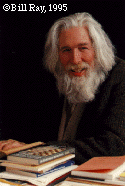
John Kay, columist

Simon Johnson’s comparison of corporate financiers with Russian oligarchs has justifiably attracted attention. Mr Johnson, a former chief economist at the International Monetary Fund, has written an article for the May issue of The Atlantic entitled “The Quiet Coup”. He exaggerates for effect. But his underlying point is important.

When a group becomes too rich and powerful, it can wield influence over politics and over commercial activities in which its members are not directly involved. The effect is to enhance that wealth and power. This process is likely to end in political and economic crisis. That was the history of royal courts across Europe, from Versailles to St Petersburg. More recently, it has been the experience of many developing countries and transitional economies. In the three decades since Margaret Thatcher and Ronald Reagan inaugurated the market revolution, it appears that Britain and the US have joined their ranks.

There is no direct connection between the financial turmoil and political sleaze. Britain’s row over MPs’ expenses and America’s scandals over congressional lobbying have their own specific origins. Yet there is an indirect connection. Parliamentarians believe the taxpayer should pay for their widescreen televisions and gardeners. Senior executives award each other ever more generous remuneration packages. Bankers genuinely believe that the state should carry off their toxic assets while they continue with business and bonuses as before. All demonstrate an exaggerated sense of entitlement.

Dukes and cardinals, oligarchs and financiers, fixers and traders become very wealthy not by virtue of their talents but as a result of the position they occupy. Legislators and the heads of large corporations readily come to feel that their functions deserve similar recognition. We may be relaxed that some people do become filthy rich, but we should not be relaxed about how they become so or how they behave once they are.

Few people quibble about Bill Gates’ fortune, although they may occasionally think that $50bn is rather a lot. They see the evident benefits of the personal computer revolution that he helped to bring about. They can admire the essential decency that has led him to devote much of his time to finding charitable ways to spend his money. It is difficult to think about bond salesmen in the same way, as it was difficult to feel positive about the hangers-on at the court of Louis XVI.

We need to reassert the notion that roles of authority are positions of responsibility rather than declarations of personal merit and routes to personal enrichment. That notion goes with old-fashioned concepts of social obligation and public service. An insistence that power is a duty, not a prize, is probably the most important reason why some countries in the world are rich and others poor. The point needs to be brought home in equal measure to legislators, chief executives and bankers.

Historians would find much that is familiar in today’s developments. In Washington, the young, fresh King Obama finds his economic councils filled by representatives of the same interests who advised his predecessor so unwisely. At the Palace of Westminster, the failing, flailing King Gordon surrounds himself more tightly with his trusted advisers, venturing forth occasionally only to address his subjects from a safe distance by YouTube.

When crisis strikes, the powerful barons react initially by using their power to protect themselves from the worst of the storm. So the banks receive trillions in state aid. Only if the anger of the populace grows large enough, or the resources of the state are exhausted, does a counter-coup provoke change. Breaking the political power of the financial services industry will not happen easily. That power may survive this crisis – as it survived the last. When the New Economy bubble burst in 2000, enough money was pumped into the system to sustain the establishment and pacify the population. Minor courtiers were executed but the essential power structure remained. But, as Louis XVI learnt as the guillotine fell, the longer reform is delayed, the bloodier the revolution. And the more unsettled and chaotic would be the eventual outcome for us all.

Write to johnkay@johnkay.com
More columns at www.ft.com/johnkay"

Wednesday, April 22, 2009

theory really does account for all human behaviour

TO BE NOTED: From The FT:

"
How economics lost sight of real world

By John Kay

Published: April 21 2009 20:51 | Last updated: April 21 2009 20:51

The past two years have not enhanced the reputation of economists. Mostly they failed to point out fundamental weaknesses of financial markets and did not foresee the crisis, and now they disagree on appropriate policies and on the likely future course of events. Although more economic research has been done in the past 25 years than ever before, the economists whose names are most frequently referenced today, such as Hyman Minsky and John Maynard Keynes, are from earlier generations.

Since the 1970s economists have been engaged in a grand project. The project’s objective is that macroeconomics should have microeconomic foundations. In everyday language, that means that what we say about big policy issues – growth and inflation, boom and bust – should be grounded in the study of individual behaviour. Put like that, the project sounds obviously desirable, even essential. I confess I was long seduced by it.

John Kay, columist

Most economists would claim that the project has been a success. But the criteria are the self-referential criteria of modern academic life. The greatest compliment you can now pay an economic argument is to say it is rigorous. Today’s macroeconomic models are certainly that.

But policymakers and the public at large are, rightly, not interested in whether models are rigorous. They are interested in whether the models are useful and illuminating – and these rigorous models do not score well here.

Indeed, at an early stage of the project Robert Lucas, one of its principal architects, who received the Nobel prize for his contributions, developed what is known as the Lucas critique. He argued that ordinary standards of statistical validity should not be applied to the project’s predictions. According to his colleague Thomas Sargent, Lucas was concerned that such tests rejected “too many really good models”.

Economists, like physicists, have been searching for a theory of everything. If there were to be such an economic theory, there is really only one candidate, based on extreme rationality and market efficiency. Any other theory would have to account for the evolution of individual beliefs and the advance of human knowledge, and no one imagines that there could be a single theory of all human behaviour. Not quite no one: a few deranged practitioners of the project believe that their theory really does account for all human behaviour, and that concepts such as goodness, beauty and truth are sloppy sociological constructs.

But these people discredit themselves by opening their mouths. That people respond rationally to incentives, and that market prices incorporate information about the world, are not terrible assumptions. But they are not universal truths either. Much of what creates profit opportunities and causes instability in the global economy results from the failure of these assumptions. Herd behaviour, asset mispricing and grossly imperfect information have led us to where we are today.

There is not, and never will be, an economic theory of everything. Physics may, or may not, be different. But the knowledge we can hope to have in economics is piecemeal and provisional, and different theories will illuminate different but particular situations. We should observe empirical regularities and – as in other applied subjects such as medicine and engineering – we will often find pragmatic solutions that work even though our understanding of why they work is incomplete.

Max Planck, the physicist, said he had eschewed economics because it was too difficult. Planck, Keynes observed, could have mastered the corpus of mathematical economics in a few days – it might now have taken him a few weeks. Keynes went on to explain that economic understanding required an amalgam of logic and intuition and a wide knowledge of facts, most of which are not precise: “a requirement overwhelmingly difficult for those whose gift mainly consists in the power to imagine and pursue to their furthest points the implications and prior conditions of comparatively simple facts which are known with a high degree of precision”. On this, as on much else, Keynes was right.

More columns at www.ft.com/kay

johnkay@johnkay.com"

Tuesday, April 14, 2009

The practical man must follow the branch approach – the science of muddling through.

TO BE NOTED: From the FT:

"
History vindicates the science of muddling through

Published: April 14 2009 21:07 | Last updated: April 14 2009 21:07

When I was a student, Penguin published several collections of classic articles on economics and business. They were an indispensable resource. The first book on business strategy I ever read was the title in that series edited by Dr H. Igor Ansoff. Recently I re-opened it and understood how much changes in the way we think about business strategy – and how much remains the same.

Only one article found there is still widely cited. It was written by the American political scientist Charles Lindblom and published in 1959 under the title The Science of Muddling Through. Prof Lindblom contrasted what he called the “root” method of decision-making with the “branch” approach. The root method required comprehensive evaluation of options in the light of defined objectives. The branch method involved building out, step-by-step and by small degrees, from the current situation. Prof Lindblom claimed “the root method is in fact not usable for complex policy questions”. The practical man must follow the branch approach – the science of muddling through.

John Kay, columist

Ansoff included Prof Lindblom’s article mainly to poke fun at those who acted on this advice. He told students the article was instructive, since “it describes a widely prevalent state of practice in business and government organisations”. We can imagine sniggering MBA students.

They would be chortling when Ansoff turned his attention to France’s Saint-Gobain, the glass and materials group. “Saint-Gobain, for all the modernity of its headquarters building, will remain something of an old lady, likely to move only with the slow deliberate steps of great age.”

America, and Ansoff, were pointing to the road ahead. Prof Lindblom, he explained, “is wrong when he claims the ‘root’ method to be impossible”. Ansoff’s analysis of TRW, the US conglomerate, “shows how one of the world’s most dynamic corporations goes about a methodical exploration of wide vistas of opportunities in the process of formulating its corporate strategy”. The future held no bounds. Senior management “feels that the corporation hasn’t begun to exploit the opportunities they believe that TRW is equipped, for example, to play a three-sided role in technological programmes for the solution to such pressing problems as urban renewal, mass transportation, and pollution”.

But Ansoff’s highest praise was reserved for Litton Industries, another US conglomerate. Litton – “a proverbial success story by any conceivable yardstick” – was the creation of Tex Thornton, the leader of the “whiz kids”. This group of brilliant young men had made an important contribution to US military organisation in the second world war. A letter from Thornton to Henry Ford II led Ford to hire the entire group to help the Ford Motor Company recover from the chaos left by war and its irascible founder. Robert McNamara, the most famous whiz kid, was the company’s president before being recruited by John Kennedy as US defence secretary.

Ansoff died in 2002. History has not been kind to him, or to the whiz kids. Even as Ansoff was putting together his collection in 1968, the future of Litton Industries was being questioned. Like many acquisitive conglomerates, it experienced a rapid ascent and sharp fall. Its reputation and share price rose steadily before a setback to earnings made its stock less attractive. Acquisitions became impossible. The business gradually unwound. Tex Thornton is today forgotten, McNamara was driven from the defence department by public hostility and his private doubts. He went on to preside over a substantial expansion of lending – much of it never repaid – at the World Bank. Today, he reminisces on his experiences – and the virtues of muddling through.

TRW, like Litton, would be forced to slim operations and ambition and return to its modest roots in automobile parts supply. Saint-Gobain, by contrast, is a successful multinational, with 200,000 employees worldwide. Prof Lindblom, still muddling through at 92, celebrates the 50th anniversary of his article. We should celebrate too – and applaud the relevance of his insight.

Post and read comments at www.ft.com/kay

johnkay@johnkay.com"