From Bloomberg:
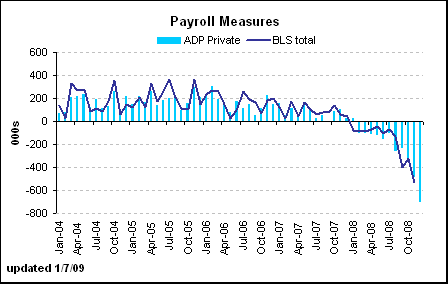
"By Bob Willis Jan. 7 (Bloomberg) -- Companies in the U.S. eliminated an estimated 693,000 jobs in December, the most since records began in 2001, a private report based on payroll data showed.
The drop in the ADP Employer Services gauge was larger than the median estimate of economists( WHO AREN'T NOTICING THE PROACTIVITY RUN ) surveyed by Bloomberg News. Today’s report is the first to reflect methodological changes that ADP says will limit the differences between its calculations and the government’s payroll numbers.
Companies are accelerating( PROACTIVELY ) the pace of firings as the recession plaguing the world’s largest economy heads into a second year. The Labor Department may report in two days that employers slashed jobs in December for a 12th consecutive month, putting total job cuts at 2.4 million for 2008, according to a Bloomberg survey median.
“Firms are continuing to react very quickly( PROACTIVELY ) to the downturn in demand( WHICH HAS BEEN LAGGING ) with a combination of layoffs and restricting new hires,” Nigel Gault, chief U.S. economist at IHS Global Insight Inc. in Lexington, Massachusetts, said before the report. “It’s a major drag on consumer spending( TRUE ).”
Revised figures issued Dec. 18 by ADP and Macroeconomic Advisers LLC showed the discrepancies with Labor Department data narrowed considerably using the new approach. The new data put ADP’s estimate of job losses from September through November at 1.03 million, more than double its prior projection and closer to the government’s figures showing a decline of 1.29 million in private payrolls for the period.
‘Time Will Tell’
The new version “should perform better than the consensus expectation -- which generally is tough to beat,” Seamus Smyth, an economist at Goldman Sachs Group Inc., wrote in an e-mail to clients last week. “That said, the ADP report was already revised once prior to this, and that revision fit very well on historical data. But when applied in real time over the past year, performance was much worse. Time will tell whether the new construction actually leads to better forecasts.”
The ADP report was forecast to show a drop of 495,000 jobs, according to the median estimate of 24 economists in a Bloomberg News survey. Projections ranged from declines of 250,000 to 550,000.
ADP includes only private employment and does not take into account hiring by government agencies, which is included in the monthly payroll report. Macroeconomic Advisers LLC in St. Louis produces the report jointly with ADP.
15-Year High
The government may report on Jan. 9 that total payrolls fell by 500,000 last month, and the unemployment rate rose to a 15- year high of 7 percent, according to the Bloomberg survey median. The economy lost 1.9 million jobs in the first 11 months of the year.
Other labor-market reports have also shown weakness. Job cuts announced by U.S. employers rose 275 percent last month from December 2007, to 166,348, Chicago-based Challenger. Gray & Christmas Inc. said today. For all of 2008, employers announced 1.22 million job cuts, the most in five years.
Today’s ADP report showed a decrease of 220,000 jobs in goods-producing industries including manufacturers and construction companies. Service providers cut 473,000 workers. Employment in construction fell by 102,000, the 21st consecutive month of cuts in the industry.
Companies employing more than 499 workers shrank their workforce by 91,000 jobs. Medium-sized businesses, with 50 to 499 employees, were down 321,000 jobs and small companies decreased payrolls by 281,000.
Financial Services
Financial-service companies and manufacturers are leading the cutbacks. Cigna Corp., the health insurer whose shares fell 69 percent last year because of investment losses, said this week it will cut about 1,100 jobs and take a fourth-quarter after-tax charge of $30 million to $40 million for 2008.
A declining stock market and the recession have eroded the earnings outlook for Cigna, which relies on investment returns for almost two-thirds of pretax income.
“Given the unprecedented economic situation we and our customers are facing, these actions are essential( PROACTIVE ),” said Cigna Chief Executive Officer H. Edward Hanway in a Jan. 5 statement. “Decisions like these are difficult and never made lightly, but they are necessary given the current environment( PROACTIVE ).”
The ADP report is based on data from about 400,000 businesses with approximately 24 million workers on payrolls.
ADP began keeping records in January 2001 and started publishing its numbers in 2006."
This is very bad news. The need to stop this Proactivity Run is urgent. The Stimulus is largely an attempt to do that, by allowing employers to expect an injection of consumption into the economy. In other words, the stimulus acts as a government guarantee to help stop the downward spiral in consumption. This argues for the Sales Tax decrease, which will give an incentive for current consumption as opposed to deferred consumption ( saving ). Only government action can stop any run, because only it has the available resources to be believed.



























 Posts
Posts