Showing posts with label Obama's Speeches. Show all posts

Wednesday, April 15, 2009

virtues of a “limited purpose banking” system, one that would greatly reduce banks’ abilities to take on risk

TO BE NOTED: From the NY Times:


April 15, 2009, 2:28 pm

The Post-Recession Appetite for Risk and Regulation

Wednesday, in his speech at Georgetown, President Obama proclaimed that “It is time to lay down tough new rules of the road for Wall Street to ensure that we never find ourselves here again.”

But just how restrictive will, and should, those rules be? Will there indeed be a permanently lower tolerance for financial risk-taking, when risk-taking and financial innovation have been a prized part of economic growth over the last few decades?

The lead-up for such “tough new rules” so far has been somewhat equivocal. America — unlike its European counterparts — has generally prioritized temporary stimulus over “permanent” regulation in the face of an economic contraction. We like to address a particular market failing in the short-term, rather than reassigning the way markets work for the long haul. In fact, America’s long-term trend over the last few decades has been toward less, rather than more, regulation. That political habit may be hard to break, no matter the volume of populist calls for straight-jacketing the private sector.

Still, a few prominent economists — whose discipline is usually seen as the bastion of laissez-faire — are fighting to sharply reverse this decades-long, freer-financial-market trend.

For example, Paul Krugman, the Nobel laureate and Times Op-Ed columnist, last week wrote about the need for new regulations to make banking “boring again” — in other words, by legally limiting bankers’ abilities to get too creative with the ways they slice, dice and assemble their financial toys.

Amar Bhidé, a business professor at Columbia University, has similarly argued for a return to “primitive finance,” which would mean greatly limiting what commercial banks are allowed to do, and reviving a more stringent version of Glass-Steagall.

And Laurence Kotlikoff, an economics professor at Boston University, has vocally proselytized the virtues of a “limited purpose banking” system, one that would greatly reduce banks’ abilities to take on risk. In this system, commercial banks would initiate only AAA-rated mortgages and business loans (approved and rated by the government, rather than by private ratings agencies), and then bundle and sell those loans within mutual funds. And that’s all these banks could do.

These aren’t the only economists arguing for what may sound like extreme curbing of the financial system. Other critics have more or less called securitization a dirty word, and suggested that the process of bundling loans and other financial products may be inherently toxic (no matter how much we upgrade the ratings agencies). They also fear that morally hazardous bailouts may yet increase banks’ appetites for reckless risks.

Others say, though, that we may emerge from the current crisis with financial institutions that are much more risk-averse than they were before the recession. In this situation, perhaps tighter regulations would not be necessary; perhaps they might even be detrimental. An economy needs some desire to assume risks in order to function and to grow, and perhaps, then, the government should be encouraging more financial innovation when the private sector’s instinct is to pull back. Besides, some say, maybe having a major financial meltdown only every 80 years or so isn’t such a bad track record, given the economic growth the existent system has produced (or at least enabled).

It will be interesting to see which, if any, of these views wins out in the coming months.

Readers, I put the question to you: What kind of financial system will emerge — either due to market forces or regulatory forces — once the dust of this crisis settles? And what kind of financial structure should we want to emerge?"

trim waste out of our discretionary budget, a process we have already begun – but we will also have to get serious about entitlement reform

TO BE NOTED: From the NY Times:

"April 14, 2009
Transcript
Obama’s Remarks on the Economy

Following are President Obama’s remarks on the economy at the Georgetown University, as provided by the White House.

It has now been twelve weeks since my administration began. And I think even our critics would agree that at the very least, we've been busy. In just under three months, we have responded to an extraordinary set of economic challenges with extraordinary action – action that has been unprecedented in both its scale and its speed.

I know that some have accused us of taking on too much at once. Others believe we haven't done enough. And many Americans are simply wondering how all of our different programs and policies fit together in a single, overarching strategy that will move this economy from recession to recovery and ultimately to prosperity.

So today, I want to step back for a moment and explain our strategy as clearly as I can. I want to talk about what we've done, why we've done it, and what we have left to do. I want to update you on the progress we've made, and be honest about the pitfalls that may lie ahead.

And most of all, I want every American to know that each action we take and each policy we pursue is driven by a larger vision of America's future – a future where sustained economic growth creates good jobs and rising incomes; a future where prosperity is fueled not by excessive debt, reckless speculation, and fleeing profit, but is instead built by skilled, productive workers; by sound investments that will spread opportunity at home and allow this nation to lead the world in the technologies, innovations, and discoveries that will shape the 21st century. That is the America I see. That is the future I know we can have.

To understand how we get there, we first need to understand how we got here.

Recessions are not uncommon. Markets and economies naturally ebb and flow, as we have seen many times in our history. But this recession is different. This recession was not caused by a normal downturn in the business cycle. It was caused by a perfect storm of irresponsibility and poor decision-making that stretched from Wall Street to Washington to Main Street.

As has been widely reported, it started in the housing market. During the course of the decade, the formula for buying a house changed: instead of saving their pennies to buy their dream house, many Americans found they could take out loans that by traditional standards their incomes just could not support. Others were tricked into signing these subprime loans by lenders who were trying to make a quick profit. And the reason these loans were so readily available was that Wall Street saw big profits to be made. Investment banks would buy and package together these questionable mortgages into securities, arguing that by pooling the mortgages, the risks had been reduced. And credit agencies that are supposed to help investors determine the soundness of various investments stamped the securities with their safest rating when they should have been labeled "Buyer Beware."

No one really knew what the actual value of these securities were, but since the housing market was booming and prices were rising, banks and investors kept buying and selling them, always passing off the risk to someone else for a greater profit without having to take any of the responsibility. Banks took on more debt than they could handle. The government-chartered companies Fannie Mae and Freddie Mac, whose traditional mandate was to help support traditional mortgages, decided to get in on the action by buying and holding billions of dollars of these securities. AIG, the biggest insurer in the world, decided to make profits by selling billions of dollars of complicated financial instruments that supposedly insured these securities. Everybody was making record profits – except the wealth created was real only on paper. And as the bubble grew, there was almost no accountability or oversight from anyone in Washington.

Then the housing bubble burst. Home prices fell. People began defaulting on their subprime mortgages. The value of all those loans and securities plummeted. Banks and investors couldn't find anyone to buy them. Greed gave way to fear. Investors pulled their money out of the market. Large financial institutions that didn't have enough money on hand to pay off all their obligations collapsed. Other banks held on tight to the money they did have and simply stopped lending.

This is when the crisis spread from Wall Street to Main Street. After all, the ability to get a loan is how you finance the purchase of everything from a home to a car to a college education. It's how stores stock their shelves, farms buy equipment, and businesses make payroll. So when banks stopped lending money, businesses started laying off workers. When laid off workers had less money to spend, businesses were forced to lay off even more workers. When people couldn't get car loans, a bad situation at the auto companies became even worse. When people couldn't get home loans, the crisis in the housing market only deepened. Because the infected securities were being traded worldwide and other nations also had weak regulations, this recession soon became global. And when other nations can't afford to buy our goods, it slows our economy even further.

This is the situation we confronted on the day we took office. And so our most urgent task has been to clear away the wreckage, repair the immediate damage to the economy, and do everything we can to prevent a larger collapse. And since the problems we face are all working off each other to feed a vicious economic downturn, we've had no choice but to attack all fronts of our economic crisis at once.

The first step was to fight a severe shortage of demand in the economy. The Federal Reserve did this by dramatically lowering interest rates last year in order to boost investment. And my administration and Congress boosted demand by passing the largest recovery plan in our nation's history. It's a plan that is already in the process of saving or creating 3.5 million jobs over the next two years. It is putting money directly in people's pockets with a tax cut for 95% of working families that is now showing up in paychecks across America. And to cushion the blow of this recession, we also provided extended unemployment benefits and continued health care coverage to Americans who have lost their jobs through no fault of their own.

Now, some have argued that this recovery plan is a case of irresponsible government spending; that it is somehow to blame for our long-term deficit projections, and that the federal government should be cutting instead of increasing spending right now. So let me tackle this argument head on.

To begin with, economists on both the left and right agree that the last thing a government should do in the middle of a recession is to cut back on spending. You see, when this recession began, many families sat around their kitchen table and tried to figure out where they could cut back. So do many businesses. That is a completely responsible and understandable reaction. But if every family in America cuts back, then no one is spending any money, which means there are more layoffs, and the economy gets even worse. That's why the government has to step in and temporarily boost spending in order to stimulate demand. And that's exactly what we're doing right now.

Second of all, I absolutely agree that our long-term deficit is a major problem that we have to fix. But the fact is that this recovery plan represents only a tiny fraction of that long-term deficit. As I will discuss in a moment, the key to dealing with our deficit and debt is to get a handle on out-of-control health care costs – not to stand idly by as the economy goes into free fall.

So the recovery plan has been the first step in confronting this economic crisis. The second step has been to heal our financial system so that credit is once again flowing to the businesses and families who rely on it.

The heart of this financial crisis is that too many banks and other financial institutions simply stopped lending money. In a climate of fear, banks were unable to replace their losses by raising new capital on their own, and they were unwilling to lend the money they did have because they were afraid that no one would pay it back. It is for this reason that the last administration used the Troubled Asset Relief Program, or TARP, to provide these banks with temporary financial assistance in order to get them lending again.

Now, I don't agree with some of the ways the TARP program was managed, but I do agree with the broader rationale that we must provide banks with the capital and the confidence necessary to start lending again. That is the purpose of the stress tests that will soon tell us how much additional capital will be needed to support lending at our largest banks. Ideally, these needs will be met by private investors. But where this is not possible, and banks require substantial additional resources from the government, we will hold accountable those responsible, force the necessary adjustments, provide the support to clean up their balance sheets, and assure the continuity of a strong, viable institution that can serve our people and our economy.

Of course, there are some who argue that the government should stand back and simply let these banks fail – especially since in many cases it was their bad decisions that helped create the crisis in the first place. But whether we like it or not, history has repeatedly shown that when nations do not take early and aggressive action to get credit flowing again, they have crises that last years and years instead of months and months – years of low growth, low job creation, and low investment that cost those nations far more than a course of bold, upfront action. And although there are a lot of Americans who understandably think that government money would be better spent going directly to families and businesses instead of banks – "where's our bailout?," they ask – the truth is that a dollar of capital in a bank can actually result in eight or ten dollars of loans to families and businesses, a multiplier effect that can ultimately lead to a faster pace of economic growth.

On the other hand, there have been some who don't dispute that we need to shore up the banking system, but suggest that we have been too timid in how we go about it. They say that the federal government should have already preemptively stepped in and taken over major financial institutions the way that the FDIC currently intervenes in smaller banks, and that our failure to do so is yet another example of Washington coddling Wall Street. So let me be clear – the reason we have not taken this step has nothing to do with any ideological or political judgment we've made about government involvement in banks, and it's certainly not because of any concern we have for the management and shareholders whose actions have helped cause this mess.

Rather, it is because we believe that preemptive government takeovers are likely to end up costing taxpayers even more in the end, and because it is more likely to undermine than to create confidence. Governments should practice the same principle as doctors: first do no harm. So rest assured – we will do whatever is necessary to get credit flowing again, but we will do so in ways that minimize risks to taxpayers and to the broader economy. To that end, in addition to the program to provide capital to the banks, we have launched a plan that will pair government resources with private investment in order to clear away the old loans and securities – the so-called toxic assets – that are also preventing our banks from lending money.

Now, what we've also learned during this crisis is that our banks aren't the only institutions affected by these toxic assets that are clogging the financial system. A.I.G., for example, is not a bank. And yet because it chose to insure trillions of dollars worth of risky assets, its failure could threaten the entire financial system and freeze lending even further. This is why, as frustrating as it is – and I promise you, nobody is more frustrated than me – we've had to provide support for A.I.G. It's also why we need new legal authority so that we have the power to intervene in such financial institutions, just like a bankruptcy court does with businesses that hit hard times, so that we can restructure these businesses in an orderly way that does not induce panic – and can restructure inappropriate bonus contracts without creating a perception that government can just change compensation rules on a whim.

This is also why we're moving aggressively to unfreeze markets and jumpstart lending outside the banking system, where more than half of all lending in America actually takes place. To do this, we've started a program that will increase guarantees for small business loans and unlock the market for auto loans and student loans. And to stabilize the housing market, we've launched a plan that will save up to four million responsible homeowners from foreclosure and help many millions more re-finance.

In a few weeks, we will also reassess the state of Chrysler and General Motors, two companies with an important place in our history and a large footprint in our economy – but two companies that have also fallen on hard times.

Late last year, the companies were given transitional loans by the previous administration to tide them over as they worked to develop viable business plans. But the plans they developed fell short, and so we have given them some additional time to work these complex issues through. We owed that, not to the executives whose bad bets contributed to the weakening of their companies, but to the hundreds of thousands of workers whose livelihoods hang in the balance.

It is our fervent hope that in the coming weeks, Chrysler will find a viable business partner and that GM will develop a business plan that will put it on a path to profitability without endless support from the American taxpayer. In the meantime, we are taking steps to spur demand for American cars and provide relief to autoworkers and their communities. And we will continue to reaffirm this nation's commitment to a 21st century American auto industry that creates new jobs and builds the fuel-efficient cars and trucks that will carry us toward a clean energy future.

Finally, to coordinate a global response to this global recession, I went to the meeting of the G20 nations in London the other week. Each nation has undertaken significant stimulus to spur demand. All agreed to pursue tougher regulatory reforms. We also agreed to triple the lending capacity of the International Monetary Fund, an international financial institution supported by all the major economies, and provide direct assistance to developing nations and vulnerable populations – because America's success depends on whether other nations have the ability to buy what we sell. We pledged to avoid the trade barriers and protectionism that hurts us all in the end. And we decided to meet again in the fall to gauge our progress and take additional steps if necessary.

So all of these actions – the Recovery Act, the bank capitalization program, the housing plan, the strengthening of the non-bank credit market, the auto plan, and our work at the G20 – have been necessary pieces of the recovery puzzle. They have been designed to increase aggregate demand, get credit flowing again to families and businesses, and help them ride out the storm. And taken together, these actions are starting to generate signs of economic progress. Because of our recovery plan, schools and police departments have cancelled planned layoffs. Clean energy companies and construction companies are re-hiring workers to build everything from energy efficient windows to new roads and highways. Our housing plan has helped lead to a spike in the number of homeowners who are taking advantage of historically-low mortgage rates by refinancing, which is like putting a $2,000 tax cut in your in pocket. Our program to support the market for auto loans and student loans has started to unfreeze this market and securitize more of this lending in the last few weeks. And small businesses are seeing a jump in loan activity for the first time in months.

This is all welcome and encouraging news, but it does not mean that hard times are over. 2009 will continue to be a difficult year for America's economy. The severity of this recession will cause more job loss, more foreclosures, and more pain before it ends. The market will continue to rise and fall. Credit is still not flowing nearly as easily as it should. The process for restructuring AIG and the auto companies will involve difficult and sometimes unpopular choices. All of this means that there is much more work to be done. And all of this means that you can continue to expect an unrelenting, unyielding, day-by-day effort from this administration to fight for economic recovery on all fronts.

But even as we continue to clear away the wreckage and address the immediate crisis, it is my firm belief that our next task is to make sure such a crisis never happens again. Even as we clean up balance sheets and get credit flowing; even as people start spending and business start hiring – we have to realize that we cannot go back to the bubble and bust economy that led us to this point.

It is simply not sustainable to have a 21st century financial system that is governed by 20th century rules and regulations that allowed the recklessness of a few to threaten the entire economy. It is not sustainable to have an economy where in one year, 40% of our corporate profits came from a financial sector that was based too much on inflated home prices, maxed out credit cards, overleveraged banks and overvalued assets; or an economy where the incomes of the top 1% have skyrocketed while the typical working household has seen their income decline by nearly $2,000.

For even as too many were chasing ever-bigger bonuses and short-term profits over the last decade, we continued to neglect the long-term threats to our prosperity: the crushing burden that the rising cost of health care is placing on families and businesses; the failure of our education system to prepare our workers for a new age; the progress that other nations are making on clean energy industries and technologies while we remain addicted to foreign oil; the growing debt that we're passing on to our children. And even after we emerge from the current recession, these challenges will still represent major obstacles that stand in the way of our success in the 21st century.

There is a parable at the end of the Sermon on the Mount that tells the story of two men. The first built his house on a pile of sand, and it was destroyed as soon as the storm hit. But the second is known as the wise man, for when "…the rain descended, and the floods came, and the winds blew, and beat upon that house…it fell not: for it was founded upon a rock."

We cannot rebuild this economy on the same pile of sand. We must build our house upon a rock. We must lay a new foundation for growth and prosperity – a foundation that will move us from an era of borrow and spend to one where we save and invest; where we consume less at home and send more exports abroad.

It's a foundation built upon five pillars that will grow our economy and make this new century another American century: new rules for Wall Street that will reward drive and innovation; new investments in education that will make our workforce more skilled and competitive; new investments in renewable energy and technology that will create new jobs and industries; new investments in health care that will cut costs for families and businesses; and new savings in our federal budget that will bring down the debt for future generations. That is the new foundation we must build. That must be our future – and my Administration's policies are designed to achieve that future.

The first step we will take to build this foundation is to reform the outdated rules and regulations that allowed this crisis to happen in the first place. It is time to lay down tough new rules of the road for Wall Street to ensure that we never find ourselves here again. Rules that punish short-cuts and abuse. Rules that tie someone's pay to their actual job performance. Rules that protect typical American families when they buy a home, get a credit card or invest in a 401k. We have already begun to work with Congress to shape this new regulatory framework – and I expect a bill to arrive on my desk for signature before the year is out.

The second pillar of this new foundation is an education system that finally prepares our workers for a 21st century economy. In the 20th century, the GI Bill sent a generation to college, and for decades, we led the world in education and economic growth. But in this new economy, we trail the world's leaders in graduation rates and achievement. That is why we have set a goal that will greatly enhance our ability to compete for the high-wage, high-tech jobs of the 21st century: by 2020, America will once more have the highest proportion of college graduates in the world.

To meet that goal, we have already dramatically expanded early childhood education. We are investing in innovative programs that have proven to help schools meet high standards and close achievement gaps. We are creating new rewards tied to teacher performance and new pathways for advancement. I have asked every American to commit to at least one year or more of higher education or career training, and we have provided tax credits to make a college education more affordable for every American.

The third pillar of this new foundation is to harness the renewable energy that can create millions of new jobs and new industries. We all know that the country that harnesses this energy will lead the 21st century. Yet we have allowed other countries to outpace us on this race to the future.

Well, I do not accept a future where the jobs and industries of tomorrow take root beyond our borders. It is time for America to lead again.

The investments we made in the Recovery Act will double this nation's supply of renewable energy in the next three years. And we are putting Americans to work making our homes and buildings more efficient so that we can save billions on our energy bills and grow our economy at the same time.

But the only way to truly spark this transformation is through a gradual, market-based cap on carbon pollution, so that clean energy is the profitable kind of energy. Some have argued that we shouldn't attempt such a transition until the economy recovers, and they are right that we have to take the costs of transition into account. But we can no longer delay putting a framework for a clean energy economy in place. If businesses and entrepreneurs know today that we are closing this carbon pollution loophole, they will start investing in clean energy now. And pretty soon, we'll see more companies constructing solar panels, and workers building wind turbines, and car companies manufacturing fuel-efficient cars. Investors will put some money into a new energy technology, and a small business will open to start selling it. That's how we can grow this economy, enhance our security, and protect our planet at the same time.

The fourth pillar of the new foundation is a 21st century health care system where families, businesses, and government budgets aren't dragged down by skyrocketing insurance premiums.

One and a half million Americans could lose their homes this year just because of a medical crisis. Major American corporations are struggling to compete with their foreign counterparts, and small businesses are closing their doors. We cannot allow the cost of health care to strangle our economy any longer.

That's why our Recovery Act will invest in electronic health records with strict privacy standards that will save money and lives. We've also made the largest investment ever in preventive care, because that is one of the best ways to keep costs under control. And included in the budgets that just passed Congress is an historic commitment to reform that will finally make quality health care affordable for every American. So I look forward to working with both parties in Congress to make this reform a reality in the coming months.

Fixing our health care system will certainly require resources, but in my budget, we've made a commitment to fully pay for reform without increasing the deficit, and we've identified specific savings that will make the health care system more efficient and reduce costs for us all.

In fact, we have undertaken an unprecedented effort to find this kind of savings in every corner of the budget, because the final pillar in building our new foundation is restoring fiscal discipline once this economy recovers. Already, we have identified two trillion dollars in deficit-reductions over the next decade. We have announced procurement reform that will greatly reduce no-bid contracts and save the government $40 billion. Secretary Gates recently announced a courageous set of reforms that go right at the hundreds of billions of dollars in waste and cost overruns that have bloated our defense budget without making America safer. We will end education programs that don't work, and root out waste, fraud, and abuse in our Medicare program.

Altogether, this budget will reduce discretionary spending for domestic programs as share of the economy by more than 10% over the next decade to the lowest level since we began keeping records nearly half a century ago. And as we continue to go through the federal budget line by line, we will be announcing additional savings, secured by eliminating and consolidating programs we don't need so that we can make room for the things we do need.

Now, I realize that for some, this isn't enough. I know there is a criticism out there that my administration has somehow been spending with reckless abandon, pushing a liberal social agenda while mortgaging our children's future.

Well let me make three points.

First, as I said earlier, the worst thing that we could do in a recession this severe is to try to cut government spending at the same time as families and businesses around the world are cutting back on their spending. So as serious as our deficit and debt problems are – and they are very serious – major efforts to deal with them have to focus on the medium and long-term budget picture.

Second, in tackling the deficit issue, we simply cannot sacrifice the long-term investments that we so desperately need to generate long-term prosperity. Just as a cash-strapped family may cut back on luxuries but will insist on spending money to get their children through college, so we as a country have to make current choices with an eye on the future. If we don't invest now in renewable energy or a skilled workforce or a more affordable health care system, this economy simply won't grow at the pace it needs to in two or five or ten years down the road. If we don't lay this new foundation, it won't be long before we are right back where we are today. And I can assure you that chronically slow growth will not help our long-term budget situation.

Third, the problem with our deficit and debt is not new. It has been building dramatically over the past eight years, largely because big tax cuts combined with increased spending on two wars and the increased costs of government health care programs. This structural gap in our budget, between the amount of money coming in and the amount going out, will only get worse as Baby Boomers age, and will in fact lead us down an unsustainable path. But let's not kid ourselves and suggest that we can do it by trimming a few earmarks or cutting the budget for the National Endowment for the Arts. Along with defense and interest on the national debt, the biggest costs in our budget are entitlement programs like Medicare, Medicaid, and Social Security that get more and more expensive every year. So if we want to get serious about fiscal discipline – and I do – then we are going to not only have to trim waste out of our discretionary budget, a process we have already begun – but we will also have to get serious about entitlement reform.

Nothing will be more important to this goal than passing health care reform that brings down costs across the system, including in Medicare and Medicaid. Make no mistake: health care reform is entitlement reform. That's not just my opinion – that was the conclusion of a wide range of participants at the Fiscal Responsibility Summit we held at the White House in February, and that's one of the reasons why I firmly believe we need to get health care reform done this year.

Once we tackle rising health care costs, we must also work to put Social Security on firmer footing. It is time for both parties to come together and find a way to keep the promise of a sound retirement for future generations. And we should restore a sense of fairness and balance to our tax code by shutting down corporate loopholes and ensuring that everyone pays what they owe.

All of these efforts will require tough choices and compromises. But the difficulties can't serve as an excuse for inaction. Not anymore.

This brings up one final point I'd like to make today. I've talked a lot about the fundamental weakness in our economy that led us to this day of reckoning. But we also arrived here because of a fundamental weakness in our political system.

For too long, too many in Washington put off hard decisions for some other time on some other day. There's been a tendency to score political points instead of rolling up sleeves to solve real problems. There is also an impatience that characterizes this town – an attention span that has only grown shorter with the twenty-four hour news cycle, and insists on instant gratification in the form of immediate results or higher poll numbers. When a crisis hits, there's all too often a lurch from shock to trance, with everyone responding to the tempest of the moment until the furor has died away and the media coverage has moved on, instead of confronting the major challenges that will shape our future in a sustained and focused way.

This can't be one of those times. The challenges are too great. The stakes are too high. I know how difficult it is for Members of Congress in both parties to grapple with some of the big decisions we face right now. It's more than most congresses and most presidents have to deal with in a lifetime.

But we have been called to govern in extraordinary times. And that requires an extraordinary sense of responsibility – to ourselves, to the men and women who sent us here, and to the many generations whose lives will be affected for good or for ill because of what we do here.

There is no doubt that times are still tough. By no means are we out of the woods just yet. But from where we stand, for the very first time, we are beginning to see glimmers of hope. And beyond that, way off in the distance, we can see a vision of an America's future that is far different than our troubled economic past. It's an America teeming with new industry and commerce; humming with new energy and discoveries that light the world once more. A place where anyone from anywhere with a good idea or the will to work can live the dream they've heard so much about.

It is that house upon the rock. Proud, sturdy, and unwavering in the face of the greatest storm. We will not finish it in one year or even many, but if we use this moment to lay that new foundation; if we come together and begin the hard work of rebuilding; if we persist and persevere against the disappointments and setbacks that will surely lie ahead, then I have no doubt that this house will stand and the dream of our founders will live on in our time. Thank you, God Bless you, and may God Bless the United States of America."

Tuesday, January 20, 2009

"Where the answer is no, programs will end. And those of us who manage the public's dollars will be held to account"

From the NY Times:

"Text of President Barack Obama's inaugural address on Tuesday, as prepared for delivery and released by the Presidential Inaugural Committee.

OBAMA: My fellow citizens:

I stand here today humbled by the task before us, grateful for the trust you have bestowed, mindful of the sacrifices borne by our ancestors. I thank President Bush for his service to our nation, as well as the generosity and cooperation he has shown throughout this transition.

Forty-four Americans have now taken the presidential oath. The words have been spoken during rising tides of prosperity and the still waters of peace. Yet, every so often the oath is taken amidst gathering clouds and raging storms. At these moments, America has carried on not simply because of the skill or vision of those in high office, but because we the people have remained faithful to the ideals of our forebears, and true to our founding documents.

So it has been. So it must be with this generation of Americans.

That we are in the midst of crisis is now well understood. Our nation is at war, against a far-reaching network of violence and hatred. Our economy is badly weakened, a consequence of greed and irresponsibility on the part of some, but also our collective failure to make hard choices and prepare the nation for a new age. Homes have been lost; jobs shed; businesses shuttered. Our health care is too costly; our schools fail too many; and each day brings further evidence that the ways we use energy strengthen our adversaries and threaten our planet.

These are the indicators of crisis, subject to data and statistics. Less measurable but no less profound is a sapping of confidence across our land -- a nagging fear that America's decline is inevitable, and that the next generation must lower its sights.

Today I say to you that the challenges we face are real. They are serious and they are many. They will not be met easily or in a short span of time. But know this, America -- they will be met.

On this day, we gather because we have chosen hope over fear, unity of purpose over conflict and discord.

On this day, we come to proclaim an end to the petty grievances and false promises, the recriminations and worn out dogmas, that for far too long have strangled our politics.

We remain a young nation, but in the words of scripture, the time has come to set aside childish things. The time has come to reaffirm our enduring spirit; to choose our better history; to carry forward that precious gift, that noble idea, passed on from generation to generation: the God-given promise that all are equal, all are free and all deserve a chance to pursue their full measure of happiness.

In reaffirming the greatness of our nation, we understand that greatness is never a given. It must be earned. Our journey has never been one of shortcuts or settling for less. It has not been the path for the faint-hearted -- for those who prefer leisure over work, or seek only the pleasures of riches and fame. Rather, it has been the risk-takers, the doers, the makers of things -- some celebrated but more often men and women obscure in their labor, who have carried us up the long, rugged path towards prosperity and freedom.

For us, they packed up their few worldly possessions and traveled across oceans in search of a new life.

For us, they toiled in sweatshops and settled the West; endured the lash of the whip and plowed the hard earth.

For us, they fought and died, in places like Concord and Gettysburg; Normandy and Khe Sahn.

Time and again these men and women struggled and sacrificed and worked till their hands were raw so that we might live a better life. They saw America as bigger than the sum of our individual ambitions; greater than all the differences of birth or wealth or faction.

This is the journey we continue today. We remain the most prosperous, powerful nation on Earth. Our workers are no less productive than when this crisis began. Our minds are no less inventive, our goods and services no less needed than they were last week or last month or last year. Our capacity remains undiminished. But our time of standing pat, of protecting narrow interests and putting off unpleasant decisions -- that time has surely passed. Starting today, we must pick ourselves up, dust ourselves off, and begin again the work of remaking America.

For everywhere we look, there is work to be done. The state of the economy calls for action, bold and swift, and we will act -- not only to create new jobs, but to lay a new foundation for growth. We will build the roads and bridges, the electric grids and digital lines that feed our commerce and bind us together. We will restore science to its rightful place, and wield technology's wonders to raise health care's quality and lower its cost. We will harness the sun and the winds and the soil to fuel our cars and run our factories. And we will transform our schools and colleges and universities to meet the demands of a new age. All this we can do. And all this we will do.

Now, there are some who question the scale of our ambitions -- who suggest that our system cannot tolerate too many big plans. Their memories are short. For they have forgotten what this country has already done; what free men and women can achieve when imagination is joined to common purpose, and necessity to courage.

What the cynics fail to understand is that the ground has shifted beneath them -- that the stale political arguments that have consumed us for so long no longer apply. The question we ask today is not whether our government is too big or too small, but whether it works -- whether it helps families find jobs at a decent wage, care they can afford, a retirement that is dignified. Where the answer is yes, we intend to move forward. Where the answer is no, programs will end. And those of us who manage the public's dollars will be held to account -- to spend wisely, reform bad habits, and do our business in the light of day -- because only then can we restore the vital trust between a people and their government.

Nor is the question before us whether the market is a force for good or ill. Its power to generate wealth and expand freedom is unmatched, but this crisis has reminded us that without a watchful eye, the market can spin out of control -- and that a nation cannot prosper long when it favors only the prosperous. The success of our economy has always depended not just on the size of our gross domestic product, but on the reach of our prosperity; on our ability to extend opportunity to every willing heart -- not out of charity, but because it is the surest route to our common good.

As for our common defense, we reject as false the choice between our safety and our ideals. Our founding fathers, faced with perils we can scarcely imagine, drafted a charter to assure the rule of law and the rights of man, a charter expanded by the blood of generations. Those ideals still light the world, and we will not give them up for expedience's sake. And so to all other peoples and governments who are watching today, from the grandest capitals to the small village where my father was born: know that America is a friend of each nation and every man, woman, and child who seeks a future of peace and dignity, and that we are ready to lead once more.

Recall that earlier generations faced down fascism and communism not just with missiles and tanks, but with sturdy alliances and enduring convictions. They understood that our power alone cannot protect us, nor does it entitle us to do as we please. Instead, they knew that our power grows through its prudent use; our security emanates from the justness of our cause, the force of our example, the tempering qualities of humility and restraint.

We are the keepers of this legacy. Guided by these principles once more, we can meet those new threats that demand even greater effort -- even greater cooperation and understanding between nations. We will begin to responsibly leave Iraq to its people, and forge a hard-earned peace in Afghanistan. With old friends and former foes, we will work tirelessly to lessen the nuclear threat, and roll back the specter of a warming planet. We will not apologize for our way of life, nor will we waver in its defense, and for those who seek to advance their aims by inducing terror and slaughtering innocents, we say to you now that our spirit is stronger and cannot be broken; you cannot outlast us, and we will defeat you.

For we know that our patchwork heritage is a strength, not a weakness. We are a nation of Christians and Muslims, Jews and Hindus -- and non-believers. We are shaped by every language and culture, drawn from every end of this Earth; and because we have tasted the bitter swill of civil war and segregation, and emerged from that dark chapter stronger and more united, we cannot help but believe that the old hatreds shall someday pass; that the lines of tribe shall soon dissolve; that as the world grows smaller, our common humanity shall reveal itself; and that America must play its role in ushering in a new era of peace.

To the Muslim world, we seek a new way forward, based on mutual interest and mutual respect. To those leaders around the globe who seek to sow conflict, or blame their society's ills on the West -- know that your people will judge you on what you can build, not what you destroy. To those who cling to power through corruption and deceit and the silencing of dissent, know that you are on the wrong side of history; but that we will extend a hand if you are willing to unclench your fist.

To the people of poor nations, we pledge to work alongside you to make your farms flourish and let clean waters flow; to nourish starved bodies and feed hungry minds. And to those nations like ours that enjoy relative plenty, we say we can no longer afford indifference to suffering outside our borders; nor can we consume the world's resources without regard to effect. For the world has changed, and we must change with it.

As we consider the road that unfolds before us, we remember with humble gratitude those brave Americans who, at this very hour, patrol far-off deserts and distant mountains. They have something to tell us today, just as the fallen heroes who lie in Arlington whisper through the ages. We honor them not only because they are guardians of our liberty, but because they embody the spirit of service; a willingness to find meaning in something greater than themselves. And yet, at this moment -- a moment that will define a generation -- it is precisely this spirit that must inhabit us all.

For as much as government can do and must do, it is ultimately the faith and determination of the American people upon which this nation relies. It is the kindness to take in a stranger when the levees break, the selflessness of workers who would rather cut their hours than see a friend lose their job which sees us through our darkest hours. It is the firefighter's courage to storm a stairway filled with smoke, but also a parent's willingness to nurture a child, that finally decides our fate.

Our challenges may be new. The instruments with which we meet them may be new. But those values upon which our success depends -- hard work and honesty, courage and fair play, tolerance and curiosity, loyalty and patriotism -- these things are old. These things are true. They have been the quiet force of progress throughout our history. What is demanded then is a return to these truths. What is required of us now is a new era of responsibility -- a recognition, on the part of every American, that we have duties to ourselves, our nation, and the world, duties that we do not grudgingly accept but rather seize gladly, firm in the knowledge that there is nothing so satisfying to the spirit, so defining of our character, than giving our all to a difficult task.

This is the price and the promise of citizenship.

This is the source of our confidence -- the knowledge that God calls on us to shape an uncertain destiny.

This is the meaning of our liberty and our creed -- why men and women and children of every race and every faith can join in celebration across this magnificent mall, and why a man whose father less than sixty years ago might not have been served at a local restaurant can now stand before you to take a most sacred oath.

So let us mark this day with remembrance, of who we are and how far we have traveled. In the year of America's birth, in the coldest of months, a small band of patriots huddled by dying campfires on the shores of an icy river. The capital was abandoned. The enemy was advancing. The snow was stained with blood. At a moment when the outcome of our revolution was most in doubt, the father of our nation ordered these words be read to the people:

''Let it be told to the future world ... that in the depth of winter, when nothing but hope and virtue could survive...that the city and the country, alarmed at one common danger, came forth to meet (it).''

America, in the face of our common dangers, in this winter of our hardship, let us remember these timeless words. With hope and virtue, let us brave once more the icy currents, and endure what storms may come. Let it be said by our children's children that when we were tested we refused to let this journey end, that we did not turn back nor did we falter; and with eyes fixed on the horizon and God's grace upon us, we carried forth that great gift of freedom and delivered it safely to future generations."

Thursday, January 8, 2009

"So if stimulus is partly a game of psychology"

Barbara Kiviat finds someone on my side:

"Obama talks stimulus. He hopes you are listening

The spate of retailers reporting devastating December sales this morning provided a nice backdrop for President-elect Obama's speech in Virginia about why we need to spend another $775 billion to fix the economy. About 40% of that sum comes in the form of tax cuts, but the bulk of the fiscal stimulus would go to pay for new programs and projects—everything from the greening of federal buildings to the computerization of medical records.

The idea, just to be really basic about it, is that American consumers and companies aren't spending enough, so the government has to. There was a great article in the New York Times yesterday about how pretty much all most economists now agree that it's go-time on this count. Even Marty Feldstein, the champion of conservative economic thought who was a top adviser to President Reagan, has noted that lower interest rates aren't getting the job done because credit markets are screwy and that tax cuts only get you so far, so the "heavy lifting" will have to be done by increased government spending. (Quick historical recap: this hasn't been the consensus in the field of economics since the 1960s.)

But most economists also agree that fiscal stimulus shouldn't be an open-ended thing. This morning I was chatting with Andrew Dilnot, an economist at Oxford University who used to run the U.K's Institute for Fiscal Studies—what he described as a cross between the Congressional Budget Office, the National Bureau of Economic Research and the Brookings Institution. He argued that fiscal stimulus should be geared toward priming the pump—that is, getting private players to start spending again. "The strongest argument for doing these sorts of things is that it's a way of the government demonstrating that they're not going to allow the economy to slide into a depression, that they'll spend the money necessary ( THAT'S MY POSITION. IT'S THE EQUIVALENT OF THE GOVERNMENT GUARANTEES NEEDED TO STOP A CALLING RUN, ONLY THIS IS A PROACTIVITY RUN. HERE, THE GOVERNMENT NEEDS TO BE A SPENDER OF LAST RESORT, AND, ONCE AGAIN, ONLY THE GOVERNMENT HAS THE RESOURCES TO BE BELIEVED AS A SOLR. IT SHOULD ALSO BE CLEAR THAT I BELIEVE THAT HAVING THESE GUARANTEES WILL STOP CALLING AND PROACTIVITY RUNS IN THE FUTURE. THE POINT OF THE GOVERNMENT GUARANTEES SHOULD BE TO KEEP PEOPLE FROM PANICKING, THEREBY KEEPING THE NEED FOR GOVERNMENT ASSISTANCE TO A MINIMUM. )," he said. "If people believe it's going to be okay, then people who are putting off buying a new car or house will instead say, I shan't lose my job, I'll go ahead and do that( THAT'S THE WHOLE POINT. I AGREE. A HUMAN AGENCY EXPLANATION. )."

So if stimulus is partly( COMPLETELY. OTHERWISE, IT'S SIMPLY GOVERNMENT SPENDING AS OPPOSED TO PRIVATE SPENDING. ) a game of psychology, then it would make sense to ease off the extra spending once the economy picks back up( YES ). Get consumers and businesses confident enough to spend again, and then let them take over( YES ). In an interview on Wednesday, Obama nodded at that logic. "I'm not out to increase the size of the government long-term," he said. "My preference would be that the private sector was doing this all on their own( MY POSITION AS WELL. )."

I'm guessing that sounds pretty nice to most folks, especially considering the amount of money we've already spent on fixing the economy. But is it true? Jay Newton-Small has a piece up on Time.com that considers how Obama's stimulus package gives him a running start on a bunch of items on his long-term agenda. If we head down this road and GDP rebounds, do we suddenly cut funding? I know a lot more about economics than I do politics, but I'm guessing most legislation doesn't come with an easy on-off switch( THAT IS A CONCERN ).

Though that's not to say I'm against spending money to increase the energy efficiency of two million homes or to build broadband access to all corners of America so that small businesses, no matter where they're located, can be globally competitive. These are good ideas as far as I'm concerned.( GOOD IDEAS. I AGREE. )

All I'm saying is when we start buying computers for schools and paying people to put up windmills let's be clear about whether we're doing these things to save the economy—or if we'd be trying to do them in the long-term anyway.( FOR THE INFRASTRUCTURE PART OF THE STIMULUS, THIS IS ESSENTIAL. )

Here's one of my favorite parts of Obama's speech:

Instead of politicians doling out money behind a veil of secrecy, decisions about where we invest will be made transparently, and informed by independent experts wherever possible. Every American will be able to hold Washington accountable for these decisions by going online to see how and where their tax dollars are being spent. ( WONDERFUL )

I can't wait.

Barbara!"

My view of the importance and use of a stimulus is exactly the same, which is why I don't believe that we need to do as Paul Krugman says:

"More stimulus notes

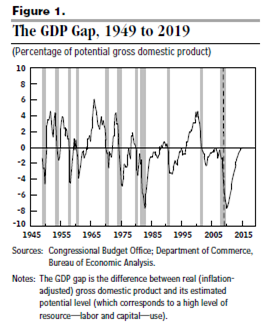
1. The new CBO budget and economic outlook is out. Above is its forecast( BS ) for the GDP gap — the hole stimulus has to fill( WHY DOES IT NEED TO FILL THE HOLE BY ITSELF? ). I’d guess( THAT'S WHAT IT IS ) that the CBO estimate, which has unemployment averaging 8.3 percent in 2009 and 9 percent in 2010, is actually too optimistic (see 3, below), but even so it puts the Obama plan in perspective: a 3% of GDP plan, with a significant share going to ineffective tax cuts( NOT CLEAR AT ALL ), to fill an 8% or more gap.

2. How ineffective? Howard Gleckman of the Tax Policy Center says Lots of Buck, not Much Bang.:

Here's his point:

"Refundable tax credits for hiring new workers promise to be an administrative nightmare and won't create many new jobs. It is tough to see how a company that is seeing its sales slaughtered in today’s recession is going to hire just because it gets a few thousand dollars per new worker from the government. Profitable firms would merely take the credit for bringing on workers they were already planning on hiring. ( IT'S AMAZING HOW PEOPLE CAN INTUITIVELY DIVINE WHETHER OR NOT AN ECONOMIC INCENTIVE WILL WORK. I HAVE NO IDEA WHAT HE'S BASING THIS VIEW ON. IT SEEMS LIKE A POSITIVE MOVE TO ME. )

I can’t begin to imagine how the variation on this idea--credits for not laying someone off--would work( HERE I AGREE ). My head throbs at the concept of the IRS trying to administer a rebate based on intentions. Worse, these breaks would never work unless they are refundable and, to be honest, giving such credits to failing business makes my skin crawl. In reality, it would become yet one more bailout—only this time taxpayers wouldn't even get stock for their trouble."

Back to Krugman:

3. The official BLS numbers won’t be out until Friday, but the ADP jobs estimate, based on private payroll data, is spectacularly grim. "( AND ACCORDING TO THE BIG PICTURE, NOT VERY USEFUL. )

Krugman's view is Mechanistic. The economy is like an engine. It needs a lot of oil. I don't credit this view at all. If there's one view that always wastes money, it's a mechanistic view of human behavior.

I would prefer an incentive for investment, but adding workers isn't a bad alternative. Let me explain something: We're fighting the fear and aversion to risk. One way to attack that is to target incentives to minimally effect this. The alternative is much more than spectacularly grim. There's no proof that any of these measures will be effective, least of all picking an enormous figure based on a graph of useful but inexact numbers. The idea that overspending poses no risk is beyond belief. It is itself a panicked reaction to our crisis. We've had a number of those recently, and, as of now, the record is mixed at best.

Saturday, November 22, 2008

"a government that spends wisely, focuses on what works"

Here are a few points from President Obama's radio address today:

"I have already directed my economic team to come up with an Economic Recovery Plan that will mean 2.5 million more jobs by January of 2011 — a plan big enough to meet the challenges we face that I intend to sign soon after taking office. We’ll be working out the details in the weeks ahead, but it will be a two-year, nationwide effort to jumpstart job creation in America and lay the foundation for a strong and growing economy. We’ll put people back to work rebuilding our crumbling roads and bridges, modernizing schools that are failing our children, and building wind farms and solar panels; fuel-efficient cars and the alternative energy technologies that can free us from our dependence on foreign oil and keep our economy competitive in the years ahead.

These aren’t just steps to pull ourselves out of this immediate crisis; these are the long-term investments in our economic future that have been ignored for far too long. And they represent an early down payment on the type of reform my administration will bring to Washington — a government that spends wisely, focuses on what works, and puts the public interest ahead of the same special interests that have come to dominate our politics.

I know that passing this plan won’t be easy. I will need and seek support from Republicans and Democrats, and I’ll be welcome to ideas and suggestions from both sides of the aisle.

But what is not negotiable is the need for immediate action. Right now, there are millions of mothers and fathers who are lying awake at night wondering if next week’s paycheck will cover next month’s bills. There are Americans showing up to work in the morning only to have cleared out their desks by the afternoon. Retirees are watching their life savings disappear and students are seeing their college dreams deferred. These Americans need help, and they need it now."

I like it, especially "a government that spends wisely". I've already accepted the need for a stimulus, focused on infrastructure. So, I'll wait and see what's proposed.

Sunday, November 16, 2008

"I have said repeatedly that America doesn't torture."

From President Obama tonight on 60 Minutes:

"Mr. Obama: Two points I'd make on this. Number one, although there are some parallels to the problems that we're seeing now and what we say back in the '30s, no period is exactly the same. For us to simply recreate what existed back in the '30s in the 21st century, I think would be missing the boat. We've gotta come up with solutions that are true to our times and true to this moment. And that's gonna be our job. I think the basic principle that government has a role to play in kick starting an economy that has ground to a halt is sound.

I think our basic principle that this is a free market system and that that has worked for us, that it creates innovation and risk taking, I think that's a principle that we've gotta hold to as well. But what I don't wanna do is get bottled up in a lot of ideology and is this conservative or liberal. My interest is finding something that works.

And whether it's coming from FDR or it's coming from Ronald Reagan, if the idea is right for the times then we're gonna apply it. And things that don't work we're gonna get rid of. "

"Kroft: How high a priority are you placing on re-regulation of the financial markets?

Mr. Obama: I think it's a top priority. I think that we have to restore a sense of trust, transparency, openness in our financial system. And keep in mind that the deregulation process, it wasn't just one party. I think there's a lot of blame to spread around.

But, hopefully, everybody's learned their lesson. And the answer is not heavy-handed regulations that crush the entrepreneurial spirit and risk taking of American capitalism. That's what's made our economy great. But it is to restore a sense of balance. "

"Mr. Obama: Yeah. Well, let's see how this thing plays itself out. For the auto industry to completely collapse would be a disaster in this kind of environment, not just for individual families but the repercussions across the economy would be dire. So it's my belief that we need to provide assistance to the auto industry. But I think that it can't be a blank check.

So my hope is that over the course of the next week, between the White House and Congress, the discussions are shaped around providing assistance but making sure that that assistance is conditioned on labor, management, suppliers, lenders, all the stakeholders coming together with a plan what does a sustainable U.S. auto industry look like? So that we are creating a bridge loan to somewhere as opposed to a bridge loan to nowhere. And that's, I think, what you haven't yet seen. That's something that I think we're gonna have to come up with.

Kroft: Are there a lot of people that think that the country would probably be better off and General Motors might be better off if it was allowed to go into bankruptcy?

Mr. Obama: Well, you know, under normal circumstances that might be the case in the sense that you'd go to a restructuring like the airlines had to do in some cases. And then they come out and they're still a viable operation. And they're operating even during the course of bankruptcy. In this situation, you could see the spigot completely shut off so that it would not potentially permit GM to get back on its feet. And I think that what we have to do is to recognize that these are extraordinary circumstances. Banks aren't lending as it is. They're not even lending to businesses that are doing well, much less businesses that are doing poorly. And in that circumstance, the usual options may not be available. "

"Mr. Obama: Well, I've said during the campaign, and I've stuck to this commitment, that as soon as I take office, I will call in the Joint Chiefs of Staff, my national security apparatus, and we will start executing a plan that draws down our troops. Particularly in light of the problems that we're having in Afghanistan, which has continued to worsen. We've got to shore up those efforts. "
"Mr. Obama: Yes. I have said repeatedly that I intend to close Guantanamo, and I will follow through on that. I have said repeatedly that America doesn't torture. And I'm gonna make sure that we don't torture. Those are part and parcel of an effort to regain America's moral stature in the world. "

These are quotes that I like. I think that he sounds pretty good.

Sunday, November 9, 2008

Sen. Obama's Agenda As Of Today

From the NY Times, Sen. Obama's agenda:

1)" Energy and Economy, Intertwined
“I will invest $15 billion a year in renewable sources of energy to create five million new energy jobs over the next decade.”
OCT. 31, DES MOINES" ( We'll see. Doesn't bother me a whole hell of a lot )
2)" Beyond ‘No Child Left Behind’
“A truly historic commitment to education — a real commitment — will require new resources and new reforms.”
MAY 28, MAPLETON, COLO" ( I'm betting on more reforms than resources )
3)"Reaching the 45 Million Uninsured
“If you don’t have health insurance, you’ll be able to get the same kind of health insurance that members of Congress get.”
OCT. 31, DES MOINES" ( I'm for a single payer national health plan, so I don't like this. I know, I know, how can that be libertarian? It can't, but I have my reasons for biting the bullet on this one. Namely, a free market won't happen, and the current hybrid plan is the worst of both extremes combined. So throw me out of the libertarian caucus if you must. I've talked about this issue before, but many people don't know how to debate issues, probably because they don't actually understand them,and so don't bother to read or debate them. Anyway, here is a post by someone who offers an intelligent libertarian critique of health care in the spirit of the later Hayek. I associate myself with the comments of Captain Sarcastic in the comments section. Fun to read.) ( One other point, which I guess I'll have to mention every time for some people to understand. Hayek himself changed his mind about this. I agree with him in "The Road To Serfdom", which I consider a libertarian book. Here's a post about it. ) ( Finally, philosophically, my argument for positive liberty in a few cases is based upon "Capitalism And Freedom", written by someone named Milton Friedman. Although he disagrees with me about health care, my notion of positive liberty is exactly the same notion that he uses to justify what he called a Negative Income Tax. I won't argue the point here, but I argue that philosophically, no matter that he claimed it was for pragmatic reasons, the Negative Income Tax philosophically rested on a weak claim of positive liberty. Period. Otherwise, the pragmatic argument made no sense at all. Agree or disagree, that's my claim.) ( One more point, for people actually interested in issues. Here's my favorite plan:"The plan would slice one Gordian knot: everyone would be required to buy health insurance, insurers would have to treat the entire population as a single pool and changes in tort and licensing laws would enable low-cost clinics for minor problems." Read about the book that describes my ultimate position here ) I should also say that my claim is empirical. I am claiming that a national plan would cost less and be better overall than what we have now. That's not an ideological position, but an empirical position. The national plan would be no panacea, it would simply be marginally to much better than what we have: Namely, a government/private hybrid loaded with idiotic incentives and redundancies )
4) "Interrogations and Guantánamo
“We’re going to lead by setting the highest of standards for civil liberties and civil rights and human rights.”
FEB. 20, DALLAS" ( Agree completely )
5) "Security and Citizenship
“We cannot deport 12 million people. Instead, we’ll require them to pay a fine, learn English and go to the back of the line.”
SEPT. 10, WASHINGTON" ( Agree completely )
6) "Tax Breaks, Old and New
“As president, here’s what I’ll do: cut taxes for every working family making less than $200,000 a year.”
OCT. 29, PAID TELEVISION ADDRESS" ( Agree completely )
7) "Withdrawing From Iraq
“Nobody’s talking about bringing them home instantly, but one to two brigades a month. It’ll take about 16 months to get our combat troops out.”
MAY 16, WATERTOWN, S.D." ( Agree completely )
8) "Working With Iran
“I would be willing to lead tough and principled diplomacy with the appropriate Iranian leaders at a time and place of my choosing.”
JUNE 4, WASHINGTON" ( Agree Completely )
9) "Negotiating Nafta
“I think we should use the hammer of a potential opt-out as leverage to ensure that we actually get labor and environmental standards that are enforced.”
FEB. 26, DEMOCRATIC DEBATE" ( Agree completely: This is terribly misunderstood. All he's saying is that we can use leverage to promote liberty and decency. I'm fine with that )
10) "But then he hedged, foreseeing the unforeseen. “We don’t know yet what’s going to happen in January,” he said. “And none of this can be accomplished if we continue to see a potential meltdown in the banking system or the financial system.” ( Agree completely )

From his acceptance speech:

"Now, many of these plans will cost money, which is why I've laid out how I'll pay for every dime: by closing corporate loopholes and tax havens that don't help America grow.

But I will also go through the federal budget line by line, eliminating programs that no longer work and making the ones we do need work better and cost less, because we cannot meet 21st-century challenges with a 20th-century bureaucracy."

Enough said. That's fine with me. Try them out, but cut them out if they don't work or are too costly.

Tuesday, November 4, 2008

"America, we have come so far. We have seen so much. But there is so much more to do"

Via CNN, our new President's remarks:

"This election had many firsts and many stories that will be told for generations. But one that's on my mind tonight's about a woman who cast her ballot in Atlanta. She's a lot like the millions of others who stood in line to make their voice heard in this election except for one thing: Ann Nixon Cooper is 106 years old.

She was born just a generation past slavery; a time when there were no cars on the road or planes in the sky; when someone like her couldn't vote for two reasons -- because she was a woman and because of the color of her skin.

And tonight, I think about all that she's seen throughout her century in America -- the heartache and the hope; the struggle and the progress; the times we were told that we can't, and the people who pressed on with that American creed: Yes we can.

At a time when women's voices were silenced and their hopes dismissed, she lived to see them stand up and speak out and reach for the ballot. Yes we can.

When there was despair in the dust bowl and depression across the land, she saw a nation conquer fear itself with a New Deal, new jobs, a new sense of common purpose. Yes we can.

When the bombs fell on our harbor and tyranny threatened the world, she was there to witness a generation rise to greatness and a democracy was saved. Yes we can.

She was there for the buses in Montgomery, the hoses in Birmingham, a bridge in Selma, and a preacher from Atlanta who told a people that "We Shall Overcome." Yes we can.

A man touched down on the moon, a wall came down in Berlin, a world was connected by our own science and imagination.

And this year, in this election, she touched her finger to a screen, and cast her vote, because after 106 years in America, through the best of times and the darkest of hours, she knows how America can change.

Yes we can.

America, we have come so far. We have seen so much. But there is so much more to do. So tonight, let us ask ourselves -- if our children should live to see the next century; if my daughters should be so lucky to live as long as Ann Nixon Cooper, what change will they see? What progress will we have made?

This is our chance to answer that call. This is our moment.

This is our time, to put our people back to work and open doors of opportunity for our kids; to restore prosperity and promote the cause of peace; to reclaim the American dream and reaffirm that fundamental truth, that, out of many, we are one; that while we breathe, we hope. And where we are met with cynicism and doubts and those who tell us that we can't, we will respond with that timeless creed that sums up the spirit of a people: Yes, we can. Thank you. God bless you. And may God bless the United States of America."

Friday, August 29, 2008

Libertarian Democrat Themes In Sen Obama's Acceptance Speech

Here are some libertarian Democrat highlights from Sen. Obama's marvelous acceptance speech:

"It's a promise that says each of us has the freedom to make of our own lives what we will...It's a promise that says the market should reward drive and innovation and generate growth...Ours is a promise that says government cannot solve all our problems...That's the promise of America -- the idea that we are responsible for ourselves...I will eliminate capital gains taxes for the small businesses and the start-ups that will create the high-wage, high-tech jobs of tomorrow...I will cut taxes -- cut taxes -- for 95 percent of all working families. Because in an economy like this, the last thing we should do is raise taxes on the middle-class...But we must also admit that programs alone can't replace parents; that government can't turn off the television and make a child do her homework; that fathers must take more responsibility for providing the love and guidance their children need."

Now, I realize that I have edited his comments in order to emphasize the libertarian aspects of his speech, which includes quite a bit that is not libertarian. My point is that Sen. Obama did indeed give some libertarian flavor to his speech, which I take to be quite important. I'm not saying that Sen. Obama is a libertarian Democrat, but that he does acknowledge some aspects of our ideas. That's a good start.

Many will believe that Sen. Obama is paying lip-service to these ideas, and doesn't really believe in them. I disagree, and believe that time will prove me correct. Wishful thinking? Isn't all political thinking?