Showing posts with label Davi. Show all posts

Tuesday, May 19, 2009

Swap dealers do not make money by over-complicating products and duping trillions of dollars worth of capital. They make money by creating a market

TO BE NOTED: From The Atlantic Business:

"May 16 2009, 10:00 am

How NPR Mangled Geithner's Plan For OTC Derivatives

Timothy Geithner has released his proposal on how to regulate the OTC derivatives market. The proposal is broad in its scope and the regulations proposed would have a profound impact on market practice if implemented. Despite this, the sleuths at NPR claim to have discovered a "huge loophole" in the plan. I've also been studying both Geithner's proposal and the NPR article on the subject, and the only holes that I found were in NPR's understanding of the OTC market. In order to fully understand the earthly implications of Geithner's policies and the gargantuan errors made on Planet Money, we should probably understand what the OTC derivatives market is. So, let's begin with a brief overview of what the OTC market is and what it isn't.

What Is An OTC Derivative?

A derivative is a contract that derives its value by reference to "something else." That something else can be pretty much anything that can be objectively observed and measured. That said, when people talk about derivatives, the "something else" is usually an index, rate, or security. For example, an option to purchase common stock is a fairly well-known and ubiquitous derivative. So are futures for commodities such as pork belly and oil. However, these are not the kind of derivatives that Geithner is talking about. Geithner is talking about OTC derivatives, or "over the counter" derivatives. This category of derivatives includes the much maligned "credit default swap" market, as well as other larger but apparently less notorious markets, such as the interest rate and foreign exchange derivatives markets. The key defining characteristic of an OTC derivative is that it is entered into directly between the parties. This is in contrast to exchange-traded derivatives, such as options to purchase common stock. Highly bespoke OTC derivatives are often negotiated at length between the parties and involve a great deal of collaboration between bankers, lawyers, and other consultants. For other, more standardized OTC contracts, commonly referred to as "plain vanilla trades", contracts can be entered into on a much more rapid and informal basis, e.g., via email.

For the limited purpose of wrapping your head around the world of derivatives, think of all derivatives as being in one of three broad categories: (1) exchange-traded derivatives (e.g., options on common stock and futures on pork belly); (2) standardized OTC contracts (e.g., your basic credit default swap); and (3) bespoke OTC contracts (transaction specific, often more complex instruments).

The "Huge Loophole"

NPR claims that Geithner's proposal has a "huge loophole", which they uncover through the following summary:

- Banks and other players have to tell the government when they buy and sell these derivatives. That means the government can know how many are out there and who has them.
- If banks and others are buying and selling standardized derivatives, they must trade them on an exchange, sort of like how stocks are traded on an exchange. That way it's more transparent and the prices should more accurately reflect the market sentiment.
- But -- and here's the big but -- banks and others are perfectly free to continue trading custom-made derivatives as private transactions between two parties.
In case you didn't catch it, that last part was supposed to be the clincher. But before we can appreciate why it's not a clincher, we need to do a bit more homework on the OTC market. In Geithner's proposal, there's a lot of talk about CCPs, or "central counterparties." These are often incorrectly equated with exchanges. CCPs are not exchanges. They are exactly what their name suggests: a central counterparty for swaps of a particular type. After two parties enter into an OTC trade together, they novate, or more colloquially, move their trades to the CCP. So unlike trades executed on an exchange, CCP trades are entered into directly between the two parties, but later shifted over to the CCP. There are a lot of reasons why this is done, and they're beyond the scope of this article. But if you're interested in reading more about CCPs, go here. The key take-away is that CCPs are not exchanges, but more like risk repository/management systems where trades get moved to after they're executed.

So, NPR believes that because OTC market participants are not forced to trade on exchanges, their trades will continue to be unnoticed and unregulated. This is completely false for two reasons: first, trades that are capable of being moved to a CCP would be required to be moved to a CCP under Geithner's plan; second, even if they weren't, Geithner's plan calls for all OTC trades, including those in the third bespoke category, to be recorded in what are known as "trade repositories," such as DTCC's Deriv/SERV. Here is the relevant language from Geithner's proposal:

[I]f an OTC derivative is accepted for clearing by one or more fully regulated CCPs, it should create a presumption that it is a standardized contract and thus required to be cleared.
[A]ll trades not cleared by CCPs [are] to be reported to a regulated trade repository.
This is in contrast to NPR's second point above, which asserts that all such trades would be traded on an exchange. That is wrong. What this says is: all trades that can be moved to a CCP (not an exchange) should be, and it will be assumed that this is required; and if they're not moved to a CCP, they have to be recorded in a trade repository. So, by definition, this proposal would make regulators aware of every single trade in the OTC market since every trade is either on a CCP, in which case the CCP will record its existence, or not on a CCP, in which case the trade repository will record its existence. But how do we explain NPR's blunder in their third point? That blunder comes from yet another equivocation between a CCP and an exchange. The relevant language from Geithner's proposal is as follows:
[Relevant laws should be amended to impose] the encouragement of regulated institutions to make greater use of regulated exchange-traded derivatives.
NPR hones in on the "encourage" language, taking this to mean that market participants will have a choice between using an exchange or being unregulated financial pirates. Of course, those swashbuckling financiers will choose the latter. As I'm sure you're starting to see, this is a false dilemma. What Geithner is suggesting here is that regulated institutions avoid the OTC market altogether, and make use of derivatives from the first category above (the exchange traded ones). Of course, such a policy should be suggestive and not prescriptive, because contrary to popular belief, OTC products serve legitimate needs that exchange traded products don't meet, at least not yet.

Customized Misinformation

No finance bashing story is complete without a kooky conspiracy theory, and so in order to fulfil the meme, NPR offers us an explanation as to why those crazy credit default swaps are so darn complex:

It seems reasonable to expect that every single sales team on Wall Street will work very hard to convince their customers that they have Very Special, One-Of-A-Kind Credit Derivatives that are far better than the boring old ones traded on the exchange.
Unfortunately for NPR, this is complete nonsense. The vast majority of credit default swaps are completely standardized and have been for a while. Recent changes to how CDS are priced has increased fungibility even further. In fact, one of NPR's commenters actually pointed this out. The NPR commenter writes:

Virtually ALL CDS contracts are standardized. Which is to say that I can open a position with Goldman Sachs and unwind that position at Citigroup. These instruments will be covered under the Obama proposal and are well suited to being exchange traded. Are there bespoke products available in the derivative market place? Absolutely. But they account for a minuscule portion of the overall business.
But NPR doesn't stop there. Acknowledging the possibility (fact) that they are wrong about standardized CDS, they go on to claim that:

[Even assuming the commenter] is right (he probably is) and most currently-traded CDS would qualify for a new exchange or clearinghouse; it seems fair to guess that lots of CDS operations will be looking for ways to avoid that clearinghouse and all the extra regulation and transparency and lowered commissions it brings with it.
Yet again, unfortunately for NPR, that is more nonsense. The major swap dealers have already set up a CCP on their own, before regulators required them to do so, and are currently moving trades to it. Swap dealers do not make money by over-complicating products and duping trillions of dollars worth of capital. They make money by creating a market. That is, they buy and sell swaps, creating a market, and pocket the difference between the prices at which they buy and sell. If you want to use jargon, you would say they create "liquidity" for swaps. That's their business. Making complicated products that aren't fungible does not advance that business model. Even more importantly, as we noted above, Geithner's proposal wouldn't let them off the hook simply because they used bespoke products. If the trade is accepted on a CCP, it is presumed to be required to go there. And even if it's not, it gets reported anyway.

Clearly Planet Money doesn't think it's a very good proposal. But in my humble opinion, it's at least a reasonable proposal for the residents of planet Earth."

From Derivative Dribble:

"
Rethinking Central CDS Counterparties In Uncategorized on May 5, 2009 at 7:45 am

Also published on Cluster Stock

Regulators have been largely supportive of the credit default swap market’s efforts to move all standard CDS (a.k.a. “vanilla” CDS) contracts onto a central counterparty (CCP). Within a relatively short amount of time, the CDS market garnered the support of both the SEC and the Federal Reserve, setup shop, and executed CDS transactions totaling $71 billion in notional amount on ICE Trust LLC (ICE), the first of what could be a handful of CCPs. Given that the CDS market is still serving time on the pillory, this kind regulatory largess seems to imply that a CCP must undoubtedly be a good thing. However, not everyone is convinced. In a recent paper, Darrell Duffie and Haoxiang Zhu of Standford University described the state of affairs with and without a CCP in mathematical terms, proposed a measure of efficiency which they use as a proxy for counterparty risk, applied this measure to each state of affairs, and came to conclusions that are surprising, but not counterintuitive once you take a moment to consider the trade-offs between a distributed dealer system and a CCP.

There are two central points in their paper: (1) the benefits of having a CCP compared to not having a CCP (the distributed dealer system) is a function of the number of dealers (i.e., the more dealers, the more the system benefits from having a CCP) and that the current number of CDS dealers might be too small to realize any benefits from a CCP; and (2) even if having a single CCP is more efficient than not having one, having more than one CCP is never more efficient than having none at all. The assumption underlying these two points is that having a CCP as opposed to not having a CCP is in essence a choice between (i) multilateral netting across a single asset class and (ii) bilateral netting across multiple asset classes. After a bit of back and forth with Duffie, I agree that this is the case, but only in the short term. That is, there is nothing about a CCP that precludes netting across asset classes, even if the current model doesn’t facilitate it. I also disagree with the two central conclusions, mostly due to shortcomings of the model that the authors acknowledge in their paper. Specifically, they acknowledge that their model doesn’t deal with so called “knock-on effects,” or simply put, how one dealer default can lead to another. I also disagree with how Duffie and Zhu measure the benefits of netting, but we’ll spare our brains the heavy lifting and focus on the more practical issues. In this article, I’ll focus on explaining why a CCP does not preclude netting across asset classes. In a follow up article, I’ll explain how a CCP mitigates counterparty risk by facilitating trade compression.

What Is A Central Counterparty?

Rather than provide a one line, academic definition, I’ll proceed gradually, and by way of example. For starters, a CCP is not an exchange. Even with a CCP, inter-dealer trades will still be entered into between dealers, and price discovery will still take place across dealers. That is, dealers will still trade with each other, at least initially. After two dealers enter into a CDS trade, they will transfer, or “novate” their positions to the CCP. For example, in the prototypical CCP transaction, if Dealer A sells protection to Dealer B, each dealer would then novate its position to the CCP. After the novation, the state of affairs is such that A sells protection to the CCP and the CCP sells protection to B. When payments are made on the CDS, they get made to the CCP and then passed on to the parties.
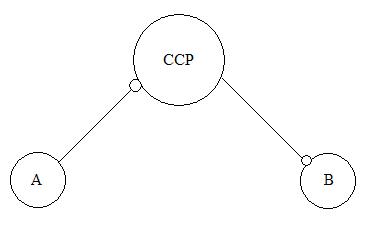
ccp-chart-1

At first blush, it might seem like all we’ve done is throw an extraneous and useless 3rd party into the transaction that does little more than operate as a conduit. However, this is not the case. The CCP is a distinct entity that has an interest in its own survival, and since the CCP is now liable to both dealers, it has an interest in being well-capitalized. While individual dealers also have an interest in being well-capitalized, they are unable to determine whether the CDS market as a whole is well-capitalized. And even if they were able to determine whether or not that is the case, each individual dealer has no power to convince others to increase the capital allocated to their positions. By centralizing all of the trade information into one entity and giving that entity control over the levels of collateral that dealers must post, we have created a method through which we can better ensure the adequate capitalization of the entire CDS market. For example, if one dealer is unable to fully collateralize its positions, the CCP can draw on its own capital and the capital of the other dealers to make up for the shortage. Without a CCP, that shortage of collateral would probably trigger events of default, which could “knock-on,” or cascade through the market. But as always, there’s no free lunch, and despite all of this upside, we have also concentrated the risk of counterparty failure.

Payment Netting And Payment Settlement

As Duffie and Zhu note, dealers net their payments and collateral across different types of vanilla swaps. So, for example, if Dealer A owed Dealer B $5 under a vanilla interest rate swap on some payment date, while Dealer B owed Dealer A $3 under a vanilla CDS, A would simply pay B $2. This type of bilateral netting across asset classes reduces the risk that dealers will default when compared to not having such netting because it reduces the total amount of cash that is needed to meet payment obligations. Duffie and Zhu argue that because CCPs segregate vanilla CDS trades from all other types of vanilla swaps, we miss the opportunity to net across asset classes. This is not necessarily the case.

First, we need to distinguish between the entities that are liable for the trades (i.e., the dealers and the CCP) and the entities that actually process the trade information and payments. In the case of ICE, trade information is processed by both TCC and DTCC. After that trade information gets processed, DTCC submits payment instructions to CLS Bank, which actually handles the payments. So, the CCP itself is not able to net payments across various asset classes, since it only handles CDS trades and moreover doesn’t actually settle the payments. However, DTCC will submit payment instructions to a settlement agent, CLS Bank, that actually handles the cash payments. CLS Bank could also receive payment instructions for other asset classes from the dealers (i.e., payment instructions on interest rate swaps, etc.) and net the payment instructions from the DTCC against the payment instructions from the dealers’ other activities. In fact, CLS Bank is also a leading settlement agent in the FX market.

In short, netting CDS contracts first does not preclude you from netting against other swaps later, especially since trading and settlement are handled by distinct entities."


Saturday, May 2, 2009

economists have no robust system of determining which statements about economics are true, and which are not

TO BE NOTED: From the Atlantic Business Channel:

"May 1 2009, 8:54 am

The Sorry State Of The Dismal Science

John Authers' recent interview with University of Chicago professor Richard Thaler is a fine example of what I hope are broader trends in economic thought. To some, it might seem like just another interview. But Authers undoubtedly recognizes its significance. Thaler is a professor at the University of Chicago, which is the birth place of the Efficient Market Hypothesis, and Authers is a well-respected columnist for the Financial Times, which is arguably the voice of the free market in the press. And yet, there they are, casting doubt upon the very theories underpinning a generation of thought that have made the University of Chicago the epicenter of free market ideology. In the language of soda-pop-economics, this interview is a "black swan."

It seems Authers is leaning ever closer towards a world view informed by behavioral economics. While I haven't done any empirical research into Authers' work, I do read his column, The Short View, religiously (personally, I recommend you do the same). And as the recent downturn developed, I noticed several articles that suggest he's come to question at least some of the assumptions underlying the old free market dogmas, particularly the Efficient Market Hypothesis. In my opinion, this is a welcomed development. And I sincerely hope it is part of a broader trend away from grandiose theories about how humans make decisions and towards precise theories which are supported by real-world observations.

Those that have toiled through my writing in the past know that I am a big fan of free markets. Yet, I am not a big fan of the EMH. And in general, I find a lot of economic theory, particularly macroeconomic theory, to be little more than hand-waving. There's an almost priestly air about it that makes me deeply suspicious of its validity. In gentler terms, Economics lacks a rigorous epistemological theory. That is, economists have no robust system of determining which statements about economics are true, and which are not. This is in stark contrast to say, mathematics. A statement about an alleged mathematical truth is verifiable (putting Gödel and Turing aside for the moment). If you tell me that you have discovered a new mathematical truth, you can sit down and in a finite number of words, provide a logical path from assumptions we both agree are true to your new found conclusions that I must accept as true, else I reject either the assumptions or logic itself. Now, I understand that economics can never be a purely deductive sport, since it is complicated by the nuance and uncertainty of, well, reality. But that doesn't mean we can't do better than simply assuming away all of human ridiculousness.

The economics that assumes rational behavior on the part of humanity is, in my opinion, dead. It is simply at odds with everyday experience. It's arguable that the desire for wealth is itself an inherently irrational impulse for most of the developed world, given that our needs would likely be satisfied on public assistance. That said, those who are able to control their behavior and act rationally do a much better job at generating and accumulating wealth. But once they get the money, they go and do something absurd with it, like buy a fleet of planes. So while reason and deferred consumption might be the means by which we accumulate wealth, the end goal of accumulating wealth seems to be driven by a need to express dominance, or at least an antisocial impulse to be free of society's constraints. This view finds support in popular culture, which often equates wealth with conspicuous consumption, sexuality, and control. All of this suggests that somewhere buried under all of those pinstripes is a real brute.

If I am correct, and there is a sea change taking place in how economists view human behavior and the markets humans create, then there may be a lot of quackery in the short term. That is, during the intellectual power vacuum that will follow the demise of the old Chicago School, a few crackpots might temporarily seize power as we trace our way from the four humors to phlogiston. But when we finally get our Lavoisier, this time let's remember to keep his head on, despite our penchant for the irrational."

Tuesday, April 21, 2009

This theory is quickly debunked by considering the glowing counterexample of Bear Stearns.

From Derivative Dribble:

"
The Art Of The Banking Controversy In Uncategorized on April 20, 2009 at 7:21 am

Also published on the Atlantic Monthly’s Business Channel.

Now that we are well into the depths of a recession, banker-bashing is all the rage. In addition to being fashionable, these “arguments” have an air of credibility about them, given the dire context in which they are made. As a result, the debate over regulating the financial sector is being recontextualized by portraying Wall Street as little more than a vacuous pig-pen. This view is informed by a grand equivocation, which lumps together all of finance under one roof, somewhere on Wall Street, where bankers convene and discuss how they can further redirect the world’s resources towards their pockets. And the shapeless anger that follows from this view has consumed not only the main stream media, but bloggers as well.

Brad Delong takes the view that both compensation and profits in the financial sector are wholly unjustified. Matthew Yglesias agrees. Another even more dubious theory, also espoused by Matthew Yglesias, is that those in finance are morally inept. (You can find Conor Clarke’s response to Yglesias here). Together, Delong and Yglesias employ straw men, false dichotomies, equivocation, conflate coincidence and causation, and in general treat a complex subject with glib answers that suggest the authors have no concern with getting it right, or have just finished reading Schopenhauer’s, “The Art of Controversy.”

Summary Judgment

In a sparsely worded opinion, Justice Delong condemns all of finance, finding the Economist’s piece on the likely pitfalls of blaming the wealthy for the current downturn an unconvincing defense to the charges. In structuring his opinion, Delong provides us with only two avenues through which we may prove our worth:

The rise in [financial sector] profits [as a share of domestic American corporate profits] from 20% to 40% would have been justified had finance produced (a) better corporate governance and thus better management, or (b) more successful diversification and thus a lowered risk-adjusted cost of and a higher risk-adjusted return to capital.

To say that profits can be justified only by satisfying exogenous factors strikes me as bizarre, especially coming from an economist. To say that there are only two such factors is simply ridiculous. There is no mandate which financial institutions must satisfy, other than the law, in order to prove their worth. The fact that Mr. Delong would like to see more emphasis on corporate governance and diversification does not create the presumption that profits earned at financial firms were somehow unjustified. Investors and clients are not in the business of making charitable contributions to financial institutions. If they paid financial institutions for services or products, they believed that they were getting good value in return at the time.

One sensible explanation for the rise in financial sector profits is that investor appetite was voracious during the relevant period. This was due at least in part to an influx of capital available for investment from the Middle East and elsewhere, which was itself due to record commodity prices, and a period of seemingly unbounded asset appreciation, each of which skewed the market’s appreciation for risk. Note that this explanation would not satisfy Delong’s demand for the justification of such profits. That is, Delong suggests that the mere existence of lawfully earned profits which the market elects to create through the demand for goods and services is insufficient. After all that happens, he, or some other economic Tsar, gets to determine which are justifiable and which are not.

Similarly, Yglesias writes:

Could it really be the case that so many people were naive enough to trust their monies to institutions that were only claiming to have brilliant investment models? Well, it seems to me that it could.

If we assume that financial institutions were merely feigning the existence of “brilliant investment models,” whatever that means, are we to simultaneously believe that these institutions were unaware of their inadequacy? After all, to accept Yglesias’ argument is to believe that Wall Street was not drinking its own Kool-Aid, but only selling it to others. This theory is quickly debunked by considering the glowing counterexample of Bear Stearns. Employees up and down the spine of corporate governance were married to Bear in the form equity. When Bear’s equity got wiped out, so did its employees, who held approximately one third of the company’s stock.

Despite Delong’s and Yglesias’ pronouncements to the contrary, the goings-on of Wall Street are not an elaborate ruse fashioned by the well-connected to deplete the world’s “precious bodily fluids.” That said, something has gone disastrously wrong. But indulging in argumentation that amounts to little more than hand waving will not help anyone to understand what happened, and more importantly, what policies should be implemented to prevent it from occurring again."

Me:

“After all, to accept Yglesias’ argument is to believe that Wall Street was not drinking its own Kool-Aid, but only selling it to others. This theory is quickly debunked by considering the glowing counterexample of Bear Stearns. Employees up and down the spine of corporate governance were married to Bear in the form equity. When Bear’s equity got wiped out, so did its employees, who held approximately one third of the company’s stock.”

The above doesn’t follow:

“What responsibility does he take, as chief executive officer, for the failure of Enron?

“I have to take responsibility for anything that happened within its businesses,” says Lay. “But I can’t take responsibility for criminal conduct of somebody inside the company.”

“This is what I call the Elmer Fudd defense — that I went to work every day and was paid $6 million a year and had a Ph.D. in economics — and somehow, despite all of this, I didn’t know anything that was going on. It’s laughable,” says Bill Lerach, a lawyer who sued to stop document shredding by Enron’s accountants. Now, he’s leading an investor lawsuit against the company, its bankers, its accountants and Lay.

“What was he doing every day in his office? Reading comic books? This man was the CEO of the company,” says Lerach. “He had an obligation to be informed about what was going on in that business every day in every way. And he utterly failed to do it.”

And:

“Prosecutors have tacitly conceded the effectiveness of Lay’s use of what is known in legal circles as the “idiot” or “ostrich” defense. The indictment handed down against him was narrowly drawn, consisting of seven counts of fraud and conspiracy, compared with the 35 counts leveled against Skilling and the 98 against former Chief Financial Officer Andrew Fastow, who is set to testify against Lay and Skilling under a plea bargain that limits his prison term to 10 years. Confined almost entirely to Lay’s actions during the last few months of 2001, the indictment accuses him of misrepresenting Enron’s condition as it careered toward insolvency.”

Of course, he was convicted.

As for Bear:

“The disintegration of the funds cost investors $1.6 billion and set in motion a series of cascading collapses, resulting in the write-down of more than $350 billion in losses and the demise of Bear Stearns itself.

“Perhaps the greatest irony yesterday was that these most networked of men, who were tuned into their Blackberries day and night, are being prosecuted through their own incriminating emails to one another.

In its indictment, the government uses email messages confiscated from both their home and work accounts to make the case that Cioffi and Tannin knowingly misled investors about the funds’ impending crackup to save their own jobs and reputations – in Cioffi’s case, going so far as to withdraw $2 million of his money from one of the funds, even as he reassured investors.

“If I can’t [turn the funds around] I’ve effectively washed a 30-year career down the drain,” Cioffi says in a June 9, 2007 email with the collapse imminent, according to the indictment.

The two are the first traders to face criminal charges in connection with the sub-prime mortgage crisis in a case that is likely to be a bellwether of the government’s ability to prosecute those who used highly complex financial transactions. ”

And:

“SEATTLE, April 8, 2008 /PRNewswire/ — Hagens Berman Sobol Shapiro filed a
third complaint today against Bear Stearns (NYSE: BSC) on behalf of current
and former employees, claiming the company violated ERISA laws concerning the
management of the Employee Stock Ownership Plan (ESOP).
Today’s lawsuit, filed in U.S. District Court in New York by plan
participant Rita Rusin, seeks to represent all employees that invested in the
ESOP from December 14, 2006 until the present.
The lawsuit claims the company’s failure to adequately manage the plan and
its investments resulted in the depletion of hundreds of millions of dollars
in retirement savings and anticipated retirement income for plan participants.
“We’ve received calls from employees looking for help,” said Hagens Berman
managing partner and lead attorney Steve Berman. “They are upset that Bear
Stearns didn’t warn them that the company stock might be in trouble.”
Berman also noted that the firm has received calls from current Bear
Stearns employees, afraid the company could retaliate against them if they
participate in the legal action. “I urge any employee who wants to speak up to
do so without fear,” Berman noted. “There are very strong laws that protect
employees when they come forward on cases such as this.”
Hagens Berman filed its first suit against Bear Stearns on March 24, 2008
after the company announced JPMorgan Chase & Co. was purchasing Bear Stearns
for $2 per share, 90 percent less than the company’s market value the week
prior.”

I don’t accept the Kool-Aid or Stupidity Defense, but all I’m asking for are through investigations into allegations of Fraud, Collusion, Negligence, and Fiduciary Mismanagement. Is that so much to ask for?

donthelibertariandemocrat 21 April 2009

Monday, April 20, 2009

buying enough protection to limit your downside, by contrast, is simply prudent

From Reuters:

"Do CDSs cause more bankruptcies?
Posted by: Felix Salmon
Tags: derivatives

Charles Davi has spent 1500 words replying in great detail to my blog entry about whether the CDS market has a deleterious effect on bankruptcy negotiations. He’s basically correct, as far as he goes, and indeed I did mix up an Event of Default with a Credit Event — my bad. But still I think he misses the bigger picture.

The problem, at heart, is this: debt negotiations are hard, arduous things. Nobody likes going through them — especially not big institutional bondholders, who can suddenly find themselves with 1% of their portfolio taking up 50% of their time. It’s something everybody wants to avoid if possible, especially since bondholders who engage in negotiations generally have to constrain themselves from trading in or out of the debt in question.

And so, at the margin, anything which makes it easier to ignore bond-restructuring negotiations is going to be jumped at by the creditors of any company. Given the choice between buying credit protection and entering into negotiations, most bondholders will happily buy the protection, even if it costs them a little bit more money.

I’m not for a minute positing the existence of protection buyers who actively seek to derail bond renegotiations so as to maximize the payout on their derivatives. Instead, I’m just saying that it becomes much harder for borrowers to renegotiate their bonds when the bondholders don’t particularly care what happens either way, because they’ve gone and bought themselves credit protection.

The problem with the originate-to-distribute model of mortgage lending was that the people who were meant to underwrite the loans couldn’t be bothered to, because they had no intention of holding on to them. Call it sheer laziness, if you like, if you don’t want to ascribe any malign intent, but the fact is that there’s an opportunity cost to getting dragged into long and boring procedures, and often a quick financial deal is much easier and cheaper than doing hundreds of hours of forensic and accounting homework.

I fear that the growth of the CDS market has made it altogether too easy for bond investors to simply rid themselves of troublesome considerations pertaining to companies in distress. Selling distressed bonds outright is extremely unpleasant; buying enough protection to limit your downside, by contrast, is simply prudent. Once you’ve done that, who can blame you for not getting bogged down in negotiations?

It’s far too early to say whether we’re going to see more bankruptcies as a result of this phenomenon, or even whether that’s necessarily a bad thing. But I do think it’s a legitimate concern."

Me:

A long time ago, about last September, when Lehman went bankrupt, I remember the words “hoisted”, “petard”, and “bankruptcy”, being used together quite a bit. The idea, as I remember it, was that bankruptcy had gotten way too hard, and bankruptcy should be made easier.

Whoa Nellie! Not so fast. Now we want bankruptcy to be harder. About the only thing that the two views have in common is a distaste for creditors, meaning people who lend companies money and have the audacity to want to get paid back and make money.

Talk about shooting yourself in the foot with a bazooka. How does it help us to market the buying of bonds as a flight to a haircut? Perhaps we should make the lending of money to companies more like charitable donations.

I favor a tax cut for investment. One way to do this is to get investors to want to buy corporate bonds. Mandating risk is not a good way to do that.I am seriously perplexed by these proposals.

Either people will stop buying bonds or they’ll demand much higher interest for their investment, meaning lower profits and wages.

What am I missing?

- Posted by Don the libertarian Democrat

Saturday, April 18, 2009

And so I have an incentive to opt for the more economically-destructive option.

From Reuters:

"How the CDS market makes restructurings more difficult
Posted by: Felix Salmon
Tags: bankruptcy, bonds and loans, derivatives

Commenter VM asks whether reduced incentives for bondholders to keep a company out of bankruptcy aren’t “a fairly horrible side effect” of the credit default swap market. Megan McArdle is thinking along similar lines, and her blog entry elicited a rather unconvincing response from Charles Davi.

To Charles’s point, no one is accusing cunning bondholders of finding “a serious loophole”, or “a nice way to make some fast cash”, or perpetrating a “restructuring-sabotage-strategy”. The problem is a bit more subtle than that, and is simply that bondholders who have bought CDS protection have much less incentive to participate in restructuring negotiations.

Let’s say that I buy $1 million of bonds. In order to protect my downside, I buy $600,000 of credit protection: if the issuer goes bust, I get $600,000, and a healthy 60% recovery value. I don’t want the issuer to go bust — I’d much rather the bonds continued to perform, and to be worth $1 million. But at least I can’t lose more than $400,000 in the event of default.

The issuer then gets into serious difficulties, and the bonds start trading at 25 cents on the dollar: my $1 million of bonds are now worth just $250,000 on the open market. The distressed issuer then seeks to avoid bankruptcy by entering into negotiations with its bondholders. “If we default and are forced into bankruptcy,” they say, “then bondholders will end up collecting no more than 20 cents on the dollar in a liquidation. But if you agree to a restructuring which keeps us out of the bankrupcy court, we can get you a good 45 cents on the dollar in value.”

Normally, bondholders would be well disposed to such an offer. But in this case, I might think twice. If the restructuring doesn’t count as an event of default for the purposes of the CDS contract, then I might end up with just 45 cents on the dollar — $450,000 — if I agree to the company’s plan. If I just let it go bust, on the other hand, I get $600,000. And so I have an incentive to opt for the more economically-destructive option.

Now there’s one big problem with this story: any restructuring as drastic as the one I described would count as an event of default — so owners of credit protection would get paid out either way.

But the fact is that whenever bondholders have bought credit protection, someone else — the protection seller — is in the position of caring deeply whether or not a restructuring goes through. But at the same time, that person can only cheer from the sidelines, and has no actual role in the bondholder negotiations, since they’re not a bondholder. Meanwhile, the bondholder doesn’t care nearly as much about the outcome of the negotiations as the issuer would like, since a lot of his exposure is hedged either way.

All of which leads Megan to propose that “swap contracts should allow the issuers to get involved in these negotiations, the way insurance companies sit at the table during lawsuits”. This is a bad idea, since there’s no limit to the amount of credit protection which can be written on any given issuer. A company thinks its dealing with a known quantity of bondholders, and then suddenly sits down at the restructuring-negotiation table to find ten times as many protection sellers? No one wants that.

And Charles Davi’s idea that companies could somehow constrain their creditors from buying credit protection is even sillier — and probably illegal. The whole point of issuing bonds is that they’re tradable, fungible, and anonymously held. You can’t covenant up bondholders in the same way you can with bank lenders.

The real solution here is to minimize the economic costs of bankruptcy. If the outcome of bankruptcy proceedings is that creditors end up with just as much value as they would have gotten from a restructuring, then there’s really no problem either way. When it’s done well, bankruptcy is little more than a change of ownership: shareholders get wiped out or diluted, and the old creditors become the new owners. The company itself doesn’t need to change much at all.

But there are certainly times when a constructive bond restructuring is going to create much more value than a drawn-out bankruptcy proceeding. And the existence of the CDS market does make such restructurings more difficult — just as the fact that mortgages have been sliced and securitized makes mortgage modifications more difficult.

Restructuring bonds outside bankruptcy is never easy — and that in fact is one reason why the bond market is normally so healthy: both issuers and investors know that companies can’t easily go back on their promise to pay what they owe. That helps to bring down the cost of funding for all companies in the bond market. But in times like these, when restructurings sadly become necessary on a large scale, having a lot of bonded debt is a problem. And when that bonded debt has been hedged in the CDS market, the problem becomes bigger still."

Me:

Let me try and understand this: I own a bond of a particular company that I bought expecting to be paid a certain amount. To protect my investment, I accept the extra investment of insurance on that bond. I thereby lessen my risk, and increase my expenses. Another bond buyer doesn’t buy insurance and has more risk. What on earth is wrong with that? It makes perfect sense to me.

So, the company is trying to restructure outside of bankruptcy. Let’s leave the type and point of bankruptcy out of it in this case. I can either accept a deal from the company or hold out for bankruptcy, depending upon what is better for me. Isn’t that our system?

The company can induce me to accept their restructuring plan by convincing me that they have a plan that will pay off for me in the long run, etc. If they don’t have one, I shouldn’t have to accept their plan.

As near as I can tell, we’re trying to create a system where my taking less risk is to be penalized because it might not fit some other person’s view of whether or not a particular company is worth trying to save. Weird. Another day, another weird and paradoxical proposal. I surely must be misunderstanding this argument. I must be very tired. I apologize.

- Posted by Don the libertarian Democrat

Monday, April 13, 2009

the bank will experience a run. To deal with this problem, we have deposit insurance

TO BE NOTED: From Derivative Dribble:

"
The Unbearable Lightness of Nassim Taleb In Uncategorized on April 13, 2009 at 7:30 am

Also published on the Atlantic Monthly’s Business Channel.

As Conor notes, Nassim Taleb offered up some less than sage advice in a recent “article” in the Financial Times. The article, which takes the form of a talismanic list, was crafted in order to the deliver humanity from its suffering by pointing our mind’s eye towards the failures of our regulatory dogma. Wielding powerful metaphors such as “Make an omelette with the broken eggs,” Taleb fails to meet even the lowest of standard for a statement on regulatory policy. “Counter-balance complexity with simplicity” might be an acceptable policy position for Deepak Chopra. But it is certainly unacceptable for an economist.

Looking beyond Taleb’s absurd delivery, the substance of his policies is, in large part, absent, and where present, addresses the real issues at play in a superficial and borderline whimsical fashion. It is unclear whether this is the product of haste, or the product of a complete lack of command over the issues and concepts. For example, Taleb states that:

7. Only Ponzi schemes should depend on confidence. Governments should never need to “restore confidence”. Cascading rumours are a product of complex systems. Governments cannot stop the rumours. Simply, we need to be in a position to shrug off rumours, be robust in the face of them.

To say that only Ponzi schemes depend on confidence — they don’t, since they’re the product of fraud and misrepresentation — is factually incorrect and suggests intellectual laziness. The extension of credit and contracting depend on confidence in the ability of a counterparty to perform. In a broader sense, the organizational structure of society depends on people being able to rely on the predictability of certain events around them (e.g., bus, train, and plane arrivals, banks maintaining deposits, etc.).

This organizational structure is itself a product of confidence. I am confident that the train will arrive shortly after I get to the train station in the morning, and as a result, I plan on taking the train to work each day. I am confident that my bank will maintain my deposit level, and so I don’t have a mattress full of cash. When confidence is eroded, the incentives of individuals become misaligned.

Take, for example, the case of a bank run. Each depositor has an incentive to withdraw its deposits based solely upon the assumption that all other depositors are doing so, since we have a fractional reserve banking system. Yet each would be better off if none of them withdrew their deposits. When the assumption rings true in the minds of enough depositors, that is, when confidence breaks down, the bank will experience a run. To deal with this problem, we have deposit insurance, which the Government provides to create and maintain confidence in the banking system."

Wednesday, April 1, 2009

it appears Hernando De Soto has joined the ranks of economists who demonstrate a complete lack of understanding of the subject area

TO BE NOTED: From Derivative Dribble:

"
How To Speak “Structured Finance” In Uncategorized on March 31, 2009 at 7:20 am

Also published on the Atlantic Monthly’s Business Channel.

With all the accusations of excessive speculation on Wall Street, the media has certainly done its fair share of speculation as to what goes on in the structured finance market. And given all the public outrage, this is information the press should should get straight before they report.

Like every trade, the world of structured finance has developed its own little language describing the things that people in the market do. The first step to understanding that language is building a vocabulary. I would say that most folks in the media have developed to the point where they can identify, point at, and grunt towards objects in the structured finance space. But it’s not just the media that doesn’t understand structured finance. It’s economists, pundits, and perhaps most ironic, financiers! Even that giant of finance, George Soros has loused up explanations of how credit default swaps work. I’ve called out economists in the past for their mumblings on credit default swaps and the like, and so has Megan McArdle. This is a serious problem because economists, finance giants, and the like command a level of authority that my local TV news anchor does not.

Continuing in the tradition of misinformation, it appears Hernando De Soto has joined the ranks of economists who demonstrate a complete lack of understanding of the subject area. But rather than devote an entire article to bashing an intelligent man, I’ve decided to use the errors in his opinion piece in The Wall Street Journal as the first step in exploring the world of structured finance for those (lucky) folks who have hitherto had little exposure to the area.

Speaking Structured Finance

Speaking “Structured Finance” is not as hard as those around you suggest. Sure, these are not ideas and terms you’ve grown up around. But with a bit of reading and thinking, you’ll be the star of your next wine and cheese night. In this article, I provide topical treatment of a wide range of subjects, but provide links for those brave souls who really want to dive in and impress their cheese-eating friends.

First, Mortgage Backed Securities are not derivatives. To my fellow finance wonks, this may be a trivial observation. But apparently Mr. De Soto was not aware of this distinction:

[A]ggressive financiers have manufactured what the Bank for International Settlements estimates to be $1 quadrillion worth of new derivatives (mortgage-backed securities, collateralized debt obligations, and credit default swaps) that have flooded the market.

A Mortgage Backed Security (MBS) is just that, a security and not a derivative. Investors that own MBSs receive regular income from these securities. What distinguishes them from traditional securities, such as corporate bonds, is that the MBS is backed by a pool of mortgages. That is, investors buy MBSs, and as a result, they have a right to the cash flows produced by that pool of mortgages. As the homeowners whose mortgages are in the pool pay off their mortgages, the money gets funneled to and split up among the MBS holders. In effect, MBSs offer investors the opportunity to finance a portion of each mortgage in the pool and receive a portion of the returns on the pool. For more on MBS, go here.

Similarly, a Collateralized Debt Obligation (CDO) is not a derivative, but a security. It is similar in concept to an MBS, except the pool is not made up of mortgages, but rather various debt instruments, such as corporate bonds. The pool underlying the CDO could be made up of loans, in which case it’s referred to as a Collateralized Loan Obligation (CLO). In general, a CDO has a pool of assets that generate cash. As that cash is generated, it gets funneled to and split up among the investors. For more on CDOs, go here and here.

A Credit Default Swap (CDS) is a derivative. So De Soto got 1 out of 3. Well then, what’s a derivative? A “derivative” is a bilateral contract where the value of the contract is derived from some other security, derivative, index, or measurable event. For example, a call option to buy common stock is a fairly well known and common derivative. A call option grants the option holder the right (they can do it) but not the obligation to buy common stock at a predetermined price. The person who sold the option has the obligation (they must do it) and not the right to sell common stock at that predetermined price. So the value of a call option that entitles the holder to buy 100 shares of ABC Co. at $10 per share would depend on the current price of ABC’s stock. If ABC is trading above $10, it would be worth something to the holder, a.k.a., “in the money.” If it’s trading below $10, it would be “out of the money.”

So what are OTC Derivatives? The term “OTC” means “over the counter.” The spirit of the term comes from the fact that OTC Derivatives are not traded on an exchange, but entered into directly between the two parties. “Swaps” are a type of OTC Derivative. And the Interest Rate Swap market is by far the largest corner of the OTC Swap market, despite media protestations as to the size of the CDS market. For more an Interest Rate Swaps, go here.

Despite the fact that the Interest Rate Swap market is an order of magnitude larger than the CDS market, we will succumb to media pressure and skip right past Interest Rate Swaps and onto the most senselessly notorious OTC Derivative of all: the Credit Default Swap.

What Did You Just Agree To?

Under a typical CDS, the protection buyer, B, agrees to make regular payments, usually quarterly, to the protection seller, D. The amount of the quarterly payments, called the swap fee, will be a percentage of the notional amount of their agreement. The term notional amount is simply a label for an amount agreed upon by the parties, the significance of which will become clear as we move on. So what does B get in return for his generosity? That depends on the type of CDS, but for now we will assume that we are dealing with what is called physical delivery. Under physical delivery, if the reference entity defaults, D agrees to (i) accept delivery of certain bonds issued by the reference entity named in the CDS and (ii) pay the notional amount in cash to B. After a default, the agreement terminates and no one makes any more payments. If default never occurs, the agreement terminates on some scheduled date. The reference entity could be any entity that has debt obligations.

Now let’s fill in some concrete facts to make things less abstract. Let’s assume the reference entity is ABC. And let’s assume that the notional amount is $100 million and that the swap fee is at a rate of 8% per annum, or $2,000,000 per quarter. Finally, assume that B and D executed their agreement on January 1, 2009 and that B made its first payment on April 1, 2009. When July 1, 2009 rolls along, B will make another $2,000,000 payment. This will go on and on for the life of the agreement, unless ABC triggers a default under the CDS. While there are a myriad of ways to trigger a default under a CDS, we consider only the most basic scenario in which a default occurs: ABC fails to make a payment on one of its bonds. If that happens, we switch into D’s obligations under the CDS. As mentioned above, D has to accept delivery of certain bonds issued by ABC (exactly which bonds are acceptable will be determined by the agreement) and in exchange D must pay B $100 million.

Why Would You Do Such A Thing?

To answer that, we must first observe that there are two possibilities for B’s state of affairs before ABC’s default: he either (i) owned ABC issued bonds or (ii) he did not. I know, very Zen. Let’s assume that B owned $100 million worth of ABC’s bonds. If ABC defaults, B gives D his bonds and receives his $100 million in principal (the notional amount). If ABC doesn’t default, B pays $2,000,000 per quarter over the life of the agreement and collects his $100 million in principal from the bonds when the bonds mature. So in either case, B gets his principal. As a result, he has fully hedged his principal. So, for anyone who owns the underlying bond, a CDS will allow them to protect the principal on that bond in exchange for sacrificing some of the yield on that bond.

Now let’s assume that B didn’t own the bond. If ABC defaults, B has to go out and buy $100 million par value of ABC bonds. Because ABC just defaulted, that’s going to cost a lot less than $100 million. Let’s say it costs B $50 million to buy ABC issued bonds with a par value of $100 million. B is going to deliver these bonds to D and receive $100 million. That leaves B with a profit of $50 million. Outstanding. But what if ABC doesn’t default? In that case, B has to pay out $2,000,000 per quarter for the life of the agreement and receives nothing. So, a CDS allows someone who doesn’t own the underlying bond to short the bond.

So why would D enter into a CDS? Most of the big swap dealers buy and sell protection and pocket the difference. But, D doesn’t have to be a dealer. D could sell protection without entering into an offsetting transaction. In that case, he has gone long on the underlying bond. That is, he has almost the same cash flows as someone who owns the bond. So a CDS allows someone who doesn’t own the bond to gain bond-like credit exposure to the reference entity.

I will follow this article up with another elaborating further on why derivatives are used and why they are your friends."

Saturday, March 28, 2009

they didn't sell enough risk

TO BE NOTED: From The Atlantic Business Channel:

"Mar 28 2009, 8:17 am

The Kling and I on credit default swaps

Arnold Kling and I will probably never agree when it comes to credit default swaps (CDS). Kling and I have had words in the past over CDS, and so have Kling and Felix Salmon. But so long as spirited debate proves interesting to us and our readers, I'm happy to participate in that hallowed, nerd-sport-of-choice: arguing over the internet.


Kling seems convinced that because he cannot conceive of a way to hedge credit risk using the long end of a CDS (the protection seller's end) it follows that CDSs have no "natural seller." In short, his position is the following:

"[N]o institution was in a position to sell credit default swaps as a natural hedge against its other business."


Why would both ends of a CDS need to hedge some risk in order for the CDS to be economically beneficial? I fail to see how hedging is the sine qua non of economic utility. If that were the case, who is a natural buyer of bonds? I'm sure Kling is incapable of answering that question because as a matter of pure logic, any answer to that question is an answer to his, since selling protection through a CDS is economically equivalent to buying the underlying bond (ignoring CDS collateral, which complicates the matter).


In any case, it seems futures and forwards are acceptable means of speculation, but CDS are not. In the case of fuel and other energy and commodity derivatives, there are those in the market who have bona fide economic exposure to the underlying risk. For example, an airline might enter into a swap or a forward contract to lock in a price for fuel, so that it can plan around that price and won't be brutalized by volatility in fuel prices. The other end of the trade could very well be an entity with no bona fide economic exposure to fuel prices. Rather, that entity wishes to speculate on the movement of energy prices. Both benefit through contract in that both get what they want: the airline wants stable fuel prices and the speculator wants the opportunity to profit by expressing a view on the movement of fuel prices.


The same applies to CDS. Certain entities in the market have bona fideeconomic exposure to credit risk. For example, banks. In order to shed this risk, banks will contract with another party, the protection seller, to absorb this credit risk. The bank wants to unload its credit risk and the other party wants to speculate as to the probability of default on and, more generally, the movement of credit spreads relative to the underlying credit. And so, both parties get what they want and the transaction is, at a minimum, economically useful ex ante."

And Felix Salmon:

"
CDS: The No-Natural-Seller Meme

I was on a panel last night with Simon Constable of Dow Jones Newswires, and I'm sure that to our lay audience a peculiar exchange in the middle of the conversation must have sounded a bit like dolphin squeaks. He was trying to demonize credit default swaps, and said with great finality and self-assuredness that if you wanted proof positive that they were the spawn of the devil, all you needed to do was examine them objectively, as he had done, and you'd see that they had no natural seller.

I then interjected that of course credit default swaps have natural sellers: any bond investor is a natural seller of CDS protection. We started going around in ever-decreasing circles of mutual incomprehension, until the moderator happily put an end to that particular discussion and moved us on to the next topic. But now Arnold Kling has resuscitated the meme:

There is no institution which, in the ordinary course of its business, takes a position for which selling credit default swaps is a natural hedge...
Credit default swaps allow companies to trade the default risk on, say, a mortgage-backed security. The holders of that security have a natural interest in buying protection. But nobody has a natural interest in selling protection.

I thought I'd dealt with this back in December, but evidently not, so let me try again, this time quoting a little of my Wired article on the Gaussian copula function:

If you're an investor, you have a choice these days: You can either lend directly to borrowers or sell investors credit default swaps, insurance against those same borrowers defaulting. Either way, you get a regular income stream--interest payments or insurance payments--and either way, if the borrower defaults, you lose a lot of money. The returns on both strategies are nearly identical, but because an unlimited number of credit default swaps can be sold against each borrower, the supply of swaps isn't constrained the way the supply of bonds is, so the CDS market managed to grow extremely rapidly.

The point is that there are a lot of very sophisticated bond investors out there, and much of the time they could replicate the risk and return of buying a bond by putting together certain trades in the CDS market -- and get much better liquidity that way. It's not easy to find bonds from certain issuers, but you can always find a broker willing to buy credit protection on any given name.

A bond investor isn't really hedging anything, so it's true that if and when a bond investor starts selling default protection, then he isn't offsetting some opposing risk. But it's simply not true that in order to make a derivatives market work, both sides have to be hedging something. In the CDS market, you can simply have one person, who doesn't want risk, selling that risk to another person, who does want it.

Generally speaking, it's a good thing for banks to sell down their risk, even as it's also a good thing for institutional fixed-income investors to buy risk: that is, after all, their job. Part of the problem in this financial crisis, as I was talking about earlier, is that banks started persuading themselves that they'd sold so much risk that there wasn't any left, even as the amount of risk they had on their balance sheets continued to balloon. That was a serious failure of risk management: they didn't sell enough risk, largely because they couldn't find any buyers (except for AIG, sometimes) for the super-senior risk tranches that they were prone to keeping on their books.

But those buyers weren't absent because there were no natural sellers of CDS; they were absent because the yields on offer on those super-senior tranches were so ridiculously low that no one in their right mind wanted to buy them. So long as there are bond buyers, there are natural sellers of default protection. They might not be hedging anything, in a narrow sense, but they are large, and numerous, and extremely useful when it comes to providing liquidity and price discovery. By all means regulate the CDS market; by all means move CDS trading onto an exchange. (Although that might not make as much of a difference as many people hope.) But let's not kid ourselves into believing that there was no reason for the CDS market to exist in the first place."

Friday, October 24, 2008

Credit Default Swaps: "Much Ado About Nothing "

Via Across The Curve, a great post on credit default swaps by Charles Davi:

"Much Ado About Nothing

So what is the big deal about these credit default swaps? Surely, there must be something terrifying and new about them that justifies all this media attention? Actually, there really isn’t. That said, all derivatives allow risk to be magnified (which I plan to discuss in a separate article)."

Please read the post and the blog. They're excellent.

As I've said, we need to make sure that we either have transparency and collateral for anything that magnifies risk or shifts it to others, or it must be minimally regulated to insure this.

Here's my comment:

“So, for anyone who owns the underlying bond, a CDS will allow them to protect the principal on that bond in exchange for sacrificing some of the yield on that bond.”

This just looks like insurance.

A. If AIG defaults, B has to go out and buy $100 million par value of AIG bonds.
B. B has to pay out $500,000 per month for the life of the agreement and receives nothing.

Why couldn’t this transaction be tied to anything? Wheat, currency, anything that I’d have to buy if it’s devalued? In other words, if you don’t own it, peg it to anything. Is there some reason to peg it to bonds or mortgages, as opposed to anything else?

If my question doesn’t make sense, don’t answer it. If you don’t want it on the blog but can answer me, please email me. Thanks, Don

And here's his answer, which is very clear and interesting:

"Hi Don,

Great name! Yes, it does look like insurance. At at a bilateral level, it is. However, insurance regulations don’t work in swap markets. Here’s why:

http://derivativedribble.wordpress.com/2008/10/21/the-regulatory-gong-show-new-york-struts-and-frets-its-hour-upon-the-stage/

Derivative contracts can indeed be linked to any objectively observable and measurable event, e.g., the occurrence of a hurricane. These types of things exist. They’re called “weather bonds.”

I’m writing a piece on “synthetic instruments” which will discuss things like this so keep an eye out for it!"

I'm going to, and you should as well.