"From Sandy Strip of Sri Lanka, Tales of Suffering as War Traps Thousands

A Sri Lankan soldier on Friday looked over civilians who had fled the war zone in the northern part of the country controlled by Tamil rebels. As many as 100,000 civilians may be trapped there.
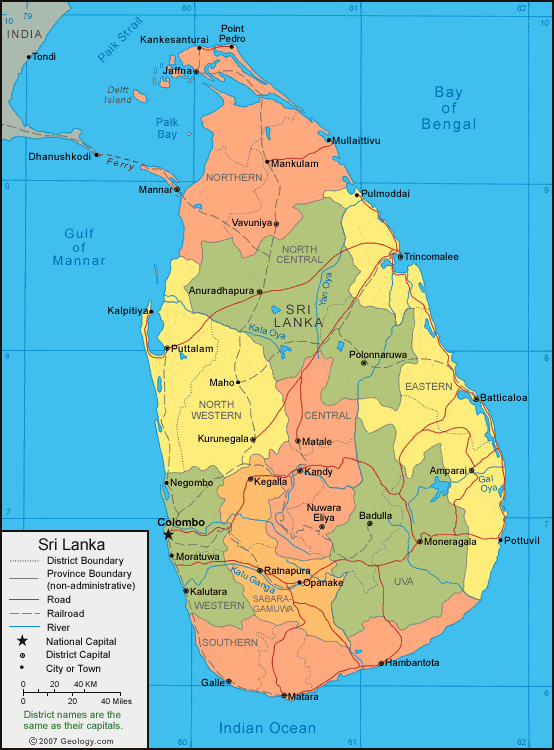
COLOMBO, Sri Lanka — In more peaceful times, the narrow, sandy strip of land that hugs the coast near the northeastern town of Mullaittivu might attract tourists to its Indian Ocean beaches.

As a soldier looked on, smoke rose Friday from the combat zone near the town of Putumattlan, in northern Sri Lanka.

Wounded civilians are dying at a hospital in Vavuniya.
Now, as the country’s long-running civil war appears to be reaching its climax, a picture of desperation is emerging from the sliver of territory between a lagoon and the sea where rebels from the ethnic Tamil minority are making their last stand.
Stories of suffering have streamed out of the area along with the tens of thousands of civilians who were able to break through the front lines last week and straggle into overwhelmed hospitals and refugee camps.
Tim Pruchnic, an American surgeon working at a hospital in the northern town of Vavuniya, said in a telephone interview that many of his patients were so weak they were dying after operations that would not normally be life threatening.
After months in the combat zone, patients are exhausted, malnourished and dehydrated, said Dr. Pruchnic, who works with the aid group Doctors Without Borders. Another doctor who works with the aid group at the same hospital, Paul McMaster, said some of his patients were losing limbs to amputations because their injuries — often from shrapnel, gunshots and land mines — had gone untreated for too long and became infected.
Civilians have been trying for weeks and sometimes months to leave the ever-shrinking area of fighting between the government and the Tamil Tiger rebels in the north, but the rebels have been holding them as human shields, building earthen barriers that make it harder not only for soldiers to get in but also for civilians to get out, according to aid agencies and the Sri Lankan military. The rebels have also forced some civilians to take up arms, the United Nations says. The government, meanwhile, has ignored appeals from the United Nations, India, the United States and other nations for a cease-fire until all the civilians are out of the combat zone.
Last week, the government was able to explode one of the rebels’ barriers, allowing about 100,000 civilians to flee.
“Even in ordinary times a population of 100,000 would be a huge burden on the health system,” said Gordon Weiss, the United Nations spokesman in Colombo. “But these are people who have had three months with very little food, they’ve traveled across mine fields and endured months of shelling and small-arms fire. It’s no surprise that the hospitals are overwhelmed.”
Shortages of doctors and nurses are also growing severe, in part because of what Mr. Weiss described as bureaucratic “bottlenecks” in the approval process for visas of foreign aid workers.
Some of the civilians who have fled ended up in the hospital at Vavuniya, where doctors say the maximum capacity is normally 600 patients. Last week, 1,700 people were crowded into its wards. Dr. Pruchnic said many of the patients, including children, arrived without their families.
“There are kids here who have had amputations, their mother and father are gone — their whole family is missing,” he said. “Yet they can still smile. I’m amazed at their resilience.”
On Saturday, the Tigers said that tens of thousands of civilians faced “imminent” starvation, according to a Web site that serves as their voice, Tamilnet.
The International Committee of the Red Cross, which evacuated hundred of wounded civilians by fishing boats used as ferries in recent days, has also warned of the lack of food and an “acute shortage of vital medical supplies” in the combat zone.
The government’s advance has been slowed somewhat by the rebels’ earthen barriers, according to Brig. Gen. Udaya Nanayakkara, a military spokesman. He said the military was now moving forward only several yards a day as troops cleared mines and booby traps. The rebels are equipped with at least one tank, artillery pieces, armor-plated vehicles, assault weapons and satellite phones, he said.
Conditions in the rebel-held territory are difficult to verify because journalists and aid workers have been barred from the combat zone.
The general also said the mingling of rebels among civilians had complicated the military’s advance.
Among the nearly 200,000 people who have escaped rebel-held territory since January, about 3,000 were determined to be fighters disguised as civilians, General Nanayakkara said. He estimates there are 500 fighters left in rebel-held territory.
“The moment we take all the trapped civilians out it’s just a matter of 48 hours to get rid of them,” General Nanayakkara said of the rebels.
Since late January, when rebel-held territory shrank significantly, about 13,500 civilians have been killed and 14,000 wounded, according to a United Nations tally. The United Nations estimates there are 50,000 to 100,000 civilians stuck on the sandy spit of land. The military says it is more like 15,000 people.
Whatever the number, the frailest among them may never make it out alive.
Patients arriving at Vavuniya hospital are usually young or middle-aged: Dr. Pruchnic says he has seen few elderly people.
“The old don’t seem to make it here,” he said. “There’s a few. But I think they’re mostly dying on the way.”
Sharon Otterman contributed reporting from New York."



















 Posts