Showing posts with label Stimulus Bang For The Buck. Show all posts

Thursday, March 26, 2009

I suspect we'd have a lot more latitude for stimulus

TO BE NOTED: From Econbrowser:

"
The Debt to GDP Trajectory in Perspective

There's been substantial discussion of how the debt-to-GDP ratio evolves under the Obama plan. In part, the House attempts to pare back certain provisions of the Obama budget are a reaction to the projected rise in the debt-to-GDP ratio [0].

Inspection of Figure 1 does provide some support for the view that we need to pare back spending, or raise taxes (seldom mentioned).

obamabudget1.gif
Figure 1: Ratio of Federal debt held by public to GDP (blue), CBO baseline (green), Obama budget as scored by CBO (black), and CBO baseline minus stimulus package (red), by fiscal years. In the baseline minus stimulus, I have merely subtracted the cumulated stimulus bill deficits; hence, no accounting for associated interest is included. Dashed line indicates last observation on actual data. Sources: CBO, CBO historical statistics, and CBO letter to Grassley (March 2, 2009), and author's calculations.

I'll make three observations at this point.

  • A big chunk of the increase in the debt-to-GDP ratio occurs because of the recession-driven collapse in revenues and the policy actions undertaken by the previous administration and Congress. Graphically, this is shown by the sharp jump in the series in FY 2009 (which started in October 2008).
  • The debt-to-GDP projections do not take into account the stimulative effects of the stimulus plan, and in the budget. This is appropriate (as I have argued in the past, in my discussion of dynamic scoring [1]) because the magnitude of the stimulative effect is a subject of debate. Still, for those who are neither RBCers, nor Classical economists, we would expect the actual path of the debt-to-GDP ratio to be lower than projected (ceteris paribus) as GDP is higher than baseline in the first few years of the outlook [2] [3].
  • The baseline debt-to-GDP ratio is in some sense unrealistic because it assumes discretionary spending grows with the CPI. Assuming that discretionary spending grows with nominal GDP -- a more realistic assumption [4] -- would make the gap between the baseline and the Obama budget debt/gdp ratio as scored by CBO smaller.

Still, even taking into account these factors, one should worry about crowding out, and the possibility that dollar denominated assets will become less desirable as the supply of Federal debt increases.

At this juncture, it might be useful to take a longer, historical, perspective on this issue. Below I plot data going back to FY 1938

obamabudget2.gif
Figure 2: Ratio of Federal debt held by public to GDP (blue), Ratio of end-FY Federal debt held by public to Calender Year GDP (real), CBO baseline (green), Obama budget as scored by CBO (black), and CBO baseline minus stimulus package (red), by fiscal years. In the baseline minus stimulus, I have merely subtracted the cumulated stimulus bill deficits; hence, no accounting for associated interest is included. Dashed line indicates last observation on actual data. Sources: CBO, CBO historical statistics, and CBO letter to Grassley (March 2, 2009), FRED II, and author's calculations.

So, in the past, the Federal debt-to-GDP ratio has been higher than it is projected to be. Admittedly, the times are different. Financial autarky (approximately) prevailed in the 1940's and early 1950's, so the degree of substitubility between dollar and pound (and franc) denominated assets was low. That is not so now. However, it's also important to realize that debt-to-GDP ratios are rising in many other economies that are associated with currencies that might be thought to be close substitutes (think UK). And in the euro area, doubts about the government debt of certain economies is likely to make euro denominated assets also poor substitutes. (Remember that many of the debt-to-GDP ratios in Europe are higher than that in the US -- see slightly different [gross] ratios here). In any case, the analysis of the dilemma we are currently facing I laid out in this post from last July.

A last observation. Just think if the 2001 and 2003 tax cuts had never occurred. What would the debt-to-GDP ratio look like? I suspect we'd have a lot more latitude for stimulus. Not a new observation -- see here (and the accompanying commentary, which in retrospect is quite amusing) -- but one useful to recall.

Posted by Menzie Chinn at March 26, 2009 05:42 AM"

Friday, February 20, 2009

"The lesson is simple: Don't count jobs; make jobs count."

And again:

"Jobs: Not a Proper Goal of Public Policy

In my previous piece I focused on a simple trap that we all fall into when we count what happens (jobs) but forget to count what doesn't happen (other jobs). We forget to net it out.

In this piece, also mercifully short, I hope, I would like to make the case that "job creation" is not a worthy goal of economic policy anyway. Sure, we want jobs for everybody who wants one, but jobs should come as a by-product of producing something or providing a service that is needed. Focusing on the job per se, rather than on what is produced with the job, leads to waste. There is always more work to be done than there are people able and willing to do it. It is the work that should drive the process; not just a job for a job's sake.

Some examples will make this obvious. The government could create enough jobs to achieve full employment by having the previously unemployed dig holes on Monday, Wednesday and Friday and fill them up on Tuesday, Thursday and Saturday. Or, in my long-time favorite example, if you want more jobs, replace the heavy equipment on a construction site with shovels. If that doesn't do it, replace the shovels with spoons. Silly? Sure, but not much sillier that some of the rhetoric we take all too seriously.

When we say we have to "create jobs," we are setting ourselves up for a misallocation of scarce resources and a sub optimization of our economic efficiency. When we say that, we imply that there are just so many jobs to go around and we need to find and fill them. Pretty soon that kind of thinking leads us into the French fallacy of spreading a given (fixed) amount of work among more workers by shortening the legal work week. Only so much work to be done; let's spread it out.

Don't forget that the demand for workers will increase with the work being done. Don't forget Say's Law, "Supply creates its own demand." We sometimes forget it in times like this because we get caught up in Keynes' Law, "Demand creates its own supply." Come to think of it, neither law is a rationale for wasting good workers by putting them in sup-optimal jobs. The lesson is simple: Don't count jobs; make jobs count."

Me:

  1. Don the libertarian Democrat Says: Your comment is awaiting moderation.

    Here I agree with you. It has to matter how the money is spent, otherwise, why even bother creating jobs? Just give people money to live. In fact, from my point of view, social safety net spending works the best, since it has to be spent. After all, it’s given to people who, theoretically at least, need it to survive, and so have to spend it, and on things essential to the economy at that.

    Infrastructure is purportedly an investment. In other words, it will more than pay for itself in the future by facilitating some business or civic function or both. If it turned out be heavily siphoned off into fraud, or spent in a way that led to enormous cost overruns in the future, wouldn’t we be angry? Otherwise, why not run a big Ponzi Scheme instead? They certainly seem to attract investors.

    From my point of view, there is a good argument, in general, to borrow for investment, so that, in a time of necessary borrowing ( This is what I call the current situation. Not necessary spending. After all, you could spend without borrowing. ), some money for infrastructure makes sense. I simply thought that $100 Billion made more sense, since I do worry about things like waste and fraud, especially under crisis conditions.

    So, I agree with you. The argument is intentionally fuzzy. We want to spend money on infrastructure as an investment, but we don’t want to observe the normal precautions we take concerning it, because we’re in a hurry to spend. This is not a good argument, and neither is the argument that it doesn’t matter what the spending is for.

The economy of the future will just be a little less productive and a little more sluggish than it would have been. Less will be seen in the future.

From Bob McTeer:

"Stimulus and Job Creation

Not Necessarily the Same Thing

Once again I'm going to be brave and state the obvious and run the risk of a "Duh" response. While my point is embarrassingly obvious, I haven't heard anyone make it during the debate on the recently passed stimulus package.

Money spent, even new money spent, on a given project or cause is much more likely to cause a diversion or reallocation of employment than to cause a net increase in employment.

As explained in my Broken Window Fallacy, when a baker has to spend money for a new window because teenagers threw a brick through the old one, he does create additional business for the window repair man, who will likely spend the proceeds on something else, and so on. The broken window does create new spending, and, perhaps, even additional employment. However, the benefits of this new spending are likely to be offset by the money not spent on something else had the window not been broken. That spending would also have led to further spending. The broken window diverted spending and reallocated the benefits, but didn't create net new spending or employment.

Substitute for the broken window the various and sundry new spending projects included in the huge stimulus package. They will result in new business for some, and perhaps even some new employment, but not necessarily any net new employment. Workers used on new projects are likely to be the same workers that would have worked on other similar projects in the same field. The workers on the new projects will be counted and added to the ranks of the newly employed; the same workers won't be subtracted from other projects because the other projects didn't materialize. As Frederic Bastiat would have put it, it's the difference between the seen and the unseen. The seen get counted; the unseen don't.

As the debt piles up, the government programs that don't get funded in the future because of the higher cost of servicing the debt won't be counted either. Those forgone programs of the future won't be counted as a cost of today's stimulus because they won't be seen either. The economy of the future will just be a little less productive and a little more sluggish than it would have been. Less will be seen in the future."

Me:

  1. Don the libertarian Democrat Says:

    “The workers on the new projects will be counted and added to the ranks of the newly employed; the same workers won’t be subtracted from other projects because the other projects didn’t materialize.”

    This sounds like your saying that, if the local government builds a courthouse, I won’t be able to find workers to build my grocery store. That can’t be right. What am I missing?

Thursday, February 5, 2009

How do we get out of this downward plunge?

From Robert Reich:

"
Senate Republicans and the Stimulus:

Playing Politics When the Economy Burns Tomorrow's job report is likely to be awful. January's job losses could easily top half a million. We're deep into the most vicious of economic cycles: Consumers are slashing their spending because they're perilously in debt and worried about keeping their jobs. But as a result, businesses are facing shrinking sales of goods and services, so they're slashing payrolls, which of course makes consumers even more anxious and further reduces their spending power. Meanwhile, businesses are cutting way back on new investments in equipment, which hurts upstream suppliers, who are now slashing their payrolls. And so it goes, downward. The gap between what the economy could produce if it were running near full capacity and what it's now producing continues to widen. The shortfall is projected to be over a trillion dollars this year.

How do we get out of this downward plunge?

Regardless of your ideological stripe, you've got to see that when consumers and businesses stop spending and investing, there's only entity left to step into the breach. It's government. Major increases in government spending are necessary, and the spending must be on a very large scale. In the last several weeks the President has put forward the outlines of a stimulus plan, and has left it to the House and Senate to fill in the details. A tiny portion of the details that made it into the House version should be stripped away because they seem like old-fashioned pork. But most spending in the bill is absolutely appropriate. My worry is there's not nearly enough of spending to fill the shortfall in overall demand.

Yet at this very moment, Senate Republicans are seeking to strip the President's stimulus package of many of its spending provisions and substitute tax cuts. Part of this is pure pander: They know tax cuts are more popular with the public than government spending, even though spending is a far more effective way to stimulate the economy (more on this in a moment). Another part is pure partisan politics: Republicans are emboldened by Obama's willingness to court Republicans (taking three Republicans into his cabinet, bringing Republican leaders into the White House for consultations, putting all those business tax cuts into the stimulus bill in order to gain Republican favor) without getting anything at all back from the GOP. House Republicans snubbed the bill entirely. So, Senate Republicans say to themselves, what's to lose?

Plenty. Millions more jobs and a full-fledged Depression, for example.

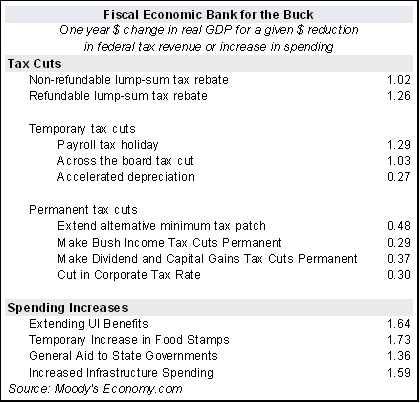
Can we get real for a moment? Take a look at this chart, which comes from calculations by Mark Zandy and his colleagues at economy.com. You see that each dollar of spending has much more impact than each dollar of tax cut. http://www.economy.com/dismal/graphs/blog/mz_012208_1t.GIF

There are three reasons for this. First, most people who receive a tax cut don't spend all of it. They use part of it to pay down their debts or they save it. Most of us did one or the other last spring with that tax rebate. From the standpoint of any particular individual, paying down debts or saving may be smart behavior -- even commendable. But what's intelligent for an individual does not necessarily translate into what's good for the economy as a whole. The only way to get businesses to create or preserve jobs is through additional spending. And unlike tax cuts used to pay down personal debt or add to savings, every dollar of government spending flows directly into the economy and adds to overall demand.

Second, even that portion of a tax cut we might actually spend doesn't necessarily go into the American economy. It goes all over the world. I have nothing against creating or preserving the jobs of Asians who assemble those flat-panel TVs you see at the mall, for example, but right now we're trying to create or preserve jobs here in America. Sure, the retail workers at the mall who sell the flat-panel TV's might benefit, but remember we're talking about how to get the biggest bang for every dollar. When government spends to repair a highway or build a school or help pay for medical services, the money and the jobs stay here in America.

Finally, those who say cutting taxes on businesses is the best way to create or preserve jobs forget about the demand side. Even with a tax cut, businesses won't hire workers unless there are customers to buy what those workers produce. A government stimulus that creates jobs is a necessary precondition.

This isn't a matter of more or less government, however much Republicans and conservatives would like to wedge it in that old ideological box. The issue is how to revive the economy. When consumers and businesses can't or won't spend enough to keep the economy going, government has to be the spender of last resort. Period."

Me:

Blogger Don said...

"Second, even that portion of a tax cut we might actually spend doesn't necessarily go into the American economy. It goes all over the world."

This cuts both ways. What if you decide to use infrastructure money to put in a light rail system that comes from, say, Sweden?

"First, most people who receive a tax cut don't spend all of it. They use part of it to pay down their debts or they save it'

Which is why a sales tax cut to be phased out in the future is a good idea.

"Finally, those who say cutting taxes on businesses is the best way to create or preserve jobs forget about the demand side. Even with a tax cut, businesses won't hire workers unless there are customers to buy what those workers produce"

No. The reason to target tax cuts for investment is to help attack the fear and aversion to risk. This is so bad right now that you can't wait for a road to be built even six months from now.

The fact is that a balanced approach is better:

1) $100 Billion Infrastructure
2) $200 Billion Sales Tax Cut
3) $100 Billion Tax Cuts For Investment
4) Social Safety Net Spending And Aid To States To Help With This: Whatever It Takes: Calling It A Stimulus Is Incorrect: We'd Do It No Matter The Multiplier

As for why 1 is so little at first, two projects you know well: Big Dig, Bay Bridge, Case Closed.

Don the libertarian Democrat

Thursday, 05 February, 2009

Sunday, February 1, 2009

Again, I don't have faith in these models and I believe agnosticism is the correct stance.

From Tyler Cowen:

"
Permanent vs. temporary increases in government consumption

Paul Krugman writes:

...he [Brad DeLong] fails to note that it’s not just wrong, it’s 180 degrees wrong: a temporary increase in government spending should have a larger impact on demand than a permanent increase, not a smaller impact.

I intend my comments as the most boring blog post I have written, so it goes beneath the fold...

Perhaps Krugman is drawing from Barro's 1981 JPE paper on government purchases, which does indeed derive the stated result, but that is no longer the dominant approach. Circa 1990, Aiyagari, Christiano, and Eichenbaum note:

First, we demonstrate analytically that -- under standard assumptions spelled out in section 2 below -- the employment and output effects of permanent increases in government consumption always exceed those of temporary increases.

On pp.4-5 they explain why Barro is incomplete.

Overall I find these debates confusing. I wonder for instance if Krugman's blog example is actually comparing tax finance to debt finance, rather than temporary vs. permanent spending shocks. (Note also that Krugman is making a claim about demand or effective "stimulus" rather than output and employment, although I am taking the latter as what matter.)

Those of you with lots of time on your hands can ponder whether the "permanent vs. temporary" debates compare "$100 billion this year vs. $100 billion for each year to come" and/or "$100 billion this year vs. the present value of $100 billion spread out over time, in perpetuity," and whether all cited articles and blog posts are making exactly the same comparisons.

Results in this area usually can be modified by further assumptions. I think of this as the central paper, published in the JME 1999. Admittedly it is for a small open economy but the key result is:

Moreover, permanent increases in government expenditures have larger positive labor supply and output effects than temporary fiscal policies.

Again, I don't have faith in these models and I believe agnosticism is the correct stance. The point is not about who is wrong and who is right but rather how treacherous these analytical waters can be. Beware!

In any case there is hardly an overwhelming brief in favor of the stimulative powers of the temporary spending increase. The best case for the temporary boost is I think the public choice argument that it is better to get it over with more quickly, so as to limit corruption of the government.

Addendum: Megan McArdle adds comments on her contribution to the debate."

And I argue:

Previewing your Comment

"On pp.4-5 they explain why Barro is incomplete."

I would say less useful. The very fact that the model is being improved leads one to believe that the model is useful, but not a complete description, or even causal, of the real world. In our circumstances, it might turn out to be of limited use.

But the same can be said of the multiplier. It seems unreasonable to put so much faith in the precision of any multiplier in this situation, or to simply plug in a consumption figure which needs to be filled.

To me, both approaches seem useful, but not persuasive. The one person I agree with, Shiller, wants us to spend a massive amount of money. I agree that would work, but it could also cause serious inflation, causing us to induce another shock. As well, spending massive amounts of money can influence behavior, but that influence might not all be benign.

And that's my problem with your NY Times post: In order for behavior to be changed in a meaningful way, the influence upon it must be large and long lasting. I think that you underplay the possible social changes that could go with such a shift. They worry me more than this downturn.

Finally, the actual bill. Here was my plan:
1) $100 Billion Infrastructure Investment
2) $200 Billion Sales Tax Cut or Payroll Tax Cut
3) $100 Billion Tax Cut for Investment
4) Social Safety Net and State Aid ( $ ? )

This is different than the bill, but, if I were the Republicans, I would have asked for something similar to my plan and split the difference, for reasons of Political Economy. It would be better that we have an agreed upon plan, precisely because the social changes going forward could be so unpleasant.

Here, I echo Burke:

"All government, indeed every human benefit and enjoyment, every virtue, and every prudent act, is founded on compromise and barter. "

I think that Burke is someone we should keep in mind during a crisis.

Saturday, January 31, 2009

hence it isn't any reason to resurrect the economic doctrines of fifty years ago.

From David Friedman:

"
Stimulus: The Power of Names

A well chosen name wins an argument by assuming its conclusion. Label cash subsidies to foreign government as "foreign aid" and who can be so hard hearted as to oppose them. Call subsidies to the public schools "aid to education" and you neatly skip over the question of whether additional spending in the public school system results in more education. Label something "pollution" and is no longer necessary to offer evidence that it is bad, since everyone knows pollution is bad—even thermal pollution, otherwise described as warm water. Occasionally we even get dueling names. Both "right to life" and "pro-choice" are obviously good things; how could anyone be against either?

For a more recent example, consider Obama's economic policy. Everyone—including Obama, back when he was running for President—is against deficit spending. Relabel it "stimulus" and everyone is for it. The label neatly evades the question of whether having the government borrow money and spend it is actually a way of getting out of a recession—a claim for which evidence is distinctly thin. It is stimulus, so obviously it must stimulate.

The success of the relabelling with the general public is not surprising. What is somewhat surprising is the way in which much, although not all, of the economics profession has suddenly adopted as gospel the 1960's Keynesianism that most of the profession rejected several decades back. Everyone talks as though deficit spending was a way, indeed the way, of reducing unemployment, a central recommendation of that theory.

One explanation, of course, is that government spending is popular, taxes are unpopular, so a argument that converts deficits from a problem to a solution has a lot of natural supporters. But that is not the whole story.

Another part of it is that the credit crunch seems to bear at least a family resemblance to what Keynesians expected to see, indeed believed they had seen, as the cause of depressions. Interest rates are so low that holding money makes more sense than investing it, so demand drops, so everything spirals down—underemployment equilibrium due to the economy falling into the liquidity trap. The solution they proposed was fiscal policy. The government borrows the money that was accumulating under mattresses, spends it, gets things going again.

There is, however, one small problem with this account of the present situation. The Keynesian liquidity trap was supposed to be a result of running out of investment opportunities. All the productive things that could be done with capital had been done, so firms were only willing to offer a trivial reward to investors, so nobody bothered to invest.

That story has nothing to do with what actually happened. Firms are eager to borrow money and invest. The problem is not that we have exhausted investment opportunities but that lenders don't know what borrowers, or what intermediaries, to trust, due to a malfunction of the capital markets set off by the bursting of the housing bubble. One can argue about who to blame for that malfunction and what to do about it. But whoever is to blame, it is not a liquidity trap, hence it isn't any reason to resurrect the economic doctrines of fifty years ago.

The first round of "stimulus" proposals, whatever their faults, could at least be defended as a response to the actual problem. Lenders did not know who to trust but did trust the Federal Government. So let the government borrow the money from them, lend it to the firms that needed capital, and so keep those firms from being destroyed by a temporary freezing up of the capital markets. Skeptics might express doubt as to the competence of the government to allocate capital, but at least the policy could be seen as an attempt to get capital allocated.

The current proposal has no such defense. It simply consists of borrowing very large amounts of money and spending it. Insofar as it has any effect on the ability of firms to borrow, it makes it harder, since public borrowing is competing with private borrowing. A dollar I spend in government securities floated to fund the deficit is a dollar I don't invest in a private firm."


"Don
said...

"A dollar I spend in government securities floated to fund the deficit is a dollar I don't invest in a private firm."

A Dollar spent is better than a dollar saved if you're trying to avoid Debt-Deflation. There's no a priori way to determine who spends anything better. To say that, in general, A spends better or more effectively than B, says just that. In general. For me, it's really a question of ownership. I'd like most resources to be in private hands, that way, if they are spent foolishly, at least it's their foolishness. Also, in the real world, governments rely on people's acceptance or acquiescence of it. One has to try and determine what can keep the system stable during a crisis. However perfect your ideas might appear to you, no one is bound to follow them. Hence, we often compromise our theories for irenic and justificatory reasons.
That's what the stimulus is. It's a product of Political Economy, which involves other factors than economic efficiency, even in you're right about that.

"Insofar as it has any effect on the ability of firms to borrow, it makes it harder, since public borrowing is competing with private borrowing."

So competition makes it harder. So what? Doesn't all competition do that? Isn't that the point?

"It simply consists of borrowing very large amounts of money and spending it."

You speak of names. How about we change "spending" to "investing"?
Does that change anything?

"Another part of it is that the credit crunch seems to bear at least a family resemblance to what Keynesians expected to see, indeed believed they had seen, as the cause of depressions"

That's it. It's a narrative. A story that we can tell ourselves to feel better about getting out of this. In truth, it's a lot of trial and error, which is how things usually work out.

By the way, there's also been a lot of talk about Helicopter Money. People are reaching for any idea that seems to help.

"Firms are eager to borrow money and invest."

In fact, employers have been proactively shedding jobs since the end of November and reducing investment. There has been a massive change in investment.

"The problem is not that we have exhausted investment opportunities but that lenders don't know what borrowers, or what intermediaries, to trust,"

Here I completely agree. But government has a role in rebuilding that trust.Why? I don't know, but people expect the government to help build it, and that's a good reason to do so. Sadly, it will probably overshoot. Take a look at the new Trust Index. Bankers are pretty low on that.

If you want to help capitalism and the free market, a good way to begin is to make sure that people understand that we have a welfare state. That way, capitalism and the free market might not be blamed for this mess. Now there's a good example of the problem of names.
Don the libertarian Democrat

12:14 PM, January 31, 2009"

Friday, January 30, 2009

Thomas Sowell on slow stimulus programs

From Paul Kedrosky:

"
Sowell on Slow Stimulus

Nice quote from Thomas Sowell on slow stimulus programs:

"Using long, drawn-out processes to put money into circulation to meet an emergency is like mailing a letter to the fire department to tell them that your house is on fire."
- Thomas Sowell on the CBO's analysis showing only $26bn of Obama's $355bn public works package will be spent this year, 30/01/09.

[via Popular Delusions]"

Me:

Paul, The stimulus has many aspects. Tax cuts and social safety net money and aid to states will be quite quick. The infrastructure will not, but, it has a different rationale. It is to show that we have the confidence to invest in our future. Tyler Cowen mentions that it can seem like a placebo affect. However, I don't agree. The government needs to be seen investing in the future. Unless you're an anarchist, you believe in government infrastructure spending of some sort, so, as long as the investments make sense, what's the problem? They have an upside, which is more than just a placebo. They're also just part of the stimulus. They're more than I would have spent, but by no means the whole bill or crazy.

For a good discussion of the notion of the importance of confidence in an economic recovery, go to Free Exchange. You can certainly disagree with me on this, but I'm certainly free to disagree with Rational Expectation Theories and Ricardian Equivalence.

Paul again:

Nicely put, Don. As I read Sowell's comment, however, it wasn't an
either/or, it was more that the entire package tilted massive long,
which arguably over-emphasizes the "confidence" aspect over the
"stimulus" aspect.
» 3 hours ago

And me again:

Everyone has fair comments. My approach is behavioral. Let me give you an example. Oddly, productivity is rising. I account for that as being the result of employers proactivly laying off workers. In other words, layoffs are exceeding the fall in demand. Hence, productivity can go up for a while. I interpret the Real GDP numbers similarly. We expected a larger drop than actually occurred.
I call this a Proactivity Run. It is simply my view of Fisher's classic Debt-Deflation article. We will also have a Savings Spree. The only difference between my view and Fisher's is that I account for these actions using behavior. Hence, I see what we are experiencing now as the opposite of what we've just gone through: namely, exuberance and panic while ignoring fundamentals. If we can diminish the fear and aversion to risk, and focus on fundamentals, then we will find that we can move out of this crisis much easier than many believe. I find that Fisher's model is a very useful guide to what we are going through. My views are also a lot like Shiller's. Sadly, our debt level doesn't allow the kind of temporary stimulus that Shiller wants. But I agree with him that human agency, behavior, is the key to economic behavior. Other models I consider mechanistic, and based on a faulty view of human rationality and the relation of math to the world. I am also not an economist. I am just a citizen, which I why I appreciate all of the comments, especially Paul's. Many bloggers don't take the time to interact with posters.

Me responding to a comment:

The facts are otherwise. Normally, Productivity declines. Read Mulligan here for his view of why things are different this time around:

http://economix.blogs.nytimes.com/2008/12/24/are-...

I would write more about this but I have to go out to dinner. I'd be interested in whether you find my explanation or Mulligan's more convincing. Dean Baker has a view similar to mine.

Thursday, January 29, 2009

I AGREE with Olivier Blanchard that fear and lack of confidence are major problems behind the current economic downturn.

From Free Exchange:

"Blanchard roundtable: The economy needs a placebo
Posted by:
Tyler Cowen
Categories:
Blanchard roundtable
Tyler Cowen is Professor of Economics at George Mason University. He co-writes the popular economics blog Marginal Revolution. This discussion can be followed in its entirety here.

I AGREE with Olivier Blanchard that fear and lack of confidence are major problems behind the current economic downturn. I also agree that the banking sector requires recapitalisation and that this is hard to do. But I dissent from his analysis in a few key regards.

First, to the extent the real problem is fear, this militates in favour of placebo policies. By that I mean initiatives which appear bold and have great symbolic value, but which don't necessarily cost us very much. I haven't seen us make a major attempt to identify such proposals, but it is unlikely that an $800 billion stimulus fits the bill. I would sooner beef up automatic stabilisers, and aid to state and local governments, and claim that this, along with some regulatory changes, will help the economy. Unorthodox monetary policy, as the Fed is intent on pursuing, should be presented in this guise as well. The reality is that we don't actually know what will work, precisely because the problem goes beyond just stimulating aggregate demand.

I'm not opposed to the idea of “ring fencing” the bad assets on bank balance sheets, but that alone doesn't solve any problems. If the assets are to be bought, the question is at what price. Buying at a low price doesn't help any. Buying at a high price means a giveaway to the banks. Such giveaways might be necessary at this point but they could cost trillions. Today the key problem is that we don't know how to turn zombie banks into real banks.

I'm not sure we should be encouraging consumers to spend so much more. We need to make the painful adjustment to lower levels of spending and debt. Consumers have to spend less at some point and I believe that point is now, however painful the results may be. Mr Blanchard focuses on insufficient spending as a key problem but I am more likely to see the economy as needing to adjust to real shocks. We need to reallocate resources out of construction, finance, and debt-financed consumption. Boosting aggregate demand could make that adjustment harder rather than easier. Mr Blanchard never tells us when he thinks that consumer spending should fall.

Most generally, we all need to keep in mind that trying to restore public confidence is tricky. If you try hard, and fail, confidence then plummets and it is even harder next time around. This is a potential problem with both the stimulus approach and the placebo approach.

Most of all, I don't think we are paying enough attention to the placebo idea. It is well known in the medical literature that sometimes placebos work as well as the drugs themselves.

(Photo credit: George Mason University)"

Me:
"First, to the extent the real problem is fear, this militates in favour of placebo policies. By that I mean initiatives which appear bold and have great symbolic value, but which don't necessarily cost us very much. I haven't seen us make a major attempt to identify such proposals, but it is unlikely that an $800 billion stimulus fits the bill."

I believe that the purpose of the stimulus is to show confidence that we will come out of this by investing in the future. In that sense, I agree that it is largely symbolic. However, investing in infrastructure can have positive benefits going forward if it is spent wisely. In that sense, it is not a placebo.

"and aid to state and local governments"

Over $100 Billion seems to be for this.

"Unorthodox monetary policy, as the Fed is intent on pursuing, should be presented in this guise as well."

I agree with this, but it is separate from the stimulus.

"The reality is that we don't actually know what will work, precisely because the problem goes beyond just stimulating aggregate demand."

This is true, which is why the bill includes incentives for investment to attack the fear and aversion to risk.

"Such giveaways might be necessary at this point but they could cost trillions. Today the key problem is that we don't know how to turn zombie banks into real banks."

They are not. We can nationalize the banks, and then return them to the private sector. Or, if that bothers us, spend a huge amount of money for nothing in return. It's our choice.

"I'm not sure we should be encouraging consumers to spend so much more."

That's not the intent of the tax cuts. It's to stop a savings spree, which would contribute to a Debt-Deflation Spiral. If you don't see that as a possibility, then I understand your point. I believe that it is a serious possibility.

The bill includes social safety net spending as well. It seems like a compromise plan, which has a decent pragmatic approach.

I would have preferred:
1) $100 Billion in infrastructure investment
2) $100 Billion in incentives for investing
3) $200 Billion in a sales tax cut or payroll tax cut
4) Social safety net spending.
The administration's approach is not far from this. Other than doing nothing like this list, what exactly are you proposing?

I like to quote Burke on politics:

"All government, indeed every human benefit and enjoyment, every virtue, and every prudent act, is founded on compromise and barter. "

Sadly, the GOP counts zero Burkeans in their midst. Of course, Burke was a Whig.
1/30/2009 1:51 AM GST"

Friday, January 23, 2009

They thought that budget deficits would stimulate growth under all circumstances, not just those of a deflationary depression.

From Mark Thoma:

"Does Stimulus Stimulate?"

Bruce Bartlett:

Does Stimulus Stimulate?, by Bruce Bartlett, Forbes.com: ...The [Great Depression] didn't really end until both monetary and fiscal policy became expansive with the onset of World War II. At that point, no one worried any more about budget deficits, and the Fed pegged interest rates to ensure that they stayed low, increasing the money supply as necessary to achieve this goal.

It was then and only then that the Great Depression truly ended. As a consequence, economists concluded that an expansive monetary and fiscal policy, which had been advocated by economist John Maynard Keynes throughout the 1930s, was the key to getting out of a depression.

Keynes was right, but many of his followers weren't. They thought that budget deficits would stimulate growth under all circumstances, not just those of a deflationary depression( I AGREE WITH BARTLETT HERE, AS I'VE POSTED. BARRO DOESN'T SEEM TO GET THE NATURE OF A CALLING RUN, ALTHOUGH HE SAYS HE DOES. ). When this medicine was applied inappropriately, as it was in the 1960s and 1970s, the result was inflation.( NOT HERE. NOT YET. )

Economists then concluded that it was a mistake to pursue countercyclical fiscal policy, and the idea of "fine-tuning" became a derogatory term. ...

In the 1980s and 1990s, economists came around to the view that only monetary policy could act quickly enough to reverse or moderate a recession. ... [But...] As we have seen, the Fed could not prevent the greatest financial downturn the world has seen since 1929. This has revived the idea that fiscal policy must be the engine that pulls us out.

Somewhat surprisingly, there has been rather heated opposition to the very principle of fiscal stimulus... We have now had several tests of the Keynesian idea--most recently with last year's $300 tax rebate... According to a new paper by University of Michigan economists Matthew Shapiro and Joel Slemrod, only a third of the money was spent, thus providing very little "bang for the buck."( TRUE )

The failure of rebates has shifted the focus to public works and other direct spending measures as a means of stimulating aggregate spending. A study by Obama administration economists Christina Romer and Jared Bernstein predicts that the stimulus plan being debated in Congress will raise the gross domestic product by $1.57 for every $1 spent.

Such a multiplier effect has been heavily criticized by a number of top economists, including John Taylor of Stanford, Gary Becker and Eugene Fama of the University of Chicago and Greg Mankiw and Robert Barro of Harvard.( I LIKE ALL OF THESE PEOPLE ) The gist of their argument is that the government cannot expand the economy through deficit spending because it has to borrow the funds in the first place, thus displacing other economic activities( THIS IS WRONG ). In the end, the government has simply moved around economic activity without increasing it in the aggregate.( WRONG )

Other reputable economists have criticized this position as being no different from the pre-Keynesian view that helped make the Great Depression so long and deep. Paul Krugman of Princeton, Brad DeLong of the University of California at Berkeley and Mark Thoma of the University of Oregon have been outspoken in their belief that theory and experience show that government spending can expand the economy under conditions such as we are experiencing today( I AGREE WITH THEM IN THIS CASE. ).

I think the critics of an activist fiscal policy are forgetting the essential role of monetary policy as it relates to fiscal policy. As Keynes was very clear about, the whole point of fiscal stimulus is to mobilize monetary policy and inject liquidity into the economy. This is necessary when nominal interest rates get very low, as they are now, because Fed policy becomes impotent. Keynes called this a liquidity trap, and I think there is strong evidence that we are in one right now.( ZIRP )

The problem is that fiscal stimulus needs to be injected right now to counter the liquidity trap. If that were the case, I think we might well get a very high multiplier effect this year( I AGREE ). But if much of the stimulus doesn't come online until next year, when we are likely to be past the worst of the slowdown, then crowding out will greatly diminish the effectiveness of the stimulus, just as the critics argue. ... Thus the argument really boils down to a question of timing. ...( I AGREE COMPLETELY )

For this reason, I think there is a better case for stimulating the economy through tax policy than has been made. Congress can change incentives instantly by, for example, saying that new investments in machinery and equipment made after today would qualify for a 10% Investment Tax Credit...( MY IDEA )

Stimulus based on private investment also has the added virtue of establishing a foundation for future growth, whereas consumption spending( OFTEN ) does not. As economist Hal Varian of the University of California at Berkeley recently put it, "Private investment is what makes possible future increases in production and consumption. Investment tax credits or other subsidies for private sector investment are not as politically appealing as tax cuts for consumers or increases in government expenditure. But if private investment doesn't increase, where will the extra consumption come from in the future?"

I don't agree with all of this, e.g. the "government is always the problem" emphasis in the analysis, and casting the debate as a tradeoff between private investment and private consumption rather than between private sector activity (consumption or investment) and public investment overstates the case for private sector solutions. [These arguments from yesterday apply as well.]

I've never objected to tax cuts being part of the package -- I have also argued that the desire for an immediate impact may necessitate some tax cut components in order to maximize the prospects for a faster recovery. And as tax cuts go, there are far worse choices than an investment tax credit( GOOD. THEN JOIN US. ). But just as there's a limit to the number of public sector projects that are shovel ready, there's also a limit to the number of private sector projects that are ready to go (though the planning stage does involve some spending, just not as much as when the public or private sector investment projects are going full throttle)( YES ). There's also a question about how strong the reaction will be to a tax credit when the economic outlook is so gloomy( TRUE. IT MIGHT ONLY MARGINALLY HELP. BUT WE NEED TO TRY. ), a question that doesn't arise when government is making the investments. So, sure, let's get as much out of the private sector as we can, but we shouldn't rely solely upon the private sector response to a tax credit to turn things around( AGREED ). It's very unlikely to be enough on its own, and it may not provide much help at all, Thus, even with tax credits, the public sector response - government spending in particular - still needs to be aggressive."

I agree. Infrastructure investment also sends a positive message. Oh my God. I actually resorted to talking about how people might behave in the real world. A real benefit of the stimulus in Infrastructure ( I said $100 Billion ) would be emotional. I will spend more money if I FEEL LIKE IT. Crowding out, a purely mechanistic explanation, is a fairly useful model, no more, under normal circumstances. Using math to describe correlations between various economic factors doesn't make you a scientist. All that the math does, or any correlative reasoning, is give you some useful guides to understanding how people might react in various circumstances. Crowding out is NOT a law of nature. Adam Smith understood philosophy, politics, economics, history, etc. What education do many of these economists receive? They have a philosophy of math that is hilarious. Of course, so do many mathematicians and philosophers, so let's not go there.

Let me repeat my plan:
1) $100 Billion on infrastructure, to be built only when benefits exceed the costs.
2) Sales tax cut $200 Billion
3) Investment incentives $100 Billion
4) Social safety net spending is not included in my stimulus. It is simply money that needs to be spent as part of the social contract.

Thursday, January 15, 2009

it provides a big bang for the buck, encouraging companies to invest now when the economy needs the spending

When I first read about this, I believed that Stiglitz really disagreed with me. Let's take a peek on the FT:

"
Do not squander America’s stimulus on tax cuts

By Joseph Stiglitz

Published: January 15 2009 19:48 | Last updated: January 15 2009 19:48

As news of the US economy worsens, worries about whether a stimulus could restart the economy are growing. Making matters more complicated is the fact that our 2009 fiscal deficit will exceed 8 per cent of gross domestic product( TRUE, WHICH IS ONE MORE REASON THE BUSH YEARS HAVE BEEN A NIGHTMARE ), even before the stimulus.

What is clear is that tax cuts will not help much. When Barack Obama, president-elect, last week proposed to use nearly 40 per cent of the stimulus for tax cuts, he was rightly told this would be less effective than, say, spending on infrastructure( HERE, I DON'T AGREE ). It has been surprising, then, to see President George W. Bush’s former economic advisers, including Greg Mankiw, argue that tax cuts are the way forward.

Mr Mankiw cites a recent study by Christina Romer and David Romer, economists at the University of California, Berkeley, who found that each dollar of tax cuts raises GDP by about $3 (€2.30). Such studies, based on past data, may have little to say about the situation the world now faces( CHUCK THEM ). Americans confronted with debt, shrinking retirement accounts, houses worth less than mortgages and a tough credit environment will save more of their money than in the past( TRUE. FOR A WHILE. ). That was the experience with the February 2008 tax cut, where less than half of it has been spent. It matters who gets the break – if it is lower income Americans, the fraction spent will, on average, be greater( TRUE ) than for wealthier Americans.

Tax breaks for business may prove to be a sink-hole as bad as the troubled assets relief programme. Particularly worrisome are rumours that companies will be allowed to set off their losses against profits made in the past five years to get tax rebates( I AGREE ) – a big gift to those who mismanaged risk, including banks such as Citibank. Some suggest that, having exhausted the more transparent bail-out strategy, banks are seeking less transparent help through the tax code. We learnt the lesson from Tarp: we need to link handouts to changes in behaviour( I AGREE ). We should have insisted banks commit to more lending. Now we should insist any tax breaks for business are linked to investment( HE AND I AGREE ).

Similar caution needs to be exercised in evaluating each element of the stimulus package. The Obama team has issued a report projecting its potential for job creation. In estimating the impact of offering relief to the states, it assumed, based on experience, that 30 per cent of the relief would be used to stall tax increases that would otherwise have occurred. (States are facing a shortfall of perhaps $150bn a year.) But with property values plummeting, there is pressure to cut property taxes. And, in any case, state taxes are more regressive than federal taxes – more of the burden of taxation is borne by those with lower incomes. This means that if tax cuts come partly at the expense of state relief, and states are forced to raise taxes, the net effect on the economy is likely to be negative.

There is a more fundamental point that the Bush team missed. Tax cuts have increased our national debt. They encouraged( ONLY THAT ) America to live beyond its means, increasing our liabilities without commensurate increases in assets( WEREN'T HOUSES ASSETS ). Further tax cuts would do the same. Good accounting looks at assets and liabilities. Spending on infrastructure, education and technology create assets; they increase future productivity( IF THEY ARE WELL SPENT. OTHERWISE, THEY CAN DO GREAT HARM. IT'S NOT A PRIORI A GREAT INVESTMENT. ).

Some of the spending in the stimulus serves multiple ends. Increased unemployment benefits ( NOT A STIMULUS )have the largest multiplier effects – cash-strapped families spend every cent given – and meet vital social needs. It is imperative to provide health insurance to the unemployed( NOT A STIMULUS ): without that, a single serious incident can push a family into bankruptcy. Helping the unemployed meet house payments reduces foreclosures, addressing one of the underlying causes of the crisis. There are thus triple benefits.( BUT NOT A STIMULUS. THIS IS SOCIAL SAFETY NET SPENDING. )

We are in uncharted territory in this crisis. But household tax cuts, except for possibly the poorest, should have no place in the stimulus. Nor should business tax breaks, except when closely linked with additional investment( I AGREE ). The one tax cut that should be included is a temporary incremental investment tax credit; it provides a big bang for the buck, encouraging companies to invest now when the economy needs the spending( I AGREE ). Increased investments in infrastructure, education and technology, relief to states, and help to the unemployed need pride of place.

This is a stimulus that some Republicans will find less attractive than previous give-aways. But Americans voted for change they could believe in. I trust that that is what we will get.

The writer was awarded the Nobel Prize in economics in 2001. His latest book is The Three Trillion Dollar War, co-authored with Linda Bilmes (2008)"

My only disagreement is about one tax cut, but it's big. I would like a sales tax cut or payroll tax cut which will be phased out in the future, giving people an incentive to spend now instead of waiting. Some people will save money by not spending, but that's fine as well.

Monday, January 12, 2009

"Luckily, using the latest data on uncertainty measures, our model predicts that the worst has been avoided."

A post on Vox by Bloom and Floetotto with a view like mine:

"
A key source of the today’s economic weakness is uncertainty( FEAR AND AVERSION TO RISK ) that led firms to postpone investment and hiring decisions( A PROACTIVITY RUN ). This column, by the authors whose model forecast the recession as far back as June 2008, report that the key measures of uncertainty have dropped so rapidly that they believe growth will resume by mid-2009( I AGREE ). This means any additional economic stimulus has to be enacted quickly. Delaying to the summer may mean the economic medicine is administered just as the patient is leave the hospital. ( GOOD IDEA )

Many pundits (e.g. Krugman) are warning that a dire recession is in the offing. We would have agreed with them three months ago; indeed, we wrote a VoxEU column predicting a severe recession in 2009; based on the analysis of 16 previous economic shocks, we forecasted a 3% drop in GDP and a 3 million increase in unemployment in each of Europe and the US with these predictions made from VAR forecasts (see Bloom 2008 for details).

We also worried about a far worse outcome – Europe and the US slipping into another Great Depression due to damaging policy responses( THAT COULD DO IT ). Luckily, using the latest data on uncertainty measures, our model predicts that the worst has been avoided.( I AGREE )

Good news: Great Depression II avoided and growth resumes mid-2009

Much like today, the Great Depression began with a stock-market crash and a melt-down of the financial system. Banks withdrew credit lines and the inter bank lending market froze-up. What turned this from a financial crisis into an economic disaster, however, was the compounding effect of terrible policy. The infamous Smoot-Hawley Tariff Act of 1930 was introduced by desperate US policymakers as a way of blocking imports to protect domestic jobs. Instead of helping workers, this worsened the situation by freezing world trade( YES ). At the same time policymakers were encouraging firms to collude to keep prices up and encouraging workers to unionize to protect wages, exacerbating the situation by strangling free markets.

In fact economic uncertainty is now dropping so rapidly that we believe growth will resume by mid-2009.( I AGREE )

Uncertainty is now falling

It now appears that the global policy response to the credit crunch has avoided repeating those mistakes. Instead, it has focused on delivering a massive dose of tax and interest rate cuts, and spending increases. Policies restricting free-markets have largely been avoided. This has calmed stock markets as the fears of an economic Armageddon have subsided. At the same time political uncertainty has dropped as world leaders have clarified their stimulus plans.

Figure 1 shows one measure of uncertainty – the implied volatility on the S&P 100 – commonly known as the financial “fear factor”. This jumped over three fold after the dramatic collapse of Lehman’s in September 2008 ( I AGREE ). But it has fallen back by 50% over the last three weeks as both economic and political uncertainty has receded. Other measures of uncertainty have also fallen; this is even true for the frequency of the word “uncertain” in the press!

As uncertainty falls the economy will rebound( I AGREE )

The heightened uncertainty after the credit crunch led firms to postpone investment and hiring decisions. Mistakes can be costly, so if conditions are unpredictable the best course of action is often to wait. Of course, if every firm in the economy waits, economic activity slows down( A PROACTIVITY RUN ).1

But now that uncertainty is falling back growth should start to rebound. Firms will start to invest and hire again to make up for lost time. Figure 2 shows our predicted impact of the spike in uncertainty following the credit crunch. This is based on our detailed analysis of 16 previous financial, economic and politically driven uncertainty shocks. After falling by 3% between October 2008 and June 2009, we forecast GDP will rapidly rebound from July 2009 onwards.

So it’s now or never for expansionary policy

Many economists make the case for a stronger policy response. That might be right, but policy makers need to act fast. Any additional economic stimulus – be it a spending package, quantitative easing or a couple of rounds of liquidity injections – has to be enacted quickly. Dithering over different courses of policy will actually make things worse by adding uncertainty( I AGREE ) (see Caballero 2008). This is exactly what happened after 9/11 when the Federal Reserve Board criticized Congress for creating unnecessary uncertainty with its lengthy debates on investment tax credits.

Delaying the stimulus package until the summer may mean that it is too late. The economic medicine will be administered just as the patient is trying to leave the hospital!

References

Caballero, Ricardo (2008). “Normalcy is Just a Few Bold Policy Steps Away,” December 17, 2008.

Bloom, Nick, Max Floetotto and Nir Jaimovich (2008). “Really Uncertain Business Cycles.”

Bloom, Nick (2008). “The Impact of Uncertainty Shocks,” Stanford mimeo, forthcoming Econometrica.

Krugman, Paul (2009). “Ideas for Obama,” New York Times column, 11 January 2009.

Footnotes

1 See “Really Uncertain Business Cycles” by Bloom, Floetotto and Jaimovich for a more detailed discussion ; here is the abstract from that paper: “This paper proposes uncertainty shocks as a new impulse driving business cycles( I AGREE ). We first demonstrate that uncertainty, measured by a number of proxies, appears to be strongly countercyclical. When uncertainty is included in a standard vector-auto-regression, uncertainty shocks lead to a large drop and rebound in economic activity. Guided by this we build a stochastic dynamic general equilibrium model that extends the benchmark neoclassical growth model along two dimensions. It allows for heterogeneous firms with non-convex adjustment costs for both capital and labor, and time varying uncertainty defined as fluctuations in the variance of technology shocks. Increases in uncertainty lead to large drops in employment and investment. This occurs because uncertainty makes firms cautious, leading them to pausing hiring and investment( FEAR AND AVERSION TO RISK ). This freeze in activity also reduces the reallocation of capital and labor across firms( THAT'S WHY THE DROP WAS ACROSS THE BOARD ), leading to a large fall in productivity growth( NOT IMMEDIATELY IN A PROACTIVITY RUN ). Taken together, the freeze in the hiring and investment, and the drop in relocation, lead to a business cycle sized drop and rebound in output, investment and productivity growth after a rise in uncertainty( I AGREE ).”

This is my view, more or less.

Friday, January 9, 2009

"what I consider to be a plausible range of economic outcomes is, at the moment, quite wide indeed"

From Felix Salmon:

"
Can We Really Guide the Economy?

Ryan Avent says that he thinks the "plausible range of economic outcomes is, at the moment, quite wide indeed", and wonders whether "the size of this conceivable range is actually reflective of potential outcomes, rather than simple ignorance":

If it seems like things could go really well or really poorly, is it because outcomes are very dependent on our actions( TRUE ) or because we have no idea what's going on( BOTH ARE TRUE )? And I suppose that if you want to understand the different approaches to policy advocated by liberals relative to libertarians, that question, and its answer, is key( HOW SO? ).

The easy answer is that this is not "simple ignorance". Studies have shown repeatedly and convincingly that the range of possible outcomes is nearly always greater than you think, not smaller. Economically speaking, actual results regularly come out quite far away from even pretty near-term forecasts, which is one reason why asking economists (or journalists, for that matter) to predict when we're going to come out of recession is an exercise in futility( I AGREE ).

On the other hand, that doesn't necessarily mean that outcomes are very dependent on our actions. What action, for instance, did we take to send the price of oil plunging by $100 a barrel in the space of a few short months? That's the kind of thing which can only happen in a highly complex and therefore wholly unpredictable system( TRUE ).

So I don't think of liberals' policy approach as being deterministic( MECHANISTIC ) -- if we do this, then the economy will do that. Instead, I think of it as working the other way around: if the economy does this, then we should do( TRY ) that. Right now, the economy is tanking( A PROACTIVITY RUN), and so we should apply a large dose of stimulus( SPENDER OF LAST RESORT ). We can't predict with any accuracy what the results will be, but there's a very high chance that they will be better than if we did nothing( WE CAN'T DO NOTHING. A PROACTIVITY RUN NEEDS TO BE STOPPED BECAUSE THERE IS NO WAY OF TELLING HOW MUCH WEALTH COULD BE LOST OR HOW MANY JOBS COULD BE LOST UNTIL IT ENDS ON ITS OWN. WE CAN'T CHANCE THAT CATASTROPHIC OF A POSSIBILITY, WHICH COULD LEAD TO SERIOUS SOCIAL DISLOCATIONS AND DISRUPTIONS. ONLY THE GOVERNMENT HAS THE RESOURCES BEHIND IT STAND UP TO A CALLING OR PROACTIVITY OR BANKING RUN IN THIS AGE. NO OTHER INTERVENTION WOULD BE BELIEVED SUFFICIENT TO STOP THE RUN. )., which is the default libertarian position."

Here's Avent on The Bellows:

"Knife Edge

Watching Obama’s speech, it occurred to me that what I consider to be a plausible range of economic outcomes is, at the moment, quite wide indeed( I AGREE ). I can envision scenarios in which recovery is fairly rapid, believe it or not( THIS IS MY POSITION ). A number of economic statistics were trending positively toward late summer of last year — before the dramatic intensification of the financial crisis laid waste to the economy. If we’re able to get banks functioning again, then a quick, large stimulus might jolt us rapidly back to something near trend growth. I can also imagine some very dire scenarios, many of which involve instability abroad and negative feedback loops to the global economic system( VERY TRUE )."

I see Mechanistic Thinking in terms of the Democratic proposals in the specificity of the amounts chosen. In other words, if we plug in this number, this will be the consequence. The usual reason seems to be that we want to replace a recent consumption figure or some number like that. I don't see the problem that way at all. To me, the stimulus is intended to stop the Proactivity Run. The amount we should spend should be enough to accomplish that, as best we can tell. It might be more than some people want or less than some people want in the end. The stimulus should be spent over two years in order to assess how it is functioning. Otherwise, why not just spend enough money to happily employ everyone. Obviously there's a limit to the sense of this amount. As well, the amount we spend could have adverse consequences by spooking our creditors. Prudence here is necessary, as well as speed. Getting bogged down in debating the enormity of the eventual size of the stimulus doesn't seem wise to me.

Friday, January 2, 2009

"When it comes to macroeconomic stimulus measures, however, policy is in disarray. "

Richard Baldwin on Vox:

"
No one knows exactly how to stop the global economic crisis, but all agree that fiscal stimulus has a key role to play( NOT EVERYONE ). By reducing the length and depth of the recession, it should reduce bankruptcies, foreclosures, and further asset-price drops( THAT'S THE HOPE ). This column presents the main logic in a recent IMF paper authored by one of the world’s leading macroeconomists, Oliver Blanchard, and others.

There is near consensus among economists that fixing the world’s economy will involve at least these two steps:( 1 ) repairing the financial sector, and( 2 ) restarting economic growth. When in comes to financial sector policies, governments are already “on the case”. Much more surely needs to be done but governments are already deploying( PLEASE STOP ) all the policies( YEP. THAT'S HOW WE DO THINGS ON PLANET EARTH, AS OPPOSED TO PLANET THEORY. ) that eventually fixed every financial crisis since the dawn of the financial sector.

When it comes to macroeconomic stimulus measures, however, policy is in disarray( EXCEPT FOR THE MILDLY HELPFUL IDEA THAT KEYNES IS BACK IN VOGUE ). The US, UK and Japan have committed to fiscal stimulus, but other nations, such as Germany, don’t see the urgency of the situation – or, according to a more cynical interpretation – are hoping to free ride on the fiscal stimulus of others( THE SAVER COUNTRIES DO NOT WANT TO END THE CURRENT SAVER/SPENDER SYMBIOSIS. THE FREE RIDE IS TRYING TO GET OUT OF THIS CRISIS WITHOUT THE SYMBIOSIS COMING APART. ). Indeed, some economists question fiscal policy’s effectiveness.( TRUE )

The IMF’s paper on fiscal policy in the crisis

Given the lack of clarity on fiscal policy, the IMF paper released on 29 December 2008, “Fiscal Policy for the Crisis”, presents some very welcomed words of wisdom. Written by one of the world leading macroeconomists – Olivier Blanchard (who also happens to be the IMF’s chief economists) – with 3 coauthors, the report distils the lessons of five of the most relevant crises, namely the( 1 ) Great Depression,( 2 ) the Japanese 1990s banking crisis,( 3 ) the 1997 Asian crisis,( 4 ) the US 1980s S&L crisis, and the( 5 ) 1990s Nordic crisis.( DIDN'T ROGOFF AND REINHART SURVEY 800 YEARS? )

Why the drop in aggregate demand?

The paper starts by reminding us that there are indications that this recession could be deeper than any since the Great Depression. The sources of the decline in aggregate demand are:

· Drops in real and financial wealth( FROM THE FORECLOSURE AVALANCHE AND CALLING RUN );

· An increase in precautionary saving( FEAR AND AVERSION TO RISK ) on the part of consumers,

· A wait and see attitude on the part of both consumers and firms( FEAR AND AVERSION TO RISK ); and

· Increasing difficulties in obtaining credit( FEAR AND AVERSION TO RISK ).

Things that won’t work

The specific features of this crisis mean that two of the standard anti-crisis macro tools are ineffective.

· The global synchronisation of recession means export-promotion policies – such as devaluations ( DON'T EXACTLY AGREE. PRINTING MONEY MIGHT HELP. )– cannot work for the major economies (and they risk making thing much worse if the ‘echo chamber’ of beggar-thy-neighbour policies starts resonating). ( GOOD LUCK. IT'S HAPPENING )

· The financial source of the crisis weakens the link between policy rates and banking lending – thus rending the traditional( YES. WE'VE TRIED THAT. ) monetary transmission mechanism much less effective.

In any case, key nations have very little room to lower policy rates, so fiscal policy is the best last policy option for avoiding a deepening of the recession which could well exacerbate the financial sector crisis.

Optimal fiscal policy in the crisis

Based on lessons extracted from past crises, the IMF argues that fiscal stimulus should be

· Timely (as there is an urgent need for action),( TRUE )

· Large (because the drop in demand is large),( TRUE )

· Lasting (as the recession will likely last for some time),( NOT SO SURE )

· Diversified (as there is uncertainty regarding which measures will be most effective),( OK )

· Contingent (to indicate that further action will be taken, if needed),( OK )

· Collective (all countries that have the fiscal space should use it given the severity and global nature of the downturn), and( HERE THERE'S A PROBLEM. )

· Sustainable (to avoid debt explosion in the long run and adverse effects in the short run).( TRUE )

The challenge facing each national government is to gauge the right balance between these features – particularly, large-and-lasting actions versus fiscal-sustainability.

Lessons from earlier crises

The IMF paper provides a survey of five well‑known crisis: Korea in 1997, Japan in the 1990s, the Nordic countries in the early 1990s, the Great Depression in the 1930s, and the US during the Savings and Loans crisis in the 1980s.

Countries have reacted to these downturns quite differently, thus providing us with some evidence on how best to manage fiscal policy in a crisis. The key lessons are:

· Successful resolution of the financial crisis is a precondition for achieving sustained growth.( MAKES SENSE )

The counter-example is Japan where fiscal policy failed because financial sector problems were allowed to fester. By contrast, prompt and sizeable support to the financial sector by the Korean authorities limited the duration of the macroeconomic consequences thus limiting the need for other fiscal action.

· The solution to the financial crisis always precedes the solution to the macroeconomic crisis.( OK )

· A fiscal stimulus is highly useful (almost necessary) when the financial crisis spills over to the corporate and household sectors with a resulting worsening of the balance sheets.( OK )

· The fiscal response can have a larger effect on aggregate demand if its composition takes into account the specific features of the crisis( THIS I AGREE WITH ).

In this regard, some of the tax and transfer policies implemented early in the Nordic crises did little to stimulate output.

Governments around the world are struggling with how to apply fiscal stimulus. The IMF’s analysis points out two features of the crisis that are important when thinking about the nature of the fiscal stimulus.

First, this crisis is here for while, so slow-acting fiscal spending can be part of the picture( INFRASTRUCTURE SPENDING IS FINE. ). (In the usual recession, the simulative spending often( MIGHT HAPPEN HERE AS WELL ) kicks in after the recession is past and thus become part of the problem rather than part of the solution.) Moreover, expenditure measures have the advantage of directly stimulating demand rather than give money to consumers and companies who might not spend it( THAT'S THE REASON FOR GOVERNMENT SPENDING THE MONEY. ).

Second, the usual macroeconomic conditions mean existing estimates of fiscal multipliers are less reliable guides to the relatively effectiveness of various fiscal policies. This is why the IMF argues for fiscal policy diversification.( IT'S A GOOD IDEA )

Direct government spending

While each government will have to deal with national concerns, constraints and circumstances, the IMF offers some general words of wisdom.

· Governments should make sure that existing programs are not cut for lack of resources.( OK )

This bit of advice is aimed particularly at the US states, many of whom operate under constitutional balanced-budget rules that are forcing them to cut back spending on current programmes. (See Krugman’s column for examples.)

· Look for spending programs can be started or restarted quickly.

For example, the state could up its share in private-public partnerships for projects that would otherwise be suspended for lack of private capital. Public sector wage increases should be avoided as they are not well targeted, difficult to reverse, and similar to transfers in their effectiveness. Nevertheless, a temporary increase in public sector employment associated with some of new programs and policies may be needed( A JOBS BILL ).

· Public perceptions matter.( VERY IMPORTANT )

Much of this recession is coming from the sharp deterioration in expectations, and the sharp increased in perceived uncertainty about the economy’s prognosis( ABSOLUTELY. THE FEAR AND AVERSION TO RISK.). A few high profile programs – especially those good long-run justification and strong externalities – could help restore consumers’ and firms’ belief that things will get better. Such confidence can itself improve aggregate demand by reducing wait-and-see behaviour.( I WOULD ARGUE THAT THIS IS IN FACT THE SOLUTION )

Stimulus aimed at consumers

Getting consumers to spend again faces three crisis-specific factors: 1) wealth reductions are a key cause of reduced consumption ( TRUE. BUT PERCEPTIONS OF IT VARY. ); 2) credit constraints( REALLY THE FEAR AND AVERSION TO RISK. ) in some nations are forcing consumption reductions; and 3) uncertainty has spawned a wait-and-see attitude that results in the delay of planned purchases( THE MOST IMPORTANT REASON ).

These factors suggest two broad recommendations: Tax cuts should target consumers who are most likely to be credit constrained( I AGREE ), and should aim at restoring consumer confidence by committing to do ‘whatever it takes’( I AGREE. THAT'S WHY GOVERNMENT GUARANTEES ARE SO IMPORTANT, AS WELL AS INCENTIVES TO ALLEVIATE THE FEAR AND AVERSION TO RISK. ). The goal is to overcome the waiting-and-see attitudes( EXACTLY ).

Fiscal stimulus aimed at firms

The high degree of uncertainty surrounding this crisis fosters a wait-and-see attitude when it comes to firms’ investments. Consequently, subsidies are unlikely to have much effect( I BELIEVE THAT TAX INCENTIVES MIGHT ). While acknowledging the political economic pitfalls, the IMF argues that there is also some scope for governments in supporting firms that are facing particularly difficult problems, could survive through restructuring, but find it difficult or impossible to receive the necessary financing from dysfunctional credit markets. Sector-wide policies like the US auto bailout are bad idea( THIS WAS DONE FOR SOCIAL REASONS, WHICH ARE IMPORTANT IN RESTORING CONFIDENCE. ).

Sustainability concerns

While the IMF’s call for deficit spending is unusual, the authors stay true to form in arguing that questions about debt sustainability would, especially in nations starting from weak fiscal postures, undercut the stimulus via adverse effects on financial markets, interest rates, and consumer spending( A GOOD WARNING ). A fiscally unsustainable path can eventually lead to sharp adjustments in real interest rates, and these in turn can destabilize financial markets and undercut recovery prospects.( A PROBLEM GOING FORWARD )

The IMF suggests a number of things that could help:

Measures should be reversible or have clear sunset clauses( WHICH IS WHY I FAVOR A SALES TAX DECREASE OR PAYROLL TAX REDUCTION ) contingent on the economic situation;

Measures that increasing the scope of automatic stabilizers are useful;

Pre-commitments to future policies that help shore up fiscal accounts are useful.( I AGREE )

Pre-commitment to unwinding stimulus measures either at a specific date (like lowering VAT for just two years as the U.K. recently did) or on a contingent basis (reversing the VAT cut once GDP growth has risen above a certain level) are a good idea;( I AGREE )

Strengthening fiscal governance by, for example, setting up an independent fiscal council( NOT SO MUCH );

Coordination: The G20’s role

Sizable fiscal stimulus is required at the global level since this crisis is global. However not all nations are in a position to widen government deficits. Many low income and emerging market countries are constrained volatile capital flows, high public and foreign indebtedness, and large risk premia – features that plague some advanced countries as well.

Given that some countries cannot pump up demand with fiscal policy, the IMF argues that it is imperative that the nations who can do. This includes some large emerging economies such as China. As fiscal stimulus is a policy that suffers from the classic free-rider externality, it is exactly one area where international coordination by the G20 nations would yield great benefits."( THE SAVER COUNTRIES AND STIMULUS PROBLEM )

Some good points.

Sunday, December 28, 2008

"experts say much of the stimulus spending may promote urban sprawl while scrimping on more green-friendly rail and mass transit. "

Patrick Deneen with a post that I agree with in spirit:

"Road Dependency

A recent article in the Washington Post outlines what is likely to be a battle that the political Left is likely to lose more decisively than the choice of Inauguration Day pastor - namely, whether the lion's share of the infrastructure stimulus will go toward existing transportation projects, or toward the creation of a new, "green" economy. Obama has already signaled that he will push for immediately effectual stimulus through the funding of "shovel ready" projects, meaning projects aimed at enlarging or reinforcing the current transportation system( IT'S FINE WITH ME IF THERE ARE SAFETY ISSUES INVOLVED ). Even without the exigencies and pressure for immediate stimulation of the economy (and the creation of large numbers of unskilled jobs), there was a strong likelihood that the lion's share of any stimulus package was going to go to "traditional" sorts of public works projects that have been at the heart of the great American build-out for the past 50+ years. There are simply too many interests, organizations and lobbying groups to ignore( I AGREE ); demands by Congress alone would have ensured that legislation would be over-brimming with a variety of locally desired pork projects( THEY'VE PROMISED NOT TO, SO WE'LL HAVE TO SEE ). With the added pressure for immediately effective economic stimulus, any efforts for long-term and not immediately stiumulative investment in a new, alternative "green" future are all-but likely to be put on permanent hold. Path dependency is simply too determining, especially in this case.

It is either farce or tragedy that we will invest further in an economic model premised on permanently cheap and readily available energy sources at a time when we have had our first taste of the reality and experience of peak oil. We will sink more of our increasingly limited funds (or, increasingly limited ability to borrow funds that we can no longer create) in maintaining or expanding a transportation system that, for a few months at least in the last year, was decreasingly being used as the price of energy rose so high to be a disincentive to travel. We saw - and continue to see - the housing of the far-flung suburbs losing its value as people began to re-think the wisdom of purchasing more house at distances that not only entailed lengthy and deadening commutes, but which were becoming so cost prohibitive to force people - for the first time in decades - to consider distance to be a factor in considerations of where to live( I HOPE SO ). And, we are likely to sink more money into a transportation system at just the moment we witness the collapse of America's automobile industry - the industry for which the massive investment in roads was largely built to support and expand( TRUE ). Growing up alongside the massive public investment in roads, bridges, and the corresponding build-out of auto-based businesses, that in one way or another employs so many Americans that the taxpayer was not only on the hook in making the growth to such massiveness possible, but is now on the hook in preventing its collapse. The reason for its demise was long in the making, but the nails in its coffin were being nailed in when it was decided that it would continue on its own path dependency of massive energy wastefulness in placing all its bets on the SUV even after our first and second experiences with various energy shocks and the industry's (and government's) awareness that the era of fossil fuels was reaching its apogee. ( WE'RE NOT HELPING THEM OUT BECAUSE OF ECONOMIC REASONS, BUT SOCIAL REASONS, WHICH ARE IMPORTANT )

The decision to bail out the automobile industry is essentially born of the same set of necessities that will orient the stimulus package in sustaining and expanding our current transporatation system, and more fundamentally, our current economic model. At the most obvious level, we have thrown so much of America's wealth into the creation of this system that it cannot be allowed to collapse( TRUE. IT ALSO HAS MANY ADHERENTS ), even though that collapse is taking place because of our confrontation with a permanently constrained energy future. More deeply, it cannot be allowed to collapse because the American way of life has become defined by the massive expenditure and waste of finite resources( I AGREE ). We will continue to maintain this system - of roads, automobiles, suburbs, vast and wasteful supply lines, and in general our "consumer" culture - because it is who we have become( TRUE ). Yet with each additional dollar that we throw into this black hole of unsustainability, we spend ourselves closer to the collapse of this groaning, creaking, crumbling system that has no future. Nearly every dollar we spend privately and that is appropriated publically now goes to sustaining the unsustainable. Yet we can be certain that we will continue to spend what is remaining to be spent to do just this - holding off, if for only a few years or months longer, the demise of a way of life that was from the outset based on wishful thinking, short term thinking and deeply flawed assumptions about a future of bottomless energy and infinite growth. "

I agree with how he feels, but I don't really know how much oil is left, or want to tell people what to buy. I simply dislike cars, suburbs, shopping malls, consumer culture, etc., personally. So, if these things were to decrease, then I would be happy. There is some economic and political sense to weaning ourselves off of oil, suburban development, more roads, etc., but the American people need to vote for these with their own money. I don't mind a nudge, but can't accept more than that. For me, it's a moral and cultural issue, which politics can only partially address. The rest is up to me or others being able to convince people through cogent argument and analysis that the things we favor are desirable for them as well.

As for the Obama Administration, from Bloomberg:

"Dec. 24 (Bloomberg) -- Missouri’s plan to spend $750 million in federal money on highways and nothing on mass transit in St. Louis doesn’t square with President-elect Barack Obama’s vision for a revolutionary re-engineering of the nation’s infrastructure.

Utah would pour 87 percent of the funds it may receive in a new economic stimulus bill into new road capacity. Arizona would spend $869 million of its $1.2 billion wish list on highways.

While many states are keeping their project lists secret, plans that have surfaced show why environmentalists and some development experts say much of the stimulus spending may promote urban sprawl while scrimping on more green-friendly rail and mass transit( I OPPOSE THIS ).

“It’s a lot of more of the same,” said Robert Puentes, a metropolitan growth and development expert at the Brookings Institution in Washington who is tracking the legislation. “You build a lot of new highways, continue to decentralize” urban and suburban communities and “pull resources away from transit.”( I OPPOSE THIS )

In proposing a stimulus plan that could total as much as $1 trillion, Obama has promised a new federal infrastructure program that would dwarf President Dwight Eisenhower’s interstate highway system that began in 1956. Obama told reporters at a Dec. 7 news conference that his effort would go beyond “roads and bridges” and fund more innovative projects.( LIKE WHAT? )

Fiscal Shortfalls

His plans are colliding with deep fiscal shortfalls among states with a backlog of road-building needs and pressure from lawmakers to use his economic recovery package mainly for “ready to go” projects that will immediately bolster the economy.

Highway construction advocates say numerous projects are needed because of years of neglect of the nation’s infrastructure. Along with new roads, these include resurfacing existing ones and guardrail installation. As evidence of the economic impact of such work, they cite President Ronald Reagan’s $12 billion investment in federal highways during the 1982 recession that created 700,000 jobs by 1985.

Caterpillar Inc. executives have said the U.S. needs as much as $700 billion in road, port and airport investments to remain competitive with countries like China. The largest maker of construction equipment stands to see a boost from the spending plan, along with rival Deere & Co., crane makers Terex Corp. and Manitowoc Co., and material producers U.S. Steel Corp. and Olympic Steel Inc.( LOBBYING )

Little Oversight

Members of Congress and some officials with the incoming administration are moving toward legislation that gives states funds through existing formulas that provide little oversight to ensure the spending fits into a broader plan to modernize the nation’s infrastructure grid and promote energy efficiency, according to several lobbyists and congressional aides.

“We like the environmentally friendly way of doing things but the charge we were given was to come up with something that can happen quickly,” said Jim Berard, a spokesman for House Transportation and Infrastructure Committee Chairman James Oberstar, a Minnesota Democrat. “We can’t lose sight of what the primary goal here is, and that is to put people to work.”( I DON'T AGREE WITH THIS PRIORITY. THE PROJECTS SHOULD BE GOOD INVESTMENTS. )

Urban planners and mass transit advocates say that approach may undercut Obama’s goal of more innovation in upgrading the nation’s infrastructure.

‘Bad Projects’

“The fear is that you would begin a bunch of bad projects that would have to be funded all the way,” said Petra Todorovich, director of the New York-based America 2050, a coalition of transportation officials and civic, business and environmental groups. That would make it “a lot harder to make the big investments needed to build high-speed rail and public transit.”( WHICH ARE WHAT I SUPPORT )

Advocates of surface-road and highway building say these projects would prove environmentally friendly because they would help relieve congestion.

The U.S. Department of Transportation has identified 220 bottlenecks that significantly increase the number of vehicles idling in traffic. “If you can eliminate the congestion, you can dramatically reduce greenhouse-gas emissions,” said Jeff Solsby, a spokesman for the Washington-based American Road and Transportation Builders Association.( OK )

The Missouri plan reflects the current needs of the state, where 90 percent of travel is by cars on highways and roads, said Sally Oxenhandler, a spokeswoman for the Missouri Department of Transportation.

‘Strike a Balance’

“We had to take a look at the needs and strike a balance, and also look at projects that we had ready to go in 180 days,” she said.

Polly Trottenberg, director of Building America’s Future, a Washington-based group promoting innovation in infrastructure improvements, counters that “there are plenty of projects that can put Americans back to work immediately and also start the transformation that is needed.”

Her organization and other groups have pinpointed $16.5 billion in mass-transit projects on which work can start within a year, and in many cases within four months( GOOD ).

In Europe and Southeast Asia, governments are investing tens of billions of dollars in high-speed rail projects that include systems designed for the rapid transport of merchandise. Proponents of a new approach to transportation in the U.S. are pushing for the stimulus package to fund similar projects.( SHOULD BE LOOKED INTO )

They also are backing a provision in the stimulus legislation that would require states to spend funds on maintenance before building new roads( GOOD ). And they also want to direct funds to metropolitan planning authorities and to create a national oversight group to help coordinate the spending( GOOD LUCK ).

This could be similar to President Franklin D. Roosevelt’s creation of a national resources planning board during the New Deal that developed long-range plans for infrastructure spending, Todorovich said. It laid the groundwork for the interstate highway system 20 years later."

It seems that Deneen is correct. I would rather the money go, after safety, to green and environmentally friendly investments for the future. I simply hope that some of it does.