Let's see how far I get with this:
“Let us suppose now that one day a helicopter flies over this community and
drops an additional $1000 in bills from the sky, …. Let us suppose further that
everyone is convinced that this is a unique event which will never be repeated,”
(Friedman (1969, pp 4-5)."
So far, so good.
"The aim of this paper is to provide a rigorous analysis of Milton Friedman’s famous
parable of the ‘helicopter’ drop of money."
Rigorous = A lot of math
"This is achieved through a reformulation of the real balance effect - the wealth effect of a change in the stock of government-issued fiat money."
Now from Amos Web:
"Before examining the details of the real-balanced effect, consider the specifics of what it does. A typical aggregate demand curve is presented in the exhibit to the right. The negative slope of the aggregate demand curve captures the inverse relation between the price level and aggregate expenditures on real production.When the price level changes, the real-balanced effect is activated, which is what then results in a change in aggregate expenditures and the movement long the aggregate demand curve. To illustrate this process, click the [Change Price Level] button.
| Along the Curve |
|---|
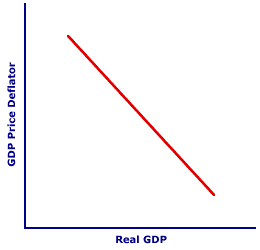 |
The real-balanced effect is based on the realistic presumption that the supply of money in circulation is constant at any given time. Money is what the four basic macroeconomic sectors use to purchase production. How much production they are able to purchase (that is, aggregate expenditures) depends on the amount of money in circulation relative to the prices of the goods and services produced (that is, the price level). When the price level changes, the purchasing power of the available money supply also changes and so too do aggregate expenditures. A higher price level means money can buy less production. A lower price level means money can buy more production."
If the amount of money stays the same, the rise in prices will mean less money can be used to increase production.
"Suppose, for example, that Duncan Thurly's share of the nation's money supply is $10. At a price of $2 each, he can afford to purchase five Wacky Willy Stuffed Amigos (those cute and cuddly armadillos and scorpions). However, if the price level rises, and with it the price of Stuffed Amigos, then he can no longer afford to purchase five of these cuddly creatures. At $2.50 each, he can now afford to buy only four Stuffed Amigos. His share of aggregate expenditures on REAL production declines from five Stuffed Amigos to four. The purchasing power of his $10 of money has fallen and with it his aggregate expenditures on real production. He has succumbed to the real-balance effect."
"Succumbed" is an odd choice.
"How in the world did economists come up with the phrase "real-balance" to indicate this effect? The "real" part refers to the "real" purchasing power of money. That is, how much real production can be purchased with the money. The "balance" part is included because money is often referred to as money "balances." This effect could be called the real-money effect just as easily."
So Buiter's going to use this Real-Balance to help explain the "Helicopter Drop".
"A related objective is to show that even when the economy is in a liquidity trap, that
is, when all current and future short nominal interests rates are at their lower bounds, a
helicopter drop of money will stimulate demand, but a helicopter drop of government bonds
will not."
Here's the main point for today's crisis that I want to point out. If the Fed goes down all the way to zero interest, and it does not increase demand, stimulate the economy, cause an upturn, then putting money into the economy will help do these things, but selling bonds will not. Printing money to fund a stimulus, versus government selling bonds to fund a stimulus.
"The government’s decision rules are exogenously given. Like the household sector, it
is subject to a solvency constraint. The government solvency constraint is the requirement
that the present discounted value of its non-monetary debt (bonds) must be non-positive in
the limit as the time horizon goes to infinity. Unlike bonds, government fiat money, by
assumption, does not have to be redeemed ever by the government. This means that, while
money is in a formal, legal sense a liability of the government, it does not represent an
effective liability of the government: there is no obligation for the issuer ever to redeem it or
convert it into anything else."
Okay. If you print the money, in other words, just dump a freshly minted bundle of cash into the economy, it's like the helicopter drop, in that you can simply leave it there ( Caution: A bunch of things could change this, but, in principle, it could stay there ). However, if you issue bonds, and fund the stimulus that way, you will have to pay the money back, as well as interest. So, all things being equal, you can't simply leave it there. The bonds needing to be redeemed is a contract that will possibly effect the amount of money you can leave in the economy from the bond sale going forward. God I hope that's it.
"Definition 1. Monetary policy is said to have a pure wealth effect on household consumption
demand if changes in the sequence of current and future nominal money stocks can change
consumption demand, holding constant the initial financial asset stocks, the sequences of
current and future values of nominal and real interest rates, the initial price level, real
government spending on goods and services, and before-tax endowments."
So, holding all these factors at bay, the amount of money in the economy can effect demand, i.e., actual buying and selling.
"Proposition 1.
A liquidity trap equilibrium does not exist, even asymptotically, in the flexible
price model if the growth rate of the stock of nominal base money is equal to
or greater than the nominal interest rate on base money, that is, if ν $ i¯M."
Got that. If the amount of money thrown into the economy is equal to or greater than the interest rate, demand will go up in the real economy, causing an end to the liquidity trap, by effecting demand upwards.
"Proof: Assume a liquidity trap equilibrium exists, beginning in period t1 $ 1. By definition,
in a liquidity trap the opportunity cost of holding money is zero ( ) and gMt
' 0, t $ t1
therefore the nominal interest rate is constant ( it )."
In a liquidity trap, by definition, the interest rate is constant at zero.
"From (15) and (16), when
' ¯i M, t $ t1
the short nominal interest rate is constant, Ωt is constant. This implies, from (41), that the
real interest rate is constant: rt . "
Some of the math is left out, so, take my word for it, the nominal interest rate and the real ( inflation adjusted ) interest rate are constant ( Stuck ).
"Since η> 0, the demand for real money balances is positive in
period t $ t1 . The monetary equilibrium condition (42) is violated. "
Lucky for us, the result of all this was that the demand for money goes up.
"Corollary 1
With irredeemable money, when the nominal interest rate on base money is
zero, there can be a liquidity trap equilibrium in the flexible price level model
only if, in the long run, the authorities (are expected to) reduce the nominal
stock of base money to zero. Any monetary rule that does not lead (and is not
expected to lead) to eventual demonetisation of the economy precludes a
liquidity trap equilibrium. Friedman’s OQM rule supports a stationary
liquidity trap equilibrium in which the nominal stock of money goes to zero in
the long run.
Proposition 1 also has obvious implications for the existence of deflationary bubbles
in the flexible price level model."
If you add money to the economy, demand will rise, and the liquidity trap will be defeated. Hence, there will be no deflation.
"Corollary 2
In the flexible price level model, deflationary bubbles do not exist when base
money is irredeemable, even though base money is not the only financial
liability of the government. Without the irredeemability of base money,
deflationary bubbles can exist in models in which the government issues both
monetary and non-monetary financial liabilities, under the FFMP given by
equations (30)-(33)."
You have to use an increase in the money, and not use bonds, to get out of the liquidity trap.
"Proposition 2:
In the representative agent model, it does not matter how money gets into the
system: Because of Ricardian equivalence, unanticipated money-financed tax
cuts (real-time helicopter money drops) have the same effect on real and
nominal equilibrium prices and quantities as unanticipated open market
purchases."
To hell with this model. Let's stick with the flexible price model. I like it better.
"Proposition 3.
In the New-Keynesian model, the augmented Taylor rule (given in (34)),
suffices to rule out non-OQM liquidity trap equilibria that are also rational
expectations equilibria."
Can't have a liquidity trap.
"Corollary.
If the nominal interest rate on base money is zero, any monetary rule that
prescribes a positive growth rate of the nominal stock of base money when the
nominal interest rate is at its zero lower bound, suffices to rule out liquidity
trap equilibria that are also rational expectations equilibria."
Okay. If the nominal interest rate is zero and you throw extra money into the economy, you can't have a liquidity trap, whatever equilibria you throw at it.
"Proposition 429:
When the interest rate on money is zero, perverse expectations, that is, expectations
that the authorities will demonetise the economy in the long run (that is,
P(t ) can cause the economy to be on a non-OQM liquidity ))&1lim
s64
e &(s&t ))¯i MM(s) ' 0
trap solution trajectory at time t ' t ."
Funny how perverse expectations show up, even in economics papers. Anyway, this can all change if idiots start decreasing the amount of money in circulation.
"The paper provides a formalisation of the monetary folk proposition that government
fiat money is an asset of the private holder but not a liability of the public issuer. It shows
how the irredeemable nature of the monetary liabilities of the state can be incorporated into
otherwise conventional approaches to monetary economics."
If the government prints money and gives it out to people, it's not a bill to the government.
"Fiat base money is net wealth to households and influences consumption through a
real balance or Pigou effect, in the restricted sense that, when the households’ and
government’s intertemporal budget constraints are consolidated, the present value of the
(infinitely distant) terminal stock of fiat government money is part of perceived consolidated
comprehensive wealth. The issuance of irredeemable base money can therefore have a pure
wealth effect on consumption (holding constant all prices, endowments and real public
spending). In equilibria that are not liquidity traps, this paper’s asymmetric treatment of the
solvency constraints of the private sector and the state has no implications for the behaviour
of nominal or real equilibrium prices and quantities. It plays a role whenever, with
symmetric treatment of private and public solvency constraints, the economy would be in a
liquidity trap."
In a liquidity trap, throwing money into the economy will increase demand.
"Any positive long-run expected growth rate for the nominal stock of base
money is sufficient to rule out a liquidity trap equilibrium. Liquidity trap equilibria are
therefore possible as rational expectations equilibria only if monetary policies are strongly
contractionary in the long run. With non-rational expectations - e.g. the incorrect belief that
the monetary authorities will, in the long run, reverse and undo any past and present
increases in the stock of base money - liquidity trap equilibria can exist for as long as these
incorrect but irrefutable expectations persist."
Problem solved. Goodbye liquidity trap. Print money. That was my solution. You don't think that I went through all this futile reading for nothing, do you. It buttresses my argument. Period.
There will be a wealth effect if money is thrown into the economy, and inflation and growth will follow.
This is probably all wrong, and didn't help anyone but me, but I'll be damned if I throwing this away now.
 The Federal Reserve released its third quarter flow of funds account. I have never been so anxious to get a release as I was today for the flow of funds account. Third quarter highlights GO something like this:
  But there is also a very troubling effect that may emerge, and that is the wealth effect.
 The chart illustrates the ratio of household net worth to disposable personal income spanning 1952:Q1 to 2008:Q3. In the third quarter, the share of net worth fell to 5.3% times current disposable income, driven by falling equity and home values. Consumer wealth is falling, and unless housing and equity markets stabilize and grow SOON, wealth will likely fall for two more quarters…at least.
 I have to say that I find this hard to believe. The difference in housing and financial wealth is huge, and the change in consumption based on the housing wealth effect seems huge.




















 Posts
Posts





November 10th, 2008 at 12:55 am
“There is a very well established wealth effect whereby $1 of housing wealth is estimated as leading to 5 to 6 cents of annual consumption.”
“But because of what was happening in the stock market it was an inopportune time to be selling shares so I sold fewer than I’d planned and bought cheaper furniture, figuring I might just buy nicer stuff later on if at some future point the animal spirits of the market drove my net worth up. Thus someone missed the chance to sell me a coffee table (pictured above) that I liked very much but that cost a lot of money. Their loss was Ikea’s gain, but that kind of decision drives GDP down.”
You sold a financial asset. I think that you prove my point, not Baker’s, that it’s the general economy that is causing this slowdown, more than the decline of buying due to the wealth effect of housing assets declining.
November 10th, 2008 at 12:58 am
Sorry. I hit the button before I was done. Your decision was based on the decline and market condition of your financial assets, not housing assets.