Showing posts with label Mr Mortgage. Show all posts

Thursday, January 8, 2009

"They are acting worse now with respect to mortgage mods than during the bubble years with exotic loans. "

Mr. Mortgage doesn't like what he sees in Mortgage Modifications:

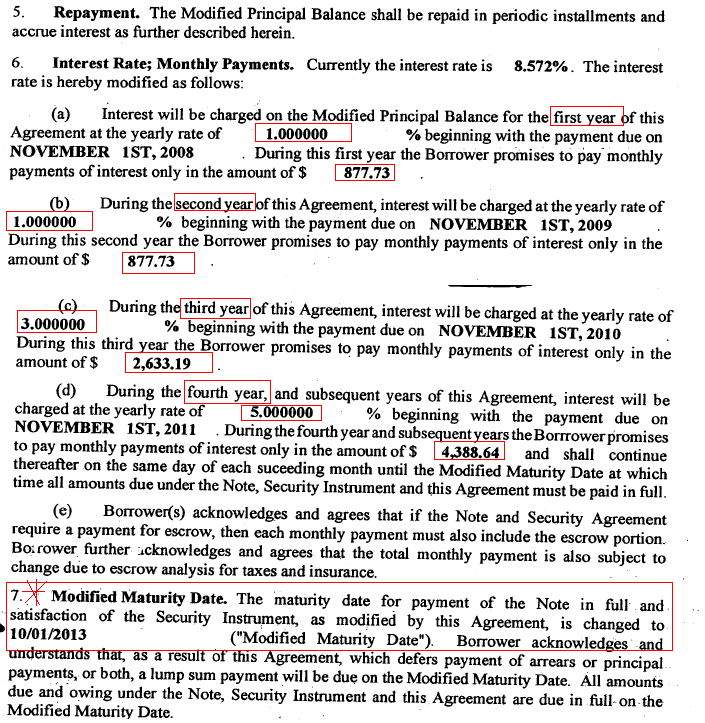
"WaMu’s New $1 million 5-year 1% Balloon Loan (mod) - $878 Per Month!( THAT SEEMS LOW )

Posted on January 7th, 2009 in Daily Mortgage/Housing News - The Real Story, Mr Mortgage's Personal Opinions/Research

WaMu takes the game of re-leveraging the home owner in order to avoid a default, foreclosure and subsequent credit loss to the next level. Banks can not be left to modify trash mortgages on their own - they do not have enough of a sense of responsibility. ( THIS SEEMS TRUE, IF WE EXPECT SOME SOCIAL LARGESS ON THEIR PART. )

They are acting worse now with respect to mortgage mods than during the bubble years with exotic loans. I have seen many mortgage mods over the past year but nothing I have ever seen is as irresponsible as this mod WaMu recently authorized…Bank of America came close (see link below).

DISASTER OF EPIC PROPORTIONS

Mortgage modifications have turned into a disaster of epic proportions. Every where you look, mortgage mod firms are promising things that I do not believe can be attained. Back in the good old days of nine months ago when I became hot and heavy on private sector loan mods, the banks and servicers were actually looking at the entire picture and reducing principal balances when necessary. The home owner or mod company would present a ‘present’ and ‘proposed’ solution to the note holder of which one of the choices was a principal reduction — and many times it was granted.

As you know, I am a big proponent of mortgage modifications done the right way. I have swung completely over to this side of the fence as regulators, law makers and banks have rolled out their harmful, boiler-plate loan modification initiatives that leave many underwater, over-leveraged renters for life.

It is obvious that these loan modification plans have been born as a result of panic and the need to protect the bank’s balance sheets( TRUE ) rather than doing what is beneficial for the home owner and broader housing market. Fannie/Freddie and FDIC ‘mod in a box’ examples below.

MORTGAGE MODS DONE RIGHT

A mortgage mod done right is a ‘mortgage banking model’ mod where the borrower is fully re-underwritten using present income and debt levels, prudent 28/36 debt-to-income ratios and current market rates — similar to a cram-down. ( SOUNDS GOOD )

This immediately de-levers the home owner enabling them to freely sell, refi, save money, shop etc. Typically a principal balance reduction is needed to bring these home owners in line, but it is the only permanent solution( I AGREE ). It is also the only solution that can prevent the broader housing market from being a dead asset class with zombie homeowners for two decades. ( I AGREE )

Given the push by regulators, law makers and banks into ‘modifications in a box’, I now have my doubts that private mortgage modification firms will have the types of successes we saw earlier in the year. Most modifications I am being told about coming out of loan mod firms around the nation are identical to the FDIC, Fannie/Freddie, Bank of America and WaMu examples herein.

These I do not endorse in most cases - specifically if they do nothing more than offer a term teaser-rate, extend the term, defer interest or principal, come with large balloon payments etc. These do nothing more than kick the can down the road and in the case of large deferred interest or principal balances make the home owner a trapped, underwater, over-leveraged renter for years, if not life. ( A GOOD POINT )

NEW WAMU LOAN MOD - THE 5-YEAR BULLET!

Below is an actual example of a recent WaMu loan mod with a 5-year $1 million bullet payment. This mod takes exotic lending to level I have never witnessed in my 20-years of mortgage banking. This makes a Pay Option ARM looks safe and cozy — and puh-lease do not tell me this is great because it frees him up to spend money into the economy.

Banks offering and borrowers actively accepting this style loan mod will guaranty that the housing crisis stays will us for a long time to come. This borrower will lose his home in 5-years, I have no doubt. That is of course unless his house price goes up 100% AND great, low rate super jumbo money returns to the market so he can refi out of it - then again, many lenders won’t even refi a loan that has had a previous loan mod done.

Property Value: $800k

Note amount: $1 million plus deferred interest

New Mod amount: $1.053 million

First TWO years rate/payment: 1% and $878

Third year rate/payment: 3% and $2633

Forth year rate/payment: 5% and $4389

FIFTH YEAR PAYMENT - THE BULLET: ALL OUTSTANDING BALANCE DUE AND PAYABLE

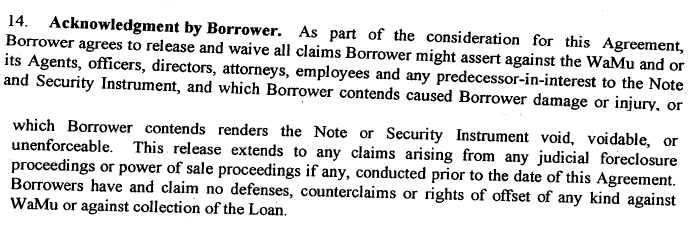
All rights to future predatory lending claims waived.
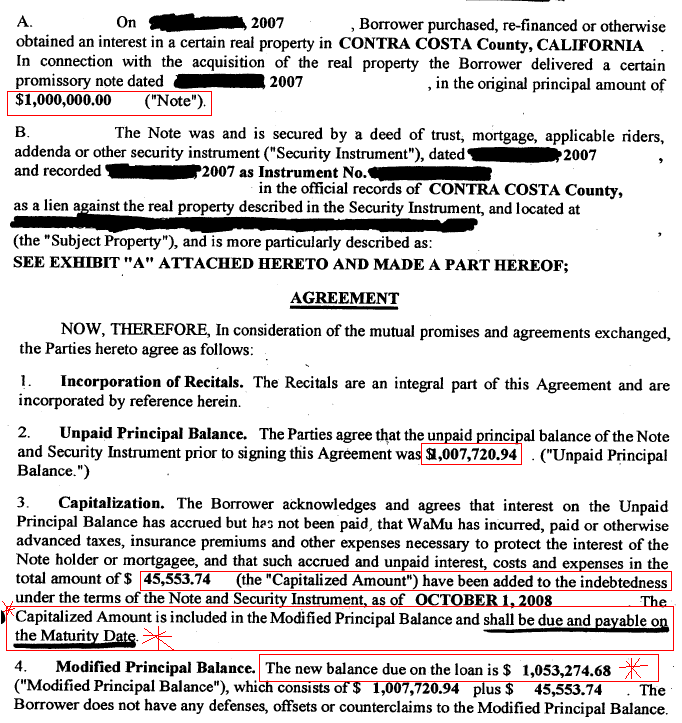

There are some very good points here. First, a Mortgage Modification must lower the principal as well as monthly payments. I liked the idea of giving the lender some of the principal when the house is sold, but Felix Salmon says the lenders don't like this idea. Second, the lenders are dealing in their own best interest as they see it, just as the banks are doing with TARP. That's how the system works, but then we shouldn't expect any social largess on their part. The lenders are , in essence, pushing foreclosures down the line in the hope of stabilizing home prices. They're trying to have it both ways. At first, of course, the lenders were hoping to be made whole by government intervention. One McCain proposal did just that. Now, barring some government plan, they're just deferring their foreclosing actions until a better time in the future. Thirdly, to the extent that fraud and other abuses occurred in the mortgage business, it doesn't look like the lenders have any fear of this being seriously pursued. If Mr. Mortgage is correct, the lenders have simply found a new way of selling dodgy loans, under the pretext of doing social good. Loans that have no real chance of working out are not kosher.

Earlier, I said that the government would have to impose a deal on the lenders in order for the plan to work, but that I didn't agree with that since it was essentially seizing private property. Without that, it's hard to see how many mortgage modifications will actually last, although some undoubtedly will. Obviously, there will be differences in the modifications depending upon how seriously each lender deals with this problem.

Tuesday, January 6, 2009

"throw out everything you thought you knew about mortgage and housing — very little that excite the markets are actionable in reality"

Mr. Mortgage with an excellent post on what's going on with mortgages. I'm not happy, but it's what I felt would happen to new mortgages with falling mortgage rates, which is not much. The refi situation puzzles me though:

"The Very Flawed Weekly Mortgage Applications Survey

Posted on January 6th, 2009 in Daily Mortgage/Housing News - The Real Story, Mr Mortgage's Personal Opinions/Research

Mortgage and housing are back in the spotlight like never before. Everywhere you look there are silver linings, lights at the ends of tunnels and ‘mustard seeds’ of hope. This is all great — I encourage hope as a broader theme in life. But ‘hope’ should not be the primary metric in an important business or investment decision — most analyst and media have based their mortgage and housing analysis primarily on ‘hope’ for the past two years.

Since conforming mortgage rates (= or <$417k) fell from 5.875% - 6.125% in November to the 5.25% - 5.5% range today, there has been increasing hype surrounding the weekly mortgage applications survey. In the past, this has been a decent measure of future refi and purchase loan fundings but not any longer.

In mid-December, a weekly release was put out that citing results that compared with 5-years ago. The bottom calling rush was on. The end result was scores of media, economists and analysts calling for the ‘great refi-boom’ to carry the nation out of its housing crisis and onto great things.

Of course, the primary thesis was that ‘if the refi market is at the same pace as 2003 then what followed 2003 in housing, mortgage and the macro economy may follow’. This is not the case. The fact is that refi loan application counts are far fewer than 2003 levels and actual loan fundings far less than that. Data being represented in this manner have led to several disappointments over the past two years. The fall out makes for less trust and weaker markets.( VERY TRUE )

Does anyone really believe that with 60% of CA, AZ and FL home owners and over 90% in NV in or near negative equity that refi’s can be anywhere near 2003 levels?

By virtue of the headline number being ‘near 2003 levels’, it highlights the imperfections with the survey. Remember, at the end of 2003 the nation was in the midst of a mad refi and purchase boom and the first few innings of the ‘Great Bubble’. Rates on intermediate-term interest only ARM money were in the 4%’s, fixed were in the 5%’s. Everyone could get and loan because of easy qualifying and stated income and there was no negative-equity — 70% to 80% of all loan applications actually funded compared to 35% to 45% today.

Mortgage applications have increased in recent weeks and subsequent fundings will as well…there is little doubt about that. Some will be able to do well taking advantage of today’s low rates, which is great for those individuals. But is putting the home owner who is already in a great position into a little better position really going to do much for the broader housing market and economy( IT WILL HELP LOWER DEBT )? The fact remains that for the majority, those that don’t need the credit can get it and those that do can’t. ( BAD NEWS )

Housing is in the perfect credit crisis storm; one which low rates alone( TRUE ) can’t ‘fix’ nor provide much protection. Mid-year 2007 when it was plainly obvious that unless something was done immediately the fall-out could be devastating — this measure may have made the difference between a housing recession and absolute implosion. Instead we heard ‘contained’ rhetoric for over a year.

Now with home prices at the median down 50% in the bubble states so vital to the nation’s economy and $9 trillion in guarantees made to most every other sector but residential real estate, the move is a day late and 5% short. As a matter of fact, even if rates were zero, it could not help the borrowers that need it the most.

The TRUTH About Mortgage Applications

The weekly survey only covers the top 10 lenders by volume

Back in 2003 through 2007, there were hundreds of national lenders. The top 10 were a driving force then but today the top 10 do the lion’s share of all loans. Therefore, even though the top 10 lender’s volume maybe equal to 2003, total national application volume is far less.

Portfolios shift from one lender to the next as rates fall - double, triple, quadruple counting

Most banks will not just roll-down a rate lock to current market if rates tumble after the borrower locks in. Some will but at a large fee. Rates tumbled a few separate days on news events in December and then backed up over subsequent days. On days when rates tumble, borrowers and brokers re-lock their loans with other banks in order to get a rate better than the one they have locked in — entire portfolios can switch lenders multiple times.

Therefore, much of last week’s jump in mortgage applications was much of the previous month of already counted loan applications switching to different lenders for the best rate. Many borrowers have four or five loan applications going with different banks simultaneously. These are all counted in their respective weekly surveys.

With three to four week underwriting and six to eight week total turn times to get a loan done right now, borrowers and brokers are not loyal to the lender at which their loan is in process making it very easy to switch. Ironically, a major reason for the long turn-times in getting a loan done is because of the long-turn times. Obviously, banks can lose a lot of productivity and revenue when losing loans worked for weeks during these volatile times. Additionally, when banks have no clue about what in their pipeline is real or what will actually fund, it is nearly impossible to hedge with any accuracy and can lead to incredible losses.

Loan applications do not necessarily lead to fundings. The overall fall-out rate is at an all-time high.

Back in 2003-2007 due to the variety of loan programs and easy approvals, 70%-80% of all applications actually funded. During these times, tracking the weekly survey was valuable. Now, 35-45% fund. Even less fund when rates are highly volatile due to the reasons explained in the previous bullet point.

The primary reasons for fall-out during 2008 were because a) the property value is too low b) the borrower does not qualify due to today’s sensible standards( I AGREE ) c) the rates are not really as low as the borrower has heard advertised by the media for their specific case d) and there is nothing in the Jumbo arena that makes sense for anyone( TRUE ).

Middle-market mortgage bankers are not pulling their weight leading to fewer fundings - they may never be able to

From HousingWire - As Refi’s Swell, Is There Enough Credit

The volume of warehouse credit providers has fallen recently from 30 to about 10, according to an article featured last week by American Banker, raising the question as to whether there is enough warehouse capacity to handle a refinance boom that has clearly surfaced in the past week.

“[I'm] not sure what mortgage companies are going to do, but there is no way all these loans will get funded any time soon with no warehouse money,” said one of HW’s sources, a mortgage banker who spoke on condition of anonymity.

A better gauge of mortgage applications

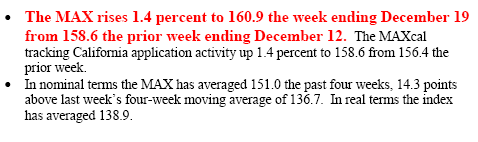
Lastly theMaxx, a research firm that I rely upon to gain more clarity on the real mortgage application counts, confirmed my research in its 12-22 issue. TheMaxx eliminates all multiple applications. They show applications only up 1.4% week over week. More importantly, theMaxx is at 158 today after this surge in applications and got in the 300’s back then. When you consider that back then 70-80% of all applications funded and now 35-45% fund, you see how bleak the picture is. Apples to apples, actual refi loans are down at least 60% at best.

In summary, The reporters covering the weekly survey must be getting analysis and PR help from the now infamous Lawrence Yun or David Lereah. This is just another example of why you have to throw out everything you thought you knew about mortgage and housing — very little that excite the markets are actionable in reality. -Best Mr Mortgage"

Wednesday, December 31, 2008

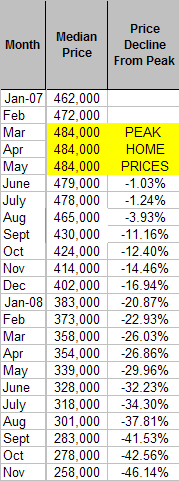
" Down almost 50% from peak levels in less than 2 years! "

EconomPic Data with another graphic of Mr. Mortgage's Scariest Housing- Related Chart Ever:

"Scariest Housing-Related Chart Ever"

Mr. Mortgage, with data from DataQuick, posts the "Scariest Housing-Related Chart Ever" (though he only shows the data... below is the chart):


Down almost 50% from peak levels in less than 2 years! In the comments section, BertDilbert lays out what it all means to California very well:

This decline of housing values in CA is absolutely going to destroy seniors who had counted their house value in their net worth, and planned on that being there for retirement. Add to that what has happened to the value of CA bonds that they were booking income off of. If they were planing on selling those and CA is on the rocks they might be in for a surprise there. Now add in every other asset they held is likely down as well and lots of blue chip dividends they had relied on might be chopped entirely.

Plus add in that CA is going to raise taxes. Where does this leave CA seniors? Those that had planned to retire in CA may no longer be able to retire here. This is going to send them state shopping for sure for a low tax retirement state that they can afford.
Update:
Max Rockbin comments:

FIRST: What if the graph showed the few years before this price drop? You would see those same housing prices skyrocketing. Seniors (who presumably mostly owned their homes before that run-up) are still way ahead. They just don't get the windfall from the bubble.

Also, why does the scale start at $250K? That just makes the chart look steeper than it really is. The numbers are grand enough not to require that kind of trite distortion.
1) If the chart showed the data a few years prior, I agree that it would show those housing prices skyrocketing. However, seniors (who did own their homes before that run up) are not necessarily "way ahead". Over the past 3-5 years, an awful lot of this wealth was already monetized and spent through home equity loans, while many used their $100,000 house that appreciated to $200,000 to pay the down payment for their new $500,000 house now worth $250,000.

In addition, I am positive that some seniors retired on the notion that their home had a specific value (while the others included this inflated price to calculate their wealth). I personally know of multiple individuals who have postponed their retirements these past 6-8 months as their wealth has declined at an alarming rate( A CASEY MULLIGAN POINT ). Those that retired in 2005-06 with the notion that their home was worth 50% more are crushed.

2) Below is the same data with a scale starting at zero. I'll agree that I should have done it this way in the first place, but it sure as hell doesn't make the information look any rosier.

Tuesday, December 30, 2008

"Below is a chart of CA median home prices as reported by DataQuick."

From Mr. Mortgage, it speaks for itself. Where is the bottom?

"The Scariest Housing-Related Chart Ever

Posted on December 30th, 2008 in Uncategorized

Below is a chart of CA median home prices as reported by DataQuick. I am working on a project, which I will get out to you shortly. These data are part of it. -Best Mr Mortgage