Showing posts with label What To Spend Stimulus On. Show all posts

Friday, February 20, 2009

"The lesson is simple: Don't count jobs; make jobs count."

And again:

"Jobs: Not a Proper Goal of Public Policy

In my previous piece I focused on a simple trap that we all fall into when we count what happens (jobs) but forget to count what doesn't happen (other jobs). We forget to net it out.

In this piece, also mercifully short, I hope, I would like to make the case that "job creation" is not a worthy goal of economic policy anyway. Sure, we want jobs for everybody who wants one, but jobs should come as a by-product of producing something or providing a service that is needed. Focusing on the job per se, rather than on what is produced with the job, leads to waste. There is always more work to be done than there are people able and willing to do it. It is the work that should drive the process; not just a job for a job's sake.

Some examples will make this obvious. The government could create enough jobs to achieve full employment by having the previously unemployed dig holes on Monday, Wednesday and Friday and fill them up on Tuesday, Thursday and Saturday. Or, in my long-time favorite example, if you want more jobs, replace the heavy equipment on a construction site with shovels. If that doesn't do it, replace the shovels with spoons. Silly? Sure, but not much sillier that some of the rhetoric we take all too seriously.

When we say we have to "create jobs," we are setting ourselves up for a misallocation of scarce resources and a sub optimization of our economic efficiency. When we say that, we imply that there are just so many jobs to go around and we need to find and fill them. Pretty soon that kind of thinking leads us into the French fallacy of spreading a given (fixed) amount of work among more workers by shortening the legal work week. Only so much work to be done; let's spread it out.

Don't forget that the demand for workers will increase with the work being done. Don't forget Say's Law, "Supply creates its own demand." We sometimes forget it in times like this because we get caught up in Keynes' Law, "Demand creates its own supply." Come to think of it, neither law is a rationale for wasting good workers by putting them in sup-optimal jobs. The lesson is simple: Don't count jobs; make jobs count."

Me:

  1. Don the libertarian Democrat Says: Your comment is awaiting moderation.

    Here I agree with you. It has to matter how the money is spent, otherwise, why even bother creating jobs? Just give people money to live. In fact, from my point of view, social safety net spending works the best, since it has to be spent. After all, it’s given to people who, theoretically at least, need it to survive, and so have to spend it, and on things essential to the economy at that.

    Infrastructure is purportedly an investment. In other words, it will more than pay for itself in the future by facilitating some business or civic function or both. If it turned out be heavily siphoned off into fraud, or spent in a way that led to enormous cost overruns in the future, wouldn’t we be angry? Otherwise, why not run a big Ponzi Scheme instead? They certainly seem to attract investors.

    From my point of view, there is a good argument, in general, to borrow for investment, so that, in a time of necessary borrowing ( This is what I call the current situation. Not necessary spending. After all, you could spend without borrowing. ), some money for infrastructure makes sense. I simply thought that $100 Billion made more sense, since I do worry about things like waste and fraud, especially under crisis conditions.

    So, I agree with you. The argument is intentionally fuzzy. We want to spend money on infrastructure as an investment, but we don’t want to observe the normal precautions we take concerning it, because we’re in a hurry to spend. This is not a good argument, and neither is the argument that it doesn’t matter what the spending is for.

The economy of the future will just be a little less productive and a little more sluggish than it would have been. Less will be seen in the future.

From Bob McTeer:

"Stimulus and Job Creation

Not Necessarily the Same Thing

Once again I'm going to be brave and state the obvious and run the risk of a "Duh" response. While my point is embarrassingly obvious, I haven't heard anyone make it during the debate on the recently passed stimulus package.

Money spent, even new money spent, on a given project or cause is much more likely to cause a diversion or reallocation of employment than to cause a net increase in employment.

As explained in my Broken Window Fallacy, when a baker has to spend money for a new window because teenagers threw a brick through the old one, he does create additional business for the window repair man, who will likely spend the proceeds on something else, and so on. The broken window does create new spending, and, perhaps, even additional employment. However, the benefits of this new spending are likely to be offset by the money not spent on something else had the window not been broken. That spending would also have led to further spending. The broken window diverted spending and reallocated the benefits, but didn't create net new spending or employment.

Substitute for the broken window the various and sundry new spending projects included in the huge stimulus package. They will result in new business for some, and perhaps even some new employment, but not necessarily any net new employment. Workers used on new projects are likely to be the same workers that would have worked on other similar projects in the same field. The workers on the new projects will be counted and added to the ranks of the newly employed; the same workers won't be subtracted from other projects because the other projects didn't materialize. As Frederic Bastiat would have put it, it's the difference between the seen and the unseen. The seen get counted; the unseen don't.

As the debt piles up, the government programs that don't get funded in the future because of the higher cost of servicing the debt won't be counted either. Those forgone programs of the future won't be counted as a cost of today's stimulus because they won't be seen either. The economy of the future will just be a little less productive and a little more sluggish than it would have been. Less will be seen in the future."

Me:

  1. Don the libertarian Democrat Says:

    “The workers on the new projects will be counted and added to the ranks of the newly employed; the same workers won’t be subtracted from other projects because the other projects didn’t materialize.”

    This sounds like your saying that, if the local government builds a courthouse, I won’t be able to find workers to build my grocery store. That can’t be right. What am I missing?

Thursday, February 5, 2009

And it's about grasping at straws to try and find something else.

From the Atlantic Business:

"
An interview with Robert Barro I spoke with Robert Barro of Harvard yesterday about the stimulus bill, fiscal policy, and related issues in macroeconomics.

I wanted to speak with Professor Barro after reading his piece in the Wall Street Journal about the multiplier on government spending. The piece, which argued that the multiplier has historically been much lower than the Obama administration hopes, produced a tremendous amount of response -- from Paul Krugman, Brad DeLong, Greg Mankiw, Matt Yglesias, and Tyler Cowen (some of them several times). And that response was notable, in part, because it turned into a reflection on the "standards" of the stimulus debate itself. I was interested to hear what Barro thought about his critics this debate.

He was admirably patient with my questions:


Conor Clarke: What I am trying to do is sort of apply a barometer to modern macroeconomics and see where the profession is, because I am sort of confused by a lot of things.

Robert Barro: [laughs] Probably the fault of the profession.

Well, one thing I am confused by is where all of this resurgent interest and fiscal policy came from. That's very broad. But where do you think it came from? When I took macroeconomics in college there was not a lot about fiscal policy.

It came from the crisis and memories of the Great Depression and the fact that monetary policy seems to have done not a tremendous amount, and conventional stuff doesn't look like its going to work anymore. And it's about grasping at straws to try and find something else.

And I take it from the Wall Street Journal piece you wrote last week... well, the piece is just specifically about measuring multipliers, but I take it that you are fairly skeptical in general that fiscal policy will boost aggregate demand.

Right. There's a big difference between tax rate changes and things that look just like throwing money at people. Tax break changes have actual incentive effects. And we have some experience with those actually working.

What would you say is the best empirical evidence there?

Well, you know, it worked to expand GDP for example in '63 and '64 with the Kennedy/Johnson cuts. And then Reagan twice in '81 and '83 and then in '86. And then the Bush 2003 tax-cutting program. Those all worked in the sense of promoting economic growth in a short time frame.

I'm the middle of a study where I am trying to estimate this overall, going back to 1913 -- sort of constructing some measure of the overall effect of the tax rate at the margin, at the moment. I'm just looking at that now, actually...

You're talking about the multiplier on a dollar of...

Well both things, but here I'm talking about the tax rate stuff. Get some measure of the effect of marginal tax rate that comes from the government -- federal, state, local. And then you can see what it looks like going down or going up and how the economy responds. And then, in addition to that, the government might be spending more or less money on either military stuff or not on military stuff. And we can estimate that at the same time. With the government spending stuff, the clearest evidence is in wartime. It's not that it's the most pertinent, but it's the clearest in terms of evidence because it's the dominating evidence at those times, especially during the world wars.

Do you read Paul Krugman's blog?

Just when he writes nasty individual comments that people forward.

Oh, well he wrote a series of posts saying he thought the World War II spending evidence was not good, for a variety of reasons, but I guess...

He said elsewhere that it was good and that it was what got us out of the depression. He just says whatever is convenient for his political argument. He doesn't behave like an economist. And the guy has never done any work in Keynesian macroeconomics, which I actually did. He has never even done any work on that. His work is in trade stuff. He did excellent work, but it has nothing to do with what he's writing about.

I'm not in a position to...

No, of course not.

I'm not in a position to know things like the degree to which Paul Krugman counts as a relevant expert on new Keynesian economics.

He hasn't done any work on that. Greg Mankiw has worked in that area.

And Greg Mankiw is, I guess, skeptical of spending for the same reasons that you are: he says that there's some empirical evidence -- I think he cites the Christina Romer study from 15 years ago -- that a dollar of tax cutting has a larger impact than...

The Romer evidence is very recent actually. It's an ongoing project.

I thought it's from 1993 or something like that. Maybe that's something else.

They have a current thing that's going to be presented at Brookings at the next meeting, where they have some estimates of how the economy responds to tax changes. It's not really looking at tax rates. It's looking at tax revenue, which is not the same thing. That's mostly what Greg was referring to, which is going to be presented in a few months.

I would need to go back and check. But one question, and I think Greg Mankiw raises this question as well, is, Why does this set of evidence depart from what seems like the standard Keynesian theory that a dollar of spending would have a larger multiplier than a dollar of tax cutting?

I don't think it is really confusing at all, because when you cut taxes there are two different effects. One is that you cut tax rates, and therefore give people incentives to do things like work and produce more and pay more -- maybe, depending on what kind of taxes. And then you also maybe give people more income. This income effect is the one that's related to this Keynesian multiplier argument, where it's usually argued that government spending should have a bigger effect. So that's the income effect. But the tax-rate effect, inducing people to do things like work and produce more and invest more, is a whole separate effect, and that could easily be much bigger than the multiplier thing, than the income thing.

This might just be my confusion, but the inducement to work, is separate from the idea of boosting aggregate demand and consumption in the short run.

Oh it's exceptionally different. But the experiment is that the government is doing something by changing the tax system to lower its collections -- by, for example, a tax cut. The response of the economy to that is not going just to isolate this business of giving people money. It's also going to have these incentive effects, more than tax rebates, on economic activity. It's going to be a combination of those two things -- income effects and incentive effects. One piece looks like this sort of multiplier stuff, which is analogous to government spending -- probably because the government spending has a first-round effect where it comes in and directly affects the aggregate demand -- and then in the second round it sort of looks like a tax cut. That's why the government spending thing is bigger in textbooks: because it has this first round in addition to all these subsequent ones.

But all that is just income responses -- people having more or less income, or the government keeping the money and then that shows up as people's income. None of that is about responses in terms of incentives -- incentives changing in response to lower or higher tax rates. And the evidence that Romer and Romer look at is combining the tax rate stuff with the income stuff. I didn't know it was possible to do that but, hey, you get different viewpoints form different people. But the study I am doing now is intended to include all these things together in one framework.

And when does this study come out?

Who knows. I mean, it's a big project, we've been working on it for a while. Part of it is just measuring, back since 1913, the effect of the tax rate that the federal government or the total government is levying on people. Measuring that was a big project. But we've sort of finished that.

I just have two more questions, quickly. One is that you've mentioned that monetary policies sort of seem to be stuck. And I guess there have been a couple of people -- Robert Lucas is one that comes to mind and maybe Greg Mankiw too -- who say there are other kinds of monetary policy that can still be pursued.

Oh I agree with that. There are things that they can still do. The sort of standard stuff. They drove the nominal rates on the usual government paper down to zero, and they drove down the federal funds rate, so they don't have any more leeway on that. But there is plenty of other stuff that they can do and that they are doing.

And what is that?

The Federal Reserve is buying up all kinds of other assets, like long-term government bonds. But they are also buying a lot of private stuff, and that will presumably have a substantial impact. I mean there's a downside to doing all this, but it should certainly have effects. So in that sense they haven't run out of ammunition. I agree with that.

The last thing is just about the stimulus bills as it stands. Two things here. One thing is what do you think about the ratio of spending to tax relief in the bill. And the second is, if you judge it by Larry Summers standard -- that stimulus be temporary, timely and targeted -- does it clear the bar?

This is probably the worst bill that has been put forward since the 1930s. I don't know what to say. I mean it's wasting a tremendous amount of money. It has some simplistic theory that I don't think will work, so I don't think the expenditure stuff is going to have the intended effect. I don't think it will expand the economy. And the tax cutting isn't really geared toward incentives. It's not really geared to lowering tax rates; it's more along the lines of throwing money at people. On both sides I think it's garbage. So in terms of balance between the two it doesn't really matter that much.

Well, presumably Larry Summers is not an idiot.

[laughs] That is another conversation. I have known him for 25 years, and I have opinions about that.

Well, presumably Christina Romer is not an idiot if you're...

They've brought in some reasonable people in terms of economic advisors. I don't know what impact they're having, and I suppose they have different views on Keynesian macroeconomics than I have. But I'm giving you my opinion about it.

I think Geithner is a good appointment. I think he's going to focus on what really matters, which is the financial system and the housing market. That's where they should be putting their efforts. That's where the problems came from.

Fixing the credit market, you mean?

That was the main problem in the Great Depression, too. Though then it was concentrated on commercial banks which were the main credit vehicle. That was the main problem in the depression and fixing that was the main thing that ended the depression.

Well since you brought it up... I have no idea what your views are on financial economics, but it seems like there's going to be another round of TARP-like bailouts. Do you have an opinion on how that should be structured?

That's a hard problem. I mean, they're basically floundering around -- the crew of the previous administration more than the current one. But I admit they're having a good effect by putting more resources into assistance. The exact way to do it is pretty tricky. It's not clear what the best thing to do is. Larry Summers did bring in Jeremy Stein, who is probably one of the best people in the area. I think he's going to have a lot of impact on that design. I hope so. That's another person they hired recently.

From Harvard?

Yeah, he's a Harvard economics department person. He's in the White House. Summers brought him in to advise particularly on the financial and housing issues, the design of the new regulations structure. That was an excellent appointment. That's the stuff that's really going to count. Not this spending thing. I mean democrats were waiting with all these ridiculous projects, and now they've got an excuse to bring it through politically.

Just one last thing. I think Joe Biden and a couple other people have said there's a fairly wide consensus among economists that fiscal stimulus in the form of a large spending bill is the way to go, and...

He said first that every economist thought that.

Well, that's Joe Biden hyperbole. But what is the lay of the land there? Presumably there are economists out there that take this seriously. And then there are economists out there who think there's a one-for-one crowding out with any government spending. And I guess, where does the profession fall on that spectrum?

Most economists haven't really been thinking about this issue, they haven't really focused on it. It's not their specialty. Most economists today, they haven't really been thinking about this kind of multiplier issue. Which goes back to that first question you asked about how come now we're so worried about this. I don't think most economists are focused on this, or that they're familiar with the empirical evidence. I don't think they've really worked on the theory. So I don't know, maybe they have some opinion that they got from graduate school or something.

I think my sense is that the sentiment has been moving against this kind of approach both within the economics profession and more broadly. I think the initial view was that "yeah, this is a terrible situation" -- which I agree with -- "and we've got to do something about this, and maybe this will work." I think there was support in that sense.

Are there any conditions under which you might think spending could have a positive effect on output or is it always going to be the case that as a relative matter that tax cuts are going to be better?

Tax cuts are bound to be better. I think the best evidence for expanding GDP comes from the temporary military spending that usually accompanies wars -- wars that don't destroy a lot of stuff, at least in the US experience. Even there I don't think it's one for one, so if you don't value the war itself it's not a good idea. You know, attacking Iran is a shovel-ready project. But I wouldn't recommend it."


Me:

Don the libertarian Democrat

"And the guy has never done any work in Keynesian macroeconomics, which I actually did. He has never even done any work on that. His work is in trade stuff. He did excellent work, but it has nothing to do with what he's writing about.'

I don't see this as a particularly profound point. I mean, after all, he could be doing a lot of work in his field and end up being wrong.

"None of that is about responses in terms of incentives -- incentives changing in response to lower or higher tax rates.'

This is true, but we are constantly presented with incentives and disincentives. For instance, there's a tax incentive to buy a house, and a tax incentive to save in an IRA. Also, since we're human beings, our assessment of these incentives can change.

I tend to agree with Buiter, and also on the lack of specificity Barro gives. Telling us that people often respond to monetary incentives isn't exactly earth shattering news. I like the idea of a cut in Sales Tax to be withdrawn in the future, say $200 Billion, and Tax Cuts for Investment, say $100 Billion. Infrastructure about $100 Billion, and Social Safety Net Spending and aid to states as well. This doesn't seem crazy, and has the merit of moving towards a compromise, in which I prefer Edmund Burke's ideas over Barro's. Perhaps Professor Barro can offer his own plan or tell me if my favorites seem reasonable.

How do we get out of this downward plunge?

From Robert Reich:

"
Senate Republicans and the Stimulus:

Playing Politics When the Economy Burns Tomorrow's job report is likely to be awful. January's job losses could easily top half a million. We're deep into the most vicious of economic cycles: Consumers are slashing their spending because they're perilously in debt and worried about keeping their jobs. But as a result, businesses are facing shrinking sales of goods and services, so they're slashing payrolls, which of course makes consumers even more anxious and further reduces their spending power. Meanwhile, businesses are cutting way back on new investments in equipment, which hurts upstream suppliers, who are now slashing their payrolls. And so it goes, downward. The gap between what the economy could produce if it were running near full capacity and what it's now producing continues to widen. The shortfall is projected to be over a trillion dollars this year.

How do we get out of this downward plunge?

Regardless of your ideological stripe, you've got to see that when consumers and businesses stop spending and investing, there's only entity left to step into the breach. It's government. Major increases in government spending are necessary, and the spending must be on a very large scale. In the last several weeks the President has put forward the outlines of a stimulus plan, and has left it to the House and Senate to fill in the details. A tiny portion of the details that made it into the House version should be stripped away because they seem like old-fashioned pork. But most spending in the bill is absolutely appropriate. My worry is there's not nearly enough of spending to fill the shortfall in overall demand.

Yet at this very moment, Senate Republicans are seeking to strip the President's stimulus package of many of its spending provisions and substitute tax cuts. Part of this is pure pander: They know tax cuts are more popular with the public than government spending, even though spending is a far more effective way to stimulate the economy (more on this in a moment). Another part is pure partisan politics: Republicans are emboldened by Obama's willingness to court Republicans (taking three Republicans into his cabinet, bringing Republican leaders into the White House for consultations, putting all those business tax cuts into the stimulus bill in order to gain Republican favor) without getting anything at all back from the GOP. House Republicans snubbed the bill entirely. So, Senate Republicans say to themselves, what's to lose?

Plenty. Millions more jobs and a full-fledged Depression, for example.

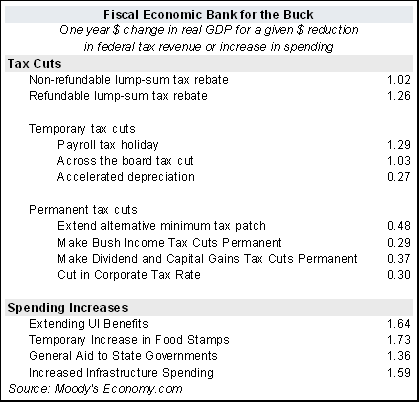
Can we get real for a moment? Take a look at this chart, which comes from calculations by Mark Zandy and his colleagues at economy.com. You see that each dollar of spending has much more impact than each dollar of tax cut. http://www.economy.com/dismal/graphs/blog/mz_012208_1t.GIF

There are three reasons for this. First, most people who receive a tax cut don't spend all of it. They use part of it to pay down their debts or they save it. Most of us did one or the other last spring with that tax rebate. From the standpoint of any particular individual, paying down debts or saving may be smart behavior -- even commendable. But what's intelligent for an individual does not necessarily translate into what's good for the economy as a whole. The only way to get businesses to create or preserve jobs is through additional spending. And unlike tax cuts used to pay down personal debt or add to savings, every dollar of government spending flows directly into the economy and adds to overall demand.

Second, even that portion of a tax cut we might actually spend doesn't necessarily go into the American economy. It goes all over the world. I have nothing against creating or preserving the jobs of Asians who assemble those flat-panel TVs you see at the mall, for example, but right now we're trying to create or preserve jobs here in America. Sure, the retail workers at the mall who sell the flat-panel TV's might benefit, but remember we're talking about how to get the biggest bang for every dollar. When government spends to repair a highway or build a school or help pay for medical services, the money and the jobs stay here in America.

Finally, those who say cutting taxes on businesses is the best way to create or preserve jobs forget about the demand side. Even with a tax cut, businesses won't hire workers unless there are customers to buy what those workers produce. A government stimulus that creates jobs is a necessary precondition.

This isn't a matter of more or less government, however much Republicans and conservatives would like to wedge it in that old ideological box. The issue is how to revive the economy. When consumers and businesses can't or won't spend enough to keep the economy going, government has to be the spender of last resort. Period."

Me:

Blogger Don said...

"Second, even that portion of a tax cut we might actually spend doesn't necessarily go into the American economy. It goes all over the world."

This cuts both ways. What if you decide to use infrastructure money to put in a light rail system that comes from, say, Sweden?

"First, most people who receive a tax cut don't spend all of it. They use part of it to pay down their debts or they save it'

Which is why a sales tax cut to be phased out in the future is a good idea.

"Finally, those who say cutting taxes on businesses is the best way to create or preserve jobs forget about the demand side. Even with a tax cut, businesses won't hire workers unless there are customers to buy what those workers produce"

No. The reason to target tax cuts for investment is to help attack the fear and aversion to risk. This is so bad right now that you can't wait for a road to be built even six months from now.

The fact is that a balanced approach is better:

1) $100 Billion Infrastructure
2) $200 Billion Sales Tax Cut
3) $100 Billion Tax Cuts For Investment
4) Social Safety Net Spending And Aid To States To Help With This: Whatever It Takes: Calling It A Stimulus Is Incorrect: We'd Do It No Matter The Multiplier

As for why 1 is so little at first, two projects you know well: Big Dig, Bay Bridge, Case Closed.

Don the libertarian Democrat

Thursday, 05 February, 2009

Sunday, February 1, 2009

Again, I don't have faith in these models and I believe agnosticism is the correct stance.

From Tyler Cowen:

"
Permanent vs. temporary increases in government consumption

Paul Krugman writes:

...he [Brad DeLong] fails to note that it’s not just wrong, it’s 180 degrees wrong: a temporary increase in government spending should have a larger impact on demand than a permanent increase, not a smaller impact.

I intend my comments as the most boring blog post I have written, so it goes beneath the fold...

Perhaps Krugman is drawing from Barro's 1981 JPE paper on government purchases, which does indeed derive the stated result, but that is no longer the dominant approach. Circa 1990, Aiyagari, Christiano, and Eichenbaum note:

First, we demonstrate analytically that -- under standard assumptions spelled out in section 2 below -- the employment and output effects of permanent increases in government consumption always exceed those of temporary increases.

On pp.4-5 they explain why Barro is incomplete.

Overall I find these debates confusing. I wonder for instance if Krugman's blog example is actually comparing tax finance to debt finance, rather than temporary vs. permanent spending shocks. (Note also that Krugman is making a claim about demand or effective "stimulus" rather than output and employment, although I am taking the latter as what matter.)

Those of you with lots of time on your hands can ponder whether the "permanent vs. temporary" debates compare "$100 billion this year vs. $100 billion for each year to come" and/or "$100 billion this year vs. the present value of $100 billion spread out over time, in perpetuity," and whether all cited articles and blog posts are making exactly the same comparisons.

Results in this area usually can be modified by further assumptions. I think of this as the central paper, published in the JME 1999. Admittedly it is for a small open economy but the key result is:

Moreover, permanent increases in government expenditures have larger positive labor supply and output effects than temporary fiscal policies.

Again, I don't have faith in these models and I believe agnosticism is the correct stance. The point is not about who is wrong and who is right but rather how treacherous these analytical waters can be. Beware!

In any case there is hardly an overwhelming brief in favor of the stimulative powers of the temporary spending increase. The best case for the temporary boost is I think the public choice argument that it is better to get it over with more quickly, so as to limit corruption of the government.

Addendum: Megan McArdle adds comments on her contribution to the debate."

And I argue:

Previewing your Comment

"On pp.4-5 they explain why Barro is incomplete."

I would say less useful. The very fact that the model is being improved leads one to believe that the model is useful, but not a complete description, or even causal, of the real world. In our circumstances, it might turn out to be of limited use.

But the same can be said of the multiplier. It seems unreasonable to put so much faith in the precision of any multiplier in this situation, or to simply plug in a consumption figure which needs to be filled.

To me, both approaches seem useful, but not persuasive. The one person I agree with, Shiller, wants us to spend a massive amount of money. I agree that would work, but it could also cause serious inflation, causing us to induce another shock. As well, spending massive amounts of money can influence behavior, but that influence might not all be benign.

And that's my problem with your NY Times post: In order for behavior to be changed in a meaningful way, the influence upon it must be large and long lasting. I think that you underplay the possible social changes that could go with such a shift. They worry me more than this downturn.

Finally, the actual bill. Here was my plan:
1) $100 Billion Infrastructure Investment
2) $200 Billion Sales Tax Cut or Payroll Tax Cut
3) $100 Billion Tax Cut for Investment
4) Social Safety Net and State Aid ( $ ? )

This is different than the bill, but, if I were the Republicans, I would have asked for something similar to my plan and split the difference, for reasons of Political Economy. It would be better that we have an agreed upon plan, precisely because the social changes going forward could be so unpleasant.

Here, I echo Burke:

"All government, indeed every human benefit and enjoyment, every virtue, and every prudent act, is founded on compromise and barter. "

I think that Burke is someone we should keep in mind during a crisis.

Saturday, January 31, 2009

hence it isn't any reason to resurrect the economic doctrines of fifty years ago.

From David Friedman:

"
Stimulus: The Power of Names

A well chosen name wins an argument by assuming its conclusion. Label cash subsidies to foreign government as "foreign aid" and who can be so hard hearted as to oppose them. Call subsidies to the public schools "aid to education" and you neatly skip over the question of whether additional spending in the public school system results in more education. Label something "pollution" and is no longer necessary to offer evidence that it is bad, since everyone knows pollution is bad—even thermal pollution, otherwise described as warm water. Occasionally we even get dueling names. Both "right to life" and "pro-choice" are obviously good things; how could anyone be against either?

For a more recent example, consider Obama's economic policy. Everyone—including Obama, back when he was running for President—is against deficit spending. Relabel it "stimulus" and everyone is for it. The label neatly evades the question of whether having the government borrow money and spend it is actually a way of getting out of a recession—a claim for which evidence is distinctly thin. It is stimulus, so obviously it must stimulate.

The success of the relabelling with the general public is not surprising. What is somewhat surprising is the way in which much, although not all, of the economics profession has suddenly adopted as gospel the 1960's Keynesianism that most of the profession rejected several decades back. Everyone talks as though deficit spending was a way, indeed the way, of reducing unemployment, a central recommendation of that theory.

One explanation, of course, is that government spending is popular, taxes are unpopular, so a argument that converts deficits from a problem to a solution has a lot of natural supporters. But that is not the whole story.

Another part of it is that the credit crunch seems to bear at least a family resemblance to what Keynesians expected to see, indeed believed they had seen, as the cause of depressions. Interest rates are so low that holding money makes more sense than investing it, so demand drops, so everything spirals down—underemployment equilibrium due to the economy falling into the liquidity trap. The solution they proposed was fiscal policy. The government borrows the money that was accumulating under mattresses, spends it, gets things going again.

There is, however, one small problem with this account of the present situation. The Keynesian liquidity trap was supposed to be a result of running out of investment opportunities. All the productive things that could be done with capital had been done, so firms were only willing to offer a trivial reward to investors, so nobody bothered to invest.

That story has nothing to do with what actually happened. Firms are eager to borrow money and invest. The problem is not that we have exhausted investment opportunities but that lenders don't know what borrowers, or what intermediaries, to trust, due to a malfunction of the capital markets set off by the bursting of the housing bubble. One can argue about who to blame for that malfunction and what to do about it. But whoever is to blame, it is not a liquidity trap, hence it isn't any reason to resurrect the economic doctrines of fifty years ago.

The first round of "stimulus" proposals, whatever their faults, could at least be defended as a response to the actual problem. Lenders did not know who to trust but did trust the Federal Government. So let the government borrow the money from them, lend it to the firms that needed capital, and so keep those firms from being destroyed by a temporary freezing up of the capital markets. Skeptics might express doubt as to the competence of the government to allocate capital, but at least the policy could be seen as an attempt to get capital allocated.

The current proposal has no such defense. It simply consists of borrowing very large amounts of money and spending it. Insofar as it has any effect on the ability of firms to borrow, it makes it harder, since public borrowing is competing with private borrowing. A dollar I spend in government securities floated to fund the deficit is a dollar I don't invest in a private firm."


"Don
said...

"A dollar I spend in government securities floated to fund the deficit is a dollar I don't invest in a private firm."

A Dollar spent is better than a dollar saved if you're trying to avoid Debt-Deflation. There's no a priori way to determine who spends anything better. To say that, in general, A spends better or more effectively than B, says just that. In general. For me, it's really a question of ownership. I'd like most resources to be in private hands, that way, if they are spent foolishly, at least it's their foolishness. Also, in the real world, governments rely on people's acceptance or acquiescence of it. One has to try and determine what can keep the system stable during a crisis. However perfect your ideas might appear to you, no one is bound to follow them. Hence, we often compromise our theories for irenic and justificatory reasons.
That's what the stimulus is. It's a product of Political Economy, which involves other factors than economic efficiency, even in you're right about that.

"Insofar as it has any effect on the ability of firms to borrow, it makes it harder, since public borrowing is competing with private borrowing."

So competition makes it harder. So what? Doesn't all competition do that? Isn't that the point?

"It simply consists of borrowing very large amounts of money and spending it."

You speak of names. How about we change "spending" to "investing"?
Does that change anything?

"Another part of it is that the credit crunch seems to bear at least a family resemblance to what Keynesians expected to see, indeed believed they had seen, as the cause of depressions"

That's it. It's a narrative. A story that we can tell ourselves to feel better about getting out of this. In truth, it's a lot of trial and error, which is how things usually work out.

By the way, there's also been a lot of talk about Helicopter Money. People are reaching for any idea that seems to help.

"Firms are eager to borrow money and invest."

In fact, employers have been proactively shedding jobs since the end of November and reducing investment. There has been a massive change in investment.

"The problem is not that we have exhausted investment opportunities but that lenders don't know what borrowers, or what intermediaries, to trust,"

Here I completely agree. But government has a role in rebuilding that trust.Why? I don't know, but people expect the government to help build it, and that's a good reason to do so. Sadly, it will probably overshoot. Take a look at the new Trust Index. Bankers are pretty low on that.

If you want to help capitalism and the free market, a good way to begin is to make sure that people understand that we have a welfare state. That way, capitalism and the free market might not be blamed for this mess. Now there's a good example of the problem of names.
Don the libertarian Democrat

12:14 PM, January 31, 2009"

Thursday, January 29, 2009

I AGREE with Olivier Blanchard that fear and lack of confidence are major problems behind the current economic downturn.

From Free Exchange:

"Blanchard roundtable: The economy needs a placebo
Posted by:
Tyler Cowen
Categories:
Blanchard roundtable
Tyler Cowen is Professor of Economics at George Mason University. He co-writes the popular economics blog Marginal Revolution. This discussion can be followed in its entirety here.

I AGREE with Olivier Blanchard that fear and lack of confidence are major problems behind the current economic downturn. I also agree that the banking sector requires recapitalisation and that this is hard to do. But I dissent from his analysis in a few key regards.

First, to the extent the real problem is fear, this militates in favour of placebo policies. By that I mean initiatives which appear bold and have great symbolic value, but which don't necessarily cost us very much. I haven't seen us make a major attempt to identify such proposals, but it is unlikely that an $800 billion stimulus fits the bill. I would sooner beef up automatic stabilisers, and aid to state and local governments, and claim that this, along with some regulatory changes, will help the economy. Unorthodox monetary policy, as the Fed is intent on pursuing, should be presented in this guise as well. The reality is that we don't actually know what will work, precisely because the problem goes beyond just stimulating aggregate demand.

I'm not opposed to the idea of “ring fencing” the bad assets on bank balance sheets, but that alone doesn't solve any problems. If the assets are to be bought, the question is at what price. Buying at a low price doesn't help any. Buying at a high price means a giveaway to the banks. Such giveaways might be necessary at this point but they could cost trillions. Today the key problem is that we don't know how to turn zombie banks into real banks.

I'm not sure we should be encouraging consumers to spend so much more. We need to make the painful adjustment to lower levels of spending and debt. Consumers have to spend less at some point and I believe that point is now, however painful the results may be. Mr Blanchard focuses on insufficient spending as a key problem but I am more likely to see the economy as needing to adjust to real shocks. We need to reallocate resources out of construction, finance, and debt-financed consumption. Boosting aggregate demand could make that adjustment harder rather than easier. Mr Blanchard never tells us when he thinks that consumer spending should fall.

Most generally, we all need to keep in mind that trying to restore public confidence is tricky. If you try hard, and fail, confidence then plummets and it is even harder next time around. This is a potential problem with both the stimulus approach and the placebo approach.

Most of all, I don't think we are paying enough attention to the placebo idea. It is well known in the medical literature that sometimes placebos work as well as the drugs themselves.

(Photo credit: George Mason University)"

Me:
"First, to the extent the real problem is fear, this militates in favour of placebo policies. By that I mean initiatives which appear bold and have great symbolic value, but which don't necessarily cost us very much. I haven't seen us make a major attempt to identify such proposals, but it is unlikely that an $800 billion stimulus fits the bill."

I believe that the purpose of the stimulus is to show confidence that we will come out of this by investing in the future. In that sense, I agree that it is largely symbolic. However, investing in infrastructure can have positive benefits going forward if it is spent wisely. In that sense, it is not a placebo.

"and aid to state and local governments"

Over $100 Billion seems to be for this.

"Unorthodox monetary policy, as the Fed is intent on pursuing, should be presented in this guise as well."

I agree with this, but it is separate from the stimulus.

"The reality is that we don't actually know what will work, precisely because the problem goes beyond just stimulating aggregate demand."

This is true, which is why the bill includes incentives for investment to attack the fear and aversion to risk.

"Such giveaways might be necessary at this point but they could cost trillions. Today the key problem is that we don't know how to turn zombie banks into real banks."

They are not. We can nationalize the banks, and then return them to the private sector. Or, if that bothers us, spend a huge amount of money for nothing in return. It's our choice.

"I'm not sure we should be encouraging consumers to spend so much more."

That's not the intent of the tax cuts. It's to stop a savings spree, which would contribute to a Debt-Deflation Spiral. If you don't see that as a possibility, then I understand your point. I believe that it is a serious possibility.

The bill includes social safety net spending as well. It seems like a compromise plan, which has a decent pragmatic approach.

I would have preferred:
1) $100 Billion in infrastructure investment
2) $100 Billion in incentives for investing
3) $200 Billion in a sales tax cut or payroll tax cut
4) Social safety net spending.
The administration's approach is not far from this. Other than doing nothing like this list, what exactly are you proposing?

I like to quote Burke on politics:

"All government, indeed every human benefit and enjoyment, every virtue, and every prudent act, is founded on compromise and barter. "

Sadly, the GOP counts zero Burkeans in their midst. Of course, Burke was a Whig.
1/30/2009 1:51 AM GST"

It's because crass materialism leads to a bigger Keynesian multiplier.

From Nick Rowe:

"
In defence of crass materialism (temporarily)

Economists are sometimes accused of crass materialism. Normally I would plead innocent, and accuse the accuser of misunderstanding economics. But right now I am in favour of crass materialism. I want government investments which yield a monetary return. Government investments which make people happy but bring in no cash aren't as good right now. And it's not because "people are short of cash right now, and can't afford art galleries". It's because crass materialism leads to a bigger Keynesian multiplier.

Suppose we have a choice between spending $100 on building a new bridge or on building a new sculpture. The bridge will bring in money, either by charging tolls, or by increasing people's incomes. The sculpture won't bring in any money, because people will be able to see it for free, and won't increase anyone's income. But people will enjoy seeing it.

Normally, like any good economist, I would say that it makes absolutely no difference that one investment brings in money and the other doesn't. The only purpose of money is to buy things that we want (that give us utility). If we get more utility indirectly from the bridge than we get directly from the sculpture, then build the bridge. But if the sculpture brings us more utility than the bridge, build the sculpture. Money income is only a means to an end.

But right now it's different. Forget the sculpture; build the bridge. The bridge will have a bigger fiscal multiplier than the sculpture. The bridge will cause a bigger increase in aggregate demand.

Suppose the investment will be financed by increased taxes. $100 spent on construction means $100 extra demand. But $100 extra taxes will reduce disposable income by $100, and reduce consumption by (say) $80. So the immediate (first round) effect will be a net $20 increase in demand. That's correct for the sculpture, but it's incorrect for the bridge. The bridge will also increase future incomes, once it's built. When people expect an increase in their future income, they usually consume more now and save less. The increased consumption from the increased future income will offset some, or maybe all, or maybe more than all, of the drop in consumption from increased taxes.

Or suppose the investment is financed by government borrowing. Both bridge and sculpture create an immediate $100 increase in demand. But if people expect higher future taxes to pay for the government debt, they expect their future disposable incomes to be lower, so they consume less now. That drop in consumption partly offsets the $100 increase in demand, so the immediate (first round) effect will be less than $100. That's correct for the sculpture, but incorrect for the bridge. If the government collects tolls from the bridge, it won't have to increase taxes as much. If the tolls pay the full borrowing costs, taxes won't need to increase at all, so consumption won't decrease now.

It's about the same if the government doesn't collect tolls, but the bridge increases people's incomes. The increase in future income from the bridge will offset the increased future taxes at least partly, maybe fully, or more than fully. So future disposable income won't fall as much, and might even rise. So current consumption won't fall as much, and might even rise.

Either way, whether financed by taxes or by borrowing, $100 spent on building the bridge will have a bigger effect on aggregate demand than $100 spent on building the sculpture. And that's what we need, in these abnormal times. Once the abnormal times are over, and aggregate demand is no longer the problem, we economists can renounce crass materialism, and return to our good old spiritual natures.

[If you are uneasy about this conclusion, because you see the sculpture as giving "psychic income", think of it this way: is the psychic income from the statue a perfect substitute for the material goods you buy with money income? If it is, so that $1 equivalent of psychic income causes the marginal utility of consumption to fall by the same amount as $1 of money income, then $1 of psychic income will have exactly the same effect on current savings as $1 of money income. In this case, the bridge and the sculpture are the same. But it seems much more plausible that the sculpture would be a very imperfect substitute for the consumption goods that money can buy, and would have little or no effect on the marginal utility of future consumption.]

And me:

Nick,

I don't credit the saving for future taxes argument as well. Everyday we make decisions and plans based on any number of conflicting desires, needs, etc. Some people might save for a tax, or they might save for other reasons. Whether you follow Quine or Wittgenstein you will have problems separating out motives and causes. I'm not saying it doesn't make some sense, but I don't see a straight line of cause and effect.

One argument put forth for infrastructure spending now, in a downturn, is that we are likely to get better terms on our infrastructure contracts at present. I'm a bit bothered by trumpeting this argument because it makes it sound as if we need recessions to improve the efficiency of government spending.

I completely agree with the point about infrastructure investment needing to be just that. However, as I said in your last post, I would market it differently. I'm a fan of the new Trust Index approach( I'd like your views Nick ):

http://blogs.wsj.com/economics/2009/01/28/trust-troubles/

Right now, trust in government is actually falling. In the US, it's hard to sell government spending as competent. Consequently, I'd use different arguments, like trust in our future.Trust in doing things together with our taxes.This can help overcome doubts about competence. However, even if they'll make a pig's breakfast of the spending, it has to also be sold, truthfully, as an attempt to invest in our future. Just telling people we're handing out money for whatever, as if the money acts mechanically, isn't a way to inspire trust. It signals insincerity.

Also, I might note the following:

http://www.nytimes.com/2008/12/27/opinion/27lyubomirsky.html?_r=2&ref=opinion

I feel that, in a downturn, selling communal projects as just that is an easier task.

Wednesday, January 28, 2009

If the government takes our money (through taxes), and spends it on our behalf, does that increase aggregate demand?

From Nick Rowe:

"
Ricardian Equivalence and government spending

If the government takes our money (through taxes), and spends it on our behalf, does that increase aggregate demand?

If the government borrows our money, making us pay back the loan (through future taxes), and spends it on our behalf, does that increase aggregate demand?

The answer is: it depends. It depends on what the government spends the money on. It depends on whether we are able to borrow ourselves. It depends on whether we, or new immigrants, or people not yet born, will pay the future taxes. H/T Kevin Quinn.

I'm going to assume that the central bank wants aggregate demand to increase (because output is below the natural rate), and so does not raise the rate of interest, or allow the exchange rate to appreciate, to offset any effects of fiscal policy.

Let's start with three simple cases.

1. Suppose the government takes our money in taxes, and gives it back to us as transfer payments. It takes $100 from my right pocket and puts $100 in my left pocket. No effect on Aggregate Demand. Unless it taxes the people who would have saved an extra dollar and transfers it to people who will spend an extra dollar.

2. Suppose the government takes our money, spends it on goods we would have bought anyway, and gives them back to us. No effect on AD. The government is just doing our shopping for us. It's like transfers in kind, instead of in cash. If the tax was $100, we cut our own consumption spending by $100, and save the same as before.

3. Suppose the government takes our money, spends it on goods which are totally useless to us (or spends it on useful goods but then throws them away). We are poorer, and so save less, and our consumption falls, but by less than the $100 tax increase. AD increases, output may increase too, but we are not better off. The best that can happen is we get the "balanced budget multiplier" of one, so a $100 increase in taxes and government spending causes output to increase by $100, but useful output to stay the same.

The more realistic cases are where the government spends our money on goods which are useful to us, but are not goods we would have bought ourselves. Unfortunately, these are less simple. It all depends on how it affects savings, and this depends on how the government spending affects our permanent income, current income, and whether the government buys goods that are substitutes or complements for current consumption and future consumption.

4. Suppose the government takes our money, and spends it on goods that will not directly affect our incomes, will give us utility, but will not affect the marginal utility of present or future consumption. Think art galleries, museums, or making the country look nice. The new art gallery does not affect our trade-off between present and future consumption or our savings decision. The result is exactly the same as in example (3), where the new goods were useless, except now they aren't useless. We get the balanced budget multiplier, and we really are happier because of the new art gallery, even though our consumption expenditure stays the same.

5. Suppose the government takes our money, and spends it on goods which are a complement to current consumption. Think of a firework display, which is free, but you need to buy a new lawnchair. (Sorry, I can't think of a more sensible example). This affects the trade-off between current and future consumption. People will save a smaller portion of their disposable income today, to buy a lawnchair. We get "crowding-in" of consumption. The multiplier is bigger than the standard balanced budget multiplier.

6. Suppose the government takes our money, and spends it on goods which are a complement to future consumption. Think of a scenic highway, which won't be completed until next year, and you may need to buy a car to enjoy it. People will now save a larger portion of their current disposable income, so they can buy a car next year. The multiplier is now smaller than the balanced budget multiplier. If the effect is strong enough, it can even be negative.

Now suppose the government spends on new investments, which don't directly make us happier, but do make us richer. Think infrastructure, education, R&D. With this sort of investment spending, it's simpler to think of them being financed by borrowing, not taxes.

7. Suppose the government borrows money, and spends it on a new investment project that will give the same rate of return as government bonds. If the return on the investment goes directly to the government, rather than increasing household income (think government toll road), then future taxes will not need to rise to repay the borrowing. It is exactly the same as an increase in private investment. We get the same large multiplier (1/[1-c] in the simple model). If the return on the investment goes to households instead (think education), then any rise in future taxes to repay the borrowing is exactly offset by the increased future income from the investment. So we get the same large multiplier effect. All this assumes, of course, that the government did not do an investment project that would have been done by the private sector anyway, and does not cause a rise in the rate of interest or shortage of inputs that would otherwise crowd out private investment or consumption.

8. And if the government borrows to invest in a project which has a greater (smaller) rate of return than on government bonds, the multiplier will be even larger (smaller) than 1/(1-c).

Now to compare spending financed by taxes to spending financed by borrowing. The Ricardian Equivalence Proposition says they are equivalent. The easiest way to do this is to consider:

9. Suppose the government borrows $100 per person and gives a transfer of $100 per person. According to REP, this is equivalent to (1) above, and so should have no effect on AD. The reasoning is that people will save all the transfer, so they can pay the higher future taxes, and will not want to change their trade-off between current and future consumption, since their lifetime wealth or permanent income is unchanged. There are many reasons that REP might be false. The most important are:

A. Some people are borrowing-constrained. They wanted to borrow more and consume more, but couldn't. Now the government has borrowed the money for them, they increase consumption.

B. Some future taxes will be paid by future immigrants, or by those not yet born. So the current generation is wealthier, and will increase consumption. (But some may not increase consumption, because they will want to leave higher bequests to their children to offset their higher taxes.)

C. Some people may not figure out the effect of borrowing on future taxes, so will increase consumption. (But others may panic at the increased debt, and may cut consumption).

D. Taxes may affect incentives, and may discourage future earning, or current investment, and so may reduce current consumption and investment.

Conclusion: if we can think of government investment projects that are productive, and give the government future income or give us future income, and which earn a good rate of return, this sort of government spending is not only good microeconomics, it can be good macroeconomics as well, if what you want is to increase aggregate demand."

And me:

"Conclusion: if we can think of government investment projects that are productive, and give the government future income or give us future income, and which earn a good rate of return, this sort of government spending is not only good microeconomics, it can be good macroeconomics as well, if what you want is to increase aggregate demand."

This is true of any investment. The problem is that, even in the private world, there's no guarantee that money invested will be productive.

By the way, since government spends a large amount of our money, we must believe, or at least some of us, that some government spending is warranted.

In other words, neither the productivity argument or argument about whether government can do anything better is very useful here. Rather, in Debt-Deflation, we are trying any number of ways to get out of it. One way is to stop a savings spree that is part of debt-deflation. The question is can government spending stop a savings spree?

I say that it can, because it helps create a perception of investment and employment, as opposed to continual job losses and little or no new investment.My argument would be based on what people say about how they might react to a stimulus. That interests me more than theories, which assume behavior not in evidence. There are so many countefactuals being bandied about, it's hard to see them as anything but a list of possible cases, none of which might occur.

Now Nick:

Hi Don:
" neither the productivity argument or argument about whether government can do anything better is very useful here. Rather, in Debt-Deflation, we are trying any number of ways to get out of it."

Surprisingly, it IS useful here. In normal times, we evaluate a government spending project in terms of whether it makes better or worse use of resources than alternative uses of resources (either government or private). And we choose the project if it has benefits exceeding the (opportunity) costs. But in bad times like these, all we care about is whether it will stimulate total demand - cause spending rather than saving. But surprisingly, it turns out that projects which meet one form of the first criterion - they create money income in the future - also give the biggest "bang for the buck" in stimulating spending now. This is because there is no "drag" from higher anticipated future taxes on current consumption. I may do another post on this, since I can expand on the reasons.

On your last paragraph: economists would phrase this as "yes, expectations matter". In this case, the more successful people expect the policy to be (in increasing income and preventing deflation) the more successful it will be. Usually, people can just learn from experience what the effects of various things will be, even if they don't understand why. But when new stuff happens, people can't rely on experience, so expectations aren't as well anchored.

Now me:

Hey Nick,

"they create money income in the future"

How can you guarantee that? Many projects have enormous overruns ( The Big Dig, The Bay Bridge) . As well, depending upon what we're talking about, the demand can change. For example, gas prices can lessen traffic and tolls. I'm assuming that what you're saying is that some projects can lead to such an increase in revenue.

My view is that infrastructure spending sends the signal that we are confident enough to invest in our future, thereby calming fears of the future.

Here's another problem: Everyday we make choices about what to do, spend, wear, etc. There are too many variables in human action to know how much people will save for a presumed tax. The theory of human action that allows such prediction doesn't exist for me. Perhaps, since you love philosophy, you can tell me what your philosophy of action is.

Sunday, January 18, 2009

"Adjusting to the global crisis provides a "win-win-win" opportunity for China. "

From Brad Setser:

"Worry about a fall in China’s demand for the world’s goods, not a fall in China’s demand for Treasuries

Last week, Sam Jones of FT’s Alphaville wrote:

If the Chinese economy collapses, or even slows dramatically, then the raison d’etre for the country’s huge FX reserves - as a sterilisation measure to dampen domestic inflation - will evaporate. With that, so will China’s US Treasury holdings.

Or alternatively the Chinese could devalue the yuan. Either way, the US will be in trouble.

I like a good China scare as much as any one. But the first concern is, I think, off. A slump in China doesn’t mean an end to Chinese financing of the world, or even necessarily a fall in China’s reserves. Let me see if I can explain why.

Suppose China’s economy slows sharply — a not-impossible development given the rather starling fall in the OECD’s leading indicators for China. How would that impact China’s balance of payments?

The first impact is rather obvious. China would import less. It would buy less. And since the rise in Chinese demand helped push the price of various commodities up, it stands to reason that a fall in Chinese demand would push prices down. It probably already has. That implies a big fall in China’s import bill, and a larger trade surplus. A slowing global economy would hurt China’s exports, but in this scenario China would slow more than the world. That means China’s imports would fall more than its exports. China’s trade surplus would rise.( GOOD POINT )

But, you might say, the current account surplus is determined by the gap between savings and investment. Why would that change in a slowdown? Simple. China’s slowdown reflects a fall in investment (especially in new buildings and the like). Less investment and the same level of savings means a bigger current account surplus. In practice, though, savings would also likely fall a bit — as a slowdown would cut into business profits and thus business savings. It possible that China’s households would reduce their saving rate to keep consumption up as their income fell. But it is also possible that Chinese households might worry more about the future and save more( MY VIEW ). My best guess though is that the fall in investment would exceed the fall in savings, freeing up more of China’s savings to lend to the world. That surplus savings has gone into Treasuries and Agencies in the past.( I AGREE )

The second impact is harder to assess. A big fall in output might lead China’s savers to lose confidence in China, or rather to lose confidence in the RMB bank accounts as a stable store of value. The big fall in output might, for example, create expectations that China would devalue the RMB v the dollar — and Chinese households, anticipating the devaluation, would have a strong incentive to hold dollars. That likely means a rise in capital outflows.

Since reserve growth is a function of both the current account balance and capital outflows, it is possible that the rise in capital outflows could overwhelm the rise in the current account surplus. That seems to be what happened in q4.

In the absence of such outflows, though, the rise in China’s current account surplus would imply that China almost certainly would continue to add to its Treasury holdings. And even if there are large outflows — so large that the outflows exceed China’s current account surplus and China’s government has to dip into its reserves to meet the surge in Chinese demand for dollars — China would still be financing the rest of the world. The accumulation of foreign assets by private Chinese savers would substitute for the accumulation of foreign assets by the central bank, but money would still be flowing out of China. And some of that outflow likely would still make its way into Treasuries. Private Chinese demand for bank deposits would rise, and the world’s banks might decide to play the yield curve and increase their Treasury holdings. And if say Hong Kong intervened to keep a big inflow of funds into the the Hong Kong dollar from pushing the Hong Kong dollar up, the rise in Hong Kong’s reserves might increase the HKMA’s purchases of Treasuries.

The key point is that as long as China runs a current account surplus someone in China will be adding to their stockpile of foreign assets. It just may not be the government.( A GOOD POINT )

As importantly, the raison d’etre for China’s foreign exchange reserves isn’t “as a sterilization mechanism to dampen inflation.” Rather the opposite. The raison d’etre for China’s reserves is that China didn’t want the RMB to rise against the dollar, or at least not to rise by all that much( TRUE. FOR EXPORT PURPOSES. ). For most of the past six years, that has required the purchase of dollars by China’s government, as private demand for dollars fell far short of the private supply of dollars at the prevailing exchange rate.

The rise in China’s reserves, in turn, threatened to push inflation up. When the PBoC buys dollars, it sells RMB and thus in the first instance increases the amount of money in circulation. Since the PBoC wanted to avoid a rise in inflation, it then sold sterilization bills to remove the currency it printed to buy dollars from circulation. The net result is that the PBoC is left with a bigger balance sheet, one where it has more foreign assets and more domestic liabilities (the sterilization bills).

But China wasn’t buying dollars to hold inflation down. It was buying dollars to hold the RMB down. To keep the weak RMB and the expansion of the PBoC’s balance sheet from stroking inflation, the government had to “sterilize” the growth in its reserves and to run a tighter fiscal policy than otherwise would have been the case.

Think of it this way. A central bank that is buying reserves is growing its balance sheet — as it is adding to its assets. Some central banks expand their balance sheet by buying domestic assets (the Fed, for example). Others expand by buying foreign assets (the PBoC). The rise in the asset side of the central banks balance sheet is offset by a rise in its liabilities. If it doesn’t sterilize, the amount of cash outstanding increases. Cash, remember, is a central bank liability. If it does sterilize, the amount of sterilization bills rises. The PBoC was sterilizing because its balance sheet was growing faster than the economy’s need for new money, and it didn’t its balance sheet expansion to lead to a rise in inflation.

Now, as Michael Pettis observes, China potentially faces the opposite problem. Money is flowing out, reserves are no longer growing, deflation is a bigger threat than inflation and banks may no longer want to lend. I wouldn’t worry too much though about the risk that the money supply will shrink just because China’s reserves aren’t growing. Growing reserves can lead to money creation. But so can the same stock of reserves and less sterilization. And the PBoC has enormous scope to reduce the scope of its sterilization operations. The recent cut in the reserve requirement is an obvious example. Moreover, if the PBoC wants to expand its balance sheet, it always could start buying domestic Chinese bonds. The real challenge — as the US and UK are discovering — is getting the banks to lend in a shrinking economy!

Bottom line: A big fall in activity in China will tend to drive China’s trade surplus up. It thus would tend to increase — not reduce — China’s (net) purchases of foreign assets. Someone in China will still buying foreign assets — and likely providing indirect support for the Treasury market — even if it is not China’s central bank. A big fall in activity also means less Chinese demand for the world’s products — as well as less Chinese demand for China’s products, which frees up capacity to export. That adds to the deflationary forces in the world economy.

And right now, the risk of a shortfall in global demand strikes me as the bigger risk than a shortfall in demand for Treasuries. The last thing the US should want is a larger Chinese current account surplus, even if a larger suplus would increase China’s capacity to finance the US deficit( TRUE ).

What then should China do if the OECD’s indicators prove accurate?

David Dollar’s suggestions seem pretty good to me."

"Considering China's options in weakening global economy

The December export numbers for China showed a 2.8 percent decline from the year before. This was the worst showing in a decade, but better than the 4-5 percent decline expected by the business press. There is still plenty of cause for worry, as economist and blogger Brad Setser wrote in a recent post, "This really doesn’t look good". While Setser is talking about the breath-taking drop in Korean and Taiwanese exports in December, some of those exports normally would be on their way to China for further processing and re-export. So, the grim news from those economies in December probably presages more tough times ahead for China's exports.

In this deteriorating global environment, the Ministry of Finance and the World Bank's Beijing office last week held a seminar with some very good international and Chinese economists to discuss China’s macroeconomic policy options. While the economists had a wide range of views, I took away a pretty strong consensus from them on three things: (1) preference for stimulating domestic demand over external demand( GOOD ); (2) preference for social spending over infrastructure in the stimulus package( NEED TO ); and (3) given that there will inevitably be some infrastructure spending, a preference for projects that improve urban quality of life over those that merely expand economic capacity( NEED TO ).

China has slowed down because it experienced a large drop in domestic demand (in the real estate sector) as well as in external demand for its products. In theory, the country could try to compensate for this either by stimulating domestic demand or by trying to induce greater external demand through devaluation or export promotion. The latter approach is not likely to work for two reasons. First, the external slowdown is so serious that efforts to gin up external demand are not likely to have much effect. Second, such efforts would definitely be viewed as "anti-social," especially by other developing countries. In this crisis, there are many developing countries that now face large external deficits and do not have big international reserves. They have no choice but to devalue. China still has a large trade surplus and massive reserves, so China does have a choice.( YES. ALTHOUGH THEY DO WANT TO KEEP THIS ARRANGEMENT IN PLACE. )

The domestic stimulus option is also attractive because China has huge fiscal space to do so. It has little public debt relative to GDP and has run budget surpluses during the boom years. Hence China can easily afford a large fiscal stimulus, even beyond the fiscal package that has already been announced.

A second area of broad agreement among the economists was that the stimulus plans announced so far mostly focus on infrastructure. These may take some time to get going and will not help the large numbers of workers losing their jobs in the export sectors. China has made a lot of progress in setting up a structure of safety net programs: urban and rural minimum income support; rural medical cooperative scheme plus medical assistance for the poor; central transfers to expand rural education. The central government could afford to expand all of these programs quickly. In general they are administered at the local level, but often lack sufficient local funding to make them fully effective. Central transfers to fully fund and expand these programs would be effective stimulus that would also address social needs. Money to support laid-off workers will be spent quickly, whereas some of the proposed infrastructure projects will inevitably take months to get off the ground.

A third interesting point was about the kinds of infrastructure projects that should be included in the stimulus. China stimulated the economy in 1997 through infrastructure projects that also set the stage for long-term growth by addressing bottlenecks. This is a nice idea that is still relevant. In 1997, there were bottlenecks in highways, power, sea ports, and airports. It is important to recognize, however, that today the bottlenecks are different. Many provincial airports are seriously under-utilized and the highway system is already well-developed, as is power and seaports. Hence there is a danger in this situation of "fighting the last war" – expanding the same infrastructure that is now basically excellent.

On the other hand, there are obvious infrastructure needs. There is not enough low-cost housing for migrants to move permanently to cities with their families; not enough schools and social services for these migrants; not enough capacity in wastewater treatment and environmental protection. The railway system is under-developed compared to highways or airports. So, there are lots of good opportunities for infrastructure investments that improve the quality of life. The challenge is to choose projects that actually address current bottlenecks.

Adjusting to the global crisis provides a "win-win-win" opportunity for China. It could stimulate domestic demand in a way that keeps the growth rate high, addresses important social gaps, and makes the development path more environmentally friendly.

Image credit: uzvards at Flickr under a Creative Commons license."

These seems to me like good points. However, I would assume that the main reason for social safety net spending and quality of life spending is to avoid social disruptions and dislocations. For the time being, they can hedge their bets and afford to be patient with exports. For the time being.

Thursday, January 15, 2009

it provides a big bang for the buck, encouraging companies to invest now when the economy needs the spending

When I first read about this, I believed that Stiglitz really disagreed with me. Let's take a peek on the FT:

"
Do not squander America’s stimulus on tax cuts

By Joseph Stiglitz

Published: January 15 2009 19:48 | Last updated: January 15 2009 19:48

As news of the US economy worsens, worries about whether a stimulus could restart the economy are growing. Making matters more complicated is the fact that our 2009 fiscal deficit will exceed 8 per cent of gross domestic product( TRUE, WHICH IS ONE MORE REASON THE BUSH YEARS HAVE BEEN A NIGHTMARE ), even before the stimulus.

What is clear is that tax cuts will not help much. When Barack Obama, president-elect, last week proposed to use nearly 40 per cent of the stimulus for tax cuts, he was rightly told this would be less effective than, say, spending on infrastructure( HERE, I DON'T AGREE ). It has been surprising, then, to see President George W. Bush’s former economic advisers, including Greg Mankiw, argue that tax cuts are the way forward.

Mr Mankiw cites a recent study by Christina Romer and David Romer, economists at the University of California, Berkeley, who found that each dollar of tax cuts raises GDP by about $3 (€2.30). Such studies, based on past data, may have little to say about the situation the world now faces( CHUCK THEM ). Americans confronted with debt, shrinking retirement accounts, houses worth less than mortgages and a tough credit environment will save more of their money than in the past( TRUE. FOR A WHILE. ). That was the experience with the February 2008 tax cut, where less than half of it has been spent. It matters who gets the break – if it is lower income Americans, the fraction spent will, on average, be greater( TRUE ) than for wealthier Americans.

Tax breaks for business may prove to be a sink-hole as bad as the troubled assets relief programme. Particularly worrisome are rumours that companies will be allowed to set off their losses against profits made in the past five years to get tax rebates( I AGREE ) – a big gift to those who mismanaged risk, including banks such as Citibank. Some suggest that, having exhausted the more transparent bail-out strategy, banks are seeking less transparent help through the tax code. We learnt the lesson from Tarp: we need to link handouts to changes in behaviour( I AGREE ). We should have insisted banks commit to more lending. Now we should insist any tax breaks for business are linked to investment( HE AND I AGREE ).

Similar caution needs to be exercised in evaluating each element of the stimulus package. The Obama team has issued a report projecting its potential for job creation. In estimating the impact of offering relief to the states, it assumed, based on experience, that 30 per cent of the relief would be used to stall tax increases that would otherwise have occurred. (States are facing a shortfall of perhaps $150bn a year.) But with property values plummeting, there is pressure to cut property taxes. And, in any case, state taxes are more regressive than federal taxes – more of the burden of taxation is borne by those with lower incomes. This means that if tax cuts come partly at the expense of state relief, and states are forced to raise taxes, the net effect on the economy is likely to be negative.

There is a more fundamental point that the Bush team missed. Tax cuts have increased our national debt. They encouraged( ONLY THAT ) America to live beyond its means, increasing our liabilities without commensurate increases in assets( WEREN'T HOUSES ASSETS ). Further tax cuts would do the same. Good accounting looks at assets and liabilities. Spending on infrastructure, education and technology create assets; they increase future productivity( IF THEY ARE WELL SPENT. OTHERWISE, THEY CAN DO GREAT HARM. IT'S NOT A PRIORI A GREAT INVESTMENT. ).

Some of the spending in the stimulus serves multiple ends. Increased unemployment benefits ( NOT A STIMULUS )have the largest multiplier effects – cash-strapped families spend every cent given – and meet vital social needs. It is imperative to provide health insurance to the unemployed( NOT A STIMULUS ): without that, a single serious incident can push a family into bankruptcy. Helping the unemployed meet house payments reduces foreclosures, addressing one of the underlying causes of the crisis. There are thus triple benefits.( BUT NOT A STIMULUS. THIS IS SOCIAL SAFETY NET SPENDING. )

We are in uncharted territory in this crisis. But household tax cuts, except for possibly the poorest, should have no place in the stimulus. Nor should business tax breaks, except when closely linked with additional investment( I AGREE ). The one tax cut that should be included is a temporary incremental investment tax credit; it provides a big bang for the buck, encouraging companies to invest now when the economy needs the spending( I AGREE ). Increased investments in infrastructure, education and technology, relief to states, and help to the unemployed need pride of place.

This is a stimulus that some Republicans will find less attractive than previous give-aways. But Americans voted for change they could believe in. I trust that that is what we will get.

The writer was awarded the Nobel Prize in economics in 2001. His latest book is The Three Trillion Dollar War, co-authored with Linda Bilmes (2008)"

My only disagreement is about one tax cut, but it's big. I would like a sales tax cut or payroll tax cut which will be phased out in the future, giving people an incentive to spend now instead of waiting. Some people will save money by not spending, but that's fine as well.