Showing posts with label Buiter. Show all posts

Friday, June 12, 2009

any conceivable US government would default on its formal obligations and renege on its political commitments before letting that happen

From Willem Buiter:

"
Limits to inflating away debt and political commitments to future public spending
June 12, 2009 11:12am

In response to my previous blog, “The fiscal black hole in the US”, ‘Peter’ makes the comment that much of the unfunded ‘liabilities’ under social security and Medicare are index-linked and cannot be inflated away. This is an important point. Inflation reduces the real value of nominal liabilities. If these nominal liabilities are interest-bearing, and have fixed market-determined interest rates that mas or menos reflect the rate of inflation expected at the date of issuance of these liabilities over the maturity of the liability, then only actual inflation higher than the inflation expected at the time of issuance actually reduces the real value servicing that liability. If longer-maturity nominal debt instruments are floating rate securities, whose variable interest rate is linked to some short-term nominal rate benchmark, it becomes very difficult to inflate the real burden of that liability away.

If the liability is index-linked, it is impossible to inflate its real value away. The same holds if the liability or the commitment is denominated in foreign currency, something that is uncommon in the US, but common elsewhere. Only a change in the real exchange rate can affect the real burden of foreign-currency-denominated liabilities.

Formally, some of the unfunded liabilities, including current social security commitments to future benefits, have indexation clauses attached to them - sometimes to CPI inflation, sometimes to the inflation rate of average earnings. Political commitments to health care provision are no doubt, in the minds of the public, commitments to a given standard of care, which amounts to index-linking to earnings growth and the growth in the cost of other health care inputs. But the legislation and rules covering these future commitments do not, as far as I know, contain any explicit indexation rules and formulae. If the political determination to renege on these commitments is there, it can therefore be achieved quite easily through actual inflation - it would not even require unexpected inflation. This is what was done in the UK with the real value of the state pension - the UK’s social security retirement benefit. As a result, the UK now has the least generous state-funded basic pension of any western country.

Of course, the true savings for the budget achieved by eroding the real value of the state pension in the UK is smaller than the reduction in the value of the state pension. The poverty in old age created by the very low state retirement pension leads to higher public expenditure in other budgetary categories. Examples of this are the Winter Fuel Payment in the UK (which amounts to throwing a discretionary payment at the elderly around Christmas, to stop them from freezing to death), or the free TV license for the over 75s, which stops the elderly from going out, rioting and blockading Parliament to demand a less stingy basic state pension. Such examples of the Haile Selassie welfare state ( named after my father’s description of watching the late Emperor of Ethiopia drive through Addis Abeba throwing bank notes from the window of his limousine) taking over when a systematic approach to welfare threatens to become unaffordable can be found all over the world.

So yes, to the extent that any liabilities, whether they are formal contractual obligations or political promises or commitments are de-facto index-linked, they cannot be inflated away. This does not mean that governments will not attempt to inflate them away. The history of hyperinflations tells us what happens if neither the anticipated inflation tax nor the unanticipated inflation tax can fill the budgetary hole. Hyperinflation is not in the US future, however, as any conceivable US government would default on its formal obligations and renege on its political commitments before letting that happen."

Me:

If Structural Imbalances are the problem, as Martin Wolf says, I think, shouldn't the Saver/Export Countries now begin buying from the Spender Countries? Why should it all be a US matter? If these countries won't do that, what's wrong with a bit of default? As Dr.Johnson said:

"Those who made the laws have apparently supposed, that every deficiency of payment is the crime of the debtor. But the truth is, that the creditor always shares the act, and often more than shares the guilt, of improper trust. It seldom happens that any man imprisons another but for debts which he suffered to be contracted in hope of advantage to himself, and for bargains in which proportioned his own profit to his own opinion of the hazard; and there is no reason, why one should punish the other for a contract in which both concurred."
Johnson: Idler #22 (September 16, 1758)

Surely the Saver/Export Countries deserve to pay a penalty for Improper Trust. Don't they? Posted by: Don the libertarian Democrat

public debt that will either have to be inflated away or that will be ‘resolved’ through sovereign default

From Willem Buiter:

"
The fiscal black hole in the US
June 12, 2009 3:00am

US budgetary prospects are dire, disastrous even. Without a major permanent fiscal tightening, starting as soon as cyclical considerations permit, and preferably sooner, the country is headed straight for a build up of public debt that will either have to be inflated away or that will be ‘resolved’ through sovereign default.

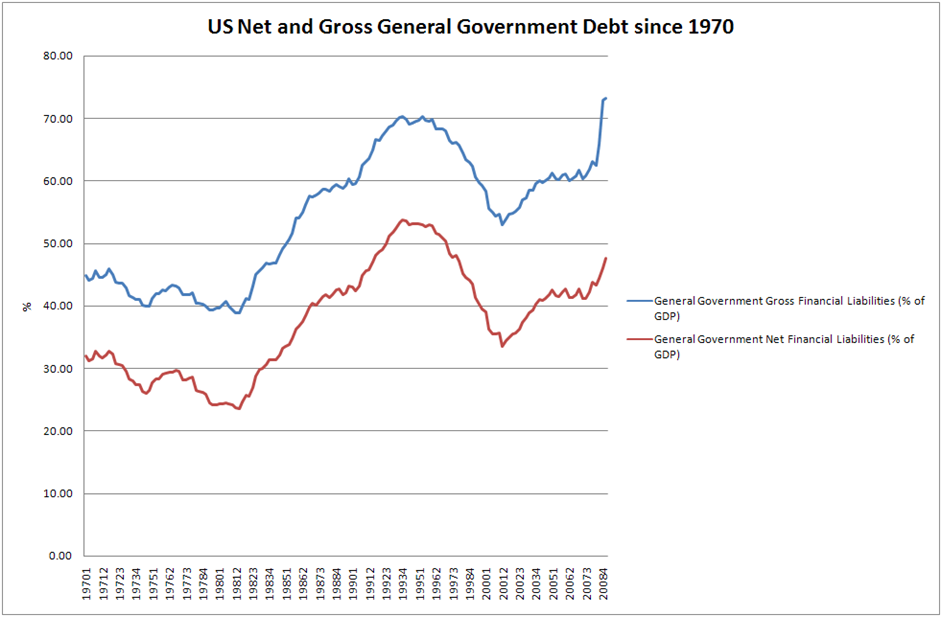
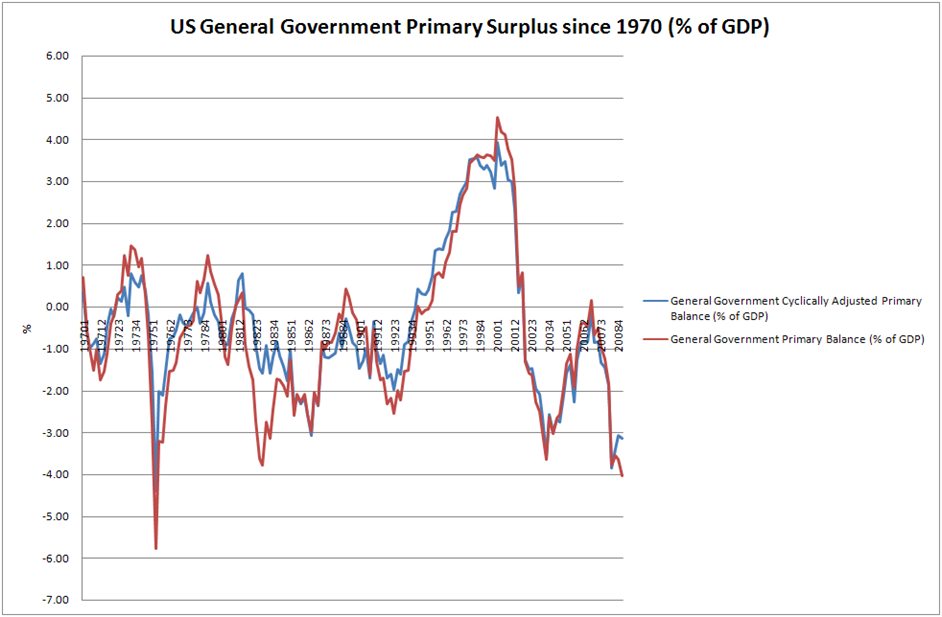
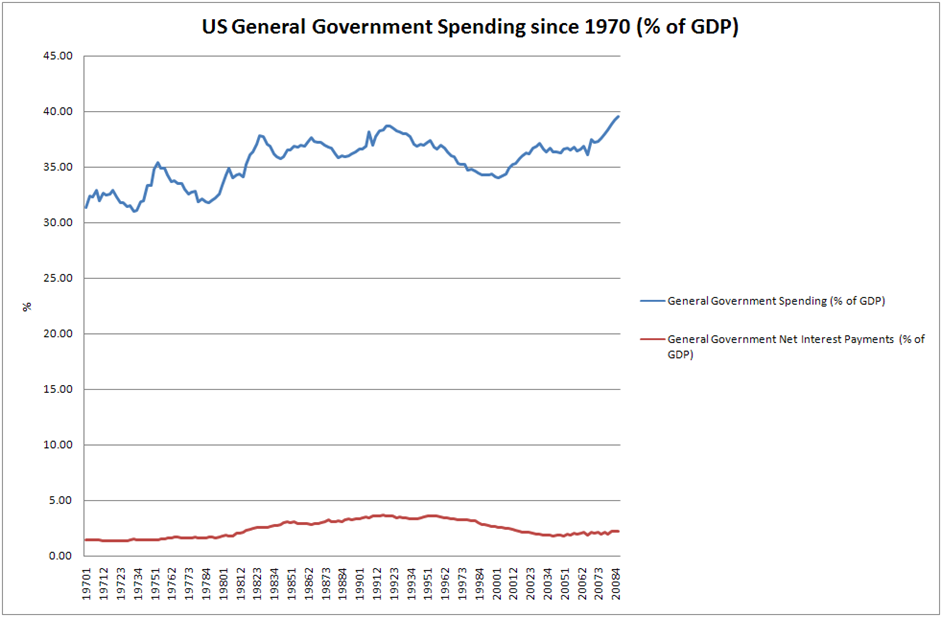
The dynamics of US general government (Federal, State and Local) public debt since 1970 is shown in Figures 1 and 2 below. They show the fiscal irresponsibility of the George W. administrations; fiscal policy was relentlessly procyclical, with the sizeable primary surpluses of the Clinton years blown away in a series of regressive tax cuts. Figure 3 shows that, even before the economic downturn started raising the numerator and lowering the denominator of public spending as a share of GDP (from the second quarter of 2008), general government expenditure had been growing faster than GDP during most of the George W. years (all three figures are based on OECD data).

Figure 1

Figure 2

Figure 3

US general government debt relative to GDP is now just above the level of the Euro Area - 73.0% for the US at the end of 2008 as opposed to 69.3% for the Euro Area. Public spending as a share of GDP in the US (38.7% for 2008) was still eight percentage points lower than in the Euro Area (46.7%). As the US entered the downturn 2 or 3 quarters before the Euro Area, the cyclically corrected difference is public spending programme size is likely to be even larger.

Even if we ignore the relentless build-up of public outlays through the social security programmes and especially through the Medicaid and Medicare programmes, the extraordinary levels predicted for the US Federal deficit for the next couple of years (13 to 14 percent of GDP for the next year and not much less for the year after that), plus the cost of recapitalising the banks, shoring up other wonky bits of the financial system and intervening to bail out rust-belt behemoths like GM and Chrysler are likely to put the general government gross debt to GDP ratio at well over 100 percent.

Even that, however, is only the beginning. It does not yet include price tag for the laudable ambition of the Obama administration to ensure that no American is without health insurance. Nor does it include planned government outlays for updating America’s clapped-out infrastructure or the pursuit of the environmental agenda. Bringing American secondary education (numeracy, literacy, foreign language skills etc.) up to the levels of the most successful emerging markets will also be very expensive, although more government money is only a necessary condition for significant progress in this area; a major change in the governance arrangements for schools in the incentives faced by teachers, heads, pupils and parents are also necessary. And I cannot really envisage Obama confronting the American Federation of Teachers. Without reform in governance and incentives, even vastly increased public spending on health and education will achieve in the US what it achieved the UK under Labour in the past six years: very little indeed.

So new spending commitments on health, infrastructure, the environment and education will take US general government spending as a share of GDP comfortably over the 40 percent level, even on a cyclically adjusted basis. Even if the US were to recoil from further imperial overstretch and halved military spending as a share of GDP, that only would know 2.5% of the total public spending share.

Then come the famous ‘unfunded liabilities’ of social security, Medicare and Medicaid. There is a bit of abuse of language in the term ‘liabilities ‘here. We are not talking about contractual commitments or legal obligations. We are talking about promises made by politicians and expectations of US citizens shaped by these promises. Unfunded social security liabilities are the “infinite horizon discounted value” of what has already been promised to recipients but has no funding mechanism currently in place. For social security this is $13.6 trillion, slightly less than a year’s worth of US GDP (around $14 trillion).

While big, social security promises are dwarfed by Medicare promises. There are three components to Medicare. Medicare Part A covers hospital stays; its unfunded component has an infinite horizon present discounted value of $34.4 trillion; Medicare B covers doctor visits; its unfunded component is worth $34.0 trillion. Medicare D covers the drugs benefit; its unfunded component amounts to $17.2 trillion. The total unfunded liability for Medicare is $85.2 trillion, just over 600% of US annual GDP. Medicare and social security together have unfunded liabilities worth 700 percent of US annual GDP.

Sure, these numbers are point estimates with wide margins of error. But the potential errors can go either way. In addition, these are, once again, not legal or contractual liabilities, like public debt or pension commitments of the state to its employees. They are promises by the government; hopes and expectations for the public.

It is obvious that these unfunded liabilities of social security and Medicare will be defaulted on. They will not be met in full. The modalities by which the state will renege on these promises and commitments can be partly foreseen based on relevant experience in the UK and elsewhere: failure to index-link social security benefits to earnings or even to the cost of living; rationing of hospital stays and doctors visits; denial of expensive treatments and medication to state-insured patients (beginning with the elderly) etc. etc. But no doubt our political masters will be able to surprise us with the ingenuity of the dodges they will design to ‘default’ on these unfunded liabilities.

To fund all these unfunded commitments, a permanent tax increase or spending cut as a share of GDP would be required equal in magnitude to the unfunded liability as a share of GDP (700 percent) times the excess of the long-term interest rate on the public debt over the long-term growth rate of GDP. Even if that excess were only 1 percentage point, the permanent primary surplus would have to rise by seven percent of GDP. If the excess is 2 percent, the permanent primary surplus would have to rise by 14 percent of GDP. The optimistic case would, if the entire adjustment were to take place through higher taxes, take the US tax burden to the current average level of the Euro Area. If the long-term interest rate is 2 percentage points above the long-term growth rate and the entire adjustment were to occur through taxes, the US would be well on its way to becoming Sweden, at least as regards the tax burden.

Adding Obama’s own new commitments to these unfunded liabilities would raise the necessary permanent increase in the general government primary surplus to at least 10 percentage points of GDP, and possibly 20 percent of GDP.

These figures should not come as a surprise. Obama’s plans for public expenditure are conventional, middle-of-the road social democratic spending plans. You cannot have social democratic spending ambitions if you are not able to impose social democratic tax burdens.

My fears about the sustainability of the US public finances is based on my belief that the US public believes there is a Santa Claus: that you can have the higher benefit levels and higher-quality provision of public goods and services without paying the price in the form of higher taxes or user charges. The US polity is so polarised, that it is not likely that a compromise will be achieved in the years and decades to come, on how to raise the additional revenues or how to cut public spending by enough to restore public debt sustainability. Exaggerating slightly, the Democrats will veto any future public spending cuts and the Republicans will veto any future tax increases.

The result will be a build-up of public debt of such magnitude, that the markets will force the government to choose between inflation and default. The state will choose inflation. It always has done to in the past when the debt burden was exceptionally high. If the state wanted to signal it will not choose inflation, it would retire its dollar-denominated debt and replace is with index-linked debt or foreign-currency denominated debt. There is no sign of this. Indeed, even as regards new debt issues, index-linked debt is hardly on the menu at all. When a commitment device is easily available but is not adopted, I tend to get concerned.

The markets are slowly waking up to the threat of inflation as a solution to fiscal unsustainability in the US. The fact that, in the short run (say for the next 3 years or so) deflation is much more likely than inflation does not help, as markets are hopelessly myopic. But once we get more than 3 years into the future, and certainly more than 5 years, the risk of high inflation (between 5 and 15 percent, say) is a material one. Only if Obama manages to put together a new coalition, based on a new national consensus, about the level of public spending and the distribution of its funding burden, will there be a non-inflationary way out of the debt dilemma. Such a major political realignment is possible, but not likely.

Ten-year rates on Treasury Notes have just begun to tickle 4 percent. Sooner (if markets become less myopic) or later (if markets remain stuck between blindness and myopia) the reality of the future inflationary threat will feed into interest rates at maturities of five years and longer. The Fed will not be able to stop this. It may temporarily be able to check the rise in long rates at those exact maturities it decides to purchase, but it cannot be present continuously at all maturities.

Ultimately, the 10-year rate is driven by expectations of short-term rates (like the Federal Funds rate) over the next 10 years. Sure there are term premia and there may be inflation risk premia (negative or positive) that come between the 10 - year rate and expected future short rates over a 10-year horizon. But expectations dominate. The Fed can only commit itself to a sequence of low future short rates (on average) if it can credibly commit itself to raise future short rates, should it be required to maintain price stability, to whatever level is necessary. But if the fiscal authorities (the Treasury and ultimately the White House) are considered likely to stop the Fed from fighting inflation effectively in the future, because such inflation is deemed necessary by the fiscal authorities to restore fiscal sustainability, then we are likely to see scenario where future short rates rise, as inflationary pressures rise, but not by enough to bring inflation down rapidly. Ex-post real rates will fall, thus achieving the objectives of the fiscal authorities.

The $300bn worth of Treasury securities the Fed has agreed to purchase already are not a threat to price stability - it is peanuts. It does barely enough to offset the reduction in the balance of the Treasury’s account with the Fed since the beginning of the crisis. But as the Federal government starts issuing additional debt worth a couple of trillion US dollars or more each year, the willingness of the Fed to monetise this increased debt issuance will be the key factor determining who will win the game of monetary-fiscal chicken that is just now starting. The independence of the Fed is not securely anchored. A chairman of the Fed who refuses to monetise government debt that the Treasury wants to be monetised, or who wants to de-monetise Federal debt acquired in past quantitative easing episodes when the Treasury does not want the Fed to exit from QE, will be replaced."

Me:

"When a commitment device is easily available but is not adopted, I tend to get concerned."

You don't really mean to apply that standard to govt in the real world, do you?

"My fears about the sustainability of the US public finances is based on my belief that the US public believes there is a Santa Claus: that you can have the higher benefit levels and higher-quality provision of public goods and services without paying the price in the form of higher taxes or user charges. "

I don't think that's right. Rather, we feel that we can kick the problem down the road a bit. We're all native Californians, in that sense.

"Only if Obama manages to put together a new coalition, based on a new national consensus, about the level of public spending and the distribution of its funding burden, will there be a non-inflationary way out of the debt dilemma. Such a major political realignment is possible, but not likely."

Maybe it'll be one of those Black Swans everyone's talking about. Apparently, they're more common than had been previously believed. A Grey Swan, perhaps. Instead of Santa Claus, we believe in Grey Tails. By the way, did you consider fat tails in your copulas? Projections?

"It may temporarily be able to check the rise in long rates at those exact maturities it decides to purchase, but it cannot be present continuously at all maturities.

Can I see a proof of that?

"But no doubt our political masters will be able to surprise us with the ingenuity of the dodges they will design to ‘default’ on these unfunded liabilities."

Good. something to look forward to.

It's a Political Problem. I agree.

"They are promises by the government; hopes and expectations for the public."

I'll take belief in Santa before these promises, and I'm Jewish. Posted by: Don the libertarian Democrat

Thursday, June 4, 2009

Does Summers have enough force of personality to bully the rest of the FOMC members into taking the inflationary path?

From Reuters:

"
Felix Salmon

nonrival, nonexcludable

June 4th, 2009

Inflating Larry Summers

Posted by: Felix Salmon
Tags: fiscal and monetary policy

Willem Buiter maps the path to inflation, and says that if we end up going there, Larry Summers will be our guide:

The only credible commitment a government can make that it will not try to inflate its debt away in the future, is to issue only index-linked debt and indeed to retire all nominally denominated debt and replace it with index-linked debt. Neither the British nor the US authorities show any sign of doing so. In fact the opposite is the case. This reluctance to issue index-linked debt is consistent with a policy of keeping the inflation option open…

In the US, this would present no serious problem. The Fed is the least independent of the leading central banks. I believe Bernanke takes price stability seriously and would resign rather than accept responsibility for a high inflation strategy forced on the Fed by the Treasury. With Larry Summers waiting in the wings to be the next Chairman of the Fed, however, the solvency-through-inflation route would be wide open.

Does Summers have enough force of personality to bully the rest of the FOMC members into taking the inflationary path? I doubt it — but given that there’s a strong case for keeping interest rates at zero for the foreseeable future, the question is probably moot. The macroeconomic future of the country is going to be determined by fiscal policy, not monetary policy — and Summers might well have more sway determining fiscal policy right now than he would have sway over monetary policy as Fed chairman."

Me:

I’m having a problem with Buiter’s reasoning on this issue. I seem to remember him wanting the government to take over banks, and then wipe out or bald bondholders, including China. Yet, he finds selling bonds at low yields, then pumping up interest rates, immoral, or, at least, ill advised.

As I tried to point out to him, in both cases, bondholders would blame the US Government for their loss. In both cases, the point would be to help the US at the expense of creditors. What’s the difference?

It’s true that the US didn’t originally own Citi, say, but, once the US Government does, it’s responsible for those debts. The underlying point is the same: The US is simply doing what it considers in its own best interests, at the expense of others. Why is one move a cause for celebration, while the other is a damnable crime? What am I missing?

- Posted by Don the libertarian Democrat

Sunday, May 24, 2009

Preserving our freedom, as set out in the Bill of Rights, is.

From Willem Buiter:

"Obushma-Biney in the Home of the Frightened
May 23, 2009 7:22pm

The spinelessness and moral cowardice of the Obama administration know no bounds. The Bush-Cheney team ordered the torture and abuse of prisoners in Guantánamo Bay Naval Base and assorted other locations abroad - offshore detention without trial as well as torture by US officials or persons acting under their instructions being permitted by Article VIII of the United States Constitution, as confirmed in the XXVIIIth Amendment to the US Constitution.

Candidate Obama declares he abhors torture and deplores what went on in Gitmo and in secret detention centres around the world, but President Obama decides that the Camp may have to remain open for another year, as he doesn’t seem to know what to do with the prisoners. The right thing to do would have been to send a plane to Guantánamo Bay Naval Base on the day of his inauguration, to move all the prisoners to the USA.

President Obama then also decides not to prosecute those who committed the crimes of torture or abuse of prisoners or were responsible for these crimes. The president’s excuse was was that he sought to turn the page on “a dark and painful chapter”. It was a “time for reflection, not for retribution”, he said.

He is quite wrong. Reflection complements the law. It is not a substitute for it. Those who can be charged with these offences should be tried and, if found guilty, punished according to the law. If among the guilty parties are CIA agents and former vice-president Dick Cheney, then so be it. If you cannot do the time, you should not do the crime. This is not vengeance, it is justice - and it is the law. Justice must be done and must be seen to be done before healing and reconciliation can start.

Then the Senate, controlled by the Democrats, voted 90-6 against closing Guantánamo. The US Senate, reflecting, regrettably, the majority view of the American people, did not want the prisoners to be moved to the US. As there appear to be fewer than 10 righteous people in the Senate (unless the four missing votes would all have been cast in favour of closing Gitmo), I hope the Lord is kinder to the US Senate than He was to Sodom and Gomorrah.

Harry Reid, the majority leader in the Senate, explained he did not want these terrorists released in the US. That, of course, was not even on the cards under what Obama had in mind. President Obama has said: “There may be a number of people who cannot be prosecuted for past crimes, in some cases because evidence may be tainted, but who nonetheless pose a threat to the security of the United States….Let me repeat: I am not going to release individuals who endanger the American people.” He then went on to defend his proposal for closing Gitmo and moving the prisoners to the US with the argument that no-one had ever escaped from the maximum security prisons that the Gitmo detainees would be sent to. How warped can you get?

The right and legal thing to do would be to take all the prisoners to the US, charge those who can be charged and release those who cannot be charged. Those who can be sent back to their countries of origin without endangering their safety can be sent back. The rest should be allowed to stay in the US (the principle in question is: ‘you break it, you own it’). Those charged then should be tried in a proper US court, not one of the kangaroo quasi-military tribunals created by Bush and Cheney. If convicted, they should serve their time, or pay with their lives, as the case may be. If acquitted they should be released. That is the rule of law. It is also the right and moral thing to do.

With Bush and Cheney, one often had the sense that they did not know what was wrong and what was right. Obama clearly knows the difference, but knowingly chooses the wrong option: video meliora proboque, deteriora sequor. The physical safety and security of the American people should not be the first and overriding concern of the US president. Preserving our freedom, as set out in the Bill of Rights, is. Hundreds of thousands have died to preserve that liberty. During World War II alone more than 400,000 Americans gave their lives in the cause of freedom.

To Patrick Henry is attributed the famous saying: “Give me Liberty, or give me Death”. The moral midgets and yellow-bellies in the US Senate and White House today would have said instead: “Give me security and comfort or I will curl up in a ball and refuse to vote for you again”.

What accounts for this transformation of the US polity into a collection of Angsthasen?

I was in the US shortly before 9/11 and shortly afterwards. The transformation in the public psyche was astonishing. Not just in New York and Washington DC, but everywhere I went, people were traumatised and visibly and audibly afraid. Both reason and principles went out of the window. It is true that this was the first serious ‘external’ attack on the US mainland since the War of 1812. There has been extremely bloody conflict since then, but all of it internal, including the Civil War and the routine fire-arms-related private violence which claims currently around 15,000 lives each year (not counting a somewhat larger number of fire-arms-related suicides).

September 11, 2001 is more than seven and a half years in the past, but the US polity and public appear no less traumatised by it today than they were in the immediate aftermath of the outrages. A very primal mood of insecurity and fear continues to afflict most of the nation and its politicians.

Fear is a poor guide to policy. It caused the US to launch an unnecessary second war against Iraq and it led its leaders to compromise the most important principles on which the country was founded. The fear-induced response of the US authorities to the murderous outrages perpetrated by Al-Queda has turned out to be a much more serious threat to what is best about the US than Al-Queda itself. Bush, Cheney and now also Obama and Reid represent a greater threat to my liberty and fundamental rights as a citizen and a human being than Osama bin Laden and his mindless murderers.

The US president and the majority leader in the US Senate have torn up the Constitution and the Bill of Rights, supposedly in the interest of the nation’s security and to preserve the safety of its people. I hope the blind fear that has de-activated the moral antennae of the American people will subside to the point that a majority will join me in loudly and clearly telling the country’s leadership that its depredations against the Constitution and the Bill of Rights are not in our name."

Me:

“Whoever has succumbed to torture can no longer feel at home in the world. The shame of destruction cannot be erased. Trust in the world, which already collapsed in part at the first blow, but in the end, under torture, fully, will not be regained. That one’s fellow man was experienced as the antiman remains in the tortured person as accumulated horror. It blocks the view into a world in which the principle of hope rules. One who was martyred is a defenseless prisoner of fear. It is fear that henceforth reigns over him.” —Jean Amery

From the best book on the Holocaust, "At The Mind's Limits: Contemplations by a Survivor on Auschwitz and Its Realities". He later wrote:

"I do not have [clarity] today, and I hope that I never will. Clarification would amount to disposal, settlement of the case, which can then be placed in the files of history. My book is meant to prevent precisely this. For nothing is resolved, nothing is settled, no remembering has become mere memory" Posted by: Don the libertarian Democrat

Thursday, May 21, 2009

nothing at all strange about a world in which you put a dollar in a deposit account and get back 95 cents after a year

From Willem Buiter:

"Negative interest rates, Sharia law and tech stocks

May 20, 2009 9:57am

Morality

I know of ethical systems that hold all interest to be sinful. Riba, interest on money, is forbidden by the Quran. I don’t know what Sharia scholars would have to say about negative nominal interest rates. If if were viewed as a gift from the lender to the borrower it might even be condoned. Perhaps an extra-credit question on the next Islamic finance examination? Medieval Christianity also banned ‘usury’, which meant any ‘interest’ rather than outrageous interest rates - its modern meaning.

Interest is viewed by some as immoral because it represents an increase in capital without any services being provided. I don’t share the sense of moral outrage at interest per se, but I can understand where it comes from - something for nothing ain’t right. However, I know of no ethical system that attaches opprobrium to an intertemporal relative price that is greater than unity but not to an intertemporal relative price that is less than unity - or vice versa.

Apparently, there are those who believe that when the price today of one unit of money tomorrow is less than one unit of money now - when the nominal interest rate is positive - there is no moral issue. When the price today of one unit of money tomorrow is more than one unit of money now - when the nominal interest rate is negative - something nasty is being perpetrated. No matter how I shake and bake this set of beliefs, I cannot make sense of it.

Equity, high tech or other

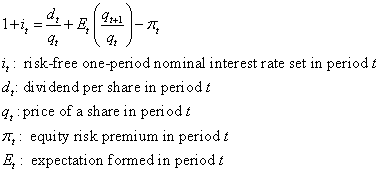
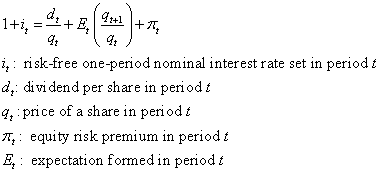
Would the temptation/urge to escape into equity (high-tech, low-tech or no-tech) should the short nominal rate of interest become negative would make a negative nominal interest rate policy infeasible? Obviously not. Below I have scribbled the standard portfolio balance or equilibrium condition that must be satisfied if an investor is will to hold both short nominal bonds with a nominal interest rate i and equity with a dividend per share d, a current share price q, an expected future share price Eq and an equity risk premium π . The risk premium can be given economic content (I won’t bother with that here). It is not whatever is required to make the relationship hold identically.


What this means is that (holding the equity risk premium constant for the sake of argument), a negative nominal interest rate, for a given positive dividend yield, requires the expectation of falling equity prices. This is less counter-intuitive if you replace ‘falling equity prices’ by ‘high but falling equity prices’. So negative nominal interest rates and tech stocks can coexist peacefully. The price today of one dollar of money tomorrow can be a dollar and five cents, that is, i = -0.05. Most economics I know breaks down only if the price today of one dollar of money tomorrow,

, were to become infinite or to become negative (i goes to -1 from above). This would mean a nominal interest rate of minus 100 percent or more. It would be a strange world if you put 1 dollar in a deposit account and after a year got back nothing or a demand for payment. But there is nothing at all strange about a world in which you put a dollar in a deposit account and get back 95 cents after a year. With a bit of luck, we may even get used to having such a state of affairs prevail from time to time."

Me:

Since I've studied the Talmud on some of these issues, I'm going to leave the religious question aside. However, via Zero Hedge, I came upon the following excellent post that gives a version of the ideas I agree with:

http://www.american.com/archive/2009/may-2009/why-not-negative-interest-rates/article_print

"Would anybody rationally pay $1.02 for $1.00 in cash? They do today, if they take cash as a non-customer from an ATM. The average ATM surcharge fee is about $2. For a $100 withdrawal, that is equivalent to a price of $1.02. Alternately thought of, if a $200 withdrawal were cash for one month, the average fee would be equivalent to a negative 12% interest rate.

In general, the increasing dependence on electronic payments makes a massive move to currency less feasible and thus negative interest rates more plausible."

Read the whole post. And, of course, there's this, via Hugo, wherever he is:

http://www.chiemgauer.info/

I have to say, the idea that you would place a disincentive on flight to quality panic buying makes perfect sense to me. Since it is, in some sense, equivalent to inflation, I can only guess that people would rather not notice that their assets have been devalued. Calling Erich Fromm! Posted by: Don the libertarian Democrat

Sunday, May 17, 2009

I was surprised, when visiting Dublin, to discover just how short some of the locals must be

From Willem Buiter:

"
They say travel broadens the mind; but you must have the mind

May 17, 2009 9:03pm

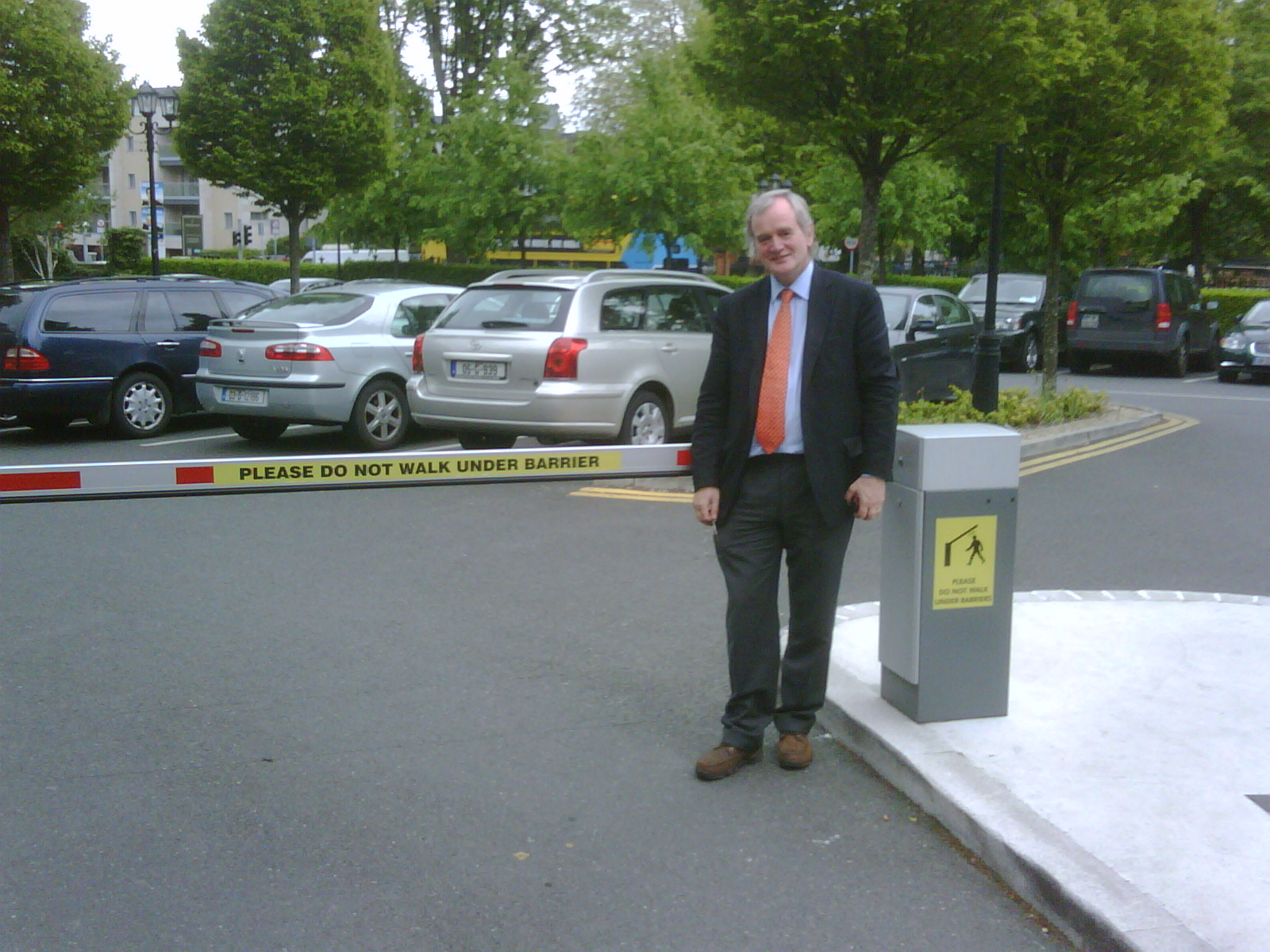
I was surprised, when visiting Dublin, at how short some of the locals must be

I was surprised, when visiting Dublin, to discover just how short some of the locals must be. The consequences of the potato famine still appear to be with us."

Me:

My guess is that somebody tried to walk under one of those barriers, sustained head and back injuries, and sued the owner of the barrier. Apparently no one yet has been castrated by trying to walk over it. Of course, that little sign on the right might better explain what is meant. I'll send you ten dollars or the equivalent of it in your choice of currency if you walk over and under. Posted by: Don the libertarian Democrat

Friday, May 15, 2009

‘Enough capital for what?’ should be the question prompted by the title of this post.

From Willem Buiter:

"
Does the ECB/Eurosystem have enough capital?

May 15, 2009 1:38am

‘Enough capital for what?’ should be the question prompted by the title of this post. The short answer, amplified below, is “enough capital to be able to engage in effective monetary policy, liquidity policy and credit-enhancing policy (including quantitative easing or QE), without endangering its price stability mandate.”

Let’s consider the conventional balance sheets of the ECB and of the consolidated Eurosystem (the ECB and the 16 national central banks (NCBs) of the Euro Area.

The most recent publicly available balance sheet of the ECB is in the 2008 Annual Report, published in April 2009. It is reproduced here:

Balance sheet of the ECB on 31 December 2008 and 31 December 2007

Assets (€ bn) Liabilities (€ bn)

2008 2007
2008 2007
Gold & Gold Receivables 10.7 10.3 Bank notes in circulation 61.0 54.1
Claims on non-euro area residents in foreign currency 41.6 29.2 Liabilities to euro area residents in euro 1.0 1.1
Claims on euro area residents in foreign
currency
22.2 3.9 Liabilities to non-euro area residents in euro 253.9 14.5
Other assets 14.3 11.3 Liabilities to euro area residents in foreign currency 0.3 0.0
Intra-Eurosystem claims 295.1 71.3 Liabilities to non-euro area residents in foreign
currency
1.4 0.7

Other liabilities 20.5 9.4
Intra-Eurosystem liabilities 40.1 4.0
Capital & reserves 4.1 4.1
Profit for the year 1.3 0
Total 383.9 126.0 Total 383.9 126.0

It is clear that if the ECB were all there is to the Eurosystem, the Euro Area would be in trouble. The ECB has negligible capital (€ 5 billion subscribed, rather less than that paid in; even if we add capital and reserves to 2008 profits, we only get €5.4 bn. With assets of €3839, that gives the ECB 71 times leverage at the end of 2008, a number that would impress even Deutsche Bank. The previous year, the ECB had 48 times leverage. On its own, the ECB looks like an overblown pawn shop.

Fortunately, the balance sheet of the ECB by itself is effectively irrelevant and uninformative as to the financial strength of the Euro Area monetary authority. In 2008, about 75% of the assets of the ECB consisted of intra-Eurosystem claims (the left hand lending to the right hand).

What is informative is the consolidated balance sheet of the ECB and the 16 NCBs of the Euro Area - the Eurosystem. This consolidated balance sheet of the Eurosystem is available monthly:

Consolidated financial statement of the Eurosystem as at 8 May 2009

Assets (EUR millions)

1 Gold and gold receivables 240,817
2 Claims on non-euro area residents denominated in foreign currency 159,299
3 Claims on euro area residents denominated in foreign currency 123,101
4 Claims on non-euro area residents denominated in euro 21,359
5 Lending to euro area credit institutions related to monetary policy operations denominated in euro 653,352
6 Other claims on euro area credit institutions denominated in euro 26,453
7 Securities of euro area residents denominated in euro 292,405
8 General government debt denominated in euro 36,790
9 Other assets 241,523
Total assets 1,795,099

Liabilities (EUR millions)
Totals/sub-totals may not add up, due to rounding
1 Banknotes in circulation 759,502
2 Liabilities to euro area credit institutions related to monetary policy operations denominated in euro 264,137
3 Other liabilities to euro area credit institutions denominated in euro 436
4 Debt certificates issued 0
5 Liabilities to other euro area residents denominated in euro 139,090

5.1 of which General government 130,717
6 Liabilities to non-euro area residents denominated in euro 177,993
7 Liabilities to euro area residents denominated in foreign currency 1,548
8 Liabilities to non-euro area residents denominated in foreign currency 11,407
9 Counterpart of special drawing rights allocated by the IMF 5,551
10 Other liabilities 159,644
11 Revaluation accounts 202,952
12 Capital and reserves 72,840
Total liabilities 1,795,099

A central bank can go broke (become insolvent) despite its ability to ‘print money’ (issue currency and/or create (electronically) deposits owned by commercial banks and other eligible counterparties that are generally accepted as final means of payment) if it has a sufficiently large stock of liabilities denominated in foreign currency and/or a sufficiently large stock of index-linked liabilities. Neither condition would seem to apply to the Eurosystem.

A shortage of foreign exchange assets or credit lines is not going to be a material problem for the Eurosystem. As of May 8, 2009, the net position of the Eurosystem in foreign currency (asset items 2 and 3 minus liability items 7, 8 and 9) was EUR 263.9 billion. The ECB is also able to create reciprocal or one-sided swap arrangements with all other serious central banks. As far as I know, the Eurosystem does not have any significant amount of index-linked liabilities.

No, the Eurosystem will not encounter the ‘Iceland problem’. It will always be able to create euro base money (either by issuing additional euro currency or by increasing euro bank reserves and similar deposits held with the Eurosystem by eligible counterparties) by any amount required to maintain its solvency. It is, however, possible that the amount of additional base money that would have to be created to maintain the Eurosystem’s solvency could endanger the ECB’s price stability mandate, operationalised as a rate of inflation, measured by the HICP, below but close to 2 percent per annum in the medium term.

So the question is: does the Eurosystem have enough capital to be able to risk significant capital losses in its monetary operations, liquidity operations and credit enhancing operations (including quantitative easing), without endangering its price stability mandate?

The Eurosystem already has taken a lot of private sector credit risk exposure on its balance sheet. It accepts as collateral in repos and at its discount window (the marginal lending facility), most private securities (including most asset-backed securities except those that have derivatives as underlying assets) rated BBB- or better. That includes a lot of rubbish. Commercial banks throughout the Eurozone (including subsidiaries of Lehman Brothers and of the now defunct Icelandic banks) have repoed with the ECB. When three banks went belly-up in late 2008, the Eurosystem was exposed to potentially dodgy collateral to the tune of about €10 bn and provisioned about € 5 bn.

With assets of € 1,795 bn and capital and reserves of € 73 bn, the Eurosystem has 24,6 times leverage. A decline of just four percent in the value of its assets would wipe out its capital. That does not look like a terribly comfortable position, as the quality of much of the assets it has accepted as collateral from Euro Area banks is likely to be uncertain at best.

Unlike the US banks and the UK banks, Eurozone banks have barely made a start on recognising the toxic and bad assets they are exposed to, on balance sheet or off-balance sheet. I won’t this time single out Iberian banks as likely suppliers of vast quantities collateral consisting of dodgy residential mortgage-backed and commercial-mortgage-backed securities to the Eurosystem. Being given the evil eye by the Governor of the Central Bank of Iberia is no laughing matter. And in any case, the Irish banks are likely to have saddled the Eurosystem with collateral that yields to no other Eurozone nation in awfulness. We know of the dreadful state of most of the German Landesbanken, the fragility of the bailed-out Commerzbank, the opaque balance sheet of Deutsche Bank, the precarious state of the remaining large listed Benelux banks, the exposure of the Austrian banks to Central and Eastern Europe etc. etc. If any of these banks had good collateral, they would not give it to the Eurosystem. They would sit on it.

Even before the Eurosystem starts to buy private securities outright (as it is planning to do with high-grade covered bonds, Pfandbriefe, to the tune of € 60 bn), it is certainly within the realm of the possible (or even likely) that it would suffer losses on its assets of €73 bn or more, before this crisis and this contraction are over.

That, of course, would not endanger the solvency of the Eurosystem, which has the present discounted value of current and future seigniorage income (the interest earned (or saved) by being able to borrow at a zero rate of interest through the issuance of currency and through mandatory reserve requirements).

The monetary base issued by the Eurosystem (not all of which is held in the Euro area) is just over a trillion euros. Eurozone GDP at current market prices in 2008 was about € 9.2 trillion. So the monetary base is about 11 percent of GDP. If long-run nominal GDP growth in the Euro Area is four percent per annum (two percent real GDP growth and 2 percent inflation), then, assuming for simplicity that the demand for base money does not depend significantly on the rate of inflation for low rates of inflation), the Eurosystem would be able to issue another 0.43 percent of GDP worth of additional base money each year ($40 bn worth of base money in 2009) withough putting upward pressure on inflation or driving it above the inflation target, assumed to be 2 percent to make the arithmetic easy.

This is likely to be an overstatement of seigniorage revenues at a rate of inflation consistent with the price stability mandate for two reasons. First, the demand for base money is likely to be boosted significantly and unsustainbly by the extreme liquidity preference of banks and households following the collapse of interbank markets and other ready sources of liquidity. Also, a large but unknown share of euro notes is held outside the Euro Area, both for legitimate and illegitimate purposes. This demand for euro currency will not depend on Euro Area income growth, inflation and interest rates.

Even if the ‘normal’ euro seigniorage as a share of GDP at a 2 percent rate of inflation is only 0.2 percent of GDP, the capitalised value of the current and future stream of seigniorage, assuming that the long-term nomopnal nterest rate exceeds the long-term growth rate of nominal GDP by one percentage point, would be 20 percent of Euro Area annual GDP. That would allow the ECB to absorb quite massive losses to its balance sheet, which as it happens equals 19.5 percent of Euro Area annual GDP.

A complete blow-out of the balance sheet of the ECB is unlikely, to say the least. Admittedly, we have to set against the present value of current and future seigniorage the present discounted value of the cost of running the Eurosystem. The ECB is lean and mean, but many of the NCBs are over-staffed, bloated organisations. I have not been able to find data on the current and capital costs of the Eurosystem, but it seems unlikely to alter the conclusion that with its monopoly of the issuance of currency in the Euro Area, and its tax on eligible bank deposits (aka reserve requirements), the Eurosystem is so wildly profitable that it can withstand very large capital losses on its conventional financial balance sheet.

Things are different in that regard for the Bank of England and the Fed, where, under normal circumstances, base money is a much smaller fraction of annual GDP than in the Euro Area - typically no more than 4 or 5 percent. The maximum losses these central banks can sustain without having to either increase base money issuance to a volume that generates inflation above the (implicit or explicit) target, or knock on the door of the Treasury for compensation for their capital losses are therefore less than a quarter of the losses the Eurosystem can tolerate.

That is just as well, since the ECB and the Eurosystem ’swim naked’: there is no Euro Area fiscal authority that, explicitly or implicitly, stands ready to act as the recapitalisor of last resort for the Eurosystem. As the Euro Area develops financially, and as its Southern Fringe becomes less tolerant of tax evasion and the grey and black economies, the demand for base money will shrink as a share of GDP. This would tighten the intertemporal budget constraint of the Eurosystem and make it more likely that it will have to look for a Euro-Area fiscal indemnity for capital losses incurred in the pursuit of its monetary, liquidity and credit easing objectives. But that is likely to become an issue only with the next financial crisis, a couple of decades down the road."

Me:

  1. Fortunately, in the US, we don't allow swimming naked. Europeans are very lax on sexuality, even in banking.
    Posted by: Don the libertarian Democrat | May 15 05:29pm | Report this comment
  2. 4. Sadly, I've been pacing in my apartment, singing like Les McCann, "Does the ECB have enough capital, compared to what? Sock it to me now."

    http://www.youtube.com/watch?v=hRONbnyNpu8

    Feel free to erase my posts. Feel very free.
    Posted by: Don the libertarian Democrat | May 15 05:52pm | Report this comment

Tuesday, May 12, 2009

Unlike the gormless arts students, limp-minded lawyers and woolly social scientists that dominate British and American economic policy making

From Willem Buiter:

"
Inflection points and turning points - since you asked
May 13, 2009 3:18am

The President of the European Central Bank, Jean-Claude Trichet, did not say that the recession was bottoming out. He said that it had reached an ‘inflection point’: “As far as growth is concerned, we’re around the inflection point in the cycle, that’s the sentiment,…” . Unlike the gormless arts students, limp-minded lawyers and woolly social scientists that dominate British and American economic policy making, President Trichet actually knows and understands mathematics. An inflection point is not a turning point.

Assume the cycle, C, can be represented as a twice continuously differentiable function of time, t, say

C = f(t)

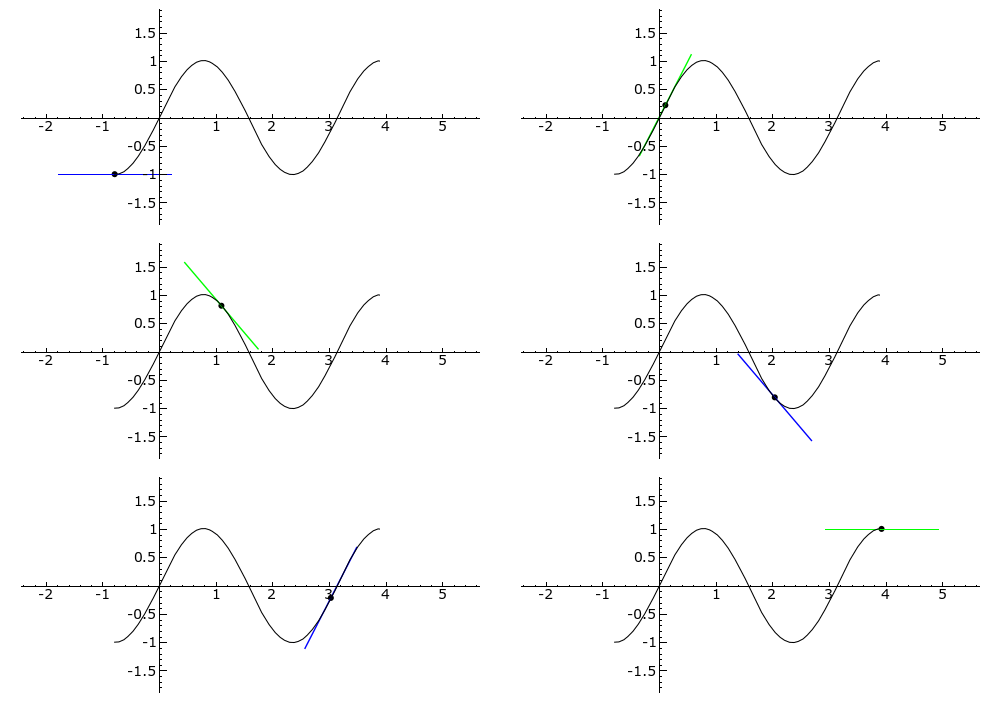
What President Trichet was referring to was that, since the last quarter of 2008 or thereabouts, real economic activity had been declining in the Euro Area, that is, f’<0 or the first derivative (nothing to do with CDS) of activity with respect to time had been negative. Not only that, but it had been declining at an increasing rate, that is, f”<>. The reference to the inflection point means that President Trichet now believes that activity, while still declining, is no longer declining at an increasing rate but instead is now falling at a decreasing rate. That is, today, f”‘ > 0, passing through f”= 0 (the inflection point) along the way.

An inflection point is a point on a curve at which the curvature changes sign from concave downwards (upwards) to concave upwards (downwards), or, equivalently in the case under consideration, where the second derivative changes sign (f”(t) = 0 is not in general a sufficient condition for t to be a point of inflection. In addition, the lowest-order non-zero derivative must be of odd order (first, third, fifth, etc.). If the lowest-order non-zero derivative is of even order, the point is not a point of inflection. So if f” changes sign and f” has the same sign ‘before’ and ‘after’, we have a point of inflection. That’s why an inflection point is not a turning point.

A turning point is where the first derivative changes sign. In our current cyclical circumstances, we are all (the moving graph works with Firefox, I cannot get it to work with Internet Exporer - one more reason for switching to Firefox).

Animated illustration of an inflection point (from Wikipedia)Plot of f(x) = sin(2x) from − π / 4 to 5 * π / 4; note f’s second derivative is f”(x) = − 4 * sin(2x). Tangent is blue where curve is concave up (above its own tangent), green where concave down (below its tangent), and red at inflection points: 0, π / 2 and π.

President Trichet’s statement that the cycle is at an inflection point is therefore quite consistent with the IMF’s forecast that real economic activity in the Euro Area will continue to decline for this year and much of the next. Both Trichet and the IMF could of course be wrong, but it helps to be clear about what he actually said."

Me:

"The reference to the inflection point means that President Trichet now believes that activity, while still declining, is no longer declining at an increasing rate but instead is now falling at a decreasing rate"

I love the moving graph, but why couldn't he have just said that since we're all innumerate, or whatever the term is? By the way, he said, "we’re around the inflection point in the cycle". What color is "around the inflection point"? Posted by: Don the libertarian Democrat

Friday, May 8, 2009

Wir lernen dort, dass die amerikanische Zentralbank den optimalen Zins bereits bei "minus 5 Prozent" sieht

TO BE NOTED: From Chiemgauer:

"Presse und Medien

Harvard-Professor Mankiw empfiehlt der US-Notenbank Negativ-Zinsen

Die Krise in den USA ist mittlerweile so tief, dass ernsthaft über die Geldpolitik nachgedacht wird. Kein Geringerer als Prof. Gregory Mankiw greift die Freigeld-Idee Silvio Gesells auf, um einen einfachen Vorschlag auf den Tisch zu bringen: Das Festhalten von Geld wird besteuert. Diese Methode sei sehr viel effektiver als die immense Überschuldung des Staates.

Mankiw zitiert den Vorschlag eines Studenten: In nicht vorausgesagten Abständen erfolgt eine Verlosung der letzten Ziffer der Seriennummern des Geldes. Wer im Besitz eines Scheins mit der gezogenen Endziffer ist, bezahlt eine Geldsteuer von zum Beispiel 10%. Diese Verlosung wird so oft durchgeführt, bis die Umlaufgeschwindigkeit des Geldes wieder ein hohes Niveau erreicht.

Diese "überraschende Auslosung einer Teilmenge des Geldes" wurde übrigens nicht von dem von Mankiw anonym zitierten Studenten erfunden, sondern bereits 1950 von Ernst Winkler in den "Blättern der Freiheit" vorgebracht (heute "Fragen der Freiheit"). Auf diesen Hinweis von mir hat sich Prof. Mankiw freundlich bedankt.

Der Vorschlag des Harvard-Ökonomen wird nun zunehmend ernsthaft diskutiert. Auch die Financial Times Deutschland (FTD) nimmt sich des Themas in der Ausgabe vom 28. April. Wir lernen dort, dass die amerikanische Zentralbank den optimalen Zins bereits bei "minus 5 Prozent" sieht.

Gar nicht so weit weg von den minus 8% des Chiemgauer. Beim Chiemgauer erfolgt die Besteuerung durch eine vierteljährliche Klebemarke im Wert von 2% des Nominalwertes. Beim Chiemgauer-Konto ist der Umlauf-Impuls noch intelligenter, denn erst nach mehr als 30 Tagen erfolgt die Berechnung eines Negativ-Zinses. Wird beim Chiemgauer das Geld regelmäßig weitergegeben, werden für den einzelnen Nutzer keine Kosten fällig.

Mankiw ist übrigens nicht der erste moderne Ökonom, der über Negativzinsen nachdenkt. Prof. Buiter von der London School of Economics, Prof. Fukao und Prof. Goodfriend haben sich in wenig beachteten Diskussionspapieren schon vor einigen Jahren im Zuge der japanischen Deflation für eine sogenannte "Gesell-Steuer" ausgesprochen.

Von: Gelleri

28.04.09

Thursday, May 7, 2009

It certainly fails my "Grandmother" test.

From Worthwhile Canadian Initiative:

"
A modest proposal for paying negative interest on currency (or something)

Willem Buiter considers various ways to make interest rates negative. The problem is how to pay negative interest rates on currency. His most interesting proposal is to separate the unit of account from the currency. The dollar would remain the unit of account (at least, he hopes it will). But he would replace dollar notes and coins with a new currency, the "rallod", which would depreciate against the dollar. If it depreciated at (say) 5% per year, it would allow nominal interest rates on dollars to go down as low as minus 5%, which should be sufficient to get us out of the recession.

It seems a very complicated proposal, when you read it. It certainly fails my "Grandmother" test. (Grandma could never understand Britain's new decimal currency, and the switch from shillings and old pennies to new pennies, so refused to deal in anything smaller than the pound, which stayed the same.)

So I decided it needed to be simplified.

My first idea, rather than changing the currency, was to change the other units of measurement. After all, we buy apples in kilograms, milk in litres, labour by the hour, etc., so why not just redefine the kilogram, litre, and hour so that they got 5% smaller per year? So even if the price of apples in dollars per kilogram stayed the same, at the end of the year we would get 5% fewer apples per unit of currency. Exactly the same as if the "rallod", were worth 5% less in terms of dollars.

But after careful consideration, and long consultations with colleagues in other departments, I decided that my idea would not make for good relations between economists and other scientists, who seem rather attached to their existing units of measurement. The engineers in particular seemed to suffer from "unit illusion", and couldn't adjust to a world of inflation. So I abandoned my first idea, and returned to thinking about Willem's proposal.

How to simplify Willem's proposal for the "rallod"?

Well, the name "rallod" has to go for starters. It's ugly, and sounds far too radical. The common convention for currency reforms is to introduce a new currency, and call it the "New...." whatever the old currency was. The "New Franc" replaced the old Franc in France. So let's just call it the "New Dollar". And to be doubly sure there is no misunderstanding, we can refer to the old dollar as the "Old Dollar".

And it would be a major hassle and expense to call in all the old dollar coins and bills and print up new dollars to replace them. It would be much simpler for the government and central bank to just make a declaration: "Henceforth, all existing dollar notes and coins are now declared to be New Dollar notes and coins!". One problem solved!

Now, since the New Dollar will be depreciating at 5% per year against the old dollar, and all existing contracts are denominated in old dollars, we will have to remind people that the number of New Dollar notes they will need to pay to fulfill any existing contract (if they choose to pay with currency) will need to be increasing at the rate of 5% per year. That would apply to all debt contracts, wage contracts, price contracts, etc. And the courts would of course enforce that interpretation of the contracts. And there is nothing unjust about doing this, of course, because the New Dollars won't be worth as much as the old dollars.

Alternatively, and perhaps it would be simpler, we could just rewrite all the old contracts, add a 5% per year premium to any price, wage, or rate of interest, so that payment could be specified in New Dollars, if that's what people wanted to pay in.

Actually, now that I come to think of it, do we really need the ugly neologism "New Dollar"? Since we wanted to avoid the cost and hassle of printing new notes and coins, the notes and coins still say "dollar" rather than the "New Dollar". So, to avoid confusion, let's keep the word "Dollar" for the New Dollar. And use the words "Old Dollar" (or "Classic Dollar"?) for any contract written before the New Dollar...I mean the Dollar...was introduced.

Actually, now I think of it some more, isn't there only one thing we need to do? Just pass a law saying that all contracts written in dollars before a certain date must have an additional 5% per year premium written into them?

So a 4% mortgage would now become a 9% mortgage, by law. A contract specifying a 3% wage increase per year would now specify 8%, by law. And so on. And just to anchor inflation expectations to the new currency regime, to help people adjust, the central bank should announce that the inflation target will be raised from 2% to 7%, and that whatever inflation rate people had previously expected, in old dollars, should now be revised upwards by 5%.

So, to recap: raise all existing nominal interest rates by 5% per year; raise all existing wage and price contracts by 5% per year; raise the inflation target by 5% per year; and tell people to expect inflation to be higher by 5% per year. New interest rates and new wage and price contracts can be set wherever they need be, of course. That's my simplified version of Willem's proposal.

Why wouldn't my version work? Only the names are different.


Me:

I don't see the problem:

http://blogs.ft.com/economistsforum/2008/11/the-case-for-negative-interest-rates-now/#more-259

"These include the periodic stamping (for a small fee) of banknotes (without the stamp they would not be valid). The idea is that by imposing a running tax on banknote hoarding, nominal risk-free rates could fall to negative levels.

In the age of the information technology revolution, surely the authorities could devise a simple and practical method of effective taxation of banknote hoards?

There are two cues to a practical method of taxing notes. The first comes from what happened during US financial crises in the 19th century.

Banks under stress of cash drains (depositors withdrawing funds) suspended temporarily the 1:1 link between cash and deposits, so their notes sold at varying discounts. The second comes from the launch of the euro; a conversion of old banknotes into new.

These cues lead to the solution.

The relevant government would announce that existing banknotes were to be converted into new notes at a fixed date, say three years from now, at a discount (for example 100 old dollar banknotes would be converted into 90 new).

In the interim, 1:1 conversion of banknotes into deposits would be suspended. Instead, a crawling peg would be established. At the start, the exchange rate between deposits and banknotes would be virtually 1:1. At the end it would be 0.9 banknotes/deposit.

As the discount grew, retailers would quote different prices for cash or cheque/card settlement. And as to the note switch-over costs, the “experiment” of Europe’s economic and monetary union demonstrates the feasibility.

The looming conversion would provide an essential degree of freedom for monetary policy. In terms of our illustrative arithmetic, the risk-free interest rate could fall to a negative 3.33 per cent a year without triggering cash withdrawals from the banking system.

Is the exercise worth it?

The main reason for believing it is stems from an appreciation of how the bursting of a global credit bubble influences the equilibrium level of risk-free interest rates relative to risky rates of return and in absolute terms.

Most of us would agree that the bursting process ushers in a period during which soberly-measured risk premiums increase sharply.

This means that the risk-free rate must plunge to be consistent with an average overall cost of capital which reflects the new glut of savings.

So, in terms of our illustrative arithmetic, it is plausible that the neutral risk-free nominal rate of interest in the US and Europe, especially taking account of a likely near-term drop of the price level, is significantly negative.

The central bank and government, by devising a system in which such negativity can express itself, can give a big fillip to the recovery process."

If it's one thing the govt can do, it's tax.

Posted by: Don the libertarian Democrat

Hi Don!

There is nothing you can do by taxing money or introducing a new currency that could not be done by changing the expected rate of inflation.

Fiat/fiduciary/paper money is just a symbol, like language. (Structuralism?). Under interest rate control, there is nothing to anchor the meaning of words/money (the price level), except Lewis-conventions (inertia of actual and expected inflation). If we go to bed in one equilibrium and while we slept a magic wand doubles all the prices, and expected prices, we would wake up next morning in the same (real) equilibrium. Just the same as if a magic wand changed the word "cat" to "dog" and vice versa, in our minds and books.

When we are in a Lewis/Schelling conventional/coordinated equilibrium, we stay there, even though there are multiple equilibria. But a symbolically important "declaration", even if it is mere "cheap talk" (not backed by real actions that alter the payoff matrix) can change the focal point and switch us to a different (nominal) equilibrium ("nominal" = where all the prices/inflation rates/meanings of words are different).

The Brits drive on the left. No individual driver has an incentive to deviate from the left equilibrium unless he expects all others to deviate. The government could switch the equilibrium to driving on the right by declaring that Britain is now part of Canada (change the currency). Or it could do it by declaring that Brits will now all drive on the right (announce a new rate of inflation). Either would work, if and only if it is believed to work.

Do dictionaries determine the proper meanings of words, or do the meanings of words determine the proper dictionary?

Don, continued: That's why I was playing with the meanings of words dollar, new dollar, old dollar, etc.

On way to change the equilibrium that is not merely a declaration (cheap talk) is for the government to do something real (get the army trucks to start driving on the right). By pegging the time path of the price of some real good, by buying and selling gold, or whatever, and abandoning interest rate control (which just swaps money for future money) we are no longer in a Schelling/Lewis coordinated game. There is only one equilibrium.

Inflation is a tax on currency. And we don't have to go to any hassle of collecting it. Just print more money. Inflation means a negative (real) interest rate on currency.

I should probably do a sensible version of this slightly silly post sometime, making all this stuff explicit, rather than implicit.

Nick,

I think that I agree with you, which is why I said the following on Buiter's blog:

"I'm less concerned on the method used, than on the use of the concept"

However, being a dunce, I'm attracted to views that I ( mis ) understand. QE and Stamping are just clear positions to me, and work towards the desired goal by clear incentives and/or disincentives. Stamping is a disincentive to buy short term bonds, as I envision it. QE is a solution to Debt-Deflation. I suppose they come to the same thing, or, as you seem to say, could come to the same thing. I avoid theory at all costs nowadays.

Posted by: Don the libertarian Democrat

received more hate mail from my NY Times article on the topic than from anything else I have ever written

TO BE NOTED: From Greg Mankiw's Blog :

"
More on Negative Interest Rates From LSE economist (and former central banker) Willem Buiter, who concludes
Removing the zero lower bound on nominal interest rates would represent a valuable addition to the policy arsenal of the central banks. We know something about how interest rates work. There is no reason to believe there would be any dramatic change in the effectiveness of policy rate cuts if these cuts to the rate [are to a] level below zero. We know next to nothing about the effectiveness of the alternative policies that central banks are forced to adopt if they don’t just want to sit on their hand[s] once the[y] hit the zero lower bound: quantitative easing and credit easing, relaxing the collateral requirements for central bank lending etc.
I should note that, economic logic aside, the "optics" of negative interest rates are not very good. I received more hate mail from my NY Times article on the topic than from anything else I have ever written. Indeed, Harvard University President Drew Faust received several emails suggesting that I be fired for writing the piece. She graciously copied me on her replies, which noted that Harvard faculty are not sacked for espousing controversial ideas. Central bankers, however, do not enjoy the same luxury."

Wednesday, May 6, 2009

It would be administratively costly and unpleasantly intrusive. This may well endear the notion to our governments.

From Willem Buiter:

"
Negative interest rates: when are they coming to a central bank near you?

May 7, 2009 2:27am

The problem

I agree with Greg Mankiw[1] that it is time for central banks to stop pretending that zero is the floor for nominal interest rates. There is no theoretical or practical reason for not having the Federal Funds target rate and market rates at, say, minus five percent, if that is what your Taylor rule, or whatever heuristic guides your official policy rate, suggests.

Economics as a science and economic reality have never had problems with negative real (inflation-adjusted) interest rates. So what is the problem with nominal rates? In a word, it’s currency.

Financial instruments can be categorised as bearer instruments (bearer securities) or registered instruments (registered securities). Bearer instruments are instruments for which the issuer does not know the identity of the owner. So, unless you can prove the opposite (after a mugging say), the holder or bearer is the owner - possession is most of the law. Currency is an example of a bearer instrument. It is a negotiable bearer bond - it is transferable to another party by delivery. And it does not have to be endorsed by the party transferring it. Many bonds are bearer securities as well, but through a variety of arrangements (including clipping coupons in the old days) it has been possible to get over the problem of paying interest on these non-currency bearer instruments.

Registered securities or instruments are securities or instruments where the issuer knows the identity of the owner. Shares are an example, so are bank accounts and reserves held by banks with the central bank. Paying interest, negative or positive, on registered instruments is trivial. In many cases today interest payments are entries in some electronic ledger. When I get a positive five percent annual interest rate on my deposit account, I put in $100 and get out $105 a year later. When I get a negative five percent interest rate, I put in $100 and get out just over $95 one year later. The same holds for bonds. I issue a one-year zero-coupon bond with a minus five percent interest rate and a year later I repay my creditors just $95 for every $100 borrowed through bond issuance.

Central banks have no problem whatsoever paying negative interest rates on deposits (reserves) held by banks with them. Neither is it any more difficult to charge a negative interest rate on collateralised borrowing by commercial banks from the central bank than it is to charge a positive interest rate. If there are Millennium-Bug-style problems with programs and spreadsheets that take the logarithm of a nominal interest rate (rather than the logarithm of one plus the interest rate, as any sensible person would have coded it), it’s time to do some overtime correcting such silly ‘technical’ obstacles to negative interest rates. The brainless should not be in banking.

Currency is the only problem. Paying positive interest on currency is difficult because you don’t know the identity of the owner. The same note could be presented repeatedly to earn the interest due for a single period. To get around this problem, the instrument itself must be clearly identified as current or non-current on interest. Once interest has been paid, it is marked, traditionally by stamping it or by clipping a coupon off it.

With negative interest, the problem is not the owner turning up too often to claim his interest. It is getting him to turn up at all. Since the authorities don’t know I am the owner of the currency I own, why should I volunteer to pay the government money for the privilege?

It is this prima facie trivial obstacle of paying negative interest on currency that has prevented central banks from breaking through the lower floor (no stories about Switzerland, please).

Stricly speaking this story must be qualified in minor ways. If currency is the most liquid security, no other risk-free nominal instrument can earn less than it, net of carry costs (costs of storage, safekeeping and insurance). Carry costs for currency are higher than for Treasury bills or reserves with the central bank. The zero lower bound is therefore, strictly speaking a lower bound somewhat below zero. But not enough to achieve a minus five percent Federal Funds target rate.

Fortunately, it turns out to be extremely simple to remove the zero lower bound on short, risk-free nominal interest rates.

Solutions

There are three practical ways to implement negative nominal interest rates.

(1) Abolish currency. This is easy and would have many other benefits. The main drawbacks would be the loss of seigniorage income to the central bank. There may be a ‘millennium bug’ type transitional problem, if a lot of bad programmers have written code that blows up when the nominal interest rate hits zero (taking the logarithm of zero or of a negative number has interesting consequences), but all that means is a couple of wasted weekends at the office re-writing the relevant code.

Advanced industrial countries can move to electronic and bank-account-based means of payment and media of exchange without like problem. Negative interest rates on bank accounts and on balances outstanding on ‘centralised or networked electronic media’ like credit cards are as easy as positive interest rates. Debit cards simply transfer money between two accounts, both of which could pay negative interest rates and don’t pose a problem. You could even retain a measure of anonymity and have ‘cash-on-a-chip cards’, which, whenever the balance on the card is replenished by drawing funds from some account, calculate the average balance held on the cash card since the last replenishment and arrange for the appropriate interest rate (positive or negative) to be applied.

The only domestic beneficiaries from the existence of anonymity-providing currency are the criminal fraternity: those engaged in tax evasion and money laundering, and those wishing to store the proceeds from crime and the means to commit further crimes. Large denomination bank notes are an especially scandalous subsidy to criminal activity and to the grey and black economies. There is no economic justification for $50 and $100 bank notes, let alone for the €200 and €500 bank notes issued by the ECB. When asked why the ECB subsidises and encourages crime by issuing these large-denomination notes, the answer comes back that Spaniards like to make large transactions in cash, and that the ECB does not want to be responsible for an increased incidence or herniated discs, caused by people having to schlep large suitcases filled with small bills to make their next home purchase. There is an answer to that answer: kvatsch!

For foreigners in developing countries and emerging markets with high-inflation-prone monetary systems, the disappearance of the US dollar notes and the euro notes could be a setback, as these provide welcome stores of value when domestic inflation rages. It has been estimated that as much as 70 percent of all US dollar bills (by value) are held outside the USA (not all by people wanting to hedge against hyperinflation at home, of course) and that up to 50 percent of all euro notes (by value) are held outside the Euro Area. To those people I would say, I feel your pain, but this is the time to replace exit with voice. Go and create a polity that will support a government that does not abuse the printing presses.

As a concession to the poor, we could keep a limited number of 1$ and 5$ bills (1€ and 2€ coins and 5€ bills) in circulation. I cannot envisage banks and other big financial players would wish to store warehouses full of small bills). If the small bills were not supplied on demand, but had their quantity exogenously determined, my option 3 below would be likely to kick in. The remaining dollar bank notes would not exchange at par with dollar deposits, dollar cash-on-a-chip or other dollar e-money, but would trade at a varying relative price (exchange rate) vis-a-vis these other, negative interest-bearing means of payment and media of exchange. The depreciation of this exchange rate would make traders and portfolio holders indifferent between holding zero interest currency and negative interest bank deposits.

My good friend and colleague Charles Goodhart responded to an earlier proposal of mine that currency (negotiable bearer bonds with legal tender status) be abolished that this proposal was “appallingly illiberal”. I concur with him that anonymity/invisibility of the citizen vis-a-vis the state is often desirable, given the irrepressible tendency of the state to infringe on our fundamental rights and liberties and given the state’s ever-expanding capacity to do so (I am waiting for the US or UK government to contract Google to link all personal health information to all tax information, information on cross-border travel, social security information, census information, police records, credit records, and information on personal phone calls, internet use and internet shopping habits).

But given the fact that e-money that can pay positive or negative interest without any additional cost can now be made available to all, in the advanced (post-) industrial countries, and given that even traditional bank accounts, credit cards and debit cards can take care of most of the retail payment system without creating a zero lower bound constraint on nominal interest rates, we really don’t need cash to facilitate trade and commerce. It is a redundant, indeed dominated medium of exchange and means of payment for legitimate transactions. Do we really want to retain cash just because it (1) allows us to hide some of our legitimate financial transactions from the government (as insurance against government abuse of the information), and (2) is a source of revenue to the central bank? These arguments pro are surely dominated by the two arguments against currency, (1) that, as currently construed (but see my third way of removing the lower bound), currency imposes a zero lower bound on nominal interest rates and (2) that it subsidises the grey and black economies and makes life easier for the global criminal and terrorist fraternity.

Instead of abolishing currency altogether, we could only issue low denominations, say nothing larger than $5 or €5. The carry costs (safe-keeping, insurance and storage) for large amounts of cash are likely to become prohibitive if you have to do it all in fivers. The zero lower bound would be likely to shift to a significantly negative lower bound.

(2) Tax currency and ‘stamp’ it to show it is ‘current on interest due’. This is Silvio Gesell’s proposal, supported by Irving Fisher and re-introduced into the policy debate by Marvin Goodfriend and by myself and Nikolaos Panigirtzoglou.[2] When the interest rate on currency is positive, the currency must be marked (by stamping or clipping coupons) to make sure the (anonymous) bearer does not present it repeatedly for the payment of interest. When the interest rate is negative, the (anonymous) bearer must (a) be induced to come forward to receive his negative interest (i.e. pay interest to the central bank) and (b) must be able to demonstrate that the negative interest has been received. To ensure (b), the currency must again be stamped or marked (electronically tagged). To get the bearer to come forward to pay the negative interest we can either rely on honesty and a sense of patriotic duty, or we can impose sanctions for non-compliance. I am afraid penalties for non-compliance (fines, a day in the stocks) would be required to make negative interest on currency work. This would require random checks etc. It would be administratively costly and unpleasantly intrusive. This may well endear the notion to our governments.

(3) Unbundle currency from the unit of account. This ideal goes back at least to Eisler (1932), was drawn to my attention by Stephen Davies in 2004 and has been formalised by me in a couple of papers since then.[3] The basic idea is simple. In an economy where the dollar is the unit of account for price and wage contracts and most other market transactions, the fact that the currency is also the dollar (that is, the fact that X dollars worth of currency purchases X dollars worth of short-term nominal public debt (or X dollars worth of reserves with the central bank) establishes a zero lower bound on the nominal interest rate (what matters is that the exchange rate of currency and short nominal debt is constant, not that it is unity).

Now abolish the dollar currency and introduce a new currency, the rallod. The exchange rate between the rallod and the dollar is not constant. It can either be determined by the government or let by the market. In the first case, the government (central bank) supplies rallod on demand at the government-determined exchange rate; in the second case, the stock of rallod currency is exogenous (determined by the government but not available from the government in whatever quantity demanded at a given exchange rate. Since the rallod is the currency, there is a zero lower bound on the rallod interest rate on rallod-denominated securities (I am ignoring carry costs and assume that solution 2 is not applied to the rallod). However, since there no longer is dollar currency, the nominal interest rate on dollar securities can be negative as easily as it can be positive.

Let St be the spot exchange rate between the dollar and the rallod in period t (number of rallods per dollar), Ft+1,t the forward exchange rate between the dollar and the rallod in period t, it+1,t the one period interest rate on safe dollar securities and i*t+1,t the one-period interest rate on safe rallod securities. No arbitrage implies that these four variables are related through covered interest parity (CIP):

As long as the interest rate on rallod securities is positive, it does not matter what the spot and forward exchange rates between the dollar and the rallod are. Assume that we hold the spot exchange rate constant and keep the forward rate equal to the spot rate. This means, from CIP, that dollar interest rates are the same as rallod interest rates.

Now assume that both interest rates would have to go below zero if the monetary authority were to follow its Taylor rule, or whatever heuristic for driving the policy rate that floats its boat. The rallod interest rate is constrained to be non-negative and therefore equals zero. However, the dollar interest rate is set at whatever negative value the central bank thinks best - minus five percent, say. Can the dollar interest rate be - 0.05 and the rallod interest rate 0.00 without this creating opportunities for pure profits - a certain positive payoff without putting any money at risk? It can provided the forward price of the dollar in terms of the rallod is five percent higher than the spot price. This follows straight from the CIP condition above. With it+1,t = - 0.05 and i*t+1,t = 0.00, the no-arbitrage condition is satisfied provided St/Ft+1,t = 0.95. If the authorities announce a path for the future spot exchange rate that is perfectly credible, the forward rate will be equal to the expected (and actual) future spot rate. Let Et denote an expectation or anticipation formed at time t, then, with perfect credibility, Ft+1,t = EtSt+1 = St+1. In this case there is uncovered interest parity (UIP) as well as covered interest parity.
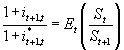
UIP

UIP

The monetary authority has three instruments in the rallod currency world: the interest rate on dollar securities (the central bank’s official policy rate), the spot exchange rate of the dollar and the rallod and the forward rate. Given these three, the interest rate on rallod securities follows (subject of course, to the non-negativity constraint on rallod interest rates.

The zero lower bound on dollar interest rates has been removed. It has been replaced by a zero lower bound on rallod interest rates, but these don’t matter, as it is the dollar general price level that matters, and the dollar is the numéraire/unit of account.

Those who want to work through these things will note that, if there is UIP, real interest rates (inflation corrected interest rates) will be the same on nominal dollar bonds as on nominal rallod bonds. This is because the law of one price implies that the dollar price level, P, say, is related to the rallod price level, P*, say, by the law of one price, that is

PS = P*

Even though dollar and rallod real interest rates are the same, the creation of the rallod and the unbundling of the medium of exchange/means of payment and the numéraire/unit of account makes a real difference to the behaviour of the economy and the effectiveness of monetary policy, whenever there is any probability that the zero lower bound would become binding in the dollar currency economy. In that case, in the rallod currency economy, dollar real interest rates and rallod real interest rates will be equal to each other, but they are different from what they would have been in the dollar economy.

What can go wrong? The only thing that can go wrong is that the dollar would cease to be the numéraire for key private contracts (especially wage and price contracts) when the dollar is replaced by the rallod as the currency. If that were to happen, if the numéraire ‘followed the currency’, the price level that matters is the rallod price level, not the dollar price level. We would be back in the dollar currency economy, simply having renamed the dollar the rallod. This would be a currency reform of the kind that replaced 100 old French francs with 1 new French franc.

The numéraire is not chosen by the monetary authority or by the government. It is the outcome of an uncoordinated social decision process. Sometimes multiple numéraire have coexisted. But while the authorities cannot legislate the numéraire, they can strongly encourage the use of a specific numéraire. In the rallod currency economy, the government can insist that all contracts in and with the public sector be denominated in dollars. They can require tax returns to be made using the dollar as numéraire, and they can insist that taxes be paid with dollar deposits or other dollar-denominated (non-currency) means of payment. They can discourage or ban the creation of checkable accounts denominated in rallods, etc. etc.

So I have little doubt that the rallod currency economy could be nudged towards retaining the dollar as the numéraire in systemically important contracts and transactions. So the zero lower bound that matters would have been removed.

After this good news, the better news. It isn’t even necessary to abolish the dollar currency and replace if by the rallod currency. You can keep the dollar currency. All that is required is that the authorities no longer maintain a fixed exchange rate (equal to 1) between bank reserves with the central bank and currency. Instead they let the exchange rate between dollar reserves with the central bank and dollar currency, St, be market-determined. The authorities of course can no longer supply dollar currency on demand (or take it back on demand) at a fixed exchange rate (currently 1) with bank reserves with the central bank. Instead they determine the stock of currency dollars exogenously.

So the authorities have two instruments in the floating exchange rate case: the dollar interest rate and the quantity of dollar (or rallod) currency it issues. The remaining degree of freedom has to be provided by a terminal condition for the exchange rate in the long run. Speculative bubbles could arise in this market, if the exchange rate is left to float.

With a floating exchange rate between the reserve dollar and the currency dollar, UIP will not in general hold. Instead we have an equilibrium relationship, shown below, that says, effectively, that the interest-rate differential between the reserve dollar and the currency dollar equals the expected proportional rate of depreciation of the reserve dollar vis-a-vis the currency dollar plus an exchange rate depreciation risk premium, as shown below.

So a reserve dollar would no longer automatically be worth a currency dollar. If that is confusing, call the currency dollar the rallod instead.

I gave a lecture on these issues at the Center for Financial Studies of the Goethe University in Frankfurt, Germany, today. Otmar Issing was in the audience. He listened carefully (he always does) and gave me quite a grilling during dinner afterwards. I don’t think I have convinced him yet of the merits of the case for breaking through the zero lower bound on nominal interest rates, but here’s to hoping! The Powerpoint slides of the presentation can be found here.

Conclusion

Removing the zero lower bound on nominal interest rates would represent a valuable addition to the policy arsenal of the central banks. We know something about how interest rates work. There is no reason to believe there would be any dramatic change in the effectiveness of policy rate cuts if these cuts to the rate level below zero. We know next to nothing about the effectiveness of the alternative policies that central banks are forced to adopt if they don’t just want to sit on their hand once the hit the zero lower bound: quantitative easing and credit easing, relaxing the collateral requirements for central bank lending etc.

All these alternative measures also blur the distinction between the responsibilities of the monetary and the fiscal authorities. It undermines central bank independence, something which, up to a point, I consider valuable.

There are at least three ways to remove the zero lower bound that are feasible: abolish currency, tax currency and ensure that currency is not the numéraire. Taxing currency may be awkward and intrusive, but abolishing currency is not just easy (just do it) but also has considerable advantages as a blow against criminality and terrorism. Unbundling currency and numéraire is something that can be done over the weekend.

I really don’t understand why central banks are not aggressively pursuing options for removing the zero lower bound. It is that they love the seigniorage so much? But they retain seigniorage revenue from currency issuance in the rallod economy. Is it hidebound conservatism and lack of imagination. Quite possibly. But if so, this is a costly mistake. Central banks should act to remove the zero lower bound on nominal interest rates now.


[1] N. Gregory Mankiw (2009) “It May Be Time for the Fed to Go Negative”, in: New York Times April 18

[2] Goodfriend, Marvin (2000), “Overcoming the Zero Bound on Interest Rate Policy“, in: Journal of Money, Credit, and Banking, Vol. 32(4)/2000, S. 1007 - 1035.

Buiter, Willem H. and Nikolaos Panigirtzoglou (2001), “Liquidity Traps: How to Avoid Them and How to Escape Them”, with Nikolaos Panigirtzoglou, in Reflections on Economics and Econometrics, Essays in Honour of Martin Fase, edited by Wim F.V. Vanthoor and Joke Mooij, , pp. 13-58, De Nederlandsche Bank NV, Amsterdam.

Buiter, Willem H. and Nikolaos Panigirtzoglou (2003), “Overcoming the Zero Bound on Nominal Interest Rates with Negative Interest on Currency: Gesell’s Solution”, Economic Journal, Volume 113, Issue 490, October 2003, pp. 723-746.

[3] Buiter, Willem H. (2004) ,”Overcoming the Zero Bound: Gesell vs. Eisler; Discussion of Mitsuhiro Fukao’s “The Effects of ‘Gesell’ (Currency) Taxes in Promoting Japan’s Economic Recovery” . Discussion presented at the Conference on Macro/Financial Issues and International Economic Relations: Policy Options for Japan and the United States, October 22-23, 2004, Ann Arbor, MI, USA. International Economics and Economic Policy, Volume 2, Numbers 2-3, November 2005, pp. 189-200. Publisher: Springer-Verlag GmbH; ISSN: 1612-4804 (Paper) 1612-4812 (Online).

Buiter, Willem H. (2007), “Is Numérairology the Future of Monetary Economics? Unbundling numéraire and medium of exchange through a virtual currency with a shadow exchange rate”, Open Economies Review, Publisher Springer Netherlands; ISSN 0923-7992 (Print); 1573-708X (Online). Electronic publication date: Thursday, May 03, 2007. See “Springer Website”.

Davies, Stephen [2004], “Comment on Buiter and Panigirtzoglou”, mimeo, Research Institute for Economics and Business Administration, Kobe University, May.

Eisler, Robert (1932), Stable Money: the remedy for the economic world crisis: a programme of financial reconstruction for the international conference 1933; with a preface by Vincent C. Vickers. London: The Search Publishing Co."

Me:

"(2) Tax currency and ‘stamp’ it to show it is ‘current on interest due’."

I'm for Stamping. It was also defended and commented upon in the FT here:

http://blogs.ft.com/economistsforum/2008/11/the-case-for-negative-interest-rates-now/#more-259

The case for negative interest rates now
November 20, 2008 12:35pm
by FT

By Brendan Brown

A conundrum has long been known to monetary economists, but only comes into the open during the once in a quarter-of-a-century type of recession apparently plaguing the global economy.

The quandary is how, in a conventional monetary economy, to bring interest rates down to the negative levels essential to speedy recovery during periods when there is a sharp decline in spending propensities.

If interest rates fall below zero, the public would simply seek to transfer their savings into hoards of banknotes.

The interest rate under discussion is the risk-free nominal rate as quoted on short-maturity government bonds, most obviously US T-bills or short-dated German government bonds.

Over the course of decades, particularly during the Japanese “lost decade” of asset deflation, suggestions have emerged as to how to solve the conundrum.

These include the periodic stamping (for a small fee) of banknotes (without the stamp they would not be valid). The idea is that by imposing a running tax on banknote hoarding, nominal risk-free rates could fall to negative levels.

In the age of the information technology revolution, surely the authorities could devise a simple and practical method of effective taxation of banknote hoards?...... "

Excellent comment by Martin Wolf:

" Martin Wolf: This is ingenious and would, no doubt, permit negative real interest rates. But I would prefer it if vigorous action were taken by the monetary authorities to sustain inflation, before deflation set it, in which case we would never need negative nominal interest rates in order to obtain negative real rates.

If it is already too late for this, I agree that this scheme would make it possible for the authorities to impose negative real short rates. Another justification for negative real rates is that it would reduce the danger of debt deflation - the rising real level of debt as the price level falls. It would be wildly unpopular, of course, among politically powerful savers. It would have to be pointed out that this loss is offset by the rising real value of nominal claims.

But would it work in the way Brendan suggests? I am not sure. Equity markets might rise a little. But I very much doubt whether companies would start to issue equity in order to invest in a substantial way, in the midst of a deep recession. The underlying logic is Hayekian. I have never been convinced of this theory of the credit cycle.

So is there an alternative? Yes. The central bank can lend directly to the government, which can spend on investment and public consumption or make transfers to consumers to spend. If real interest rates were negative, this would be even cheaper for the government. That would certainly add to the effectiveness of such a policy, in any case.
Posted by: Martin Wolf"

Both Nick Rowe and Scott Sumner have good points against Stamping, but I find it simple and effective. I'm less concerned on the method used, than on the use of the concept. Brad De Long has also commented on it recently:

http://delong.typepad.com/sdj/2009/04/silvio-gesell-and-stamped-money-another-thing-fisher-and-wicksell-knew-that-modern-economists-have-forgotten.html

But Silvio Gesell is the topic of part VI of chapter 23 of Keynes's flagship work, The General Theory of Employment, Interest and Money. And it's not just Keynes in his flagship work. There are 55,000 google hits for "Silvio Gesell." Patinkin (1993) reports that Irving Fisher advocated Gesell-based "velocity control" in his 1932 Booms and Depressions. Nobel prize-winning Maurice Allais was an advocate as well. Gerardo della Paolera and Alan Taylor are Gesell's biggest boosters today in their book Straining at the Anchor: The Argentine Currency Board and the Search for Macroeconomic Stability, 1880-1935, a University of Chicago Press book that is part of the NBER's series on "long term factors in economic development." Willem H. Buiter and Nikolaos Panigirtzoglou writing in the Economic Journal in 2003: "Overcoming the Zero Bound on Nominal Interest Rates with Negative Interest on Currency: Gesell's Solution."

This is, I think, yet another example of how much economics has lost by cutting itself off from its moral philosophical and historical roots. Something that Keynes and Fisher and the other founders of monetary economics seriously wrestled with is today seen as something unknown and new to be thought of by clever graduate students. Once again the answer to Olivier Blanchard's question "What Do We Know that Fisher and Wicksell Did Not?" is that Olivier is asking the wrong question: what did they know that we have forgotten?

Here is John Maynard Keynes writing in 1936, summarizing Silvio Gesell writing in 1916:

J.M. Keynes, General Theory of Employment, Interest and Money, chapter 23: It is convenient to mention at this point the strange, unduly neglected prophet Silvio Gesell (1862-1930), whose work contains flashes of deep insight.... [T]he English version (translated by Mr Philip Pye) being called "The Natural Economic Order". In April 1919 Gesell joined the short-lived Soviet cabinet of Bavaria as their Minister of Finance, being subsequently tried by court-martial.... Professor Irving Fisher, alone amongst academic economists, has recognised its significance. In spite of the prophetic trappings with which his devotees have decorated him, Gesell's main book is written in cool, scientific language; though it is suffused throughout by a more passionate, a more emotional devotion to social justice than some think decent in a scientist.... I believe that the future will learn more from the spirit of Gesell than from that of Marx.... Gesell's specific contribution to the theory of money and interest is... that the peculiarity of money, from which flows the significance of the money rate of interest, lies in the fact that its ownership as a means of storing wealth involves the holder in negligible carrying charges.... [H]e had carried his theory far enough to lead him to a practical recommendation, which may carry with it the essence of what is needed... the prime necessity is to reduce the money-rate of interest, and this, he pointed out, can be effected by causing money to incur carrying-costs just like other stocks of barren goods. This led him to the famous prescription of 'stamped' money, with which his name is chiefly associated and which has received the blessing of Professor Irving Fisher.... [C]urrency...would only retain their value by being stamped each month, like an insurance card, with stamps purchased at a post office. The cost of the stamps... should be roughly equal to the excess of the money-rate of interest (apart from the stamps) over the marginal efficiency of capital corresponding to a rate of new investment compatible with full employment. The actual charge suggested by Gesell was 1 per mil. per week, equivalent to 5.2 per cent per annum.... The idea behind stamped money is sound..."

It would be wonderful if this idea was seriously considered.

"Taxing currency may be awkward and intrusive"

This is easily the most effective proposal, since it fits into our system of government. Posted by: Don the libertarian Democrat

And:

The point of stamping, in my view, is to give a disincentive to buying bonds in a Debt-Deflationary situation. In other words, when investors are driving down yields in a panic in the flight to safety and liquidity, you tempt them to put their money into other assets, like stocks or corporate bonds or helping a friend start a business.

It makes sense to me to invest in stocks when the market is low and you are getting nothing in return for buying bonds. Then, when bond yields go up, you buy bonds. That's why some inflation in the future is a good sign.

QE can work as well, and so read this:

http://ftalphaville.ft.com/blog/2009/05/07/55605/the-qe-stockmarket-effect/?source=rss

"But, as Lewis also points out, QE may be having another, perhaps less expected, but nonetheless still very welcome effect - on equities. As he explains (our emphasis):
Possibly, the chief impact of QE will come through the equity market. If ‘other financial institutions’ see their bank deposits increasing, they may be inclined to commit some of these funds to equity investment. "

In my view, with low yields on short term bonds, and gradually increasing yields on longer term bonds, this result is expected. Posted by: Don the libertarian Democrat