Showing posts with label Lehman Brothers. Show all posts

Thursday, May 21, 2009

Holy Libor, Batman!

TO BE NOTED: From Bloomberg:

"Libor Drops by Most in More Than Two Months as Recession Eases


By Lukanyo Mnyanda

May 21 (Bloomberg) -- The cost of borrowing in dollars between banks dropped the most in more than two months, adding to evidence that policy makers are unfreezing credit markets.

The London interbank offered rate, or Libor, for three- month dollar loans decreased six basis points today, the biggest drop since March 19, to 0.66 percent, the British Bankers’ Association said. The rate has more than halved this year. Libor is used to set borrowing costs on about $360 trillion of financial products globally, according to the BBA.

The decline coincides with growing signs the worst of the financial turmoil has passed. Europe’s manufacturing and service industries shrank at the slowest pace in eight months in May, a report showed today. Nobel Prize-winning economist Paul Krugman said in Ho Chi Minh City, Vietnam, that the global “freefall” may have ended, with the U.S. economy on course to expand “slightly” in the second half.

“The decline in Libor does gel with a lot things going on, as general volatility and risk aversion have been reduced,” said Padhraic Garvey, head of investment-grade debt strategy at ING Groep NV in Amsterdam. “The market has a nose for things getting better in due course.”

The Federal Reserve committed $12.8 trillion to stem the longest recession since the 1930s and central banks around the world cut interest rates to near zero as they sought to ease the flow of credit. Three-month Libor, one of the rates that determines everything from student loans to mortgages, rose to 4.82 percent in October in the wake Lehman Brothers Holdings Inc.’s collapsed a month earlier.

TED, OIS Spreads

The TED spread, the difference between what banks and the U.S. Treasury pay to borrow for three months, narrowed four basis points to 51 basis points today, the least since August 2007, when the credit crisis began. It peaked at 464 basis points on Oct. 10.

The Libor-OIS spread, another gauge of banks’ reluctance to lend that measures the difference in the three-month rate and the overnight indexed swap rate, decreased to 46 basis points, the least since February 2008. It has dropped from as high as 364 basis points in October.

Libor is derived from a survey of banks conducted by the BBA each day in London. Institutions are asked how much it would cost them to borrow from each other for 15 different periods, from overnight to one year, in currencies from dollars to euros and yen. The BBA then calculates averages that exclude the four highest and lowest quotes, before publishing them before noon.

To contact the reporter on this story: Lukanyo Mnyanda in London at lmnyanda@bloomberg.net"

Tuesday, May 19, 2009

To understand the role of the Federal Reserve in the causation of the current depression, we must understand its influence on interest rates

From The Atlantic Business Channel:

May 19 2009, 12:09PM

A Failure of Capitalism (III)--Blame the Fed, the Government in General, and the Economists

To understand the role of the Federal Reserve in the causation of the current depression, we must understand its influence on interest rates, and how interest rates influence economic activity.

The Treasury Department borrows money to finance government activities by issuing bonds, which are bought by banks and other investors, and also by the Federal Reserve. When the Fed wants to stimulate economic activity, it buys Treasury bonds from banks and other investors, paying cash, which increases the balances in bank accounts and by doing so provides more money for lending and spending. (The process is actually somewhat different and more complicated, but I am presenting an intuitive version that will be easier for readers who are not experts to understand.) As the supply of money for loans rises, interest rates fall (the larger the supply of a good, including loans, the lower the price, which in the case of a loan is the interest rate). As interest rates fall, borrowing becomes cheaper, and people borrow more and go deeper into debt, rather than saving. With more borrowing, banks need more money to lend, so they borrow too; as it is cheaper to borrow capital than to raise it by issuing more stock (because interest is deductible from income tax and the compensation that providers of equity capital to firms receive from those firms is not) banks become more indebted too, and hence more risky. And because houses are a product bought mainly with debt (for example, an 80 percent or 90 percent or even 100 percent mortgage), the demand for houses rise. So more houses are built, but in addition, because the overall stock of housing is so durable and is therefore not replaced frequently, the increase in demand pushes up prices. If nothing else besides low interest rates is pushing up housing prices, we have a bubble, in the sense that, as soon as the crutch of low interest rates is withdrawn, prices are likely to fall, as houses become more expensive to buy, the higher interest rates are. It was the collapse of the housing bubble when interest rates rose (mainly in 2005 and 2006) that started the economic collapse, and because banks were so heavily invested in housing through their role in issuing mortgages, they came near to collapse as well, triggering the depression.

The Federal Reserve pushed interest rates way down at the end of 2000 and kept them there until 2005 and during this period of low interest rates (in part of the period, the short-term interest was negative in real terms, because it was lower than the inflation rate). This was the decisive error that put too much risk into the economy, against a background of deregulation that allowed the banking industry to take whatever level of risk was profit maximizing given interest rates. The Fed was fooled by the fact that the usual indices of inflation, such as the Consumer Price Index, did not indicate a high rate of inflation. But the reason was that low-cost imports from China and other East Asian countries kept prices of most goods and services down. Inflationary pressures caused by an overheated economy flooded with lending were deflected into assets such as houses and common stocks.

The Federal Reserve missed all this. As late as October 2005, as the housing bubble was beginning to leak air, Ben Bernanke, the chairman of the President's Council of Economic Advisers--and about to be appointed the chairman of the Federal Reserve--stated publicly that the rapidly rising housing prices were not the product of a bubble. And so the finance industry, reassured, continued making risky mortgage loans and selling risky securities backed by those loans.

There were plenting of warnings of a housing bubble, going back to 2002 and found even in local newspapers. But most economists missed the bubble, and so it was easy to dismiss the few who warned as Cassandras and sourpusses. I do not fault the Federal Reserve for following the conventional wisdom. I do fault it for having failed either to take the warnings seriously enough to evaluate them in depth (the Fed has 250 Ph.D. economists), or to prepare contingency plans in the event that the ascent of housing prices proved to indeed be a bubble and the bubble collapses and brought the banking industry (so heavily invested in housing) down with it. As a result of the Fed's unpreparedness, when the banks began collapsing in September of last year the government was caught by surprise, improvised spasmodically, failed critically to prevent the bankruptcy of Lehman Brothers, and by its pratfalls deepened the downturn.

I read recently the statement by one business economist that if there is any hero in this mess we find ourselves in, it is Ben Bernanke. As far as I can judge, he has since last October managed the response to the crisis competently--perhaps more competently than his predecessor Greenspan would have done, or other possible replacements for Bernanke. But he is like a general who having been defeated in battle because of his errors manages the retreat of his army competently. He does not thereby escape blame for the defeat, and should not be permitted to shift blame to the soldiers under his command who gave way under attack."

Me:

Don the libertarian Democrat

"As interest rates fall, borrowing becomes cheaper, and people borrow more and go deeper into debt, rather than saving."

Are people's wages rising as well? If you think that something is cheap, why rush out and buy it unless you think that it will be more expensive later? If you think that x is cheap because of low interests rates, you must assume that they will eventually go higher. Otherwise, they're not cheap. So, two simple points:

1) How are incomes faring as compared to housing prices or even payments?
2) If rates are low, then they must at some point be high.

In other words, borrowing becoming cheaper takes place in a context. Nothing in that context necessitates lowering capital requirements, lending standards, etc. If a product keeps getting more expensive, wouldn't you expect people to be buying less of it?

Lower interest rates are an incentive for investment. They take place in a context of competing incentives and disincentives. But an incentive is just that. Raising interest rates on the entire economy seems a rather blunt instrument to stop a housing bubble. The bubble part came from housing prices going up in an extraordinary amount as against most other purchases and parts of the economy. Had down payments been 20% or based on a reasonable percentage of income, then this crisis might not have taken place. Why focus on interest rates if there are other possible cures for the disease? For all we know, raising interest rates could have also meant that many potentially valuable businesses might never come into existence.

Perhaps the Fed should have done things differently, but why not focus on the industry itself where the problem existed?

Monday, May 18, 2009

“We’re definitely seeing an improvement on the liquidity front and the risk aversion perception is sharply decreasing,”

TO BE NOTED: From Bloomberg:

"Dollar Libor Drops Most in Two Months as Markets Thaw (Update1)

By Lukanyo Mnyanda

May 18 (Bloomberg) -- The cost of borrowing in dollars between banks fell the most in two months as credit markets thaw amid record low interest rates and rising customer deposits.

The London interbank offered rate, or Libor, for three- month loans slid four basis points to 79 basis points today, the biggest decline since March 19, according to British Bankers’ Association data. It decreased for the past 34 days, including a drop of 11 basis points last week, the most since January.

“We’re definitely seeing an improvement on the liquidity front and the risk aversion perception is sharply decreasing,” said Mickael Benhaim, who manages about $32 billion as head of global bonds at Pictet & Cie Banquiers in Geneva. “Non conventional measures from the central banks are working pretty well. Things are normalizing gradually.”

The availability of credit has improved as the Federal Reserve committed $12.8 trillion to stem the longest recession since the 1930s and central banks around the world cut interest rates to near zero. Libor, used to set borrowing costs on about $360 trillion of financial products globally, according to the BBA, has declined from as high as 4.82 percent in October, after the collapse of Lehman Brothers Holdings Inc.

Customer Deposits

The drop in Libor is being fueled by surging customer deposits as much as increased confidence among banks, Jim Vogel, an analyst at FTN Financial said last week. Deposits at U.S. banks jumped by almost $400 billion in the past six months, contributing to reduced demand for loans in the interbank market, Vogel wrote in a note to clients May 11.

The TED spread, the difference between what banks and the U.S. Treasury pay to borrow for three months, narrowed one basis point to 66 basis points, the lowest level since August 2007, when the credit crisis began. The Libor-OIS spread, another gauge of banks’ reluctance to lend, narrowed five basis points to 58 basis points, the least since March 24, 2008.

Libor has dropped more than two basis points for the past four days. The last time it fell so much was in the four days through Jan. 13.

“The rate of decline has increased the last few days and it seems there’s more money around,” said Peter Chatwell, a fixed-income strategist in London at Calyon, the investment- banking unit of Credit Agricole SA. “Things are progressing nicely. It’s looking positive.”

Still Wary

Some measures show financial institutions are still wary of lending after banks racked up more than $1.4 trillion of writedowns and losses since the start of 2007.

The difference between the Fed’s target rate for overnight bank loans between banks and three-month Libor was 54 basis points today, compared with an average of 22 basis points in the five years before credit markets froze.

“People have become a bit more relaxed now because we haven’t had any bad news recently,” said Jan Misch, a money- market trader in Stuttgart at Landesbank Baden-Wuerttemberg, Germany’s biggest state-owned bank. “On the other hand, I doubt the turnover has increased at the same pace. We’ve now reached a level where I wouldn’t expect further declines.”

Libor is derived from a survey of banks conducted by the BBA each day in London. Institutions are asked how much it would cost them to borrow from each other for 15 different periods, from overnight to one year, in currencies from dollars to euros and yen. The BBA then calculates averages, throwing out the four highest and lowest quotes, before publishing them before noon.

Royal Bank of Canada quoted the highest rate today for three-month dollar loans, at 0.90 percent, while Deutsche Bank AG contributed the lowest, at 0.70 percent, a difference of 20 basis points, down from 21 basis points on May 15. Royal Bank of Scotland Group Plc’s quote fell seven basis points from last week to 0.83 percent, the biggest decline in the survey.

To contact the reporter on this story: Lukanyo Mnyanda in London at lmnyanda@bloomberg.net"

Wednesday, May 13, 2009

Averting the potential for a run in the midst of a bankruptcy, which would surely bring chaos, is the point of the reorganization

TO BE NOTED: From Financial Crisis and Recession:

"Financial policy: Looking forward

Washington is turning its attention to the future, having put out most of the financial fires. The crisis seems to be over, but questions remain about how to manage under-capitalized banks and, especially, how to design a financial system for the future that is more robust to adverse shocks. With fiscal stimulus in place and no likelihood of more, financial policy by the Fed and the Treasury is the only active possibility for further action to offset the recession.

The current state of the economy

The stock market thinks that the economy is turning around, and the financial press greeted last Friday’s payroll report with a positive spin, for once. But the news is not good. Here’s payroll employment, compared to the severe recession of 1981-82:
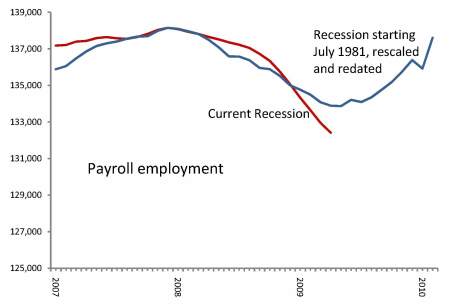
payroll

The good news is only the almost invisible inflection in the downward path of jobs.

Apart from the successful effort to prevent the collapse of the financial system, the primary financial action to offset the recession has been the Fed’s adoption of an interest-rate target for interbank lending of essentially zero. Rates on short-term safe assets–Treasury obligations and private instruments enjoying explicit or implicit government guarantees–are close to zero. But, sadly, rates actually paid by most private decision makers are almost as high, or in some cases higher, than before the recession began. The Fed and Treasury’s policies to lower these rates have delivered fairly little so far. Here is the record:
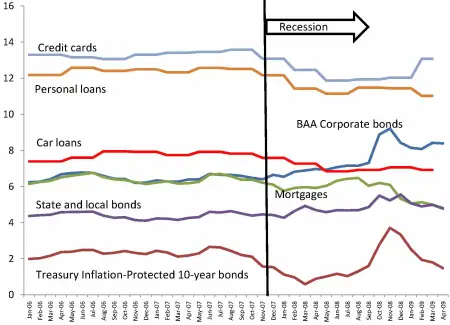
interestRates paid by individuals–credit cards, pesonal loans, car loans, and mortgages–have fallen slightly, but by less than the decline in inflation, so the real rates are up a bit. Rates paid by corporations, measured here as BAA bond rates, have risen substantially in nominal terms and even more in real terms. Rates paid by state and local governments have also risen in slightly in nominal terms and more in real terms.

The notion that monetary policy has been highly expansionary–promoted by those looking only at safe government (Treasury) interest rates and at the volume of bank reserves–is plainly incorrect. Rather, higher interest rates are discouraging spending and production.

Monetary expansion

The Fed is attacking high interest rates by purchasing private debt. Higher demand for any class of debt will drive down the interest rate for that class. One of the important lessons of the past year has been that various interest rates do not all move together in times of severe financial stress (or at other times either). Thus, the Fed has not run out of options after it drives the Fed funds rate to zero. Unfortunately, the Fed is not able to expand its holdings of private securities efficiently. The efficient borrower is the Treasury, which floats short-term debt at very low rates in the world credit market. The buyers placing the highest value of Treasury debt outbid the others, so the debt finds its most desirable home. By contrast, the Fed borrows only from American banks. The Fed currently pays twice as high an interest rate on its borrowings as does the Treasury for its shortest-term borrowings (25 basis points for the Fed; 14 for the Treasury). The Fed displaces other asset holdings in American bank portfolios, whereas the Treasury places its debt in many portfolios around the world. Earlier in the crisis, the Treasury did borrow and place the funds at the Fed’s disposal, providing the efficient approach to Fed expansion, but the Treasury has withdrawn most of those funds. It’s time for the Treasury to resume its past practice on a much larger scale and for the Fed to cut reserves back to more normal levels. The political obstacle to this move is the ceiling on the national debt, which fails to count reserves as part of the debt, so the government can circumvent the ceiling by creating reserves instead of issuing Treasury securities, at a somewhat higher cost.

Current policy for weak financial institutions

Economists are increasingly puzzled by the government’s treatment of banks and other financial institutions that are teetering near insolvency. The doctrine is widely accepted that institutions in this state are a danger to the economy (because their incentive is to take some big risks to try to get out of the hole, as the S&Ls did in the 1980s) and that regulators should take prompt, aggressive action to return them to sound financial condition. This doctrine calls for institutions to be reorganized or recapitalized so that they are unambiguously solvent and the consequences of risk-taking are mainly their own. The government’s actions for Chrysler and General Motors follow the doctrine. In Chrysler’s case, bankruptcy converts the claims of debtholders into equity, making its new relationship with Fiat financially attractive to Fiat. General Motors may be able to continue as a stand-alone automaker if the claims of its debtholders, including the debt-like claims of retirees, become equity.

By contrast, the government’s current policy for all large financial institutions is to dribble taxpayers’ funds into the institutions so that they can meet their stated obligations to all parties, including debtholders, but just barely. The government injects funds into AIG, Citigroup, the Bank of America, and many other institutions to keep them just above water. The government has forgotten the doctrine of immediate full recapitalization in the case of financial institutions, despite the clear lessons of international experience. The Scandinavian countries aggressively reorganized and recapitalized banks after the crisis of the early 1990s and quickly restored full employment and growth; the Japanese followed the policy of supporting marginal banks for what became the “lost decade.”

The celebrated stress tests, just completed, illustrate the current policy perfectly. The test asks if it is likely that a bank can sustain its current status through the end of 2010. “Sustain” means earn enough from operations and asset returns to cover losses that would occur under a pessimistic macro forecast. The Fed’s white paper describing the tests contains the following remarkable sentence: “While this approach [the stress test] likely captures the bulk of the losses that might be realized on these assets, it is important to note that it does not include the substantial losses that have already been taken.” (page 3) The stress test takes the current condition of the bank as the goal for the future. If the bank can just squeak through the next 20 months with enough profit from operations and margins of investment earnings over the cost of funds to offset increases in reserves for loan losses, then it passes the test. If the bank would have inadequate capital at the end of 2010 under the scenario, it flunks the test and needs more capital. Many large banks including Citigroup and the Bank of America flunked. They need to raise capital to be barely solvent at the end of next year. The test has nothing to do with ensuring that banks are heavily capitalized, ready to resume their normal roles in the economy. The stress test is the right way to figure out the minimum amount needed to inject in weak banks to keep them barely afloat, but that is the wrong policy. The government turned to stress tests, it appears, out of discomfort with the answers the standard capital tests gave, based on seeing that properly measured capital was adequate in relation to obligations.

Unfavorable developments since the design of the stress test raise questions about its interpretation as the most pessimistic reasonable forecast. In the “more adverse” forecast that claimed that character, the unemployment rate is 8.9 percent for 2009 and 10.3 percent for 2010. The rate as of April 2009 was already 8.9 percent and almost certain to rise more during the coming months. The “more adverse” projection of 3.3 percent decline in real GDP in 2009 over 2008 is close to the current consensus. The figure for 2010 of 0.5 is below the consensus.

The market for bank debt tells an interesting story about the current policy (data are available to the public from FINRA’s TRACE database). Citigroup’s debt maturing in the next few years sells at par. The market believes the government’s pronouncement that it will keep Citigroup solvent in the near term. For longer maturities, the debt is deeply discounted. A large issue maturing in 2032, with a coupon rate of 6.625 percent, sold on May 8 for $65 per $100 of par value, to yield 10.8 percent. The market assigns a significant probability to default after the crisis clears up.

The effect of the government’s current policy is to pay off all claimants on financial institutions at face value, including those which, when they were first issued, had no expectation of federal bailout and received substantial interest premiums on account of their willingness to accept the risk of default. This policy is hugely expensive and stands in stark contrast to the losses that the government has expected investors in the debt of automakers to recognize. The Treasury has proposed legislation to empower the government to reorganize financial institutions but has not indicated that the new powers would focus on reorganizations that would recapitalize financial institutions without handing debtholders huge capital gains. The continuation of current policy would automatically give those capital gains. Holders of the Citigroup debt mentioned above would enjoy a large capital gain (from $65 to somewhere near $100) if investors came to believe that the government would keep dribbling funds into Citigroup to enable it to meet all its future obligations, including paying the interest and principal on that debt issue.

Because Congress, acting on behalf of the taxpayers, seems reluctant to vote new bailout funds for most financial institutions and is firmly opposed in the case of AIG, the government needs a better alternative for stabilizing weak institutions. There are much better uses for federal money than handing capital gains to debtholders.

We can easily describe the desirable policy in terms of goals, though implementation is more of a challenge. A primary goal is to avoid interference with the high-speed transactions of modern financial institutions. As the unwinding of Lehman Brothers shows, traditional bankruptcy can be a disorderly method for reorganizing modern financial institutions. The reorganization needs to start with a clear statement that the institution will meet its short-run obligations in full. In other words, some minimal amount of capital gains to claimants is involved in a practical reorganization. If an institution has substantial amounts of debt outstanding that is subordinated to all other claims, reorganization is fairly simple. The danger to the institution is that the subordinated claimants will put the institution into barnkruptcy at some future time when the institution fails to make required payments to those debtholders and that the bankruptcy will plunge the entire organization into Lehman-like chaos. To sidestep this danger, the reorganization alters the claims of the subordinated debtholders so that they cannot trigger a bankruptcy or so that the bankruptcy that they can trigger does not interfere with the activities of the institution.

The first approach is easy. It is the one that the government pushed on the debtholders of the automakers–convert debt to equity. With new powers granted by Congress, the government could figure out a conversion value for a large amount of debt that gave the debtholders the same market value as equity as they currently enjoy. The debtholders would suffer no capital gain or loss. As the experience with automakers’ debt showed, it is virtually impossible to achieve such an exchange voluntarily, because both sides will play “chicken” until adult supervision intervenes. The compulsion of new law is necessary. Finding the conversion value is easier said than done, but is at least a well-posed question.

If a borderline institution lacks enough fully-subordinated debt to achieve an adequate level of capital by converting debt to equity, longer-term debt could be treated as if it were fully subordinated. Again, the debtholders could be given equity equal in value to the market value of the debt they gave up. In this case, the claimants subordinate to the converted debtholders would enjoy a captial gain, at the cost of the shareholders. One could imagine some kind of redistribution to deal with this inequity, but it is a complication. In the case of Citi, the claimants subordinated to the debt to be converted are mainly the foreign depositors. Foreign depositors stand to absorb losses before the debt-holders do. Because the foreign deposits can be withdrawn on demand, even a hint of a policy that failed to deliver full value would trigger a run. Averting the potential for a run in the midst of a bankruptcy, which would surely bring chaos, is the point of the reorganization.

Actual exchanges of debt for equity are not needed to recapitalize shaky institutions. Recall that the goal is to prevent bankruptcy from interfering with substantive business, not to prevent bankruptcy entirely. Reorganizing an institution so that the debtholders retain a debt claim is practical. If the institution suffers further losses in value which cause it to default on the debt, a bankruptcy will occur. Our earlier post described how to do this. In brief, the debtholders’ and existing shareholders’ claims are moved to a holding company (if they are not already in a holding company) which owns all of the equity in the operating institution. Some people, including us in our earlier post, called the holding company the “bad bank” and the operating entity the “good bank.” If the earnings of the operating institution are insufficient to meet the obligations to the debtholders at some future time, the holding company does a simple Chapter 7 bankruptcy in which the debtholders become the shareholders in the holding company, with no implications for the operating institution. This type of reoganization involves quite a few alterations in the contracts between the operating institution and its customers and counterparties, so it definitely requires the kinds of new powers that the Treasury has sought recently from Congress.

The bottom line is that Congress and the taxpayers are intolerant of continued expenditures for bailouts that generate large capital gains for debtholders, that the bailout policy maintains shaky financial institutions while a better policy would deliver fully capitalized, reliable ones, and that Congress should enact legislation promptly that would make these reorganizations possible.

Reform for the longer run

Among economists, a consensus is forming that regulation of the financial instutitons that enjoy the government’s protection should compel those institutions to have a structure that eases the type of reorganization discussed above (see the statement of the Squam Lake Working Group, an alliance of leading financial economists). The simplest version is to require that banks hold fully subordinated debt and equity of, say, 40 percent of assets, in a holding company, in such a way that the bankruptcy of the holding company would not interfere even briefly with the immediate operations of the bank. As we discussed above, if the operations of the bank, paid as dividends to the holding company, could not meet the obligations to the debtholders, the holding company would go through a Chapter 7 bankruptcy and the bondholders would take over as shareholders. The Squam Lake proposal would sidestep the bankruptcy by designing the debt to convert to equity on its own terms under adverse conditions.

The idea that banks should have large amounts of fully subordinated debt is hardly new. The only novelty in this line of thought is methods for protecting banks and similar institutions from breakdowns in high-speed financial transactions. And this novelty arises because our financial institutions have new moving parts they did not have even 25 years ago, and because it has been such a long time since our largest banks were so close to insolvent. The regulatory structure has not kept up.

Under a requirement of substantial amounts of subordinated debt, bank deposits would become almost completely safe. Banks would be limited to financing their activities through deposits to the remaining fraction, 60 percent in our example above. For larger banks, this would not be a binding limitation."

Wednesday, May 6, 2009

engaged in a systematic campaign to deceive the investing public

TO BE NOTED: From the NY Times:

"
Money Fund Managers Are Accused of a Fraud

The Securities and Exchange Commission on Tuesday accused the father-and-son team that operated the Reserve Primary Fund of securities fraud, contending they had lied to investors when the fund “broke the buck” last fall and created a near panic in the money market fund industry.

Bruce Bent Sr. and his son, Bruce Bent II, were charged in a civil lawsuit with “falsely assuring” shareholders, the fund’s board and rating agencies that their flagship fund remained safe and liquid at a time when the bankruptcy of Lehman Brothers had made the fund far more precarious than investors realized.

The Bents “engaged in a systematic campaign to deceive the investing public,” the S.E.C. said in the lawsuit, which was filed in Federal District Court in Manhattan. The government also said that the two men had “placed their own financial and reputation interests ahead of the fund and its shareholders.”

The $62 billion Reserve Primary Fund, founded in 1970, was the nation’s first and one of the largest money market funds. The senior Mr. Bent, who helped invent the money fund concept, was described by the S.E.C. as “the public face” and “a longtime advocate of the safety and stability of money market funds.”

Yet, on Sept. 15, the day Lehman filed for bankruptcy, the Reserve Primary Fund held $785 million in Lehman securities. The government contends that the Bents gave false assurances that they would provide “unqualified financial support” to maintain the fund’s per-share value at a dollar and prevent a “calamitous ratings downgrade.”

A day later, the fund reported a value of 97 cents a share, becoming only the second money fund ever to “break the buck.” This action forced the government to set up an ad hoc insurance program to calm panicky shareholders. In addition, virtually all the money funds operated by Mr. Bent’s management company, the Reserve Management Company, froze shareholder withdrawals, prompting 29 lawsuits from investors seeking the return of their money.

“The fund’s managers turned a blind eye to investors and the reality of the situation at hand before the fund broke the buck last September,” said Mary L. Schapiro, chairwoman of the S.E.C.

In a statement, the senior Mr. Bent said that his company would defend itself vigorously and that the Lehman bankruptcy had “created an unforeseeable and out-of-control condition for many parties and the results were serious. Our management worked extremely hard throughout the chaotic and fast-moving events of Sept. 15-16 and we remain confident we acted in the best interests of our shareholders.”

To resolve a logjam created by the various investor lawsuits, the S.E.C. also sought Tuesday to force the distribution of $3.5 billion that the Bents have been holding in reserve because of litigation against the fund, its trustees and its corporate officers.

The S.E.C. is asking that the $3.5 billion be distributed to investors on a pro-rata basis and is seeking to obtain a ruling in federal court within 60 days. The court has the option of either rejecting or accepting the request of the S.E.C., or devising an alternative plan to distribute the money. If a distribution plan were ordered, it would resolve the outstanding litigation against the Bents and the fund.

Harvey J. Wolkoff, a lawyer with the firm of Ropes & Gray who represents Ameriprise Financial, a financial planning firm that has sued the Reserve Primary Fund, said he was “gratified by the S.E.C.’s actions” in seeking the pro-rata distribution.

“The Reserve Management’s actions were so fraudulent that the only fair thing to do would be to distribute what’s left of the fund on an equal, pro-rata basis, so that all shareholders, large and small, would be treated equally, with the large institutional investors gaining no advantage over the small,” Mr. Wolkoff said.

In its complaint, the government outlines a steady — and increasingly risky — shift in the investment strategy by the Bents. Historically, the Reserve Primary Fund invested in conservative assets, which brought high ratings and allowed the Bents to promise safety and liquidity.

But in 2007 and 2008, the fund began to seek higher yields by buying risky commercial paper from Lehman, Merrill Lynch and Washington Mutual, a move that attracted billions from new shareholders. Unlike other money market funds that are affiliated with large public companies or commercial banks that could inject cash if needed, the Reserve Primary Fund was operated by a private family-owned company.

This meant that investors relied solely on the Bent family’s ability to support the value of the fund.

Yet on the day that Lehman filed for bankruptcy — and shareholders withdrew more than $10 billion and requested redemptions for an additional $10 billion — the Bents did not disclose the fund’s deteriorating financial situation or that State Street Bank in Boston had suspended the fund’s overdraft privileges, the regulatory complaint said.

Instead, in a series of meetings with trustees, in public statements and in information given to the ratings agencies, the Bents “actively fostered the impression that the situation was under control,” according to the complaint.

Diana B. Henriques contributed reporting."

Thursday, April 30, 2009

suing their banks because they claim they were not informed that they risked losing all their money should the bank go bust

TO BE NOTED:

04/28/2009 12:30 PM

BURNED BY LEHMAN SECURITIES

German Bank Admits Giving Wrong Advice to Investors

Tens of thousands of German investors who had bought Lehman Brothers certificates lost their savings when the bank went under. Now one savings bank has admitted giving its customers the wrong advice and is offering compensation.

When the US bank Lehman Brothers went bust last September, tens of thousands of private German investors who had bought supposedly safe Lehman securities got burned. Since then, they have held protests and demanded compensation from their banks, claiming they were not warned of the risks.

"My bank is broke -- I am too": German investors protest outside a Citibank branch in Hamburg.
DPA

"My bank is broke -- I am too": German investors protest outside a Citibank branch in Hamburg.

Now a German bank has admitted that it gave customers the wrong advice relating to the purchase of Lehman Brothers certificates. According to a report on the German public television station ARD, the savings bank Frankfurter Sparkasse (Fraspa) said it had discovered that "in a very small number of cases the advice did not meet our quality standards."

In a statement confirming the television report later on Monday, the bank also said it had offered to compensate customers as a gesture of goodwill "in a small number of cases of financial hardship."

Fraspa began to compensate individual clients who had invested in Lehman certificates in March. It concentrated on investors who had been particularly hard hit when their securities lost their value after Lehman Brothers went bankrupt.

However consumer rights advocates have criticized the bank's approach to compensation. "Arbitrary compensation given at the whim (of the bank) is unacceptable," Hartmut Strube from the North Rhine-Westphalia Consumer Rights Center told ARD.

Many investors who were sold the Lehman certificates -- which were specially developed for the German market -- are suing their banks because they claim they were not informed that they risked losing all their money should the bank go bust. Many of the customers were pensioners who thought they were buying rock-solid investments. The banks are accused of deliberately targeting unsophisticated older clients who they dismissively referred to as "AD" customers, which stood for "old and dumb" in German. Unlike normal savings accounts, the securities were generally not covered by Germany's deposit protection scheme, which guarantees investments in the event of banks going bust.

Consumer rights organizations estimate that around 40,000 people in Germany lost money when Lehman went under. Some of the banks have already offered voluntary compensation to their clients. The Hamburger Sparkasse savings bank announced in February that it had already compensated 1,000 of a total of 3,700 investors affected by Lehman's collapse.

Fraspa was one of the German savings bank which sold the most Lehman securities, flogging around 5,000 Lehman certificates to their clients. The German branch of Citibank, which is now owned by France's Crédit Mutuel, and Dresdner Bank were also active in selling the certificates to their retail customers.

dgs -- with wire reports


Wednesday, April 1, 2009

More such arrangements are being planned so importers can avoid paying for Chinese goods with dollars

TO BE NOTED: From Bloomberg:

"China Boosts Yuan Swaps, Store Payments as Dollar Concern Grows

By Bob Chen and Judy Chen

April 2 (Bloomberg) -- China’s leaders, increasingly concerned about the nation’s $740 billion of U.S. Treasuries, are making it easier for trading partners and consumers to do business in yuan.

The People’s Bank of China has agreed to provide 650 billion yuan ($95 billion) to Argentina, Belarus, Hong Kong, Indonesia, Malaysia and South Korea through so-called currency- swaps. More such arrangements are being planned so importers can avoid paying for Chinese goods with dollars, the central bank said. In Hong Kong, which has pegged the currency to its U.S. counterpart since 1983, stores from Park’n Shop supermarkets to jewelers accept yuan.

Chinese officials are using the Group of 20 meeting, which begins today in London, to call for reducing the dollar’s role and the creation of a new global reserve currency. Premier Wen Jiabao has said he’s concerned that a weaker greenback will erode the value of China’s Treasuries as the U.S. tries to spend its way out of the longest recession since the 1930s.

“China has learned from this financial crisis that we must reduce reliance on the dollar and promote the yuan as a regional or international currency,” Zhang Ming, secretary general of the international finance research center at the Chinese Academy of Social Sciences said in a March 31 interview in Beijing. “We need to shield our economy from any more turmoil in the U.S.”

The yuan has risen 21 percent to 6.8343 per dollar since the central bank scrapped a fixed exchange rate in July 2005. China has limited its advance to 2.7 percent in the past year as a stronger currency made the nation’s exports less competitive at a time when the economy is growing at the slowest pace in seven years. Gross domestic product will expand 6.5 percent in 2009, from 9 percent last year, according to the World Bank.

Anxiety Increased

Wen said on March 13 that China, the world’s biggest holder of foreign exchange reserves, wants guarantees for the safety of its U.S. assets. The Fed last month announced a $1.15 trillion plan to buy Treasuries and mortgage-related bonds, boosting supply of the currency.

Anxiety increased in the past year because the dollar’s gains were driven in part by investors fleeing riskier assets after the bankruptcy of Lehman Brothers Holdings Inc. in September froze credit markets. The PBOC said March 31 its swaps were designed to help developing nations running short of dollars “cope with the current crisis.”

The Dollar Index, which the ICE uses to track the greenback against the euro, yen, pound, Canadian dollar, Swiss franc and Swedish krona, rallied 18 percent in the past year. It dropped 2.9 percent last month as the Fed started buying Treasuries.

Super Currency

PBOC Governor Zhou Xiaochuan asked the International Monetary Fund on March 23 to expand the use of so-called Special Drawing Rights, which are valued against a basket of currencies, and move toward a “super-sovereign reserve currency.” G-20 members Russia and Indonesia supported the proposal, which would reduce the volatility of reserves.

China and its Asian allies will adopt a “mild approach” on the plan to avoid driving down the value of U.S. investments, said Lee Chi Hun, deputy director at Korea Centre for International Finance, a Seoul-based government research agency.

“A rapid collapse in the dollar system will cause damage to those who hold the most dollar assets,” said Lee. The proposal is “a strong warning for the U.S. to protect the value of Chinese assets,” he said.

The dollar made up 64 percent of the world’s $6.71 trillion foreign-exchange reserves at the end of last year, down from 64.4 percent in September and 72.7 percent in June 2001, IMF data shows. The yuan can’t be a reserve currency because it isn’t fully convertible.

Dollar Dominance

“It’s very premature to think the U.S. dollar can be replaced,” said Diane Lin, a Sydney-based fund manager at Pengana Capital, which oversees about $1.9 billion. “The Chinese yuan will eventually become a convertible currency internationally. But we are talking about a timeframe of over five years.”

China, the world’s second-largest exporter after Germany, according to the World Trade Organization, is turning to other strategies to reduce its dependence on the U.S. currency.

Bank of China Ltd., the nation’s largest foreign-exchange lender, has started trials for the yuan settlement program in Shanghai and Hong Kong, President Li Lihui said in Beijing last month. While China allowed the currency to be used for trading goods and services in December 1996, it had to be converted before cross-border payments were made.

Controls on buying or selling yuan for investment are also being eased. The government said on Dec. 9 it will triple the amount of domestic securities that overseas funds can buy under the qualified foreign institutional investors program to $30 billion, without giving a timeframe.

Potential for Gains

“The next step will probably be to allow use of yuan in trade with more regions or nations,” said Chan Wing Kee, managing director of Hong Kong-based Yangtzekiang Garment Ltd., which makes GAP and Levi’s clothes. “I’m pretty sure the yuan has more potential to strengthen than the dollar, the euro, the pound and the yen.”

Indonesian companies will be able to buy Chinese goods using yuan for the first time after last month’s 100 billion yuan currency swap, Bank Indonesia Deputy Governor Hartadi Sarwono said yesterday in Jakarta.

“Importers don’t need to use dollars and they can directly pay their import bills with yuan,” Sarwono said. “This will reduce pressure in the dollar market and help stabilize the foreign-exchange rate.”

Hong Kong banks have been able to accept yuan deposits since 2004 and stores have increasingly welcomed payment in China’s currency since 2003, when a relaxation of visa controls led to a surge in the number of mainlanders visiting the city.

“A lot of tourists were bringing nothing but cash for purchases so we had to adapt as retailers,” said Caroline Mak, chairman of the Hong Kong Retail Management Association. “Watch, even jewelry shops, they all take yuan now.”

Monday, March 16, 2009

In any case, Lehman's collapse is not evidence for the No Failure policy.

From Clusterstock:

"
The New Yorker's Economics Dude: Lehman Matters!

lehmanbarclayssign0925ap.jpgJames Surowiecki is the guy the New Yorker pays to explain the economy and the stock market to its readers. He's also running a great blog called "The Balance Sheet" these days. And recently he decided to wade forth into the debate over Lehman Brothers.

Surowiecki takes as his starting point the paper from Stanford economist John Taylor that argues that the credit market crisis last fall was not spurred by Lehman going under so much as uncertainty about the effects of government action. Taylor's central piece of evidence is the movement of 3-Month Libor, which didn't go into panic mode until well after Lehman collapsed. The timing, he argues, is more closely linked to the bailout than Lehman's collapse.

Surowiecki thinks that Taylor's evidence doesn't support this conclusion.

"Taylor’s assumption in his paper is that investors would have known right away how severe the repercussions of Lehman’s bankruptcy would be. But this is simply untrue—for whatever reasons (some suggest fraud, others panic), the hole in Lehman’s balance sheet was much bigger than people initially thought it would be, which meant that the losses its lenders suffered were much bigger than anticipated. (One study suggests that the chaotic nature of Lehman’s bankruptcy alone cost creditors tens of billions of dollars.) As the magnitude of the losses became clearer, so too did banks’ risk aversion, since Lehman’s failure seemed to demonstrate starkly the risks of lending to any other big financial institution."

As regular readers know, we've been making the lonely argument that the government's failure to rescue Lehman was not a disaster. We think Surowiecki's point here actually supports our case. The only problem is that he construes the revelation of "the magnitude of the losses" too narrowly. What caused the panic was that the collapse of Lehman signalled to market participants that the magnitude of losses throughout the financial sector was far greater than had been anticipated.

Importantly, nothing about a rescue of Lehman would have avoided this outcome. Lehman's collapse into a government rescue or bankruptcy would still have set off the alarm signals. The simultaneous collapses of AIG and Merrill Lynch were also occurring, and Citigroup was soon viewed to be in critical condition. In short, it was the desperate situation of the financial sector rather than the failure to rescue Lehman that almost destroyed the financial system.

Surowiecki seems to disagree. He writes that "thinking about what Lehman’s failure tells us about how we should deal with tottering financial institutions today," concluding that we must stop implosions at all costs.

This debate matters because Lehman is constantly invoked by those who want to convince us that Lehman’s failure was a catastrophe and want to encourage us to avoid "No Failure" as our future policy. In other words, they are arguing that the risks of allowing failure are far greater than the damage to markets caused by propping up failed firms. We have our doubts, although we're willing to acknowledge that this could be the correct view. In any case, Lehman's collapse is not evidence for the No Failure policy."

Me:

Don the libertarian Democrat
(URL) said:
"What caused the panic was that the collapse of Lehman signalled to market participants that the magnitude of losses throughout the financial sector was far greater than had been anticipated."

"It seems far more likely that what was occuring prior to the collapse of Lehman fed by a lack of information about the dire financial condition of the financial sector."

From the Sunday before the Lehman bankruptcy:


"The head of bond fund Pimco, Bill Gross, said a Lehman bankruptcy risks an "immediate tsunami" because of the unwinding of derivative and credit swap-related positions worldwide in the dealer, hedge fund and buyside universe."

"If Lehman were to file for bankruptcy, credit spreads for all corporates are expected to widen dramatically, causing large losses to investors, including those without any direct exposure to Lehman."

"Update 4:50 PM: Cash Mundy in an earlier comment highlighted Nouriel Roubini's reading on the consequences of a Lehman unwinding:

It is now clear that we are again — as we were in mid- March at the time of the Bear Stearns collapse — an epsilon away from a generalized run on most of the shadow banking system, especially the other major independent broker dealers (Lehman, Merrill Lynch, Morgan Stanley, Goldman Sachs). If Lehman does not find a buyer over the weekend and the counterparties of Lehman withdraw their credit lines on Monday (as they all will in the absence of a deal) you will have not only a collapse of Lehman but also the beginning of a run on the other independent broker dealers (Merrill Lynch first but also in sequence Goldman Sachs and Morgan Stanley and possibly even those broker dealers that are part of a larger commercial bank, I.e. JP Morgan and Citigroup). Then this run would lead to a massive systemic meltdown of the financial system. That is the reason why the Fed has convened in emergency meetings the heads of all major Wall Street firms on Friday and again today to convince them not to pull the plug on Lehman and maintain their exposure to this distressed broker dealer."


"NEW YORK -- A rare emergency trading session opened Sunday afternoon to allow Wall Street dealers in the $455 trillion derivatives market reduce their exposure to a potential bankruptcy filing by Lehman Brothers.

U.S. regulators and bankers were making last-ditch efforts on Sunday to prevent toxic assets from ailing Lehman Brothers spilling into global markets and rupturing investor faith in the international financial system.

"This is an extremely, and I stress extremely, rare event. It also speaks to the more general notion that, in today's highly disrupted financial markets, the unthinkable is thinkable," said Mohamed El-Erian, the chief executive of Pimco, the world's biggest bond fund, based in Newport Beach, California."

Where, in any of this, do you find a lack of understanding how dire the situation was? As near as I can tell, before the bankruptcy, people were saying that Lehman going bankrupt mattered because of the consequences of Lehman going bankrupt. I can't find anyone saying that if Lehman goes Bankrupt, then we'll know things are bad. They knew how bad things were.

Thursday, March 12, 2009

Back now, though, to the specifics of Lehman’s collapse.

TO BE NOTED: From the FT:

"
Why letting Lehman go did crush the financial markets

For some time now, the folks over at Clusterstock - notably John Carney - have led a challenge to a particularly virulent piece of received wisdom: that the failure of Lehman was necessarily an inflection point that took the severity of the financial crisis to a whole new level.

And with that the implication that the government’s decision to let Lehman fail was, in itself, a failure.

Until now, that kind of debate might have seemed a little academic - a question for historians. But day by day; bailout by bailout, its pertinence to current events and future policy is growing: politicians and regulators are going to find themselves increasingly under pressure to account for the growing number of expensive opportunities they are being occasioned with to Save The World.

Loath as we are to turn again to the “Japanese Scenario” for appropriate lessons, it’s worth bearing in mind that in Japan, it was ultimately the weight of public opinion, as much as it was economic or financial considerations, that came to shape the way the crisis played out. Distaste for spending taxpayers’ money grew extreme: bailouts became taboo. The way Japan’s authorities consequently pussy-footed their way around problems rather than tackling them head on drew the crisis out for nigh on a decade - dare we now even say, two.

_______

Back now, though, to the specifics of Lehman’s collapse.

The broadest and most challenging question, we suppose, is whether in the long run, the whole banking system was set for failure anyway. Or to rephrase it: from a counter factual point of view, would a world in which Lehman was propped up necessarily be a safer one? As the FT’s own John Gapper has argued, it would not. The locus of panic would simply have shifted onto the next institution:

I’m not convinced that, even if Lehman had been rescued, that would have averted the problem since the weight of selling and panic would have moved on to the next financial institution and then the next. So the world would probably have ended up in the same position it is in today, with a broad financial sector bail-out.

Wedded to this is the assumption that bailing out Lehman would have had nothing to do with actually cauterising the root cause of the crisis: the US housing market.

But…

The collapse of Lehman did create panic among the world’s financial institutions, and it did significantly increase “risk” in the system, not just redistribute it. And it seems likely that it did indeed make it more reasonable to expect that other institutions would fail - because it created generalised panic in the funding markets which every bank - irregardless of their pedigree or resilience - was dependent upon.

After Lehman collapsed, Morgan Stanley and Goldman Sachs very nearly did too.

While a Lehman bailout would not, as Gapper, Carney and others have noted, have solved the solvency crisis that faces banks currently, it would have averted the extremely violent - though short - liquidity crisis that the financial world experienced in September and October.

Whether that perfect September storm counts as a hastening of the crisis which in the long run may come to be seen as a good thing, the jury is still out on. We here at FT Alphaville though, think that the damage it wrought - damage which totally caught the US authorities by surprise - should not be underestimated.
_______

First though, a little more on that post-Lehman liquidity crisis itself - and whether, indeed, per Clusterstock’s latest post, it was caused by Lehman at all.

Stanford University’s John Taylor has authored an “event study” that suggests that it was not the inability or unwillingness of regulators to save Lehman over the weekend of September 13-14 2008 that led credit markets to seize up around the globe. “The Financial Crisis and the Policy Responses: An Empirical Analysis of What Went Wrong” demonstrates that the credit markets actually did not actually go into cardiac arrest after Lehman declared bankruptcy. Rather, it was the dithering and incoherent government reaction that brought on the crisis.

In support of that, here, from Taylor’s paper, is this key graph:

link to Libor-OIS crisis graph

It shows the Libor-OIS spread - a key measure of perceived counterparty risk in the market. You can see just how egregious that widening was, in context, by looking at the spread over a longer period. And as Carney notes, it apparently also shows that it was government dithering after the collapse, rather than the collapse itself, that prompted the widening. Writes Taylor:

On Friday of that week the Treasury announced that it was going to propose a large rescue package, though the size and details weren’t there yet. Over the weekend the package was put together and on Tuesday September 23, Federal Reserve Board Chairman Ben Bernanke and Treasury Secretary Henry Paulson testified at the Senate Banking Committee about the TARP, saying that it would be $700 billion in size. They provided a 2-1/2 page draft of legislation with no mention of oversight and few restrictions on the use. They were questioned intensely in this testimony and the reaction was quite negative, judging by the large volume of critical mail received by many members of the United States Congress. As shown in Figure 13 it was following this testimony that one really begins to see the crises deepening, as measured by the relentless upward movement in Libor-OIS spread for the next three weeks. Things steadily deteriorated and the spread went through the roof to 3.5 per cent.

The problem here is that the Libor component of the Libor-OIS spread, is not really a wholly useful indicator of the state of the credit markets. It’s a reality-based fiction based on the aggregated opinions of individual banks as to the cost of unsecured interbank lending. What it is not is an actual demonstration of market movements. It does not necessarily actually reflect the rates banks are lending to each other at.

More to the point, Libor is calculated from an aggregate of individual banks’ guesses as to what rate at which other banks are likely to lend to them. Libor is a proxy metric.

In the wake of a collapse like Lehman, there is thus naturally a margin for significant statistical lag with Libor: no bank would wish to stand out by submitting the highest number, for it would show them to be the most at risk of failing next. At individual banks, those responsible for guestimating the daily Libor figure they will submit to the BBA are indeed very wary of what the previous day’s Libor figure revealed. Libor has path dependency.

While this odd Libor psychology doesn’t wholly explain the lag identified by Taylor and Carney, there is more compelling hard evidence.

If Libor is a proxy, here’s some compelling hard evidence. In a technical sense, interbank lending is typically done so that banks are able to meet their solvency requirements at the close of their books each day. At the Fed, banks lend money to each other by transferring it between their accounts in order that they might meet their close of trade reserve requirement.

What’s telling then, is what happened to banks’ reserves held at the Fed immediately after the Lehman collapse.

US monetary base

The weekly data behind the above graph (monetary base, which is banks’ Fed-held reserves plus coinage) shows that in the five days following the LEH demise, banks more than doubled their cash held in reserve at the Fed - cash way in excess of their reserve requirements.

In other words, clearly the banks anticipated - or were already experiencing - an interbank lending collapse straight after Lehman, even if it wasn’t immediately shown in the Libor figures they reported. (One explanation for the discrepancy is perhaps that because no interbank lending was actually taking place, Libor calculations became even more path dependent than normal- the calculations had nothing else of empirical worth to be based on).

To boot, there are hard statistics on another, arguably even more important, source of short-term wholesale financing for the banks that dried-up straight after Lehman: the commercial paper market.

The most immediate disaster for banks after Lehman’s collapse was the failure of Reserve Primary - a huge money market fund which broke the buck on September 15th after it suffered losses on unsecured commercial paper it had bought from LEH.

What happened in the commercial paper market - or “money market” as it is colloquially often known- really shows the true scale of the Lehman disaster: an electronic run on the banks. In graphical form:

Money market fund assets

The red line shows the collapse - in the two days following Lehman’s bankruptcy - of the market for commercial paper issued by banks. Within a week, $500bn of short-term funding had dried up. Then there is the asset-backed CP market, which fared equally badly. Credit lines banks had supplied to asset-backed conduits became less reliable and so too, therefore, did CP issued by those conduits, in turn making it more likely that such credit lines would be drawn down upon - a vicious cycle worse than that seen for ABCP structures when the crisis first hit them a year earlier.
________

It was thus in context that the decision to allow Lehman to collapse was a failure. A Lehman failure didn’t have to spell disaster- it could, perhaps should, have occurred alongside an announcement of a generalised guarantee on money market funds - as well as a broad commitment from the Fed to extend its liquidity facilities. That such announcements in reality, came a week later was no good.

In the context of what happened with Bear Stearns too, not bailing out Lehman was a mistake. The Bear decision introduced huge moral hazard, as John Carney at Clusterstock earlier noted:

… the bailout of Bear Stearns had in fact introduced massive moral hazard into the markets, allowing investment banking executives and their boards to believe that they wouldn’t be allowed to fail.

Lehman’s failure though realised that hazard. This Bank of America graph is particularly revealing:

cp

In the world before Bear, CP investors had their wits about them. The CP they bought from the ailing bank decreased sharply as concerns about its health grew. In the world after Bear, the opposite was the case. Investors were more than happy to buy Lehman CP: lulled into a false sense of security by a sort of faintly implicit guarantee from the US government against too-big-to-fail banks.

______

Arguing counterfactuals is always problematic. In a world in which Lehman had survived, would a TARP ever have made it through Congress? After a Lehman bailout, would AIG have ended up a victim: a bailout too far? (If so, the consequences would have been far worse.)

There is - in spite of all the above - a lot to be said for the fact that a bailout of Lehman would have led to much more protracted, if less severe, financial malaise.

Importantly, nothing would have changed if Lehman had been rescued.

From Clusterstock:

"
Why Rescuing Lehman Would Not Have Helped

lehmanbros.jpgWe've noted before the remarkable resilency of the prevailing orthdoxy on the collapse of Lehman Brothers. Many market watchers are absolutely unshakable in their belief that the government's failure to arrange a rescue of Lehman precipiated an financial calamity. So time and again, we've found ourselves in the lonely role of attempting to exorcise this idea from our bewitched friends.

Sam Jones at the Finacial Times' Alphaville is the latest to mount a defense of orthodox view. His best piece of evidence is a graph showing that banks more than doubled the cash they held in reserve at the Federal Reserve. In ordinary times, banks are loathe to hold much cash beyond regulatory requirements because they earn so little (often nothing) on that money. They'd rather put it to work. So the cash hoarding Jones shows does indicate that the bans were racked with fear after Lehman collapsed.

So we have no argument when Jones says that the banks anticipated - or were already experiencing - an interbank lending collapse after Lehman went down.The question, however, is not whether Lehman's collapse put the fear of God into the markets. It whether is the government's failure to rescue Lehman caused the panic.

We have a different interpretation of events. It seems far more likely that what was occuring prior to the collapse of Lehman fed by a lack of information about the dire financial condition of the financial sector. Many banking executives and investors had convinced themselves the Bear Stearns had been brought down by a liquidity shortage and a "bear hunt" by short sellers. They were complacent about the huge balance sheet holes in the financial institutions.

The collapse of Lehman was like a beacon of truth about the financial sector. The long dishonesty or delusion collapsed, and brought down banks' confidence in each other with it. AIG and Merrill Lynch were also revealed, at the same time, to be financial cripples. Citigroup became suspect, in part because regulators had apparently concluded it couldn't possibly bailout Lehman or Merrill.

Importantly, nothing would have changed if Lehman had been rescued. The bailout of Lehman Brothers would not have concealed the deep disfunction that head spread throughout the banking system. It would simply have encouraged the disfunction in the way Bear Stearns had. Banks would still have been distrustful, panicked even. They would have demanded that the implicit guarantee of the financial sector become explicit, which is what wound up happening anyway.

That is to say, it was the colllapse of Lehman that set off the problems in the sector. But it was not the failure to mount a rescue. Lehman's collapse was a signal that would have sounded just as loudly even if it had been bailed out by the government. Credit markets froze because banks realized the banking system was sick almost to death. Rescuing Lehman would have done little, probably nothing at all, to alleviate this."

Me:

Don the libertarian Democrat (URL) said:
The reason that Lehman going bankrupt caused the panic was because the government was expected to not let that happen. That's why the government immediately stepped in on AIG and Merrill and Money Market Accounts. The alternative would be that letting Lehman fall would have rallied the markets, or moved them on to Plan B sans government aid. There was no such plan.

Actually, on the Sunday before Lehman, many investors said that if Lehman fell Merrill might follow. I've heard no evidence that they said that it didn't matter.

As for Taylor's argument, there are 3 alternatives:
1) Government intervenes
2) Government dithers
3) Government declines to intervene

If 3 was what the investors and markets were looking for, then 2 should have been better than 1. After all, no action is better than some action under that view. Only the lack of 1 could have caused a problem while the government dithered.

There are all sorts of quotes by actual actors in this drama, including China, that have said that they understood that the US government had implicitly guaranteed these assets, and did not expect the US government to let Lehman go bankrupt.

As for it wouldn't have mattered, it made all the difference because it set off a Calling Run. For anyone who sees this through Fisher's eyes, this is the onset of Debt-Deflation. The alternative is not a scenario of zero losses, but one in which there is a more orderly unwinding of losses sans panic. The two events are not the same. The onset of Debt-Deflation has made this crisis much worse.

I'll reiterate one point again: many investors knew that the situation was dire and that Lehman was a disaster. Otherwise, nothing would have happened immediately, but it did. Your scenario is that everything was changed by the depth of Lehman's problems. Everybody but you knew about that on Sunday, otherwise the special trading session and deal with the B of A or Barclays might have worked.

Banks did not freeze because they were in trouble: they knew that. They froze because they thought that they might be on their own. That's obvious by the fact that they immediately requested government intervention. By your scenario, their stock price should have immediately fallen to zero, which would have happened w/o government intervention.

Wednesday, March 11, 2009

I still think that senior unsecured debt of most major banks is probably safe

From Felix Salmon:

"
Bank Funding Datapoint of the Day

Bloomberg reports:

Contracts on the Markit iTraxx Financial index of credit-default swaps linked to the senior debt of 25 banks and insurers were more expensive today than the Markit iTraxx Europe corporate index. That hasn't happened since Lehman Brothers Holdings Inc. went bankrupt in September and, before that, JPMorgan's takeover of Bear Stearns, according to BNP Paribas. It reflects "systemic stress" in the financial system.

So much for rallying confidence in the banking system. This is senior debt we're talking about here, not subordinated debt (which often doubles as regulatory equity). Another word for senior debt is "wholesale funding": if a bank doesn't have a large deposit base, then it makes its money on the spread between its senior debt and the rate at which companies and other clients borrow from it. If that spread is now negative, then it's hard to see how the banking system as a whole can be nearly as profitable as the likes of John Hempton seem to think. (Yes, I know I'm conflating CDS spreads with actual funding costs. I suspect that the actual funding spreads are if anything wider than the CDS spreads.)

Indeed, far from seeing profits, the markets seem to be forecasting outright defaults, certainly on the subordinated debt, and possibly on the senior unsecured as well:

"The current prices imply that the companies' equity is worthless, the government's investment is worthless and subordinated debt holders will lose some of their investment," said David Darst, an analyst at FTN Equity Capital Markets in Nashville, Tennessee.

What's more, if bank-debt spreads stay at their present level for any length of time, they're likely to become increasingly self-fulfilling. Right now, these prices represent significant unrealized losses for people who bought at par. But increasingly they're going to start representing significant potential gains for people who are buying at today's levels and hoping to be paid off at par -- paid off, that is, essentially by taxpayers. Since those people can be broadly characterized as hedge-fund managers, one can foresee a lot of Congressional pushback if a large number of hedgies start pulling in tens of millions of dollars just by playing the moral hazard trade. Or, to put it another way, it's a lot easier to impose a haircut when a haircut is priced in than when it isn't.

I still think that senior unsecured debt of most major banks is probably safe, although the WaMu precedent does give me pause. But anything which can be considered equity is increasingly looking like fair game."

Me:

"But anything which can be considered equity is increasingly looking like fair game."

Fair game? More like game over. I'm ready to throw in the towel. William Gross has won this round. Some of these bondholders are going down with the system. They're taking us with them if they can. Some of them are countries, after all. Let's just guarantee these bondholders and regroup, if we've got the brass. They were toying with us. They hold all the cards right now anyway. It's time to start humming "Brazil".











