Showing posts with label Mir Hussein Moussavi. Show all posts

Wednesday, June 17, 2009

One day after the government revoked press credentials for foreign journalists and ordered journalists not to report from the streets

TO BE NOTED: From the NY Times:

"
Bracing for New Protests, Iran Tightens Crackdown

TEHRAN — In the face of a growing official campaign to block channels of dissent with arrests and restrictions, Tehran braced for a third day of mass defiance by opposition supporters on Wednesday after Iran’s leaders failed to halt demonstrations against last week’s disputed election results.

Thrown on the defensive by the biggest demonstrations since the Islamic revolution in 1979, the authorities on Tuesday offered a concession to the sustained rage here, saying they would allow a limited recount of the vote — an offer that was resoundingly rejected as opposition leaders sought to maintain the impetus of the protests.

In a message on a Web site associated with him, Mir Hussein Moussavi, the main opposition candidate in last Friday’s contested vote, called on his supporters to stage a further mass rally Thursday, and to go to their local mosques to mourn protesters killed in the demonstrations, officially numbering seven. His call directly challenged Iran’s supreme leader, Ayatollah Ali Khamenei, who had urged Mr. Moussavi to work through the country’s electoral system.

Iranians using the Internet messaging service Twitter had already spread the word that another silent demonstration was scheduled for 5 p.m. Wednesday and called on protesters to wear green, the signature color of the opposition.

One day after the government revoked press credentials for foreign journalists and ordered journalists not to report from the streets, there were increasing signs Wednesday that the authorities were preparing further restrictions on opposition figures and on news about the protest. Government officials telephoned or sent faxes Wednesday to reporters in Tehran working for foreign news organizations telling them not to venture outside to cover events being held without an official permit. That included rallies by supporters of Mr. Moussavi and news conferences or other public events held without the government’s approval, reporters in Tehran said.

Government officials told journalists that they were at risk on the streets following an incident on Tuesday when a photographer was stabbed and wounded while covering a rally. Two well-known analysts, Sayeed Leylaz and Mohammad-Reza Jalaipour, were detained Wednesday and were likely to be held for several days, associates and family members said.

The Associated Press reported that the powerful Revolutionary Guards threatened restrictions Wednesday on the digital online media that many Iranians use to communicate among themselves and to send news of their protests overseas. In a first statement since last Friday’s vote, the Revolutionary Guards said Iranian Web site operators and bloggers must remove content deemed to “create tension” or face legal action, the A.P. said.

Defying the restrictions, new amateur video surfaced outside of Iran on Wednesday, apparently showing a government militia rampaging through a dormitory area of Tehran University late Tuesday or early Wednesday.

There were indications that the authorities were using more sophisticated measures, putting out misinformation on a popular opposition site, Persiankiwi. The site warned its followers in a series of posts to ignore instructions from people with no record of reliable posts.

But there were other, older reflexes. Reuters reported that Mohammadreza Habibi, the senior prosecutor in the central province of Isfahan, had warned demonstrators that they could be executed under Islamic law.

“We warn the few elements controlled by foreigners who try to disrupt domestic security by inciting individuals to destroy and to commit arson that the Islamic penal code for such individuals waging war against God is execution,” Mr. Habibi said, according to the Fars news agency. It was not clear if his warning applied only to Isfahan or the country as a whole, Reuters said.

In Paris, Soazig Dollet, a spokeswoman for Reporters Without Borders, a press freedom advocacy group, said at least 11 reporters had been arrested since the elections and the fate of 10 more was unclear since they may either be in hiding or under arrest.

On its Web site, the organization said Aldolfatah Soltani, a lawyer and human rights activist, had been detained along with “10 or so opposition activists, politicians and civil society figures” in Tehran and three other cities — Tabriz, Isfahan and Shiraz.

The developments came a day after supporters of Mr. Moussavi jammed into a line more than a mile long in Tehran. They marched mostly in silence, some carrying signs in English asking, “Where is my vote?”

Despite the media crackdown, extraordinary accounts about the protests in Tehran and other cities have reached the outside world. On Tuesday, many Web sites posted a wrenching video that purported to show the death of a student in Isfahan in a shooting by pro-government militia members. Other videos showed limp and bleeding demonstrators in Tehran after the unprecedented protests on Monday.

The numbers of opposition protesters did not match those on Monday, when hundreds of thousands of Iranians joined the demonstrations, enraged that the conservative president, Mahmoud Ahmadinejad, was declared the winner of Friday’s election with 63 percent of the votes.

“Nothing will change if we don’t come,” said one protester, Madjid, 26, an employee of the Foreign Ministry who was afraid to give his family name. “We need to become a big force to achieve what we want.”

There were reports that at least two moderate politicians, Mohammad Ali Abtahi and Saeed Hajarian, as well as two other activists, were arrested on Tuesday. The government arrested more than 100 politicians and activists on Sunday. Some have been released.

The English-language Press TV wing of state-owned television said Behzad Nabavi, another reformist politician, had also been arrested. The detainees include politicians, intellectuals, activists and journalists, the A.P. reported.

Worry over the future of Iran, a country crucially important for its oil, its proximity to Iraq, Afghanistan and Pakistan, its nuclear program and its ties to extremist groups, spilled over its borders.

In Washington, President Obama said that it would be counterproductive for the United States “to be seen as meddling” in the disputed presidential election. He dismissed criticism that he had failed to speak out forcefully enough about the growing unrest in Iran.

“I have deep concerns about the election,” Mr. Obama told reporters at the White House. “I think that the world has deep concerns about the election.”

In Vienna, Mohamed ElBaradei, the head of the United Nations atomic energy watchdog, said in a BBC interview that he believed Iran wanted to develop nuclear weapons technology “to be recognized as a major power in the Middle East.”

As the confrontation inside Iran continued to build momentum on Tuesday, each side laid down more cards.

Reformers, with substantial popular support but without the power of the state, worked to gain religious backers, urging clerics to break with the government. “No one in his sane mind can accept these results,” a senior opposition cleric, Hassan-Ali Montazeri, said in a public letter posted on his Web site.

Supporters of Mr. Ahmadinejad — though apparently fewer than 10,000 of them — marched through Tehran’s streets proclaiming their candidate the election’s fair winner and chanting, “Rioters should be executed!”

The Guardian Council, the watchdog body that must certify the results, said it was willing to conduct a partial recount of the votes, the IRNA news agency reported. Ayatollah Khamenei, who had urged the council on Monday to examine the vote-rigging claims, said Tuesday that the candidates needed to resolve the issue through legal channels.

Mr. Moussavi’s representative, Ali Akbar Mohtashamipour, said a recount would not meet the demands of the protesters, Ghalamnews, a Web site linked to Mr. Moussavi, reported.

Nazila Fathi reported from Tehran, and Alan Cowell from Paris. Reporting was contributed by Bill Keller from Tehran, and Sharon Otterman from New York."

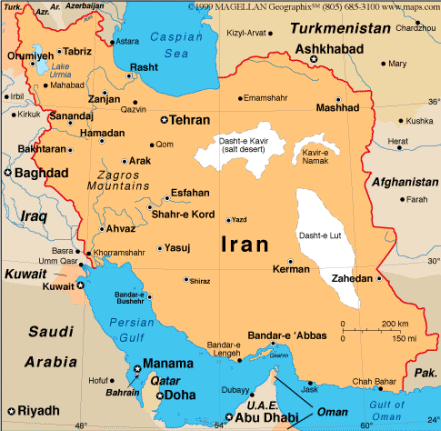
http://www.merriam-webster.com/maps/images/maps/iran_map.gif

Monday, June 15, 2009

If he uses violence to stamp them out, the myth of a popular mandate for the Islamic revolution will die.

TO BE NOTED: From the NY Times:

Olivier Laban-Mattei/Agence France-Presse — Getty Images

Ayatollah Ali Khamenei arrived at a polling place in Tehran on Friday to cast his vote. He has a reputation for caution. More Photos »

Multimedia

Opposition Defies Protest Ban in TehranSlide Show

Opposition Defies Protest Ban in Tehran


"
In Iran, an Iron Cleric, Now Blinking

For two decades, Ayatollah Ali Khamenei has remained a shadowy presence at the pinnacle of power in Iran, sparing in his public appearances and comments. Through his control of the military, the judiciary and all public broadcasts, the supreme leader controlled the levers he needed to maintain an iron if discreet grip on the Islamic republic.

But in a rare break from a long history of cautious moves, he rushed to bless President Mahmoud Ahmadinejad for winning the election, calling on Iranians to line up behind the incumbent even before the standard three days required to certify the results had passed.

Then angry crowds swelled in cities around Iran, and he backpedaled, announcing Monday that the 12-member Council of Guardians, which vets elections and new laws, would investigate the vote.

“After congratulating the nation for having a sacred victory, to say now that there is a possibility that it was rigged is a big step backward for him,” said Abbas Milani, the director of Stanford University’s Iranian studies program.

Few suggest yet that Ayatollah Khamenei’s hold on power is at risk. But, analysts say, he has opened a serious fissure in the face of Islamic rule and one that may prove impossible to patch over, particularly given the fierce dispute over the election that has erupted amid the elite veterans of the 1979 revolution. Even his strong links to the powerful Revolutionary Guards — long his insurance policy — may not be decisive as the confrontation in Iran unfolds.

“Khamenei would always come and say, ‘Shut up; what I say goes,’ ” said Azar Nafisi, the author of two memoirs about Iran, including “Reading Lolita in Tehran.” “Everyone would say, ‘O.K., it is the word of the leader.’ Now the myth that there is a leader up there whose power is unquestionable is broken.”

Those sensing that important change may be afoot are quick to caution that Ayatollah Khamenei, as a student of the revolution that swept the shah from power, could still resort to overwhelming force to crush the demonstrations.

In calling for the Guardian Council to investigate the vote, he has bought himself a 10-day grace period for the anger to subside, experts note. The outcome is not likely to be a surprise. Ayatollah Ahmed Jannati, the council’s chairman, is one of Ayatollah Khamenei’s few staunch allies among powerful clerics. In addition, the ayatollah appoints half the members, while the other half are nominated by the head of the judiciary, another appointee of the supreme leader.

“It is simply a faux investigation to quell the protests,” said Karim Sadjadpour, an Iran specialist at the Carnegie Endowment for International Peace.

Ayatollah Khamenei was an unlikely successor to the patriarch of the revolution, the Ayatollah Ruhollah Khomeini, and his elevation to the post of supreme leader in 1989 might have sown the seeds for the political crisis the country is facing today.

The son of a cleric from the holy city of Mashhad, Ayatollah Khamenei was known as something of an open-minded mullah, if not exactly liberal. He had a good singing voice; played the tar, a traditional Iranian stringed instrument; and wrote poetry. His circle of friends included some of the country’s most accomplished poets.

In the violence right after the overthrow of Shah Mohammed Reza Pahlavi, a bomb hidden in a tape recorder permanently crippled his right arm, and he was elevated to president in 1981 after another bomb killed the incumbent. He managed to attract the ire of Ayatollah Khomeini himself once, ironically, by publicly questioning some aspects of having a vilayat-e-faqih, or supreme leader system.

He also clashed repeatedly with Mir Hussein Moussavi, the powerful prime minister at the time. After being trounced in the official election results by Mr. Ahmadinejad, Mr. Moussavi, the reformist presidential candidate, challenged Ayatollah Khamenei in the one area where he has always been vulnerable: his religious credentials.

Mr. Moussavi wrote an open letter to the clergy in the holy city of Qom about the election results. By appealing to the grand clerics, he was effectively saying Ayatollah Khamenei’s word as supreme leader lacked sufficient weight.

Ayatollah Khamenei was elevated from the middle clerical rank, hojatolislam, to ayatollah overnight in what was essentially a political rather than a religious decision. He earned undying scorn from many keepers of Shiite tradition, even though Iran’s myth-making machinery cranked up, with a witness professing he saw a light pass from Ayatollah Khomeini to Ayatollah Khamenei much the way the imams of centuries past were anointed.

Still, lacking a political base of his own, he set about creating one in the military. It was the end of the Iran-Iraq war, and many senior officers returning from the front demanded a role in politics or the economy for their sacrifices. Ayatollah Khamenei became a source of patronage for them, giving them important posts in broadcasting or as leaders of the vast foundations that had confiscated much of the pre-revolution private sector.

“By empowering them, he got power,” said Mehdi Khalaji of the Washington Institute for Near East Policy.

In the wake of the election debacle, questions are being raised about who controls whom. But over the years, Ayatollah Khamenei gradually surmounted expectations that he would be eclipsed.

“He is a weak leader, who is extremely smart in allying himself, or in maneuvering between centers of power,” said one expert at New York University, declining to use his name because he travels to Iran frequently. “Because of the factionalism of the state, he seems to be the most powerful person.”

But many analysts say the differences between factions have never been quite so pronounced nor public as in the past few days. Former President Ali Akbar Hashemi Rafsanjani, once a close Khamenei ally who helped him become supreme leader, sent an open letter to him in the days before the election warning that any fraud would backfire, Mr. Milani noted. If he allowed the military to ignore the public will and to destroy senior revolutionary veterans, the decision would haunt him, Mr. Rafsanjani warned: “Tomorrow it is going to be you.”

Everyone speaking of Ayatollah Khamenei tends to use the word “cautious,” a man who never gambles. But he now faces a nearly impossible choice. If he lets the demonstrations swell, it could well change the system of clerical rule. If he uses violence to stamp them out, the myth of a popular mandate for the Islamic revolution will die.

“The Iranian leadership is caught in a paradox,” said Ms. Nafisi, the author of memoirs about Iran."

http://iranmap.com/images/IranMap.gif

Saturday, June 13, 2009

“They didn’t even look at the vote. They just wrote the name and put the number in front of it.”

TO BE NOTED: From the NY Times:

"
Reverberations as Door Slams on Hope of Change

Amir Hesami/Agence France-Presse — Getty Images
Supporters of President Mahmoud Ahmadinejad of Iran flashed victory signs on Saturday in Qum, south of Tehran

Multimedia

Iranian Protesters Fill Streets After Election ResultSlide Show

Iranian Protesters Fill Streets After Election Result

Memo From Tehran
Reverberations as Door Slams on Hope of Change

TEHRAN — It is impossible to know for sure how much the ostensible re-election of Mahmoud Ahmadinejad represents the preference of an essentially conservative Iranian public and how much, as opposition voters passionately believe, it is the imposed verdict of a fundamentally authoritarian regime.

But for those who dreamed of a gentler Iran, Saturday was a day of smoldering anger, crushed hopes and punctured illusions, from the streets of Tehran to the policy centers of Western capitals.

Iranians who hoped for a bit more freedom, a better managed economy and a less reviled image in the world wavered between protest and despair on Saturday.

On the streets around Fatemi Square, near the headquarters of the leading opposition candidate, Mir Hussein Moussavi, riot police officers dressed in RoboCop gear roared down the sidewalks on motorcycles to disperse and intimidate the clots of pedestrians who had gathered to share rumors and dismay.

“Another four years of dictatorship,” a voter muttered. “This is a coup d’état,” several others agreed. Some women wept openly. Some talked of “mutiny.” Others were more cynical.

“It was just a movie,” said Hussein Gharibi, a 54-year-old juice vendor, scoffing at those who had gotten their hopes up. “They were all just players in a movie.”

Far off, President Obama and other Western leaders who had seen a better relationship with Iran as potentially helpful in resolving the problems of Afghanistan, Iraq and nuclear proliferation faced the prospect of doing business with a man who, in addition to being a Holocaust-denying hard-liner, now stands suspected in a sham election.

There were some important constituencies that took satisfaction from the outcome.

Domestically, Mr. Ahmadinejad appealed to the fears of the more pious and poor who had found change unsettling. This included those alarmed by the days of political street carnival preceding the election and those (not just men) put off by Mr. Moussavi’s attention to the traditional, second-class role of women in this paternalistic quasi-theocracy.

They were joined by the civil servants, police officers and pensioners who all enjoyed the incumbent’s oil-financed generosity to his base, by those who relished his name-naming attack on corruption and by those who took pride in his defiance of the West.

Outside Iran, the result was comforting to hawks in Israel and some Western capitals who had feared that a more congenial Iranian president would cause the world to let down its guard against a country galloping toward nuclear weapons capability. (Mr. Moussavi, while promising a more conciliatory foreign policy, did not disavow the country’s nuclear-processing project, which Iran insists is for civilian ends alone.)

“In fact, Moussavi will be more difficult to deal with, because he will be nicer,” one skeptical Western diplomat said on the eve of the vote.

Among downcast Iranian journalists and academics, the chatter focused on why the interlocking leadership of clerics, military officers and politicians, without whose acquiescence little of importance happens, decided to stick with Mr. Ahmadinejad. Did they panic at the unexpected passion for change that arose in the closing weeks of the Moussavi campaign? Did Mr. Moussavi go too far in his promises of women’s rights, civil freedom and a more conciliatory approach to the West? Or was the surge an illusion after all, the product of wishful thinking?

The optimists in Iran and abroad have to ask themselves whether the joyful ruckus that filled the streets represented a new popular force or just an opportunity to let off steam. While Iran is not quite the closed society many imagine — it is a nation of text messagers and Facebook users, with access to Persian-language BBC broadcasts and other independent voices — it is still a controlled society.

On the street, the speculation focused more on how the election was manipulated, as many voters insisted it must have been for Mr. Ahmadinejad to score such a preposterous margin of victory.

One version (from somebody’s brother who supposedly knew someone inside) had it that vote counters simply were ordered to doctor the numbers: “Make that 1,000 for Ahmadinejad a 3,000.”

Others pointed out that the ballots seemed designed to lead opposition voters astray. Voters were obliged to choose a candidate and fill in a code. Though Mr. Moussavi was candidate No. 4, the code No. 44 signified Mr. Ahmadinejad.

One employee of the Interior Ministry, which carried out the vote count, said the government had been preparing its fraud for weeks, purging anyone of doubtful loyalty and importing pliable staff members from around the country.

“They didn’t rig the vote,” claimed the man, who showed his ministry identification card but pleaded not to be named. “They didn’t even look at the vote. They just wrote the name and put the number in front of it.”

The government on Saturday insisted that the election was aboveboard and made it ominously clear that it would have little patience with anyone who questioned the purity of Iranian democracy.

It was far from clear what recourse the opposition had left.

Mr. Moussavi, who disappeared amid rumors that he was under house arrest or worse, sent word that there would be no turning back, but he did not say how he or his followers should challenge the outcome.

The text messaging that is the nervous system of the opposition was shut down, along with universities, Web sites and newspapers the government regarded as hostile. Mr. Moussavi was not allowed a platform on Saturday and barely managed to get out a communiqué calling the election “a magic show.”

Although there were bursts of defiance that were forcibly subdued, there was also a palpable fear; on Saturday, unlike on Friday, few opposition voters would let their names be used.

“By the evening, people will pour into the streets,” predicted one young woman, from inside the hood of her black chador. “But Ahmadinejad will become president by force.”

[Country map of Iran]

Monday, June 8, 2009

But the president’s rally was overmatched in turn by a larger, simultaneous demonstration by Mr. Moussavi’s followers

TO BE NOTED: From the NY Times:

Ben Curtis/Associated Press

Supporters displayed posters of reformist candidate Mir Hussein Moussavi in downtown Tehran on Monday.

"Huge Campaign Rallies Snarl Tehran

TEHRAN — A pair of sprawling demonstrations here brought the capital of Iran virtually to a standstill on Monday, with followers of President Mahmoud Ahmadinejad and his main electoral challenger struggling to demonstrate their street following ahead of presidential elections on Friday.

The demonstrations were the largest gatherings here in more than a decade, veteran political observers said.

Iranian elections always bring a loosening of the rules on public speech and behavior, but many say this year’s election is different, in part because of the social crackdown of the past four years under Mr. Ahmadinejad.

“What’s happening now is more than what should happen before an election,” said Mashalah Shamsolvaezin, a political commentator and former director of several reformist newspapers. “This is an expression of protest and dissatisfaction by people. They are venting their frustration and feeling very powerful.”

Mr. Ahmadinejad’s campaign organized a huge rally in a prayer hall in central Tehran on Monday afternoon, where tens of thousands of chanting supporters gathered apparently in an effort to match the raucous outdoor rallies that are being held nightly by followers of Mir Hussein Moussavi, his leading challenger for the presidency.

But the president’s rally was overmatched in turn by a larger, simultaneous demonstration by Mr. Moussavi’s followers, who formed a human sea of people that blocked traffic for miles along one of Tehran’s main boulevards.

The rallies underscored the unusual passions being aroused by the campaign, in which the leading candidates have exchanged accusations that are extraordinarily fierce for Iranian politics. There have been scattered street clashes in recent days, but the police have generally not intervened, in part — analysts say — because they do not want to unleash protests by the unruly and mostly young crowds.

The rallies appear to have surprised and unsettled the authorities, and Iran’s supreme leader, Ayatollah Ali Khamenei, in a message broadcast on state television, warned against any further escalation.

“I don’t want to comment about people coming onto the streets, but they should not turn into confrontation or clashes between supporters of the candidates,” Ayatollah Khamenei said.

Monday’s rally by Mr. Moussavi’s supporters was motivated partly by anger at Mr. Ahmadinejad, whose campaign rescheduled its own rally in a way that displaced an event by Mr. Moussavi. He had planned to give a speech in the same prayer hall where Mr. Ahmadinejad appeared Monday. Instead, Mr. Moussavi’s followers gathered in a long chain running from the south of the capital to the north, most of them wearing sashes of green, his campaign’s signature color.

The campaign has included fierce spoken exchanges among the candidates, especially during the presidential debates of the past week, in which Mr. Ahmadinejad has accused leading figures of the 1979 revolution of corruption.

On Monday, Ali Akbar Hashemi Rafsanjani, a former two-time president and one of Mr. Ahmadinejad’s chief targets, defended himself for the first time.

“Unfortunately, the course of the election has become tainted with all sorts of lies and slanderous statements,” Mr. Rafsanjani said.

Although the harsh criticisms have shocked many Iranians, they seem to have played well with Mr. Ahmadinejad’s followers, who view them as a natural part of his populist campaign against the rich and the corrupt.

As it happened, the crowds at Mr. Ahmadinejad’s rally were so thick that he was not able to get through to the podium in time to speak, and many of his supporters left early. At the same time, not far away, thousands of Mr. Moussavi’s supporters crowded the streets, creating traffic jams so heavy that the blocked roads were full of people walking home through the stopped cars.

For weeks, Mr. Ahmadinejad’s opponents have been saying they are concerned that the government will rig the vote in his favor. On Monday, a group of Interior Ministry employees released a letter saying a senior cleric close to Mr. Ahmadinejad had authorized fixing the vote in his favor, several reformist Web sites reported."