Showing posts with label Obama. Show all posts

Saturday, June 6, 2009

the role Egypt should play, as an important ally of Sudan, in resolving the conflict

TO BE NOTED: From Enough:

President Obama: World Has "Obligation to Act" To Stop Genocide

Printer-friendly version
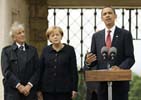
Obama delivers remarks at Buchenwald

Following up on his speech in Cairo yesterday, President Obama, speaking at the Nazi Concentration Camp Buchenwald, today addressed the genocide in Darfur and his administration's behind-the-scenes work to address Sudan's immediate humanitarian needs and broader, long-term efforts to end the conflict.

In a response to a reporter's question, here's what the president said:

…On the issue of genocide, I think “never again” means that the international community has a obligation, even when it’s inconvenient, to act when genocide is occurring. So on the issue of Darfur, for example, I didn’t simply mention it in a speech yesterday before a Muslim audience, talking about genocide that’s taking place within a majority Muslim country, but I also raised it in discussions with President Mubarak of Egypt, who has strong diplomatic relations with the country of Sudan.

And I’ve assigned one of my closest national security advisors, General Scott Gration, as a special envoy who has been traveling throughout the region trying to not only solve the immediate humanitarian crisis that exists and that was made worse when President Bashir kicked out many of the international non-governmental organizations that have been providing humanitarian assistance. We’ve been working diligently to solve that immediate problem and get humanitarian assistance back on the ground. But what we’ve also been doing is to try to reactivate the possibilities of a peaceful — a peace settlement between Khartoum and some of the rebels in Darfur that would allow the internally displaced people from Darfur to start returning to their homes.

So we’ve been very active on this issue. It may not have received the attention in the press that some of the other issues have, but we are spending a lot of time trying to make sure that we make progress and that the people of Darfur are able to return to their homes and live in peace.

It is promising to see that President Obama knew it was insufficient to address ongoing genocide in just one line of his speech; it was imperative that President Obama discuss with Egyptian President Mubarak the role Egypt should play, as an important ally of Sudan, in resolving the conflict. Coming on the heels of a high-profile speech, with international headlines still buzzing about what the president did and didn't say, the public is more tuned into his subsequent remarks, which is helpful for keeping a spotlight on Sudan. It’s also noteworthy that while the president avoided using the word ‘genocide’ yesterday to describe the conflict in Darfur, today he didn’t shy away. Against the backdrop of the site of unimaginable suffering, the president's words are a powerful call to action.

But as we have been saying, along with editorial boards, activists, and U.S. leaders, President Obama's strong rhetoric must be followed up with concrete action. This high-profile verbal commitment to ending the genocide in Darfur is very welcome, but we -- and certainly the people of Darfur and Sudan as a whole -- are waiting to see the tangible results.

N.B.: To listen to a powerful radio broadcast by Edward Murrow from 1945, reporting on the liberation of Buchenwald, click here.

Photo: President Barack Obama delivers remarks at Nazi concentration camp Buchenwald, alongside German Chancellor Angela Merkel and Holocaust survivor Elie Wiesel. AP/Ina Fassbender"

From the WSJ:

"President Barack Obama called “for all of us to redouble our efforts” toward separate Israeli and Palestinian states. Alongside German Chancellor Angela Merkel one day after his trip to the Middle East, Obama said: “The United States can’t force peace upon the parties.” But he said America has “at least created the space, the atmosphere, in which talks can restart.” Here, the remarks from their news conference in Dresden.

10:30 A.M. (Local)

CHANCELLOR MERKEL: (As translated.) We are delighted to have the American President here this morning with us, after having met the last time at the NATO summit. We will visit a little bit of Dresden and later on we go on to Buchenwald, to the former concentration camp. I think that this is, indeed, a trip of a highly symbolic nature. Let me just remind all of us of the visit to Buchenwald that we will take later in the day. It is so important that the American President, Barack Obama, makes his first stop here in Dresden. This is a highly symbolic city. It is a city that was almost completely destroyed during the Second World War, was then rebuilt after Germany unification. It has again turned out to be a jewel of German culture and civilization. The people here are so glad that you’ve come to see them because it shows that you also pay tribute to the tremendous efforts they made in those 20 years after the fall of the wall.

We have made very good use of that time, talking about the political agenda, pressing issues. President Obama yesterday gave a very important speech in Cairo, which I think will be an ideal basis for a lot of action of a positive nature, particularly as regards speeding of the peace process in the Middle East. We also talked about a possible time frame for possible progress to be made. I said on behalf of the Federal Republic of Germany that we would like to try and be helpful in this peace process to the extent that this is possible to us. We need a two-state solution; we need a viable Palestinian state and a viable state of Israel, side by side. And whatever we can do in order to constructively accompany this along the way we will gladly do.

The status of negotiations with Iran on the nuclear program was also at the very top of our agenda. Here, too, we agreed to work closely together. Germany will try its utmost with its contacts, with its expert knowledge to give a positive contribution to this issue.

We also obviously debated the situation on world markets. We exchanged views on the different stimulus programs that we pursue in our countries. And we also talked about what we feel is necessary in order to prepare the next G20 meeting, then also the upcoming G8 meeting. What is important is to implement what we decided on in London. The European states are now doing that; the United States are doing that. You have a very ambitious plan that you outlaid. So we will keep a close eye on developments. And then in the autumn when we meet at G20 we will also state very clearly that strengthening the multilateral system is also one that we consider to be important.

This year negotiations on climate change, on a post-Kyoto regime are also on the agenda. We very much welcome the very, very hard work that the United States has done in order to see to it that the necessary answers are found for this phenomenon of climate change. We know that it’s very much an uphill battle; we’re very familiar with that from the debate that we have here in our country. And we are keeping a close eye on legislation that is passed. We, I think, are at one in saying we need an ambitious program, we want to have successful negotiations in Copenhagen, and we want to make the best possible use of our time leading up to this.

Once again, a very warm welcome to you, sir, and we are so glad that you and the members of your team have taken the trouble to come here.

PRESIDENT OBAMA: Well, thank you very much, everybody. Good morning. It is wonderful to be in the beautiful city of Dresden, which obviously is steeped in history and, as Chancellor Merkel discussed, has overcome great tragedies and is now this beautiful city full of hope. And so I’m very grateful to not only Chancellor Merkel but to the German people for their hospitality.

Germany is a close friend and a critical partner to the United States, and I believe that friendship is going to be essential not only for our two countries but for the world if we are to make progress on some of the critical issues that we face, whether it’s national security issues or economic issues or issues that affect the globe like climate change.

Chancellor Merkel, as she mentioned, and I had a very productive discussion. We continue to work closely together to confront the global economic crisis and to restore growth and prosperity for our people. The downturn knows no borders and it will take some time and sustained action by all of us to move forward.

At the G20, we successfully laid out the parameters for collective action. And we’ve seen, I think on both sides of the Atlantic, some progress in stabilizing the economy, but we’re far from done in the work that’s required. I mentioned to her that, in the United States, we are working diligently to strengthen financial regulations to ensure that a crisis like this doesn’t happen again, and it’s going to be very important to coordinate between Europe and the United States as we move to strengthen our financial regulatory systems. We affirmed that we are not going to engage in protectionism. And as all of us do what’s required to restart our economy, we have to make sure that we keep our borders open and that companies can move back and forth between the United States and Europe in providing goods and services to our respective countries.

I’m very pleased to see the resolution of the Opel situation here. We are very sympathetic towards each other, that it’s not easy to help auto companies restructure, and it’s not always popular, but it’s also, we are convinced, the right thing to do. And I’m hopeful that not only are we going to see these companies stabilize, but also that they’re going to emerge even stronger and more competitive in the international marketplace.

Chancellor Merkel and I discussed a range of security challenges. Germany has been a very strong NATO partner. As all of you know, we have great challenges in Afghanistan and increasingly in Pakistan, but our collective commitment to making sure that we are not seeing the kinds of terrorist bases that could pose harm to all of our people, that we maintain that commitment.

We also discussed the issue of Iran — and not in isolation, but in a broader context of avoiding a nuclear arms race in the Middle East that could be profoundly dangerous. And I’ve said publicly that I’m committed to engaging in serious dialogue and negotiations with Iran. That can’t be done in isolation, it has to be done in conjunction with the P5-plus-1 or the E3-plus-3 process, and Germany is going to be a critical partner in that process.

Later in the summer I will be traveling to Russia to discuss how we can reduce U.S. nuclear stockpiles and Russian nuclear stockpiles. And so as I said, our concern is not just Iran, but a broader effort to strengthen nonproliferation so that the threat of nuclear weapons is greatly reduced in our lifetime.

And as the Chancellor mentioned, we discussed my recent trip to the Middle East and the need for all of us to redouble our efforts to bring about two states, Israel and a Palestinian state, that are living side by side in peace and security. I think the moment is now for us to act on what we all know to be the truth, which is that each side is going to have to make some difficult compromises; we have to reject violence. The Palestinians have to get serious about creating the security environment that is required for Israel to feel confident. Israelis are going to have to take some difficult steps. I discussed some of those in the speech.

Ultimately, the United States can’t force peace upon the parties. But what we’ve tried to do is to clear away some of the misunderstandings so that we can at least begin to have frank dialogue. And we’re not going to be able to do that by ourselves; we’re going to require strong partners like Germany in that process. And I know that Chancellor Merkel is very much committed to that.

So, again, it is a great pleasure to be here. It is a great pleasure to be with my friend once again, who I always seek out for intelligent analysis and straight talk. And I’m looking forward to continued partnership between our two countries to deal with the wide range of issues that we confront at this time.

So thank you very much.

CHANCELLOR MERKEL: Well, I believe you have the possibility to ask questions. Maybe we ought to — do we start with a German question?

Q Christiane Meier, from the First German Television. Mr. President, did you have the opportunity to also address the issue of Guantanamo and do you feel sufficiently supported by Europe and here, in particular, by Germany, in accepting prisoners, former prisoners? And does this perhaps overshadow your relationship with the Chancellor or perhaps not — there has been certain mild, sometimes even wild speculation over the course that your trip took, that you left certain venues open until the end and that this had something to do with your relationship with the Chancellor.

And Chancellor, did you make an offer or were you actually able as regards Guantanamo to give certain assurances to the President and accommodate him?

PRESIDENT OBAMA: I think your characterization of wild speculations is accurate — they are very wild and based on no facts. The truth of the matter is, is that the relationship not only between our two countries but our two governments is outstanding. Most of the speculation around my schedule here in Germany doesn’t take into account simple logistics: traveling, trying to get from one place to the other, coming off a Middle East trip, having to go to Normandy tomorrow. There are only 24 hours in the day. And so there’s nothing to any of that speculation beyond us just trying to fit in what we could do on such a short trip. That’s all that there was.

So stop it, all of you. (Laughter.) I know you have to find something to report on, but we have more than enough problems out there without manufacturing problems.

In terms of the issue of Guantanamo, look, this is a very difficult issue. It’s difficult in my country; it’s difficult internationally. We have a facility that contains some people who are very difficult to deal with. Some of them probably should not have been detained in those facilities in the first place. They should have been processed and tried and convicted. If they weren’t convicted, then they should not have been languishing in a facility like that, that became a symbol for many around the world of us not sticking to our ideals and our traditions and rule of law.

But it was done. And that’s the past. And now we have to move forward. We have spoken to the European Union about the possibilities of working with us and helping us in managing the closure of Guantanamo. Chancellor Merkel has been very open to discussions with us. We have not asked her for hard commitments, and she has not given us any hard commitments beyond having a serious discussion about are there ways that we can solve this problem. And I don’t anticipate that it’s going to be resolved anytime in the next two or three months. I think it’s going to be a longer process of evaluation.

But I’m very appreciative of the openness, not only of Chancellor Merkel but other European countries to work with us, because I think they recognize that we have a shared interest in battling extremists and terrorists at the same time as we have a shared interest in upholding broader principles of international justice; and that those things are compatible, but it’s going to take some time.

We’ll be looking at individual cases; seeing are there people who can safely be transferred; if they are safely transferred, where would they be transferred to. And this is a conversation we’re not just having with Germany but the broader European Union. And I very much appreciate the constructive manner in which Chancellor Merkel has approached the issue.

CHANCELLOR MERKEL: Allow me, if I may, to, as regards that one part of the question, say that it’s fun to work together with the American President because very serious, very thorough analytical discussions very often lead us to draw the same conclusions. And I think we proved that in London, we proved that on previous meetings. I think that’s part of our job, isn’t it, that you exchange views, different views that you may have also. And wherever it was necessary, we have come to common solutions. So I very much look forward to our future cooperation.

On Guantanamo, Germany has always come out in favor, in particular my government, for closing down this facility. This has been a long-standing issue. We very purposefully at the time accepted Mr. Kurnaz, who has some sort of relation to Germany. And we also said that when there is a solution in the offing we will constructively contribute to it. Now there are talks going on of the Minister of the Interior with the American side, very intensive discussions, which we wish to continue. And at the very end I am absolutely confident that we will find a common solution.

I believe a question from the American side maybe.

PRESIDENT OBAMA: Just pick on somebody or —

Q Mr. President –

PRESIDENT OBAMA: You know, Jennifer has got the mic; sorry, Jake. (Laughter.)

Q He handed it to me, so I’m going to keep it.

PRESIDENT OBAMA: There you go.

Q Thank you, Mr. President. You challenged — on Mideast peace, you challenged all the parties yesterday and again here in your opening remarks to take actions. The Israelis, the Palestinians, the Arab states, things they’ve been asked to do for years, actually agreed to do, but still today remain even — perhaps even more unwilling or unable to do them. What are your specific next steps to try to break this stalemate? And why do you think your approach is realistic?

And then to Chancellor Merkel, if I could, you talked about a timeline that the two of you discussed on Mideast peace. Can you be more specific about that, please?

PRESIDENT OBAMA: As I said at the outset of my speech, yesterday was just one speech and it doesn’t replace all the hard work that’s going to have to be done — that was done before the speech and is going to have to be done in the years to come in order to solve what has been a 60-year problem. And I’m under no illusions that whatever statements I’ve put forward somehow are going to supplant the need to do that work.

I think that what is different now is, number one, you’re seeing a U.S. administration and American President engage this issue almost on the day that I took office. We’ve only been in office five months, and yet we’ve seen extraordinary activity already on this issue. And that’s sent a signal to all the parties in the Middle East that we are serious. I’ve assigned George Mitchell, my special envoy, who has met repeatedly with all the players in the region and who is going to be going back next week in the wake of my appearance in Cairo to follow up with each of the individual parties on a whole host of negotiation points and potential confidence-building measures that can be taken.

And I’ve already met with Prime Minister Netanyahu. Our governments are in close contact and communication about how we can move forward on some of the items that might be inhibiting restarting talks. I’ve had Abbas in the White House to do the same.

And so you’ve probably seen more sustained activity on this issue in the first five months than you would have seen in most previous administrations. The reason we are doing that is because not only had talks ground to a halt, but there was a sense that all sides were getting so dug in and so cynical that you might reach a point where you could never get the parties back at the table. And I think given what we’ve done so far, we’ve at least created the space, the atmosphere, in which talks can restart.

Now, I just have to say one more time, the United States can’t solve this problem. The United States can be a partner in solving the problem, but ultimately the parties involved are going to have to make a decision that the prosperity and security of their people is best served by negotiations and compromise, and we can’t force them to make those difficult decisions. What we can do is to provide them a framework and a forum and the support for such an outcome to be achieved.

And I’m sure that — one of the things I very much appreciate was Chancellor Merkel’s willingness to put the prestige and the resources of the German government behind that same effort. I think the entire international community is going to have a responsibility to help these parties achieve a hard-won peace that will ultimately be good for everybody’s security interests.

CHANCELLOR MERKEL: Well, I believe that with the new American administration, with President Barack Obama, there is actually a unique opportunity now to see to it that this peace process — or let’s perhaps be more careful — this negotiation process to be revived again.

Yesterday’s speech in a way opened up also the door to the Arab world again. And in the way that it was described just now you have sort of made steps along the way. And when steps are made along the way then we feel as Germans we can perhaps be helpful to accompany this. For historical reasons we have a very close and very special relationship with Israel. We have a very great interest in the safety and security of Israel. And on the other hand we also have a very fervent wish a Palestinian state be built.

This agenda needs to be worked on step by step, but it is certainly true the parties, themselves, have to show a readiness, a willingness to do something for the peace and security of the world as a whole. I see this as a core issue, and an essential and crucial issue. And this is why we all have the wish and the willingness to bring this matter forward. The historical opportunity I think is there, even though looking at many, many countries in the Arab world — even looking at many countries in the Arab world, they have a very great interest in progress there because for the economic development as well they need peace there, they need security. And we should have every interest in seeing this bring about and we will give our contribution to it.

Q You will later on, Mr. President, visit the former concentration camp, Buchenwald. Tell me now already, if possible, what is your personal motivation, what drives you to this? We were told here in Germany that because you know Elie Wiesel, the Nobel Peace Prize Winner so well, because he told you about his periods in the camp where he suffered great hardship that this sort of made you do it.

And another political issue, if I may. Madam Chancellor, climate change. Germany, Europe are putting concrete targets on the agenda, concrete reduction targets. Will America in the post-Kyoto process be willing to commit itself to concrete reduction targets? Or are you pursuing a different kind of approach, Mr. President, similar to you predecessor in office?

PRESIDENT OBAMA: Well, first of all, one of the main reasons for me being in Europe this week is to commemorate the 65th anniversary of the landing in Normandy. And this is a moment that obviously is of great importance to the United States, so many lives were lost during this period; it marks the beginning of the end of World War II, and many of the veterans of World War II are in the sunset of their years. And so having an opportunity to acknowledge them once again and the sacrifices they made was very important to me.

As part of that trip we thought it was very important for me to visit Buchenwald. First of all, I’ve never traveled to one of the concentration camps, but this one has a personal connection to me. It’s not only that I know Elie Wiesel and have read about his writings, it’s also that — and I’ve stated this before — that my grandfather’s — my grandmother’s brother was one — was part of the units that first liberated that camp. And I’ve talked about this before in the United States, perhaps not in Germany, the shock for this very young man — he couldn’t have been more than 19, 20, 21 at the time, was such that he ended up, when he returned, having a very difficult time readjusting to civilian life, and it was a memory that burned in him for quite some time.

And that, you know, was something that I learned about as a young person, and for me then to be able to come and reflect on this very difficult history and to not only reflect on the dangers of when peoples are in conflict and not acknowledging a common humanity; but also to celebrate how out of that tragedy you now have a unified Europe, a Germany that is a very close ally of Israel, and the possibilities of reconciliation and forgiveness and hope. All those things I think are part of why this visit is very important to me.

In terms of climate change, ultimately the world is going to need targets that it can meet. It can’t be general, vague approaches. We’re going to have to make some tough decisions and take concrete actions if we are going to deal with a potentially cataclysmic disaster. And we are seeing progress in Congress around energy legislation that would set up for the first time in the United States a cap and trade system. That process is moving forward in ways that I think if you had asked political experts two or three months ago would have seemed impossible.

So I’m actually more optimistic than I was about America being able to take leadership on this issue, joining Europe, which over the last several years has been ahead of us on this issue.

As I told Chancellor Merkel, unless the United States and Europe, with our large carbon footprints, per capita carbon footprints, are willing to take some decisive steps, it’s going to be very difficult for us to persuade countries that on a per capita basis at least are still much less wealthy, like China or India, to take the steps that they’re going to need to take in controlling carbon emissions.

So we are very committed to working together and hopeful that we can arrive in Copenhagen having displayed that commitment in concrete ways.

CHANCELLOR MERKEL: Allow me, if I may, to say, as to a visit to Buchenwald, that this is for me deeply moving, to see an American President, in this case President Barack Obama, as a visitor in Buchenwald. And he talked about his personal background as regards this question.

Look at Buchenwald. Buchenwald is one example of these horrible concentration camps, liberated by American troops. Later on it was turned during the Soviet period again, and it also, in the time when Germany was divided, it again became somewhat symbolic. People in that part of the country were not able to enjoy freedom and security.

Now, after the end of the Cold War, we go there after Germany has been reunited, after Europe has been reunited, now that we also enjoy freedom and democracy, as the United States does. That is very moving, and it shows you that actually history makes things possible if a sufficient number of people believe in the dream of freedom.

Q Thank you, Mr. President. A couple questions, one just to follow up on Jennifer’s. What are some of the gestures of good faith that you’d like to see from the Israelis and Palestinians? But then regarding your visit to Buchenwald, since the Holocaust, a constant refrain in the United States has been “never again,” but U.S. President after U.S. President has sat back and let genocides happen over and over, whether Cambodia or Rwanda. What does “never again” mean to you as a U.S. President, especially given the fact that genocide is going on right now in Darfur? There were accusations of genocide in Sri Lanka a few weeks ago. What does it mean to you? And are you doing everything you can to make sure “never again” is not a hollow refrain?

And then for Chancellor Merkel, does Germany not have an extra obligation to take action to prevent genocide from happening in other parts of the world? Thank you.

PRESIDENT OBAMA: With respect to confidence-building measures or next steps, again, I’m going to be sending George Mitchell back into the region next week. He’s going to be meeting with all the various parties involved. I think I’ve said publicly and I repeated in the speech some things that are going to have to be done.

You know, a lot of attention has been given to my statement that the Israelis need to stop settlement construction, and I recognize that it’s received a lot of attention in Israel, as well. Keep in mind that all I’ve done there is reaffirm commitments that the Israelis themselves had already made in the road map. And I recognize the very difficult politics within Israel of getting that done, and I’m very sympathetic to how hard it will be.

But as Israel’s friend, the United States I think has an obligation to just be honest with that friend about how important it is to achieve a two-state solution — for Israel’s national security interests, as well as ours, as well as the Palestinians. And that’s an area where steps can be taken.

They’re not the only steps, by the way, that Israel can take and will need to take in order to advance movement towards peace. And I mentioned some of the other issues that I’ve discussed with Prime Minister Netanyahu’s office, for example, increasing freedom of movement within the West Bank, dealing with the humanitarian crisis in Gaza and allowing reconstruction to proceed more aggressively.

What’s been interesting is that less attention has been focused on the insistence on my part that the Palestinians and the Arab states have to take very concrete actions. When it comes to the Palestinians, we know what they’re supposed to be doing. They have to continue to make progress on security in the West Bank.

They have to deal with incitement issues. There’s still a tendency, even within — among Palestinians who say they are interested in peace with Israel, to engage in statements that are — that incite a hatred of Israel or are not constructive to the peace process. Now I think, to his credit, President Abbas has made progress on this issue — but not enough.

We still have not seen a firm commitment from the Palestinian Authority that they can control some of the border areas that Israel is going to be very concerned about if there were to be a two-state solution. There are still problems of corruption and mismanagement within the Authority that have to be addressed.

So there are going to be a whole set of things having to do with the Palestinians’ ability to govern effectively and maintain security. And if they’re not solved, Israelis are going to have trouble moving forward.

And the Arab states, what I’d like to see is indicators that they are willing, if Israel makes tough commitments, to also make some hard choices that will allow for an opening of commerce, diplomatic exchanges between Israel and its neighbors.

Now, all these things are going to take time. They’re not going to happen immediately. But I’m confident that if we stick with it, having started early, that we can make some serious progress this year.

On the issue of genocide, I think “never again” means that the international community has a obligation, even when it’s inconvenient, to act when genocide is occurring. So on the issue of Darfur, for example, I didn’t simply mention it in a speech yesterday before a Muslim audience, talking about genocide that’s taking place within a majority Muslim country, but I also raised it in discussions with President Mubarak of Egypt, who has strong diplomatic relations with the country of Sudan.

And I’ve assigned one of my closest national security advisors, General Scott Gration, as a special envoy who has been traveling throughout the region trying to not only solve the immediate humanitarian crisis that exists and that was made worse when President Bashir kicked out many of the international non-governmental organizations that have been providing humanitarian assistance. We’ve been working diligently to solve that immediate problem and get humanitarian assistance back on the ground. But what we’ve also been doing is to try to reactivate the possibilities of a peaceful — a peace settlement between Khartoum and some of the rebels in Darfur that would allow the internally displaced people from Darfur to start returning to their homes.

So we’ve been very active on this issue. It may not have received the attention in the press that some of the other issues have, but we are spending a lot of time trying to make sure that we make progress and that the people of Darfur are able to return to their homes and live in peace.

CHANCELLOR MERKEL: Well, first, experience — part and parcel of our history, of our past experience here in Germany is obviously the Shoah. And out of that comes an everlasting responsibility for the safety and security of the state of Israel. If you like, this has been the (inaudible) of every German government, ever since the Federal Republic came into being, and it will always be that case.

As regards genocide all over the world, we have an international responsibility that we need to shoulder here. And here, too, we work very closely together. We, all of us, have made the experience I think along the way that this quite often takes much longer to resolve than one would like it to be and can be satisfied about.

But military intervention alone, without any political framework that we put on these issues, is also not always successful. We’ve made that experience, as well. This is why the European Union — actually during the EU-Africa Summit established very close links with the African Union, trying also to win over African countries to shoulder their responsibility or helping them shoulder their responsibility, for example by providing them with the necessary material, the equipment, but also through political discussions.

I think that due to the experience we’ve made over the years as European Union members that we were able after the Second World War to live together peacefully. We have an obligation not only to create peace within Europe, because we’ve been able to do that, but to actually share with others the knowledge how we managed to get that to happen. Dignity of man is inviolable. This is what is inscribed in the German constitution. And this goes not only for the Germans, not only for the Europeans, but for every human being all over the world. It means we can solve problems of this kind. We as Germans, after the Second World War, have made an experience that was certainly not a matter of course. The Allies actually extended a helping hand to us, to our neighbor France, the United Kingdom, but also the United States of America. We need to share this experience in order to prevent further cases of tragedy occurring. And we will always be at your side, at the side of the Americans.

Thank you very much.

PRESIDENT OBAMA: Thank you.

END 11:12 A.M. (Local)

Source: The White House"

Saturday, April 18, 2009

"Without significant change to steer away from ever-expanding deficits and debt, we are on an unsustainable course," he added.

TO BE NOTED: From Reuters:

Photo
1 of 1Full Size

WASHINGTON (Reuters) - President Barack Obama said on Saturday he would soon announce the elimination of dozens of wasteful or ineffective government programs as part of a broad effort to restore fiscal accountability to the federal budget.

Obama, speaking in his weekly radio address, said he would use his first full Cabinet meeting on Monday to ask department and agency heads for specific proposals for trimming their budgets.

He named two new officials as part of a team of management, technology and budget experts that will drive the process of trimming the fat and waste from government spending.

"As surely as our future depends on building a new energy economy, controlling healthcare costs and ensuring that our kids are once again the best educated in the world, it also depends on restoring a sense of responsibility and accountability to our federal budget," Obama said.

"Without significant change to steer away from ever-expanding deficits and debt, we are on an unsustainable course," he added.

The United States posted a record $956.8 billion budget deficit for the first half of fiscal 2009, more than three times the shortfall of a year ago, the Treasury Department reported earlier this month.

Much of the deficit was caused by spending on financial and economic rescue programs aimed at propping up companies whose collapse could worsen the global recession.

Obama said Cabinet officials already had begun cutting back unnecessary expenditures, including a consulting contract to create new seals and logos that cost Department of Homeland Security $3 million since 2003.

The president also commended Defense Secretary Robert Gates' project to reform defense contracting procedures to eliminate what he said were hundreds of billions of dollars in wasteful spending and cost overruns.

"If we're to going to rebuild our economy on a solid foundation, we need to change the way we do business in Washington," Obama said. "We need to restore the American people's confidence in their government -- that it is on their side, spending their money wisely, to meet their families' needs."

He named Jeffrey Zients, a management consultant and entrepreneur, to act as chief performance office with the official title of deputy director for management of the Office of Management and Budget.

Zients is a director of Sirius XM Radio and served as chief executive of The Advisory Board Company.

His job will be to streamline processes, cut costs and find best practices throughout the government, Obama said.

He named Aneesh Chopra, the secretary of technology for the state of Virginia, to be the U.S. chief technology officer charged with promoting technological innovation."

Saturday, April 4, 2009

“My administration,” the president added, “is the only thing between you and the pitchforks.”

TO BE NOTED: from the TNR:

Obama to Bankers: Beware the Pitchforks

Eamon Javers did some more reporting about that meeting at the White House last week between Obama and top bank CEOs and turned up this exchange:

[T]he CEOs of the most powerful financial institutions in the world offered several explanations for paying high salaries to their employees — and, by extension, to themselves.

“These are complicated companies,” one CEO said. Offered another: “We’re competing for talent on an international market.”

But President Barack Obama wasn’t in a mood to hear them out. He stopped the conversation and offered a blunt reminder of the public’s reaction to such explanations. “Be careful how you make those statements, gentlemen. The public isn’t buying that.”

“My administration,” the president added, “is the only thing between you and the pitchforks.”

No word on whether Obama fired up the little-used trap door Cheney had installed in the Roosevelt Room.

--Noam Scheiber

Tuesday, March 24, 2009

government needs those powers to intervene when companies such as insurer American International Group Inc. pose a risk to the financial system

TO BE NOTED: From Bloomberg:

"Obama Says He Expects Public Support for New Resolution Power

By Hans Nichols

March 24 (Bloomberg) -- President Barack Obama said he expects there will be “strong support” for a new government authority to take over non-banking financial institutions that threaten the economy.

Treasury Secretary Timothy Geithner and Federal Reserve Chairman Ben S. Bernanke told the House Financial Services Committee today the government needs those powers to intervene when companies such as insurer American International Group Inc. pose a risk to the financial system."

Saturday, March 21, 2009

the potential effect of the bill that emerged from Congress on efforts to stabilize the financial system

TO BE NOTED: From the NY Times:

"
Obama Uneasy About Tax on Bonuses

WASHINGTON — The White House stopped short on Friday of endorsing legislation to severely tax bonuses paid to executives of companies that accepted taxpayer bailout funds.

Administration officials said instead that President Obama would assess the potential effect of the bill that emerged from Congress on efforts to stabilize the financial system.

At the same time, as Wall Street executives anxiously pondered the ramifications of the measure quickly passed by the House this week, some Senate Republicans began to voice opposition to the legislation, saying it was hasty and abusive.

The House overwhelmingly adopted on Thursday a bill that would impose a 90 percent tax on bonuses paid since Jan. 1 by companies that owe the government at least $5 billion in bailout funds. That tax would apply to employees with family income of $250,000 or more, and would have an impact on businesses like Citigroup and Bank of America.

The Senate has proposed its own bill that would apply to all employees at companies owing $100 million in bailout money. The Senate measure would impose a 35 percent tax on the bonus recipient and on the company, which would apply to any amount above $50,000 for a merit bonus and to the full amount of any bonus paid solely to retain the worker.

Representative Barney Frank, the Massachusetts Democrat who is chairman of the Financial Services Committee, introduced another bill on Friday to curb bonuses. His measure would bar bonuses not based on merit for as long as a company owed bailout money to the government.

Wall Street firms reacted angrily to the tax proposals, with several saying they would explore ways to end their participation in the bailout program.

The chief executive of Citigroup, Vikram S. Pandit, sent employees a memorandum Friday saying, “The work we have all done to try to stabilize the financial system and to get this economy moving again would be significantly set back if we lose our talented people because Congress imposes a special tax on financial services employees. It would affect countless number of people who will find it difficult, if not impossible, to pay back the bonuses that they earned.”

Other companies said they would probably refuse to participate in other Federal Reserve programs aimed at stabilizing the financial sector.

For private investment firms, the prospect that the rules can be changed at the whim of Congress introduced a powerful element of doubt in their calculations.

“When you don’t have the goal posts, you don’t know where to run and how far,” said Thomas J. Barrack Jr., the chief executive of Colony Capital, a $38 billion private equity firm.

Mr. Obama, who initially said he welcomed the effort by Congress to tax bonuses, is now taking a more measured approach. The White House press secretary, Robert Gibbs, said the administration would have to consider the impact of the legislation on its wider efforts to prop up banks and increase the flow of consumer credit to families and small businesses.

“The president shares the outrage and the frustration that everybody has,” Mr. Gibbs said at his daily press briefing Friday, referring to $165 million in bonuses paid by the American International Group. Mr. Gibbs also acknowledged the larger goals. “All of that will be evaluated throughout the process when a bill gets to his desk,” he said.

The White House has called on A.I.G. employees to return the bonus money and reimburse the federal government, while the company’s chief executive, Edward M. Liddy, has asked workers to give back at least half of their bonuses. Some officials said action on the tax proposals could depend on whether A.I.G. made good on the refunds.

Business leaders struggled to digest the terms of the House bill, which would clearly hit some companies and employees sooner than others. The tax would apply retroactively to bonuses paid since Jan. 1 or paid in the future. But it would not apply to bonuses paid in 2008. For example, one of the most controversial payouts on Wall Street involved the $3.6 billion bonus pool at Merrill Lynch; the firm paid out $2.5 billion of that amount in December, earlier than usual, before its merger with Bank of America.

The effect of the House measure on stock options and other benefits was not fully clear.

Nearly half of House Republicans joined most Democrats in favor of the tax on bonuses, which was approved by a vote of 328 to 93. But it was far from certain that there would be such bipartisan support in the Senate, where some Republicans began to voice objections.

“It is wrong for members of the United States Congress and the president to propose to use the taxing authority of the government in a manner that is arbitrary, punitive and targeted on a single group of people,” said Senator Judd Gregg, Republican of New Hampshire, and the party’s senior member of the budget committee.

The Senate Republican leader, Mitch McConnell of Kentucky, has not yet expressed a position on the tax proposal, but has said that Americans deserve an explanation of how the bonuses at A.I.G. were allowed, even though the government now owns nearly 80 percent of the insurance conglomerate.

“Taxpayers are still looking for an answer to the question of how this happened, so we can make sure their hard-earned pay isn’t wasted in the future,” Mr. McConnell said Thursday on the Senate floor.

Graham Bowley, Michael J. de la Merced and Louise Story contributed reporting from New York."

Friday, March 6, 2009

Surpris, les Congolais découvrent des interlocuteurs très informés.

TO BE NOTED: From le carnet de Colette Braeckman

"Congo-Rwanda: le premier succès diplomatique de Barack Obama

Avec effusion, des officiers congolais prennent congé de James Kabarebe, le chef d’état major rwandais, hier encore considéré comme l’ennemi numero un. Des journalistes rwandais invités à Goma fraternisent avec leurs collègues congolais. Les deux pays vont échanger des ambassadeurs, normaliser leurs relations. Et surtout, le Rwanda garde en détention Laurent Nkunda, séquestré dans une résidence de Gisenyi, tandis que les Congolais assurent aux combattants hutus qui campent sur leur territoire depuis quinze ans que « le temps de l’hospitalité est terminé » et qu’ils sont bien résolus à les forcer au retour. Même si les opérations ne sont pas terminées, 1300 combattants et 4000 civils ont déjà été rapatriés au Rwanda et chaque jour le HCR enregistre de nouveaux candidats au retour.
Ce virage à 180 degrés, qui permet enfin d’espérer le retour de la paix dans les Grands Lacs, n’a pas fini de surprendre les Européens et il passera peut –être à l’histoire comme le premier succès diplomatique de Barack Obama.

Wednesday, February 11, 2009

Sweden looks like a good model.

From Tyler Cowen:

"
Barack Obama on Sweden

Read this post; here is Obama speaking:

Sweden, on the other hand, had a problem like this. They took over the banks, nationalized them, got rid of the bad assets, resold the banks and, a couple years later, they were going again. So you'd think looking at it, Sweden looks like a good model. Here's the problem; Sweden had like five banks. [LAUGHS] We've got thousands of banks. You know, the scale of the U.S. economy and the capital markets are so vast and the problems in terms of managing and overseeing anything of that scale, I think, would -- our assessment was that it wouldn't make sense. And we also have different traditions in this country.

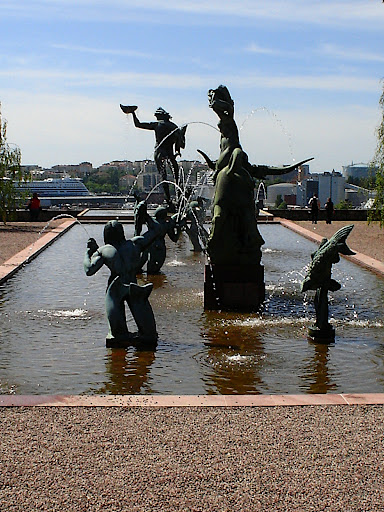
Here is a short movie by Ingmar Bergman. Here is a Carl Milles sculpture. Here is some cabbage with your pizza.

Posted by Tyler Cowen on February 11, 2009 at 07:41 AM in Political Science | Permalink"

Me:

"Sweden looks like a good model"

Here's the deal: It's a model. That means:

1) It worked
2) It can be assessed as you're implementing it
3) It's harder to lobby against
4) It's moral hazard that the bankers fear
5) It will be easier to get out of

TARP is a hybrid. The interests of the banks and taxpayers are not the same. The GAO couldn't even assess it. You can believe that this mess and expense is worth it to avoid actually taking over a few banks, but you're fooling yourself. These banks are wards of the state, and the money we're spending is taxpayer money. We were talking recently about using the stimulus to fool people into thinking things are better than they are or that government is on the case. TARP is fooling everyone into believing that we're preserving some sacred free market principles. Maybe the stimulus will work, even if it is a placebo.

Posted by: Don the libertarian Democrat at Feb 11, 2009 9:52:49 AM

Hybrid example for today:

http://www.nytimes.com/2009/02/11/business/economy/11react.html?hp

"Washington Hopes ‘Vulture’ Investors Will Buy Bad Assets"

"Another big issue is the price at which the troubled assets would be valued by the banks. While potential investors want to buy as cheaply as possible, the banks might have to take debilitating write-downs if they sold at fire-sale prices. Such an outcome might not be in the government’s — or taxpayers’ — interests.

But competing interests are bound to bedevil this kind of deal, said Campbell R. Harvey, a professor at the Fuqua School of Business at Duke University.

“Given the conflicting objectives, I’m not sure I’d be interested in this kind of altruistic investing,” he said.

And the potential political costs, money managers said, are real. Some managers said that if they did their job well, they could earn double-digit returns and, with them, public scorn.

“We can’t really win,” one private equity executive said. “When we made money, people criticized us. This year, we lost money, and people are criticizing us.”

Posted by: Don the libertarian Democrat at Feb 11, 2009 10:37:36 AM

Tuesday, February 10, 2009

All of which points I'm sure Obama could have made much better himself,

From Felix Salmon:

"
Barack Obama for Treasury Secretary!

After Tim Geithner's uninspired and uninspiring performance today, Barack Obama stepped up to show him how questions about nationalization should be answered:

TERRY MORAN: There are a lot of economists who look at these banks and they say all that garbage that's in them renders them essentially insolvent. Why not just nationalize the banks?

PRESIDENT OBAMA:Well, you know, it's interesting. There are two countries who have gone through some big financial crises over the last decade or two. One was Japan, which never really acknowledged the scale and magnitude of the problems in their banking system and that resulted in what's called "The Lost Decade." They kept on trying to paper over the problems. The markets sort of stayed up because the Japanese government kept on pumping money in. But, eventually, nothing happened and they didn't see any growth whatsoever.

Sweden, on the other hand, had a problem like this. They took over the banks, nationalized them, got rid of the bad assets, resold the banks and, a couple years later, they were going again. So you'd think looking at it, Sweden looks like a good model. Here's the problem; Sweden had like five banks. [LAUGHS] We've got thousands of banks. You know, the scale of the U.S. economy and the capital markets are so vast and the problems in terms of managing and overseeing anything of that scale, I think, would -- our assessment was that it wouldn't make sense. And we also have different traditions in this country.

Obviously, Sweden has a different set of cultures in terms of how the government relates to markets and America's different. And we want to retain a strong sense of that private capital fulfilling the core -- core investment needs of this country.

And so, what we've tried to do is to apply some of the tough love that's going to be necessary, but do it in a way that's also recognizing we've got big private capital markets and ultimately that's going to be the key to getting credit flowing again.

Now I'm on the record as being decidedly pro-nationalization, but this is as clear and well-argued a case for not nationalizing as you could hope to get. First, Obama makes it very clear that he understands full well why nationalization is an attractive idea not just at first blush ("Why not just nationalize the banks?") but at second blush too.

Obama then makes the good point that the banking system in the US is orders of magnitude larger and more complex than the banking system in Sweden was when it was nationalized. He doesn't even need to mention that the Swedish government is good at getting things done in the way that American governments simply aren't. You try orchestrating something like this as seamlessly as the Swedes managed it. If the US government was in charge of "managing and overseeing" everything from trillions of dollars in bank assets to the amount that banks charge for a bounced check, there might well be all manner of unintended consequences, and indeed pro-nationalizers like myself have generally tried to come up with plans which would keep the banks operating at arm's length from their shareholder even after they were nationalized.

Obama also talks about "traditions" and "cultures" -- and he's right, the Swedes are much more amenable, on a gut level, to state-owned banks than Americans are. That kind of thing matters more than many economists will admit. America has always prided itself on being the home of private-sector capitalism, and it doesn't want to signal otherwise.

And so the Obama administration has put together a plan which tries to involve private capital as much as possible -- something which really can't be done if you're nationalizing. It's now incumbent upon Tim Geithner to articulate that plan clearly and in detail -- something he inexplicably failed at today. I used to go to his press conferences when he was last at Treasury, in the late 1990s, and he was always very much on top of his brief then, so it defeats me why he would take no questions today and generally be so vague about what he intends to do.

Never has it been more important that the markets have faith in the Treasury secretary -- and first impressions count for a lot. Today was a very bad start for Geithner. Obama's doing his best to support him, but really that's the wrong way round. Things had better start improving markedly very soon, or Geithner might not stay in his job for very long.

Incidentally, Paul Kedrosky is much less impressed by Obama's response than I am:

All this talk of "culture", "traditions", and so on are an opaque way of saying that Democrats are terrified of nationalization because they worry about Republican name-calling. Further, saying that Sweden had five banks and the U.S. has thousands, so nationalization can't happen here, is misleading. It ignores the relative GDPs of the two countries. What's more, as measured by asset size, the problem is chiefly in the six largest U.S. banks which collectively account for the preponderance of the banking industry balance sheet. Muddying the issue by saying that we would need to nationalize "thousands of banks" isn't helpful.

As I say, I think the point about culture and traditions is actually substantive; it's not party-political. The number of banks in a country has almost nothing to do with its GDP; I don't know what Kedrosky's point is there. And Obama never said that we would need to nationalize thousands of banks. But if you nationalize some banks, then you introduce a generalized, and possibly self-fulfilling, fear that you might nationalize any bank. Pointing at smaller banks and saying "we won't nationalize you" is a recipe for creating multiple bank failures, if there's no other option for bailing them out. All of which points I'm sure Obama could have made much better himself, had Moran followed up rather than moving on to another topic."

Me:

"Obama also talks about "traditions" and "cultures" -- and he's right, the Swedes are much more amenable, on a gut level, to state-owned banks than Americans are. That kind of thing matters more than many economists will admit. America has always prided itself on being the home of private-sector capitalism, and it doesn't want to signal otherwise"

I can't think of a better way of discrediting the free market and small government than identifying it with TARP, in all its alluring versions of imbecility. We have a Welfare State. It's heavily, especially in the last 8 years, influenced by cronyism. Here's a paper I like. I'm sure most people won't:

http://www.petersoninstitute.org/publications/interstitial.cfm?ResearchID=1096

"But if you nationalize some banks, then you introduce a generalized, and possibly self-fulfilling, fear that you might nationalize any bank"

And if you don't take that chance, you might well leave the banks believing that lobbying saved the day. That's hardly an unjustified fear. We're currently living it.

"orders of magnitude larger and more complex"

Give me a figure.

"the Swedish government is good at getting things done in the way that American governments simply aren't."

So we're condemned to wasting billions of dollars?

"So you'd think looking at it, Sweden looks like a good model"

Gee. A model. How awful. Much better to use error and error until something seems to work.

"there might well be all manner of unintended consequences'

That's true of any plan. Look, no ones arguing that nationalization is pleasant or easy. It's just much better than TARP because:
1) It's worked
2) There's a model, so that we can assess our progress.
3) It will terrify the banks. A good thing.
4) It's not a hybrid, where the interests of the govt and banks collide.

I admire you for trying to be fair, because, it's true, nothing is written, but this has left me wondering what's changed. Silly me, expecting change.

Sunday, January 25, 2009

"As CBS’s Bob Simon put it, they must be put into a “panic” that American support is now conditional on specific behavior. "

From Bernard Avishai:

"What's Love Got To Do With It - Part Two

(This is the second of a two-part post marking Senator Mitchell's appointment as Middle East Envoy.)

Make no mistake: Palestine is not Hamas and Israel is not its settlers, though the trends are depressing( I AGREE ). Poll after poll shows that a majority of Palestinians still want peace with Israel: Palestinian elites look forward to cooperation with Israelis on advanced businesses, higher education, construction, and tourism; they may even have some affection for Israelis; they know that their economic dignity and secular life depend on staving off Hamas. ( I AGREE )

And a majority of Israelis still want peace with Palestine, skeptical as they may be of Palestinian political institutions. Israeli elites are stirred by globalization and know that West Bank business infrastructure cannot development with 500 checkpoints. They know their own economic growth and cultural vitality depend on peace; their children, many of whom are leaving the country, hate guarding and paying for settlements.( TRUE )

Yet both sides’ leaders, no matter who they are, cannot break out of a now impossible bind. They cannot imagine prompting a near-term fight with their own rejectionists, which means wide-scale civil disobedience, even civil war, for a long-term negotiation that would be hostage to the first atrocity( THIS HAS BEEN THE PROBLEM ALL ALONG ). Peace advocates are exhausted, increasingly cynical, overwhelmed by military professionals and insurgent militias depicting their own actions as preempting the other side in a fight-to-the-finish. Hamas and Israeli rightists do not oppose a peace deal the way Republicans oppose Keynes. They have killed their own leaders to get their way. And this—not just a stalled “peacemaking process”—is where America comes in.

THERE IS ONLY way out of this trap: the Obama administration must make it clear—crystal—that the deal embodied in the Clinton parameters is American policy and a vital American national interest. To oppose it is to oppose America. Negotiation is over the details of implementing it, like the Geneva Initiative group, but not over its main principles. For the record, the Israeli government under Ehud Barak accepted these principles in December 2000, while Yasir Arafat dragged his feet, accepted them with reservations, but then authorized the PA negotiating team to follow up at Taba (out of which the Geneva negotiations sprouted). Later in 2002, as the violence spread, Arafat accepted the Taba plan.( TRUE )

So in adopting the Clinton parameters, the Obama administration would not exactly be pushing on an open door, but it would be embracing the deal that any Israeli and Palestinian leader sincere about peace has already embraced( YES ). Adoption would certainly expose leaders who are not sincere about peace--people who use the other side's threat as a cover for ultra-nationalist ends. One such leader may soon be the Israeli prime minister. ( YES )

The PA's current leaders, many of whom have participated in creating the deal, are not likely to act in ways that will undermine it. They are its most obvious immediate beneficiaries, and will no doubt use it to gain international legitimacy for a stronger security force, and new infrastructural investment, leading to a Palestinian state. And adoption would reinvigorate the Israeli peace camp; it would immediately reimpose an invisible border. In any case, Israeli leaders must see that resisting this deal means foiling American interests, those of the European Union, and moderate Arab regimes, too; that is the world’s deal, based on conventional notions of civil rights and utilitarian principles; that Israel risks growing isolation, political and economic, if it fails to adapt to it. New settlements beyond this border, in the West Bank or Jerusalem, will be met with sanctions.( YES )

Israel’s leaders, in other words, must start their planning for a permanent border, and new administrative arrangements for Jerusalem( YES ). As CBS’s Bob Simon put it, they must be put into a “panic” that American support is now conditional on specific behavior( YES. OR WE GET OUT. ). The Road Map, which was Mitchell's brainchild, speaks of building confidence—Israel by stopping settlements, Palestinians by containing terror—before moving to a deal. If this sequence ever made sense, it now gets things exactly backwards. Both sides need the deal to be etched in their imaginations and reinforced by all manner of international actions. Only then does it make sense to speak of building confidence.( YES )

THERE IS A serious change in approach here, as there has been with the economy, but it is not hard to imagine how to proceed. Senator Mitchell is coming here next week, according to reliable reports. Secretary Clinton might come immediately after his initial meetings to address both the Israeli Knesset and what's left of the Palestinian parliament to announce that the Clinton parameters are American policy; that she challenges all sides to embrace them. Obama, for his part, should then stress how failure to accept the parameters will be viewed as inimical to American plans for the region.

In parallel, Clinton and the new National Security Advisor, General James Jones, should line-up support from the EU and the UN Security Council, which will almost certainly rally to them. But their vision should not end there. They should speak positively about President Sarkozy’s idea of a Mediterranean Union, with Israel and Turkey acting as anchors. Clinton should offer to help organize a start to a regional water carrier to bring Turkish water to Syria, Jordan, Palestine and Israel. There should be talk of an common market between Israel, Palestine and Jordan( A GREAT IDEA ). Jones should speak about a bilateral defense pact with Israel and an American naval base in Haifa. The U.S. must get away from the idea that peace means "We give them land, and then maybe they'll leave us alone."

Rather, the deal should appear a part of an emerging global consensus—like cooperation on emergency financial reform, or police action against terror. The talk should be of new federal relations and new economic unions: a patently Jewish state that is also a state of global citizens; a Palestinian state linked to Jordan and Israel that is patently a state of laws and civil rights. People who oppose the consensus must be made to feel like international pariahs, not just opponents of some (spineless) domestic “peace camp.”( YES )

YET--AND THIS is crucial--President Obama should stress that implementation need not be rushed. As long as all know where we are going( YES ), we can get there with deliberate caution, in a gradual but time-certain way that permits affected parties--Israeli settlers, returning Palestinian refugees, Israeli defense specialists nervous about letting go of the tiger's tail--to take steps toward a new reality in way that minimizes the furies of disappointment and grief. A little compassion, and a lot of hopeful oratory, can go along way here. The deal will overturn many lives; it will take some time for people to see its virtues. Obama's ability to speak about generational transformation is a unique asset here.( OK )

Israeli settlers must be given time, perhaps five years, to find new homes within the Israeli state. The Israeli state apparatus should have time to repatriate and compensate Israelis who return; to plan, with the help of international forces, to cut settlements off according to a time-table from the Israeli power grid and water network.

The PA, for its part, should be given time to develop an effective domestic security force, like the one in Ramallah and Jenin, to establish its authority throughout the West Bank. Before refugees begin returning, the PA must be given time to engender the businesses and construction projects that will employ them. The state must develop an “absorptive capacity,” as the British once said about the Jewish Yishuv in Palestine. Only then will the PA be able to restart dialogue with Hamas from a position of strength. Meantime, the border between Gaza and Egypt should be opened.( YES )

Most important—and even before Israel terminates its occupation—the U.S. should lead the creation of a 10,000-person NATO force in and around Gaza and the West Bank, to monitor events and buttress anticipated areas of demilitarization. The force should give greater confidence to foreign investors, working alongside—not in place of—the emerging PA police. All members of the Arab league should make clear that recognition of Israel and full peace goes along with the deal; they should offer as down payment open academic and business exchanges with Israel. In this context, a peace with Syria should be concluded, with the demilitarized Golan turned into a demilitarized nature preserve.

The point is, if we have learned anything from this past year it is that things that “cannot go on” eventually can’t. The current carnage in Gaza is nothing if not a wake-up call: peace is not impossible, but Jerusalem could become a kind of Sarajevo in a matter of weeks, with Israeli Arabs joining in the fray. President Obama has the privilege of coming into power during a Middle Eastern crisis, which like all the other crises create opportunity. He can bring a new era to this region, but as with his plans for economic recovery, climate change, and the rest, the greatest danger is in thinking small."( YES PLEASE )

Wednesday, January 21, 2009

"but it seems to be the best of many bad solutions"

Andrew Ross Sorkin in the NY Times:

"Dealbook:Obama’s Bailout Challenge

Another week, another bailout.

Governments in several countries are suddenly scrambling to deliver a second round of financial support to their teetering banking systems, after a first wave handed out at the height of the financial crisis failed miserably in its mission of getting credit flowing again( TRUE ).

Britain on Monday set the stage for a full takeover of its banking system. And now, Barack Obama is trying to figure out how to shore up this nation’s banking industry as its crisis snowballs.

Mr. Obama is going to have one heck of a first day on the job. Already, his aides have a bevy of ideas to sift through, ranging from having government buy banks’ troubled assets, to creating a “bad bank” to soak them up.( YIKES )

And it doesn’t stop there. Others say he should follow the model of Sweden and flat-out nationalize the American banking system( NOT THE ENTIRE SYSTEM. COME ON. ). Or he should inject more money into the banks and force them to lend it( THEY'RE SO GOOD AT IT. ). Another view says he should take a page from Henry M. Paulson Jr., the Treasury secretary, and try to “ring fence” the entire system with the equivalent of government insurance for banks.

Lawrence H. Summers, Mr. Obama’s chief economic adviser, hinted Sunday that he’d been developing a new plan, and seemed to suggest he was leaning toward finding a way to press banks to lend more money. “The focus isn’t going to be on the needs of banks,” he said. “It’s going to be on the needs of the economy for credit.”

Prime Minister Gordon Brown made similar noises on Monday, when he outlined a new £100 billion plan in which the government wrests a promise from banks to raise lending in exchange for having the taxpayer limit the banks’ losses from troubled assets.

“That will be legally binding,” Mr. Brown declared.

But let’s stop for a moment. This has been a popular — and populist — view that has emerged over recent months: those greedy bankers are hoarding our tax dollars instead of lending the money the way they were supposed to do. And it needs to stop.

This view, however, may be misplaced. As Citigroup and Bank of America have sadly demonstrated, if they had lent the money they were given last fall as part of the Treasury Department’s $700 billion bailout plan, they would be in even more trouble than they are now. And we, the taxpayers, would be even worse off.

Why? Because the government bought preferred shares with its first round of capital injections, banks, whose capital cushions have already thinned drastically, must keep the capital on their books if they are eventually to repay the loans.( THAT'S TRUE )

Yet if the banks directly lent the money being pumped into them, many could go bankrupt, requiring the government to step in again( YEP ). At the end of the day, as Mr. Obama and others have acknowledged, the nation must have a viable financial system.

Jamie Dimon, the chief executive of JPMorgan Chase, whose bank received TARP funds, took the issue seriously last week on a conference call with investors. “There have been a lot of questions out there on whether banks are making loans,” he said. “We are making loans all the time, but we are trying to follow the intent and spirit of TARP, which is to help the economy of the United States recover and make sure we’re financing people.”

Mr. Dimon, however, represents just one bank, and it may be the only bulge bracket bank in the nation that is healthy.

Which leads us to the much-heralded idea of following Sweden’s model of nationalizing our banking system. This approach worked quite well for the Swedes in 1992, when their banking industry was teetering much the way ours is now after a real estate bubble and lax lending led to a realization that the banking system was insolvent.

The Swedes spent $11.7 billion at the time, taking huge stakes in their banks. It took years, but eventually, they sold these stakes successfully. And while the gamble at the time was huge — the bill was about 4 percent of its gross domestic product — some observers say Sweden has since been whole. So intriguing was the idea, the Swedes sent a delegation to Washington in September to talk about their experience.

But the Swedish model, as attractive as it appears at first blush, would be a challenge to pull off here in the United States. Aside from the fact that America isn’t about widespread nationalization( JUST WIDESPREAD AND FOOLISH BAILOUTS ), the biggest problem with the Swedish model is that when it is applied here, it costs more — much more.( DID YOU HEAR THAT IT WORKED? )

America has already spent $1.5 trillion trying to solve our problem. To pull off a response similar to Sweden’s, we’d probably have to double, if not triple, that number. The chances we’d recover the money are even slimmer, given how much time it will take a larger economy like ours to come back from such a severe recession.( AND BUYING TOXIC ASSETS? )

More important, the values of our financial garbage — subprime mortgages, C.D.O.’s and derivatives — may eventually prove ethereal. Sweden’s banks had at least backed real tangible assets.

With options narrowing, Mr. Obama is also being pressed to consider the Paulson “ring fence” plan, adopted by Mr. Brown of Britain on Monday. And while it may work there, it would be difficult to make it work here in a systemwide way. So far, it’s been used in an ad hoc manner, customized for each bank.

So we’ve been left with a plan pushed by Sheila C. Bair, the chairwoman of the Federal Deposit Insurance Corporation, that calls for the government to buy up toxic assets from the banks, similar to the original plan for the TARP money.

But that plan was abandoned for all the right reasons: it would mean government would either have to buy the assets at inflated prices from banks — and therefore lose even more money on them — or risk forcing such massive write-downs that the banks would be insolvent all over again.( THAT'S IT )

I know what you’re saying: it’s easy to to knock down others’ ideas — what’s your idea?

Well, how about just following the current system of injecting money into banks to recapitalize them when they need it and “ring-fencing” bad assets when we can? It may not be popular, and it may take a while to work, but it’s one of the few viable alternatives. Perhaps we’ll have to pony up even more money — and maybe we should take an even bigger slice of equity — but it seems to be the best of many bad solutions."

Not quite.

If these "concerned" investors would rather try to fight for what they are owed, post-bankruptcy, amid the utter wreckage of Wall Street,

Andrew Leonard on Salon:

"The Obama honeymoon is over: Dow drops 332

Roll up your sleeves, Mr. President. For economy-watchers of a liberal persuasion, the euphoria induced by the swearing in of the nation's first African-American president had all but evaporated by the time the New York Stock Exchange closed for the day. The Dow Jones industrial average fell 330 points, or 4 percent, closing under 8000. The honeymoon? Over -- even before the sun had set on the first day of Obama's presidency.

Banking woes, again, spurred the sell-off( TRUE ). If the announcement that the Royal Bank of Scotland had toted up losses of $40 billion for all of 2008 wasn't enough, revelations of severer-than-anticipated problems at Boston's State Street bank stoked additional fear among investors who now seem to have one finger permanently on the panic button.

The Financial Times found one unnamed "Wall Street banker" who claimed that fears of "nationalization" were contributing to investor dismay.

Investors are deeply concerned that the U.S. government might follow the lead of the U.K. and come in with a rescue package that hurts shareholders by wiping out companies' shares..."

They should be so lucky. At this point, fewer and fewer alternatives to outright nationalization appear feasible( TRUE ). If these "concerned" investors would rather try to fight for what they are owed, post-bankruptcy, amid the utter wreckage of Wall Street, one might be tempted to wish them luck( I AGREE. OR THEY COULD LEND MONEY TO THE BANKS THEMSELVES OR BUY MORE STOCK, DRIVING THE PRICE UP. ), if it weren't for the real possibility that a wave of cascading bank failures could easily propel the current financial crisis into an even more destructive stage -- for everyone.

President Obama already has a meeting with his top economic advisers on the schedule for Wednesday morning -- which is also when Treasury Secretary nominee Timothy Geithner's confirmation hearing is set to finally take place. One wonders how many questions Geithner will get on his tax issues relative to what some might consider a more pressing worry: What do you plan to do, this afternoon, to stop the global banking system from imploding?( IN POLITICS, THE TRIVIAL IS OFTEN THE FOCUS. )

Friday, January 16, 2009

"A better option is to push for a workable solution now"

From Daniel Levy on Prospects For Peace:

"
Gaza and the Obama Effect—Ending the War

This piece can also be read at Huffington Post.

Barack Obama is not even President yet but he may have just played a central role in getting to a ceasefire in the current Gaza Israel crisis--just by being there. All the signals are that we are in a final and ugly escalatory cycle in advance of hostilities being ceased and that the proximity of this war ending to next week's inauguration of the new President is not coincidental. ( GOOD NEWS )

Here's where things stand:

Egyptian mediation is now reaching a ceasefire package building on U.N. Security Council Resolution 1860, and barring last minute hiccups, it is likely to deliver a breakthrough in the very near future( VERY GOOD ). The elements of that ceasefire package are well known: ending military actions and rocket strikes, withdrawing IDF forces, opening the Gaza border crossings, and preventing future weapons smuggling into Gaza. In fact, one of the most painful truths of this conflict is that these ingredients were known in advance and had the current, frantic diplomacy been conducted one month ago, this terrible human suffering could probably have all been avoided( ALL VERY TRUE ). The details are now being hashed out with the comings and goings of Israeli and Hamas officials in Cairo.

On the Israeli side, there have been fierce disagreements within both the political and military leaderships since Operation Cast Lead was launched. Defense Minister Barak apparently supported a truce during the very first days of the attack( GOOD FOR HIM ). Foreign Minister Livni later got on board for a de-escalation( I ACTUALLY LIKE HER ), and with the military chief of staff widely reported to be unenthusiastic about an entrenched and prolonged re-occupation of Gaza( SMART ), the Prime Minister seems finally ready to bring this to an end.

In recent days, the Israeli media has seemed to be building to this crescendo with generous helpings of propaganda with regards to Israel's achievements and the of enfeeblement of Hamas (the true picture is likely to be more mixed). ( TRUE )

The Defense Minister also scored his victory photo today with the killing of Hamas Interior Minister Said Siam. While that is the picture most Israelis will be looking at, the rest of the world is likely to be pouring over further bombings of U.N. facilities and a death toll that is now over a thousand, of which according to Israeli estimates, only 360 are Hamas fighters (according to Ofer Shelah in the Maariv newspaper, quoting Israeli military sources). Nevertheless, the war has given Ehud Barak and his Labor party a boost in the run-up to February's elections. ( I'M HAPPY ABOUT THAT, BUT DON'T AGREE WITH THIS WAR. )

The war has been popular with Israelis and a key element in delaying a ceasefire has been the need for not just one, but two, victory narratives and photos--one each for the two senior ministers whose parties are competing in elections (Livni and Barak). By the way, it's worth remembering that the Iraq War was just as popular with the American public after three weeks as this action is with the Israeli public. But even if Israel ends now, the longer term consequences are likely to be as debilitating for Israel in this situation as they have been for the US in Iraq. ( I AGREE )

According to the latest news, Livni is now likely to get her own victory photo, too. The Israeli Foreign Minister is on her way to Washington to sign a memorandum of understanding with Secretary Rice regarding American commitments to assist in preventing weapons smuggling into Gaza. It will almost certainly be Rice's last act in office.

Hamas, too, is busy preparing its own victory narrative. They will claim to have withstood the Israeli onslaught and to have deterred the Israelis from entering deeper into the urban warfare awaiting them in Gazan cities. They will assert that despite international efforts to isolate Hamas, they have been negotiating the terms of the ceasefire and that they have achieved their key demand of lifting the closure on Gaza (it's worth noting that according to Israeli's former Mossad chief and former national security adviser, Efraim Halevy, "If Israel's goal were to remove the threat of rockets from the residents of southern Israel, opening the border crossings would have ensured such quiet for a generation"( I AGREE )). Expect Hamas to also emerge politically strengthened with President Abbas having looked like a bystander throughout this conflict and even being perceived by many as complicit in the destruction wrought on Gaza( TRUE. THIS SADDENS ME. I ADMIRE HIM GREATLY. ). The terrible images emerging from Gaza, and that may get worse (when foreign camera crews finally get into Gaza and the extent of damage becomes known) are likely to generate further sympathy.

If a ceasefire is becoming imminent, then it is fair to assume that while the dynamics of the conflict (Israeli recoil from fully re-occupying Gaza), and the diplomatic effort have played a role, the key element to timing here is the approaching Obama presidency. ( INTERESTING )

First of all, the various actors--and one imagines Israel in particular--will not want to piss on Obama's parade this Tuesday. More substantively, there is an expectation that the new president would have felt compelled to immediately intervene in this situation. While there is an assumption that the Obama administration will remain strongly supportive of Israel, one can also anticipate a more thoughtful articulation of what serves American interests in the Middle East, how the close Israel-America relationship should be managed, and the taking of corresponding efforts to immediately de-escalate this spiraling crisis. It might be pushing the envelope to call Obama the peacemaker here, but it's hard to deny that his impending entrance to the world stage has an effect.

If this conflict does now end (as one desperately hopes it will), then it will of course be the Obama administration that is left to deal with the fall out. The memo of understanding, due to be signed by Israel and the US tomorrow, is one part of that. It seems to be a smart move by Condoleezza Rice to give this to the Israeli Foreign Minister in order to get her fully on board for ending the war. If it is indeed mostly political theater, an election campaign photo-op for Livni, then so be it. But if it amounts to more, then this might well be one final poison chalice that the Bushies are bequeathing to 44. If America is to play an active military role in the Sinai, then expect complications and a scenario with all the makings of nurturing over time another insurgency with possible blowback, and even with consequences for the shaky and unpopular regime of Egyptian President Hosni Mubarak.

Then there is the rest of the post-Gaza mess: a humanitarian emergency to alleviate, the further weakening of America's regional allies, notably including the Palestinian Authority, and a new wave of anger in the region directed at America and its Israeli ally. The first challenge is to make the elements of the ceasefire actually work - ensure an end to hostilities, an IDF withdrawal, and functioning border arrangements( TRUE ). Immediately following that comes the need to rebuild and rehabilitate Gaza which will require an international effort. Essential here will be to avoid the temptation of using reconstruction assistance as a blunt instrument to advance regime change in Gaza but rather to shape this as a core ingredient in facilitating the beginning of a serious Palestinian national reconciliation. That means changing course on the previous failed policy and encouraging - and not vetoing - third party mediation efforts between Fatah and Hamas. ( I AGREE )

But it is the bigger picture of the festering Israeli-Palestinian conflict that will continue to sap US credibility and security until a workable equilibrium can be found. That will require a realistic approach not only to Gaza and its rulers but also to the other 94% of the Palestinian territories - the West Bank and East Jerusalem (the '67 territories) - an approach that finally guarantees Israeli security within recognizable borders and Palestinian independence and de-occupation( I AGREE ). US leadership will be a prerequisite for achieving it.

This issue has forced itself early onto the Obama agenda and if it returns to the back burner than it is guaranteed to periodically explode in everyone's face, sucking America in and costing America dear. A better option is to push for a workable solution now. Nothing will more dramatically and positively affect the prospects for successful US diplomacy in the vital challenges it faces in this most dangerously destabilized of regions. "

I agree.