Showing posts with label In the dark. Show all posts

Saturday, June 6, 2009

The play revolves around the character of Lulu, an enigmatic figure who is at times innocent and vulnerable and at others cynical and manipulative

TO BE NOTED: From In The Dark:

"Lulu

On Thursday (4th June) I went to the first night of the Royal Opera’s new production of Lulu, an Opera by Alban Berg. I was planning to blog about this yesterday but after the Opera my birthday celebrations descended into drunken chaos and I ended up getting back very late to Cardiff yesterday; I had to catch up a number of things so I didn’t have time. After the performance and dinner in a nearby restaurant we sat out on Joao’s roofgarden in Notting Hill drinking until the sun started to come up. That part is a bit of blur, but judging by the scale of my hangover yesterday it must have been good. Anyway, I’ve now recovered enough write something about the Opera.

Before Thursday I hadn’t seen Lulu in a live performance, although I do have it on DVD so I knew a bit about it. Berg was a student of Arnold Schoenberg, but he developed his own take on the twelve-tone techniques developed by his mentor. Not everyone finds serialist music easy to enjoy, but I think if you’re going to have a go at it this Opera is one of the best places to start. I think the score for Lulu is completely wonderful: it’s constantly changing texture, sometimes lushly romantic (with a big nod in the direction of Mahler in Act I), sometimes bleak and jagged. Sometimes there is no music at all and the singers use a stylised method of vocalisation in between speaking and singing (called Sprechstimme). This is used only sparingly in Lulu, but it is wonderfully effective dramatically when it is.

The Orchestra of the Royal Opera House, conducted by Antonio Pappano, were absolutely fantastic throughout the performance. I’m no musician but I reckon this music must be extremely difficult to play, especially in the brass section, but they played with great passion as well as flawless precision. They really brought Berg’s music to life, and invested it with a vitality that positively glowed throughout the performance. It was easy to understand why Berg was such an influential composer: you can hear in this Opera the ideas behind many Hollywood movie scores, for example.

So what about the Opera itself? The play revolves around the character of Lulu, an enigmatic figure who is at times innocent and vulnerable and at others cynical and manipulative. Her personality is only revealed to us through her interactions with men, all of which end in disaster. Lulu’s first husband has a heart attack and dies; her second commits suicide. She then shoots another man and is imprisoned but eventually escapes. By the end of the opera, many years later on, she has wound up in London and is living in poverty working as a prostitute. She dies at the hands of Jack the Ripper.

The structure of the Opera is like a mirror, with Lulu’s reversal of fortunes happening after an intermezzo in the middle of Act 2 at the centre of which there is a musical palindrome (shown above). Before this her, role in the drama is to drive the men around her into obsession, madness and death, although she never appears to understand why she has this effect on them. After the dramatic fulcrum of the piece she becomes more and more of a victim. The reason for this is not some great change in her own psychological make-up but just that she is getting older and losing her looks. No longer sexually desirable, she has lost the only way of controlling the men in her life. From this point on, her decline is inexorable and death inevitable.

The new production is quite unlike the recording I have on DVD in that the staging is resolutely minimal. There is no set, just an occasional translucent screen, the costumes are modern and colours are monochrome. Lulu is dressed at one point in a black cocktail dress very like that worn by Audrey Hepburn in Breakfast at Tiffany’s. This might have been a deliberate reference to the parallels between Lulu and Holly Golightly (at least in Truman Capote’s novella, which is a much darker concoction than the film based on it); soprano Agneta Eichenholz bears more than a passing resemblance to Audrey Hepburn too. Her slender build -unusual for an opera singer with such a powerful voice – allowed her to play Lulu’s vulnerable aspects very well.

Against a sparse backdrop the characters emerge as series of grotesques, which – at least in principle - is not a bad way of presenting this Opera. Set in such a way it appears as a piece of absurdist theatre which is definitely part of what it represents. There are two problems, however.

One is that the sets give very little clue as to the location of the drama: I wouldn’t have known that the last scene was meant to be Victorian London unless I’d seen it before, so Jack the Ripper’s appearance must have been very confusing to those who hadn’t picked up on that. Lulu is also meant to be a lot older in the last Act, but no attempt is made to age her in this production. The libretto makes repeated reference to a painting of her,but no portrait appears; I found that a bizarre omission.

The other problem is that there are strong links between the story of Lulu and the Grand Guignol of horror plays, with their opulently macabre stagings and exaggeratedly gory endings. Throwing all those connections away robs the Opera of all of its schlock value and, with that, a great deal of the irony needed to make this blackest of black comedies work the way it should. The killing of Lulu in fact happens off stage in this production which makes the ending very tame. I wouldn’t want to go over-the-top in depicting the horror of Lulu’s death – I wanted to see an Opera, not a snuff movie – but the audience should be shocked by the brutality of her final moments; these are the key to what the Opera is about. Perhaps the director was concerned not to let the drama descend into mere titillation. There’s always a danger of crossing the line into pornography in making the sexuality and violence explicit but I think this production is too afraid of taking risks. This opera should feel more dangerous than this setting allows it to be.

Although limited by the stylized nature of the production, the principals were good. Agneta Eichenholz’s is a desensitized creature, damaged by abuse and inhabiting a moral vacuum. Her detachment in the face of the death and destruction around her is perfectly judged. She sang beautifully for the most part but - possibly because of first night nerves - her voice came apart on a couple of high notes early on. Other characters worth mentioning are Michael Volle who was outstanding as Dr Schön and Philip Langridge in the dual role of the Prince and the Marquis.

This morning I read Andrew Clements’ review in the Guardian which I thought was a bit harsh: only two stars doesn’t really do justice to it. I would have given three stars for the quality of the music alone. Personally, I could have listened to the whole thing in a concert performance and still enjoyed it. But having decided to go for a full staging, it seems to me a bit perverse to have stripped it down so drastically. Clements claimed he was “bored” by what happened on stage. I certainly wasn’t, but I did find myself more perplexed by the production that by the moral ambivalence of the story itself, so I’d have to say it didn’t really do justice to an Opera which I still think of as masterpiece."

Sunday, May 31, 2009

I think the Miles Davis version demonstrates his genius not only as a musician himself but also as a bandleader.

TO BE NOTED: From In The Dark:

"On Green Dolphin Street

Years ago in 1980, when the great pianist Bill Evans passed away suddenly, Humphrey Lyttelton paid tribute to him on his radio programme “The Best of Jazz” by playing a number of tracks featuring him. I didn’t really know much about Bill Evans at the time – I was only 17 then – but one track that Humph chose has been imprinted on my mind ever since, and it’s one of those pieces of music that I listen to over and over again.

The track is On Green Dolphin Street, as recorded in 1958 by the great Miles Davis sextet of the time that featured himself on trumpet, John Coltrane on tennor sax, Julian “Cannonball” Adderley on alto sax, Jimmy Cobb on drums, Paul Chambers on bass and Bill Evans on piano. This is the same band that played on the classic album Kind of Blue, one of the most popular and also most innovative jazz records of all time, which was recorded a bit after the recording of On Green Dolphin Street. I love Kind of Blue, of course, but I think this track is even better than the many great tracks on that album (All Blues, Flamenco Sketches, Blue in Green, etc). In fact, I’d venture the opinion – despite certainty of contradiction – that this is the greatest Jazz recording ever made.

On Green Dolphin Street was suggested to Miles Davis the band’s leader by the saxophonist Cannonball Adderley. It was the theme tune from a film from the late 1940s. It’s also the title of a more recent very fine novel by Sebastian Faulks.

I think the Miles Davis version demonstrates his genius not only as a musician himself but also as a bandleader. On Green Dolphin Street definitely bears the Miles Davis hallmark, but it also manages to accommodate the very different styles of the other musicians and allows them also to impose their personality on it. This is done by having each solo introduced with a passage with the rhythm section playing a different, less propulsive, beat behind it. This allows each musician to set out their stall before the superb rhythm section kicks into a swinging straight-ahead 4-4 and they head off into their own territory. As the soloists hand over from one to the other there are moments of beautiful contrast and dramatic tension, especially – and this is the reason why Humph picked this one in 1980 – when Bill Evans takes over for his solo from Cannonball Adderley. He starts with hesitant single-note phrases before moving into a richly voiced two handed solo fully of lush harmonies. It’s amazing to me to hear how the mood changes completely and immediately when he starts playing.

Not that the other soloists play badly either. After Bill Evans short but exquisite prelude, Miles Davis takes over on muted trumpet, more lyrical and less introspective than in Kind of Blue but still with a moody, melancholic edge. He’s followed by John Coltrane’s passionately virtuosic solo which floods out of him in an agonized stream which contrasts with Miles’ poised simplicity. By contrast, Cannonball Adderley is jaunty and upbeat, sauntering through his solo up to that wonderful moment where he hands over to the piano. Then Miles Davis takes over again to take them to the conclusion of the piece.

I’m not into League tables for music, but this is definitely fit to put up alongside the greatest of them all…

Thursday, May 21, 2009

these deep and moving expressions of romantic love were not written from a man to a woman, but from one man to another

TO BE NOTED: From In The Dark:

"The Darling Buds of May

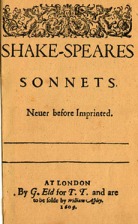
Four hundred years ago today, on the 20th May 1609, William Shakespeare published a collection of 154 Sonnets which arguably represent just as high a level of literary achievement as his plays. At any rate they’ve survived in popularity just as well and also furnished a huge number of memorable phrases including, appropriately enough for the time of year, the title of this post. This was, in fact, the only edition of the Sonnets published in Shakespeare’s lifetime and the circumstances of its publication remain uncertain.

Most of the poems concern Shakespeare’s love for a young man, ”Mr WH, the Onlie Begetter of the Sonnets”. However, there is a also group of sonnets addressed to his mistress, an anonymous “dark lady”, which are far much more sexual in content than those addressed to the “Fair Youth”. The usual interpretation of this is that Shakespeare’s love for the boy was purely Platonic rather than sexual in nature. Anyway, it was certainly a physical attraction. Verse after verse speaks of the young man’s beauty. The first group of sonnets even encourage him to get married and have children so his beauty can continue and not die with his death. Sonnet 20 laments that the youth is not a woman, suggesting that this ruled out any sexual contact. These early poems seem to suggest a slightly distant relationship between the two as if they didn’t really know each other well. However, as the collection goes on the poems become more and more intimate and it’s hard for me to accept that there wasn’t some sort of involvement between the two. Although homosexual relationships were not officially tolerated in 17th Century England, they were not all that rare especially in the theatrical circles in which Shakespeare worked.

We’ll probably never know who Mr WH was – not Smith presumably – or indeed what was the real nature of his relationship to Shakespeare but we still have the poems. I do think it’s worth remembering, though, that these deep and moving expressions of romantic love were not written from a man to a woman, but from one man to another. Here is perhaps the most famous one of all, Sonnet 18

Shall I compare thee to a summer’s day?
Thou art more lovely and more temperate:
Rough winds do shake the darling buds of May,
And summer’s lease hath all too short a date;
Sometime too hot the eye of heaven shines,
And often is his gold complexion dimm’d;
And every fair from fair sometime declines,
By chance or nature’s changing course untrimm’d;
But thy eternal summer shall not fade,
Nor lose possession of that fair thou ow’st;
Nor shall Death brag thou wander’st in his shade,
When in eternal lines to time thou grow’st:

So long as men can breathe or eyes can see,
So long lives this, and this gives life to thee."

Wednesday, May 20, 2009

don’t know much about what this is, except that in order to make our current understanding work out it has to act like a source of anti-gravity

TO BE NOTED: From In The Dark:

"Neophlogistonianism

What happens when something burns?

Ask a seventeenth century scientist that question and the chances are the answer would have involved the word phlogiston, a name derived from the Greek φλογιστόν, meaning “burning up”. This “fiery principle” or “element” was supposed to be present in all combustible materials and the idea was that it was released into air whenever any such stuff was ignited. The act of burning separated the phlogiston from the dephlogisticated “true” form of the material, also known as calx.

The phlogiston theory held sway until the late 18th Century, when Antoine Lavoisier demonstrated that combustion results in an increase in weight of the material being burned. This poses a serious problem if burning also involves the loss of phlogiston unless phlogiston has negative weight. However, many serious scientists of the 18th Century, such as Georg Ernst Stahl, had already suggested that phlogiston might have negative weight or, as he put it, “levity”. Nowadays we would probably say “anti-gravity”.

Eventually, Joseph Priestley discovered what actually combines with materials during combustion: oxygen. Instead of becoming dephlogisticated things become oxidised by fixing oxygen from air, which is why their weight increases. It’s worth mentioning, though, the name that Priestley used for oxygen was in fact “dephlogisticated air” (because it was capable of combining more extensively with phlogiston than ordinary air). He remained a phlogistonian longer after making the discovery that should have killed the theory.

So why am I rambling on about a scientific theory that has been defunct for more than two centuries?

Well, its because there just might be a lesson from history about the state of modern cosmology…

The standard cosmological model involves the hypothesis that about 75% of the energy budget of the Universe is in the form of “dark energy”. We don’t know much about what this is, except that in order to make our current understanding work out it has to act like a source of anti-gravity. It does this by violating the strong energy condition.

Dark energy is needed to reconcile three basic measurements: (i) the distance supernovae that seem to indicate the Universe is accelerating (which is where the anti-gravity comes in); (ii) the cosmic microwave background that suggests the Universe has flat spatial sections; and (iii) the direct estimates of the mass associated with galaxy clusters that accounts for about 25% of the mass needed to close the Universe.

A universe without dark energy appears not to be able to account for these three observations simultaneously within our current understanding of gravity as obtained from Einstein’s theory of general relativity.

I’ve blogged before, with some levity of my own, about how uncomfortable this dark energy makes me feel. It makes me even more uncomfortable that such an enormous industry has grown up around it and that its existence is accepted unquestioningly by so many modern cosmologists.

Isn’t there a chance that, with the benefit of hindsight, future generations will look back on dark energy in the same way that we now see the phlogiston theory?

Or maybe the dark energy really is phlogiston. That’s got to be worth a paper! At least I prefer the name to quintessence."

Sunday, May 3, 2009

To many minds this unexplained coincidence is a blemish on the face of an otherwise rather attractive structure

TO BE NOTED: From In The Dark:

"The Cosmic Tightrope

Here’s a thought experiment for you.

Imagine you are standing outside a sealed room. The contents of the room are hidden from you, except for a small window covered by a curtain. You are told that you can open the curtain once and only briefly to take a peep at what is inside, and you may do this whenever you feel the urge.

You are told what is in the room. It is bare except for a tightrope suspended across it about two metres in the air. Inside the room is a man who at some time in the past - you’re not told when - began walking along the tightrope. His instructions were to carry on walking backwards and forwards along the tightrope until he falls off, either through fatigue or lack of balance. Once he falls he must lie motionless on the floor.

You are not told whether he is skilled in tightrope-walking or not, so you have no way of telling whether he can stay on the rope for a long time or a short time. Neither are you told when he started his stint as a stuntman.

What do you expect to see when you eventually pull the curtain?

Well, if the man does fall off sometime it will clearly take him a very short time to drop to the floor. Once there he has to stay there.One outcome therefore appears very unlikely: that at the instant you open the curtain, you see him in mid-air between a rope and a hard place.
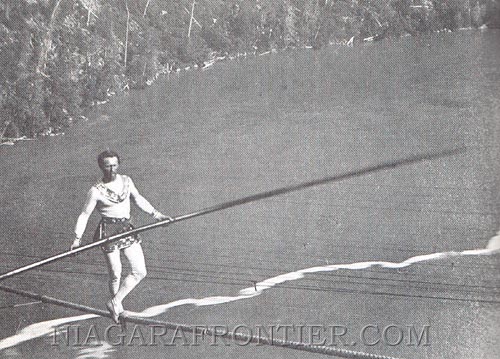
Whether you expect him to be on the rope or on the floor depends on information you do not have. If he is a trained circus artist, like the great Charles Blondin here, he might well be capable of walking to and fro along the tightrope for days. If not, he would probably only manage a few steps before crashing to the ground. Either way it remains unlikely that you catch a glimpse of him in mid-air during his downward transit. Unless, of course, someone is playing a trick on you and someone has told the guy to jump when he sees the curtain move.

This probably seems to have very little to do with physical cosmology, but now forget about tightropes and think about the behaviour of the mathematical models that describe the Big Bang. To keep things simple, I’m going to ignore the cosmological constant and just consider how things depend on one parameter, the density parameter Ω0. This is basically the ratio between the present density of the matter in the Universe compared to what it would have to be to cause the expansion of the Universe eventually to halt. To put it a slightly different way, it measures the total energy of the Universe. If Ω0>1 then the total energy of the Universe is negative: its (negative) gravitational potential energy dominates over the (positive) kinetic energy. If Ω0<1>0=1 exactly then the Universe has zero total energy: energy is precisely balanced, like the man on the tightrope.

A key point, however, is that the trade-off between positive and negative energy contributions changes with time. The result of this is that Ω is not fixed at the same value forever, but changes with cosmic epoch; we use Ω0 to denote the value that it takes now, at cosmic time t0, but it changes with time.

At the beginning, at the Big Bang itself, all the Friedmann models begin with Ω arbitrarily close to unity at arbitrarily early times, i.e. the limit as t tends to zero is Ω=1.

In the case in which the Universe emerges from the Big bang with a value of Ω just a tiny bit greater than one then it expands to a maximum at which point the expansion stops. During this process Ω grows without bound. Gravitational energy wins out over its kinetic opponent.

If, on the other hand, Ω sets out slightly less than unity – and I mean slightly, one part in 1060 will do – the Universe evolves to a state where it is very close to zero. In this case kinetic energy is the winner and Ω ends up on the ground, mathematically speaking.

In the compromise situation with total energy zero, this exact balance always applies. The universe is always described by Ω=1. It walks the cosmic tightrope. But any small deviation early on results in runaway expansion or catastrophic recollapse. To get anywhere close to Ω=1 now - I mean even within a factor ten either way - the Universe has to be finely tuned.

A slightly different way of describing this is to think instead about the radius of curvature of the Universe. In general relativity the curvature of space is determined by the energy (and momentum) density. If the Universe has zero total energy it is flat, so it doesn’t have any curvature at all so its curvature radius is infinite. If it has positive total energy the curvature radius is finite and positive, in much the same way that a sphere has positive curvature. In the opposite case it has negative curvature, like a saddle. I’ve blogged about this before.

I hope you can now see how this relates to the curious case of the tightrope walker.

If the case Ω0= 1 applied to our Universe then we can conclude that something trained it to have a fine sense of equilibrium. Without knowing anything about what happened at the initial singularity we might therefore be pre-disposed to assign some degree of probability that this is the case, just as we might be prepared to imagine that our room contained a skilled practitioner of the art of one-dimensional high-level perambulation.

On the other hand, we might equally suspect that the Universe started off slightly over-dense or slightly under-dense, at which point it should either have re-collapsed by now or have expanded so quickly as to be virtually empty.

About fifteen years ago, Guillaume Evrard and I tried to put this argument on firmer mathematical grounds by assigning a sensible prior probability to Ω based on nothing other than the assumption that our Universe is described by a Friedmann model.

The result we got was that it should be proportional to (Ω|Ω-1|)-1. I was very pleased with this result, which is based on a principle advanced by Ed Jaynes, but I have no space to go through the mathematics here. Note, however, that this prior has three interesting properties: it is infinite at Ω=0 and Ω=1, and it has a very long “tail” for very large values of Ω. It’s not a very well-behaved measure, in the sense that it can’t be integrated over, but that’s not an unusual state of affairs in this game. In fact it is an improper prior.

I think of this prior as being the probabilistic equivalent of Mark Twain’s description of a horse:

dangerous at both ends, and uncomfortable in the middle.

Of course the prior probability doesn’t tell usall that much. To make further progress we have to make measurements, form a likelihood and then, like good Bayesians, work out the posterior probability . In fields where there is a lot of reliable data the prior becomes irrelevant and the likelihood rules the roost. We weren’t in that situation in 1995 - and we’re arguably still not - so we should still be guided, to some extent by what the prior tells us.

The form we found suggests that we can indeed reasonably assign most of our prior probability to the three special cases I have described. Since we also know that the Universe is neither totally empty nor ready to collapse, it does indicate that, in the absence of compelling evidence to the contrary, it is quite reasonable to have a prior preference for the case Ω=1. Until the late 1980s there was indeed a strong ideological preference for models with Ω=1 exactly, but not because of the rather simple argument given above but because of the idea of cosmic inflation.

From recent observations we now know, or think we know, that Ω is roughly 0.26. To put it another way, this means that the Universe has roughly 26% of the density it would need to have to halt the cosmic expansion at some point in the future. Curiously, this corresponds precisely to the unlikely or “fine-tuned” case where our Universe is in between two states in which we might have expected it to lie.

Even if you accept my argument that Ω=1 is a special case that is in principle possible, it is still the case that it requires the Universe to have been set up with very precisely defined initial conditions. Cosmology can always appeal to special initial conditions to get itself out of trouble because we don’t know how to describe the beginning properly, but it is much more satisfactory if properties of our Universe are explained by understanding the physical processes involved rather than by simply saying that “things are the way they are because they were the way they were.” The latter statement remains true, but it does not enhance our understanding significantly. It’s better to look for a more fundamental explanation because, even if the search is ultimately fruitless, we might turn over a few interesting stones along the way.

The reasoning behind cosmic inflation admits the possibility that, for a very short period in its very early stages, the Universe went through a phase where it was dominated by a third form of energy, vacuum energy. This forces the cosmic expansion to accelerate. This drastically changes the arguments I gave above. Without inflation the case with Ω=1 is unstable: a slight perturbation to the Universe sends it diverging towards a Big Crunch or a Big Freeze. While inflationary dynamics dominate, however, this case has a very different behaviour. Not only stable, it becomes an attractor to which all possible universes converge. Whatever the pre-inflationary initial conditions, the Universe will emerge from inflation with Ω very close to unity. Inflation trains our Universe to walk the tightrope.

So how can we reconcile inflation with current observations that suggest a low matter density? The key to this question is that what inflation really does is expand the Universe by such a large factor that the curvature radius becomes infinitesimally small. If there is only “ordinary” matter in the Universe then this requires that the universe have the critical density. However, in Einstein’s theory the curvature is zero only if the total energy is zero. If there are other contributions to the global energy budget besides that associated with familiar material then one can have a low value of the matter density as well as zero curvature. The missing link is dark energy, and the independent evidence we now have for it provides a neat resolution of this problem.

Or does it? Although spatial curvature doesn’t really care about what form of energy causes it, it is surprising to some extent that the dark matter and dark energy densities are similar. To many minds this unexplained coincidence is a blemish on the face of an otherwise rather attractive structure.

It can be argued that there are initial conditions for non-inflationary models that lead to a Universe like ours. This is true. It is not logically necessary to have inflation in order for the Friedmann models to describe a Universe like the one we live in. On the other hand, it does seem to be a reasonable argument that the set of initial data that is consistent with observations is larger in models with inflation than in those without it. It is rational therefore to say that inflation is more probable to have happened than the alternative.

I am not totally convinced by this reasoning myself, because we still do not know how to put a reasonable measure on the space of possibilities existing prior to inflation. This would have to emerge from a theory of quantum gravity which we don’t have. Nevertheless, inflation is a truly beautiful idea that provides a framework for understanding the early Universe that is both elegant and compelling. So much so, in fact, that I almost believe it."

And:

"A New Theory of the Universe

Yesterday I went on the train to London to visit my old friends in Mile End. I worked at the place that is now called Queen Mary, University of London for nearly a decade and missed it quite a lot when I moved to Nottingham. More recently I’ve had a bit more time and plausible excuses to visit London, including yesterday’s invitation to give a seminar at the Astronomy Unit. Although we were a bit late starting, owing to extremely slow service in the restaurant where we had lunch before the talk, it all seemed to go quite well. Afterwards we had a few beers and a nice chat before I took the train back to Cardiff again.

In the pub (which was the Half Moon, formerly the Half Moon Theatre, a place of great historical interest) I remembered a joke I sometimes make during cosmology talks but had forgotten to do in the one I had just given. I’m not sure it will work in written form, but here goes anyway.

I’ve blogged before about the current state of cosmology, but it’s probably a good idea to give a quick reminder before going any further. We have a standard cosmological model, known as the concordance cosmology, which accounts for most relevant observations in a pretty convincing way and is based on the idea that the Universe began with a Big Bang. However, there are a few things about this model that are curious, to say the least.
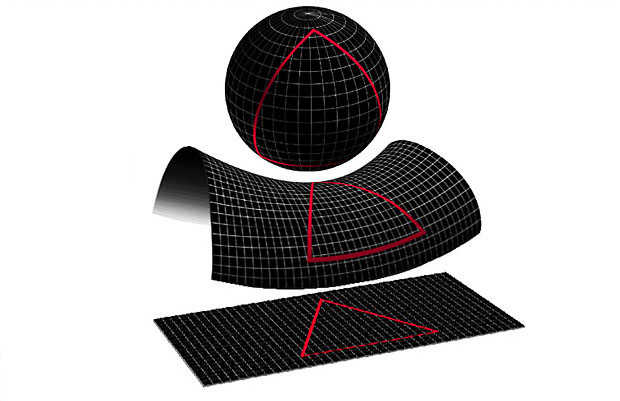
First, there is the spatial geometry of the Universe. According to Einstein’s general theory of relativity, universes come in three basic shapes: closed, open and flat. These are illustrated to the right. The flat space has “normal” geometry in which the interior angles of a triangle add up to 180 degrees. In a closed space the sum of the angles is greater than 180 degrees, and in an open space it is less. Of course the space we live in is three-dimensional but the pictures show two-dimensional surfaces.

But you get the idea.

The point is that the flat space is very special. The two curved spaces are much more general because they can be described by a parameter called their curvature which could in principle take any value (either positive for a closed space, or negative for an open space). In other words the sphere at the top could have any radius from very small (large curvature) to very large (small curvature). Likewise with the “saddle” representing an open space. The flat space must have exactly zero curvature. There are many ways to be curved, but only one way to be flat.

Yet, as near as dammit, our Universe appears to be flat. So why, with all the other options theoretically available to it, did the Universe decide to choose the most special one, which also happens in my opinion to be also the most boring?

Then there is the way the Universe is put together. In order to be flat there must be an exact balance between the energy contained in the expansion of the Universe (positive kinetic energy) and the energy involved in the gravitational interactions between everything in it (negative potential energy). In general relativity, you see, the curvature relates to the total amount of energy.
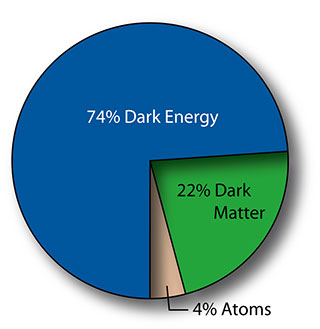
On the left you can see the breakdown of the various components involved in the standard model with the whole pie representing a flat Universe. You see there’s a vary strange mixture dominated by dark energy (which we don’t understand) and dark mattter (which we don’t understand). The bit we understand a little bit better (because we can sometimes see it directly) is only 4% of the whole thing. The proportions look very peculiar.

And then finally, there is the issue that I talked about in my seminar in London and have actually blogged about (here and there) previously, which is why the Universe appears to be a bit lop-sided and asymmetrical when we’d like it to be a bit more aesthetically pleasing.

All these curiosities are naturally accounted for in my New Theory of the Universe, which asserts that the Divine Creator actually bought the entire Cosmos in IKEA.

This hypothesis immediately explains why the Universe is flat. Absolutely everything in IKEA comes in flat packs. Curvature is not allowed.

But this is not the only success of my theory. When God got home he obviously opened the flat pack, found the instructions and read the dreaded words “EASY SELF-ASSEMBLY”. Even the omnipotent would struggle to follow the bizarre set of cartoons and diagrams that accompany even the simplest IKEA furniture. The result is therefore predictable: strange pieces that don’t seem to fit together, bits left over whose purpose is not at all clear, and an overall appearance that is not at all like one would have expected.

It’s clear where the lop-sidedness comes in too. Probably some of the parts were left out so the whole thing isn’t held together properly and is probably completely unstable. This sort of thing happens all the time with IKEA stuff. And why is it you can never find the right size Allen Key to sort it out?

So there you have it. My new Theory of the Universe. Some details need to be worked out, but it is as good an explanation of these issues as I have heard. I claim my Nobel Prize.

If anything will ever get me a trip to Sweden, this will."

Thursday, April 16, 2009

One of the biggest problems is that your eyes keep focussing and unfocussing to look for depth. It’s almost impossible to stop yourself doing it.

TO BE NOTED: From In The Dark:

"Perception, Piero and Pollock

For some unknown reason I’ve just received an invitation to a private view at a small art gallery that’s about ten minutes’ walk from my house. Cocktails included. I shall definitely go and will blog about it next week. I’m looking forward to it already.

This invitation put me in an artistic frame of mind so, to follow up my post on randomness (and the corresponding parallel version on cosmic variance), I thought I’d develop some thoughts about the nature of perception and the perception of nature.

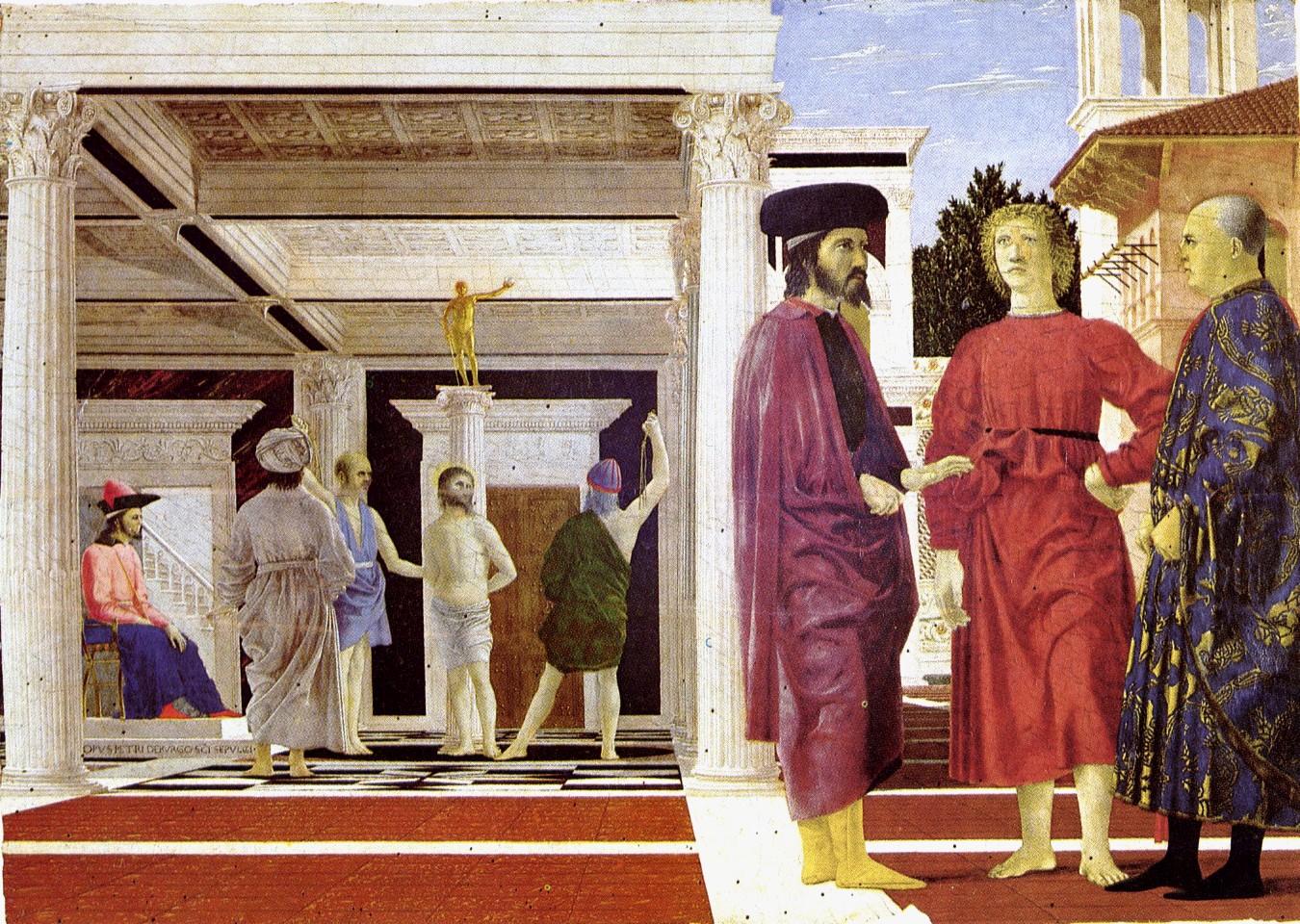
This famous painting is The Flagellation of Christ, by Piero della Francesca. I actually saw it many years ago on one of my many trips to Italy; it’s in an art gallery in Urbino. The first thing that strikes you when you see it is actually that the painting is surprisingly small (about 60cm by 80cm). However, that superficial reaction aside, the painting draws you into it in a way which few other works of art can. The composition is complicated but mathematically precise. The use of linear perspective is sufficiently straightforward that your eye can quickly understand the geometry of the space depicted and locate the figures and actions within it. The Christ figure is clearly in the room to the left rear and the scene is then easily recognized as part of the story leading up to the crucifixion.

That’s what your eye always seems to do first when presented with a figurative representation: sort out what’s going on and fill in any details it can from memory and other knowledge.

But once you have made sense of the overall form, your brain immediately bombards you with questions. Who are the three characters in the right foreground? Why aren’t they paying attention to what’s going on indoors? Who is the figure with his back to us? Why is the principal subject so far in the background? Why does everyone look so detached? Why is the light coming from two different directions (from the left for the three men in the foreground but from the right for those in the interior)? Why is it all staged in such a peculiar way? And so on.

These unresolved questions lead you to question whether this is figurative work first sight led you to think it was. It’s clearly much more than that. Deeply symbolic, even cryptic, it’s effect on the viewer is eery and disconcerting. The individual elements of the painting add up to something, but the full meaning remains elusive. You feel there must be something you’re missing, but can’t find it.

This is such an enigmatic picture that it has sparked some extremely controversial interpretations, some of which are described in an article in the scientific journal Nature. I’m not going to pretend to know enough to comment on the theories, escept to say that some of them at least must be wrong. They are, however, natural consequences of our brain’s need to impose order on what it sees. The greatest artists know this, of course. Although it sometimes seems like they might be playing tricks on us just for fun, part of what makes art great is the way it gets inside the process of perception.

Here’s another example from quite a different artist.

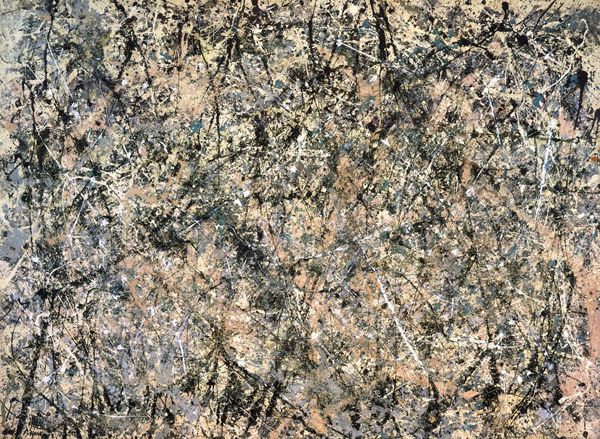
This one is called Lavender Mist. It’s one of the “action paintings” made by the influential American artist Jackson Pollock. This, and many of the other paintings of its type, also get inside your head in quite a disconcerting way but it’s quite a different effect to that achieved by Piero della Francesca.

This is an abstract painting, but that doesn’t stop your eyes seeking a point of reference to make geometrical sense of it. There’s no perspective to draw you into it so you look for depth in the layers of paint. Standing in front of one of these very large works - I find they don’t work at all in reduced form like on the screen in front of you now - you find your eyes constantly shifting around, following lines here and there, trying to find recognizable shapes and to understand what is there in terms of other things you have experienced either in the painting itself or elsewhere. Any order you can find, however, soon becomes lost. Small-scale patterns dissolve away into sea of apparent confusion. Your brain tries harder, but is doomed. One of the biggest problems is that your eyes keep focussing and unfocussing to look for depth. It’s almost impossible to stop yourself doing it. You end up dizzy.

I don’t know how Pollock came to understand exactly how to make his compositions maximally disorienting, but he seems to have done so. Perhaps he had a deep instinctive understanding of how the eye copes with the interaction of structures on different physical scales.

This artist has also been the subject of interest by mathematicians and physicists because his work seems to display some of the characteristic properties of fractal sets. I remember going to a very interesting talk a few years ago by Richard Taylor of the University of Oregon who claimed that fractal dimensions could be used to authenticate (or otherwise) genuine works by Pollock as he seemed to have his own unique signature.

I suppose what I’m trying to suggest is that there’s a deeper connection than you might think between the appreciation of art and the quest for scientific understanding.


Sunday, April 12, 2009

it is subjective in the sense that it is something to do with the way we manage our knowledge about nature rather than about nature itself

TO BE NOTED: From In The Dark:

"Arrows and Demons

My recent post about randomness and non-randomness spawned a lot of comments over on cosmic variance about the nature of entropy. I thought I’d add a bit about that topic here, mainly because I don’t really agree with most of what is written in textbooks on this subject.

The connection between thermodynamics (which deals with macroscopic quantities) and statistical mechanics (which explains these in terms of microscopic behaviour) is a fascinating but troublesome area. James Clerk Maxwell (right) did much to establish the microscopic meaning of the first law of thermodynamics he never tried develop the second law from the same standpoint. Those that did were faced with a conundrum.

The behaviour of a system of interacting particles, such as the particles of a gas, can be expressed in terms of a Hamiltonian H which is constructed from the positions and momenta of its constituent particles. The resulting equations of motion are quite complicated because every particle, in principle, interacts with all the others. They do, however, possess an simple yet important property. Everything is reversible, in the sense that the equations of motion remain the same if one changes the direction of time and changes the direction of motion for all the particles. Consequently, one cannot tell whether a movie of atomic motions is being played forwards or backwards.

This means that the Gibbs entropy is actually a constant of the motion: it neither increases nor decreases during Hamiltonian evolution.

But what about the second law of thermodynamics? This tells us that the entropy of a system tends to increase. Our everyday experience tells us this too: we know that physical systems tend to evolve towards states of increased disorder. Heat never passes from a hot body to a cold one. Pour milk into coffee and everything rapidly mixes. How can this directionality in thermodynamics be reconciled with the completely reversible character of microscopic physics?

The answer to this puzzle is surprisingly simple, as long as you use a sensible interpretation of entropy that arises from the idea that its probabilistic nature represents not randomness (whatever that means) but incompleteness of information. I’m talking, of course, about the Bayesian view of probability.

First you need to recognize that experimental measurements do not involve describing every individual atomic property (the “microstates” of the system), but large-scale average things like pressure and temperature (these are the “macrostates”). Appropriate macroscopic quantities are chosen by us as useful things to use because they allow us to describe the results of experiments and measurements in a robust and repeatable way. By definition, however, they involve a substantial coarse-graining of our description of the system.

Suppose we perform an idealized experiment that starts from some initial macrostate. In general this will generally be consistent with a number - probably a very large number - of initial microstates. As the experiment continues the system evolves along a Hamiltonian path so that the initial microstate will evolve into a definite final microstate. This is perfectly symmetrical and reversible. But the point is that we can never have enough information to predict exactly where in the final phase space the system will end up because we haven’t specified all the details of which initial microstate we were in. Determinism does not in itself allow predictability; you need information too.

If we choose macro-variables so that our experiments are reproducible it is inevitable that the set of microstates consistent with the final macrostate will usually be larger than the set of microstates consistent with the initial macrostate, at least in any realistic system. Our lack of knowledge means that the probability distribution of the final state is smeared out over a larger phase space volume at the end than at the start. The entropy thus increases, not because of anything happening at the microscopic level but because our definition of macrovariables requires it.

ham

This is illustrated in the Figure. Each individual microstate in the initial collection evolves into one state in the final collection: the narrow arrows represent Hamiltonian evolution.

However, given only a finite amount of information about the initial state these trajectories can’t be as well defined as this. This requires the set of final microstates has to acquire a sort of “buffer zone” around the strictly Hamiltonian core; this is the only way to ensure that measurements on such systems will be reproducible.

The “theoretical” Gibbs entropy remains exactly constant during this kind of evolution, and it is precisely this property that requires the experimental entropy to increase. There is no microscopic explanation of the second law. It arises from our attempt to shoe-horn microscopic behaviour into framework furnished by macroscopic experiments.

Another, perhaps even more compelling demonstration of the so-called subjective nature of probability (and hence entropy) is furnished by Maxwell’s demon. This little imp first made its appearance in 1867 or thereabouts and subsequently led a very colourful and influential life. The idea is extremely simple: imagine we have a box divided into two partitions, A and B. The wall dividing the two sections contains a tiny door which can be opened and closed by a “demon” – a microscopic being “whose faculties are so sharpened that he can follow every molecule in its course”. The demon wishes to play havoc with the second law of thermodynamics so he looks out for particularly fast moving molecules in partition A and opens the door to allow them (and only them) to pass into partition B. He does the opposite thing with partition B, looking out for particularly sluggish molecules and opening the door to let them into partition A when they approach.

The net result of the demon’s work is that the fast-moving particles from A are preferentially moved into B and the slower particles from B are gradually moved into A. The net result is that the average kinetic energy of A molecules steadily decreases while that of B molecules increases. In effect, heat is transferred from a cold body to a hot body, something that is forbidden by the second law.

All this talk of demons probably makes this sound rather frivolous, but it is a serious paradox that puzzled many great minds. Until it was resolved in 1929 by Leo Szilard. He showed that the second law of thermodynamics would not actually be violated if entropy of the entire system (i.e. box + demon) increased by an amount every time the demon measured the speed of a molecule so he could decide whether to let it out from one side of the box into the other. This amount of entropy is precisely enough to balance the apparent decrease in entropy caused by the gradual migration of fast molecules from A into B. This illustrates very clearly that there is a real connection between the demon’s state of knowledge and the physical entropy of the system.

By now it should be clear why there is some sense of the word subjective that does apply to entropy. It is not subjective in the sense that anyone can choose entropy to mean whatever they like, but it is subjective in the sense that it is something to do with the way we manage our knowledge about nature rather than about nature itself. I know from experience, however, that many physicists feel very uncomfortable about the idea that entropy might be subjective even in this sense.

On the other hand, I feel completely comfortable about the notion:. I even think it’s obvious. To see why, consider the example I gave above about pouring milk into coffee. We are all used to the idea that the nice swirly pattern you get when you first pour the milk in is a state of relatively low entropy. The parts of the phase space of the coffee + milk system that contain such nice separations of black and white are few and far between. It’s much more likely that the system will end up as a “mixed” state. But then how well mixed the coffee is depends on your ability to resolve the size of the milk droplets. An observer with good eyesight would see less mixing than one with poor eyesight. And an observer who couldn’t perceive the difference between milk and coffee would see perfect mixing. In this case entropy, like beauty, is definitely in the eye of the beholder.

The refusal of many physicists to accept the subjective nature of entropy arises, as do so many misconceptions in physics, from the wrong view of probability.

Tuesday, April 7, 2009

statements about the nature of reality are ontological, whereas I think randomness is only a useful concept in an epistemological sense

TO BE NOTED: From In The Dark:

"Random Thoughts: Points and Poisson (d’Avril)

I’ve got a thing about randomness. For a start I don’t like the word, because it covers such a multitude of sins. People talk about there being randomness in nature when what they really mean is that they don’t know how to predict outcomes perfectly. That’s not quite the same thing as things being inherently unpredictable; statements about the nature of reality are ontological, whereas I think randomness is only a useful concept in an epistemological sense. It describes our lack of knowledge: just because we don’t know how to predict doesn’t mean that it can’t be predicted.

Nevertheless there are useful mathematical definitions of randomness and it is also (somtimes) useful to make mathematical models that display random behaviour in a well-defined sense, especially in situations where one has to take into account the effects of noise.

I thought it would be fun to illustrate one such model. In a point process, the random element is a “dot” that occurs at some location in time or space. Such processes occur in wide range of contexts: arrivals of buses at a bus stop, photons in a detector, darts on a dartboard, and so on.

Let us suppose that we think of such a process happening in time, although what follows can straightforwardly be generalised to things happening over an area (such a dartboard) or within some higher-dimensional region. It is also possible to invest the points with some other attributes; processes like this are sometimes called marked point processes, but I won’t discuss them here.

The “most” random way of constructing a simple point process is to assume that each event happens independently of every other event, and that there is a constant probability per unit time of an event happening. This type of process is called a Poisson process, after the French mathematician Siméon-Denis Poisson, who was born in 1781. He was one of the most creative and original physicists of all time: besides fundamental work on electrostatics and the theory of magnetism for which he is famous, he also built greatly upon Laplace’s work in probability theory. His principal result was to derive a formula giving the number of random events if the probability of each one is very low. The Poisson distribution, as it is now known and which I will come to shortly, is related to this original calculation; it was subsequently shown that this distribution amounts to a limiting of the binomial distribution. Just to add to the connections between probability theory and astronomy, it is worth mentioning that in 1833 Poisson wrote an important paper on the motion of the Moon.

In a finite interval of duration T the mean (or expected) number of events for a Poisson process will obviously just be proportional to the product of the rate per unit time and T itself; call this product l.

The full distribution is then

This gives the probability that a finite interval contains exactly x events. It can be neatly derived from the binomial distribution by dividing the interval into a very large number of very tiny pieces, each one of which becomes a Bernoulli trial. The probability of success (i.e. of an event occurring) in each trial is extremely small, but the number of trials becomes extremely large in such a way that the mean number of successes is l. In this limit the binomial distribution takes the form of the above expression. The variance of this distribution is interesting: it is alsol. This means that the typical fluctuations within the interval are of order the square root of l on a mean level of l, so the fractional variation is of the famous “one over root n” form that is a useful estimate of the expected variation in point processes. Indeed, it’s a useful rule-of-thumb for estimating likely fluctuation levels in a host of statistical situations.

If football were a Poisson process with a mean number of goals per game of, say, 2 then would expect must games to have 2 plus or minus 1.4 (the square root of 2) goals, i.e. between about 0.6 and 3.4. That is actually not far from what is observed and the distribution of goals per game in football matches is actually quite close to a Poisson distribution.

This idea can be straightforwardly extended to higher dimensional processes. If points are scattered over an area with a constant probability per unit area then the mean number in a finite area will also be some number l and the same formula applies.

As a matter of fact I first learned about the Poisson distribution when I was at school, doing A-level mathematics (which in those days actually included some mathematics). The example used by the teacher to illustrate this particular bit of probability theory was a two-dimensional one from biology. The skin of a fish was divided into little squares of equal area, and the number of parasites found in each square was counted. A histogram of these numbers accurately follows the Poisson form. For years I laboured under the delusion that it was given this name because it was something to do with fish, but then I never was very quick on the uptake.

This is all very well, but point processes are not always of this Poisson form. Points can be clustered, so that having one point at a given position increases the conditional probability of having others nearby. For example, galaxies like those shown in the nice picture are distributed throughout space in a clustered pattern that is very far from the Poisson form. But it’s very difficult to tell from just looking at the picture. What is needed is a rigorous statistical analysis.

The statistical description of clustered point patterns is a fascinating subject, because it makes contact with the way in which our eyes and brain perceive pattern. I’ve spent a large part of my research career trying to figure out efficient ways of quantifying pattern in an objective way and I can tell you it’s not easy, especially when the data are prone to systematic errors and glitches. I can only touch on the subject here, but to see what I am talking about look at the two patterns below:

pointbpointa

You will have to take my word for it that one of these is a realization of a two-dimensional Poisson point process and the other contains correlations between the points. One therefore has a real pattern to it, and one is a realization of a completely unstructured random process.

I show this example in popular talks and get the audience to vote on which one is the random one. The vast majority usually think that the top is the one that is random and the bottom one is the one with structure to it. It is not hard to see why. The top pattern is very smooth (what one would naively expect for a constant probability of finding a point at any position in the two-dimensional space) , whereas the bottom one seems to offer a profusion of linear, filamentary features and densely concentrated clusters.

In fact, it’s the bottom picture that was generated by a Poisson process using a Monte Carlo random number generator. All the structure that is visually apparent is imposed by our own sensory apparatus, which has evolved to be so good at discerning patterns that it finds them when they’re not even there!

The top process is also generated by a Monte Carlo technique, but the algorithm is more complicated. In this case the presence of a point at some location suppresses the probability of having other points in the vicinity. Each event has a zone of avoidance around it; the points are therefore anticorrelated. The result of this is that the pattern is much smoother than a truly random process should be. In fact, this simulation has nothing to do with galaxy clustering really. The algorithm used to generate it was meant to mimic the behaviour of glow-worms which tend to eat each other if they get too close. That’s why they spread themselves out in space more uniformly than in the random pattern.

The tendency to find things that are not there is quite well known to astronomers. The constellations which we all recognize so easily are not physical associations of stars, but are just chance alignments on the sky of things at vastly different distances in space. That is not to say that they are random, but the pattern they form is not caused by direct correlations between the stars. Galaxies form real three-dimensional physical associations through their direct gravitational effect on one another.

People are actually pretty hopeless at understanding what “really” random processes look like, probably because the word random is used so often in very imprecise ways and they don’t know what it means in a specific context like this. The point about random processes, even simpler ones like repeated tossing of a coin, is that coincidences happen much more frequently than one might suppose.

I suppose there is an evolutionary reason why our brains like to impose order on things in a general way. More specifically scientists often use perceived patterns in order to construct hypotheses. However these hypotheses must be tested objectively and often the initial impressions turn out to be figments of the imagination, like the canals on Mars.

Now, I think I’ll complain to wordpress about the widget that links pages to a “random blog post”.

I’m sure it’s not really random….