Showing posts with label Obama on taxes. Show all posts

Thursday, January 8, 2009

"So if stimulus is partly a game of psychology"

Barbara Kiviat finds someone on my side:

"Obama talks stimulus. He hopes you are listening

The spate of retailers reporting devastating December sales this morning provided a nice backdrop for President-elect Obama's speech in Virginia about why we need to spend another $775 billion to fix the economy. About 40% of that sum comes in the form of tax cuts, but the bulk of the fiscal stimulus would go to pay for new programs and projects—everything from the greening of federal buildings to the computerization of medical records.

The idea, just to be really basic about it, is that American consumers and companies aren't spending enough, so the government has to. There was a great article in the New York Times yesterday about how pretty much all most economists now agree that it's go-time on this count. Even Marty Feldstein, the champion of conservative economic thought who was a top adviser to President Reagan, has noted that lower interest rates aren't getting the job done because credit markets are screwy and that tax cuts only get you so far, so the "heavy lifting" will have to be done by increased government spending. (Quick historical recap: this hasn't been the consensus in the field of economics since the 1960s.)

But most economists also agree that fiscal stimulus shouldn't be an open-ended thing. This morning I was chatting with Andrew Dilnot, an economist at Oxford University who used to run the U.K's Institute for Fiscal Studies—what he described as a cross between the Congressional Budget Office, the National Bureau of Economic Research and the Brookings Institution. He argued that fiscal stimulus should be geared toward priming the pump—that is, getting private players to start spending again. "The strongest argument for doing these sorts of things is that it's a way of the government demonstrating that they're not going to allow the economy to slide into a depression, that they'll spend the money necessary ( THAT'S MY POSITION. IT'S THE EQUIVALENT OF THE GOVERNMENT GUARANTEES NEEDED TO STOP A CALLING RUN, ONLY THIS IS A PROACTIVITY RUN. HERE, THE GOVERNMENT NEEDS TO BE A SPENDER OF LAST RESORT, AND, ONCE AGAIN, ONLY THE GOVERNMENT HAS THE RESOURCES TO BE BELIEVED AS A SOLR. IT SHOULD ALSO BE CLEAR THAT I BELIEVE THAT HAVING THESE GUARANTEES WILL STOP CALLING AND PROACTIVITY RUNS IN THE FUTURE. THE POINT OF THE GOVERNMENT GUARANTEES SHOULD BE TO KEEP PEOPLE FROM PANICKING, THEREBY KEEPING THE NEED FOR GOVERNMENT ASSISTANCE TO A MINIMUM. )," he said. "If people believe it's going to be okay, then people who are putting off buying a new car or house will instead say, I shan't lose my job, I'll go ahead and do that( THAT'S THE WHOLE POINT. I AGREE. A HUMAN AGENCY EXPLANATION. )."

So if stimulus is partly( COMPLETELY. OTHERWISE, IT'S SIMPLY GOVERNMENT SPENDING AS OPPOSED TO PRIVATE SPENDING. ) a game of psychology, then it would make sense to ease off the extra spending once the economy picks back up( YES ). Get consumers and businesses confident enough to spend again, and then let them take over( YES ). In an interview on Wednesday, Obama nodded at that logic. "I'm not out to increase the size of the government long-term," he said. "My preference would be that the private sector was doing this all on their own( MY POSITION AS WELL. )."

I'm guessing that sounds pretty nice to most folks, especially considering the amount of money we've already spent on fixing the economy. But is it true? Jay Newton-Small has a piece up on Time.com that considers how Obama's stimulus package gives him a running start on a bunch of items on his long-term agenda. If we head down this road and GDP rebounds, do we suddenly cut funding? I know a lot more about economics than I do politics, but I'm guessing most legislation doesn't come with an easy on-off switch( THAT IS A CONCERN ).

Though that's not to say I'm against spending money to increase the energy efficiency of two million homes or to build broadband access to all corners of America so that small businesses, no matter where they're located, can be globally competitive. These are good ideas as far as I'm concerned.( GOOD IDEAS. I AGREE. )

All I'm saying is when we start buying computers for schools and paying people to put up windmills let's be clear about whether we're doing these things to save the economy—or if we'd be trying to do them in the long-term anyway.( FOR THE INFRASTRUCTURE PART OF THE STIMULUS, THIS IS ESSENTIAL. )

Here's one of my favorite parts of Obama's speech:

Instead of politicians doling out money behind a veil of secrecy, decisions about where we invest will be made transparently, and informed by independent experts wherever possible. Every American will be able to hold Washington accountable for these decisions by going online to see how and where their tax dollars are being spent. ( WONDERFUL )

I can't wait.

Barbara!"

My view of the importance and use of a stimulus is exactly the same, which is why I don't believe that we need to do as Paul Krugman says:

"More stimulus notes

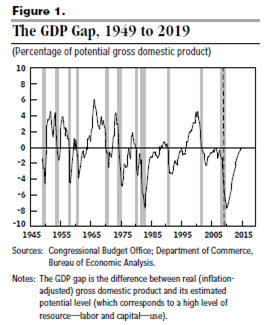
1. The new CBO budget and economic outlook is out. Above is its forecast( BS ) for the GDP gap — the hole stimulus has to fill( WHY DOES IT NEED TO FILL THE HOLE BY ITSELF? ). I’d guess( THAT'S WHAT IT IS ) that the CBO estimate, which has unemployment averaging 8.3 percent in 2009 and 9 percent in 2010, is actually too optimistic (see 3, below), but even so it puts the Obama plan in perspective: a 3% of GDP plan, with a significant share going to ineffective tax cuts( NOT CLEAR AT ALL ), to fill an 8% or more gap.

2. How ineffective? Howard Gleckman of the Tax Policy Center says Lots of Buck, not Much Bang.:

Here's his point:

"Refundable tax credits for hiring new workers promise to be an administrative nightmare and won't create many new jobs. It is tough to see how a company that is seeing its sales slaughtered in today’s recession is going to hire just because it gets a few thousand dollars per new worker from the government. Profitable firms would merely take the credit for bringing on workers they were already planning on hiring. ( IT'S AMAZING HOW PEOPLE CAN INTUITIVELY DIVINE WHETHER OR NOT AN ECONOMIC INCENTIVE WILL WORK. I HAVE NO IDEA WHAT HE'S BASING THIS VIEW ON. IT SEEMS LIKE A POSITIVE MOVE TO ME. )

I can’t begin to imagine how the variation on this idea--credits for not laying someone off--would work( HERE I AGREE ). My head throbs at the concept of the IRS trying to administer a rebate based on intentions. Worse, these breaks would never work unless they are refundable and, to be honest, giving such credits to failing business makes my skin crawl. In reality, it would become yet one more bailout—only this time taxpayers wouldn't even get stock for their trouble."

Back to Krugman:

3. The official BLS numbers won’t be out until Friday, but the ADP jobs estimate, based on private payroll data, is spectacularly grim. "( AND ACCORDING TO THE BIG PICTURE, NOT VERY USEFUL. )

Krugman's view is Mechanistic. The economy is like an engine. It needs a lot of oil. I don't credit this view at all. If there's one view that always wastes money, it's a mechanistic view of human behavior.

I would prefer an incentive for investment, but adding workers isn't a bad alternative. Let me explain something: We're fighting the fear and aversion to risk. One way to attack that is to target incentives to minimally effect this. The alternative is much more than spectacularly grim. There's no proof that any of these measures will be effective, least of all picking an enormous figure based on a graph of useful but inexact numbers. The idea that overspending poses no risk is beyond belief. It is itself a panicked reaction to our crisis. We've had a number of those recently, and, as of now, the record is mixed at best.

Saturday, December 27, 2008

"We expect to evaluate and to be evaluated rigorously to ensure that Washington is held accountable for how tax dollars are spent. "

Lawrence Summers in the Washington Post:

"By Lawrence Summers

Sunday, December 28, 2008; B07

When President-elect Barack Obama takes office, he will face what may well( COULD BE ) be the bleakest economic outlook since World War II. Economic forecasts have been revised significantly downward over the past several months; today, many experts believe that unemployment could reach 10 percent by the end of next year and our economy could fall $1 trillion short of its full capacity -- which translates into more than $12,000 in lost income for a family of four.( I DON'T AGREE )

As difficult as these conditions are, however, the Obama administration also inherits an economy with great potential for the medium and long terms. Investments in an array of areas -- including energy, education, infrastructure and health care -- offer the potential of extraordinarily high social returns while allowing our country to address some long-standing national challenges and put our economy on a solid footing for years to come( HOW SO ? ).

In this crisis( JUST THIS ONE ), doing too little poses a greater threat than doing too much( I AGREE ). Any sound economic strategy in the current context must be directed at both creating the jobs that Americans need and doing the work that our economy requires. Any plan geared toward only one of these objectives would be dangerously deficient. Failure to create enough jobs in the short term would put the prospect of recovery at risk. Failure to start undertaking necessary long-term investments would endanger the foundation of our recovery and, ultimately, our children's prosperity( GO ON ).

Our president-elect understands both the peril and the promise of the situation and the importance of responding to changing conditions. That is why his economic team is crafting a broad proposal, the American Recovery and Reinvestment Plan, to support the jobs and incomes essential for recovery while also making a down payment on our nation's long-term financial health( HERE WE GO ).

A key pillar of the Obama plan is job creation. In the face of deteriorating economic forecasts, Obama has revised his goal upward, to 3 million. For one thing, significantly fewer positions would be created in the absence of any recovery plan. Second, more than 80 percent of these 3 million jobs will be in the private sector, including emerging sectors such as environmental technology( I LIKE THE GOAL, BUT...). This is a bold goal. But economists across the political spectrum recognize that it is far less risky to stand firmly against the forces propelling our economy downward than to be timid in the face of a mounting crisis.

The Obama plan represents not new public works but, rather, investments( ESSENTIAL ) that will work for the American public. Investments to build the classrooms, laboratories and libraries our children need to meet 21st-century educational challenges( THIS WORRIES ME ). Investments to help reduce U.S. dependence on foreign oil by spurring renewable energy initiatives (many of which are on hold because of the credit crunch)( I LIKE THESE ). Investments to put millions of Americans back to work rebuilding our roads, bridges and public transit systems( FOCUS ON THE LAST ONE ). Investments to modernize our health-care system, which is necessary to improve care in the short term and key to driving down costs across the board( GOOD LUCK ).

Laying the groundwork for recovery and future prosperity will require shedding Washington habits. We must measure progress not by the agendas of interest groups( GOOD LUCK ) but by whether the American people experience results( I AGREE ). We must focus not on ideology but on drawing the best ideas from all quarters( I AGREE ). That is why, for example, in key sectors such as energy, Obama is pushing for both public investments and the removal of barriers to private investment( GOOD ). It is also why his plan relies on both government spending and tax cuts to raise incomes and promote recovery( I AGREE. WE NEED BOTH. ).

The president-elect has insisted that investments proposed in the recovery plan meet standards much higher than has been traditional. There will be no earmarks( GOOD LUCK ). Investments will be chosen strategically based on what yields the highest rate of return for the economy and monitored closely( ESSENTIAL ) not just by officials but also by the public as government becomes more transparent. We expect to evaluate and to be evaluated rigorously to ensure that Washington is held accountable for how tax dollars are spent( ESSENTIAL ).

Some argue that instead of attempting to both create jobs and invest in our long-run growth, we should focus exclusively on short-term policies that generate consumer spending. But that approach led to some of the challenges we face today -- and it is that approach that we must reject if we are going to strengthen our middle class( ESSENTIAL FOR SOCIAL HARMONY ) and our economy over the long run. Far from being an excuse for inaction or delay, the magnitude of the work ahead is all the more reason to begin that work."

It sounds good. But...

Sunday, November 23, 2008

"he was prepared to hold off introducing new taxes for his first two years as president."

It doesn't look like President Obama will raise taxes. Good news. They will probably wait for the Bush Tax Cuts to expire, and deal with the issue then. From the FT:

"Democratic officials made clear on Sunday that the cost of Barack Obama’s economic rescue plan would run into hundreds of billions of dollars and hinted he was prepared to hold off introducing new taxes for his first two years as president.'

This is good news. Wise Policy.

"Over the weekend, the president-elect revealed the outlines of a sweeping programme aimed at creating or saving 2.5m jobs by January 2011 through investment in infrastructure, public services and “green” technology."

I believe that infrastructure spending should be the primary thrust of the stimulus. Remember, I don't consider UI and other social safety net provisions, which are very important, to be part of the stimulus as I define it.

"Chuck Schumer, a leading Democratic senator, predicted it could be as much as $500bn-$700bn. “It’s a little like having a new New Deal, but you have to do it before the Depression. Not after,” he told ABC’s This Week."

I'm fine with the figure, but would like to see actual plans on how it will be spent.

"In an olive branch to Republicans, Mr Axelrod floated the possibility that the president-elect might wait for the Bush tax cuts to expire in 2010 rather than acting sooner to raise rates for high earners."

What to do about these tax cuts should wait until we get to 2010. Period.

Thursday, November 6, 2008

"Let's be clear about this: Barack Obama isn't going to raise your taxes in 2009"

Interesting post on the NY Times:

"Barack Obama and his advisers have spent much of the last three years devising policies to deal with the economy’s big, long-term problems, like inequality, health care, the budget deficit. In the process, they came up with an agenda that’s serious, detailed and mostly cogent.

Yet none of it will be their first priority.

Instead, the initial thrust of their economic policy will be on keeping the economy from falling into a recession that’s nastier than most of us have ever experienced.

This year’s election coincided with an important moment in the financial crisis. The credit markets have stabilized in the last few weeks and even improved a bit. But the rest of the economy is deteriorating fairly rapidly. It’s now in danger of falling into a vicious spiral, in which spending cuts by consumers and businesses lead to further layoffs and then more spending cuts.

Mr. Obama and his advisers acknowledge that their focus has to shift, but the change is still likely to be challenging, and a bit disappointing. “Unfortunately, the next president’s No. 1 priority is going to be preventing the biggest financial crisis in possibly the last century from turning into the next Great Depression,” says Austan Goolsbee, an Obama adviser. “That has to be No. 1. Nobody ever wanted that to be the priority. But that’s clearly where we are.”

Justin Fox has a good take on it
:

"Let's be clear about this: Barack Obama isn't going to raise your taxes in 2009. He already said back in September, before the severity of the current economic downturn was apparent, that he would probably hold off on rescinding the Bush tax cuts on high-income households because of the fragility of the economy. In October, his campaign said it was backing off plans to impose a windfall profits tax on oil companies--at least until oil prices start heading up again.

The reasoning here is pretty simple. When the economy is shrinking, you don't raise taxes or do anything else (such as cutting spending) aimed at shrinking the federal deficit. Instead, you do whatever it takes to get the economy growing again."

Read the rest. Here's my comment:
  1. donthelibertariandemocrat Says:

    "Mr. Obama and his advisers acknowledge that their focus has to shift, but the change is still likely to be challenging, and a bit disappointing. “Unfortunately, the next president's No. 1 priority is going to be preventing the biggest financial crisis in possibly the last century from turning into the next Great Depression,” says Austan Goolsbee, an Obama adviser. “That has to be No. 1. Nobody ever wanted that to be the priority. But that's clearly where we are.”

    I agree. I notice that Paul Krugman, Ezra Klein, Jeffrey Sachs, John Judis, etc., have been pushing a big spending line, but I believe that they will be disappointed, if I'm reading them correctly. I believe that I'm likely to be happier with President Obama than they will be.

    As for the rest of your analysis, I agree with it. I hope that doesn't bother you.

Wednesday, November 5, 2008

"Almost everything else is off the table right now, with Obama having little financial room to do very much."

Paul Kedrosky with an excellent post:

"There are many things on here, including a healthy industry distrust of lying politicians and their promises. But it is mostly something else: Wall Street doesn't believe Obama, and it didn't believe McCain either. While Wall Street worried for a little while about Obama's tax increase promise, his pro union leanings, and his regulatory fervor, it now doesn't really care. Why? Because Wall Street knows that everything has changed, as happens with any battle plan after the first skirmish. President Obama can't raise taxes right now. A tax increase during the most severe U.S. economic downturn in modern memory would be a Depression-class error, the sort of thing guaranteed to get you in the history books, albeit for all the wrong reasons. So it's not going to happen. And it's not just tax increases that markets have discounted from Obama, it's pretty much everything, except for more bank bailouts, some regulatory reform, and one or two major financial stimulus packages. Almost everything else is off the table right now, with Obama having little financial room to do very much.

The same would have been true, of course, of President McCain, had he been the voters' choice. Either way, however, Wall Street has now given the presidential election a good close look and decided that it matters less than ever this time around. The financial services industry's recent collapse has turned to a smoking ruin the U.S.'s already burnt balance sheet, putting President Obama square into fire-fighting with a straw and no money for water. All he can do is try to survive in the face of massive deficits, a teetering economy and a looming social security nightmare. Wall Street has neatly managed to half-way marginalize President Obama, even if it had to gut itself and the economy to do it."

This is pretty much Peston's view and my view.

"whether Obama’s plan to raise income taxes on high earners makes economic sense in the short run."

James Suroweicki on whether or not President Obama will raise taxes:

"In the long run, allowing the Bush tax cuts to lapse, restoring tax rates to where they were during the Clinton Administration, seems not just fair (given the outsized gains enjoyed by high-income earners during the past decade) but necessary, given the massive and ever-increasing deficits we’re piling up. But in the short run, raising taxes in the middle of a recession is a rather different matter, particularly when many, if not most, of the people you’re going to be raising taxes on are significantly poorer today than they were six months ago."

I agree with this. Read his whole post. He should not raise taxes now and let the tax cuts lapse if he feels that we need the revenue then. I want to wait to see where we are before deciding on what to do then.

Friday, September 12, 2008

Comparing The Candidates Tax Proposals

I've already addressed the difference's between Sen. Obama's and Sen McCain's tax proposals in reference to an excellent column by Sebastian Mallaby in the Washington Post.

Today, Ezra Klein referenced a study of their tax proposals by the Tax Policy Center.

Here's a link to that study.

Libertarians For Obama references a story about Douglas Holtz-Eakin, McCain's top economic adviser, admitting that Sen. McCain will have to raise taxes as President if he can't make serious spending cuts.

The reason Holtz-Eakin says that is because McCain's plan vastly increases the budget deficit.

Other highlights include the fact that Sen. Obama's plan reduces taxes on the middle class and poor, while raising taxes on the wealthy. Sen. McCain's plan largely reduces taxes on the wealthy.

To be fair, Sen. Obama's plan seems to lead to taxes as percentage of GDP being higher than Sen. MCain's plan, but, of course, that's because Sen. MCain's plan reduces taxes now but increases them in the future through a larger budget deficit. Of course, Sen. McCain could vastly reduce federal spending, but, given his priorities, which include a huge military budget, there's no reason to believe that he will.

Friday, August 29, 2008

Libertarian Democrat Themes In Sen Obama's Acceptance Speech

Here are some libertarian Democrat highlights from Sen. Obama's marvelous acceptance speech:

"It's a promise that says each of us has the freedom to make of our own lives what we will...It's a promise that says the market should reward drive and innovation and generate growth...Ours is a promise that says government cannot solve all our problems...That's the promise of America -- the idea that we are responsible for ourselves...I will eliminate capital gains taxes for the small businesses and the start-ups that will create the high-wage, high-tech jobs of tomorrow...I will cut taxes -- cut taxes -- for 95 percent of all working families. Because in an economy like this, the last thing we should do is raise taxes on the middle-class...But we must also admit that programs alone can't replace parents; that government can't turn off the television and make a child do her homework; that fathers must take more responsibility for providing the love and guidance their children need."

Now, I realize that I have edited his comments in order to emphasize the libertarian aspects of his speech, which includes quite a bit that is not libertarian. My point is that Sen. Obama did indeed give some libertarian flavor to his speech, which I take to be quite important. I'm not saying that Sen. Obama is a libertarian Democrat, but that he does acknowledge some aspects of our ideas. That's a good start.

Many will believe that Sen. Obama is paying lip-service to these ideas, and doesn't really believe in them. I disagree, and believe that time will prove me correct. Wishful thinking? Isn't all political thinking?