Showing posts with label Feyerabend. Show all posts

Thursday, March 26, 2009

This is how scientists have deceived themselves and everyone else about their business, but without any real disadvantage

Paul Feyerabend (1975)

Against Method

Outline of an anarchistic theory of knowledge


Source: Analytical Index (being a sketch of the main argument) and the concluding chapter from Against Method (1975) publ. Humanities Press. Just the Analytical Table of Contents and Concluding Chapter reproduced here.


  • Science is an essentially anarchistic enterprise: theoretical anarchism is more humanitarian and more likely to encourage progress than its law-and-order alternatives.
  • This is shown both by an examination of historical episodes and by an abstract analysis of the relation between idea and action. The only principle that does not inhibit progress is: anything goes.
  • For example, we may use hypotheses that contradict well-confirmed theories and/or well-established experimental results. We may advance science by proceeding counter-inductively.
  • The consistency condition which demands that new hypotheses agree with accepted theories is unreasonable because it preserves the older theory, and not the better theory. Hypotheses contradicting well-confirmed theories give us evidence that cannot be obtained in any other way. Proliferation of theories is beneficial for science, while uniformity impairs its critical power. Uniformity also endangers the free development of the individual.
  • There is no idea, however ancient and absurd, that is not capable of improving our knowledge. The whole history of thought is absorbed into science and is used for improving every single theory. Nor is political interference rejected. It may be needed to overcome the chauvinism of science that resists alternatives to the status quo.
  • No theory ever agrees with all the facts in its domain, yet it is not always the theory that is to blame. Facts are constituted by older ideologies, and a clash between facts and theories may be proof of progress. It is also a first step in our attempts to find the principles implicit in familiar observational notions.
  • As an example of such an attempt I examine the tower argument which the Aristotelians used to refute the motion of the earth. The argument involves natural interpretations - ideas so closely connected with observations that it needs a special effort to realise their existence and to determine their content. Galileo identifies the natural interpretations which are inconsistent with Copernicus and replaces them by others.
  • The new natural interpretations constitute a new and highly abstract observation language. They are introduced and concealed so that one falls to notice the change that has taken place (method of anamnesis). They contain the idea of the relativity of all motion and the law of circular inertia.
  • Initial difficulties caused by the change are defused by ad hoc hypotheses, which thus turn out occasionally to have a positive function; they give new theories a breathing space, and they indicate the direction of future research.
  • In addition to natural interpretations, Galileo also changes sensations that seem to endanger Copernicus. He admits that there are such sensations, he praises Copernicus for having disregarded them, he claims to have removed them with the help of the telescope. However, he offers no theoretical reasons why the telescope should be expected to give a true picture of the sky.
  • Nor does the initial experience with the telescope provide such reasons. The first telescopic observations of the sky are indistinct, indeterminate, contradictory and in conflict with what everyone can see with his unaided eyes. And, the only theory that could have helped to separate telescopic illusions from veridical phenomena was refuted by simple tests.
  • On the other hand, there are some telescopic phenomena which are plainly Copernican. Galileo introduces these phenomena as independent evidence for Copernicus while the situation is rather that one refuted view - Copernicanism - has a certain similarity with phenomena emerging from another refuted view - the idea that telescopic phenomena are faithful images of the sky. Galileo prevails because of his style and his clever techniques of persuasion, because he writes in Italian rather than in Latin, and because he appeals to people who are temperamentally opposed to the old ideas and the standards of learning connected with them.
  • Such 'irrational' methods of support are needed because of the 'uneven development' (Marx, Lenin) of different parts of science. Copernicanism and other essential ingredients of modern science survived only because reason was frequently overruled in their past.
  • Galileo's method works in other fields as well. For example, it can be used to eliminate the existing arguments against materialism, and to put an end to the philosophical mind/body problem (the corresponding scientific problems remain untouched, however).
  • The results obtained so far suggest abolishing the distinction between a context of discovery and a context of justification and disregarding the related distinction between observational terms and theoretical terms. Neither distinction plays a role in scientific practice. Attempts to enforce them would have disastrous consequences.
  • Finally, the discussion in Chapters 6-13 shows that Popper's version of Mill's pluralism is not in agreement with scientific practice and would destroy science as we know it. Given science, reason cannot be universal and unreason cannot be excluded. This feature of science calls for an anarchistic epistemology. The realisation that science is not sacrosanct, and that the debate between science and myth has ceased without having been won by either side, further strengthens the case for anarchism.
  • Even the ingenious attempt of Lakatos to construct a methodology that (a) does not issue orders and yet (b) puts restrictions upon our knowledge-increasing activities, does not escape this conclusion. For Lakatos' philosophy appears liberal only because it is an anarchism in disguise. And his standards which are abstracted from modern science cannot be regarded as neutral arbiters in the issue between modern science and Aristotelian science, myth, magic, religion, etc.
  • Moreover, these standards, which involve a comparison of content classes, are not always applicable. The content classes of certain theories are incomparable in the sense that none of the usual logical relations (inclusion, exclusion, overlap) can be said to hold between them. This occurs when we compare myths with science. It also occurs in the most advanced, most general and therefore most mythological parts of science itself.
  • Thus science is much closer to myth than a scientific philosophy is prepared to admit. It is one of the many forms of thought that have been developed by man, and not necessarily the best. It is conspicuous, noisy, and impudent, but it is inherently superior only for those who have already decided in favour of a certain ideology, or who have accepted it without having ever examined its advantages and its limits. And as the accepting and rejecting of ideologies should be left to the individual it follows that the separation of state and church must be supplemented by the separation of state and science, that most recent, most aggressive, and most dogmatic religious institution. Such a separation may be our only chance to achieve a humanity we are capable of, but have never fully realised.

The idea that science can, and should, be run according to fixed and universal rules, is both unrealistic and pernicious. It is unrealistic, for it takes too simple a view of the talents of man and of the circumstances which encourage, or cause, their development. And it is pernicious, for the attempt to enforce the rules is bound to increase our professional qualifications at the expense of our humanity. In addition, the idea is detrimental to science, for it neglects the complex physical and historical conditions which influence scientific change. It makes our science less adaptable and more dogmatic: every methodological rule is associated with cosmological assumptions, so that using the rule we take it for granted that the assumptions are correct. Naive falsificationism takes it for granted that the laws of nature are manifest and not hidden beneath disturbances of considerable magnitude. Empiricism takes it for -ranted that sense experience is a better mirror of the world than pure thought. Praise of argument takes it for granted that the artifices of Reason give better results than the unchecked play of our emotions. Such assumptions may be perfectly plausible and even true. Still, one should occasionally put them to a test. Putting them to a test means that we stop using the methodology associated with them, start doing science in a different way and see what happens. Case studies such as those reported in the preceding chapters show that such tests occur all the time, and that they speak against the universal validity of any rule. All methodologies have their limitations and the only 'rule' that survives is 'anything goes'.

The change of perspective brought about by these discoveries leads once more to the long-forgotten problem of the excellence of science. It leads to it for the first time in modern history, for modern science overpowered its opponents, it did not convince them. Science took over by force, not by argument (this is especially true of the former colonies where science and the religion of brotherly love were introduced as a matter of course, and without consulting, or arguing with, the inhabitants). Today we realise that rationalism, being bound to science, cannot give us any assistance in the issue between science and myth and we also know, from inquiries of an entirely different kind, that myths are vastly better than rationalists have dared to admit.' Thus we are now forced to raise the question of the excellence of science. An examination then reveals that science and myth overlap in many ways, that the differences we think we perceive are often local phenomena which may turn into similarities elsewhere and that fundamental discrepancies are results of different aims rather than of different methods trying to reach one and the same 'rational' end (such as, for example, 'progress', or increase of content, or 'growth').

To show the surprising similarities of myth and science, I shall briefly discuss an interesting paper by Robin Horton, entitled 'African Traditional Thought and Western Science'.' Horton examines African mythology and discovers the following features: the quest for theory is a quest for unity underlying apparent complexity. The theory places things in a causal context that is wider than the causal context provided by common sense: both science and myth cap common sense with a theoretical superstructure. There are theories of different degrees of abstraction and they are used in accordance with the different requirements of explanation that arise. Theory construction consists in breaking up objects of common sense and in reuniting the elements in a different way. Theoretical models start from analogy but they gradually move away from the pattern on which the analogy was based. And so on.

These features, which emerge from case studies no less careful and detailed than those of Lakatos, refute the assumption that science and myth obey different principles of formation (Cassirer), that myth proceeds without reflection (Dardel), or speculation (Frankfort, occasionally). Nor can we accept the idea, found in Malinowski but also in classical scholars such as Harrison and Cornford, that myth has an essentially pragmatic function or is based on ritual. Myth is much closer to science than one would expect from a philosophical discussion. It is closer to science than even Horton himself is prepared to admit.

To see this, consider some of the differences Horton emphasises. According to Horton, the central ideas of a myth are regarded as sacred. There is anxiety about threats to them. One 'almost never finds a confession of ignorance and events 'which seriously defy the established lines of classification in the culture where they occur' evoke a 'taboo reaction' .4 Basic beliefs are protected by this reaction as well as by the device of 'secondary elaborations" which, in our terms, arc series of ad hoc hypotheses. Science, on the other hand, is characterised by an essential scepticism; 'when failures start to come thick and fast, defence of the theory switches inexorably to attack on it'.' This is possible because of the 'openness' of the scientific enterprise, because of the pluralism of ideas it contains and also because whatever defies or fails to fit into the established category system is not something horrifying, to be isolated or expelled. On the contrary, it is an intriguing 'phenomenon' - a starting-point and a challenge for the invention of new classifications and new theories. We can see that Horton has read his Popper well. A field study of science itself shows a very different picture.

Such a study reveals that, while some scientists may proceed as described, the great majority follow a different path. Scepticism is at a minimum; it is directed against the view of the opposition and against minor ramifications of one's own basic ideas, never against the basic ideas themselves. Attacking the basic ideas evokes taboo reactions which are no weaker than are the taboo reactions in so-called "primitive societies." Basic beliefs are protected by this reaction as well as by secondary elaborations, as we have seen, and whatever fails to fit into the established category system or is said to be incompatible with this system is either viewed as something quite horrifying or, more frequently, it is simply declared to be non-existent. Nor is science prepared to make 'a theoretical pluralism the foundation of research. Newton reigned for more than 150 years, Einstein briefly introduced a more liberal point of view only to be succeeded by the Copenhagen Interpretation. The similarities between science and myth are indeed astonishing.

But the fields are even more closely related. The massive dogmatism I have described is not just a fact, it has also a most important function. Science would be impossible without it." 'Primitive' thinkers showed greater insight into the nature of knowledge than their 'enlightened' philosophical rivals. It is, therefore, necessary to re-examine our attitude towards myth, religion, magic, witchcraft and towards all those ideas which rationalists would like to see forever removed from the surface of the earth (without having so much as looked at them - a typical taboo reaction).

There is another reason why such a re-examination is urgently required. The rise of modern science coincides with the suppression of non-Western tribes by Western invaders. The tribes are not only physically suppressed, they also lose their intellectual independence and are forced to adopt the bloodthirsty religion of brotherly love - Christianity. The most intelligent members get an extra bonus: they are introduced into the mysteries of Western Rationalism and its peak - Western Science. Occasionally this leads to an almost unbearable tension with tradition (Haiti). In most cases the tradition disappears without the trace of an argument, one sim ply becomes a slave both in body and in mind. Today this development is gradually reversed - with great reluctance, to be sure, but it is reversed. Freedom is regained, old traditions are rediscovered, both among the minorities in Western countries and among large populations in non-Western continents. But science still reigns supreme. It reigns supreme because its practitioners are unable to understand, and unwilling to condone, different ideologies, because they have the power to enforce their wishes, and because they use this power ' just as their ancestors used their power to force Christianity on the peoples they encountered during their conquests. Thus, while an American can now choose the religion he likes, he is still not permitted to demand that his children learn magic rather than science at school. There is a separation between state and church, there is no separation between state and science.

And yet science has no greater authority than any other form of life. Its aims are certainly not more important than are the aims that guide the lives in a religious community or in a tribe that is united by a myth. At any rate, they have no business restricting the lives, the thoughts, the education of the members of a free society where everyone should have a chance to make up his own mind and to live in accordance with the social beliefs he finds most acceptable. The separation between state and church must therefore be complemented by the separation between state and science.

We need not fear that such a separation will lead to a breakdown of technology. There will always be people who prefer being scientists to being the masters of their fate and who gladly submit to the meanest kind of (intellectual and institutional) slavery provided they are paid well and provided also there are some people around who examine their work and sing their praise. Greece developed and progressed because it could rely on the services of unwilling slaves. We shall develop and progress with the help of the numerous willing slaves in universities and laboratories who provide us with pills, gas, electricity, atom bombs, frozen dinners and, occasionally, with a few interesting fairy-tales. We shall treat these slaves well, we shall even listen to them, for they have occasionally some interesting stories to tell, but we shall not permit them to impose their ideology on our children in the guise of 'progressive' theories of education. We shall not permit them to teach the fancies of science as if they were the only factual statements in existence. This separation of science and state may be our only chance to overcome the hectic barbarism of our scientific-technical age and to achieve a humanity we are capable of, but have never fully realised. Let us, therefore, in conclusion review the arguments that can be adduced for such a procedure.

The image of 20th-century science in the minds of scientists and laymen is determined by technological miracles such as colour television, the moon shots, the infra-red oven, as well as by a somewhat vague but still quite influential rumour, or fairy-tale, concerning the manner in which these miracles are produced.

According to the fairy-tale the success of science is the result of a subtle, but carefully balanced combination of inventiveness and control. Scientists have ideas. And they have special methods for improving ideas. The theories of science have passed the test of method. They give a better account of the world than ideas which have not passed the test.

The fairy-tale explains why modern society treats science in a special way and why it grants it privileges not enjoyed by other institutions.

Ideally, the modern state is ideologically neutral. Religion, myth, prejudices do have an influence, but only in a roundabout way, through the medium of politically influential parties. Ideological principles may enter the governmental structure, but only via a majority vote, and after a lengthy discussion of possible consequences. In our schools the main religions are taught as historical phenomena. They are taught as parts of the truth only if the parents insist on a more direct mode of instruction. It is up to them to decide about the religious education of their children. The financial support of ideologies does not exceed the financial support granted to parties and to private groups. State and ideology, state and church, state and myth, are carefully separated.

State and science, however, work closely to-ether. Immense sums are spent on the improvement of scientific ideas. Bastard subjects such as the philosophy of science which have not a single discovery to their credit profit from the boom of the sciences. Even human relations are dealt with in a scientific manner, as is shown by education programmes, proposals for prison reform, army training, and so on. Almost all scientific subjects are compulsory subjects in our schools. While the parents of a six-year-old child can decide to have him instructed in the rudiments of Protestantism, or in the rudiments of the Jewish faith, or to omit religious instruction altogether, they do not have a similar freedom in the case of the sciences. Physics, astronomy, history must be learned. They cannot be replaced by magic, astrology, or by a study of legends.

Nor is one content with a merely historical presentation of physical (astronomical, historical, etc.) facts and principles. One does not say: some people believe that the earth moves round the sun while others regard the earth as a hollow sphere that contains the sun, the planets, the fixed stars. One says: the earth moves round the sun - everything else is sheer idiocy.

Finally, the manner in which we accept or reject scientific ideas is radically different from democratic decision procedures. We accept scientific laws and scientific facts, we teach them in our schools, we make them the basis of important political decisions, but without ever having subjected them to a vote. Scientists do not subject them to a vote - or at least this is what they say - and laymen certainly do not subject them to a vote. Concrete proposals are occasionally discussed, and a vote is suggested. But the procedure is not extended to general theories and scientific facts. Modern society is 'Copernican' not because Copernicanism has been put on a ballot, subjected to a democratic debate and then voted in with a simple majority; it is 'Copernican' because the scientists are Copernicans and because one accepts their cosmology as uncritically as one once accepted the cosmology of bishops and cardinals.

Even bold and revolutionary thinkers bow to the judgement of science. Kropotkin wants to break up all existing institutions - but he does not touch science. Ibsen goes very far in unmasking the conditions of contemporary humanity - but he still retains science as a measure of the truth. Evans-Pritchard, Lévi-Strauss and others have recognised that 'Western Thought', far from being a lonely peak of human development, is troubled by problems not found in other ideologies - but they exclude science from their relativisation of all forms of thought. Even for them science is a neutral structure containing positive knowledge that is independent of culture, ideology, prejudice.

The reason for this special treatment of science is, of course, our little fairy-tale: if science has found a method that turns ideologically contaminated ideas into true and useful theories, then it is indeed not mere ideology, but an objective measure of all ideologies. It is then not subjected to the demand for a separation between state and ideology.

But the fairy-tale is false, as we have seen. There is no special method that guarantees success or makes it probable. Scientists do not solve problems because they possess a magic wand - methodology, or a theory of rationality - but because they have studied a problem for a long time, because they know the situation fairly well, because they are not too dumb (though that is rather doubtful nowadays when almost anyone can become a scientist), and because the excesses of one scientific school are almost always balanced by the excesses of some other school. (Besides, scientists only rarely solve their problems, they make lots of mistakes, and many of their solutions are quite useless.) Basically there. is hardly any difference between the process that leads to the announcement of a new scientific law and the process preceding passage of a new law in society: one informs either all citizens or those immediately concerned, one collects 'facts' and prejudices, one discusses the matter, and one finally votes. But while a democracy makes some effort to explain the process so that everyone can understand it, scientists either conceal it, or bend it, to make it fit their sectarian interests.

No scientist will admit that voting plays a role in his subject. Facts, logic, and methodology alone decide - this is what the fairy-tale tells us. But how do facts decide? What is their function in the advancement of knowledge? We cannot derive our theories from them. We cannot give a negative criterion by saying, for example, that good theories are theories which can be refuted, but which are not yet contradicted by any fact. A principle of falsification that removes theories because they do not fit the facts would have to remove the whole of science (or it would have to admit that large parts of science are irrefutable). The hint that a good theory explains more than its rivals is not very realistic either. True: new theories often predict new things - but almost always at the expense of things already known. Turning to logic we realise that even the simplest demands are not satisfied in scientific practice, and could not be satisfied, because of the complexity of the material. The ideas which scientists use to present the known and to advance into the unknown are only rarely in agreement with the strict injunctions of logic or pure mathematics and the attempt to make them conform would rob science of the elasticity without which progress cannot be achieved. We see: facts alone are not strong enough for making us accept, or reject, scientific theories, the range they leave to thought is too wide; logic and methodology eliminate too much, they are too narrow. In between these two extremes lies the ever-changing domain of human ideas and wishes. And a more detailed analysis of successful moves in the game of science ('successful' from the point of view of the scientists themselves) shows indeed that there is a wide range of freedom that demands a multiplicity of ideas and permits the application of democratic procedures (ballot-discussion-vote) but that is actually closed by power politics and propaganda. This is where the fairy-tale of a special method assumes its decisive function. It conceals the freedom of decision which creative scientists and the general public have even inside the most rigid and the most advanced parts of science by a recitation of 'objective' criteria and it thus protects the big-shots (Nobel Prize winners; heads of laboratories, of organisations such as the AMA, of special schools; 'educators'; etc.) from the masses (laymen; experts in non-scientific fields; experts in other fields of science): only those citizens count who were subjected to the pressures of scientific institutions (they have undergone a long process of education), who succumbed to these pressures (they have passed their examinations), and who are now firmly convinced of the truth of the fairy-tale. This is how scientists have deceived themselves and everyone else about their business, but without any real disadvantage: they have more money, more authority, more sex appeal than they deserve, and the most stupid procedures and the most laughable results in their domain are surrounded with an aura of excellence. It is time to cut them down in size, and to give them a more modest position in society.

This advice, which only few of our well-conditioned contemporaries are prepared to accept, seems to clash with certain simple and widely-known facts.

Is it not a fact that a learned physician is better equipped to diagnose and to cure an illness than a layman or the medicine-man of a primitive society? Is it not a fact that epidemics and dangerous individual diseases have disappeared only with the beginning of modern medicine? Must we not admit that technology has made tremendous advances since the rise of modern science? And are not the moon-shots a most impressive and undeniable proof of its excellence? These are some of the questions which are thrown at the impudent wretch who dares to criticise the special position of the sciences.

The questions reach their polemical aim only if one assumes that the results of science which no one will deny have arisen without any help from non-scientific elements, and that they cannot be improved by an admixture of such elements either. 'Unscientific' procedures such as the herbal lore of witches and cunning men, the astronomy of mystics, the treatment of the ill in primitive societies are totally without merit. Science alone gives us a useful astronomy, an effective medicine, a trustworthy technology. One must also ' assume that science owes its success to the correct method and not merely to a lucky accident. It was not a fortunate cosmological guess that led to progress, but the correct and cosmologically neutral handling of data. These are the assumptions we must make to give the questions the polemical force they are supposed to have. Not a single one of them stands up to closer examination.

Modern astronomy started with the attempt of Copernicus to adapt the old ideas of Philolaos to the needs of astronomical predictions. Philolaos was not a precise scientist, he was a muddle-headed Pythagorean, as we have seen, and the consequences of his doctrine were called 'incredibly ridiculous' by a professional astronomer such as Ptolemy. Even Galileo, who had the much improved Copernican version of Philolaos before him, says: 'There is no limit to my astonishment when I reflect that Aristarchus and Copernicus were able to make reason to conquer sense that, in defiance of the latter, the former became mistress of their belief' (Dialogue, 328). 'Sense' here refers to the experiences which Aristotle and others had used to show that the earth must be at rest. The 'reason' which Copernicus opposes to their arguments is the very mystical reason of Philolaos combined with an equally mystical faith ('mystical' from the point of view of today's rationalists) in the fundamental character of circular motion. I have shown that modern astronomy and modern dynamics could not have advanced without this unscientific use of antediluvian ideas.

While astronomy profited from Pythagoreanism and from the Platonic love for circles, medicine profited from herbalism, from the psychology, the metaphysics, the physiology of witches, midwives, cunning men, wandering druggists. It is well known that 16th- and 17th-century medicine while theoretically hypertrophic was quite helpless in the face of disease (and stayed that way for a long time after the 'scientific revolution'). Innovators such as Paracelsus fell back on the earlier ideas and improved medicine. Everywhere science is enriched by unscientific methods and unscientific results, while procedures which have often been regarded as essential parts of science are quietly suspended or circumvented.

The process is not restricted to the early history of modern science. It is not merely a consequence of the primitive state of the sciences of the 16th and 17th centuries. Even today science can and does profit from an admixture of unscientific ingredients. An example which was discussed above, in Chapter 4, is the revival of traditional medicine in Communist China. When the Communists in the fifties forced hospitals and medical schools to teach the ideas and the methods contained in the Yellow Emperor's Textbook of Internal Medicine and to use them in the treatment of patients, many Western experts (among them Eccles, one of the 'Popperian Knights') were aghast and predicted the downfall of Chinese medicine. What happened was the exact opposite. Acupuncture, moxibustion, pulse diagnosis have led to new insights, new methods of treatment, new problems both for the Western and for the Chinese physician.

And those who do not like to see the state meddling in scientific matters should remember the sizeable chauvinism of science: for most scientists the slogan 'freedom for science' means the freedom to indoctrinate not only those who have joined them, but the rest of society as well. Of course - not every mixture of scientific and non-scientific elements is successful (example: Lysenko). But science is not always successful either. If mixtures are to be avoided because they occasionally misfire, then pure science (if there is such a thing) must be avoided as well. (It is not the interference of the state that is objectionable in the Lysenko case, but the totalitarian interference that kills the opponent instead of letting him go his own way.)

Combining this observation with the insight that science has no special method, we arrive at the result that the separation of science and non-science is not only artificial but also detrimental to the advancement of knowledge. If we want to understand nature, if we want to master our physical surroundings, then we must use all ideas, all methods, and not 'just a small selection of them. The assertion, however, that there is no knowledge outside science - extra scientiam nulla salus - is nothing but another and most convenient fairy-tale. Primitive tribes have more detailed classifications of animals and plants than contemporary scientific zoology and botany, they know remedies whose effectiveness astounds physicians (while the pharmaceutical industry already smells here a new source of income), they have means of influencing their fellow men which science for a long time regarded as non-existent (Voodoo), they solve difficult problems in ways which are still not quite understood (building of the pyramids; Polynesian travels), there existed a highly developed and internationally known astronomy in the old Stone Age, this astronomy was factually adequate as well as emotionally satisfying, it solved both physical and social problems (one cannot say the same about modern astronomy) and it was tested in very simple and ingenious ways (stone observatories in England and in the South Pacific; astronomical schools in Polynesia - for a more detailed treatment and references concerning all these assertions c.f. my Einführung in die Naturphilosophie). There was the domestication of animals, the invention of rotating agriculture, new types of plants were bred and kept pure by careful avoidance of cross fertilisation, we have chemical inventions, we have a most amazing art that can compare with the best achievements of the present. True, there were no collective excursions to the moon, but single individuals, disregarding great dangers to their soul and their sanity, rose from sphere to sphere to sphere until they finally faced God himself in all His splendour while others changed into animals and back into humans again. At all times man approached his surroundings w' h wide open senses and a fertile intelligence, at all times he made incredible discoveries, at all times we can learn from his ideas.

Modern science, on the other hand, is not at all as difficult and as perfect as scientific propaganda wants us to believe. A subject such as medicine, or physics, or biology appears difficult only because it is taught badly, because the standard instructions are full of redundant material, and because they start too late in life. During the war, when the American Army needed physicians within a very short time, it was suddenly possible to reduce medical instruction to half a year (the corresponding instruction manuals have disappeared long ago, however. Science may be simplified during the war. In peacetime the prestige of science demands greater complication.) And how often does it not happen that the proud and conceited judgement of an expert is put in its proper place by a layman! Numerous inventors built 'impossible' machines. Lawyers show again and again that an expert does not know what he is talking about. Scientists, especially physicians, frequently come to different results so that it is up to the relatives of the sick person (or the inhabitants of a certain area) to decide by vote about the procedure to be adopted. How often is science improved, and turned into new directions by non-scientific influences! it is up to us, it is up to the citizens of a free society to either accept the chauvinism of science without contradiction or to overcome it by the counterforce of public action. Public action was used against science by the Communists in China in the fifties, and it was again used,, under very different circumstances, by some opponents of evolution in California in the seventies. Let us follow their example and let us free society from the strangling hold of an ideologically petrified science just as our ancestors freed us from the strangling hold of the One True Religion!

The way towards this aim is clear. A science that insists on possessing the only correct method and the only acceptable results is ideology and must be separated from the state, and especially from the process of education. One may teach it, but only to those who have decided to make this particular superstition their own. On the other hand, a science that has dropped such totalitarian pretensions is no longer independent and self-contained, and it can be taught in many different combinations (myth and modern cosmology might be one such combination). Of course, every business has the right to demand that its practitioners be prepared in a special way, and it may even demand acceptance of a certain ideology (I for one am against the thinning out of subjects so that they become more and more similar to each other; whoever does not like present-day Catholicism should leave it and become a Protestant, or an Atheist, instead of ruining it by such inane changes as mass in the vernacular). That is true of physics, just as it is true of religion, or of prostitution. But such special ideologies, such special skills have no room in the process of general education that prepares a citizen for his role in society. A mature citizen is not a man who has been instructed in a special ideology, such as Puritanism, or critical rationalism, and who now carries this ideology with him like a mental tumour, a mature citizen is a person who has learned how to make up his mind and who has then decided in favour of what he thinks suits him best. He is a person who has a certain mental toughness (he does not fall for the first ideological street singer he happens to meet) and who is therefore able consciously to choose the business that seems to be most attractive to him rather than being swallowed by it. To prepare himself for his choice he will study the major ideologies as historical phenomena, he will study science as a historical phenomenon and not as the one and only sensible way of approaching a problem. He will study it together with other fairy-tales such as the myths of 'primitive' societies so that he has the information needed for arriving at a free decision. An essential part of a general education of this kind is acquaintance with the most outstanding propagandists in all fields, so that the pupil can build up his resistance against all propaganda, including the propaganda called 'argument'. It is only after such a hardening procedure that he will be called upon to make up his mind on the issue rationalism-irrationalism, science-myth, science-religion, and so on. His decision in favour of science - assuming he chooses science - will then be much more 'rational' than any decision in favour of science is today. At any rate - science and the schools will be just as carefully separated as relig' ion and the schools are separated today. Scientists will of course participate in governmental decisions, for everyone participates in such decisions. But they will not be given overriding authority. It is the vote of everyone concerned that decides fundamental issues such as the teaching methods used, or the truth of basic beliefs such as the theory of evolution, or the quantum theory, and not the authority of big-shots hiding behind a non-existing methodology. There is no need to fear that such a way of arranging society will lead to undesirable results. Science itself uses the method of ballot, discussion, vote, thou-h without a clear grasp of its mechanism, and in a heavily biased way. But the rationality of our beliefs will certainly be considerably increased.
Sunday, December 7, 2008

"Students cannot understand the value of "this is what we don't know"—they think it is not information, that they are learning nothing. "

I'm a big Taleb fan, and partly this derives from the fact that he sounds to me, both in his views and his style, like Paul Feyerabend. Here's a post he did:

"Statistical and applied probabilistic knowledge is the core of knowledge; statistics is what tells you if something is true, false, or merely anecdotal; it is the "logic of science"; it is the instrument of risk-taking; it is the applied tools of epistemology; you can't be a modern intellectual and not think probabilistically—but... let's not be suckers. The problem is much more complicated than it seems to the casual, mechanistic user who picked it up in graduate school. Statistics can fool you. In fact it is fooling your government right now. It can even bankrupt the system (let's face it: use of probabilistic methods for the estimation of risks did just blow up the banking system)."

I see trial and error as the core of knowledge, and statistics as one way or method of relating to reality. The main failure of any explanation involving Human Agency is viewing it Mechanistically. What blew up the system was risk taking, but it was quite clearly informed.

"The current subprime crisis has been doing wonders for the reception of any ideas about probability-driven claims in science, particularly in social science, economics, and "econometrics" (quantitative economics). Clearly, with current International Monetary Fund estimates of the costs of the 2007-2008 subprime crisis, the banking system seems to have lost more on risk taking (from the failures of quantitative risk management) than every penny banks ever earned taking risks. But it was easy to see from the past that the pilot did not have the qualifications to fly the plane and was using the wrong navigation tools: The same happened in 1983 with money center banks losing cumulatively every penny ever made, and in 1991-1992 when the Savings and Loans industry became history. "

I'm really quite amazed that my main point of reference for this crisis, namely, the S & L Crisis, is seldom mentioned.

Here's something about what Taleb might also be talking about:

"The Brady Plan, the principles of which were first articulated by U.S. Treasury Secretary Nicholas F. Brady in March 1989, was designed to address the so-called LDC debt crisis of the 1980's. The debt crisis began in 1982, when a number of countries, primarily in Latin America, confronted by high interest rates and low commodities prices, admitted their inability to service hundreds of billions of dollars of their commercial bank loans. Because many of these countries' economies were then dependent on commercial bank financing, continued debt reschedulings and the resulting perception of uncreditworthiness led to a "lost decade" of economic stagnation, during which voluntary international credit and capital flows to these nations and their private sectors were severely interrupted.

From 1982 through 1988, debtor nations and their commercial bank creditors engaged in repeated rounds of rescheduling and restructuring sovereign and private sector debt, in the belief that the difficulty these nations experienced in meeting their debt obligations was a temporary liquidity problem that would end as the debtor nations' economies rebounded. However, by the time the Brady Plan was announced, it was widely believed that most debtor nations were no closer to financial health than they had been in 1982, that many loans would never be entirely repaid, and that some form of substantial debt relief was necessary for these nations and their fragile economies to resume growth and to regain access to the global capital markets.

The basic tenets of the Brady Plan were relatively simple and were derived from common practices in domestic U.S. corporate work-out transactions: (1) bank creditors would grant debt relief in exchange for greater assurance of collectability in the form of principal and interest collateral; (2) debt relief needed to be linked to some assurance of economic reform and (3) the resulting debt should be more highly tradable, to allow creditors to diversify risk more widely throughout the financial and investment community.

Because the rescheduling process evolved on a case-by-case basis, each Brady issue was unique, but most Brady restructurings included at least two basic options for debt holders: the exchange of loans for either Par Bonds or Discount Bonds. Par Bonds resulted from an exchange of loans for bonds of equal face amount, with a fixed, below-market rate of interest, allowing for long-term debt service reduction by means of concessionary interest terms. Discount Bonds resulted from an exchange of loans for a lesser amount of face value in bonds (generally a 30-50% discount), allowing for immediate debt reduction, with a market-based floating rate of interest. The principal of both Par and Discount Bonds was secured at final maturity by a pledge of zero-coupon instruments which, in the case of Par and Discount Bonds denominated in U.S. dollars, were U.S. Treasury securities. A portion of the interest payable on Par and Discount Bonds (generally from 12 to 24 months coverage) was also secured by the pledge of high-grade investment securities.

While both Par and Discount Bonds were 30-year collateralized bonds, a number of nations also issued uncollateralized bonds with shorter tenors (e.g., "Floating Rate Bonds" and "Front Loaded Interest Reduction Bonds"). Some nations also issued bonds in exchange for unpaid interest on defaulted loans (e.g., "Past Due Interest Bonds" or "Interest Arrears Bonds"). Each Brady country negotiated the specific terms and details of its Brady restructuring during discussions with its commercial bank creditors, who were offered a resulting 'Menu of Options' for their exchange of eligible debt.

Mexico, the first nation to begin negotiating with its commercial bank creditors (August 1982), was also the first nation to restructure under the Brady Plan (1989-90). In addition to Mexico, Brady bonds were issued (in an aggregate face amount of over US$ 160 billion) by Argentina, Brazil, Bulgaria, Costa Rica, the Dominican Republic, Ecuador, Ivory Coast (Cote d'Ivoire), Jordan, Nigeria, Panama, Peru, the Philippines, Poland, Russia, Uruguay, Venezuela and Vietnam. The large issue size of many Brady bond issuances helped to provide the Brady bond market with substantially greater liquidity than is found in many other financial marketplaces.

The Brady Plan was very successful in several important respects. First, it allowed the participating countries to negotiate substantial reductions in their overall levels of debt and debt service. Second, it succeeded in diversifying sovereign risk away from commercial bank portfolios more widely throughout the financial and investment communities. Third, it encouraged many Emerging Markets countries to adopt and pursue ambitious economic reform programs. Finally, the Brady Plan has enabled many Emerging Market countries to regain access to the international capital markets for their financing needs.

This is not to say, of course, that the Brady Plan succeeded in solving all economic problems throughout the Emerging Markets. The road to greater economic development and democratization has been a bumpy one for some countries. But the Brady Plan did facilitate a return from the rescheduling mode of the LDC debt crisis to a more normalized, market-oriented relationship between Emerging Markets countries and their creditors.

With these successes and the subsequent re-access to international capital markets by Emerging Markets countries, the dominance of Brady bonds in the Emerging Markets debt markets was gradually eroded, as they were essentially replaced by a wide variety of even more market-friendly instruments. By mid-2006, most Brady debt had been exchanged or bought back by debtor nations in public or private secondary market transactions. While Brady bond trading accounted for 61% of total Emerging Markets debt trading in 1994 (U.S. $1.68 trillion), EMTA's Debt Trading Volume Survey showed that Brady bond market share had declined to approximately 2% of total trading by 2005. "

I threw this in because we also talked recently about Brady Bonds. Anyway, you get the point. We've been through this kind of misallocation of resources and debt crisis before. Recently.

"It appears that financial institutions earn money on transactions (say fees on your mother-in-law's checking account) and lose everything taking risks they don't understand. I want this to stop, and stop now— the current patching by the banking establishment worldwide is akin to using the same doctor to cure the patient when the doctor has a track record of systematically killing them. And this is not limited to banking—I generalize to an entire class of random variables that do not have the structure we thing they have, in which we can be suckers."

It would be nice if we could see some malpractice suits filed.

"And we are beyond suckers: not only, for socio-economic and other nonlinear, complicated variables, we are riding in a bus driven a blindfolded driver, but we refuse to acknowledge it in spite of the evidence, which to me is a pathological problem with academia. After 1998, when a "Nobel-crowned" collection of people (and the crème de la crème of the financial economics establishment) blew up Long Term Capital Management, a hedge fund, because the "scientific" methods they used misestimated the role of the rare event, such methodologies and such claims on understanding risks of rare events should have been discredited. Yet the Fed helped their bailout and exposure to rare events (and model error) patently increased exponentially (as we can see from banks' swelling portfolios of derivatives that we do not understand)."

(How can a rare event immediately occur? That takes real skill to predict that incorrectly. Don )

"Are we using models of uncertainty to produce certainties? "

That can't be done.

"This masquerade does not seem to come from statisticians—but from the commoditized, "me-too" users of the products. Professional statisticians can be remarkably introspective and self-critical. Recently, the American Statistical Association had a special panel session on the "black swan" concept at the annual Joint Statistical Meeting in Denver last August. They insistently made a distinction between the "statisticians" (those who deal with the subject itself and design the tools and methods) and those in other fields who pick up statistical tools from textbooks without really understanding them. For them it is a problem with statistical education and half-baked expertise. Alas, this category of blind users includes regulators and risk managers, whom I accuse of creating more risk than they reduce."

( You know, that has to be correct, otherwise, it's not possible for a rare event to occur immediately. They were obviously increasing the risk and provoking it. Don )

"So the good news is that we can identify where the danger zone is located, which I call "the fourth quadrant", and show it on a map with more or less clear boundaries. A map is a useful thing because you know where you are safe and where your knowledge is questionable. So I drew for the Edge readers a tableau showing the boundaries where statistics works well and where it is questionable or unreliable. Now once you identify where the danger zone is, where your knowledge is no longer valid, you can easily make some policy rules: how to conduct yourself in that fourth quadrant; what to avoid."

Okay. What were the first three quadrants?

"So the principal value of the map is that it allows for policy making. Indeed, I am moving on: my new project is about methods on how to domesticate the unknown, exploit randomness, figure out how to live in a world we don't understand very well. While most human thought (particularly since the enlightenment) has focused us on how to turn knowledge into decisions, my new mission is to build methods to turn lack of information, lack of understanding, and lack of "knowledge" into decisions—how, as we will see, not to be a "turkey"."

There isn't a map that makes for easy policy making, which includes values. My method of learning how to live in a world I don't understand very well is called agoraphobia.

"This piece has a technical appendix that presents mathematical points and empirical evidence. (See link below.) It includes a battery of tests showing that no known conventional tool can allow us to make precise statistical claims in the Fourth Quadrant. While in the past I limited myself to citing research papers, and evidence compiled by others (a less risky trade), here I got hold of more than 20 million pieces of data (includes 98% of the corresponding macroeconomics values of transacted daily, weekly, and monthly variables for the last 40 years) and redid a systematic analysis that includes recent years.
"

Sorry Taleb, I don't believe that you can hold more than 10 million pieces of data. Tops.

What Is Fundamentally Different About Real Life

"My anger with "empirical" claims in risk management does not come from research. It comes from spending twenty tense (but entertaining) years taking risky decisions in the real world managing portfolios of complex derivatives, with payoffs that depend on higher order statistical properties —and you quickly realize that a certain class of relationships that "look good" in research papers almost never replicate in real life (in spite of the papers making some claims with a "p" close to infallible). But that is not the main problem with research."

That's a fairly large problem in my book.

"For us the world is vastly simpler in some sense than the academy, vastly more complicated in another. So the central lesson from decision-making (as opposed to working with data on a computer or bickering about logical constructions) is the following: it is the exposure (or payoff) that creates the complexity —and the opportunities and dangers— not so much the knowledge ( i.e., statistical distribution, model representation, etc.). In some situations, you can be extremely wrong and be fine, in others you can be slightly wrong and explode. If you are leveraged, errors blow you up; if you are not, you can enjoy life."

I don't like leverage either, but then, I'm not an investor or banker.

"So knowledge (i.e., if some statement is "true" or "false") matters little, very little in many situations. In the real world, there are very few situations where what you do and your belief if some statement is true or false naively map into each other. Some decisions require vastly more caution than others—or highly more drastic confidence intervals. For instance you do not "need evidence" that the water is poisonous to not drink from it. You do not need "evidence" that a gun is loaded to avoid playing Russian roulette, or evidence that a thief a on the lookout to lock your door. You need evidence of safety—not evidence of lack of safety— a central asymmetry that affects us with rare events. This asymmetry in skepticism makes it easy to draw a map of danger spots."

( That doesn't sound correct. You need to be afraid, and then you'll ask for evidence. The reason you lock your door or don't play with guns is called prudence, meaning not taking undue risk:

noun
1. the quality or fact of being prudent.
2. caution with regard to practical matters; discretion.
3. regard for one's own interests.
4. provident care in the management of resources; economy; frugality.

I don't know, but I like my description better.

"The Dangers Of Bogus Math

I start with my old crusade against "quants" (people like me who do mathematical work in finance), economists, and bank risk managers, my prime perpetrators of iatrogenic risks (the healer killing the patient). Why iatrogenic risks? Because, not only have economists been unable to prove that their models work, but no one managed to prove that the use of a model that does not work is neutral, that it does not increase blind risk taking, hence the accumulation of hidden risks."

Can't these guys read a philosophy of math book? If your model or theory is wrong, you might fall off the edge of the earth or be poisoned. I don't think that risks are hidden, but ignored. Also, induction works differently in math and the world:

"The problem of induction exists within the philosophy of science, but not within the philosophy of mathematics, which may seem puzzling. However, scientific induction and mathematical induction are very different. Scientific induction relies on generalizing a set of observations in a non-deductive manner, while mathematical induction relies on axioms to make deductive arguments. For example, proving general theorems about the natural numbers requires appealing to the axiom of induction. The epistemic question of why mathematician are allowed to use these arguments is sidestepped by making induction a part of the systems they are investigating. To over-simplify the issue, it could be said that mathematics replaces the question "Why should we use inductive arguments at all?" with "What conclusions do we reach if we allow certain kinds of inductive arguments?"

Figure 1 My classical metaphor: A Turkey is fed for a 1000 days—every days confirms to its statistical department that the human race cares about its welfare "with increased statistical significance". On the 1001st day, the turkey has a surprise.

Figure 2 The graph above shows the fate of close to 1000 financial institutions (includes busts such as FNMA, Bear Stearns, Northern Rock, Lehman Brothers, etc.). The banking system (betting AGAINST rare events) just lost > 1 Trillion dollars (so far) on a single error, more than was ever earned in the history of banking. Yet bankers kept their previous bonuses and it looks like citizens have to foot the bills. And one Professor Ben Bernanke pronounced right before the blowup that we live in an era of stability and "great moderation" (he is now piloting a plane and we all are passengers on it).

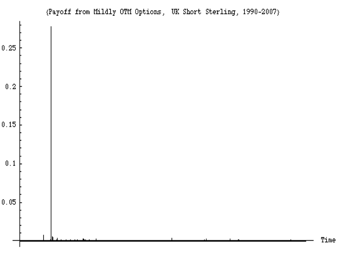
Figure 3 The graph shows the daily variations a derivatives portfolio exposed to U.K. interest rates between 1988 and 2008. Close to 99% of the variations, over the span of 20 years, will be represented in 1 single day—the day the European Monetary System collapsed. As I show in the appendix, this is typical with ANY socio-economic variable (commodity prices, currencies, inflation numbers, GDP, company performance, etc. ). No known econometric statistical method can capture the probability of the event with any remotely acceptable accuracy (except, of course, in hindsight, and "on paper"). Also note that this applies to surges on electricity grids and all manner of modern-day phenomena.
Figures 1 and 2 show you the classical problem of the turkey making statements on the risks based on past history (mixed with some theorizing that happens to narrate well with the data). A friend of mine was sold a package of subprime loans (leveraged) on grounds that "30 years of history show that the trade is safe." He found the argument unassailable "empirically". And the unusual dominance of the rare event shown in Figure 3 is not unique: it affects all macroeconomic data—if you look long enough almost all the contribution in some classes of variables will come from rare events (I looked in the appendix at 98% of trade-weighted data)"

Didn't Hume already talk about this?

"The problem of induction is the philosophical question of whether inductive reasoning is valid. That is, what is the justification for either:

  1. generalizing about the properties of a class of objects based on some number of observations of particular instances of that class (for example, the inference that "all swans we have seen are white, and therefore all swans are white," before the discovery of black swans) or
  2. presupposing that a sequence of events in the future will occur as it always has in the past (for example, that the laws of physics will hold as they have always been observed to hold).

The problem calls into question all empirical claims made in everyday life or through the scientific method. Although the problem dates back to the Pyrrhonism of ancient philosophy, David Hume introduced it in the mid-18th century, with the most notable response provided by Karl Popper two centuries later. A more recent, probability-based extension is the "no-free-lunch theorem for supervised learning" of Wolpert."

"Now let me tell you what worries me. Imagine that the Turkey can be the most powerful man in world economics, managing our economic fates. How? A then-Princeton economist called Ben Bernanke made a pronouncement in late 2004 about the "new moderation" in economic life: the world getting more and more stable—before becoming the Chairman of the Federal Reserve. Yet the system was getting riskier and riskier as we were turkey-style sitting on more and more barrels of dynamite—and Prof. Bernanke's predecessor the former Federal Reserve Chairman Alan Greenspan was systematically increasing the hidden risks in the system, making us all more vulnerable to blowups."

( Imagine no more- Don )

"By the "narrative fallacy" the turkey economics department will always manage to state, before thanksgivings that "we are in a new era of safety", and back-it up with thorough and "rigorous" analysis. And Professor Bernanke indeed found plenty of economic explanations—what I call the narrative fallacy—with graphs, jargon, curves, the kind of facade-of-knowledge that you find in economics textbooks. (This is the find of glib, snake-oil facade of knowledge—even more dangerous because of the mathematics—that made me, before accepting the new position in NYU's engineering department, verify that there was not a single economist in the building. I have nothing against economists: you should let them entertain each others with their theories and elegant mathematics, and help keep college students inside buildings. But beware: they can be plain wrong, yet frame things in a way to make you feel stupid arguing with them. So make sure you do not give any of them risk-management responsibilities.)"

There's also the problem of:
1) Relying on experts
2) Anybody can be wrong

In a way, Taleb is confusing himself, by expecting people to be infallible, like Greenspan and Bernanke, and then admitting that they can't be. All anyone on earth does it try their best. I'm not sure that he's refuted induction, by the way. The Turkey isn't conscious in the way that we supposedly are. If it was, it wouldn't be looking forward to Thanksgiving. If something happens a lot, it's reasonable to expect that it will continue to happen, until it doesn't. I would say that there were two main problems:
1) Accepting an incorrect relationship between math and the world
2) Not getting enough data or the appropriate data to make decent predictions with
The third, the predisposition to look the other way or ignore risk for a possible payoff, effected more than the quants. I actually like my prudence explanation better. I mean, once the facts are in, making fun of the people who got things wrong is fun, but not really profound.

"Bottom Line: The Map

Things are made simple by the following. There are two distinct types of decisions, and two distinct classes of randomness."

I don't believe this. His map or rules are just that, and are useful or not based on whether or not we can actually use them to our benefit.

"Decisions: The first type of decisions is simple, "binary", i.e. you just care if something is true or false. Very true or very false does not matter. Someone is either pregnant or not pregnant. A statement is "true" or "false" with some confidence interval. (I call these M0 as, more technically, they depend on the zeroth moment, namely just on probability of events, and not their magnitude —you just care about "raw" probability). A biological experiment in the laboratory or a bet with a friend about the outcome of a soccer game belong to this category"

Okay.

"The second type of decisions is more complex. You do not just care of the frequency—but of the impact as well, or, even more complex, some function of the impact. So there is another layer of uncertainty of impact. (I call these M1+, as they depend on higher moments of the distribution). When you invest you do not care how many times you make or lose, you care about the expectation: how many times you make or lose times the amount made or lost. "

This looks like this from Derivative Dribble
:

"
A Closer Look At Risk

As stated here, my own view is that risk is a concept that has two components: (i) the occurrence of an event and (ii) a magnitude associated with that event. This allows us to ask two questions: What is the probability of the event occurring? And if it occurs, what is the expected value of its associated magnitude? We say that P is exposed to a given risk if P expects to incur a gain/loss if the risk-event occurs. As is evident, under this rubric, that whole conversation above was grossly imprecise. But that’s ok. Its import is clear enough. "

"Probability structures
: There are two classes of probability domains—very distinct qualitatively and quantitatively. The first, thin-tailed: Mediocristan", the second, thick tailed Extremistan. Before I get into the details, take the literary distinction as follows:

In Mediocristan, exceptions occur but don't carry large consequences. Add the heaviest person on the planet to a sample of 1000. The total weight would barely change. In Extremistan, exceptions can be everything (they will eventually, in time, represent everything). Add Bill Gates to your sample: the wealth will jump by a factor of >100,000. So, in Mediocristan, large deviations occur but they are not consequential—unlike Extremistan.

Mediocristan corresponds to "random walk" style randomness that you tend to find in regular textbooks (and in popular books on randomness). Extremistan corresponds to a "random jump" one. The first kind I can call "Gaussian-Poisson", the second "fractal" or Mandelbrotian (after the works of the great Benoit Mandelbrot linking it to the geometry of nature). But note here an epistemological question: there is a category of "I don't know" that I also bundle in Extremistan for the sake of decision making—simply because I don't know much about the probabilistic structure or the role of large events."

Let's keep going:

"The Map

Now it lets see where the traps are:

First Quadrant: Simple binary decisions, in Mediocristan: Statistics does wonders. These situations are, unfortunately, more common in academia, laboratories, and games than real life—what I call the "ludic fallacy". In other words, these are the situations in casinos, games, dice, and we tend to study them because we are successful in modeling them.

Second Quadrant: Simple decisions, in Extremistan: some well known problem studied in the literature. Except of course that there are not many simple decisions in Extremistan.

Third Quadrant: Complex decisions in Mediocristan: Statistical methods work surprisingly well.

Fourth Quadrant: Complex decisions in Extremistan: Welcome to the Black Swan domain. Here is where your limits are. Do not base your decisions on statistically based claims. Or, alternatively, try to move your exposure type to make it third-quadrant style ("clipping tails").

The four quadrants. The South-East area (in orange) is where statistics and models fail us.

Tableau Of Payoffs


I think that the map is pretty straightforward. It's an attempt to assign the value of statistics and probablity in various delineated realms.

"Two Difficulties

Let me refine the analysis. The passage from theory to the real world presents two distinct difficulties: "inverse problems" and "pre-asymptotics".

Inverse Problems. It is the greatest epistemological difficulty I know. In real life we do not observe probability distributions (not even in Soviet Russia, not even the French government). We just observe events. So we do not know the statistical properties—until, of course, after the fact. Given a set of observations, plenty of statistical distributions can correspond to the exact same realizations—each would extrapolate differently outside the set of events on which it was derived. The inverse problem is more acute when more theories, more distributions can fit a set a data.
This inverse problem is compounded by the small sample properties of rare events as these will be naturally rare in a past sample. It is also acute in the presence of nonlinearities as the families of possible models/parametrization explode in numbers"

We absract and organize the events that we observe.

"Pre-asymptotics
. Theories are, of course, bad, but they can be worse in some situations when they were derived in idealized situations, the asymptote, but are used outside the asymptote (its limit, say infinity or the infinitesimal). Some asymptotic properties do work well preasymptotically (Mediocristan), which is why casinos do well, but others do not, particularly when it comes to Extremistan.

Most statistical education is based on these asymptotic, Platonic properties—yet we live in the real world that rarely resembles the asymptote. Furthermore, this compounds the ludic fallacy: most of what students of statistics do is assume a structure, typically with a known probability. Yet the problem we have is not so much making computations once you know the probabilities, but finding the true distribution."

Even with Mechanics, the models or theories or math are not exact, but work well enough for us to find them useful. If they don't work for us, then they're not useful. What's going on in math and other such endeavors is a different, although related, question.


"The Inverse Problem Of The Rare Events

Let us start with the inverse problem of rare events and proceed with a simple, nonmathematical argument. In August 2007, The Wall Street Journal published a statement by one financial economist, expressing his surprise that financial markets experienced a string of events that "would happen once in 10,000 years". A portrait of the gentleman accompanying the article revealed that he was considerably younger than 10,000 years; it is therefore fair to assume that he was not drawing his inference from his own empirical experience (and not from history at large), but from some theoretical model that produces the risk of rare events, or what he perceived to be rare events."

That does seem a bizarre statement, assuming it has to do with human culture in some way.

"Alas, the rarer the event, the more theory you need (since we don't observe it). So the rarer the event, the worse its inverse problem. And theories are fragile (just think of Doctor Bernanke)."

( You would certainly need a better explanation for why you believe as you do- Don )

"The tragedy is as follows. Suppose that you are deriving probabilities of future occurrences from the data, assuming (generously) that the past is representative of the future. Now, say that you estimate that an event happens every 1,000 days. You will need a lot more data than 1,000 days to ascertain its frequency, say 3,000 days. Now, what if the event happens once every 5,000 days? The estimation of this probability requires some larger number, 15,000 or more. The smaller the probability, the more observations you need, and the greater the estimation error for a set number of observations. Therefore, to estimate a rare event you need a sample that is larger and larger in inverse proportion to the occurrence of the event. "

You could certainly use it.

"If small probability events carry large impacts, and (at the same time) these small probability events are more difficult to compute from past data itself, then: our empirical knowledge about the potential contribution—or role—of rare events (probability × consequence) is inversely proportional to their impact. This is why we should worry in the fourth quadrant!"

( Of course, if you have less data, it's harder to make a prediction- Don )

"For rare events, the confirmation bias (the tendency, Bernanke-style, of finding samples that confirm your opinion, not those that disconfirm it) is very costly and very distorting. Why? Most of histories of Black Swan prone events is going to be Black Swan free! Most samples will not reveal the black swans—except after if you are hit with them, in which case you will not be in a position to discuss them. Indeed I show with 40 years of data that past Black Swans do not predict future Black Swans in socio-economic life.

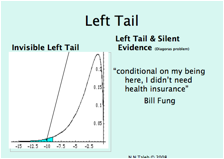
Figure 4 The Confirmation Bias At Work. For left-tailed fat-tailed distributions, we do not see much of negative outcomes for surviving entities AND we have a small sample in the left tail. This is why we tend to see a better past for a certain class of time series than warranted.

Surely the S & L Crisis and Tech Bubble could have added up to an attitude and disposition to prudence. Is that really so hard to imagine?

"Fallacy Of The Single Event Probability

Let us look at events in Mediocristan. In a developed country a newborn female is expected to die at around 79, according to insurance tables. When she reaches her 79th birthday, her life expectancy, assuming that she is in typical health, is another 10 years. At the age of 90, she should have another 4.7 years to go. So if you are told that a person is older than 100, you can estimate that he is 102.5 and conditional on the person being older than 140 you can estimate that he is 140 plus a few minutes. The conditional expectation of additional life drops as a person gets older."

You are more likely to die, over a certain age.

"In Extremistan things work differently and the conditional expectation of an increase in a random variable does not drop as the variable gets larger. In the real world, say with stock returns (and all economic variable), conditional on a loss being worse than the 5 units, to use a conventional unit of measure units, it will be around 8 units. Conditional that a move is more than 50 STD it should be around 80 units, and if we go all the way until the sample is depleted, the average move worse than 100 units is 250 units! This extends all the way to areas in which we have sufficient sample."

A human being is a living organism, the price of a stock is not. For one thing, one can go in either direction on a continuum, while the other cannot.

"This tells us that there is "no typical" failure and "no typical" success. You may be able to predict the occurrence of a war, but you will not be able to gauge its effect! Conditional on a war killing more than 5 million people, it should kill around 10 (or more). Conditional on it killing more than 500 million, it would kill a billion (or more, we don't know). You may correctly predict a skilled person getting "rich", but he can make a million, ten million, a billion, ten billion—there is no typical number. We have data, for instance, for predictions of drug sales, conditional on getting things right. Sales estimates are totally uncorrelated to actual sales—some drugs that were correctly predicted to be successful had their sales underestimated by up to 22 times!"

Same point.

"This absence of "typical" event in Extremistan is what makes prediction markets ludicrous, as they make events look binary. "A war" is meaningless: you need to estimate its damage—and no damage is typical. Many predicted that the First War would occur—but nobody predicted its magnitude. Of the reasons economics does not work is that the literature is almost completely blind to the point."

That's hard to believe, but maybe it's true.

"A Simple Proof Of Unpredictability In The Fourth Quadrant

I show elsewhere that if you don't know what a "typical" event is, fractal power laws are the most effective way to discuss the extremes mathematically. It does not mean that the real world generator is actually a power law—it means you don't understand the structure of the external events it delivers and need a tool of analysis so you do not become a turkey. Also, fractals simplify the mathematical discussions because all you need is play with one parameter (I call it "alpha") and it increases or decreases the role of the rare event in the total properties"

It's still a model, however.

"For instance, you move alpha from 2.3 to 2 in the publishing business, and the sales of books in excess of 1 million copies triple! Before meeting Benoit Mandelbrot, I used to play with combinations of scenarios with series of probabilities and series of payoffs filling spreadsheets with clumsy simulations; learning to use fractals made such analyses immediate. Now all I do is change the alpha and see what's going on."

He likes fractals. They can generate large increases or decreases.

"Now the problem: Parametrizing a power law lends itself to monstrous estimation errors (I said that heavy tails have horrible inverse problems). Small changes in the "alpha" main parameter used by power laws leads to monstrously large effects in the tails. Monstrous."

Small changes can generate large effects, which is why non-linearity is also used in chaos theory, I believe.

"And we don't observe the "alpha. Figure 5 shows more than 40 thousand computations of the tail exponent "alpha" from different samples of different economic variables (data for which it is impossible to refute fractal power laws). We clearly have problems figuring it what the "alpha" is: our results are marred with errors. Clearly the mean absolute error is in excess of 1 (i.e. between alpha=2 and alpha=3). Numerous papers in econophysics found an "average" alpha between 2 and 3—but if you process the >20 million pieces of data analyzed in the literature, you find that the variations between single variables are extremely significant.


Figure 5—Estimation error in "alpha" from 40 thousand economic variables. I thank Pallop Angsupun for data.

Now this mean error has massive consequences. Figure 6 shows the effect: the expected value of your losses in excess of a certain amount(called "shortfall") is multiplied by >10 from a small change in the "alpha" that is less than its mean error! These are the losses banks were talking about with confident precision!

Figure 6—The value of the expected shortfall (expected losses in excess of a certain threshold) in response to changes in tail exponent "alpha". We can see it explode by an order of magnitude.

What if the distribution is not a power law? This is a question I used to get once a day. Let me repeat it: my argument would not change—it would take longer to phrase it.

Many researchers, such as Philip Tetlock, have looked into the incapacity of social scientists in forecasting (economists, political scientists). It is thus evident that while the forecasters might be just "empty suits", the forecast errors are dominated by rare events, and we are limited in our ability to track them. The "wisdom of crowds" might work in the first three quadrant; but it certainly fails (and has failed) in the fourth."

The "rare" events involve massive results. My problem isn't with the massive events or results, but the word "rare". In other words, there are two predictions:
1) How likely?
2) How large?

It seems that in Extremistan both are terribly misjudged. But they are, by definition, more complex than his earlier binary decisions and probablities to begin with. The math doesn't seem to be helping us out with the difficulties inherent in the very definition of the domain. It merely puts it into graph form.

"Living In The Fourth Quadrant

Beware the Charlatan. When I was a quant-trader in complex derivatives, people mistaking my profession used to ask me for "stock tips" which put me in a state of rage: a charlatan is someone likely (statistically) to give you positive advice, of the "how to" variety.

Go to a bookstore, and look at the business shelves: you will find plenty of books telling you how to make your first million, or your first quarter-billion, etc. You will not be likely to find a book on "how I failed in business and in life"—though the second type of advice is vastly more informational, and typically less charlatanic. Indeed, the only popular such finance book I found that was not quacky in nature—on how someone lost his fortune—was both self-published and out of print. Even in academia, there is little room for promotion by publishing negative results—though these, are vastly informational and less marred with statistical biases of the kind we call data snooping. So all I am saying is "what is it that we don't know", and my advice is what to avoid, no more.

You can live longer if you avoid death, get better if you avoid bankruptcy, and become prosperous if you avoid blowups in the fourth quadrant.

Now you would think that people would buy my arguments about lack of knowledge and accept unpredictability. But many kept asking me "now that you say that our measures are wrong, do you have anything better?"

I used to give the same mathematical finance lectures for both graduate students and practitioners before giving up on academic students and grade-seekers. Students cannot understand the value of "this is what we don't know"—they think it is not information, that they are learning nothing. Practitioners on the other hand value it immensely. Likewise with statisticians: I never had a disagreement with statisticians (who build the field)—only with users of statistical methods.

Spyros Makridakis and I are editors of a special issue of a decision science journal, The International Journal of Forecasting. The issue is about "What to do in an environment of low predictability". We received tons of papers, but guess what? Very few addressed the point: they mostly focused on showing us that they predict better (on paper). This convinced me to engage in my new project: "how to live in a world we don't understand".

This is what I really like about Taleb. He focuses on what we don't know. We do need to live in a world that we cannot understand.

"So for now I can produce phronetic rules (in the Aristotelian sense of phronesis, decision-making wisdom). Here are a few, to conclude. "

I don't like the word "rules". I would say "guidelines" or "rules of the road" or "tricks of the trade".

"Phronetic Rules: What Is Wise To Do (Or Not Do) In The Fourth Quadrant

1) Avoid Optimization, Learn to Love Redundancy. Psychologists tell us that getting rich does not bring happiness—if you spend it. But if you hide it under the mattress, you are less vulnerable to a black swan. Only fools (such as Banks) optimize, not realizing that a simple model error can blow through their capital (as it just did). In one day in August 2007, Goldman Sachs experienced 24 x the average daily transaction volume—would 29 times have blown up the system? The only weak point I know of financial markets is their ability to drive people & companies to "efficiency" (to please a stock analyst’s earnings target) against risks of extreme events.

Indeed some systems tend to optimize—therefore become more fragile. Electricity grids for example optimize to the point of not coping with unexpected surges—Albert-Lazlo Barabasi warned us of the possibility of a NYC blackout like the one we had in August 2003. Quite prophetic, the fellow. Yet energy supply kept getting more and more efficient since. Commodity prices can double on a short burst in demand (oil, copper, wheat) —we no longer have any slack. Almost everyone who talks about "flat earth" does not realize that it is overoptimized to the point of maximal vulnerability.

Biological systems—those that survived millions of years—include huge redundancies. Just consider why we like sexual encounters (so redundant to do it so often!). Historically populations tended to produced around 4-12 children to get to the historical average of ~2 survivors to adulthood.

Option-theoretic analysis: redundancy is like long an option. You certainly pay for it, but it may be necessary for survival."

( 1 ) Save

"2) Avoid prediction of remote payoffs—though not necessarily ordinary ones. Payoffs from remote parts of the distribution are more difficult to predict than closer parts.

A general principle is that, while in the first three quadrants you can use the best model you can find, this is dangerous in the fourth quadrant: no model should be better than just any model.
"

( 2 ) Take the money

"3) Beware the "atypicality" of remote events. There is a sucker's method called "scenario analysis" and "stress testing"—usually based on the past (or some "make sense" theory). Yet I show in the appendix how past shortfalls that do not predict subsequent shortfalls. Likewise, "prediction markets" are for fools. They might work for a binary election, but not in the Fourth Quadrant. Recall the very definition of events is complicated: success might mean one million in the bank ...or five billions!"

( 3 ) Stick to what you know and understand

"4) Time. It takes much, much longer for a times series in the Fourth Quadrant to reveal its property. At the worst, we don't know how long. Yet compensation for bank executives is done on a short term window, causing a mismatch between observation window and necessary window. They get rich in spite of negative returns. But we can have a pretty clear idea if the "Black Swan" can hit on the left (losses) or on the right (profits).

The point can be used in climatic analysis. Things that have worked for a long time are preferable—they are more likely to have reached their ergodic states.
"

( 4 ) Look at past results, but going forward base rewards on future proven results

"5) Beware Moral Hazard. Is optimal to make series of bonuses betting on hidden risks in the Fourth Quadrant, then blow up and write a thank you letter. Fannie Mae and Freddie Mac's Chairmen will in all likelihood keep their previous bonuses (as in all previous cases) and even get close to 15 million of severance pay each."

This is my most important one for this crisis:
( 5 ) Do not give implicit or explicit guarantees without tying the people involved to personal responsiblity for the results or severely circumscribing their performance

"6) Metrics. Conventional metrics based on type 1 randomness don't work. Words like "standard deviation" are not stable and does not measure anything in the Fourth Quadrant. So does "linear regression" (the errors are in the fourth quadrant), "Sharpe ratio", Markowitz optimal portfolio, ANOVA shmnamova, Least square, etc. Literally anything mechanistically pulled out of a statistical textbook."

( 6) Forget mechanistic explanations

"My problem is that people can both accept the role of rare events, agree with me, and still use these metrics, which is leading me to test if this is a psychological disorder.

The technical appendix shows why these metrics fail: they are based on "variance"/"standard deviation" and terms invented years ago when we had no computers.
One way I can prove that anything linked to standard deviation is a facade of knowledge: There is a measure called Kurtosis that indicates departure from "Normality". It is very, very unstable and marred with huge sampling error: 70-90% of the Kurtosis in Oil, SP500, Silver, UK interest rates, Nikkei, US deposit rates, sugar, and the dollar/yet currency rate come from 1 day in the past 40 years, reminiscent of figure 3. This means that no sample will ever deliver the true variance. It also tells us anyone using "variance" or "standard deviation" (or worse making models that make us take decisions based on it) in the fourth quadrant is incompetent."

He's describing weakness of the will, which is a very old problem.

"7) Where is the skewness?
Clearly the Fourth Quadrant can present left or right skewness. If we suspect right-skewness, the true mean is more likely to be underestimated by measurement of past realizations, and the total potential is likewise poorly gauged. A biotech company (usually) faces positive uncertainty, a bank faces almost exclusively negative shocks. I call that in my new project "concave" or "convex" to model error.

( 7 ) Try and figure out where your weaknesses are.

"8) Do not confuse absence of volatility with absence of risks. Recall how conventional metrics of using volatility as an indicator of stability has fooled Bernanke—as well as the banking system.

Figure 7 Random Walk—Characterized by volatility. You only find these in textbooks and in essays on probability by people who have never really taken decisions under uncertainty.


Figure 8 Random Jump process—It is not characterized by its volatility. Its exits the 80-120 range much less often, but its extremes are far more severe. Please tell Bernanke if you have the chance to meet him.

( 8 ) Be prepared for surprises

"9) Beware presentations of risk numbers. Not only we have mathematical problems, but risk perception is subjected to framing issues that are acute in the Fourth Quadrant. Dan Goldstein and I are running a program of experiments in the psychology of uncertainty and finding that the perception of rare events is subjected to severe framing distortions: people are aggressive with risks that hit them "once every thirty years" but not if they are told that the risk happens with a "3% a year" occurrence. Furthermore it appears that risk representations are not neutral: they cause risk taking even when they are known to be unreliable."

( 9 ) Always be conservative with risk

"Technical Appendix to "The Fourth Quadrant"—Click Here"

Okay. I made up my own rules from his rules. So sue me. Read him yourself. It's fun.