Showing posts with label H.Paulson. Show all posts

Thursday, June 4, 2009

if we are going to celebrate the fact that the world hasn't ended, Hank Paulson has to get some of the credit for that

From:

The Curious Capitalist – TIME.com

Hank Paulson, national hero

Evan Newmark has a column in the WSJ making the case that we should start honoring Hank Paulson as a "national hero." Newmark lists the various improvements in credit markets since Paulson got Congress to approve his Troubled Asset Relief Program last fall, then writes:

All of this is not to suggest that TARP alone made all these good things happen. Certainly, Ben Bernanke's Fed has been pretty forgiving with its monetary policy.

Nor is it to suggest that Hank Paulson knew exactly what he was doing in the frenzied days of last fall. He didn't. The TARP as originally conceived was to buy up toxic assets off the bank balance sheets. To this day, those assets are still sitting there.

But TARP was the beginning of the end of the crisis. And it was Paulson's baby.

I think Newmark is mostly right about this. There's a lot one can berate Paulson for: Letting Lehman go, bailing out AIG in such sloppy fashion, lobbying the SEC—back when he was CEO of Goldman Sachs—to allow investment banks to take on more leverage. But when the financial world was on the brink of collapse last fall, he did whatever he could to keep it from actually collapsing. And he succeeded.

Which brings to mind a moment from that Bloomberg/Vanity Fair panel discussion on the crisis last week that I attended and has since been transcribed and is making its way around the blogosphere. Austan Goolsbee was talking about how a Depression had been averted, and Andrew Sorkin said (according to the somewhat muddled transcript),

SORKIN: By the way, are we going to give Obama credit for that or are we going to give Bush credit for that?

GOOLSBEE: You're going to give Bush credit for what?

SORKIN: Stopping the Great Depression, or no?

GOOLSBEE: No. I wouldn't do that as a “no.” [I think he really said "I would do that as a 'no'"]

SORKIN: You'd be better than “no.” OK. So Paulson didn't do anything.

GOOLSBEE: I didn't say he didn't do anything. Many of the things he did I wish he hadn't done.

When pressed to list some of these things (this doesn't show up in the transcript, but I remember it) Goolsbee had nothing to say. I thought this was his weakest moment in the whole discussion. The Obama administration has not significantly strayed from the course set by Paulson. It has elaborated upon it, and in some cases improved upon it. But if we are going to celebrate the fact that the world hasn't ended, Hank Paulson has to get some of the credit for that."

Me:

  1. donthelibertariandemocrat Says:

    "1. Tuesday, November 4, 2008 at 2:21 pm

    "Now I'm not sure that the current buy-stakes-in-every-last-financial-institution-that-asks is really the right approach either. But at least Paulson has set an encouraging precedent: When the facts change, he changes his mind."

    I haven't agreed with his positions, but I don't envy him his position. I've had to make huge compromises with my own beliefs to try and understand this mess and how it should best play out, but I don't matter.

    My understanding was simply that going in with a Swedish type plan right from the beginning was a better way of biting the bullet, and eventually getting back out. It was cleaner. Maybe he's seeing that, especially since he's finding that, as the WSJ says, jawboning doesn't do much.

    I'm not happy with the expansion of TARP recipients, but, again, where you have a messy plan with lots of lobbying, this was expected.

    I'd like to hear his positions on all this when he's out of it. But you're right. I've had enough of government officials with no learning curve. He might end up being one of the better people in the administration in the last eight years. Of course, that's even fainter praise."

    That's from this blog. He did a fair job, and, for a Bush Administration person, he was about as good as it gets.

Thursday, March 5, 2009

Things could be much worse, either that or the US government would explicitly own Merrill by now.

From Free Exchange:

"What sank Bank of America?
Posted by:
Economist.com | NEW YORK
Categories:
Financial markets

WHAT sealed the fate of Bank of America? I was surprised by something Thomas Friedman said yesterday.

And many other banks — the ones that took on the most leverage like Citigroup and Bank of America — are in trouble because of all the loans on their books that can't now be repaid, such as auto loans, commercial real estate loans, credit card loans, corporate loans.

In the run up to the crisis, there was reckless behaviour on the part of Citibank, Lehman and Bear—but is it fair to put BofA in that category? By acquiring Merrill and Countrywide, BofA has lots of nasty things on its books and it has taken lots of government money. But a big reason why things are so dire is because it bought a bank in really bad shape, not because it engaged in irresponsible lending and took on too much leverage.

Not to say things would be so rosy if it had not bought Merrill. While BofA may not have been as exposed as other firms, according to William Patterson, executive director of CTW Investment Group (which claims its affiliated funds own 116m BofA shares), by March 2008 BofA had lost 30% of its market capitalisation from the previous year. That was largely the result of liquidity support agreements from the CDOs it issued.

Also, even tougher times may lie ahead. The original BofA is heavily exposed to the American consumer. That may be a problem if unemployment goes above 10%. BofA has lots of home-equity loans and credit-card default could turn out to be a big problem. But, its behaviour, prior to acquiring Merrill, would not have left it on the brink of explicit nationalisation. It seems by taking on Merrill, it also took on its poor image. That made things even worse by sinking confidence further.

So even if Bank of America did not behave as recklessly as Merrill, was the decision to acquire it equally irresponsible? A letter circulating today from Mr Patterson to Temple Sloan, the bank’s lead outside director, calls for the removal of Ken Lewis for making that decision.

The board, however, subsequently allowed Mr. Lewis to take outsized, reckless risks by acquiring Merrill Lynch in the midst of severe financial uncertainty. After hastily arranging the ill-considered acquisition, management then failed to disclose Merrill’s staggering fourth quarter losses prior to the shareholder vote on the merger. In addition, BAC’s senior management was reportedly aware of Merrill Lynch’s intent to distribute nearly $4 billion in bonuses at a time when Merrill Lynch was suffering heavy losses. It also appears that Mr. Lewis had the ability to prevent the payments under a previously undisclosed agreement.

Mr Lewis claims he had no idea how bad 4th quarter earnings were until the board voted. Though, a friend of mine who works at Merrill put the merger rather succinctly: “It’s like buying a house during Hurricane Katrina and then acting surprised later the house is uninhabitable because of flood damage."

Nonetheless, after Mr Lewis realised how bad things were at Merrill, he claims he tried to back out of the deal. But Hank Paulson pressured him to stay the course (with the understanding of $20 billion of new capital from the government).

It’s ironic that now BofA is being cast in the same light as the worst behaving banks. The decision to buy Merrill may have been bad for BofA. But can you imagine where we would be now if that same fateful weekend Merrill went down with Lehman, or if Mr Lewis did back out of the deal to buy the troubled bank? Things could be much worse, either that or the US government would explicitly own Merrill by now. Who knows? If BofA survives this, it may someday be glad it bought Merrill (assuming that house does not need to be condemned)."

Me:
Don the libertarian Democrat wrote:
March 6, 2009 1:48

"Nonetheless, after Mr Lewis realised how bad things were at Merrill, he claims he tried to back out of the deal. But Hank Paulson pressured him to stay the course (with the understanding of $20 billion of new capital from the government).

It’s ironic that now BofA is being cast in the same light as the worst behaving banks. The decision to buy Merrill may have been bad for BofA. But can you imagine where we would be now if that same fateful weekend Merrill went down with Lehman, or if Mr Lewis did back out of the deal to buy the troubled bank? Things could be much worse, either that or the US government would explicitly own Merrill by now. Who knows?"

You make a good point, but let's follow through with some conclusions from this.

First, there was serious fear on the Sunday before Lehman went bust that, if they did, Merrill would follow. The actions of the following week to get the B of A to buy Merrill seem to argue that the fear was justified. Why then take the chance of letting Lehman go bust? Why not have given more aid to the B of A to buy Lehman?

Secondly, given the tax provisions of the original TARP that helped Wells acquire Wachovia, and all of the other actions, it's obvious that the plan to take care of these large businesses was to make them bigger. But what if the size was the problem?

Thirdly, since Bernanke and Bair have said that neither the FDIC or any other government agency can seize these large banks, what was the contingency plan if that occurred? Surely somebody must have asked what would happen if a large bank became insolvent. As best as we can tell, the plan was to turn the large banks over to other large banks with government help. That is the definition of a government guarantee. If the agency that seizes insolvent banks can't seize an insolvent large bank, and we don't let banks go bust in the US, that means that the government is financially committed to saving that bank. Period.

Finally, since you make the point that the B of A was pressured to and helped in the saving of Merrill, how can we help but conclude that the government now feels honor bound to save them?

Wednesday, January 28, 2009

When Lehman failed, it did so with clear indications from its regulators that they wouldn't continue with Bear-style bailouts

From Felix Salmon:

"
More on Lehman Revisionism

I've been thinking a bit more about the Lehman Brothers revisionism coming from the likes of Bernanke, Paulson, and Geithner: the fact that although they were quite clear about letting Lehman fail at the time, they subsequently have backtracked on that, and said that although they tried very hard to rescue Lehman, they simply weren't allowed to do so.

I still think that's probably bullshit, and that in this crisis, as we've seen, where there's a will, in government, there's a way. Paulson, for one, was not the type of person to let a bunch of Federal Reserve lawyers stop him from doing what he thought needed to be done. But what if he's telling the truth, and rescuing Lehman really was illegal? How can that be squared with contemporaneous statements?

I think the answer might lie in market psychology. When Lehman failed, it did so with clear indications from its regulators that they wouldn't continue with Bear-style bailouts, and that there was no kind of Paulson Put, where failed banks automatically get rescued by Treasury.

If the sun rose the following morning and the world didn't come to an end, that would be an astonishingly strong signal about market resilience in the face of government inaction, and would help boost sentiment a very great deal.

On the other hand, if Lehman's failure really was going to have nasty systemic consequences, then a few statements from Treasury were unlikely to make things substantially worse: an apocalyptic meltdown is an apocalyptic meltdown either way.

So I can see why Paulson and Bernanke said what they did in the immediate wake of Lehman's collapse: there was substantial upside to saying it if markets went up, while if markets went down the downside was so big either way it made very little difference whether they said it or not."

Me:

From the Economics Of Contempt:

http://economicsofcontempt.blogspot.com/2009/01/merrill-and-basis-trade.html

"Any CDS contract with Lehman as counterparty needed to be replaced when Lehman collapsed. Remember the emergency "Risk Reduction Trading Session" the ISDA opened on the Sunday that Lehman was preparing to file for bankruptcy? That was so that the major dealers could start replacing their derivative contracts where Lehman was the counterparty with contracts with other counterparties. The emergency trading session was a disaster (about which more later), but it was especially disastrous for Merrill.

Remember the timing.

The emergency trading session ran from 2 pm to 6 pm on the Sunday that Lehman was preparing to file for bankruptcy. The news that BofA was in advanced talks to buy Merrill didn't break until around 5 pm. Before that announcement, everyone was looking for who would be the next to fall, and the consensus was that Merrill was next in line. So traders turned their guns on Merrill. In a standard CDS, no money is exchanged upfront. But when a firm looking to enter into a CDS contract might default before the contract matures, counterparties start to demand money upfront—known as "points upfront" or "initial margin." Since Merrill was expected to collapse if it couldn't find a buyer, and news of the BofA deal had not yet leaked, counterparties were demanding that Merrill make huge upfront payments in order to enter into a CDS contract. And because Merrill had huge exposure to Lehman as a counterparty, it had a lot of contracts it needed to replace."

Doesn't this show that a Calling Run, Fisher's Debt-Deflation, was a real possibility if Lehman collapsed?

Monday, January 19, 2009

Following Lehman’s filing on Sept. 15, “there was a spiral of confidence disappearing

More on the Lehman Debacle. From Bloomberg:

"By Jennifer Ryan

Jan. 19 (Bloomberg) -- Lehman Brothers Holdings Inc.’s rescue failed when U.S. officials couldn’t find a bank to provide the same trading guarantees that Bear Stearns Cos. received, the New York Federal Reserve’s general counsel said.

“Plan A was to prepare a Bear Stearns-style rescue, plan B was the alternative case,” Thomas Baxter, who attended the discussions to save the bank, told a conference in London today. “The problem with plan A was the problem with guarantees” and “if you don’t have that guarantee and a strong hand, market confidence in a weaker member is going to continue to erode.”

Lehman’s failure in September led to the biggest bankruptcy filing in history and prompted an escalation in the financial crisis which threatened to undermine banks around the world. An agreement by U.K.-based Barclays Plc to buy Lehman was blocked at the last minute by British regulators.( WOW )

“The facts are often that people conclude that we let Lehman fail, and that factual predicate is not accurate, that the government let Lehman fail,” Baxter said. “The problem we encountered on Sunday, Sept. 14, is Barclays wasn’t in a position to give a similar guarantee of the trading obligations of Lehman” as JPMorgan Chase & Co. gave to Bear.

Bank of America Corp and Barclays were the only two potential suitors for Lehman when officials met before the bankruptcy filing on Sept. 15., said Baxter, speaking at a conference organized by the Financial Markets Group of the London School of Economics.

‘Cast of Characters’

“When we started into Lehman weekend on Friday, Sept. 12, we gathered at the New York Fed,” he said. “The cast of characters were the secretary of the Treasury, Hank Paulson, my president, Tim Geithner, the chairman of the SEC,” Christopher Cox, and the heads of as many as 14 financial institutions.

“It soon became clear that Bank of America was not so much interested in Lehman, but something else. That was Merrill.” Baxter said. “So we lost Bank of America. That left Barclays.”

The group of bankers and officials was trying to repeat the Bear rescue on Lehman, except that this time officials told lenders that “unlike with Bear, you all are going to finance the assets that are taken to facilitate the acquisition. That was plan A,” Baxter said.

“The problem with plan A was not an absence of financing” because the bankers in the room did agree on a deal, Baxter said. “They had the money and they were willing to put it out.”

‘More Technical’

The hitch was “much more technical,” Baxter said.

“The problem for plan A relates to, what do you do in the period between the announcement of a merger and the actual closing of the merger?” Baxter said. He said plan A failed because Barclays couldn’t guarantee the trading obligations.

Barclays agreed to acquire Lehman after a syndicate of banks consented to backstop a new entity that would take over $55 billion to $60 billion of Lehman’s troubled assets, according to people familiar with the negotiations. The deal fell apart when the U.K.’s Financial Services Authority refused to sign off on the Barclays purchase that day and U.S. officials refused to take further steps to save the deal.( GOOD WORK )

The New York Fed meeting then turned to discuss plan B, Baxter said.

“The best option was to put the parent of Lehman into bankruptcy, to continue an operation as broker-dealer at least in the U.S., and to continue a broker-dealer operation through Federal Reserve liquidity,” Baxter said. “That happened.”

‘Big Time’ Loans

In the week after the bankruptcy filing, the Fed loaned “big time” to keep the broker-dealer in business, with funds totaling as much as $50 billion, he said. Barclays then returned to the table and bought the division.

“If you go back and study the way we did Bear Stearns, you’ll see the importance of the guarantees( I AGREE ),” Baxter said.

Following Lehman’s filing on Sept. 15, “there was a spiral of confidence disappearing( A CALLING RUN, DEBT-DEFLATION SPIRAL ),” Tony Lomas, a partner at PricewaterhouseCoopers who is administering Lehman’s U.K. bankruptcy, told the same conference today. He previously worked on the aftermath of Enron Corp.’s financial collapse.

“We had a call Saturday night, we were appointed Sunday lunchtime,” Lomas said. “We had half a day to prepare. In the Enron insolvency, we had a two-week window to talk with management on what they would do if support from the parent stopped.”

To contact the reporter on this story: Jennifer Ryan in London at Jryan13@bloomberg.net"

This was a terrible mistake.

Friday, January 16, 2009

"How do you attack that agency problem? You give control to a government-appointed conservator"

Excellent post by Justin Fox:

"Why hasn't the government nationalized Citigroup? Hank Paulson's sort of answer

Roger Ehrenberg thinks it's long past time for Treasury to bite the bullet on Citi:

What if, just what if, Treasury (together with the SEC) had said four months ago - game over, guys. Employ FAS 157 across your asset portfolios, show us exactly how broke you are, hand us the keys, we'll settle accounts with those who are owed money and say too bad to those who aren't (common stockholders and unsecured debtholders), sell of the good assets and warehouse the bad at marked-down levels. The Government could have worked out illiquid derivatives positions over time without causing a market cataclysm. Oh, and Management and the Board, don't let the doorknob hit you in the butt on your way out. You'll be hearing from a few lawyers any day now. These decisive actions would have saved taxpayers tens if not hundreds of billions of dollars, yet we still have the good ol' Citi management at the helm steering the ship.( I AGREE )

I actually asked Hank Paulson in early December why Treasury hadn't done this, although I did in far more mealy-mouthed language than Ehrenberg. Here's the excerpt from the transcript:

Q: A thought experiment that I've seen a lot of people making with AIG and with Citi … the conservatorship route, there's this cleanless to it: “Okay it's over, you guys are out. We'll take it public again in a few years.”

A: Every criticism I agree with in terms of the problem. The question is, I ask myself what would I have done differently. With Fannie and Freddie we had conservatorship because it was in the law. People just sort of accept that right now. That was such a stretch, and so heroic as far as I'm concerned to get there a couple weeks ahead of the Lehman earnings, which we knew were coming.

AIG, there was essentially no regulator at the federal level. The New York Fed learned about this the same time I did, that there was pending failure. They were told that New York state's got it under control, the insurance regulator. It was the weekend we were dealing with Lehman Brothers, there was no TARP at that time. Fortunately the Fed was able to make determination that there were the hard assets to do the loan against. So that was done that way. I still believe that the government owning the vast majority of that was warranted by the circumstances. So remember, this is a breakup strategy in terms of selling off pieces that is totally different than Citi, which is a very systemically important bank and we were dealing with severe stress in the markets. But clearly it's important that private capital be welcomed, be encouraged, that government doesn't have the capability to run a business like that for a long period of time.( TRUE )

I think he's sort of missing the point there, and I wish I had pressed him further. Nobody thinks the government is brilliant at running banks( I AGREE. BUT NEITHER ARE BANKERS. ). But right now you have situation where taxpayers have put a lot of money into Citi (and other banks), but the people running those banks are still answerable not to taxpayers but to the shareholders at large. The taxpayers are shareholders too, but they're minority shareholders, and they're stuck with liabilities if the bank fails that other shareholders don't have to worry about.( YEP )

If everything works out for the best and the bank quickly recovers, it's smiles all around. But if the troubles continue you've got a bank management looking out for the interests( THE PROBLEM WITH HYBRIDS ) of limited-liability shareholders (not to mention its own interests), who are generally going to be much less risk-averse than the taxpayers (because they won't be stuck with the bill if all goes pear shaped). It's an agency problem."

"Also sometimes referred to as the principal-agent problem. The difficult but extremely important and recurrent organizational design problem of how organizations can structure incentives so that people (“agents”)( THIS IS WHAT I MEAN BY HUMAN AGENCY. I JUST THINK THAT MY TERM IS EASIER TO UNDERSTAND. ) who are placed in control over resources that are not their own with a contractual obligation to use these resources in the interests of some other person or group of people actually will perform this obligation as promised — instead of using their delegated authority over other people's resources to feather their own nests at the expense of those whose interests they are supposed to be serving (their “principals”). Enforcing such contracts will involve transaction costs (often referred to as agency costs), and these costs may sometimes be very high indeed."

Back to Justin Fox:

"How do you attack that agency problem? You give control to a government-appointed conservator, who isn't necessarily going to be any smarter than existing bank management, but will have minimizing taxpayer losses as a first priority( THAT'S IT ). After that's taken care of, then you can start thinking about how to get private capital back in."( I AGREE. NATIONALIZE, THEN PRIVATIZE. )

Many of the terms and theories I use have more technical names, but I try and make things easier to understand, especially for myself. In any case, a terrific post.

Saturday, January 10, 2009

“If Paulson was still an employee of Goldman Sachs and he’d done this deal, he would have been fired,”

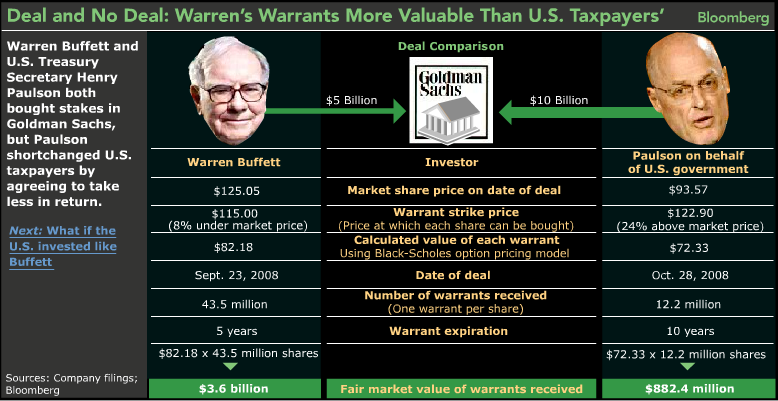
Back in October, I argued that it was incumbent that the taxpayers get a better deal than private investors. From Bloomberg:

"By Mark Pittman

Jan. 10 (Bloomberg) -- Henry Paulson’s bank bailouts, done under “great stress” during the worst financial crisis since the Great Depression, failed to win for U.S. taxpayers what Warren Buffett received for his shareholders by investing in Goldman Sachs Group Inc.( TRUE )

The Treasury secretary made 174 purchases of banks’ preferred shares that include warrants to buy stock at a later date. While he invested $10 billion in Goldman Sachs in October, twice as much as Buffett did the month before, Paulson gained certificates worth one-fourth as much as the billionaire, according to data compiled by Bloomberg. The Goldman Sachs terms were repeated in most of the other bank bailouts.( A DISGRACE )

Paulson’s decisions to prop up the financial system included purchasing shares in institutions from Goldman Sachs, the most profitable Wall Street firm last year, to Saigon National Bank, a Westminster, California, lender whose market value is $3.8 million.

“We were not looking to replicate one-off private deals” in the transactions, made under the $700 billion Troubled Asset Relief Program, Paulson said in a Bloomberg TV interview yesterday.( I ARGUE JUST THE OPPOSITE )

“The market was under great stress and the private sector was extracting very, very severe terms( IT WAS THE OTHER WAY AROUND! ). What we were attempting to do, which I think we did successfully, was design a program that would be accepted by a large group of healthy banks( ? ) with terms that would replicate what you would get in normal market conditions,” he said.

‘20-20 Hindsight’

“With 20/20 hindsight,” the bank-capital injections have achieved their objectives and the decisions on TARP will “prove to be the right ones,” the Treasury secretary said.( HUH? )

Paulson’s warrant deals may give taxpayers less profit from any recovery in financial stocks than shareholders such as Goldman Sachs Chief Executive Officer Lloyd Blankfein and Saudi Arabian Prince Alwaleed bin Talal, owner of 4 percent of Citigroup Inc., said Simon Johnson, former chief economist for the International Monetary Fund.

The transactions are “just egregious,” said Johnson, a fellow at the Peterson Institute for International Economics in Washington. “You want to do it the way Warren does it.”( OBVIOUSLY )

Paulson said “he had to make it attractive to banks, which is code for( COLLUSION ) ‘I’m going to give money away,’” said Joseph Stiglitz, who won a Nobel Prize in 2001 for his work on the economic value of information.

‘Giveaway’

“The worst aspect of this is that they were designed not to do what they were supposed to do,” he said in a telephone interview from Paris Jan. 7. “In many ways, it’s not only a giveaway, but a giveaway that was designed not to work.”( TRUE )

The Treasury would have held warrants for 116 million shares of Goldman Sachs under Buffett’s terms, which would be equivalent to a 21 percent stake when added to those currently outstanding. Instead, the dilution is 2.7 percent under the Treasury plan. Blankfein is the company’s biggest individual investor, with 2.08 million shares worth about $178 million today, according to Bloomberg data. His 0.47 percent interest would have declined to 0.36 percent under Buffett’s terms and would be 0.44 percent if the Treasury’s warrants were exercised.

Senator Judd Gregg, a New Hampshire Republican, estimated in a Jan. 4 Wall Street Journal opinion article that TARP investments have earned about $8 billion while recapitalizing the banking system.

Changes to TARP

Government agencies have committed more than $8.5 trillion to shoring up the financial system, including TARP, signed into law Oct. 3 by President George W. Bush. The program was sold to Congress as a way to buy securities that had fallen in market value. Paulson shifted his emphasis to direct capital injections to banks to prevent the financial sector from foundering.( NOT ACCEPTABLE. BAIT AND SWITCH. )

The House Financial Services Committee and TARP Congressional Oversight Panel plan hearings on how federal bailout money will be used during the administration of President-elect Barack Obama. The financial services panel scheduled its meeting for Jan. 13.

The oversight panel has contracted an independent analyst to examine the terms of TARP investments and is scheduled to deliver a report by Jan. 30, said Elizabeth Warren, chairwoman of the oversight panel, in an interview today. The question matters, Warren said, because shareholders are now being protected by taxpayer dollars.

“Supporting equity is such a profound shift in American economic policy that we must take a hard look at that decision( A GOOD IDEA ),” said Warren, a Harvard Law School professor who specializes in bankruptcy.

‘Something Worth Nothing’

Stiglitz said finance professionals at Treasury possessed expertise on warrant pricing that members of Congress didn’t. As a result, Paulson gave lip service to the lawmakers’ intent on TARP without gaining much value for taxpayers, said Stiglitz, a Columbia University professor who described the pricing mechanism as “a gimmick to make sure that they were giving away something worth nothing.”( I AGREE )

“If Paulson was still an employee of Goldman Sachs and he’d done this deal, he would have been fired,” he said.

A $5 billion U.S. loan last week to GMAC LLC, the Detroit- based finance affiliate of General Motors Corp., was made under the Treasury program and was part of $6 billion advanced to keep the automaker afloat.

In advancing the $5 billion, Paulson accepted warrants that reward taxpayers with an additional $250 million, or 5 percent of the stake. That compares with 15 percent on the 174 completed bank rescues as well as the 100 percent Berkshire Hathaway Inc. Chairman Buffett obtained on an investment in Goldman Sachs in September, Bloomberg data show. A warrant is a company-issued certificate that represents an option to buy a certain number of shares at a specific price by a predetermined date.

‘Stronger Terms’

“You’d certainly hope that the trend would be in the other direction, for stronger terms,” said Rep. Scott Garrett, a New Jersey Republican on the House Financial Services panel, in a telephone interview Dec. 26. “I don’t buy the methodology that they have to be circumspect to protect the parties involved. Ultimately their position has to be to protect the American taxpayer( CORRECT ).”

While the government has pledged to recover its investments, Congress provided little guidance on how to accomplish that. Legislation mandated that the Treasury receive warrants to acquire shares in companies tapping the program to potentially reward taxpayers. The law didn’t specify how many warrants or how they should be priced, factors that will determine how much money, if any, taxpayers get in exchange for their risk.

Buffett’s Warrants

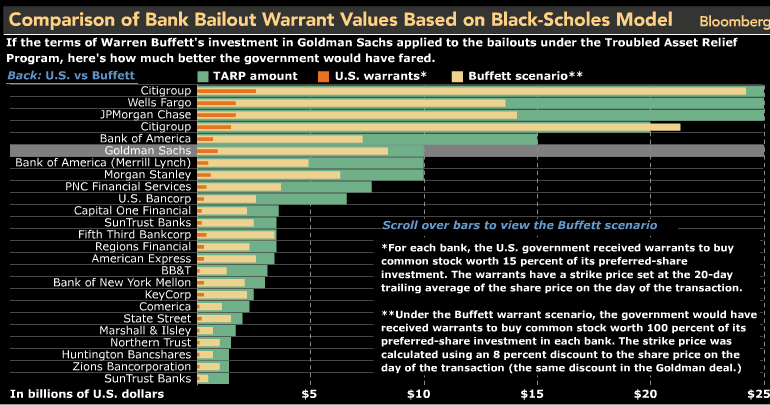
The government has received warrants valued at $13.8 billion in the 25 biggest capital injections from TARP, according to Bloomberg data. Under the terms Buffett negotiated for his $5 billion stake in Goldman Sachs, the TARP certificates would have been worth $130.8 billion.( PLEASE DON'T TELL ME THAT. )

Buffett received 43.5 million Goldman Sachs warrants valued at $82.18 apiece on the date of the transaction, or $3.6 billion, Bloomberg analytics show. Paulson, who served as the New York- based bank’s chief executive officer until 2006, injected twice as much taxpayer money into Goldman Sachs a month later and got 12.2 million warrants worth $72.33 each, or $882 million.

If the Treasury had received the same terms as Buffett, taxpayers would have become the biggest investors in most of the bailed-out banks and existing stakes( COLLUSION ) would have been diluted, Bloomberg data show.

No Confidence

“I halfway believed that the taxpayers would make money in September, but I really don’t believe it now,” Rep. Brad Miller, a North Carolina Democrat on the House Financial Services committee, said in a telephone interview last month.

“We have to have confidence in Treasury to run the program in a way that protects taxpayers, and there’s very little in the way they’ve run it that inspires confidence( TRUE ),” he said.

Congress left it to Paulson and his staff to decide how warrants would be priced and how many the U.S. would receive under the TARP, according to Caleb Weaver, a spokesman for the program’s oversight board. Treasury imposed identical terms for 140 capital injections. Thirty-four closely held lenders issued certificates to the government for preferred stock instead of common shares and one community development institution wasn’t required to issue warrants, according to the Jan. 6 Treasury report on TARP.

Bailouts for American International Group Inc., GMAC, GM and the second of two infusions into Citigroup were reported separately in the Treasury statistics.

‘Not Day Traders’

Paulson and former Goldman Sachs banker Neel Kashkari, who runs TARP as the interim assistant secretary of the Treasury for financial stability, have said the bank bailout will pay off.

“We’re not day traders, and we’re not looking for a return tomorrow( YOU SHOULD BE LOOKING FOR THE BEST DEAL GENIUS. ),” Kashkari told a Mortgage Bankers Association conference on Dec. 5 in Washington. “We are looking to try to stabilize the financial system, get credit flowing again, and over time, we believe that the taxpayers will be protected and have a return on their investment.”

Jackie Wilson, a spokeswoman for Omaha, Nebraska-based Berkshire Hathaway, didn’t respond to e-mail and telephone messages seeking comment. Goldman Sachs spokesman Michael DuVally declined to comment, as did Citigroup spokesman Michael Hanretta.

Paulson left money on the table in three ways, according to economist Johnson:( 1 ) accepting fewer warrants than Buffett did;( 2 ) setting the certificates’ price trigger, or strike, above market values; and( 3 ) receiving an annual yield on the preferred shares that is half of what Buffett will get for the first five years.

Dividend Payments

The government will forgo almost $48 billion over the next five years in preferred stock dividend payments from the 25 biggest TARP infusions, as compared with Buffett, according to the terms of the deals.

Buffett’s five-year warrants for 43.5 million shares of Goldman Sachs were valued at $82.18 each using the Black-Scholes option pricing model developed by Fischer Black and Myron Scholes to estimate the fair market value of such contracts. The model uses, among other data, the implied price volatility of the underlying security. The Treasury received 10-year warrants for 12.2 million Goldman shares priced at $72.33 on Oct. 28 using the same method.

The taxpayers’ certificates were set at the 20-day trailing average of the share price, which for Goldman Sachs was $122.90 on Oct. 28, when the company closed almost $30 cheaper at $93.57. The trailing average ensured a higher strike price, and lower value for the warrants, because bank stocks were plummeting.

8 Percent

By contrast, Buffett received an 8 percent discount to the market price at $115 a share on Sept. 23, when the stock closed at $125.05.

Taxpayers also acquired preferred shares as part of the bailout. These securities, which can’t vote unless the issue at hand is the creation of a more senior preferred stake, carry an interest payment of 5 percent that increases to 9 percent in five years. Buffett’s preferred shares in Goldman Sachs pay a 10 percent yield.

If Goldman Sachs rises to its five-year average price of $147, Buffett will be able to profit by $1.4 billion from exercising his warrants. The government warrants will be in the money for $294 million, or about a fifth as much for twice the investment.( COME ON )

TARP was set up to recapitalize banks and other financial institutions that lost money on subprime mortgages and commercial lending. It allocated $125 billion to nine of the largest banks and securities firms, and then invited all banks or savings and loans to apply for part of another $125 billion.

Saigon National

Recipients range from JPMorgan Chase & Co. in New York, which got $25 billion, to Saigon National, which received $1.2 million.

The government plans billions more in cash injections to companies including credit-card networks Discover Financial Services and American Express Co.

Under Buffett’s terms, the Treasury’s investment in Citigroup would also have brought greater potential for profit to taxpayers. The two cash infusions totaling $45 billion would have resulted in warrants for about 5.6 billion shares, which would more than double the 5.4 billion of existing shares. The Treasury’s warrants call for 464 million shares, or 8 percent of the number under Buffett’s terms.

None of the bank warrants for the biggest 25 capital injections from TARP funds can be exercised profitably now. Goldman Sachs closed in New York Stock Exchange composite trading at $83.92 yesterday, 32 percent less than its $122.90 strike price. Citigroup closed at $6.75, or 62 percent less than its highest exercise price of $17.85.

Exercising Warrants

Four of the 25 bank warrants could be exercised in the next year, based on Bloomberg surveys of analysts’ 12-month share- price forecasts. The average projection for Morgan Stanley at $26.46 is more than $3 higher than its strike price.

Analysts also expect American Express Co., Bank of New York- Mellon Corp. and the second capital injection for SunTrust Banks Inc. to rise above their strike prices, according to the surveys.

Congress may have another chance to get money back. The TARP legislation includes a requirement that lawmakers find a way in five years for taxpayer losses to be recouped from the financial industry.

To contact the reporter on this story: Mark Pittman in New York at mpittman@bloomberg.net."

I said at the time that it was a disgrace.

Now, in graphic form, from The Big Picture:

"Earlier this morning, we discussed how badly the Treasury department, along with Congress, had bungled the bailout monies.

These two graphics show exactly what an awful deal the taxpayer got for our monies.

Buffett’s Better Deal

click for much larger graphs

>

Source:
Paulson Bank Bailout in ‘Great Stress’ Misses Terms Buffett Won
Mark Pittman
Bloomberg, Jan. 10 2009
http://www.bloomberg.com/apps/news?pid=20601087&sid=aAvhtiFdLyaQ&"

Friday, January 9, 2009

that Washington did not understand the magnitude of what was happening and wasn’t ready to do what was necessary to alleviate the crisis

I'd forgotten that Big James Suroweicki is back at blogging after a break ( I only break for internet connection problems, as I'm having this week. My rabbit chewed a cord, and I've not yet been able to replace it. ):

"
What Precipitated the Stock Market Crash of 2008?

Sunday’s New York Times featured a long and interesting Op-Ed by Michael Lewis and David Einhorn on the trouble with Wall Street. There’s lots of good stuff in it, as well as some contentious claims, and I’ll probably mention it a couple more times this week. But at the moment, I just want to touch on a small but also important part of the narrative of the last four months that they skip over.

Lewis and Einhorn are very skeptical of the evolution of the government’s bailout plan into a scheme to give banks capital as a way of strengthening their balance sheets. And they’re especially skeptical of Henry Paulson’s role in all this. As they tell the story, Paulson got Congress to give him the $700 billion bailout plan by telling them that “if they didn’t give him the money the stock market would collapse.” Then he got the money but, they write, “the stock market fell anyway.”

Now, I don’t think it’s true that if you go back to that week in September when Paulson and the Fed chair Ben Bernanke were lobbying Congress, that their main focus was on the stock market. Most of the rhetoric, it seems to me, really focussed on the credit markets and what was going to happen to them. But even if the goal was to keep the stock market from falling, there’s an important piece of the story that Lewis and Einhorn leave out, which is, of course, that Congress didn’t pass the bailout plan the first time around. Instead, in what was a tremendous surprise to the financial markets, the House killed the bill, and only in a second go-round did Congress finally enact the law.( THAT'S TRUE )

The reason this part of the story matters, at least from the perspective of the stock market, is that even after Lehman Brothers failed (provoking the crisis that Paulson and Bernanke were talking about) stocks initially held up pretty well. While they tumbled right after Lehman failed, the talk of a rescue plan seemed to reassure investors( IT WAS MORE A QUESTION OF WHETHER OR NOT THEY'D LEARNED THEIR LESSON, AND WOULDN'T LET ANYONE ELSE FAIL. ), to the point that the day before the first vote in the House was taken, the S. & P. 500 was only slightly below where it had been before Lehman went under, at around 1213. It was only after Congress failed to pass the bill that the market went into free-fall, tumbling twenty-five per cent in the next ten trading days.( ONE POINT: THE PRECIPITATING ACTION WAS THE VOTE. THEY COULD HAVE WAITED A FEW DAYS LONGER TO VOTE, OR MAYBE EVEN A WEEK. IT WAS THE NEGATIVE VOTE THAT SIGNALLED THE LACK OF GOVERNMENT GUARANTEES. )

Now, it’s true that the second time around, Congress did pass a new version of the rescue plan, and that this had no apparent effect on investors—”the stock market fell anyway.” But it’s a mistake to overlook the fact that it was Congress’ failure to do what investors clearly thought was necessary( THIS IS CORRECT ) that precipitated the steep drop in the stock market. That doesn’t mean that, had Congress passed the bill the first time around, that the S. & P. would still be near 1200. But I do think that Congress’ failure (thanks primarily to House Republicans) to pass the bill was a massive blow to investor confidence( TRUE ), because it told investors that Washington did not understand the magnitude of what was happening and wasn’t ready to do what was necessary to alleviate the crisis( THIS IS ABSOLUTELY CORRECT ), and that it played a major( YOU ARE CORRECT SIR )—and, for the most part, forgotten—role in the financial-market turmoil that followed. By the time the second version passed, the negative-feedback loop in the markets had already become tremendously powerful, and the damage had already been done.( THE CALLING RUN ACHIEVED ESCAPE VELOCITY )

My problem has never been that Paulson acted, but with his decisions. Oddly, I'm coming to like him more and more, and I still say he's about as good as it gets in the Bush Debacle. But he did make some poor decisions, and misread the danger, and that needs to be acknowledged.

My disagreement with Suroweicki is that what was important was the depth and breadth of the government guarantees, and explicitly guaranteeing Agency Bonds and adopting a Begehot like Swedish Plan might have stopped the Calling Run, and, in doing so, the following Proactivity Run, which, contra Casey Mulligan, didn't start until November.

Thursday, January 8, 2009

“Government support [of mortgages[ needs to be either explicit or non-existent, and structured to resolve the conflict between public and private

From my perspective, this is big news. Via HousingWire:

"U.S. Treasury
secretary Henry Paulson managed to shake more than a few feathers in the mortgage industry Wednesday, with a speech that suggested in part that the government consider turning Fannie Mae ([1] FNM: 0.7884 +5.12%) and Freddie Mac ([2] FRE: 0.7975 +6.33%) into public utilities, akin to power and telephone companies.

“Government support [of mortgages[ needs to be either explicit or non-existent, and structured to resolve the conflict between public and private purposes," he told the Economic Club of Washington. "Any middle ground is a recipe for another crisis."( MY GOD. THAT'S MY WHOLE POINT ABOUT WHY WE SHOULD AVOID GOVERNMENT/PRIVATE SECTOR HYBRIDS AND MAKE GUARANTEES EXPLICIT. AND I AGREE 100% THAT IF THESE POLICIES AREN'T CARRIED OUT, WE WILL HAVE ANOTHER SUCH CRISIS, ALTHOUGH HOPEFULLY NOT OF THIS MAGNITUDE, VERY SOON. FROM PAULSON, NO LESS. AMAZING. )

Prior to the government's take-over, the "inherent conflict" in the structure of Fannie and Freddie was obvious, Paulson contended. "[T]he GSEs served both a public mission and private shareholders — they received public support but operated for private shareholder gain … returning the GSEs to their pre-conservatorship form is not an option.”( TRUE )

That sort of policy decision won’t be Paulson’s to make, of course, since the outgoing Treasury secretary will be replaced on Jan. 20 by current New York Fed chief Tim Geithner. But Paulson outlined a utility-model for the GSEs that hasn’t been suggested in the past, likely in the hopes of influencing at least some debate over the future of Fannie and Freddie — and the government’s ultimate role in mortgage banking.

“A public utility-like mortgage credit guarantor could be the best way to resolve the inherent conflict between public purpose and private gain,” Paulson said. Under this approach, Fannie and Freddie would be replaced by a private entity or entities, regulated heavily by a rate commission, that would purchase and securitize mortgages guaranteed by the government. The private organizations would not have investment portfolios, he said.( THE ONLY WAY TO KEEP GOVERNMENT INVOLVED. YES. )

The suggestions drew sharp responses from industry participants.

“We have public utilities because of economies of scale in power and utility production and distribution and because everyone needs it,” Jim Vogel, head of fixed-income research at First Financial Capital Markets Corp., [3] told American Banker. “So you need a common capital pool to produce utilities. I’m not sure how mortgages fit into any of those economic categories unless we’ve just changed the whole nation’s housing system( IT CHANGED ITSELF FRIEND, BY TURNING A BLIND EYE TO OR ACTUALLY COMMITTING FRAUD. ).”

Vogel’s remarks underscore what may be the core agenda difference between more than a few consumer groups and those in the industry: is housing a right for everyone? Or is it a privilege for those who have the means to afford it? Much of the lobbying sure to follow over the GSEs in months to come will center squarely on whatever vision for the nation’s housing system a particular group subscribes to.( LET'S CHOOSE ONE ALTERNATIVE. )

Other options for the GSEs Paulson discussed included nationalization( FINE ), privatization( MY PREFERENCE. ONLY NOT IF IT'S GUARANTEED. ) and one hybrid approach( NO ); all are options that have been discussed before, and Paulson made it clear there are problems with each, at least in his view.

Soon-to-be Treasury secretary Timothy Geithner and the new administration will need to decide if the government will explicitly( CHOOSE. NO MORE IMPLICIT GUARANTEES. THEY'VE WORSENED THE CRISIS SIGNIFICANTLY. ) back Fannie and Freddie debt and mortgage-backed securities, said Paulson. Doing so, however, would come with some hurdles; the Congressional Budget Office has already said in Sept. 2008 that it believes the GSEs [4] should be incorporated directly into the federal budget. An explicit guarantee would likely force that to take place.( IT SHOULD. YES. THE WHOLE ARRANGEMENT SHOULD BE DISCUSSED AND VOTED ON. )

Paulson also suggested that the Obama administration could use the GSEs to push mortgage rates down to 4 percent, but warned — as we have at HousingWire in the past — that doing so would require a huge issuance of new Treasury notes( A VERY BAD IDEA. ); he also hinted that the government could use such a program temporarily, as well. Of course, such efforts would require that the GSEs remain under government control, something Paulson doesn’t believe is feasible long-term.( I AGREE )

“Fannie Mae and Freddie Mac are in a temporary form that, while stable, cannot efficiently serve their Congressionally-chartered mission and protect the taxpayers’ investment over the long-term,” he said. “We took the right actions to meet a specific need at a specific time.”

In other words: what happens next is a problem for the next guy.

[5] Read Paulson’s full remarks.

- Paul Jackson contributed to this report.

Write to Kelly Curran at [6] kelly.curran@housingwire.com.

Disclosure: The author held no relevant investment positions when this story was published. Indirect holdings may exist via mutual fund investments. HW reporters and writers follow a strict disclosure policy, the first in the mortgage trade."

Here's Paulson:

"Washington – Good afternoon. Thank you, David and thanks to the Washington Economic Club for this opportunity to provide my thoughts on long-term reform of the housing Government Sponsored Enterprises, the GSEs, Fannie Mae and Freddie Mac.

Debate over the role and function of these entities has raged for years. Congress established Fannie and Freddie decades ago to meet a public policy goal – to increase the funding available for home mortgage financing. The GSEs achieve this through providing liquidity to the secondary market for a limited range of home mortgages, either through credit guarantees on mortgage-backed securities (MBS) or by directly investing in mortgages and mortgage-related securities through their retained mortgage portfolios. To further this mission, their congressional charters grant the GSEs several benefits which together created a perception that the GSEs were backed by the U.S. government, even though this was not the case. This "implicit" government guarantee provided the GSEs with a funding advantage over other mortgage market participants.( AND IS A CAUSE OF THIS CRISIS. )

The inherent conflict( AS IN ALL HYBRIDS ) in this structure is obvious – the GSEs served both a public mission and private shareholders – they received public support but operated for private shareholder gain. While policymakers of every ideological stripe have acknowledged the risks created by this conflict( SEVERE ), entrenched debate, often with little recognition of market realities, prevented reform. Over time, the GSEs' advantages enabled them to grow at a phenomenal pace, so that today they have $5.4 trillion in obligations outstanding, held by investors in the U.S. and around the world. As a comparison, that is almost 40 percent the size of the entire $14 trillion U.S. economy. The systemic risk posed by such size was heightened by the fact that investors assumed that GSE securities were backed by the U.S. government and therefore virtually risk-free, despite repeated statements by consecutive U.S. administrations to the contrary( A TERRIBLE MISTAKE ). These debt-holders would be the largest, but not the only, conduits of systemic impact should either GSE fail. Derivative counterparties, for example, would also be overwhelmed by a default of either GSE.

For some time market participants had questioned whether the GSEs were adequately capitalized for the risk they were taking, and therefore able to withstand losses without triggering a systemic event. Policymakers acknowledged that the GSE regulator did not have the authorities to address these risks, yet they could not reach consensus to improve it, and instead left a clearly inadequate regulatory structure in place. When I came to Washington, I saw an opportunity to improve the regulatory structure, even if it wouldn't be perfect. I set to work in the fall of 2006 to broker progress in the House, and we did begin to solve some of the seemingly intractable differences.

Even as Washington debated GSE oversight, there was little debate over the extent to which government should subsidize homeownership( I WOULD RATHER IT SUBSIDIZE HOUSING WITH CASH FOR INDIVIDUALS TO USE FOR ANY HOUSING. ) , and whether such government support was contributing to a housing bubble( IT DID. ). The U.S. government has many policies that subsidize homeownership – it would be oversimplifying and wrong to blame Fannie and Freddie for the bubble, but they clearly are part of the public policy bias that contributed to it. ( IT'S TRUE. A SMALL PART. )

In sum, the GSE reform debate was largely frozen in place, or moving at glacial speed. Then suddenly, the unprecedented housing correction shifted the ground under that debate and forced action.

Today I will review the actions we have taken and their effect, and address two issues before us. First, in the short-term, how do we use the GSEs to mitigate the current credit crisis and housing downturn? Second, given the temporary nature of their current status, how might we address the appropriate long-term structure?

Prelude to Recent Actions Regarding Fannie Mae and Freddie Mac

As we progressed through the current housing market downturn, investors fled mortgages that carried any credit risk( A CALLING RUN, CAUSING A FLIGHT TO SAFETY. ). But because the GSEs take the credit risk on the mortgages they guarantee and because investors believed there was implicit government backing, the conforming loan market continued to function relatively well( THAT'S CORRECT. BECAUSE OF THE IMPLICIT GOVERNMENT GUARANTEES. ). As a result, the GSE share of new mortgage business rose from 46 percent in the second quarter of 2007 to 84 percent in the second quarter of 2008( TRUE. EVIDENCE THAT PEOPLE SUSPECTED A BUBBLE AND WANTED GOVERNMENT GUARANTEES. ). Without the GSEs to finance mortgages, it was very clear that mortgage finance would essentially dry up.( TRUE. RISK WAS TOO HIGH. NOTICE: MANY PEOPLE SAW A CRISIS APPROACHING. )

However, as the extraordinary housing correction deepened, weaknesses in these entities became apparent. In July 2008, investors lost confidence as they became increasingly uncertain about Fannie and Freddie's capital position. The GSEs' already depressed stock prices plummeted further. Shareholder losses did not pose a public policy concern, but the share price drop further weakened confidence among the holders of the $5.4 trillion of GSE debt and MBS. Investors at home and abroad were reducing purchases and even selling from their holdings of GSE debt( AGENCY DEBT. THE FLIGHT TO EXPLICIT GUARANTEES. ). The consequences of either GSE failing would be catastrophic. We couldn't wait for a failure; we had to act preemptively to shore up confidence in these enterprises.( I AGREE )

In July, I requested that Congress quickly complete work on long-sought GSE regulatory reform and also provide Treasury with expanded authority to support Fannie, Freddie and the Federal Home Loan Banks. Congress did so – giving us enormous temporary authorities to inject capital if the GSEs asked for it, and to create a back up liquidity facility for GSE debt.( YOU SHOULD HAVE MADE THE GUARANTEE EXPLICIT. THAT'S THE ONLY WAY TO END A CALLING RUN. )

Immediately after passage of the legislation, in coordination with the Federal Reserve, the newly-constituted GSE regulator, FHFA, and our advisor Morgan Stanley, we began a comprehensive financial review of the GSEs. At the same time, mortgage market conditions continued to deteriorate. Negative earnings announcements by Fannie and Freddie in August reflected those worsening conditions, and further roiled markets. Neither company appeared to have any reasonable prospect of raising private capital( WON'T WORK IN A CALLING RUN. ) to allay those concerns in the foreseeable future, and our examination found capital to be inadequate – in terms of both the quality of capital and the embedded losses stemming from worsening mortgage market conditions.

Confidence in the GSE model was largely shattered. It was clear to me that simply injecting even a great deal of equity into their business model would not create the market confidence necessary to fund these enterprises going forward and to bolster confidence in the $5.4 trillion of extant GSE obligations, which posed the greatest systemic risk. Market fragility and the GSEs' deteriorating balance sheets required that we take responsibility for the GSE structural ambiguities( IMPLICIT GUARANTEES ) that U.S. policymakers had let fester for decades. If we had asked Congress for, and received, the power to explicitly guarantee the GSEs' obligations, we would have done so( THIS WAS WHAT NEEDED TO BE DONE. ). But without that authority, we had to be creative and find a way to effectively guarantee the GSEs' obligations.

We had to stabilize the situation immediately. We knew that markets were exceptionally fragile and would be further threatened in September when we expected that a number of large financial institutions, including Lehman Brothers, would post disappointing earnings. Chairman Bernanke, FHFA Director Lockhart and I met almost daily, over a 10 day period, to work toward a comprehensive action plan. As I made clear at the time, we sought a temporary solution that would achieve three goals: (1) stabilize markets, (2) promote mortgage availability, and (3) protect the taxpayer( ONLY TAKING OVER A COMPANY DOES THIS. ).

In comprehensive action taken on September 7th, FHFA placed Fannie and Freddie into conservatorship, enabling Treasury to take creative steps to support their obligations. We moved quickly to do what was necessary. Our actions would have been impossible to implement were it not for the GSE reform legislation that gave FHFA the expanded power to make qualitative and quantitative judgments about capital and also gave Treasury the financial authorities necessary to make conservatorship a stabilizing, as opposed to a destabilizing, event. We devised Preferred Stock Purchase Agreements to effectively guarantee the GSEs' obligations by ensuring Fannie and Freddie would maintain a positive net worth. This commitment ensures that they can fulfill their financial obligations, even after the temporary authorities expire in December 2009. Additionally, Treasury established a new secured lending credit facility intended to serve as an ultimate liquidity backstop. To further support the availability of mortgage financing, Treasury initiated a program to purchase GSE MBS and has purchased over $50 billion thus far.

We took these actions first, to avert the financial market meltdown that would ensue from the collapse of these institutions and, second, to allow the GSEs to continue, in the midst of overall market stress, to perform their essential role of providing mortgage finance. This conservatorship, with the explicit backing of the federal government( WASN'T ENOUGH ), is temporary and must be resolved for the long-term. In the meantime, the GSEs must serve the taxpayers' interest by assisting in turning the corner on the housing correction, which is critical to return normalcy to the capital markets and resume U.S. economic growth. The GSEs can facilitate progress through the housing correction by keeping mortgage rates low and by mitigating foreclosures.( A TOUGH JOB )

Keeping Mortgage Rates Low

Lower mortgage rates enable more potential homebuyers to return to the market and help put a floor under home prices. Initially, following our September actions, mortgage rates did fall. Market turmoil subsequently increased and mortgage rates rose, but not nearly as much as the cost of other forms of credit. Still, neither the taxpayers nor the economy were getting the full benefit of the agreements put in place to effectively guarantee GSE debt. We could have gone back to Congress to ask for authority to directly guarantee GSE debt, however this would have been difficult to achieve. While a simple, direct government guarantee of GSE MBS might have reduced rates further ( WE SHOULD HAVE DONE THIS ) – given the extraordinary strains in today's markets it probably would still have failed to produce all of the desired mortgage rate reductions. Therefore, we examined other means of deploying our authorities that could reduce mortgage rates.

We immediately noted that, given the effective government guarantee and the spread between Treasury rates and those of the GSEs, the taxpayers would profit if the government simply issued Treasuries to buy GSE securities( I DON'T LIKE IT, BUT IT MAKES SENSE. ). And in fact, we have funded the purchase of GSE securities with the issuance of Treasury bonds. But to make an impact on mortgage rates, such an initiative would have to be very large and those Treasury issuances would count against the debt limit.

On November 25, the Federal Reserve announced a new program to purchase up to $100 billion in GSE debt securities and $500 billion in GSE MBS. This Federal Reserve program had a significant impact. The 30-year fixed rate has fallen from an average of 6.04 percent the week before the policy was announced to a record low 5.10 percent last week, accomplishing a vitally important step in addressing this housing correction – lower mortgage rates( I DON'T SEE THIS DOING MUCH. ) that may bring additional credit-worthy buyers into the housing market.

Foreclosure Mitigation Efforts

While the GSEs are in this temporary form, we have also worked to increase their impact on foreclosure mitigation. In November, FHFA, the GSEs, Treasury and the HOPE NOW Alliance announced a major streamlined loan modification program (SMP) to move struggling homeowners into affordable mortgages. The new protocol relies heavily on the "IndyMac model" developed by the FDIC and creates sustainable monthly mortgage payments by targeting a benchmark ratio of housing payments to monthly gross income. Together with the IndyMac/FDIC protocol, the SMP creates a powerful new model that should help ensure that no borrower who wants to stay in their home and can make a reasonable monthly payment will fall into foreclosure.( NOT WORKING WELL ENOUGH )

The SMP will directly and immediately apply to the 50 percent of homeowners with loans serviced under the GSEs' auspices. Fannie and Freddie announced that they would suspend foreclosure sales and cease evictions of owner-occupied homes until January 9th to allow time for implementation of the modification program. The timing of this initiative is especially important as prime loans now account for almost 50 percent of new delinquencies, and delinquencies are increasingly the result of overall economic factors rather than the loan features and underwriting practices associated with Alt-A and subprime products.( TRUE. ONE BIG REASON TO STOP A CALLING RUN. )

And the impact of the SMP will go much further. The vast majority of servicing contracts for non-GSE mortgages reference the GSEs' practices, and we therefore expect the SMP to be widely adopted and quickly move hundreds of thousands of struggling borrowers into sustainable, affordable mortgages. Further, this streamlined protocol frees up servicing industry resources that can be redirected to providing case-by-case assistance to more difficult cases that fall outside the SMP protocol. ( I DOUBT THIS )

Impact of Temporary Authorities to Stabilize the GSEs

Given the authority granted by Congress last summer, we have gone about as far as we can to avert systemic risk and to use the GSEs to speed progress through the housing correction that lies at the heart of our economic downturn. Although the effective guarantee of GSE debt and MBS has brought some degree of stabilization, it is not the most efficient way to remove the ambiguity inherent in the GSE structure, even temporarily.

To the extent that the Congress and the next Administration wish to use the GSEs as a tool to further reduce mortgage rates, they could, under existing authorities, make large purchases of mortgages made at a target rate of, say, 4 percent – although very large volumes of Treasury issuances would be required for such a program to be effective. A targeted program such as one that purchases only new mortgages made for home purchases, as opposed to refinancing, for a one year period would require less but still substantial funding. Separately, the next Administration could pursue legislative authority to directly guarantee GSE debt for the remainder of the conservatorship period. ( TRUE )

Long-Term Policy Recommendations

The GSEs are playing a necessary role supporting the mortgage availability which is essential to eventually turning the corner on the housing correction, reducing the stress in our capital markets and returning to growth in our economy. This must continue to be our first priority. But we will make a grave error if we don't use this period to decide what role government in general, and these entities in particular, should play in the housing market.

The public debate over the long-term structure of the GSEs is dramatically changed today – no one any longer doubts the systemic risk these entities posed. It is clear to all conservatorship is a temporary form, and that returning the GSEs to their pre-conservatorship form is not an option.

The debate about the future of Fannie and Freddie requires answering the much larger and more important question of the federal government's role in the mortgage market and in housing policy, generally. Given the bubble we have experienced, policymakers must ask what amount of homeownership subsidies are appropriate. Numerous long-standing indirect subsidies already exist, including the mortgage interest deduction, subsidized FHA mortgages, and the variety of other HUD programs that expand homeownership opportunities.( GET RID OF THEM. )

Is that enough? Or should government also reduce mortgage rates for a larger group of homebuyers? Policymakers must decide if the GSE subsidy is a public policy priority. If the GSEs are to play a role, then, the debate is clearly framed: Government support needs to be either explicit or non-existent, and structured to resolve the conflict between public and private purposes( ABSOLUTELY CORRECT ).. Any middle ground is a recipe for another crisis. ( I AGREE )Although there are strong differences of opinion over the government's role in supporting housing, under any course policymakers choose, there are structures and choices that can resolve the long-term conflict of purposes issues.

And it is clear that to protect against systemic risk in the future, the GSEs should be constituted with a portfolio no larger than what is minimally necessary for warehousing purposes. Without portfolios of significant size, the enterprises' management of interest rate risk would remain a vital function for the safety and soundness of the enterprises, but would no longer present the same potential systemic risk.( FINE )

As a public policy tool to expand homeownership, the GSEs, like FHA-Ginnie Mae, reduce mortgage rates for borrowers by taking on the credit risk that mortgage investors would otherwise bear and guaranteeing( YES ) that mortgage investors will be paid in full should the mortgage borrower default. As Congress considers the future role and structure of the GSEs, it must consider how much credit risk the Federal government should take.( I AGREE )

Addressing Credit Risk

In today's stressed mortgage market, between FHA-Ginnie Mae, Fannie Mae, and Freddie Mac, almost all new mortgage market originations have federal government credit support. This is not sustainable over the long-run( TRUE ). It will lead to inefficiency, less innovation and higher costs. It also contradicts basic U.S. market principles. We must have some degree of private sector involvement in the evaluation of credit risk if we are going to have a mortgage market that allocates resources with efficiency.( TRUE )

In the mortgage market of the future, I clearly see a role for the FHA and Ginnie Mae for first-time and low income homebuyers. Beyond the explicit guarantee provided to FHA and Ginnie Mae policymakers must decide how much to further subsidize mortgage credit risk, if at all, and must decide the role of private capital in any subsidy plan. Depending on the degree of subsidy policymakers choose, there are a variety of options for structures to replace the GSEs, including:

(1) Expanded FHA/Ginnie Mae. Some advocate that beyond the current credit crisis the U.S. government's long-term policy should make the implicit, explicit. Explicitly guaranteeing Fannie and Freddie's obligations would essentially nationalize this significant portion of the U.S. housing finance market. Under this model, the GSEs could become a government entity, or their functions could be absorbed by FHA/Ginnie Mae . In either case, the GSEs would no longer have private shareholders. The size of the eligible population of homebuyers would determine how large a share of mortgage credit exposure the government would own.( I AGREE )

I view the permanent nationalization of the GSEs, essentially expanding the role of FHA and Ginnie Mae, as a less-than optimal model( I AGREE ). While it offers the perceived advantage of explicit government support, it eliminates the necessary private sector evaluations of credit risk and the private market stimulus to innovation.

(2) Partial Guarantee.( UNDER NO CONDITIONS ) A hybrid of this would be to create a Ginnie Mae-like entity for non-FHA mortgages, structured as a partial guarantee mechanism. The new entity could operate on a similar basis as Ginnie Mae, but provide only partial guarantees for MBS. Investors would then have a floor under potential MBS losses, but would still evaluate the credit risk associated with individual issuers. While such a hybrid program would clearly define the extent of the government's guarantee, developing risk sharing parameters compatible with profit incentives would be as problematic, and potentially as inefficient, as in the current GSE structure.

(3) Privatization. A third alternative would be to remove all direct or indirect government support, completely privatizing these companies while breaking them up to minimize systemic risk. As appealing as this alternative sounds, it is difficult to envision a sound, practical, private sector mortgage insurance business of any significant size that does not require large amounts of capital, and consequently generates only a modest return on capital. The recent problems encountered by monoline insurers, which ventured into guaranteeing mortgage product as well as the experience of the GSEs, underscores this point. Moreover, a break up scenario does not look particularly promising, as reverse economies of scale would take hold. It is also worth noting that a regional mortgage insurer would lack diversity as a risk mitigant. Perhaps a consortium of banks would find it advantageous to own a national mortgage insurer to wrap their product, or some other good private sector business model may emerge. But I am skeptical that the "break it up and privatize it" option will prove to be a robust or even viable model of any substantial scale, without some sort of government support or protection( NO WAY THEN ). However, should policymakers choose to scale back public policy bias toward homeownership, we will eventually find out what business model the free market would support.

(4) Housing Utility. Finally, given traditional U.S. public policy support for marshalling private capital to expand homeownership, establishing a public utility-like mortgage credit guarantor could be the best way to resolve the inherent conflict between public purpose and private gain. Under a utility model, Congress would replace Fannie Mae and Freddie Mac with one or two private sector entities. The entities would purchase and securitize mortgages with a credit guarantee backed by the federal government, and would not have investment portfolios. These entities would be privately-owned, but governed by a rate setting commission that would establish a targeted rate of return, thereby addressing the inherent conflicts between private ownership and public purpose that are unresolved in the current GSE structure. This commission would also approve mortgage product and underwriting innovations to continually improve the availability of mortgage finance for a population to be defined by the Congress. In this model, continued safety and soundness regulation would be essential.( TRUE )

Need to Support Vibrant Private Market

If we are to maintain a private-sector secondary mortgage market – which I believe serves the taxpayer and the homebuyer equally well – then we must enhance the ability of depository institutions to fund mortgages, either as competitors to a newly-established government structure or as a substitute for government funding. One way to do this is for the government to receive some compensation for its guarantee( A POSSIBILITY ). The current GSE Preferred Stock Purchase Agreements take a small step in this direction, in that as of 2010 the GSEs must pay the government a fee for the taxpayer backstop on their guarantees. Of course, if this rate perfectly reflected the risk versus the cost of the guarantee, there would be no subsidy to mortgage availability. It is obviously inherently difficult to reach an exactly correct price, yet a long-term fee-like structure in exchange for explicit government backing would help to reduce advantages over private institutions( TRUE ). Over time, another approach might be to offer other financial institutions the opportunity to pay a fee for government backing on securitized, conforming loans, a structural transformation that would lower entry barriers, and increase competition and innovation in housing finance.( A GOOD IDEA )

Covered bonds are another private sector alternative worth exploring. The FDIC has made regulatory changes to support the emergence of covered bonds, which could provide enhanced opportunities for depository institutions to fund and manage mortgage credit risk. There is strong interest in developing a U.S. covered bond market, but we will have to work through the credit crisis before a new market is likely to take hold. Some have advocated dedicated covered bond legislation, which could be helpful to establishing this market, and should be considered in the context of broader housing finance reforms.( A GOOD IDEA )

Additionally, the President's Working Group on Financial Markets has recommended extensive reforms in the mortgage securitization process by investors, ratings agencies, underwriters and regulators, especially with respect to mortgage origination oversight. When these reforms are in place, we expect private label securitization to return with greater oversight and market discipline.( UNCOVERING AND PROSECUTING CRIMES WOULD HELP )

Conclusion

My thoughts today are intended to inform the necessary debate over the future structure of the housing GSEs. By allowing the GSE structural ambiguities to persist for too long, U.S. policymakers have created an untenable situation. Today, Fannie Mae and Freddie Mac are in a temporary form that, while stable, cannot efficiently serve their Congressionally-chartered mission and protect the taxpayers' investment over the long-term. We took the right actions to meet a specific need at a specific time.

The GSEs are critical to getting us through this current period, and this is our first priority. More may need to be done to clarify and simplify their structure and to increase their effectiveness in curbing further housing price correction. But we cannot look only at this short-term need; policymakers must resolve the question of long-term structure because the pre-conservatorship model has been disproven.

The first step must be for policymakers to decide – in light of the recent housing bubble and the severe financial and economic penalty it has imposed on our nation – the role government should play in supporting home ownership. We cannot allow a repeat of the devastation this housing correction has wreaked on families and communities across the United States. Once that decision is made, the GSEs should be restructured to meet that public policy choice and satisfy three objectives: First, there must be no ambiguity as to government backing. It must be explicit or non-existent( I AGREE ). Second, there must be a clear means of managing the conflict between public support and private profit( I AGREE ). Third, there must be strong regulatory oversight of the resulting institutions( I AGREE, ALTHOUGH I WANT SUPERVISION. )

As I have outlined, whatever role the U.S. government chooses to play in subsidizing mortgage finance, there is a structure that can meet the objectives. With the knowledge of recent experience, we have a responsibility to begin work now on a long-term GSE structure which avoids the dangerous mix of policy and market distortions created by the former flawed GSE model( I AGREE ). Thank you."

Unbelievable. A very good speech. Of course, now that he's on my team, he's already become irrelevent. In order to stop a calling run, there will have to be some explicit government guarantees. I'm fine with any alternative that does that, although a more free market approach would please me. My only worry about the paying for a guarantee method is that we also need to implement other complimenatry measures, in order that this insurance not encourage too much risk. As far as housing is concerned, I favor a general housing subsidy for the less well-off. I would not favor any particular housing sector.