"Signs of a thaw
Yes, I saw the discouraging headlines. But I also see signs of hope in last week's economic news.
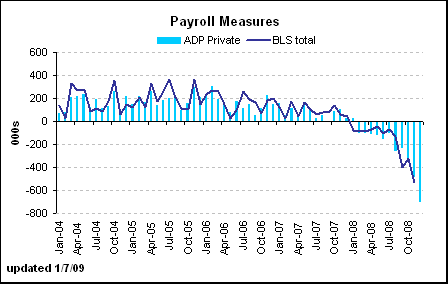
Let me begin by acknowledging the awful employment news. This was undeniably grim( BUT IT HAS TO DO WITH THE PROACTIVITY RUN, NOT THE CALLING RUN. ), though popular descriptions that BLS had reported the biggest job loss in any calendar year since 1945 are perhaps unnecessarily alarmist. Population growth would naturally mean that both job gains and job losses would be expected to be bigger absolute numbers than they used to be, and there's no special reason to look at calendar years rather than all 12-month intervals. The graph below shows that in percentage terms, the employment decline so far is similar to what we see in a typical recession.( TRUE )
 |
But my primary concern has not been unemployment per se but instead the dysfunctional financial market that produced it. And here there are some encouraging developments. The TED spread is the difference between the 3-month LIBOR rate (an average of interest rates offered in the London interbank market for 3-month dollar-denominated loans) and the 3-month Treasury bill rate. Its spike up last fall was a very troubling indicator of perceived bank risk, flight to quality, and frictions in the interbank lending market. But the TED spread has declined significantly over the last 6 weeks.( AS HAS THE VIX )
 |
The gap between the A2/P2 and AA rates, which measures how much more riskier (but still prime) nonfinancial commercial firms must pay to borrow compared with safer borrowers, had also reached scary heights and has also come down significantly.( A SIGN OF A DIMINUTION IN THE FEAR AND AVERSION TO RISK. )
 |
These may be among the developments that persuaded the Federal Reserve it could begin the process of contracting its now enormous balance sheet( A GOOD POINT ). The assets of the Federal Reserve had exploded from $940 billion at the beginning of September to $2.3 trillion by the end of the year, as the Fed expanded operations such as its Term Auction Facility, which offered term loans directly to banks at much more favorable rates than the previously spiking LIBOR, and the commercial paper lending facility, which propped up the commercial paper market with direct purchases. The Fed apparently felt comfortable enough with the current situation to reduce these balances by $126 billion during the week ended January 7. More than half of that reduction came from a reduction in the volume of term auction credit outstanding( GOOD NEWS ).
 |
This reduction in assets was necessarily matched by an equal reduction in liabilities; for details on how this works see my earlier description of the Federal Reserve balance sheet. The primary change last week was a reduction in the Treasury's accounts with the Fed.
 |
The TED spread and A2/P2-AA spread have often exhibited a pattern of temporary respite followed by a resurgence of perceived risk, and the same could certainly happen again. Nevertheless, I read the recent numbers as clearly encouraging."
I see both the recent TED and VIX movements as a sign of the diminution of the fear and aversion to risk due to the Calling Run. The Proactivity Run is still going.

























 Posts






