Showing posts with label Japan. Show all posts

Wednesday, May 13, 2009

coming from Japan’s opposition party — which isn’t exactly steaming ahead towards victory

TO BE NOTED: From Alphaville:

"
Samurai-ed: Japan ‘would avoid dollar bonds’

Japan voiced some anti-dollar/US Treasuries remarks and a future preference for samurai bonds late Tuesday.

From the BBC:
Japan’s opposition party says it would refuse to buy American government bonds denominated in US dollars, if elected.

The chief finance spokesman of the Democratic Party of Japan, Masaharu Nakagawa, told the BBC he was worried about the future value of the dollar. Japan has been a major buyer of US government bonds, helping the US finance its Federal budget deficits.

But, he added, it would continue to buy bonds only if they were denominated in yen - the so-called samurai bonds.

Yen-denominated bonds would effectively mean that the US is exposed to the risk of future falls in the value of the USD rather than Japan. That’s a pretty big policy shift for Nippon, which has been a strong buyer of US Treasuries - and, taken with comments coming out of China, hints at a growing unease in Asia over the USD’s supremacy.

But, as the BBC story notes, this is coming from Japan’s opposition party — which isn’t exactly steaming ahead towards victory. Nakagawa’s comments have also been toned down since his interview with the BBC, and there is, as often happens with Japanese politics, undoubtedly a dose of anti-gaijin political rhetoric in the above. BarCap has a good summary:
Masaharu Nakagawa, the “shadow” finance minister of Japan’s largest opposition party, the Democratic Party of Japan, was quoted by BBC on 12 May saying that his party would shun buying US bonds denominated in dollars if his party took the reins of government as a result of Japan’s upcoming lower house election. In an interview with Bloomberg News on 13 May, however, Mr. Nakagawa clarified that it would merely be one option for Japan to propose that the US government issue samurai bonds (US bonds denominated in yen), and that this was strictly his personal proposal and would not necessarily be implemented immediately by the party if it took the helm. The comments, while perhaps reflecting a genuine concern shared by other world leaders, would also serve to boost Mr. Nakagawa’s nationalist credentials ahead of the election and, we believe, should be viewed primarily in that context. Japan’s lower house election must be held by this September, but could be called earlier if the prime minister decides to dissolve the lower house prior to that time.

The samurai will be waiting for a while, it seems.

Samurai

Related links:
Samurai bond market revives - FT
China to US: We hate you - FT Alphaville
We ‘hate you guys’ even more now… - FT Alphaville

Sunday, May 3, 2009

Asian nations will set up a $120 billion foreign-currency reserve pool by year-end

TO BE NOTED: From Bloomberg:

"Asia’s $120 Billion Reserve Fund to Boost Investor Confidence


By Shamim Adam and Jason Clenfield

May 4 (Bloomberg) -- Asian nations will set up a $120 billion foreign-currency reserve pool by year-end to help revive investor confidence as economies around the region falter amid the worst global recession since World War II.

The Association of Southeast Asian Nations, together with Japan, China and South Korea, will use the funds in times of turmoil. They will set up a surveillance unit that will identify risks to the region and provide oversight of the fund. Japan also offered $60 billion of yen-denominated swap facilities.

“It’s not so much the amounts of money being put in, but the concept of these countries getting together and cooperating,” Mark Mobius, who helps oversee $20 billion in emerging-market assets at Templeton Asset Management Ltd., said in an interview yesterday in Bali, Indonesia. “That’s a very positive development.”

The fund, known as the Chiang Mai Initiative, widens access to foreign-exchange reserves allowing nations such as Indonesia and Thailand, recipients of International Monetary Fund bailouts a decade ago, to defend their currencies. The 13 nations have accumulated more than $3.6 trillion of currency reserves since, with China owning more than half of the assets.

“The idea is for the Asean plus three countries to effectively look after ourselves with our own reserves,” Thai Finance Minister Korn Chatikavanij said yesterday in Bali, where the officials met.

$100 Billion Loans

The IMF arranged more than $100 billion of loans to Thailand, Indonesia and South Korea after their currencies collapsed during the 1997-1998 crisis. In return, governments were forced to cut spending, raise interest rates and sell state-owned companies.

In Thailand, former Prime Minister Thaksin Shinawatra asked his countrymen to fly the national flag on offices, homes and factories after making the last payment in 2003 of the $12.3 billion it drew. Indonesia repaid its debt in 2006, four years before schedule.

Following yesterday’s agreement, Japan will contribute $38.4 billion to the fund, while China and Hong Kong together will add another $38.4 billion to the pool. South Korea’s contribution will be $19.2 billion.

The Southeast Asian nations will contribute 20 percent of the total amount. Thailand, Indonesia, Malaysia and Singapore, the four biggest Southeast Asian economies, will contribute $4.77 billion each, and the Philippines will provide $3.68 billion.

Surveillance System

Under the Chiang Mai Initiative, Asian nations can borrow, without restrictions, 20 percent of an agreed swap amount. They can tap the 80 percent balance only after agreeing to IMF-style restrictions.

That may change as the surveillance system is developed, Korn said. The IMF, Asian Development Bank and the Asean Secretariat will be tapped initially for their expertise in such matters, finance ministers said.

“We feel that we ought to also develop a surveillance system and manage it ourselves as opposed to needing to rely on the surveillance system of institutions outside the region,” Korn said. “The idea is that as we increase our surveillance capacity, the de-linked portion increases.”

Nine of the region’s 10 currencies tracked by Bloomberg fell against the U.S. dollar in the first three months of the year. This quarter, eight have gained against their U.S. counterpart.

‘Real Traction’

“One of the beneficiaries of this crisis, if you want to call it that, has been the way it speeded up the regional market development,” said Gerard Lyons, London-based chief economist at Standard Chartered Bank, said in an interview in Bali. “The Chiang Mai Initiative has now started to get real traction.”

Countries such as Japan and China are doing more to help others navigate through the crisis. China last month announced plans to create a $10 billion investment cooperation fund and offer $15 billion in credit to its Southeast Asian neighbors.

Japan’s Finance Minister Kaoru Yosano yesterday said the country will offer $60 billion of yen-denominated swap facilities to help nations during a financial crisis. Asia’s biggest economy will also guarantee up to 500 billion yen ($5 billion) of yen-denominated bonds, or Samurai bonds, issued in Japanese markets by developing countries, he said.

“The entire world was hit by the crisis and it can only be addressed through international cooperation,” Yosano said. Cooperation is “the resource we achieved in the meeting.”

Friday, April 17, 2009

adopt the stock-buying plan comes in spite of considerable opposition to government intervention in the market

TO BE NOTED: From the FT:

"
Japan plans emergency share purchases

By Michiyo Nakamoto in Tokyo

Published: April 17 2009 05:41 | Last updated: April 17 2009 18:12

Japan’s ruling Liberal Democratic Party on Friday unveiled details of its proposed Y50,000bn scheme to allow the government to buy shares from the market if share prices fall to an extent that is seen as an economic emergency.

LDP lawmakers said the proposals would be submitted to parliament on April 27, the same day a supplementary budget to fund a record Y15,400bn ($155bn) stimulus package is put ­forward.

The stock-buying facility, which would run only until March 2012, highlights concerns about the impact of the sharp fall in Japanese share prices, which hit a 26-year low last month. The LDP’s plan is in addition to the stimulus package

Masaaki Shirakawa, the Bank of Japan governor, on Friday warned that fears about the fall in stock prices or a worsening economy could damage the ability of financial institutions to perform their role in financial intermediation.

“Commercial paper and corporate bond issuance is improving. But Japan’s financial environment remains severe as a whole with more companies, regardless of their size, saying funding conditions and banks’ lending attitudes are severe,” Mr Shirakawa told BoJ regional branch managers on Friday.

Since Japanese banks count a substantial level of stock holdings as part of their capital, a sharp decline in share prices hurts their ability to increase assets.

Under the LDP’s proposal, a new public body would be set up to buy the shares with funds raised from the Bank of Japan as well as private banks and guaranteed by the government.

Strict criteria would have to be met to trigger the buying of shares, and the prime minister would head a financial crisis committee responsible for giving the go-ahead.

For example, action could be triggered by the market’s price-formation function being seriously damaged or the price earnings ratio of companies dropping to below “normal” levels for an extended period. Panic selling could also trigger buying by the public body.

The decision to adopt the stock-buying plan comes in spite of considerable opposition to government intervention in the market.

Some sceptics see it as an election ploy by the LDP. “It appears to be a political gambit to make sure that the stock market doesn’t collapse during the election campaign,” said an equity salesperson at a western investment bank."

Saturday, April 11, 2009

Aso, 68, said the government will consider raising the consumption tax from the current 5 percent once the economy recovers

TO BE NOTED: From Bloomberg:

"Aso’s Stimulus Plan May Spur Economy at ‘Massive’ Future Cost

By Keiko Ujikane and Toru Fujioka

April 11 (Bloomberg) -- Japan’s record 15.4 trillion ($153 billion) stimulus package may give a short-term boost to the nation’s economy, while leaving it saddled with a debt burden that will smother future growth, economists said.

The plan unveiled yesterday by Prime Minister Taro Aso, who faces elections this year, is aimed at creating jobs in an economy heading for the worst recession since 1945. Equal to 3 percent of gross domestic product, the measures will add to debt that the OECD already forecasts will rise to 197 percent of gross domestic product next year.

“The stimulus will probably prevent Japan from falling apart in the short term, but it will leave a massive bill for the future,” said Hiromichi Shirakawa, chief economist at Credit Suisse Group AG in Tokyo. “The package doesn’t do anything to promote a sustainable economic recovery.”

The plan does little to address the nation’s liabilities, give its aging citizens confidence in their pension system, or encourage them to spend some of their 1,400 trillion yen in financial assets, according to Kirby Daley, senior strategist at Newedge Group in Hong Kong.

“The fiscal situation of the government is deteriorating faster than anyone imagined,” Daley said in an interview with Bloomberg Television. The government needs to address its debt “so the Japanese consumer feels comfortable that their pension system is viable. They will then start to unlock those savings,” he said.

Financing Package

Finance Minister Kaoru Yosano said the government will sell more than 10 trillion yen of debt to fund the spending on top of 33.3 trillion yen of bonds to be issued this fiscal year. That would take total liabilities to more than 800 trillion yen by March 2010, excluding short-term debt that the Organization for Economic Cooperation and Development uses to calculate its ratio.

The debt burden will be borne by a shrinking population that will be hard pressed to keep the economy growing fast enough in years to come, said John Richards, head debt-market strategist for the Asia-Pacific region at Royal Bank of Scotland Plc in Tokyo.

“The burden of this debt is going to be felt and it’s going to be much worse than people thought,” Richards said. “It’s going to result in higher interest rates and slower growth than Japan can otherwise achieve.”

Weighing Tax Increase

Aso, 68, said the government will consider raising the consumption tax from the current 5 percent once the economy recovers “in order to not leave a huge debt to our children.”

Bond yields are already rising, climbing to the highest in almost five months on April 9 on speculation the supply of debt will keep increasing as the government tries to spend its way out of the recession.

“Yields may rise as the government fails to give confidence that the stimulus package will improve jobs and consumption and boost tax revenue,” said Kyohei Morita, chief economist at Barclays Capital in Tokyo. “Higher government bond yields may lead to higher borrowing costs for companies,” stunting investment and economic growth, Morita said.

Aso pledged to create up to 2 million jobs in the next three years and boost demand by between 40 trillion yen and 60 trillion yen by focusing on industries such as solar power, electric cars and energy-saving consumer electronics.

That compares with the 3.5 million jobs U.S. President Barack Obama pledged to save or create with his $787 billion stimulus package. The 25 trillion yen in total spending announced by Aso since he became prime minister in September is about 5 percent of GDP, a ratio comparable to the U.S. stimulus.

Boost Demand

“Aso is very optimistic” on that jobs creation number when you compare it with Obama’s plan, Daley said. “When you throw $150 billion at an economy in one year, you will see an effect. It will not be long term, nor sustainable.”

The Nikkei 225 Stock Average erased its losses for the year, climbing 2.5 percent for the week after details of the stimulus were leaked by ruling party officials. Economists said the plan would help moderate the economy’s deterioration later this year.

“This new package likely will significantly boost domestic demand, mainly in private consumption and government investment, from the third quarter,” said Masamichi Adachi, senior economist at JPMorgan Chase & Co. in Tokyo.

Analysts said that fixing the country’s long-term fiscal problems is the key to stimulating domestic consumption and weaning the country off its export dependence.

Japan’s older generation is reluctant to spend after the government revealed two years ago that it had lost pension records for 50 million people, or more than a third of the entire population. Younger people are growing concerned that the system will have run out of money by the time they retire.

Retirement Worry

A record 84 percent of Japanese are worried about retiring because they say they lack savings, an annual Bank of Japan survey showed in October.

“What households and the elderly need to see in order for them to start spending money is evidence that they don’t have to worry about retirement,” said Shirakawa at Credit Suisse. “The government isn’t providing any relief or convincing plans for the future. It’s all cheap talk by politicians.”

Thursday, April 9, 2009

Fed really had no other choice. Moreover, as we’ll discuss, this is the beginning of monetization actions by the Fed. They’re just getting warmed up.

TO BE NOTED: From Financial Sense:

"I've Got Friends In Low Places

BY BRIAN PRETTI

I have to admit that Fed actions announced at the last FOMC meeting very much took me by surprise. Point being, I did not expect the Fed to begin monetization so soon. But surprised I should not have been. Not by a long shot. To be honest, Fed monetization of Treasury debt was inevitable in the current cycle. The recent global capital flow and realized/expected Treasury issuance numbers over the last half-year really tell the whole story quite elegantly. So although there has been plenty of ranting and raving about Fed monetization, myself included, I think it’s much more important to our forward investment decision making to simply address this fact objectively and unemotionally. The Fed really had no other choice. Moreover, as we’ll discuss, this is the beginning of monetization actions by the Fed. They’re just getting warmed up. THE issue now is not the monetization itself, but rather how monetization will influence investment risk and opportunities. I'll divide up in sections the highlight points I believe tell the story of the need for the Fed to monetize and why they will not be able to stop any time soon.

THE TREASURY CALENDAR

To the point, the top clip of the chart below chronicles the issuance of US Treasuries since the beginning of 2006. Alongside is the quarterly level of like period purchases of US Treasuries by the foreign community. As I note in the chart, 3Q and 4Q of last year mark the highest nominal dollar levels of Treasury purchases by the foreign community on record. But these purchase levels were simply dwarfed by the $1 trillion+ issuance of Treasuries over the last half of 2008.

0409.01

The bottom clip of the chart takes the same data and presents it as foreign purchases of UST’s as a percentage of actual Treasuries issued by quarter since 2006. The “rule” in this view of life is that the foreign community has consistently purchased well in excess of 50% of total Treasuries issued. In fact, from 3Q of 2007 through 2Q of 2008, the foreign community purchased Treasuries at a rate well in excess of 100% of total Treasuries issued. But as is absolutely clear, all of this has changed starting in the middle of last year. The bottom line today is that foreign buying of Treasuries, although at record levels in nominal dollars, has not been able to keep up with what has been and will continue to be for some time Treasury issuance on steroids. Although I will not drag you through yet another data review, you’ll have to trust me when I tell you that domestic buying of Treasuries has not and will not make up the gap. As of today, total domestic ownership of Treasuries rests at a level below that of the foreign community. The Fed is now quite simply the plug figure between projected Treasury issuance, foreign buying and levels of domestic Treasury ownership. The fact is that the Fed had no choice but to come into play right now. And so here we are. No conspiracies, no mysteries, no ranting and raving, simply the factual numbers.

Very quickly, as of right now, the OMB (Office of Management and Budget) has projected at worst an annualized $1.8 trillion deficit for the US later in the current year. From this alone we know Treasury issuance will be incredibly large. Well beyond what the foreign community would ever have the chance of soaking up. In the OMB’s view of life and under the Administration’s budget planning, expectations are for 3%+ GDP growth in 2010 and over 4% in 2011. Although we’ll have to see what happens ahead, I personally believe there is zero chance these GDP numbers will be hit. Zero. As such, the Administration’s belief/projection that the US budget deficit will fall back below $1 trillion in 2010 is wishful thinking at best and probably lunacy at worst. Point being Treasury issuance over the next few years at least should indeed be well beyond current “projections.” If anyone thinks the shortfall between projected Treasury issuance and the ability of the foreign community to soak up this issuance will somehow narrow any time soon, they are dreaming. Given the mosaic produced by putting all of these facts together, I see a picture of a US Fed who has just begun to monetize the Federal debt. Although I am absolutely guessing at this point, before the current cycle is over, Treasury monetization by the Fed may end up being five to six times what has already been announced and begun with the current $300 billion. That’s an appetizer. Don’t be surprised as this is exactly what the real numbers are pointing to dead ahead. And this of course assumes the foreign community at least keeps purchasing at levels we’ve experienced over the last year or so, which is no guarantee at all.

THE CHINA SYNDROME

We all know that at the margin China has been the key foreign buyer of US Treasuries over the current decade. From 2000 through January of this year, China accounted for 37.4% of all Treasuries purchased by foreign entities. As of now, they are the largest holder of US Treasuries on planet Earth, holding 24% of all Treasuries owned by the foreign sector. Bottom line? China’s global capital flows at the margin are extremely important. Let’s face it, it’s China who could change the dynamics of what we talked about above for the better or for a whole lot worse as we move forward. They carry the largest stick and their forward actions will be the key factor influencing just how much monetization of Treasuries the Fed will necessarily need to undertake. Again, not want to undertake, but need to undertake.

The top clip of the next chart looks at actual year-by-year purchases of US Treasuries by China. 2008 was simply off the charts. Although we do need to remember that in many senses Treasury buying in 2008 was in large part about the “safety trade” as opposed to what might be seen as mercantilist economics (essentially financing the purchasing of your exports), it’s hard to imagine China could again experience a 50% year over year increase in their US Treasury holdings in 2009. The estimated 2009 number I present in the chart is simply January’s experience annualized. Be forewarned this is a guess at best based on one-month data. From my standpoint, there is simply no way China can keep up the level of Treasury purchases we saw last year, especially when trade flows are falling like a rock and China needs to commit stimulus funds domestically.

0409.02

Finally, the bottom clip of the above chart puts China’s prior purchases of Treasuries in perspective relative to total Treasury issuance over the period shown. Again, there is just no way China or the foreign community as a whole could ever dream of keeping up with current and to come Treasury issuance. The numbers are simply self-explanatory. You may have seen that just before the Geithner disguised bank bailout toxic asset plan was announced a few Monday’s back, China put out a press release reaffirming their commitment to US debt purchases. Again, the numbers belie the perceptual intent of that message as new Treasury issuance will be far too large to be sopped up by Chinese purchasing. As always, watch what they do, not what they say.

TRADING PLACES

Quick one. You know full well by now that the US trade deficit has been shrinking very rapidly over the last five months. In good part the price of oil is a factor, but equally important has been the literal collapse in global trade. When a country like China tells us its year over year exports have fallen by 25%, is there really a need for further explanation? I didn’t think so. In short, a dramatic fall off in global trade means less dollars being “exported” and exchanged for goods and services, and ultimately less global foreign reserves that may potentially be recycled back into US financial assets. The trade related monetary “juice” the foreign community, and especially China, has in its pockets both now and ahead very simply argues for a lower level of foreign buying of total US assets, not just Treasuries. And this is exactly what we are experiencing right now and should continue to experience for some time to come.

0409.03

So there you have it in terms of the short explanation as to why Fed monetization was inevitable and will continue to be ahead. The foreign and domestic communities will simply not be able to soak up all of the Treasury issuance to come. And so here we now stand with the Fed as truly the buyer of last resort, in addition to being the lender of last resort. There will be no “next buyer.” Ultimately, although we’re not there yet, the ability of the US to deficit spend will rest upon the ability of the Fed to monetize sovereign debt. I just have one reminder to you as we continue to move through this very special cycle, that ability is not unlimited and not without serious longer-term consequences. Of course from an investment standpoint, it’s these potential unintended consequences that eat up most of our current investment thinking time.

Everything's All Right, I'll Just Say Goodnight And I'll Show Myself To The Door

Very briefly while we are on the subject, the issue of foreign capital flows and the ability of the foreign community to continue purchasing US Treasuries ahead is certainly a crucial monitor point in my ongoing assessment of US investment outcomes, but we also need to be aware of the rhythm of foreign investment in the broader US financial markets and specific asset classes. I’ve been through this data before so I’ll just show you one updated chart. The bottom line is that the foreign community has been heavy sellers of US agency paper, corporate paper and US equities over the last four to six months. They may not be able to keep up with Treasury issuance in their Treasury buying activity, but they are literally blowing out agency and corporate debt as well as equities in as of now almost uninterrupted fashion. The current level of foreign sales of US agency and corporate paper has never been seen before in nominal dollars. Important why? As we also heard in the Fed‘s FOMC communiqué, they are about to print and buy back another $750 billion in MBS (mortgage backed securities) paper. This is on top of the $600B in MBS purchases they announced just a short while ago. Funny thing about monetization, once it begins it can take on a life of its own in almost geometric fashion. It’s a very dangerous road to cross, but one that must be crossed at least in the land of Treasuries as I showed you above. The Fed also announced that they are considering additional purchases to include corporates and “distressed” securities. Point being, in part they fully realize that they are perhaps needing to monetize other assets being sold by the foreign community.

The chart below is a look at the longer-term foreign community purchases of all US financial assets. Interestingly, the twelve-month moving average (a measure I prefer as it smoothes out monthly “noise”) peaked in June of 2007, exactly one month prior to the July 2007 Bear Sterns twin hedge fund blowups that were in hindsight the initial rumblings of a US credit cycle about to come apart at the seams. Does action of the foreign community since that time relative to their US financial asset holdings say something about trust and faith in the US financial system from an outsiders perspective?

0409.04

The Road Ahead

The Fed moving into all out monetization mode is a new construct for today’s investment community. We’re going to be navigating ahead with few historical guideposts. The poster child reference point for quantitative easing in the modern era is clearly the experience of Japan, and that’s not necessarily a comforting experiential outcome. As I'm sure you already know, Japan was very late in the game in its own post equity and real estate bubble reconciliation cycle when it decided to pull the QE monetary policy trigger. As the chart below shows us, the Bank of Japan officially announced its intention to print money to buy sovereign debt on March 19 of 2001. Within a month of the announcement, the Nikkei had rallied just over 19%. Post the rally peak, the Nikkei never saw this level again for four and one half years and proceeded to lose almost 48% of its value over the next year and three quarters post the initial QE announcement rally.

0409.05

But I believe there are a number of absolutely key differential points we need to keep in mind when trying to benchmark what will be significant US quantitative easing efforts ahead, as I discussed above, against the experience of Japan. In my mind THE key differential is that Japan began their quantitative easing during a period in which the country as a whole was running a very large surplus. Conditions for the US could not be a further polar opposite at the moment. Japan began their QE efforts when household savings in Japan was quite high and had been for year’s prior. Again, quite the opposite of the current US circumstances. Bottom line? Japan began QE from a position of internal financial strength. The US now begins QE after not having been able to internally fund its own borrowing for many moons, being already heavily indebted and in a big deficit position. And so now deficit spending in the US is to move into hyper drive, supported in large part by Fed sponsored QE? A huge contrast point to the experience of Japan.

From my perspective, I see Japan’s experience as country that chose to undertake QE as a proactive monetary policy choice. And it did so from a position of surplus and savings rich financial strength. Alternatively, as I hope I made clear above, the Fed is not moving to QE as a proactive choice or within the context of greater US financial surplus and savings strength, but is rather being forced to undertake QE as quite simply there is no other buyer large enough to finance US Treasury issuance to come. In my mind, a glaring differential and potentially a key differentiation point in terms of forward economic and financial market outcomes. Without sounding melodramatic, please do not forget these key points. I believe that to blindly assume a relatively benign outcome for the US in terms of forward interest rates, global capital flows and currency valuation, as very much was the case for Japan post embarking on QE, will be a huge mistake.

Like the initial experience in Japan, US equities have so far responded favorably to the supposedly magic drug of monetization. But we need to ask ourselves in the larger picture, can US equities build an intermediate or longer term bull market case based on the rationale of massive government deficit spending supported by a Fed that will print money to fund that deficit spending? Can it really be that within the context of the global economy of the moment, the key competitive advantage of the US is a printing press? Make no mistake about it, monetization can positively influence economic and financial market outcomes for a time. We need to respect this fact. Greenspan proved this in spades during the late 1990’s pre-Y2K liquidity extravaganza in the US. As you’ll remember, the NASDAQ doubled. Of course the aftermath was none too pleasant, and continues as such to this day. As I mentioned above, I believe the key to navigating the investment environment ahead is to anticipate the unintended consequences of current government spending and Fed actions. Over the years it has been my experience that the most important drivers of asset prices are not the outcomes that can be seen and/or anticipated by the many, but rather the unseen outcomes that only the few dare anticipate. Hasn’t this exactly been the case since equity market highs of 2007? I believe it will continue to be so ahead.

Brian Pretti"

About 460,000 people have lost their jobs since the Sept. 15 collapse of Lehman Brothers Holdings Inc., according to government data.

TO BE NOTED: From Bloomberg:

‘Lehman Shock’ Fuels New Wave of Homeless in Osaka (Update1)

By Stuart Biggs and Masatsugu Horie

April 9 (Bloomberg) -- Within two months of losing his job packing shelves at a cold-storage company in Osaka, Toshiyuki Miki says, he was homeless. “Lehman Shock” turned his life upside down, he says.

Lacking the 60,000 yen ($600) a month he needs to pay rent, Miki, 40, sleeps in cardboard boxes under the elevated Hanshin expressway in Umeda, Osaka’s central business district. It’s his home as the global recession triggered by the implosion of Wall Street banks batters Japan. About 460,000 people have lost their jobs since the Sept. 15 collapse of Lehman Brothers Holdings Inc., according to government data.

“I never realized it would affect me in this way,” said Miki, who picked up the Japanese phrase “Lehman Shokku” from the pages of discarded newspapers. “Before, I could always find some kind of job, but now there’s nothing.”

Miki’s loss of housing shows how Japan’s 2.95 million unemployed people threaten to fuel a rise in homelessness. Prime Minister Taro Aso may unveil a 15.4 trillion yen stimulus package tomorrow, according to a document obtained by Bloomberg News. Finance Minister Kaoru Yosano said April 6 the package will include a new social safety net for non-regular workers.

Yosano didn’t specify what help would be given to the lower-paid temporary or part-time workers. They accounted for 34.5 percent of Japan’s 55.3 million employed in September 2008 compared with 24 percent in 1999, official data show.

‘Crisis Situation’

Japan’s jobless rate will soar to a record of 5.7 percent by the end of March 2010 after reaching a three-year high of 4.4 percent in February, according to a Bloomberg survey of 11 economists. That’s the highest since 1953 when records began. Companies from Toyota Motor Corp. to Sony Corp. are firing thousands of workers and reducing output as Japan’s exports plunged a record 49.4 percent in February.

“We’re seeing a crisis situation here,” said Martin Schulz, a senior economist at Fujitsu Research Institute in Tokyo. “The spike in unemployment is much faster, and younger people have much less of a buffer.”

Many are temporary workers like Miki who find themselves in a downward spiral with little savings and an inadequate welfare system to fall back on, said Michihiko Okino, secretary-general of a nonprofit group that manages a homeless shelter in Osaka.

Across Japan, 77 percent of unemployed people don’t receive benefits, according to an International Labor Organization report released March 24. That compares with 57 percent in the U.S. and 13 percent in Germany.

‘Serious Problem’

“You’re going to have a serious problem,” Okino said. “People will use their savings first, then stay with friends if they can. It’s what happens after that we are bracing for.”

Japan’s average unemployment rate since 1953 is 2.5 percent, less than half the 5.7 percent in the U.S., according to Bloomberg data. Unemployment is above 8 percent in the U.S. and the euro region.

The rate in Japan is historically lower because there are fewer women in the workforce and men have tended to have long- term contracts they hold onto, according to Julian Jessop, chief international economist at Capital Economics Ltd. in London. He forecasts a rate of about 5.5 percent for the end of March 2010.

A rush of newly homeless is expected starting in May as workers exhaust their savings after being released from six- month or annual contracts that expired at the end of the fiscal year on March 31, Okino said.

Welfare Applications

Applications for state welfare assistance in Osaka surged 30 percent in December and 54 percent in January. City officials say they fear a rebound in homeless numbers that they have brought down to 4,024 from 7,757 in 2003, according to an official count, as the economy expanded for 5 1/2 years to October 2007.

“The numbers will definitely increase,” said Kazuo Furuya, head of homeless affairs in the city government, which is already 5 trillion yen in debt. “It’s not just Osaka, it’s a national problem.”

Osaka, with its blue-collar working base centered on traditional steel, manufacturing and shipping industries, is an indicator of the nation’s economic health, Schulz said.

Miki is two decades younger than most men sleeping in the streets of Osaka, a city of 2.64 million people that is 400 kilometers (250 miles) southwest of Tokyo. It has the largest number of homeless of any Japanese city.

Miki said he came to Osaka a decade ago, having previously worked on building sites in Yokohama, 30 kilometers south of Tokyo, after graduating from high school in Hiroshima when he was 18. Until his cold-storage job ended, he secured enough short-term contracts and part-time jobs in construction to feed and house himself, he said.

Soup Kitchens

Homeless since October, he keeps his hair neatly groomed and his red jacket, blue jeans and sneakers clean. The only hint of his circumstances is the black nylon suitcase he carries everywhere, containing his belongings.

A 15-minute drive south of where Miki spends his nights is Airin, a district where shelters and soup kitchens have sprung up to serve hundreds of older day laborers who are veterans of the streets.

Workers came to Airin, known locally as Kamagasaki, in the 1960s to work on construction sites for the 1970 Osaka Expo, which is regarded as marking Japan’s recovery from World War II. During the building boom of the 1980s and early 1990s, Airin’s population swelled to as many as 120,000 in an area the size of 116 football fields. There were more jobs than workers, and accommodations were cheap.

200 per Job

Now there are 200 applicants for every job, up from 30 to 40 a year ago, said Eriko Otani, a career counselor at Hello Work, a placement agency that fills lower-paid or temporary jobs. The number of factories in Osaka declined to 16,913 in 2005 from 28,392 in 1995 as manufacturers shifted jobs overseas, government data show.

On a cold March afternoon, more than 300 men stood in line at the labor office that assigns the next day’s shifts. Most left dejected. In the evening in Airin’s dirt-covered park, dozens of men with graying hair and thick coats warmed themselves around a fire as others rummaged through trash piles.

A stream of homeless men arrived at the entrance of the area’s largest shelter, whose 20-foot pale green metal walls dominate the park. Each got a pack of plain biscuits and could take a shower before claiming one of the 1,040 iron-framed beds with a thin mattress and a blanket. The only rule is no alcohol.

Beds Filling Up

“The situation has never been as bad as this for the residents of Airin,” said Yoshiko Mochihara, manager of the shelter. Its beds, which usually fill up in May and June, are already approaching full capacity, and the nonprofit group is considering building another shelter in the north of the city, she said.

“Most newly homeless will choose net cafes and other parts of the city before they come here,” she said.

Noboru Moto, 60, said he is too old to be hired for one of the few construction jobs available, so he collects aluminum cans around Airin’s park to sell to scrap metal merchants.

Until last year, he could earn 160 yen a kilogram, or 2,300 yen a day, enough for three square meals, he said. A drop in aluminum prices means he now gets 50 yen a kilogram, reducing him to a solitary lunch box of rice, vegetables and a little meat sold at convenience stores, he said.

“I’ll keep collecting; what else can I do?” Moto said, pausing by his cart with his prized possession, a pocket radio in a plastic bag tied to the handle.

‘Dirty and Smelly’

Miki tried sleeping in Airin but was put off by the conditions.

“It’s just not a good place, dirty and smelly,” he said. “There are better places to go that aren’t so desperate.”

No one knows how many like him are moving on to Osaka’s streets, charity officials say.

In 2004, then-Prime Minister Junichiro Koizumi extended labor laws, allowing carmakers and other manufacturers to use more lower-paid temporary workers and for longer periods. That helped employers cut production costs because they could hire and fire to meet demand.

“The labor laws switched the burden for supporting Japan’s workforce from the companies to the government,” said Wataru Kishi, in charge of welfare assistance at Osaka’s city government. “The issue is whether the government can provide the support or the entire system will collapse.”

Japan’s national government, which pays 75 percent of welfare costs, according to Kishi, has already pledged 1.1 trillion yen in economic stimulus to subsidize temporary workers’ jobs and house those out of work.

‘Felt Ashamed’

In December, the government announced it secured 13,000 housing units nationwide to give to the newly unemployed. It also said it would pay companies 60,000 yen a month to keep temporary workers they planned to eliminate on the payroll. The subsidy lasts for 6 months.

Miki said he didn’t know he might be entitled to assistance and hasn’t applied for any.

Instead, he makes around 3,600 yen a day from selling the Big Issue, a magazine for the benefit of homeless people, outside the Hankyu railway station in northern Osaka from 8 a.m. to 7 p.m., he said. That’s far less than the 260,000 yen a month he reports making in a 60-hour week at his packing job.

“The first time I sold Big Issue, I felt so ashamed,” he said. “But I’m not doing it out of choice. This could happen to anyone.”

Miki said he reads newspapers he finds looking for signs of an economic rebound. For now, he said, he worries that a prolonged recession may reduce the number of shoppers who buy the Big Issue.

“If that happens,” he said. “I’m really going to be in a tough spot.”

Taro Aso told Kaoru Yosano

TO BE NOTED: From the FT:

"
Japan prepares record fiscal stimulus

By Michiyo Nakamoto in Tokyo

Published: April 7 2009 03:00 | Last updated: April 7 2009 03:00

Japan's prime minister told his government yesterday to prepare a record fiscal stimulus package to lift the world's second-biggest economy from its deepening gloom, with real spending exceeding 2 per cent of gross domestic product or more than Y10,000bn.

Taro Aso told Kaoru Yosano, the finance and economy minister, to work on a stimulus plan focused mainly on five key issues: a new social safety net for non-regular workers, full use of government financial institutions to ease the credit crunch, a big expansion of solar energy, improvements to healthcare and medical services, and subsidies to local governments for the revitalisation of regional economies.

The government plans to unveil details of the package on Friday, and aims to submit necessary legislation to the Diet before the Golden Week holidays in late April and early May.

Japan has already implemented a range of stimulus measures totalling Y12,000bn ($119bn) in actual government spending under Mr Aso to combat the impact of the global recession,as recommended by the International Monetary Fund.

However, the Japanese economy has remained under severe stress, with exports plunging by record amounts over the past few months.

GDP fell by 3.3 per cent quarter on quarter in the last three months of 2008, and the most recent business sentiment survey by the Bank of Japan, released last week, showed that optimism had deteriorated to a record low.

The measures come amid mounting suggestions that Mr Aso may be preparing for a general election.

The prime minister must call an election for the powerful lower house of parliament by the end of September. But popular discontent with his ruling Liberal Democratic party has made the timing of the election difficult for him.

The latest stimulus package "stops things from getting worse . . . [but] it doesn't necessarily make things better", said John Richards, head of research at Royal Bank of Scotland in Tokyo.

The gap between Japan's potential and actual output was about Y20,000bn, so the government was filling about half of that, said Mr Richards. "It's big [but] it certainly isn't too much."

The measures to provide a safety net for non-regular workers and to improve medical and healthcare services were likely to be effective in stimulating economic activity, although "the devil is in the details", he said.

However, measures to support local government to revitalise regional economies could end up simply increasing unnecessary public works projects, said Masaaki Kanno, the chief economist at JPMorgan in Tokyo.

"Japan has been doing the same things since the 1990s. They should do things that they can't normally do, which require strong leadership," said Mr Kanno.

In addition to the five pillars of the new stimulus package, the LDP is finalising proposals for a temporary relaxation of Japan's so-called gift tax, which is aimed at spurring a transfer of wealth from older to younger people.

The LDP is proposing to increase the amount that is exempt from the gift tax if wealth transferred from the older to younger generation is used to buy real estate.

www.ft.com/asia-pacific

Japanese government is to provide Y50,000bn in loan guarantees to government affiliated financial institutions to buy stocks in the market

TO BE NOTED: From the FT:

"
Japan unveils $154bn stimulus plan

By Michiyo Nakamoto in Tokyo

Published: April 9 2009 03:46 | Last updated: April 9 2009 11:27

The Japanese government is to provide Y50,000bn in loan guarantees to government affiliated financial institutions to buy stocks in the market as part of a record stimulus plan that will cost the government Y15,400bn.

The size of the new package, which amounts to 3 per cent of GDP, highlights the government’s intention to act aggressively to combat the debilitating impact of the global recession on the Japanese economy.

It will give “a large stimulus to the domestic economy”, said Richard Jerram, chief economist at Macquarie in Tokyo.

The package also includes a tax break on up to Y40m of “gift” money parents provide their children to buy a house.

Details of the new stimulus plan, which also includes measures to stimulate solar energy, encourage more lending to corporations and support the unemployed, will be unveiled on Friday.

Using fiscal policy aggressively “will damage the already poor fiscal position but tolerating extended deflation and recession would probably be worse for the path of government debt,” he said.

Takeo Kawamura, chief cabinet secretary told the Japanese media the government would likely have to issue construction bonds and deficit bonds of Y11,000bn to pay for the additional spending.

The new stimulus package comes as core machinery orders rose for the first time in five months, posting a 1.4 per cent month-on-month increase in February.

Tokyo shares surged on hopes the stimulus package would help lift economic activity, with the Nikkei average rising 3.74 per cent to 8,916.06, but bonds slumped over concerns of a flood of new government debt.

Separately, prime minister, Taro Aso, unveiled a mid-to-long-term growth strategy to boost Japan’s real gross domestic product by Y120,000bn, or 24 per cent up from 2008, and create 4m new jobs.

Mr Aso also pledged to provide financial assistance to help double Asia’s economy by 2020 through infrastructure and other investments.

“Asia is the “growth centre of the 21st century.” One of Japan’s major advantages is that it is located in Asia. When thinking about Japan’s new strategy for growth it is important to make the best of this strength,” Mr Aso said.

Under the new growth initiative, the Japanese government will aim to create 2m jobs in the next three years and stimulate demand worth a cumulative Y40,000bn to Y60,000bn.

This will be done through bold institutional reforms and public and private investment focused on increasing the use of environmentally friendly products, creating a society that is “elderly-friendly,” and promoting Japan’s inherent attractiveness, such as its anime cartoons and fashion.

Under the plan, Japan will seek to regain its number one position in solar energy by increasing solar energy production levels 20-fold by 2020, subsidizing the use of solar energy in homes and turning schools “green.”

To make life easier for the elderly, the government will increase the number of nursing care workers from 1.3m today to 2.2m by 2020 and improve medical services in regions among other initiatives.

By improving infrastructure, Japan will also aim to boost its tourism market from Y2,5000bn today to Y4,300bn in 2020.

The government will support “soft power” industries, such as manga comics and fashion to create an industry of Y20,000bn to Y30,000bn, Mr Aso said."

Thursday, April 2, 2009

the whole world can't export itself out of recession, and the demand has to come from somewhere

From Free Exchange:

"What does this betoken?
Posted by:
Economist.com | WASHINGTON
Categories:
Financial markets

IN A piece mentioned in yesterday's Link exchange, Keiichiro Kobayashi wrote the following:

Only after Resona Bank had been temporarily placed under government control, the IRCJ had been established, and Japanese banks had embarked on an all-out effort to dispose of bad loans, did stock prices finally pick up and people come to embrace the recovery. Up until then, whatever measures had been taken by the government — whether bank recapitalization or pork-barrel fiscal spending — did nothing but provide temporary pain relief.

My response to this line of argument is this:

The connexion between flailing banks and economic weakness isn't as clear as is often asserted. Some researchers have argued that Japanese household debt was the real source of the lost decade, which isn't encouraging for America but at least suggests a different policy tack. Mr Posen also notes that the Japanese economy began to take off in 2002, when it got serious about fixing the banks. But that also happens to be when Japan's recent export boom began.

This sets up an interesting challenge to Paul Krugman. You see, Mr Krugman made the export argument I cite above. But Mr Krugman also points to Japan as a case where a zombie banking system produced a lost decade. These seem like conflicting beliefs. And today, in a post that floored me, Mr Krugman resolves the issue:

I have a problem. You see, it’s hard, looking at the data, to see much role for bank reform in Japan’s recovery, such as it was...

A first read would be that recovery came from an export boom, which in turn fed a modest increase in consumption — full stop. What did banks have to do with it?

Gah! I mean, how to square this with his relentless attacks on the Obama administration's approach to the banking system? I can see how this outlook would justify a push for more stimulus—as he says, the whole world can't export itself out of recession, and the demand has to come from somewhere. But if anything, the above suggests that Mr Krugman should be arguing against any relief to banks at all (or for the minimum necessary to prevent a systemic meltdown), rather than for—in no uncertain terms—nationalisation."

Me:

Don the libertarian Democrat wrote:
April 2, 2009 14:33

I went back and looked at his original post, in which his main point was that we were in trouble because we couldn't export our way out of our crisis as Japan did. From his chart, I suggested an increase in investment. For example, using targeted tax cuts to increase investment. Since, unlike your blog, his blog doesn't post all comments, I didn't get to raise my question.

But the question remains: Wouldn't more investment help? Or am I misunderstanding his chart?

Wednesday, March 25, 2009

Is it possible this is just the end of the "globalization bubble"?

TO BE NOTED:From EconomPic Data:

"Japanese Export Dive or Just a Reversion to Mean Growth?

Bloomberg reports:

Japan’s exports plunged a record 49.4 percent in February as deepening recessions in the U.S. and Europe sapped demand for the country’s cars and electronics. Shipments to the U.S., the country’s biggest market, tumbled an unprecedented 58.4 percent from a year earlier, the Finance Ministry said today in Tokyo. Automobile exports slid 70.9 percent.

The collapse signals gross domestic product may shrink this quarter at a similar pace to the annualized 12.1 percent contraction posted in the previous three months, the sharpest since 1974. Prime Minister Taro Aso is compiling his third stimulus package as companies from Toyota Motor Corp. to Panasonic Corp. fire thousands of workers.


Is it possible this is just the end of the "globalization bubble"?

Source: TSOJ

Wednesday, February 18, 2009

And needless to say, we can’t all export ourselves out of a global slump. So, how does this end?

From the NY Times:

"
The eschatology of lost decades
INSERT DESCRIPTION

Martin Wolf channels Richard Koo, whose balance-sheet analysis of Japan’s lost decade does indeed provide one of the best road maps to the mess the world as a whole is now in. And Koo’s counterintuitive praise for Japan — while it had a bad decade, it did not have a depression — is a useful corrective to the constant claims that fiscal policy failed.

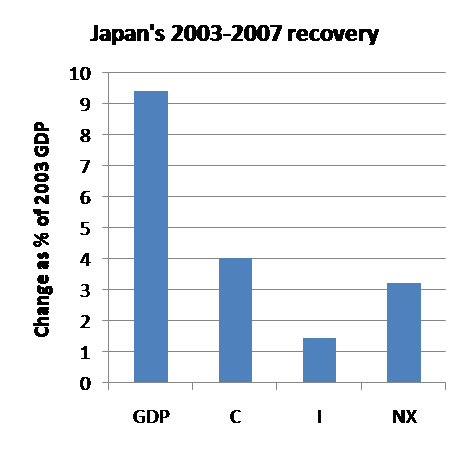
But here’s my question: does Japan’s experience offer any guidance on how a balance-sheet slump ends? Koo writes about the gradual rebuilding of private balance sheets, preparing the ground for recovery; and Japan did in fact have a fairly convincing bounce-back from 2003 to 2007.

But a closer look at that recovery is not encouraging. The chart above is a quick-and-dirty summary of the sources of Japanese growth from 2003 to 2007. It shows the change in real GDP, the change in real consumer spending, the change in real business investment, and the change in real net exports, all as percentages of 2003 GDP. What we see is nothing special happening to consumption, which grew more or less at its long-term trend growth rate, and only a modest investment boom. Exports were the driving force behind recovery.

And needless to say, we can’t all export ourselves out of a global slump.

So, how does this end?"

Me:

"By that chart, wouldn’t investment be worth a shot? Which is why I wanted targeted tax cuts for investment. Generous ones. I also wanted a sales tax cut, which would be phased out in the future, to keep consumption from falling off a cliff, not to encourage needless spending. That would help with C. I would also argue for Buiter’s Helicopter Money Proposal:

http://www.nber.org/~wbuiter/helijpe.pdf

This would be my QE. Finally, a more modest stimulus would have made sense, in order to encourage some optimism that we are investing for the future. Maybe $100 Billion Dollars. We should spend generously on social safety net help as well.

All these ideas follow from my reading of Fisher, since we’re attacking deflation and the fear and aversion to risk. What we cannot do, because of our circumstances, is spend as much as I or Shiller might like. There are too many negative possibilities in doing that.

Along with temporary nationalization of some banks, and some common sense from other countries as well, we might make some advances.

A subsidy to prop up home prices does not seem like a good idea. A better idea would be a general housing subsidy for a time, but that’s not going anywhere.

— Don the libertarian Democrat"

Tuesday, February 17, 2009

In the end, reality will come out. But that may follow a lengthy pretence.

From Paul Kedrosky:

"
How is Japan Relevant to U.S.?

Good new Martin Wolf column out comparing the U.S. experience in this deflationary deleveraging with what has happened in Japan:

The good news is that the asset price bubbles themselves were far smaller in the US than in Japan (see charts below). Furthermore, the US central bank has been swifter in recognising reality, cutting interest rates quickly to close to zero and moving towards “unconventional” monetary policy.

The bad news is that the debate over fiscal policy in the US seems even more neanderthal than in Japan: it cannot be stressed too strongly that in a balance-sheet deflation, with zero official interest rates, fiscal policy is all we have. The big danger is that an attempt will be made to close the fiscal deficit prematurely, with dire results. Again, the US administration’s proposals for a public/private partnership, to purchase toxic assets, look hopeless. Even if it can be made to work operationally, the prices are likely to be too low to encourage banks to sell or to represent a big taxpayer subsidy to buyers, sellers, or both. Far more important, it is unlikely that modestly raising prices of a range of bad assets will recapitalise damaged institutions. In the end, reality will come out. But that may follow a lengthy pretence.

More here.

Me:

"In the end, reality will come out. But that may follow a lengthy pretence."
If you thought in September that:
1) Debt-Deflation, leading to massive unemployment, was the big problem
2) Some sort of Swedish Plan was necessary to help stop Debt-Deflation
3) Quantitative Easing was necessary to stop Debt-Deflation
then much of this crisis has seemed unnecessary. The problem was evident before Lehman, and certain evident the day after. In fact, saving Bear was evidence that somebody saw the problem ahead.
Consequently, I'm not so forgiving or certain that we'll do the right thing at all. It's looked like a save the banks and shareholders at all cost play, written by lobbyists. It never occurred to me that so many people bought into the pretense that our government was anything other than a Cronyist Welfare State. WW II and the 1970s seemed like far worse contexts for financial crises, and I actually thought that we were well situated to make some hard choices. Silly me. I might rather now say, "At the end, reality will come out". The question is really what will end.

Today, i read a post by Wallerstein, whose Modern world System I thought was terrific, but who is politically a few steps away from me. I found myself agreeing with most of the post. What a strange world that we've entered.

Monday, January 26, 2009

Others talk of de facto nationalization, in which the government owns a sizeable chunk of the banks but not a majority, with all that connotes.

If it's in the NY Times, maybe they're considering it:

Published: January 25, 2009

WASHINGTON — Only five days into the Obama presidency, members of the new administration and Democratic leaders in Congress are already dancing around one of the most politically delicate questions about the financial bailout: Is the president prepared to nationalize a huge swath of the nation’s banking system? ( IS HE? )

Skip to next paragraph
Mark Wilson/Getty Images

Speaker Nancy Pelosi has alluded to internal debate over whether large banks should be nationalized, while aides to President Obama have avoided the word and are looking into alternatives.( IT'S A SCARY WORD )

Privately( IT'S NOT A SECRET ), most members of the Obama economic team concede that the rapid deterioration of the country’s biggest banks, notably Bank of America and Citigroup, is bound to require far larger investments of taxpayer money, atop the more than $300 billion of taxpayer money already poured into those two financial institutions and hundreds of others.

But if hundreds of billions of dollars of new investment is needed to shore up those banks, and perhaps their competitors, what do taxpayers get in return? And how do the risks escalate as government’s role expands from a few bailouts to control over a vast portion of the financial sector of the world’s largest economy?

The Obama administration is making only glancing references to those questions. In an interview Sunday on “This Week” on ABC, the House speaker, Nancy Pelosi, alluded to internal debate when she was asked whether nationalization, or partial nationalization, of the largest banks was a good idea.

“Well, whatever you want to call it,” said Ms. Pelosi, Democrat of California. “If we are strengthening them, then the American people should get some of the upside of that strengthening. Some people call that nationalization. ( I AGREE )

“I’m not talking about total ownership( I AM ),” she quickly cautioned — stopping herself by posing a question: “Would we have ever thought we would see the day when we’d be using that terminology? ‘Nationalization of the banks?’ ”

So far, President Obama’s top aides have steered clear of the word entirely, and they are still actively discussing other alternatives, including creating a “bad bank” that would nationalize the worst nonperforming loans by taking them off the hands of financial institutions without actually taking ownership of the banks. Others talk of de facto nationalization( PROBABLY OUR DESTINATION. ), in which the government owns a sizeable chunk of the banks but not a majority, with all that connotes.

That has already happened; taxpayers are now the biggest shareholders in Bank of America, with about 6 percent of the stock, and in Citigroup, with 7.8 percent. But the government’s influence is far larger than those numbers suggest, because it has guaranteed( THE KEY CONCEPT ) to absorb the losses of some of the two banks’ most toxic assets, a figure that could run into the hundreds of billions of dollars.

Many believe this form of hybrid ownership — part government, part private, with the responsibilities of ownership unclear — will not prove workable( I'VE SAID THAT SINCE SPETEMBER. ).

“The case for full nationalization is far stronger now than it was a few months ago,” said Adam S. Posen, the deputy director of the Peterson Institute for International Economics. “If you don’t own the majority, you don’t get to fire the management, to wipe out the shareholders, to declare that you are just going to take the losses and start over. It’s the mistake the Japanese made in the ’90s.”( YES SIR )

“I would guess that sometime in the next few weeks, President Obama and Tim Geithner,” he said, referring to the nominee for Treasury secretary, “will have to come out and say, ‘It’s much worse than we thought,’ and just bite the bullet.” ( IF ONLY )

So far the Obama administration has signaled that it is trying to avoid that day, and members of its economic team — among them Mr. Geithner and the president’s top economic adviser, Lawrence H. Summers — made the case during the Asian financial crisis in the 1990s that governments make lousy bank managers.

Indeed, the risks of nationalization they warned about then apply equally to the United States now. The first is that nationalization can prove contagious( OVERBLOWN. ). If the Obama administration took over Bank of America and Citigroup, two of the largest banks in the United States, private investors could decide to flee from the likes of JPMorgan Chase and Wells Fargo, or other major banks, fearing they could be next.( THEY NEED TO CHECK THE BOOKS. THAT'S WHAT GOOD INVESTORS DO. )

Moreover, Mr. Obama’s advisers say they are acutely aware that if the government is perceived as running the banks, the administration would come under enormous political pressure to halt foreclosures or lend money to ailing projects in cities or states with powerful constituencies, which could imperil the effort to steer the banks away from the cliff.( AND IF THEY DON'T, THESE PRESSURES GO AWAY? )

“The nightmare scenarios are endless( FEAR AND AVERSION TO RISK IN GOVERNMENT ),” one of the administration’s senior officials said.

The argument in favor of nationalization, even a brief nationalization of a few months or years, is straightforward: It might be the only way to pull America’s largest financial institutions out of the downward spiral that makes it enormously difficult to raise the capital they need to keep operating.( THAT'S MY POINT )

Right now, many banks are reluctant to write off their bad debts, and absorb huge losses, unless they can first raise enough capital to cushion the blow. But they cannot attract that capital without first purging their balance sheets of the toxic assets. Japan’s experience proved the dangers of that downward swirl; the economy stagnated, new lending ground to a halt and the country’s diplomatic clout shrank with its balance sheets.( VERY BAD )

Nationalization could pull the banks out of that dive, at least temporarily, as the government injected capital, hired new managers and ordered a restart to lending. But some Republicans who bit their tongues when President George W. Bush ordered huge interventions in the market would charge that Mr. Obama was steering America toward socialism( PLEASE. THE REAL FEAR IS NATIONALISM OR TOTALITARIANISM, WHICH WILL ENSUE IF WE KEEP PISSING ON THE MIDDLE AND LOWER CLASSES. ).

Nationalization, said Charles Geisst, a financial historian at Manhattan College “is just not a term in the American vocabulary.”( NEITHER IS "WELFARE STATE", BUT THAT'S WHAT WE HAVE. )

“We think of it,” he continued, “as something foreigners do to us, not something we do.”

It is also something foreigners do to themselves: the British have recently taken a majority stake in the Royal Bank of Scotland.

Some of Mr. Obama’s advisers have asked who the government would get to run the banks. Many of the most experienced executives are tainted by the decisions they made during the age of excess. And how would the government attract the best talent if it demanded that they take minimal pay — a political reality in the current environment( YOU CAN'T FIND A SINGLE PATRIOT? WE ARE IN BAD SHAPE. )?

Another option is for the government to buy the banks’ most toxic assets either through a giant fund, or, more likely, a federally supported bad bank designed to buy up troubled investments. But in that case, taxpayers might well be the losers: They would have all of the banks’ worst assets and none of their performing loans. And unless a deal is worked out to take a larger share of the banks whose bad loans are shuffled off to the government, the taxpayers would not have the chance to benefit by selling the shares back to private investors.( A MORASS )

Moreover, cleaning up the banks’ bad assets, without extracting a heavy price for the bank managers, shareholders and their lenders, is exactly what Mr. Summers and Mr. Geithner warned against during the Asian financial crisis.( UM, YES. BUT IT FEELS SO AWFULLY GOOD TO LECTURE PEOPLE. )

“We told the Asians that they had to be willing to let banks and companies fail,” said Jeffrey Garten, a professor at the Yale School of Management and a top official in the Clinton administration. “We warned that there was great moral hazard if governments just bailed them out.”

“And now,” he said, “we are doing the polar opposite of our advice.”(THAT'S OUR SYSTEM )

Who knew that our financial system was based on government guarantees to intervene in case of a financial crisis? Why the Investor Class, of course. Are they socialists too? They surely do seem to be still pulling the strings. Money well spent on their part. They bought insurance from the government, and some people didn't even see it happen.

Friday, January 9, 2009

"Unsurprisingly, Japan is kicking serious metallic ass."

Is there still a mine shaft gap? From Reason, we are lagging very far behind in robots:

"
Domo Arigato

Robots are not quite up to Asmovian levels worldwide yet, sadly. But we've hit about 1 million industrial robots worldwide. Check out the distribution of robots about the globe, from IEEE:

robots everywhere!

Unsurprisingly, Japan is kicking serious metallic ass. And these figures don't even count adorable robot dogs and creepy robot women (hello uncanny valley!).

Assuming our march toward an all service economy continues despite the downturn, we'll probably never catch up to Japan on industrial robots, so we'd better make a go of it with service robots, America.

Via BoingBoing"

Saturday, January 3, 2009

"We can't predict how deep the recession will be, or how long it will last, because it depends on psychology. "

Another good post from the Guardian:

"Bill Emmott

"What, pray, is all the fuss about?" asked a sage columnist in these pages on the first anniversary of the credit crunch ("Crisis, what crisis?", 12 August). In response to claims that this was a great crisis of capitalism he even deployed the word "phooey". That sage columnist was of course yours truly; it is safe to say that article will not be pasted into my scrapbook titled "Most Prescient Pieces".

My argument was, of course, correct in so far as it looked in the rear-view mirror rather than at the road ahead. The striking thing about the first year of the crunch, in Britain and globally, was how little impact it had on the wider economy beyond the banks, the City and Wall Street( TRUE ).

And any impact that has yet been seen does not make the situation worse than the recession of the early 90s, or especially the early 80s, when unemployment was nearly double today's level. Still, it is no longer possible to be as sanguine as I was in August. We are still far from a "worst since the 30s" situation, but there is no doubt that in the last four months all developed economies, and many developing ones, have frozen up. How bad might it get? We don't know, because we can't know.( TRUE )

It is worth dwelling for a moment (as I have for many moments, especially since mid-September) on why I was proved so wrong. There are, I think, two reasons beyond idiocy or complacency.

First, I may have spent too much time thinking about Japan. It really did have the rich world's worst financial crisis since 1929, when after 1990 its stockmarket fell by 75% and property prices by 70%. But it never had a severe recession: more a slow squeeze that ended, from 1997 onwards, in deflationary stagnation. A slump was prevented by a huge Keynesian public spending programme; meltdown was prevented by using public funds to rescue banks.

The collapse of our financial pyramid scheme could be absorbed, I thought, by learning from Japan's example and improving on it. That is exactly what Gordon "saviour of the world" Brown did by recapitalising Britain's banks 14 months into the crisis, rather than waiting eight years, as Japan had; and it is reflected in the fiscal expansion announced in Alistair Darling's pre-budget report in November and the huge spending programme being prepared by the US president-elect.

However, our drama now feels worse than Japan's because it is international. Japan's economy was propped up by healthy global growth, whereas now we are all slowing or receding together. It is also worse because of the second factor that I misjudged in August: psychology( THE KEY TO THE WHOLE CRISIS ).

The position I took was, in effect, an attempt to argue that we risked talking ourselves into recession, through media scaremongering, and remarks such as Darling's warning, in his Guardian interview of 29 August, that Britain faced the worst economic times for 60 years, with more "profound and long-lasting" effects than people were expecting. No doubt he now thinks he has been proved correct, while I still hope that he won't be, and feel he may have contributed to the panic( TRUE. BUT IT'S UNDERSTANDABLE. ) - even though it would be implausible to argue that he caused it.

Now fear has taken over( THE FEAR AND AVERSION TO RISK ). Companies, households and banks have decided that cash must be king, to be in debt is to risk death, and new commitments are best avoided. Individually, this is rational. Collectively, it is disastrous( TRUE ). Or, to avoid being a scaremonger, it brings about( I AGREE ) the thing we are afraid of: a nasty recession.

We can't predict how deep the recession will be, or how long it will last, because it depends on psychology( I AGREE ). Economics is not about models and mathematics, it is about behaviour( THAT IS THE WHOLE POINT OF A HUMAN AGENCY EXPLANATION ): our reactions to opportunities, risks and fears.

Brown and Darling are right to be trying to counter that deflationary psychology( TO TRY AND LESSEN THE AVERSION AND FEAR OF RISK ) by throwing away the old fiscal rules, cutting VAT and expanding public borrowing. Like in Japan, this will help to mitigate the slump. But whether it can end the slump will depend on companies, households and banks that hold cash being convinced( YES ) that it is time to start spending again - because they have become sufficiently less afraid of an apocalypse, and sufficiently convinced that opportunities to invest, buy and lend have become sufficiently attractive( YES ).

Meanwhile, note, this is not - yet - a true "crisis of capitalism"( I AGREE ). That would arise if confidence never seems likely to return, if unemployment has soared( A TRUE DISASTER ) and if hope seems truly to have been destroyed. It cannot be ruled out( I AGREE ). But let us, as the future US president said in his book, have the audacity to hope that it won't happen, and the sense not to announce it until and unless it does.

• Bill Emmott is a former editor of the Economist and author of Rivals - How the Power Struggle between China, India and Japan will Shape our Next Decade"

I agree with this post and its emphasis.