Showing posts with label Money Supply. Show all posts

Wednesday, June 10, 2009

It would be very easy to repeat the Fed's mistake in 1936 and 1937.

TO BE NOTED: From Bob McTeer:

"The Fed’s Balance Sheet and Excess Bank Reserves

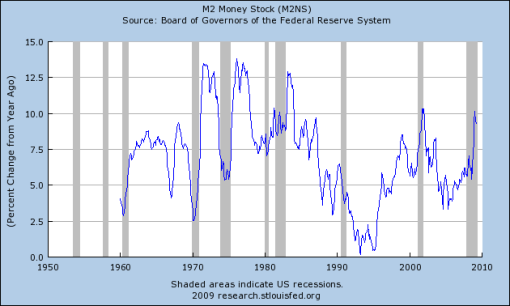
People keep talking and writing about the explosion of the money supply and the coming inflationary tsunami. Let me point out once again that the M1 and M2 measures of the money supply spiked but have since come back down. There is no explosion of the money supply.

I

The monetary base (currency outstanding plus bank reserves) has exploded, and it's graph is indeed startling-startling that is until you realize that excess bank reserves on deposit at the Fed is the reason. We learned to pay attention to the monetary base because it provided the raw material (reserves) from which the banking system can create new money by lending and investing. Because of the money expansion multiplier, the monetary base has been referred to historically as "high powered money."

In today's ongoing financial crisis, however, the base is not being used as the basis for monetary expansion. The accumulation of excess reserves behind the explosion of the monetary base is the result of the weak state of many banks and the fear of bankers that they won't have enough liquidity to meet deposit withdrawals. In other words, the reserves that are excess in a regulatory or legal sense, aren't excess at all in the minds of the bankers. They represent the prudent hoarding of bank cash in uncertain times. Measures to reduce "excess" reserves could, therefore, have disastrous results as banks liquidate assets to restore their liquidity.

This movie has been shown before. It played a significant role in the 1930s when the Fed acted to "mop up" excess reserves in the banking system by raising reserve requirements in 1936 and again in early 1937. Then, as now, the reserves were excess only in a regulatory or legal sense. Under the circumstances bankers did not regard them as excess, and their reaction to the increase in reserve requirements helped prolong and deepen the Great Depression. We should not make the same mistake now.

I find it amazing that I have not heard a single talking head on financial television or read a single article in the financial press about this instructive experience in the 1930s that has such important lessons for today. I suppose it's largely a result of the youth of the pundits these days and their reliance on memory.

What follows is my review of the 1930s episode along with a refresher on money and banking.

II

One might think of the Fed influencing the economy by influencing the reserve base of the banking system to generate more or less lending and money creation. If bank reserves become more plentiful, through Fed loans to banks or open market security purchases, the banks will make more loans or purchase more investments and, in doing so, cause the money supply to expand.

Largely because of gold inflows resulting from the devaluation of the dollar in 1934, banks accumulated large amounts of reserve deposits at the Fed. By 1936 banks had accumulated much more reserve deposits at the Fed than were "required." In other words, they had excess reserves, or substantially more than were required. The Fed came to think of those excess reserves as a buffer or cushion that loosened its rein on the banks. Its policy actions might not elicit the response intended for the banking system. If the Fed added or removed reserves from the banking system, the banks could let losses be absorbed by their excess reserves and might just let additions add to the excess already there.

In an effort to tighten the link between its actions and the banks' reactions, the Fed in 1936 and again in early 1937 raised reserve requirements to mop up the excess reserves. Its intent was to tighten the reins, not to tighten monetary policy. It wasn't tightening policy, it thought, because the reserves absorbed were already in excess. It wouldn't force banks to cut back on lending.

But cut back they did. On Monday morning, it was revealed that those bank reserves were excess only in a legal or regulatory sense. The banks didn't regard them as excess given the uncertain and turbulent times. In effect, the banks own reserve requirement were higher than the Fed's reserve requirement. The banks thought of all their reserves as precautionary balances needed for emergencies; so the increase in reserve requirements had the unintended consequence of a substantial tightening of monetary policy which either made the depression worse or helped cause a double dip recession, whichever you prefer.*

We hear many references today to the "excess liquidity" represented by the large amount of excess reserves on the Fed's balance sheet. Before we recommend doing something about that in the interest of preventing future inflation, we should consider the lesson of the 1930s. Those excess reserves may not be considered excess by their owners, even less so since they do now earn a nominal interest rate. It would be very easy to repeat the Fed's mistake in 1936 and 1937.

*An excellent account of the excess reserve experiment during the depression may be found in Richard H. Timberlake, Money, Banking, and Central Banking. In the first edition, it begins on page 201. Professor Timberlake was my teacher in these matters back in the olden days."

Thursday, May 14, 2009

The paradox of high inflation is that it can make stocks, claims on productive assets very cheap

TO BE NOTED: From ducati998:

"Liquidity, velocity and stocks

snoopytyping_800x600

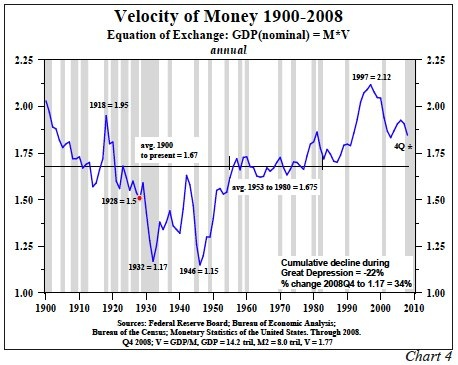
M2_velocity

The function of money is to facilitate exchange, and eliminate barter, thus speeding up, and expanding trade. The demand for money is increased by the following two conditions:

*Increase in productivity
*Increase in prices

The demand for money falls when the opposite conditions are operant:

*Fall in productivity
*Fall in prices

The Federal Reserve and Treasury have been increasing the volume of money within the system. Productivity has been falling, curtailed by falling demand for products & services that have excess capacity. The money supply has continued to grow.

fredgraph

Who are the recipients of the increased money supply? One of the rules of inflation is that the early recipients of new money, are allowed to buy assets with the new money thus essentially buying at a discount. The later you enter the chain, the greater the expropriation of your wealth that you will suffer.

The banks, auto-makers, and any other lame ducks that you can think of. Essentially anyone who was profilgate and stupid in combination.

What will they do with the new money? Hoarding will take place in some instances, but, many will buy assets with the money, to take advantage of a small window of opportunity of increased buying power that the new money affords.

Stocks have been rising, but the common concensus would seem to indicate that it is not Mutual Fund Managers, Pension Fund Managers etc who are driving the market. However, the banks have on aggregate, have been simply hoarding, rebuilding their capital ratios via Federal Reserve interest payments on said reserves.

Surplus money, or liquidity, needs to find a home. Rising asset prices, provide such a home. Rising prices remove liquidity, and by definition drive an increase in the demand for money.

The surplus money or liquidity, in pushing prices higher therefore eliminates the surplus supply of money, creating in time a deficit. A money deficit can be corrected through selling products/services.

What happens though when money is continuously pumped into the system? Prices will continue to rise. The Federal Reserve and other Central Banks, have not yet considered slowing the creation of new money, as, the economy, and particularly unemployment remain critical issues to their re-election, albeit, for Obama, 2.5yrs away.

Time will play a factor within the advent of an increase in liquidity and rising prices, as it takes time for the increased liquidity to leak out. Banks, as previously alluded, are not buying, rather, they are hoarding, rebuilding Balance Sheets.

Treasury paper, for psychological reasons, has been a recipient of much liquidity, although, with a failed auction last week, this asset class may well start leaking liquidity back into alternate assets. Banks, Pension Funds and Sovereign holders constitute major players.

China, is not happy. China has already made noises with regard to replacing the US dollar as the Reserve Currency. China will not be blind to the threat of increased liquidity within the Banks and what it must eventually mean. As a country in surplus, as opposed to a US deficit, China can withdraw liquidity, at no discount, due to US liquidity provision via Quantitative Easing, and reallocate this liquidity, [this holds true for Petro-dollars etc]

Where would this liquidity flow to?

The paradox of high inflation is that it can make stocks, claims on productive assets very cheap. Asia and South American inflations of recent times bear this out.

Although the official inflation rate is negligible, the creation of so much new money has created the potential of a serious inflation should it be released, highly possible."

Tuesday, January 13, 2009

Good (short) video interview with Stanford economist John Taylor on increasing the money supply:

I'm a big fan of John Taylor, but he gets this wrong. Via Paul Kedrosky:

John Taylor on Increasing the Money Supply

Good (short) video interview with Stanford economist John Taylor on increasing the money supply:

Sphere It | Digg this! Digg it | Bookmark this! Bookmark it | Stumble It! Stumble it | Facebook this! Facebook it

What we had following the mortgage foreclosure run was a Calling Run. The problem with a Calling run is that one of its causes is the inability of various investors to quickly get out of investments with which they could meet their calling requirements. I'm still puzzled why people believe that the government buying these calcified investments would be any easier than anyone else buying them, unless the government unfroze the market by vastly overpaying for the assets. Otherwise, the government doesn't know any more, and probably knows a lot less, than John Paulson, who is said to be buying them now that the government is out the picture. Excuse me if I think that Paulson is a better investor than the government. Paulson's actions tell me that the government would be overpaying for the assets.

In order to buy time for the investors to get out of their investments, the government stepped in to give these investors enough money to make it through this crisis and eventually unwind their investments. Think of AIG. This makes sense. It might even work. My point is that this government intervention should have been at the cost of seizing the businesses saved to be resold into private hands later. Only onerous conditions like this can honor Bagehot's Principles.

But the only way to stop a Calling Run is government intervention, because investors do not believe that anyone but the government can guarantee an orderly unwinding. Without that, it's every investor for its call. The result of that is a Proactivity Run, which we now have anyway, although not as bad as anticipated by some. The result of a prolonged Proactivity Run is very serious social unrest, whether in China, or here. Good luck if it comes to that.

Friday, December 26, 2008

"but the critics never mention the reason for the low rates nor their benefits."

Bob McTeer takes the blame for turning the water on in the Spigot Theory, which I don't credit:

"When recession becomes an issue, as it now is, the remedy involves increasing total spending, or aggregate demand, to match the capacity of the economy to produce goods and services at full employment( TRUE ).

One way to view aggregate demand is by its spending components such as consumption, investment, and government spending. This "Keynesian approach facilitates a focus on fiscal policy( TRUE ).

An equally valid approach that highlights monetary policy is to treat aggregate demand as the money supply (M) times its velocity (V). MV gives you the same spending totals as above( YES ).

A third approach, rarely used, is productivity (output per hour worked) times the number of hours worked. That too gives the same result. It's like describing the same thing in different languages.( OK )

Productivity growth came into prominence in the late 1990s because its acceleration had very positive results. It enabled employers to give pay increases without increasing their unit labor costs. That permitted an easier monetary policy with less worry about inflation. We had faster growth with falling inflation( YES ).

Remarkably, faster productivity growth continued as we climbed out of the recession in 2002. That was a mixed blessing since business expanded with little or no expansion in employment. Rising output coinciding with rising unemployment led to the term "jobless recovery."( YES. THAT'S SOMETIMES AN ODDITY OF AN INCREASE IN PRODUCTIVITY )

While rising productivity was increasing our standard of living, it also depressed employment growth, which is probably not a desirable tradeoff when the economy is weak( I AGREE ). Rising employment spreads the benefits of growth more widely( YES ).

As 2002 progressed, the recovery sputtered and a double dip recession threatened. Falling inflation threatened to morph into actual deflation. Fear of deflation, was the main reason the Greenspan Fed allowed the Federal funds rate to go so low, eventually reaching one percent. Alan Greenspan is routinely blamed for those low interest rates fueling the housing boom, but the critics never mention the reason for the low rates nor their benefits( TRUE. SAME PLAN AS THIS TIME ).

Whether the policy was justified or not, I left my fingerprints at the scene. At the September 2002 FOMC meeting, I dissented, along with Governor Ned Gramlich, in favor of reducing rates. We didn't prevail at that meeting, but the vote to ease was unanimous at the next meeting, on November 6.

I wrote the following rational for the minutes, which are now public:

Messrs. Gramlich and McTeer dissented because they preferred to ease monetary policy at this meeting. The economic expansion, which resumed almost a year ago, had recently lost momentum, and job growth had been minimal over the past year. With inflation already low and likely to decline further in the face of economic slack and rapid productivity growth, the potential cost of additional stimulus seemed low compared with the risk of further weakness.

So, you see, it wasn't Chairman Greenspan's fault. It was mine."

I would have voted with McTeer. But, as I say, I don't hold Low Interest Rates as the cause of our crisis. My main complaint against Greenspan is not recognizing problems and voicing concerns about them. He was too much of a cheerleader for some dubious views about current Political Economy.

Saturday, December 13, 2008

"Keynes’s prescriptions were guided by his conception of money, which plays a disturbing role in his economics."

Robert Skidelsky on Keynes again in the NY Times:

"Among the most astonishing statements to be made by any policymaker in recent years was Alan Greenspan’s admission this autumn that the regime of deregulation he oversaw as chairman of the Federal Reserve was based on a “flaw”: he had overestimated the ability of a free market to self-correct and had missed the self-destructive power of deregulated mortgage lending. The “whole intellectual edifice,” he said, “collapsed in the summer of last year.”

I have to admit that it is astonishing.

"What was this “intellectual edifice”? As so often with policymakers, you need to tease out their beliefs from their policies. Greenspan must have believed something like the “efficient-market hypothesis,” which holds that financial markets always price assets correctly. Given that markets are efficient, they would need only the lightest regulation. Government officials who control the money supply have only one task — to keep prices roughly stable."

It is very important to understand, or tease out, beliefs from policies. For me, this is the difference between Politics and Political Theory and Political Economy and Economics. I don't believe markets are efficient. I do believe that the Fed's main function is to keep prices roughly stable, with a bias towards slight inflation.

"I don’t suppose that Greenspan actually bought this story literally, since experience of repeated financial crises too obviously contradicted it. It was, after all, only a model. But he must have believed something sufficiently like it to have supported extensive financial deregulation and to have kept interest rates low in the period when the housing bubble was growing. This was the intellectual edifice, of both theory and policy, which has just been blown sky high. As George Soros rightly pointed out, “The salient feature of the current financial crisis is that it was not caused by some external shock like OPEC raising the price of oil. . . . The crisis was generated by the financial system itself.”

This is not very clear. I don't see a lot of explanatory power here. Is the decline in housing prices like the price of oil? Is the tsunami of foreclosures like OPEC or is it part of the financial system itself? I also don't credit the power of low interests rates as the most important cause of the current crisis. Deregulation might have had a part in this drama as well, but I need a little more explanation of what that part entails.

"This is where the great economist John Maynard Keynes (1883-1946) comes in. Today, Keynes is justly enjoying a comeback. For the same “intellectual edifice” that Greenspan said has now collapsed was what supported the laissez-faire policies Keynes quarreled with in his times. Then, as now, economists believed that all uncertainty could be reduced to measurable risk. So asset prices always reflected fundamentals, and unregulated markets would in general be very stable."

So Laissez-Faire Policies entail believing that:
1) All uncertainty can be reduced to measurable risk ( Don't agree )
2) Asset prices always reflect fundamentals ( Don't agree. This involves perception and interpretation )
3) Unregulated markets are generally stable ( We don't have an unregulated market. I could say something banal and pronounce that well-regulated markets are stable. I guess that I just did, for all the lack of specificity and essentially tautological reasoning good it does me )

What's with the focus on Greenspan? Is this going to all be about Central Banks?

"By contrast, Keynes created an economics whose starting point was that not all future events could be reduced to measurable risk. There was a residue of genuine uncertainty, and this made disaster an ever-present possibility, not a once-in-a-lifetime “shock.” Investment was more an act of faith than a scientific calculation of probabilities. And in this fact lay the possibility of huge systemic mistakes."

I agree with Keynes here. Strangely, I thought that Hayek agreed with this.

"The basic question Keynes asked was: How do rational people behave under conditions of uncertainty? The answer he gave was profound and extends far beyond economics. People fall back on “conventions,” which give them the assurance that they are doing the right thing. The chief of these are the assumptions that the future will be like the past (witness all the financial models that assumed housing prices wouldn’t fall) and that current prices correctly sum up “future prospects.” Above all, we run with the crowd. A master of aphorism, Keynes wrote that a “sound banker” is one who, “when he is ruined, is ruined in a conventional and orthodox way.” (Today, you might add a further convention — the belief that mathematics can conjure certainty out of uncertainty.)"

I should say that I'm a big fan of his writing style, which favorably disposes me to him. I would say:
1) People fall back on Narratives
2) That the future follows from the past must in some sense be true, since day follows from night. I thought that Keynes believed that it was very hard to predict the future in various situations, not all situations. In other words, some events are easier to predict than others.
3) I would say that we are part of a society. Run with the crowd is too Mechanistic for my taste.
4) Math cannot conjure certainty from uncertainty, if I understand what he means.

"But any view of the future based on what Keynes called “so flimsy a foundation” is liable to “sudden and violent changes” when the news changes. Investors do not process new information efficiently because they don’t know which information is relevant. Conventional behavior easily turns into herd behavior. Financial markets are punctuated by alternating currents of euphoria and panic."

This all adds up to people aren't omniscient. I don't think that all markets are euphoric then panicked, then euphoric and then panicked, and I certainly don't believe that this is inevitable. If I did, then that would go a long way towards predicting it.

"Keynes’s prescriptions were guided by his conception of money, which plays a disturbing role in his economics. Most economists have seen money simply as a means of payment, an improvement on barter. Keynes emphasized its role as a “store of value.” Why, he asked, should anyone outside a lunatic asylum wish to “hold” money? The answer he gave was that “holding” money was a way of postponing transactions. The “desire to hold money as a store of wealth is a barometer of the degree of our distrust of our own calculations and conventions concerning the future. . . . The possession of actual money lulls our disquietude; and the premium we require to make us part with money is a measure of the degree of our disquietude.” The same reliance on “conventional” thinking that leads investors to spend profligately at certain times leads them to be highly cautious at others. Even a relatively weak dollar may, at moments of high uncertainty, seem more “secure” than any other asset, as we are currently seeing."

I'm a bit disturbed by this paragraph. I save money in order to have it in case I need it in the future for some unseen event. I find living in general disquieting, money much less so.

"It is this flight into cash that makes interest-rate policy such an uncertain agent of recovery. If the managers of banks and companies hold pessimistic views about the future, they will raise the price they charge for “giving up liquidity,” even though the central bank might be flooding the economy with cash. That is why Keynes did not think that cutting the central bank’s interest rate would necessarily — and certainly not quickly — lower the interest rates charged on different types of loans. This was his main argument for the use of government stimulus to fight a depression. There was only one sure way to get an increase in spending in the face of an extreme private-sector reluctance to spend, and that was for the government to spend the money itself. Spend on pyramids, spend on hospitals, but spend it must."

I call this a fear and aversion to risk and the accompanying flight to safety. I get the point, which is why I believe that a stimulus is worth a shot, after trying lowering interest rates. Is this supposed to be controversial?

"This, in a nutshell, was Keynes’s economics. His purpose, as he saw it, was not to destroy capitalism but to save it from itself. He thought that the work of rescue had to start with economic theory itself. Now that Greenspan’s intellectual edifice has collapsed, the moment has come to build a new structure on the foundations that Keynes laid."

That's basically my purpose. I believe that theories are of limited value, even Keynes' theories. I must not be in Greenspan's camp since I don't find any of this puzzling. As for Keynes, as I've said before, his theories will, in fact, end up being of limited worth as to specifics. We are looking to Keynes as a part of our Narrative that helps us deal with the present. It happens that the policies we're throwing at this crisis resemble Keynes enough that we are conjuring up his ghost to help us deal with it. That's fine. That's how we deal with crises. But we are essentially embarked on a trial and error ride that is more pragmatic than ideological, which is how it should be. It seems to me that what I've just stated is very Keynsian, if by that cognomen is meant one who uses what's truly valuable in Keynes' thought.

Wednesday, November 26, 2008

"Deflation: Making Sure "It" Doesn't Happen Here ": So I Don't Have To Think About It

Ben Bernake gave a speech in 2002 about Deflation that I'd like to scan:

"Since World War II, inflation--the apparently inexorable rise in the prices of goods and services--has been the bane of central bankers. Economists of various stripes have argued that inflation is the inevitable result of (pick your favorite) the abandonment of metallic monetary standards, a lack of fiscal discipline, shocks to the price of oil and other commodities, struggles over the distribution of income, excessive money creation, self-confirming inflation expectations, an "inflation bias" in the policies of central banks, and still others. Despite widespread "inflation pessimism," however, during the 1980s and 1990s most industrial-country central banks were able to cage, if not entirely tame, the inflation dragon. Although a number of factors converged to make this happy outcome possible, an essential element was the heightened understanding by central bankers and, equally as important, by political leaders and the public at large of the very high costs of allowing the economy to stray too far from price stability. "

I agree with this. A small amount of inflation bias might well be beneficial, for reasons to do with Human Agency and the perception of prices and goods.

"With inflation rates now quite low in the United States, however, some have expressed concern that we may soon face a new problem--the danger of deflation, or falling prices. That this concern is not purely hypothetical is brought home to us whenever we read newspaper reports about Japan, where what seems to be a relatively moderate deflation--a decline in consumer prices of about 1 percent per year--has been associated with years of painfully slow growth, rising joblessness, and apparently intractable financial problems in the banking and corporate sectors. While it is difficult to sort out cause from effect, the consensus view is that deflation has been an important negative factor in the Japanese slump. "

In Japan, Deflation, a drop in Consumer Prices of about 1% per year, caused, or is associated with:
1) Slow Growth
2) A rise in unemployment
3) Insoluble problems in the financial world

"So, is deflation a threat to the economic health of the United States? Not to leave you in suspense, I believe that the chance of significant deflation in the United States in the foreseeable future is extremely small, for two principal reasons."

They are:
1) "The first is the resilience and structural stability of the U.S. economy itself."

See, this one's a little dodgy.

"Over the years, the U.S. economy has shown a remarkable ability to absorb shocks of all kinds, to recover, and to continue to grow."

Let's hope this ability continues to be operative.

"Flexible and efficient markets for labor and capital, an entrepreneurial tradition, and a general willingness to tolerate and even embrace technological and economic change all contribute to this resiliency."

How about a strong stomach?

"A particularly important protective factor in the current environment is the strength of our financial system: Despite the adverse shocks of the past year, our banking system remains healthy and well-regulated, and firm and household balance sheets are for the most part in good shape."

Here's a good reason not to have a blog. Every idiotic thing I say is recorded.

"Also helpful is that inflation has recently been not only low but quite stable, with one result being that inflation expectations seem well anchored. For example, according to the University of Michigan survey that underlies the index of consumer sentiment, the median expected rate of inflation during the next five to ten years among those interviewed was 2.9 percent in October 2002, as compared with 2.7 percent a year earlier and 3.0 percent two years earlier--a stable record indeed. "

A lot of people blame our current situation on such low rates and the somnolent effect of the formerly great moderation.

2) "The second bulwark against deflation in the United States, and the one that will be the focus of my remarks today, is the Federal Reserve System itself."

Bulwark? The Fed's more like a turret disgorging its ammunition as it rotates around like a spinning top.

"The Congress has given the Fed the responsibility of preserving price stability (among other objectives), which most definitely implies avoiding deflation as well as inflation. I am confident that the Fed would take whatever means necessary to prevent significant deflation in the United States and, moreover, that the U.S. central bank, in cooperation with other parts of the government as needed, has sufficient policy instruments to ensure that any deflation that might occur would be both mild and brief."

Would the Congress would take it back? I was also confident in 2002 that the Red Sox would never win the World Series again.

"Of course, we must take care lest confidence become over-confidence."

We can definitely rest easy here.

"Deflationary episodes are rare, and generalization about them is difficult."

That didn't stop us from predicting a housing bubble wouldn't burst.

"Indeed, a recent Federal Reserve study of the Japanese experience concluded that the deflation there was almost entirely unexpected, by both foreign and Japanese observers alike (Ahearne et al., 2002). So, having said that deflation in the United States is highly unlikely, I would be imprudent to rule out the possibility altogether."

Right now, I can't rule out that Don will be running the Fed soon.

"Accordingly, I want to turn to a further exploration of the causes of deflation, its economic effects, and the policy instruments that can be deployed against it. Before going further I should say that my comments today reflect my own views only and are not necessarily those of my colleagues on the Board of Governors or the Federal Open Market Committee. "

I think that they would have rather you said that earlier.

"Deflation: Its Causes and Effects
Deflation is defined as a general decline in prices, with emphasis on the word "general."

Lot's of prices of things need to decline.

"At any given time, especially in a low-inflation economy like that of our recent experience, prices of some goods and services will be falling. Price declines in a specific sector may occur because productivity is rising and costs are falling more quickly in that sector than elsewhere or because the demand for the output of that sector is weak relative to the demand for other goods and services. Sector-specific price declines, uncomfortable as they may be for producers in that sector, are generally not a problem for the economy as a whole and do not constitute deflation. Deflation per se occurs only when price declines are so widespread that broad-based indexes of prices, such as the consumer price index, register ongoing declines."

Same thing.

"The sources of deflation are not a mystery."

Otherwise, I'd have damned little to say about it.

"Deflation is in almost all cases a side effect of a collapse of aggregate demand--a drop in spending so severe that producers must cut prices on an ongoing basis in order to find buyers."

People stop buying things, so businesses try and cut prices to induce them to buy.

"Likewise, the economic effects of a deflationary episode, for the most part, are similar to those of any other sharp decline in aggregate spending--namely, recession, rising unemployment, and financial stress. "

Deflation causes or is associated with:
1) Recession
2) Rising Unemployment
3) Financial stress

This list is remarkably similar to the earlier one.

"However, a deflationary recession may differ in one respect from "normal" recessions in which the inflation rate is at least modestly positive: Deflation of sufficient magnitude may result in the nominal interest rate declining to zero or very close to zero.2 Once the nominal interest rate is at zero, no further downward adjustment in the rate can occur, since lenders generally will not accept a negative nominal interest rate when it is possible instead to hold cash. At this point, the nominal interest rate is said to have hit the "zero bound."

Let me try and understand this. It's pretty profound. If I get a negative interest rate, I'll get less money back than I put in or I'll pay a fee. Given that, I'd rather hold on to my cash, because, at least, it's not going down.

"Deflation great enough to bring the nominal interest rate close to zero poses special problems for the economy and for policy."

It's seems like it will be hard to get people to buy your wonderful negative interest bonds.

"First, when the nominal interest rate has been reduced to zero, the real interest rate paid by borrowers equals the expected rate of deflation, however large that may be.3 To take what might seem like an extreme example (though in fact it occurred in the United States in the early 1930s), suppose that deflation is proceeding at a clip of 10 percent per year. Then someone who borrows for a year at a nominal interest rate of zero actually faces a 10 percent real cost of funds, as the loan must be repaid in dollars whose purchasing power is 10 percent greater than that of the dollars borrowed originally. In a period of sufficiently severe deflation, the real cost of borrowing becomes prohibitive. Capital investment, purchases of new homes, and other types of spending decline accordingly, worsening the economic downturn."

I think that this is the same thing I said earlier. This time it says that you'll pay back your loan in dollars that are worth less, so you'll have to pay back, essentially, more money than you loaned.

"Although deflation and the zero bound on nominal interest rates create a significant problem for those seeking to borrow, they impose an even greater burden on households and firms that had accumulated substantial debt before the onset of the deflation. This burden arises because, even if debtors are able to refinance their existing obligations at low nominal interest rates, with prices falling they must still repay the principal in dollars of increasing (perhaps rapidly increasing) real value."

Actually, this is simply the same point as above , only worse, since deflation essentially starting doing its little dance on you earlier.

"When William Jennings Bryan made his famous "cross of gold" speech in his 1896 presidential campaign, he was speaking on behalf of heavily mortgaged farmers whose debt burdens were growing ever larger in real terms, the result of a sustained deflation that followed America's post-Civil-War return to the gold standard.4 The financial distress of debtors can, in turn, increase the fragility of the nation's financial system--for example, by leading to a rapid increase in the share of bank loans that are delinquent or in default. Japan in recent years has certainly faced the problem of "debt-deflation"--the deflation-induced, ever-increasing real value of debts. Closer to home, massive financial problems, including defaults, bankruptcies, and bank failures, were endemic in America's worst encounter with deflation, in the years 1930-33--a period in which (as I mentioned) the U.S. price level fell about 10 percent per year. "

A little history lesson, which is always welcome.

"Beyond its adverse effects in financial markets and on borrowers, the zero bound on the nominal interest rate raises another concern--the limitation that it places on conventional monetary policy."

Quite frankly, it's hard to see how you can have one.

"Under normal conditions, the Fed and most other central banks implement policy by setting a target for a short-term interest rate--the overnight federal funds rate in the United States--and enforcing that target by buying and selling securities in open capital markets. When the short-term interest rate hits zero, the central bank can no longer ease policy by lowering its usual interest-rate target.5"

We already know why.

"Because central banks conventionally conduct monetary policy by manipulating the short-term nominal interest rate, some observers have concluded that when that key rate stands at or near zero, the central bank has "run out of ammunition"--that is, it no longer has the power to expand aggregate demand and hence economic activity."

I bet that you find my turret analogy more appropriate now, don't you. This is just a clever phrase for the third time we've gone over this problem.

"It is true that once the policy rate has been driven down to zero, a central bank can no longer use its traditional means of stimulating aggregate demand and thus will be operating in less familiar territory. The central bank's inability to use its traditional methods may complicate the policymaking process and introduce uncertainty in the size and timing of the economy's response to policy actions. Hence I agree that the situation is one to be avoided if possible. "

Let's try it for a fourth time. We can't use the "traditional" methods.

"However, a principal message of my talk today is that a central bank whose accustomed policy rate has been forced down to zero has most definitely not run out of ammunition."

Don't worry. I won't be coming down from this turret in the near future.

"As I will discuss, a central bank, either alone or in cooperation with other parts of the government, retains considerable power to expand aggregate demand and economic activity even when its accustomed policy rate is at zero."

We have ways to get people to spend. It involves free liquor.

"In the remainder of my talk, I will first discuss measures for preventing deflation--the preferable option if feasible. I will then turn to policy measures that the Fed and other government authorities can take if prevention efforts fail and deflation appears to be gaining a foothold in the economy. "

I don't like this approach. Get the rough stuff out of the way first.

"Preventing Deflation
As I have already emphasized, deflation is generally the result of low and falling aggregate demand. The basic prescription for preventing deflation is therefore straightforward, at least in principle: Use monetary and fiscal policy as needed to support aggregate spending, in a manner as nearly consistent as possible with full utilization of economic resources and low and stable inflation. In other words, the best way to get out of trouble is not to get into it in the first place. Beyond this commonsense injunction, however, there are several measures that the Fed (or any central bank) can take to reduce the risk of falling into deflation. "

Wait a second. I need to ponder this one a spell. Don't get into a mess, and you won't have to get out. That's it. We can all go home now.

"First, the Fed should try to preserve a buffer zone for the inflation rate, that is, during normal times it should not try to push inflation down all the way to zero.6"

Buffer zone? That's just a fancy way of saying don't get into the mess.

"Most central banks seem to understand the need for a buffer zone. For example, central banks with explicit inflation targets almost invariably set their target for inflation above zero, generally between 1 and 3 percent per year. Maintaining an inflation buffer zone reduces the risk that a large, unanticipated drop in aggregate demand will drive the economy far enough into deflationary territory to lower the nominal interest rate to zero. Of course, this benefit of having a buffer zone for inflation must be weighed against the costs associated with allowing a higher inflation rate in normal times. "

You see, a drop from 3 to 1 is a larger drop than from 1 to 0. Do you see?

"Second, the Fed should take most seriously--as of course it does--its responsibility to ensure financial stability in the economy. Irving Fisher (1933) was perhaps the first economist to emphasize the potential connections between violent financial crises, which lead to "fire sales" of assets and falling asset prices, with general declines in aggregate demand and the price level. A healthy, well capitalized banking system and smoothly functioning capital markets are an important line of defense against deflationary shocks. The Fed should and does use its regulatory and supervisory powers to ensure that the financial system will remain resilient if financial conditions change rapidly. And at times of extreme threat to financial stability, the Federal Reserve stands ready to use the discount window and other tools to protect the financial system, as it did during the 1987 stock market crash and the September 11, 2001, terrorist attacks. "

You know, I tried to scan a Fisher paper and I couldn't. Maybe someone can help me. Oh, and don't get into the mess.

"Third, as suggested by a number of studies, when inflation is already low and the fundamentals of the economy suddenly deteriorate, the central bank should act more preemptively and more aggressively than usual in cutting rates (Orphanides and Wieland, 2000; Reifschneider and Williams, 2000; Ahearne et al., 2002). By moving decisively and early, the Fed may be able to prevent the economy from slipping into deflation, with the special problems that entails. "

What happened to the buffer zone? When you go down from 3, always go directly to 1. It's more like a chasm than a buffer zone.

"As I have indicated, I believe that the combination of strong economic fundamentals and policymakers that are attentive to downside as well as upside risks to inflation make significant deflation in the United States in the foreseeable future quite unlikely."

Just because I brought this topic up, don't go home and hoard cash.

"But suppose that, despite all precautions, deflation were to take hold in the U.S. economy and, moreover, that the Fed's policy instrument--the federal funds rate--were to fall to zero. What then?"

I'm afraid you'll be needing a new chairman. My nickname is "Fair Weather Ben". Just kidding.

"In the remainder of my talk I will discuss some possible options for stopping a deflation once it has gotten under way. I should emphasize that my comments on this topic are necessarily speculative, as the modern Federal Reserve has never faced this situation nor has it pre-committed itself formally to any specific course of action should deflation arise. Furthermore, the specific responses the Fed would undertake would presumably depend on a number of factors, including its assessment of the whole range of risks to the economy and any complementary policies being undertaken by other parts of the U.S. government.7"

If this occurs, prepare to be dazzled by the gyrations of my policies. I call it "The Kitchen Sink Approach". It's speculative because I've no real idea of what a kitchen sink has to do with trying everything that you can think of.

"Curing Deflation"

Shouldn't we be listening to the NIH or something?

"Let me start with some general observations about monetary policy at the zero bound, sweeping under the rug for the moment some technical and operational issues. "

This is one of those useless models that we were just talking about.

"As I have mentioned, some observers have concluded that when the central bank's policy rate falls to zero--its practical minimum--monetary policy loses its ability to further stimulate aggregate demand and the economy. At a broad conceptual level, and in my view in practice as well, this conclusion is clearly mistaken. Indeed, under a fiat (that is, paper) money system, a government (in practice, the central bank in cooperation with other agencies) should always be able to generate increased nominal spending and inflation, even when the short-term nominal interest rate is at zero. "

I'm glad you're confident.

"The conclusion that deflation is always reversible under a fiat money system follows from basic economic reasoning. A little parable may prove useful:"

What is this? A mashal? Midrash? Once Rabbi Don Of Tacoma noticed that the prices in Tacoma were going down. "This was really the problem in Sedom and 'Amorah ( ' = ayin )", he said.

"Today an ounce of gold sells for $300, more or less. Now suppose that a modern alchemist solves his subject's oldest problem by finding a way to produce unlimited amounts of new gold at essentially no cost. Moreover, his invention is widely publicized and scientifically verified, and he announces his intention to begin massive production of gold within days. What would happen to the price of gold? Presumably, the potentially unlimited supply of cheap gold would cause the market price of gold to plummet. Indeed, if the market for gold is to any degree efficient, the price of gold would collapse immediately after the announcement of the invention, before the alchemist had produced and marketed a single ounce of yellow metal."

I thought Newton believed in alchemy.

"What has this got to do with monetary policy?"

Who knows? Mashals always lead to other mashals.

"Like gold, U.S. dollars have value only to the extent that they are strictly limited in supply. But the U.S. government has a technology, called a printing press (or, today, its electronic equivalent), that allows it to produce as many U.S. dollars as it wishes at essentially no cost. By increasing the number of U.S. dollars in circulation, or even by credibly threatening to do so, the U.S. government can also reduce the value of a dollar in terms of goods and services, which is equivalent to raising the prices in dollars of those goods and services. We conclude that, under a paper-money system, a determined government can always generate higher spending and hence positive inflation. "

We'll print more money and prices will go up. Isn't this alchemy?

"Of course, the U.S. government is not going to print money and distribute it willy-nilly (although as we will see later, there are practical policies that approximate this behavior)"

We spin a wheel, but it has only a few possibilites on it.

"Normally, money is injected into the economy through asset purchases by the Federal Reserve. To stimulate aggregate spending when short-term interest rates have reached zero, the Fed must expand the scale of its asset purchases or, possibly, expand the menu of assets that it buys. Alternatively, the Fed could find other ways of injecting money into the system--for example, by making low-interest-rate loans to banks or cooperating with the fiscal authorities. Each method of adding money to the economy has advantages and drawbacks, both technical and economic. One important concern in practice is that calibrating the economic effects of nonstandard means of injecting money may be difficult, given our relative lack of experience with such policies. Thus, as I have stressed already, prevention of deflation remains preferable to having to cure it. If we do fall into deflation, however, we can take comfort that the logic of the printing press example must assert itself, and sufficient injections of money will ultimately always reverse a deflation. "

The Fed can spend. Isn't this a stimulus? Or we loan at no interest. Or print money. The point is, we have options.

"So what then might the Fed do if its target interest rate, the overnight federal funds rate, fell to zero? One relatively straightforward extension of current procedures would be to try to stimulate spending by lowering rates further out along the Treasury term structure--that is, rates on government bonds of longer maturities.9"

Lower interest rates on longer bonds, to induce spending.

"There are at least two ways of bringing down longer-term rates, which are complementary and could be employed separately or in combination. One approach, similar to an action taken in the past couple of years by the Bank of Japan, would be for the Fed to commit to holding the overnight rate at zero for some specified period. Because long-term interest rates represent averages of current and expected future short-term rates, plus a term premium, a commitment to keep short-term rates at zero for some time--if it were credible--would induce a decline in longer-term rates. A more direct method, which I personally prefer, would be for the Fed to begin announcing explicit ceilings for yields on longer-maturity Treasury debt (say, bonds maturing within the next two years). The Fed could enforce these interest-rate ceilings by committing to make unlimited purchases of securities up to two years from maturity at prices consistent with the targeted yields. If this program were successful, not only would yields on medium-term Treasury securities fall, but (because of links operating through expectations of future interest rates) yields on longer-term public and private debt (such as mortgages) would likely fall as well.

As I said, no interest on certain loans. Say that you won't raise interest rates above a certain point.

"Here is Ed Yardeni's very interesting take:

I know what Ben Bernanke will do next, and it should be very bullish for stocks, bonds, commodities, and real estate. He soon will target the 10-year Treasury yield at 2.50%. It was at 3.40% yesterday. That would immediately bring the mortgage rate down to 4%-5%. The inventory of unsold existing and new homes will plunge as homebuyers swarm back into the real estate market. Home prices would stop falling, and might start rising again. The stock market would jump 25% within a few days. By the spring of 2009, housing starts and auto sales will rebound. The worst of the recession will be behind us after the first quarter of next year. "

You know, the only thing that I can see that this does is encourage spending instead of saving, and maybe help businesses and people buying homes with lower rates.

"Lower rates over the maturity spectrum of public and private securities should strengthen aggregate demand in the usual ways and thus help to end deflation. Of course, if operating in relatively short-dated Treasury debt proved insufficient, the Fed could also attempt to cap yields of Treasury securities at still longer maturities, say three to six years. Yet another option would be for the Fed to use its existing authority to operate in the markets for agency debt (for example, mortgage-backed securities issued by Ginnie Mae, the Government National Mortgage Association).'

Same thing. Get people to spend by lowering longer term rates and capping them. I included the Yardeni quote because he seems to see it as a real boost in demand.

"Historical experience tends to support the proposition that a sufficiently determined Fed can peg or cap Treasury bond prices and yields at other than the shortest maturities. The most striking episode of bond-price pegging occurred during the years before the Federal Reserve-Treasury Accord of 1951.10 Prior to that agreement, which freed the Fed from its responsibility to fix yields on government debt, the Fed maintained a ceiling of 2-1/2 percent on long-term Treasury bonds for nearly a decade. Moreover, it simultaneously established a ceiling on the twelve-month Treasury certificate of between 7/8 percent to 1-1/4 percent and, during the first half of that period, a rate of 3/8 percent on the 90-day Treasury bill. The Fed was able to achieve these low interest rates despite a level of outstanding government debt (relative to GDP) significantly greater than we have today, as well as inflation rates substantially more variable. At times, in order to enforce these low rates, the Fed had actually to purchase the bulk of outstanding 90-day bills. Interestingly, though, the Fed enforced the 2-1/2 percent ceiling on long-term bond yields for nearly a decade without ever holding a substantial share of long-maturity bonds outstanding.11 For example, the Fed held 7.0 percent of outstanding Treasury securities in 1945 and 9.2 percent in 1951 (the year of the Accord), almost entirely in the form of 90-day bills. For comparison, in 2001 the Fed held 9.7 percent of the stock of outstanding Treasury debt. "

He's saying that history shows that lenghtening the bonds that you're lowering and capping works to increase demand. Beats me. I guess it works.

"To repeat, I suspect that operating on rates on longer-term Treasuries would provide sufficient leverage for the Fed to achieve its goals in most plausible scenarios. If lowering yields on longer-dated Treasury securities proved insufficient to restart spending, however, the Fed might next consider attempting to influence directly the yields on privately issued securities."

Okay. Say doing this to government bonds doesn't work. In that case, we'll fiddle with bonds from outside the government.

"Unlike some central banks, and barring changes to current law, the Fed is relatively restricted in its ability to buy private securities directly.12 However, the Fed does have broad powers to lend to the private sector indirectly via banks, through the discount window.13 Therefore a second policy option, complementary to operating in the markets for Treasury and agency debt, would be for the Fed to offer fixed-term loans to banks at low or zero interest, with a wide range of private assets (including, among others, corporate bonds, commercial paper, bank loans, and mortgages) deemed eligible as collateral.14 For example, the Fed might make 90-day or 180-day zero-interest loans to banks, taking corporate commercial paper of the same maturity as collateral. Pursued aggressively, such a program could significantly reduce liquidity and term premiums on the assets used as collateral. Reductions in these premiums would lower the cost of capital both to banks and the nonbank private sector, over and above the beneficial effect already conferred by lower interest rates on government securities.15"

Lend money at low interest rates or no interest rate, and get something in return from the banks as collateral. They could then loan money cheaply, lower rates, discourage saving, attract business loans, etc.

"The Fed can inject money into the economy in still other ways. For example, the Fed has the authority to buy foreign government debt, as well as domestic government debt. Potentially, this class of assets offers huge scope for Fed operations, as the quantity of foreign assets eligible for purchase by the Fed is several times the stock of U.S. government debt.16"

This is like printing money or a stimulus. I'm wondering why the Fed should do this?

"I need to tread carefully here. Because the economy is a complex and interconnected system, Fed purchases of the liabilities of foreign governments have the potential to affect a number of financial markets, including the market for foreign exchange. In the United States, the Department of the Treasury, not the Federal Reserve, is the lead agency for making international economic policy, including policy toward the dollar; and the Secretary of the Treasury has expressed the view that the determination of the value of the U.S. dollar should be left to free market forces. Moreover, since the United States is a large, relatively closed economy, manipulating the exchange value of the dollar would not be a particularly desirable way to fight domestic deflation, particularly given the range of other options available. Thus, I want to be absolutely clear that I am today neither forecasting nor recommending any attempt by U.S. policymakers to target the international value of the dollar. '

Buying the foreign debt might effect the exchange rate, by fiddling with the price of the dollar. Holy cow, I'm dizzy. Calling Willem Buiter or Brad Setser.

"Although a policy of intervening to affect the exchange value of the dollar is nowhere on the horizon today, it's worth noting that there have been times when exchange rate policy has been an effective weapon against deflation. A striking example from U.S. history is Franklin Roosevelt's 40 percent devaluation of the dollar against gold in 1933-34, enforced by a program of gold purchases and domestic money creation. The devaluation and the rapid increase in money supply it permitted ended the U.S. deflation remarkably quickly. Indeed, consumer price inflation in the United States, year on year, went from -10.3 percent in 1932 to -5.1 percent in 1933 to 3.4 percent in 1934.17 The economy grew strongly, and by the way, 1934 was one of the best years of the century for the stock market. If nothing else, the episode illustrates that monetary actions can have powerful effects on the economy, even when the nominal interest rate is at or near zero, as was the case at the time of Roosevelt's devaluation."

He printed money and devalued the dollar? Anyway, here's my problem. After printing money, all these proposals look like a stimulus plan to increase spending in the economy. Why have the Fed do it? I guess it has to anyway if the stimulus involves deficit spending, but why have unilateral action by the Fed do these things? Why not vote on them?

"Fiscal Policy
Each of the policy options I have discussed so far involves the Fed's acting on its own. In practice, the effectiveness of anti-deflation policy could be significantly enhanced by cooperation between the monetary and fiscal authorities."

Well, I got my answer. He doesn't like it either.

"A broad-based tax cut, for example, accommodated by a program of open-market purchases to alleviate any tendency for interest rates to increase, would almost certainly be an effective stimulant to consumption and hence to prices. Even if households decided not to increase consumption but instead re-balanced their portfolios by using their extra cash to acquire real and financial assets, the resulting increase in asset values would lower the cost of capital and improve the balance sheet positions of potential borrowers. A money-financed tax cut is essentially equivalent to Milton Friedman's famous "helicopter drop" of money.18"

Again, a stimulus to encourage spending and demand, propping up prices. I have to say, that, if you have to prop up prices into some slight inflationary effect, it does seem to argue that slight inflation is a good thing.

"Of course, in lieu of tax cuts or increases in transfers the government could increase spending on current goods and services or even acquire existing real or financial assets. If the Treasury issued debt to purchase private assets and the Fed then purchased an equal amount of Treasury debt with newly created money, the whole operation would be the economic equivalent of direct open-market operations in private assets. "

With tax cuts you leave the money in people's hands, with spending you give it to them. That's our current debate. I've talked so much about that let's leave it.

How come it didn't work in Japan?

"First, as you know, Japan's economy faces some significant barriers to growth besides deflation, including massive financial problems in the banking and corporate sectors and a large overhang of government debt. Plausibly, private-sector financial problems have muted the effects of the monetary policies that have been tried in Japan, even as the heavy overhang of government debt has made Japanese policymakers more reluctant to use aggressive fiscal policies (for evidence see, for example, Posen, 1998). Fortunately, the U.S. economy does not share these problems, at least not to anything like the same degree, suggesting that anti-deflationary monetary and fiscal policies would be more potent here than they have been in Japan. "

Japan had:
1) Financial problems
2) High Government Debt
Don't we have these now?

"Second, and more important, I believe that, when all is said and done, the failure to end deflation in Japan does not necessarily reflect any technical infeasibility of achieving that goal. Rather, it is a byproduct of a longstanding political debate about how best to address Japan's overall economic problems. As the Japanese certainly realize, both restoring banks and corporations to solvency and implementing significant structural change are necessary for Japan's long-run economic health. But in the short run, comprehensive economic reform will likely impose large costs on many, for example, in the form of unemployment or bankruptcy. As a natural result, politicians, economists, businesspeople, and the general public in Japan have sharply disagreed about competing proposals for reform. In the resulting political deadlock, strong policy actions are discouraged, and cooperation among policymakers is difficult to achieve."

They couldn't implement useful policies because they would adversely hit some people, and politically that was not found acceptable. Same here now? We'll see.

"In short, Japan's deflation problem is real and serious; but, in my view, political constraints, rather than a lack of policy instruments, explain why its deflation has persisted for as long as it has. Thus, I do not view the Japanese experience as evidence against the general conclusion that U.S. policymakers have the tools they need to prevent, and, if necessary, to cure a deflationary recession in the United States. "

It was politics. They knew what to do, but couldn't stomach doing it. Will we?

"Conclusion

Sustained deflation can be highly destructive to a modern economy and should be strongly resisted. Fortunately, for the foreseeable future, the chances of a serious deflation in the United States appear remote indeed, in large part because of our economy's underlying strengths but also because of the determination of the Federal Reserve and other U.S. policymakers to act preemptively against deflationary pressures. Moreover, as I have discussed today, a variety of policy responses are available should deflation appear to be taking hold. Because some of these alternative policy tools are relatively less familiar, they may raise practical problems of implementation and of calibration of their likely economic effects. For this reason, as I have emphasized, prevention of deflation is preferable to cure. Nevertheless, I hope to have persuaded you that the Federal Reserve and other economic policymakers would be far from helpless in the face of deflation, even should the federal funds rate hit its zero bound.19"

I usually enjoy Bernanke's talks, but this one wore me out. Here's my bottom line: I think I understand the point of printing money. So do that. Print it willy nilly, I don't care. The other proposals have sent me to the Vicodin. Please God, no deflation. It's hideously awful to reason through.


Tuesday, November 25, 2008

"the main propositions about economics that so-called Austrians believe."

Via Positive Liberty, I came upon this credo of Austrian Economics put up by Peter Boettke :

"
Proposition 1:
Only individuals choose.

Man, with his purposes and plans, is the beginning of all economic analysis. Only individuals make choices; collective entities do not choose. The primary task of economic analysis is to make economic phenomena intelligible by basing it on individual purposes and plans; the secondary task of economic analysis is to trace out the unintended consequences of individual choices."

I'm not sure that I understand this. Can't a Union, say, the UAW, choose to ratify a contract? Also, I don't understand what it means to say "make economic phenomena intelligible", if all there is to describe are individual actions. In order to describe a person's choice, say, why he chose an apple instead of a pear, you simply ask him. His intentions make his decision intelligible. All economic choices are is really a subset of human choices and actions that have to do with things like buying and selling. In the same way, one can only have an unintended consequence of an action where one has an intention to be fulfilled by the action that goes sideways, or that one didn't foresee. However, an unintended consequence can't simply mean anything that flows from a particular action, otherwise it encompasses consequences that can't be humanly predicted, and, therefore, can't even be intended.

When you limit or delimit a range of human action as economic, you are already abstracting out a quality that rises over and above individual actions. It's the difference between the members of the set, and the set. To the extent that you attempt to standardize, regularize, or categorize, particular human actions, you are describing something over and above the individual, unless saying that individuals make choices and collective entities do not, simply means that collective entities are not physical. Yet, even that seems false, since a club can be a group of particular individuals. This seems a lot like Russell trying to define numbers with sets, and getting into a bit of jam by doing so, as I remember.

A point about methodology. It's no good telling me that something I can say meaningfully doesn't really mean anything. If I say, "The Chess Club is meeting on Tuesday", you can't reply that I really mean to say that " The members of the Chess Club are going to meet on Tuesday". Suppose I say, "The Chess Club is 100 years old". Do I mean to say that the members of the club are all 100 years old?

"
Proposition 2:
The study of the market order is fundamentally about exchange behavior and the institutions within which exchanges take place.

The price system and the market economy are best understood as a “catallaxy,” and thus the science that studies the market order falls under the domain of “catallactics.” These terms derive from the original Greek meanings of the word “katallaxy”—exchange and bringing a stranger into friendship through exchange. Catallactics focuses analytical attention on the exchange relationships that emerge in the market, the bargaining that characterizes the exchange process, and the institutions within which exchange takes place."

This sounds like barter. Here's Liddell:

katallagê 1
      I.exchange, esp. of money: the profits of the money-changer, Dem.
      II.a change from enmity to friendship, reconciliation, Aesch., etc.
        2.reconciliation of sinners with God, NTest.

I like number three. None of them fit. Anyway, from Wikipedia, this is funny:

"According to Mises (Human Action, page 3) it was Richard Whately who coined the term "catallactics". In effect, in Whately's book Introductory Lectures on Political Economy, published in 1831, it can be read:

"It is with a view to put you on your guard against prejudices thus created, (and you will meet probably with many instances of persons influenced by them,) that I have stated my objections to the name of Political-Economy. It is now, I conceive, too late to think of changing it. A. Smith, indeed, has designated his work a treatise on the "Wealth of Nations;" but this supplies a name only for the subject-matter, not for the science itself. The name I should have preferred as the most descriptive, and on the whole least objectionable, is that of CATALLACTICS, or the "Science of Exchanges.""

Also, in a footnote to these sentences, he continues:

"It is perhaps hardly necessary to observe, that I do not pretend to have classical authority for this use of the word Catallactics; nor do I deem it necessary to make any apology for using it without such authority. It would be thought, I conceive, an absurd pedantry to find fault with such words as "thermometer," "telescope," "pneumatics," "hydraulics," "geology," &c. on the ground that classical Greek writers have not employed them, or have taken them in a different sense. In the present instance, however, I am not sure that, if Aristotle had had occasion to express my meaning, he would not have used the very same word. In fact I may say he has used another part of the same verb in the sense of "exchanging;" (for the Verbals in are, to all practical purposes, to be regarded as parts of the verbs they are formed from) in the third book of the Nicom. Ethics he speaks of men who hold their lives so cheap, that they risked them in exchange for the most trifling gain []. The employment of this and kindred words in the sense of "reconcilement," is evidently secondary, reconciliation being commonly effected by a compensation; something accepted as an equivalent for loss or injury."

It has also been cited that Whately first coined the term in commentary during his Oxford lectures. [3]

I love when he says," nor do I deem it necessary to make any apology for using it without such authority". No. But you need to spend a paragraph justifying it.

I think I said buying and selling earlier, without have to search through Liddell. What about the institutions? Fine. But this kind of defining the limits of a subject is messy.

"Proposition 3: The “facts” of the social sciences are what people believe and think.

Unlike the physical sciences, the human sciences begin with the purposes and plans of individuals. Where the purging of purposes and plans in the physical sciences led to advances by overcoming the problem of anthropomorphism, in the human sciences, the elimination of purposes and plans results in purging the science of human action of its subject matter. In the human sciences, the “facts” of the world are what the actors think and believe.

I would say that Human Agency has Intentionality.

"The meaning that individuals place on things, practices, places, and people determines how they will orient themselves in making decisions. The goal of the sciences of human action is intelligibility, not prediction. The human sciences can achieve this goal because we are what we study, or because we possess knowledge from within, whereas the natural sciences cannot pursue a goal of intelligibility because they rely on knowledge from without. We can understand purposes and plans of other human actors because we ourselves are human actors."

I agree.

"But unless the Martian comes to understand the purposes and plans (the commuting to and from work), his “scientific” understanding of the data from Grand Central Station would be limited. The sciences of human action are different from the natural sciences, and we impoverish the human sciences when we try to force them into the philosophical/scientific mold of the natural sciences."

The Martian would use the Martian version of the Principle of Charity. Read Quine.

"Proposition 4: Utility and costs are subjective.

All economic phenomena are filtered through the human mind. Since the 1870s, economists have agreed that value is subjective, but, following alfred marshall, many argued that the cost side of the equation is determined by objective conditions. Marshall insisted that just as both blades of a scissors cut a piece of paper, so subjective value and objective costs determine price (see microeconomics). But Marshall failed to appreciate that costs are also subjective because they are themselves determined by the value of alternative uses of scarce resources. Both blades of the scissors do indeed cut the paper, but the blade of supply is determined by individuals’ subjective valuations."

Marshall is philosophically correct. Cost is not Subjective. Cost can be no more subjective than the meaning of a word. We can't have a Private Language, and we can't have a Private Cost.

As Wittgenstein says:

94. But I did not get my picture of the world by satisfying myself of its correctness; nor do I have it because I am satisfied of its correctness. No: it is the inherited background against which I distinguish between true and false.

Institutions and the meanings of words and the cost of a pear are objective, not subjective. What is subjective is my decision to buy the pear or not.

"In deciding courses of action, one must choose; that is, one must pursue one path and not others. The focus on alternatives in choices leads to one of the defining concepts of the economic way of thinking: opportunity costs. The cost of any action is the value of the highest-valued alternative forgone in taking that action. Since the forgone action is, by definition, never taken, when one decides, one weighs the expected benefits of an activity against the expected benefits of alternative activities."

This is not how human beings act. This picture is an abstraction, an attempt to organize disparate intentions and actions. Nothing more. It might be useful, but it is not true.

As Yeats says:

"Man can embody truth but he cannot know it. W.B. Yeats"

"
Proposition 5:
The price system economizes on the information that people need to process in making their decisions.

Prices summarize the terms of exchange on the market. The price system signals to market participants the relevant information, helping them realize mutual gains from exchange. In Hayek’s famous example, when people notice that the price of tin has risen, they do not need to know whether the cause was an increase in demand for tin or a decrease in supply. Either way, the increase in the price of tin leads them to economize on its use. Market prices change quickly when underlying conditions change, which leads people to adjust quickly."

The price system is useful to us. Nothing more. If something was or becomes more useful, we will use that. It has no special magic.

"Proposition 6: Private property in the means of production is a necessary condition for rational economic calculation.

Economists and social thinkers had long recognized that private ownership provides powerful incentives for the efficient allocation of scarce resources. But those sympathetic to socialism believed that socialism could transcend these incentive problems by changing human nature. Ludwig von Mises demonstrated that even if the assumed change in human nature took place, socialism would fail because of economic planners’ inability to rationally calculate the alternative use of resources. Without private ownership in the means of production, Mises reasoned, there would be no market for the means of production, and therefore no money prices for the means of production. And without money prices reflecting the relative scarcities of the means of production, economic planners would be unable to rationally calculate the alternative use of the means of production."

The only book by Von Mises that I really liked was "Socialism". It is the best book on the subject. I haven't read it for many years, but as I remember it, Von Mises said that if Socialism could do what is says it can, we would all be socialists. However, it cannot. That's my opinion, but my opinion is provisional. I don't like the human nature argument at all. It could be that the reason private property works has nothing to do with what we tell ourselves. What has come about has done so because it works, not because it was preordained. We merely perceive what works as preordained.

"Proposition 7: The competitive market is a process of entrepreneurial discovery.

Many economists see competition as a state of affairs. But the term “competition” invokes an activity. If competition were a state of affairs, the entrepreneur would have no role. But because competition is an activity, the entrepreneur has a huge role as the agent of change who prods and pulls markets in new directions.

The entrepreneur is alert to unrecognized opportunities for mutual gain. By recognizing opportunities, the entrepreneur earns a profit. The mutual learning from the discovery of gains from exchange moves the market system to a more efficient allocation of resources. Entrepreneurial discovery ensures that a free market moves toward the most efficient use of resources. In addition, the lure of profit continually prods entrepreneurs to seek innovations that increase productive capacity. For the entrepreneur who recognizes the opportunity, today’s imperfections represent tomorrow’s profit.1 The price system and the market economy are learning devices that guide individuals to discover mutual gains and use scarce resources efficiently."

The most efficient uses of resources for what? I actually helped start a business. It was formed really out of dissatisfaction by the two other people who started the business with me with the business we were working at. I simply went along for the ride. People starts businesses for many different reasons. They do it. That's what we need to know. Some incentives might work once, and not work later. That's life.

"Proposition 8: Money is nonneutral.

Money is defined as the commonly accepted medium of exchange. If government policy distorts the monetary unit, exchange is distorted as well. The goal of monetary policy should be to minimize these distortions. Any increase in the money supply not offset by an increase in money demand will lead to an increase in prices. But prices do not adjust instantaneously throughout the economy. Some price adjustments occur faster than others, which means that relative prices change. Each of these changes exerts its influence on the pattern of exchange and production. Money, by its nature, thus cannot be neutral...

But inflation is socially destructive on several levels. First, even anticipated inflation breaches a basic trust between the government and its citizens because government is using inflation to confiscate people’s wealth. Second, unanticipated inflation is redistributive as debtors gain at the expense of creditors. Third, because people cannot perfectly anticipate inflation and because the money is added somewhere in the system—say, through government purchase of bonds—some prices (the price of bonds, for example) adjust before other prices, which means that inflation distorts the pattern of exchange and production."

I generally agree with this, but it strikes me as exaggerated. A little inflation might well work for reasons that are hard to define. Major discontinuities are generally destructive.

"Since money is the link for almost all transactions in a modern economy, monetary distortions affect those transactions. The goal of monetary policy, therefore, should be to minimize these monetary distortions, precisely because money is nonneutral.2"

I don't know what's being distorted. It's like saying that if a planet does something different than expected, and varies from our models, it's a distortion. Rather, it's simply that our models are of limited use.

"
Proposition 9:
The capital structure consists of heterogeneous goods that have multispecific uses that must be aligned.

Right now, people in Detroit, Stuttgart, and Tokyo City are designing cars that will not be purchased for a decade. How do they know how to allocate resources to meet that goal? Production is always for an uncertain future demand, and the production process requires different stages of investment ranging from the most remote (mining iron ore) to the most immediate (the car dealership). The values of all producer goods at every stage of production derive from the value consumers place on the product being produced. The production plan aligns various goods into a capital structure that produces the final goods in, ideally, the most efficient manner. If capital goods were homogeneous, they could be used in producing all the final products consumers desired. If mistakes were made, the resources would be reallocated quickly, and with minimal cost, toward producing the more desired final product. But capital goods are heterogeneous and multispecific; an auto plant can make cars, but not computer chips. The intricate alignment of capital to produce various consumer goods is governed by price signals and the careful economic calculations of investors. If the price system is distorted, investors will make mistakes in aligning their capital goods. Once the error is revealed, economic actors will reshuffle their investments, but in the meantime resources will be lost"

I don't understand the use of "distorted". People use the information available as best they can. If they make too many cars, why is that a "distortion"? If I throw a pitch and it's called a ball, is that a distortion?

"
Proposition 10:
Social institutions often are the result of human action, but not of human design.

Many of the most important institutions and practices are not the result of direct design but are the by-product of actions taken to achieve other goals. A student in the Midwest in January trying to get to class quickly while avoiding the cold may cut across the quad rather than walk the long way around. Cutting across the quad in the snow leaves footprints; as other students follow these, they make the path bigger. Although their goal is merely to get to class quickly and avoid the cold weather, in the process they create a path in the snow that actually helps students who come later to achieve this goal more easily. The “path in the snow” story is a simple example of a “product of human action, but not of human design” (Hayek 1948, p. 7).

The market economy and its price system are examples of a similar process. People do not intend to create the complex array of exchanges and price signals that constitute a market economy. Their intention is simply to improve their own lot in life, but their behavior results in the market system. Money, law, language, science, and so on are all social phenomena that can trace their origins not to human design, but rather to people striving to achieve their own betterment, and in the process producing an outcome that benefits the public.4

This seems true. As Austin says:

"...our common stock of words embodies all the distinctions men have found worth drawing, and the connections they have found worth marking, in the lifetime of many generations: these surely are likely to be more numerous, more sound, since they have stood up to the long test of survival of the fittest, and more subtle, at least in all ordinary and reasonable practical matters, than any that you or I are likely to think up in our armchair of an afternoon – the most favorite alternative method"

"The implications of these ten propositions are rather radical. If they hold true, economic theory would be grounded in verbal logic and empirical work focused on historical narratives. With regard to public policy, severe doubt would be raised about the ability of government officials to intervene optimally within the economic system, let alone to rationally manage the economy.

Perhaps economists should adopt the doctors’ creed: “First do no harm.” The market economy develops out of people’s natural inclination to better their situation and, in so doing, to discover the mutually beneficial exchanges that will accomplish that goal. Adam Smith first systematized this message in The Wealth of Nations. In the twentieth century, economists of the Austrian school of economics were the most uncompromising proponents of this message, not because of a prior ideological commitment, but because of the logic of their arguments."

I don't see these propositions as that radical, and they seem true, by and large, as does this final statement. I also don't like the phrase "logic of their arguments". All this says is that the proposition follow from each other, not that they are true. Logic needs premises.

Am I an adherent of Austrian Economics? No. It seems to be a misnomer, for one thing. But do the economists mentioned in this group have a lot of important things to tell us? Yes.