Showing posts with label Kivu. Show all posts

Friday, May 29, 2009

kept for one year as a slave during which time she was repeatedly raped and became pregnant

TO BE NOTED: From Enough:

Profiles in Congolese Courage

Printer-friendly version
Lee Ann De Reus

I want to you impress upon you the severity of what is happening here without sensationalizing the violence – and at the same time, speak to the hope that still lives in the hearts of Congolese women. I want you to know that while there are incredible atrocities committed against women, the majority of Congolese men are wonderful human beings. And even though so much attention is given to the women, the men are suffering too – when they are kidnapped by militias, or sexually violated, or killed protecting their families, or rendered helpless by perpetrators while they watch the abuse of their wives and daughters. And I want you to know that Congo is more than rape, war, corruption and danger around every corner. There is a rich culture that persists despite it all, and the country itself has a stunning beauty. It is unfortunate that what is right and good about Congo is unknown to most of us in the West. And so, it is in this conflicted space that I share with you one young woman’s story.

Mateso (not her real name), 13 years old, was walking to the market to sell cassava when she stumbled into an ambush and was kidnapped by the FDLR. She was taken to the bush and kept for one year as a slave during which time she was repeatedly raped and became pregnant. She spoke of a mass grave and her disbelief that she, too, was not killed, considering she was “no better” than those who had died. Because of difficulties with labor and delivery, the soldiers used a knife to increase the size of the vaginal opening. The baby was stillborn. Mateso was then locked in a room for days during which time she was forced to drink the urine of the soldiers and flies began to swarm around her injuries. Because she was so severely wounded, the soldiers never suspected that she might escape. But she found the strength to flee and managed to walk for three nights, hiding during the day. Eventually, she found help and was taken to Panzi. Mateso is 15 now, having lived at Panzi for two years. She suffers from a fistula and despite multiple surgeries, she continues to leak urine. She has family but they live far away so she stays on with the hope that the next surgery will be successful and that she can one day return to her village.

Mateso’s smile is broad and bright, set off by the brilliant blue African print dress she wore the day we met. She approached me with determination as I visited with other women in the hospital courtyard. I was struck by her assuredness and caught off guard when she launched into her story. When I asked her why she felt it was important to share this with me, she said, “I tell you my story because so many people don’t know! I want you to tell others.” Yes, Mateso. Others will know, I promise, and you will not be forgotten.
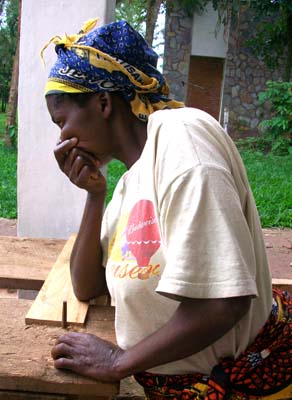
A woman at Panzi hospital in Bukavu, South Kivu. Courtesy of Lee Ann De Reus

Lee Ann De Reus is the 2009 recipient of the Carl Wilkens Fellowship, given by Genocide Intervention Network, and an associate professor of Human Development & Family Studies and Women's Studies at Penn State Altoona. She is currently in Bukavu, South Kivu in the Democratic Republic of Congo, where she is conducting interviews with survivors of sexual violence. This is the second in a series of posts."

Thursday, March 19, 2009

led to the return of more than 180,000 Congolese refugees

TO BE NOTED: From UNHCR:

New brick houses dot Sebele village, where Amina lives. © UNHCR/F.Fontanini
UNHCR News Stories

UNHCR shelter programme in South Kivu needs fresh funding

BARAKA, Democratic Republic of the Congo, March 18 (UNHCR) – Pressure to provide new housing in South Kivu is mounting as more and more people return to the relatively peaceful and stable province in the Democratic Republic of the Congo (DRC). But the ability of agency's such as UNHCR to keep pace with demand will depend on the continuing generosity of donors.

"The absence of adequate housing is one of the biggest challenges refugees face upon their return to South Kivu. After years of absence, most find their homes destroyed and have nowhere to stay," Sebastien Apatita, head of the UN refugee agency's office in Baraka, explained during a recent visit.

Most of the refugees returning to South Kivu come from camps across Lake Tanganyika in Tanzania. Last year, the agency funded the construction of some 500 shelters in the province's Uvira and Fizi districts to accommodate some 2,500 of the more than 14,500 returnees it helped back home, mostly via this lakeside port.

Over the next two years, with thousands more refugees expected back, UNHCR hopes to provide the resources to build 1,500 more houses in Uvira and Fizi for the most vulnerable families. But this ambitious target will depend on receiving sufficient funding during a time of economic recession.

"It's a very critical situation," said UNHCR Regional Representative Mohamed Boukry. "Unless we receive contributions, we will have no choice but to reduce this important assistance to thousands of Congolese refugees coming back home from Tanzania," he added.

UNHCR does not construct the new brick houses and shelters in South Kivu, but provides the materials and tools. This includes corrugated iron sheets for roofing, pre-made doors and windows, nails, axes, hammers and the like. The families then build their own houses.

Those who might find it difficult or impossible to build their own homes, including single women, the elderly and the ill, get help from the community. Amina,* a single mother of four, did not know what to make of the shelter kit she received from UNHCR after being ferried across the lake to Baraka.

"I did not how to use it, but then – thanks to help of my brothers and sisters – we succeed in building a house," she proudly told visitors in the village of Sebele, located a few kilometres from Baraka. UNHCR and its partners follow up to make sure that the shelter kits have been used properly.

"It is a miracle to come home with almost nothing and almost immediately to have a house after spending more than 10 years in a tent in a refugee camp," Amina enthused.

The beneficiaries of the programme are identified by members of the community with advice from UNHCR and the government's National Commission for Refugees.

Years of devastating civil war in the DRC formally ended in 2003, with a peace treaty. While human rights abuses continue to be recorded in South Kivu, the province has largely remained peaceful in recent years, unlike neighbouring North Kivu province, where conflict continues to displace people.

The relative improvements in security in South Kivu, Equateur and Katanga provinces has led to the return of more than 180,000 Congolese refugees, mainly from Tanzania, the Republic of Congo and Zambia, since UNHCR repatriation operations started in 2005. This year, UNHCR plans to help home about 35,000 Congolese from Tanzania and Zambia.

* Name changed for protection reasons

By Francesca Fontanini in Baraka, Democratic Republic of the Congo"

Friday, December 26, 2008

" It is made by EVERYONE around the world who is sensitive to what is happening in this part of the world."

If you are interested in following what's happening in the Congo, please go here:

http://stopthewarinnorthkivu.wordpress.com/

"This blog is a S.O.S. message in a bottle. It is written in Goma, North Kivu, where thousands of people are living displaced now. It is made by EVERYONE around the world who is sensitive to what is happening in this part of the world.

You can:

-Send us a comment.

-Send us a short text in French, English or Spanish.

-Send us a podcast as an mp3 file.

-Put a link to this blog it in your blog or web page.

-Upload a video in Youtube and send us the URL, or tell us about video content about North Kivu hosted somewhere else.

Our address: bloggersforgoma@gmail.com

Thanks and… spread the word!"

Monday, December 15, 2008

"the world could soon be living with a greater shame than the Rwandan genocide."

Thank God for Giles Foden in the Guardian:

"In 2001, I was in a bar in Kigoma, on the Tanzanian side of Lake Tanganyika. As I sipped my beer, I could hear the clipped tones of a South African speaking into a radio transceiver. He was ordering supplies for the United Nations peacekeeping mission known as Monuc, then operating out of Kalemie on the lake's Congolese side. At the time, Monuc's blue berets were just about managing to keep a lid on things in eastern Congo, but already the strain was showing.

Earlier that year Congolese president Laurent Kabila was shot by his bodyguard. He was replaced by his son Joseph, largely as a result of pressure brought to bear by Robert Mugabe. Zimbabwe was one of a number of nations then taking part in the second Congo war (1998-2003). It was allying itself, along with Angola, Namibia, Chad and Sudan, with the Kabilas. On the other side, though sometimes fighting each other, were Uganda and Rwanda.

All sides in this many-phased conflict, which has claimed more than five million lives( PLEASE READ THIS NUMBER ) during the past decade, have been engaged in extraction of Congo's rich mineral deposits ( THAT'S RIGHT ). These have been a cause of bloodshed in the region right back to the 1960s, following Belgium's messy exit from its former colony. These riches are one reason why regional collaborations to end the conflict have so far failed; another is the historical effects of the 1994 Rwandan genocide.

Since the official end of the second Congo war, fighting has been concentrated in the eastern region - the Congolese borders of Uganda, Rwanda and Sudan - with mainly Rwandan proxies fighting a circumstantial alliance of the Congolese army and Hutus. The most recent focus is on the territorial ambitions of "General" Nkunda, a Rwandan-backed warlord accused of massacring 150 civilians in Kivu last month. ( THIS IS A PROXY WAR )

Last week Ban Ki-moon, the UN secretary general, wrote to European leaders asking the EU to intervene in Congo. The recent collapse of the Congolese army in the eastern region has caused hundreds of thousands of people to be displaced and an eruption of mass killings and rapes. The letter was an admission that Monuc had failed, having too few troops to deal with a conflict that could potentially again spread over an area as large as the EU itself.

The UN has authorised more troops, but they will not be deployed for at least four months. EU foreign policy chief Javier Solana, who met Ban yesterday in New York, has proposed four options to EU leaders: sending a rapid response "battle group" of 1,500 troops; dispatching within several months a 3,000-strong mission; simply reinforcing Monuc with forces from European countries; or achieving a concrete objective, such as securing the all-important Goma airport and other sites.

The second proposal has already been rejected by France. On Friday, Nicolas Sarkozy said African forces should reinforce Monuc. He also questioned whether an increase in the number of troops was the answer. Britain, too, is adamant the EU should not get involved, and Germany is not keen. These big EU players cite practical or tactical reasons, but underneath the shilly-shallying is a collective failure of moral leadership. The long-term lack of proper response to the scale of this fluid, deadly conflict is part of the same narrative that saw western governments fail to respond to genocide in Rwanda. It is eminently possible that a tragedy of a larger scale could now take place.( SOMETHING SHOULD BE DONE! )

Ordinary Africans are already suffering on a scale that dwarfs casualties from terrorist outrages and conflicts in Afghanistan and Iraq. In particular, the harrowing reports of mass rape in the Congo demand a response - a military one. There are good political as well as human rights reasons why stopping mass rape should be the platform for this intervention. Women are the "glue" in central African society. They are the carers, the food providers. If many in several generations of women are damaged, injured or killed, the chances of a return to civil society are extremely slim.

In the immediate term, pressure should be put on the Rwandan leadership itself to rein in Nkunda; in the short term, Monuc should be supplemented by a large EU force; in the longer term, as eastern Congo seems ungovernable from Kinshasa, I see no option but the creation of a buffer state on the western shores of Lakes Kivu and Tanganyika. This could be achieved by regional forces with Monuc-EU backup. ( GO FOR IT! )

Geopolitically, the Great Lakes region is a hornet's nest - but unless someone puts smoke in that nest, the world could soon be living with a greater shame than the Rwandan genocide. ( THE WORLD WEARS SHAME WELL )