Showing posts with label Big Picture. Show all posts

Tuesday, May 12, 2009

if we could issue debt like the biggies, we’d get a guarantee but of course small banks can’t economically do that

TO BE NOTED: From The Big Picture:

"How the Bailouts Screw Smaller Banks

Posted By Barry Ritholtz On May 12, 2009 @ 9:57 am In Bailouts, Corporate Management, Credit | 81 Comments

Front page story of today’s NYT [1] discusses the small, well managed, profitable, risk averse banks.

Indeed, as Chris Whalen has so frequently noted, the vast majority of banks in the United States are Triple A by his standards. Its just that these 6,500 banks hold a minority of the total deposits in the nation, with biggest dozen or so banks sitting on 65% or so.

Talk about burying the lead: The Times also noted — in the very last paragraphs — how the big incompetent banks and their very pricey bailouts are screwing these small healthy banks:

“At DeMotte [State Bank, an 11-branch operation in the northwest part of Indiana, Bank President] Mr. Goetz is bracing for a steep increase in a crucial overhead cost: the bill from the Federal Deposit Insurance Corporation, which is basically an insurance fund underwritten by banks.

Last year, DeMotte paid $42,000 into the fund. This year, because of failures in other parts of the country and particularly among national banks, that sum will rise to $500,000 or more.

“Isn’t that the American way?” he says, folding his arms. “Whoever is left standing, whoever was prudent, is always the one who has to pick up the pieces.”

Thus, yet another reason why these bailouts are so absurd: They punish the risk averse and reward the irresponsible . . .

UPDATE, May 12, 2009 10:20am

I emailed William Dunkleberg, who is chairman of Liberty Bell Bank, in Cherry Hill NJ. It has 4 branches, runs the bank conservatively, (i.e., only makes loans to people who will pay them back). The FDIC bill more than doubled to $400k range, basically wiping out profits for this year.

Bill writes:

“They ask us to build capital, lend more, but steal all the “material” we would use to do exactly that! And who wants to buy our shares when we keep reporting virtually no earnings even tho we grow 30%!! and have no unusual loan problems! Last year, FDIC also made us (and thousands of others I am sure) add a few hundred thousand to loan loss reserves. We wont lose the money, so eventually get it back, but this clobbers earnings. Then, adding insult to injury, Ben Bernake takes 500bps off of prime, with a third of our loans tied to prime. I have to write letters to our savers saying “because mega banks need cheap money, I have to cut the rate we pay you on your savings”.

More screwing of the little ones in the economy, little banks, little savers! Why do we have to pay for the big bad banks who finance their assets with 25 cents of domestic deposits on the $1 while we have to use $1 of domestic deposits and pay insurance on that? I guess if we could issue debt like the biggies, we’d get a guarantee but of course small banks can’t economically do that. We can’t permanently keep a block of free federal funds on the balance sheet. So, we don’t have that “cheap money” to boost our profits. Gave a talk to Haverford Trust people yesterday and several in attendance were investors in and/or attended little bank board meetings and report the same hits on profits. bummer!

>

Source:
We’re Dull, Small Banks Say, but Have Profits [1]
DAVID SEGAL
May 12, 2009
http://www.nytimes.com/2009/05/12/business/12small.html"

Monday, March 30, 2009

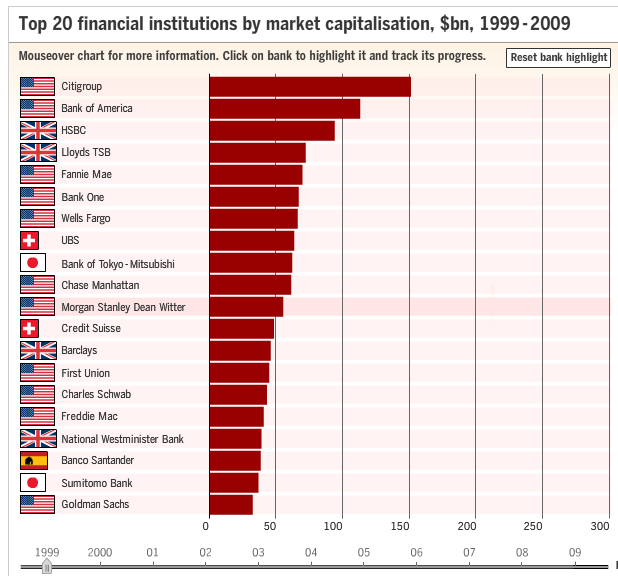
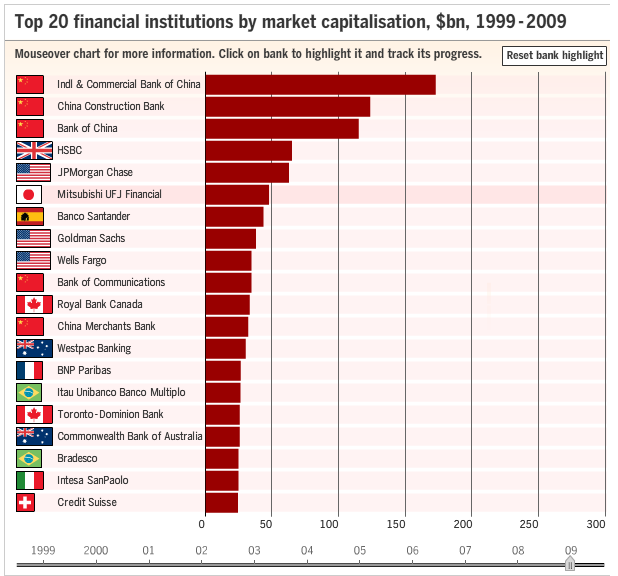
Fascinating infographic via the FT on the top twenty financial institutions, according to market cap.

TO BE NOTED: From The Big Picture:

"Financial Institutions, Market Cap, 1999-2009
Email this post Print this post
By Barry Ritholtz - March 30th, 2009, 11:45AM

Fascinating infographic via the FT on the top twenty financial institutions, according to market cap.

Click either of the graphics to reach the interactive charts, and then use the slider to see the changes take place.

>

1999: Top 20 Financials by Market Cap

>

2009: Top 20 Financials by Market Cap

>

Source:
The decade for global banks
Steven Bernard, Jeremy Lemer, Helen Warrell, Cleve Jones, Peter Thal Larsen and Simon Briscoe
FT, March 22 2009
http://www.ft.com/cms/s/0/ea450788-1573-11de-b9a9-0000779fd2ac.html"

Saturday, March 28, 2009

Under normal circumstances, it works fine

TO BE NOTED: From The Big Picture:

"Paul Krugman is Wrong About Securitization
Email this post Print this post
By Barry Ritholtz - March 28th, 2009, 11:26AM

Since the credit crisis began, I have frequently found myself in agreement with Paul Krugman. Not everything, but for the most part, especially on many major points, we are sympatico: He has been correct about Moral Hazard, about the folly of these many bailouts, about the advantages of nationalizing the banks. And, I suspect he is right that the economy would benefit (short term) from a bigger rather than smaller stimulus.

Where we part ways is on his criticism of Securitization. I simply do not see it as a proximate or even secondary cause of the crisis and collapse. It is a tool, and whether it is used for good or evil is a function of too many things beyond what its purpose it.

First, lets go to the professor’s Friday column, then see where we part ways:

“Underlying the glamorous new world of finance was the process of securitization. Loans no longer stayed with the lender. Instead, they were sold on to others, who sliced, diced and puréed individual debts to synthesize new assets. Subprime mortgages, credit card debts, car loans — all went into the financial system’s juicer. Out the other end, supposedly, came sweet-tasting AAA investments. And financial wizards were lavishly rewarded for overseeing the process.

But the wizards were frauds, whether they knew it or not, and their magic turned out to be no more than a collection of cheap stage tricks. Above all, the key promise of securitization — that it would make the financial system more robust by spreading risk more widely — turned out to be a lie. Banks used securitization to increase their risk, not reduce it, and in the process they made the economy more, not less, vulnerable to financial disruption.

Sooner or later, things were bound to go wrong, and eventually they did. Bear Stearns failed; Lehman failed; but most of all, securitization failed . . .

A quick definition before proceeding further:

“Securitization is a structured finance process that involves pooling and repackaging of cash-flow-producing financial assets into securities, which are then sold to investors. As a portfolio risk backed by amortizing cash flows - and unlike general corporate debt - the credit quality of securitized debt is non-stationary due to changes in volatility that are time- and structure-dependent. If the transaction is properly structured and the pool performs as expected, the credit risk of all tranches of structured debt improves; if improperly structured, the affected tranches will experience dramatic credit deterioration and loss.¹

Under normal circumstances, securitization works fine. But the 1998 - 2008 period was filled with all manner of aberrational issues. Much of that era terribly skewed financial activity. Consider:

-Fed Chair Alan Greenspan took rates to 1% — so low as to cause an enormous credit bubble;

-The Fed refused to supervise/regulate the new “innovative” mortgage lenders. Hence, millions of ill advised loans took place;

-For most of history, credit transactions were based on the borrowers ability to sevice the debt (i.e., repay the loan); For a 5 year window (2002-07), that no longer mattered. What dominated the lending decision was the lenders ability to sell the loan to Wall Street; Hence, the lend-to-securitize model was born;

-These firms sold mortgages to Wall Street with an unconscionably short warranty: They guaranteed these mortgages would not default for a mere 90 days. This removed the lenders incentive to find qualified borrowers.

-AAA: Therating agencies (Moody’s S&P, Fitch) failed their functions.. These firms were wholly corrupted by their new business model of getting paid by underwriters, as opposed to the bond buyers. This pay-to-play model is little more than good old fashioned “Payola.” They slapped a Triple AAA rating on pretty much anything they could get a fee on.

-Without these AAA ratings, most of this paper could not have been sold to the various funds, central banks, and SIVs that bought them;

-Credit Default Swaps on the securitized products were wholly unregulated.

All of the above is painfully detailed in to Bailout Nation.

Do not forget that Securitization had been around for decades without major problems. And over the entire period of time in question, credit card loans, auto financing, and student loans were securitized without incident (other than expected cyclical recessionary downturns).

We wouldn’t draw the conclusion that because the lending industry made so many bad loans, that mortgages were the problem, and therefore we should do away with them. You have to look at the context in which the loans and securitization took place.

Securitization is no different.

Under normal circumstances, it works fine. And if we tweak a bit around the edges — make sure that securitizers cannot shed liability as easily as they have, and adjust incentive compensation away from the current hit & run style of faux profits but real bonuses, Securitization will work just fine.

>

Source:
The Market Mystique
PAUL KRUGMAN
NYT, March 26, 2009
http://www.nytimes.com/2009/03/27/opinion/27krugman.html

1. Raynes, Sylvain and Ann Rutledge, The Analysis of Structured Securities, Oxford U Press, 2003, p. 103 via wikipedia"

Sunday, March 1, 2009

Along with guests Jim Rogers and Michael Hudson, Keiser discusses angry bailout losers in the US

From The Big Picture:

A must see episode of BBC World’s The Oracle with Max Keiser. Along with guests Jim Rogers and Michael Hudson, Keiser discusses angry bailout losers in the US; a ‘monetary Stalingrad’ in Eastern Europe; and whether Swiss banking can survive without tax cheats and money launderers.

Part one

Part two

The Oracle with Max Keiser Guests: Michael Hudson and Alfredo Vallabao Topics: Bailouts and China, US Treasuries

Part three:

February 27, 2009


Me:

Don the libertarian Democrat Says:
I agree with Jim Rogers about letting insolvent banks fail, if that means seizing them and spitting them back out to private buyers. I especially agree with his political point, which is that propping up banks and shareholders at the expense of the taxpayers is a recipe for political problems going forward. Many people seem to be underestimating the downside to a massive taxpayer loss to save incompetent banks. At best, it looks like crony capitalism. At worst, if it ends up losing us hundreds of billions of dollars, it will lead to a serious distaste for the whole system. Where that distaste leads is very problematic

Friday, January 23, 2009

"its time to liquidate the banks, liquidate capital, liquidate shareholders, liquidate bond holders . . ."

From the Big Picture:

"Time to Get Swedish
Email this post Print this post
By Barry Ritholtz - January 23rd, 2009, 9:16AM

As previously noted, the dilly dallying around with these horrific banks and their grossly incompetant management must come to an end.

Sometimes the market gets it just right: The selloff in the financial sector might very well be the cumulative conclusion reached by traders that this sector cannot be rescued by nere recapitalization alone( TRUE ). The market, looking to open down 200 points, may also be sensing the inevitable nationalization.( YES )

The Brits, soon to nationalize Barclays, have the right idea: Go Swedish. Wipe out shareholders, bond holders, and all the bad debt and junk paper these firms hold. Zero it out, spin out the assets with clean balance sheets.( YES )

If the behavior of these corporate executives is nothing short than egregious: Their embarassing attitudes, foolish excesses, sense of entitled greed is annoying but tolerable when its on their ownshareholders dime; when the taxpayer is footing the bill, it is utterly unacceptable.

To paraphrase a Mellon, its time to liquidate the banks, liquidate capital, liquidate shareholders, liquidate bond holders . . .( I AGREE )

>

Source:
Sweden’s Fix for Banks: Nationalize Them
CARTER DOUGHERTY
NYT, January 22, 2009
http://www.nytimes.com/2009/01/23/business/worldbusiness/23sweden.html"
Wednesday, January 14, 2009

We have avoided financial armageddon, but other than that, it has been an abject failure.

From The Big Picture:

"With the government now debating the release of the second half of the TARP funds, perhaps now is as good a time as any to look at how successfully spent the first $350 Billion dollars were.

The evidence is not very favorable.

What I can say without reservation is that the TARP spending prevented large brokers and banks from going to zero. Since the legislation was passed in the Fall, there has not been a major disruptive bankruptcy.( I AGREE )

Sure, the FDIC had to take over a few institutions that were overdue for the long dirt nap anyway, but the sort of market roiling Bear Steans collapse, and the subsequent Q3 Lehman/AIG/CitiGroup disasters have at least stopped.

This is not, to be clear, any declaration that the TARP has been a success. We have avoided financial armageddon, but other than that, it has been an abject failure. ( TRUE )

The short list of criticisms starts with the ad hoc way it was formed, and foisted on the public. There were no clear goals, no over-arching strategy, no milestones to evaluate its success.

Let’s take a quick look at some of the shortcomings and misfires the TARP has yielded:

1. No Strategic Plan: What was the original purpose of the TARP? Its hard to say, other than it was of the greatest importance it be passed with minimum debate and even less information. Without stated objectives, its difficult to evaluate whether it is achieving those goals.

2. Methods and Tactics: By what method was the TARP to be implemented? Buy distressed assets? Recapitalize the banks? Increase lending to businesses and consumers? Rescue foreclosed homeowners? Stimulate the economy? The constantly morphing objectives make it hard to take the original claims very seriously.

3. No Triage: There seemed to be no evaluative method in determining which banks should be saved and which should be put down. If the goal was to strengthen the financial sector, then the approach is to help those that can be strengthened, and have an orderly liquidation of those that cannot. Merely throwing money at weak and dying banks is no long term strategy.

4. Wasting Taxpayer Monies: Why did private investors like Warren Buffett get so much of a better deal than Uncle Sam? Its clear to me that both Treasury and the Fed lack the expertise to negotiate these investments. Instead, set up a matching investment. Let those in the private sector with the expertise to do so make substantial arms-length investments, with the the US matching ( at 10 or even 20X) on the same terms.

5. Transparency, Accountability, Responsibility: How monies have been spent by the Treasury department (and Fed) should be a textbook example of government accountability and transparency. Its not, and there is no good reason why. The Fed is even worse, refusing to release any details, which has led to lawsuits being filed by Bloomberg and Fox News to get the specific public information.

6. Evaluating Progress: All major programs should have some method of evaluating if they are achieving their goals. This is missing from the TARP, and its why so many people have no idea if it has been successful or not.

7. Moral Hazard: Why are we rewarding companies that were poorly managed, reckless money losers? All of the TARP recipients should have anyone senior management associated with the bad investments fired; bonuses suspended, shareholders wiped out. How are these firms paying dividends with government money? Where are the clawbacks of bonuses from Stan O’Neill, Angelo Mozilo, Chuck Prince? That the people responsible for the mess are even remotely profiting from it is simply unconscionable.

As bad as the $700 plus billion expnditures have been, the real damage lay in the future. When in doubt, traders will go bigger and more reckless than ever before. That is the terrible lessons of the TARP: Make sure you screw up big enough to get the taxpayer to rescue you . . ."

I'll just remind my reader of this prescient post:

Thursday, October 2, 2008

How I've Approached The Plans Being Put Forward

I am a libertarian Democrat. As such, I'm interested in working within a party which can actually change our government over time. Perhaps I am also simply more comfortable culturally in the Democratic Party Coalition.

In any case, I accept that there is a difference between politics and political theory. Politics is the art of the possible. Political Theory is the view of the government that you would ideally like to see.

In the current crisis, I acknowledged two plans as having some merit, and fulfilling my requirement that any plan be clear and understandable:

1) A totally free market plan.

2) A version of the Swedish Plan.

In my mind, there are three points that are informing my views on which plan to favor:

A) There will be a government intervention of some sort, undoubtedly large.

B) Because crises such as these bring about government intervention.

C) If there is government intervention, it should be for as broad a purpose as possible and be as thrifty with the taxpayers money as possible.

Based on these assumptions, I favor a version of the Swedish Plan.

It's not that I don't see other plans as possibly working, but hybrid/compromise plans are generally:

1) Easier to manipulate by special interests.

2) Harder to determine what worked and what didn't.

3) Riskier financially.

That's how I've approached this crisis.

If you read my blog, you will notice that I mentioned all of these problems in October.

Monday, January 12, 2009

"I suspect that most people think both the Recession and Unemployment are worse now"

The Big Picture with two good posts about the history of the Unemployment Rate:

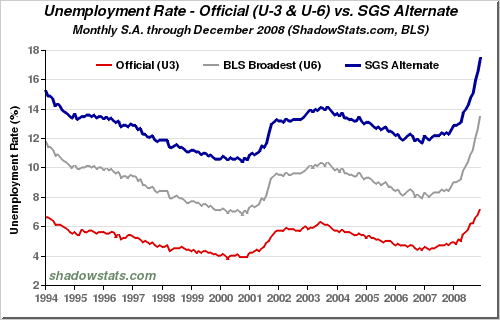
"Here’s the worst case scenario of the U6 Unemployment Rate, as noted in this Reuters article, Great Depression jobs parallel may not be far flung. I disagree with the article, and believe we are nowhere near depression levels of unemployment.

>

The series by John Williams’ Shadow Stats folds back all of the workers who have left the Labor Pool. We do not know how many are actual workers and how many have simply left the labor pool, so that 17.5% number probably skews high.( TRUE )

While I believe the 7.2% unemployment rate is laughably inaccurate, I do not think we are at 17.5% either . . .( I AGREE. BUT, AGAIN, GOVERNMENT NUMBERS ARE NOT NECESSARILY THE BEST NUMBERS. THEY ARE JUST THE NUMBERS THAT THE GOVERNMENT FINDS MOST USEFUL, FOR WHATEVER REASONS, IF ANY. )

>

Hat tip Paul

>

Source:
Great Depression jobs parallel may not be far flung
Pedro Nicolaci da Costa Reuters
Jan 8, 2009 9:37pm EST
http://www.reuters."

Now, the second post:

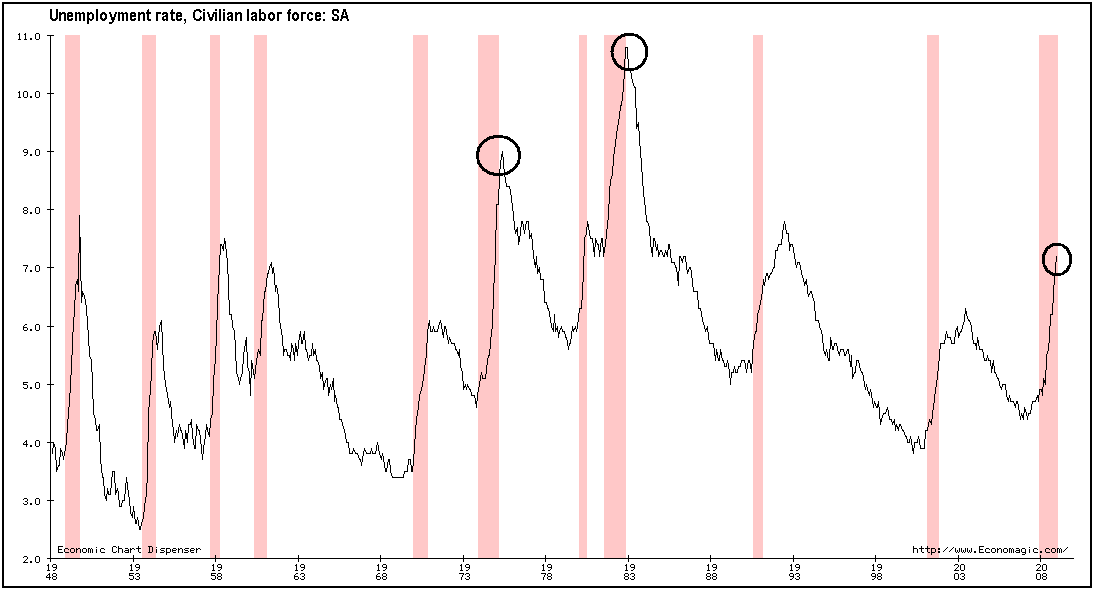
"Is the economy better or worse than it was in the early 70s? How about early 80s? What about Unemployment?( ALL BETTER NOW )

I suspect that most people think both the Recession and Unemployment are worse now than it was during either of those prior periods. ( I DISAGREE )

If that is the case, than what are we to make of the following chart below? It shows Unemployment peaking (after) the ‘74 recession at ~9%, and unemployment peaking (after) the ‘82 recession at 11%. Here we are 12 months into this recession, with Unemployment just over 7%.

I can think of several explanations for this anomaly: 1) The data is off( TRUE. BUT WE DON'T KNOW WHERE. ); 2) this recession is not as bad as those were( MY VIEW ); 3) structural changes in the economy mean less layoffs( MY VIEW ); 4) demographics are impacting people leaving the labor force, helping to keep UR lower( TRUE. A CASEY MULLIGAN POINT. ); 5) we have a lot further to run in terms of job losses( I HOPE NOT. ). Perhaps some combination of all 5 of these factors are involved. ( CORRECT )

>
click for ginormous chart

via economagic"

As you know, I believe that the economics of a given era are impacted by the context of the era. We are much better off today than in the past.

Sunday, January 11, 2009

but if I fail to define something adequately, let me know in the comments, and I will add an entry to the new Jargon page.

If you read my blog ( Cate ), you know that I try and simplify things. In that spirit, two excellent posts. First, from The Big Picture, a good resource:

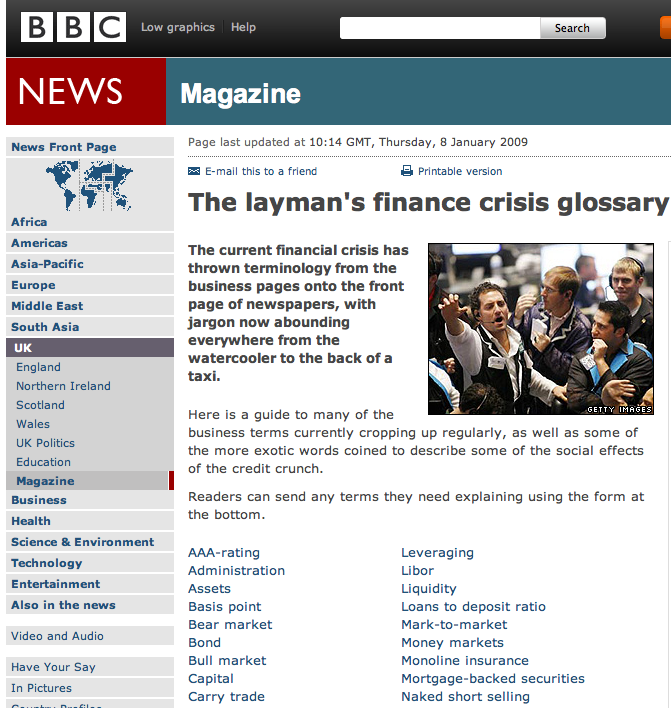
Killer glossary via the BBC:

click for full crisis glossary

>

Source:
The layman’s finance crisis glossary
BBC, 10:14 GMT, Thursday, 8 January 2009
http://news.bbc.co.uk/2/hi/uk_news/magazine/7642138.stm

Saturday, January 10, 2009

This way we not only see what people are saying, but we can measure exactly what they are doing.

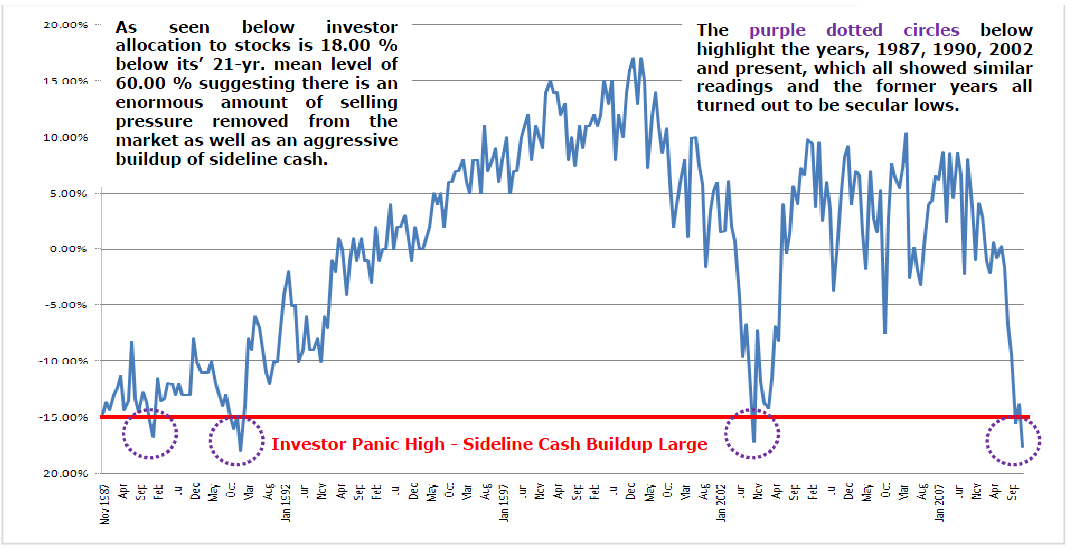
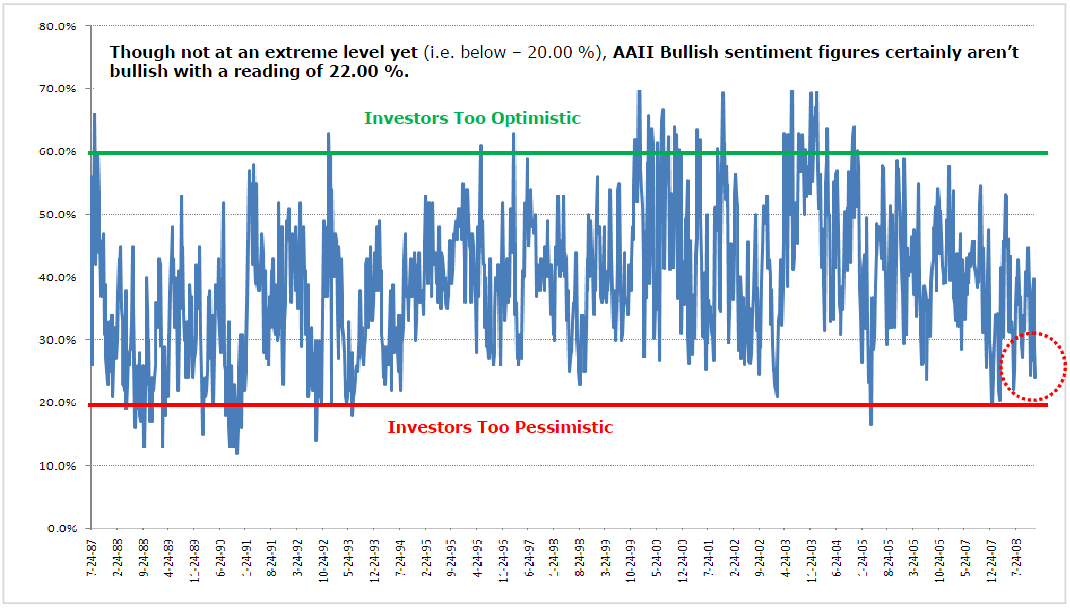
From The Big Picture, some good news. Especially the amount of cash being held for investment going forward:

"We are fond of all manner of sentiment measures, including anecdotal info like this.

However, we always find ourselves going back to the data. While sentiment surveys produce a chartable data stream, we especially prefer Asset Allocation measures.

This way we not only see what people are saying, but we can measure exactly what they are doing.( EXACTLY. NOW, ASK YOURSELF, HOW HAVE INVESTORS BEEN REACTING TO GOVERNMENT BAILOUTS? WHAT MIGHT THE ASSUMPTIONS AND PRESUPPOSITIONS UNDERLYING THOSE REACTIONS BE?)

>

American Association of Individual Investors (AAII)
Average Asset Allocation Survey

American Association of Individual Investors (AAII)
Bullish Sentiment Survey (Stocks)

Charts courtesy of Fusion IQ

Friday, January 9, 2009

"lending support to the notion that the consumer is deleveraging"

From the Big Picture:

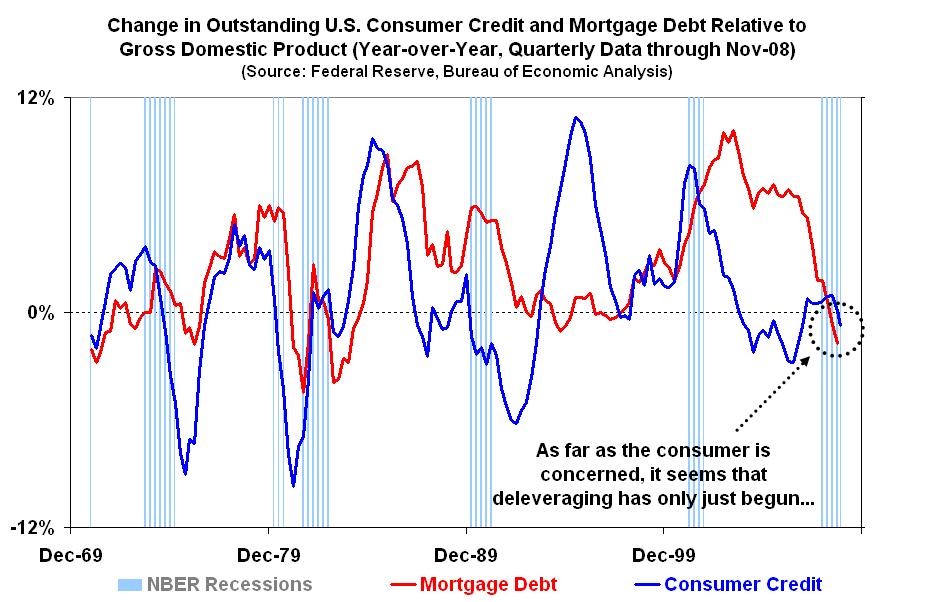
"Yesterday, the Federal Reserve reported that outstanding consumer credit for November fell a worse-than-expected $7.9 billion, lending support to the notion that the consumer is deleveraging.( I HAD SEEN NO SIGNS OF A SAVINGS SPREE BY CONSUMERS, ONLY THE BEGINNING OF SOME PRUDENT SAVING. THIS MIGHT BE IT. NOTICE THAT IT COINCIDES WITH THE PROACTIVITY RUN, AND IS SIMPLY THE CONSUMER'S VERSION OF THE PROACTIVITY RUN OF EMPLOYERS. BOTH OF THESE LAGGED THE CALLING RUN BY AT LEAST A MONTH, AND MAYBE TWO. )

However, based on the accompanying graph of year-over-year changes in consumer credit and mortgage debt relative to GDP, it seems like deleveraging has hardly begun.( I, OF COURSE, HAVE MY DOUBTS ABOUT HOW FAR IT WILL GO. LET'S SEE. )

>

Thursday, January 8, 2009

"Why bother aping a data series that is not particularly helpful in real time?"

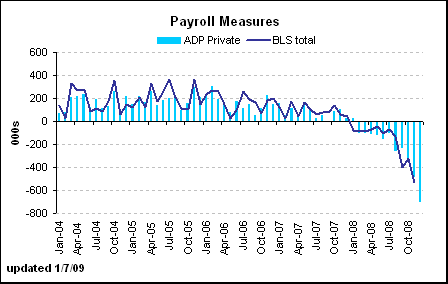
The Big Picture criticizes ADP on job data reports:

"ADP has put together a fairly miserable track record in forecasting BLS job data. This month, they have, once again, revamped their methodology in an attempt to more closely track BLS data, which they claim after the BLS revisions one year later their data will match up.

Why? Why is that goal is even remotely desirable? ( A GOOD POINT. IT SEEMS REDUNDANT. )

ADP has their own proprietary data sources; they track employees (new and existing), they can track payroll dollars (total gains and losses, and per employee changes), off of the actual payroll checks going to employees. Why try to imitate the BLS output each month? ADP can create a very specific set of reports that ARE PURELY DRIVEN BY THEIR OWN PAYROLL RECEIPTS, that stands on its own. ( WHY NOT? )

Why even bother messing around with trying to imitate or forecast BLS data? ( A GOOD QUESTION )

The BLS Non-Farm Payroll numbers are somewhat flawed, subject to massive revisions, and fatally flawed due to how the Birth Death adjustment has been applied.

If ADP wants to contribute something valuable, they should stop trying to forecast BLS, and instead generate their own, proprietary, data driven monthly NFP numbers. ( SEEMS GOOD )

Consider how NFP lags the end of recessions, continuing to be negative long after the recovery begins. Employers often expand output without new hiring( TRUE ): They offer full time employment to part–time workers, and offer overtime to full timers( ESPECIALLY AFTER A DOWNTURN. ). ADP can track that, and capture a real time improvement in the economy long before it shows up in the BLS data. ( WOULDN'T THAT SHOW IN THE PRODUCTIVITY NUMBERS? )

Inquiring minds want to know: Why bother aping a data series that is not particularly helpful in real time?

>

via Barron’s Econoday

>

Source:
ADP Reports 693,000 Private-Sector Jobs Lost in December
January 7, 2009, 8:28 am
http://blogs.wsj.com/economics/2009/01/07/adp-reports-693000-private-sector-jobs-lost-in-december/

U.S. Economy: Companies Cut Payrolls at Faster Pace in December
Bob Willis and Courtney Schlisserman
Bloomberg, Jan. 7 2008
http://www.bloomberg.com/apps/news?pid=20601068&sid=aXIeFj0a21bY&

Tuesday, January 6, 2009

"The NAR turned a blind eye to fraud amongst realtors in terms of referrals to corrupt appraisers and mortgage brokers."

From The Big Picture:

"Alternative Title: David Lereah: Even More Full of Shit Than Previously Believed

Of all the various parties who contributed to the boom and bust in housing and credit, none have escaped more unscathed than the National Association of Realtors, and their former Baghdad-Bob-in-Chief, David Lereah.

The NAR turned a blind eye to fraud( I AGREE ) amongst realtors in terms of referrals to corrupt appraisers and mortgage brokers. They constantly cheerleaded prices, despite evidence to the contrary. For 3 years, they have been forecasting 2nd half price recoveries, dissuading realism amongst home sellers. They continually spun data, presented misleading commentary, and otherwise engaged in behavior that could only be characterized as sleazy.( IS THAT ALL IT IS? )

I find EVERYTHING out of the NAR to be suspect, tainted and generally worthless. The NAR Housing Affordability Index is essentially worthless; from 1989 - 2009, the NAR showed housing as “Unaffordable” for just one month.

If you have any doubts as to whether or not the NAR are a bunch of shameless, lying hucksters who deserve to have glass catheters inserted in their Urethras then shattered, consider this:

Working for realtors, David Lereah was famously optimistic. Not anymore.
By Donna Rosato

As chief economist for the National Association of Realtors, David Lereah was famously optimistic. Now a private consultant, he’s abandoned what he calls the “positive spin.”

Q: Were you wrong to be so bullish?
A: I worked for an association promoting housing, and it was my job to represent their interests. If you look at my actual forecasts, the numbers were right inline with most forecasts. The difference was that I put a positive spin on it It was easy to do during boom times, harder when times weren’t good. I never thought the whole national real estate market would burst.

Q: The NAR’s latest forecast calls for a slight increase in home prices next year. Thoughts?
A: My views are quite different now. I’m pretty bearish and have been for the past year and a half. Home prices will continue to drop. I think we’ll see a very modest recovery in sales activity in 2009. But we’ve still got excess inventories, a bad economy and a credit crunch that will push prices down further, another 5% to 10% more( I SAID 5%, BUT NOW AGREE THAT IT MIGHT BE 10% ). It’ll take a long time to get back to the peak prices we saw in many markets.

Q: Any regrets?
A: I would not have done anything different. But I was a public spokesman writing about housing having a good future. I was wrong. I have to take responsibility for that.

-DONNA ROSATO - Fri Dec 19 2008, 11:14

Ahhh, so he admits to being nothing more than a paid shill whose mouth was available for a price. How does that job description vary from the Trannies who hang out by the West Side Highway? In my book, not by very much. A whore is a whore is a whore. Anyone who pays attention to the garbage generated by the NAR is a fool.

Oh, and I’m presenting Wednesday at Global Connect:

A World of Innovation, today January 7 at the Marriott Marquis, on the main stage on Wednesday, January 7, 2009.

Session: Wednesday, January 7, 2009, 3:30 pm - 4:15 pm

Description: Bulls vs. Bears: A frank discussion of where we are in the cycle of housing prices.
Panel: Noah Rosenblatt, Nouriel Roubini, Lawrence Yun (NAR), Barry Ritholtz

Lereah’s replacement — Lawrence Yun — is also on the panel. He has yet to demonstrate whether he will be an improvement over Baghdad Bob Lereah.

>

Previously:
Realtors Get Real (March 2007)
http://www.ritholtz.com/blog/2007/03/quote-of-the-day-realtors-get-real/

Pending Home Sales Index, NAR Housing Market “Bottoms” (January 2008)
http://www.ritholtz.com/blog/2008/01/pending-home-sales-index-nar-housing-market-bottoms

How Counter-Productive is Realtor Association Spin? (March 2008)
http://www.ritholtz.com/blog/2008/03/how-counter-productive-is-realtor-association-spin/

NAR Housing Affordability Index is Worthless (August 2008)
http://www.ritholtz.com/blog/2008/08/nar-housing-affordability-index-is-worthless/

Source:
Former real estate bull admits, “I spun”
VOL. 38, NO. 1 - January 2009 - Mon Dec 22 2008, 08:58
http://money.cnn.com/magazines/moneymag/moneymag_archive/2009/01/01/toc.html

Confessions of a former real estate bull
Donna Rosato,
Money Magazine, January 5, 2009: 10:30 AM ET
http://money.cnn.com/2009/01/05/real_estate/Lereah.moneymag/index.htm


I appreciate his admissions, but such people should be, at the very least, shunned.

Also, with this admission, I'm still shocked that more people don't agree with me, that Fraud, Negligence, Fiduciary Mismanagement, and Collusion, constitute, as a class, the second most important cause of our crisis. They are what explains subprime loans, and, in fact, all bad loans, because, at the very least, these loans constitute negligence. Instead, people want to blame equations and incentives and stupidity. Mark my words, this tsunami of graft will soon be back. Didn't Conservatives use to believe in human frailty and fighting crime?

Thursday, January 1, 2009

“We would like to sputter in shock and disbelief. "

Not a good sign.From The Big Picture:

"GMAC: 0% Financing for Subprime FICO Scores
Email this post Print this post
By Barry Ritholtz - December 31st, 2008, 12:55PM

I found this quote from GM Sales & Marketing chief to be astounding:

“’Six hundred twenty is not a subprime score,’ GM’s sales and marketing chief Mark LaNeve told Automotive News. ‘That’s a very creditworthy buyer. Hopefully, we’ll have access to more of the market that is out there.’”
- Automotive News (12/30/08)

Bill Ryan of Portales Partners adds the following:

“We would like to sputter in shock and disbelief. General Motors Acceptance Corp. (GMAC) lost $5B in the 9 months ending September 2008 (on an operating basis). It has $100B in subprime and nonconforming mortgages through its ResCap subsidiary, and the government just lent them $5B at an 8% interest rate.

In addition, General Motors (GM) just announced a 0% financing option to car buyers.

So it turns out that we are now subsidizing a globally uncompetitive carmaker that does not understand what qualifies as a subprime FICO score and is offering 0% loans financed by a government (taxpayer) investment that costs 8%.

We guess they are hoping to make it up on volume.”

Astonishing.

FYI: Subprime is defined as those credit applicants with a FICO score below 660. Hence, GM plans on shoveling its excess inventory out the door — with a 8% hit on the financing — and the taxpayer bailout holding the bag.

A brand new chapter on Moral Hazard has just been written. I expect will will see significant costs for this profligacy down the road."

This deal is poor. I can't deny that.

Tuesday, December 30, 2008

"we’ll see hopefully soon if it’s price or cost of money that will drive the buying decision.”

From The Big Picture:

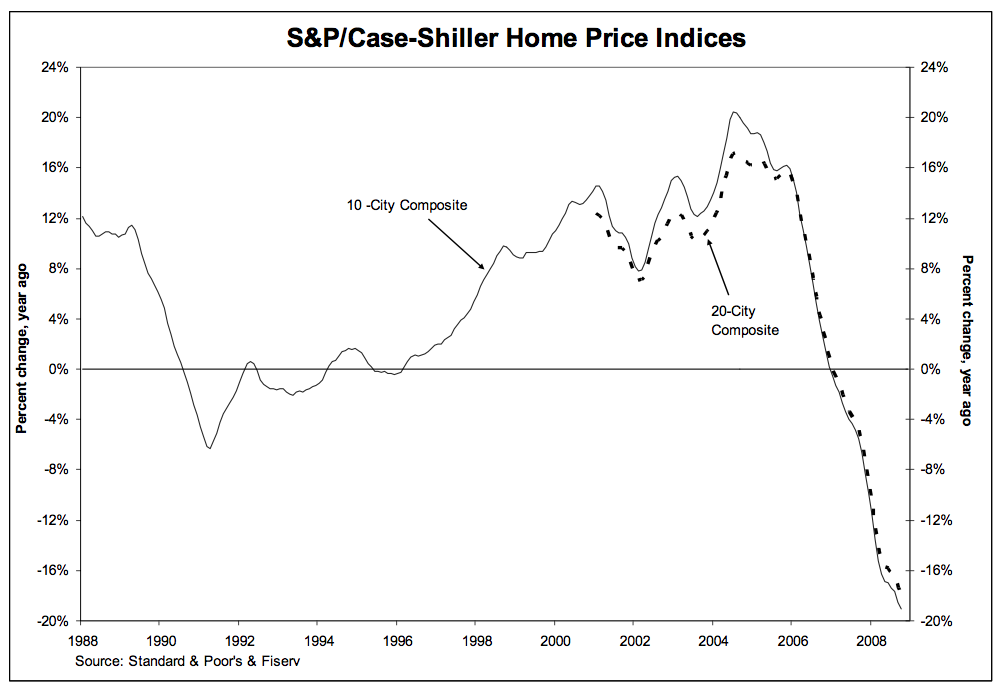
"Home Prices Fall to 2004 Levels; 18% Record Drop
Email this post Print this post
By Barry Ritholtz - December 30th, 2008, 9:47AM

Data through October 2008 shows continued broad based declines in the prices of existing single family homes across the United States, with 14 of the 20 metro areas showing record 10% versus October 2007.

The overall 20 city composite index fell 18% year over year, up from a drop of 17.4% y/o/y in September. The usual culprits led the decline, Vegas, Phoenix, San Francisco, LA, San Diego and Miami. The smallest y/o/y decline was in Charlotte which fell just 4.45%.

Peter Boockvar notes that “While weak but not unexpected, the more interesting data will be seen beginning with the Nov #’s as that is when mortgage rates started its sharp drop. Today in fact, according to Bankrate.com, the average 30 yr mortgage rate reached its lowest level since Sept ‘05 at 5.22%. To this point, the only big reaction to the drop in rates has been in refi’s but it’s purchases that need to be revived and we’ll see hopefully soon if it’s price or cost of money that will drive the buying decision.”

That's a very good question, because I have been pushing for a drop in housing prices of 5 % more. However, we're getting pretty close to that now.

Friday, December 26, 2008

"To many Americans, the Bush administration was a national disaster.”

Evidence that the Bush Administration is Cause Number Three in our Crisis Causes List. I've already posted hopefully about the importance of Obama's poll numbers. Here's The Big Picture:

“An Obama job approval rating of 79 percent — that’s the sort of rating you see when the public rallies around a leader after a national disaster. To many Americans, the Bush administration was a national disaster.”( THAT'S MY THIRD CAUSE IN A NUTSHELL. A VERY BITTER TASTING NUT INDEED )

- Bill Schneider, CNN’s senior political analyst, on a poll indicating overwhelming approval for Barack Obama.

>

Any dead enders want to challenge this thesis?"

Source:
Poll: 79% approve of way Obama is handling transition
Paul Steinhauser
CNN, December 9, 2008
http://www.cnn.com/2008/POLITICS/12/09/Obama.poll/

Monday, December 22, 2008

"Waiving down-payments requirements, dropping lending standards, allowing predatory lenders to flourish — that is what is the underlying cause"

Another sensible view about home ownership from The Big Picture:

"Let’s start out with a brief excerpt from Bailout Nation:

From Reagan to George W. Bush, each President of the past 25 years bears some responsibility for contributing to the belief that we can let markets govern themselves.

Of the four Presidents over that period of time, President George W. Bush is the one with the seemingly greatest culpability. Not just because this crisis happened on his watch — although that is reason enough to give him a fair share of responsibility. More significantly, the basis of his culpability is that he shared Greenspan’s and Gramm’s radical belief system — that markets could police themselves, and that all regulation was inherently bad. This philosophy colored all of the President’s appointments to key supervisory positions, as well as his legislative agenda.

That philosophy, and the executive, administrative and legislative acts, including political appointments, is where we should focus our ire at the soon the be former-President Bush. The belief system that leads to the conclusion that really bad behavior in the corporate world needs no proscribing is where you should look to place blame.

That Bush had as a goal increased home ownership is, quite bluntly, irrelevant. It is a worthy goal, and certainly one that could be achieved without forcing the collapse of the financial system.( I AGREE )

Indeed, as the chart at right shows (source: NYT), home ownership has increased every year since 1994. Funny, from that year and for each of the next 10 years, there was no collapse. You have to ask yourself why. No, the 1997 Tax Break, did not, as the NYT implied yesterday, Help Cause Housing Bubble. Home ownership was rising years before that went into effect.( TRUE )

What Bush did differently than prior Presidents was that he genuinely believed that regulations proscribing bad corporate behavior were unnecessary. It was that ruinous belief system, one he shared with other key players, that led to the crisis.( TRUE )

In fairness to Bush, many of the really bad policies that led to the boom and bust of Housing, and the collapse of credit, were in place before he was sworn into office. In particular, the repeal of Glass Steagall (Gramm-Biley-Leach Act), and the Commodities Future Modernization Act (CFMA), were both heavily lobbied for by the industry, sponsored by Phil Gramm, and passed by a Congress that didn’t bother to read them( TRUE ). They were both signed into law by Bill Clinton. That set of legislation is where you begin to find answers to The Reckoning.

Consider:

“Former Presidents Clinton, George H.W. Bush, and Reagan all have some responsibility, but far less. Bush Senior is probably the least culpable. Reagan did not reappoint Fed Chair Paul Volcker, and replaced him with Alan Greenspan. Regardless of other actions, this alone haunts his legacy, and gives the Gipper some degree of responsibility.

While some partisans have tried to paint the crisis a purely Republican debacle, history informs us otherwise. Yes, the GOP did control Congress from 1994 to 2006. However, President Clinton, a Democrat, bears a significant amount of responsibility too. He and his Treasury Secretaries, Robert Rubin and Lawrence Summers, each supported very limited regulation of free markets. Clinton, Rubin and Summers are one step behind W. in the hierarchy of proximate causes of the debacle.” (Bailout Nation) ( THAT'S TRUE. I DID TOO )

The requisite Fannie Mae/Freddie Mac discussion in the article is simply silly. Yes, FNM/FRE were cogs in the housing machinery, yes, they were corrupt organizations. No, they were not a proximate cause of the boom/bust/collapse( ALL TRUE ). For those of you who keep asking why I emphasize this, this article is why.

Increasing home ownership in America is a legitimate political goal. Waiving down-payments requirements, dropping lending standards, allowing predatory lenders to flourish — that is what is the underlying cause of boom bust and collapse.( I AGREE COMPLETELY )

Once again, we relearn that worthy ends do not justify foolish means."

"That seemingly impossible amount would now buy:"

An interesting comparison from EconomPic Data and The Big Picture:

Bank Valuations --> Then and Now


Consider that one year ago Royal Bank of Scotland paid US$100 billion for ABN Amro. That seemingly impossible amount would now buy:

Citibank $22,5 billion (74% down)
Morgan Stanley $10,5 billion (-72%)
Goldman Sachs $21 billion (-67%)
Merril Lynch $12,3 billion (-77%)
Deutsche Bank $13 billion (-71%)
Barclays $12,7 billion (-71%)
And still leave $8 billion change - with which you would be able to pick up General Motors, Ford, Chrysler and the Honda F1 team.

Not too shabby!

Hat tip: Prieur, Investment Postcards"

Thursday, December 18, 2008

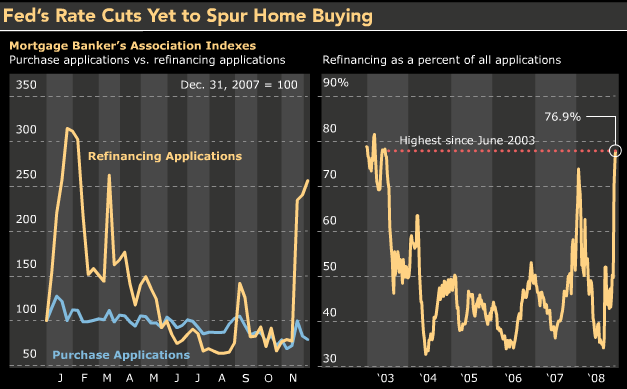
"The Federal Reserve’s efforts to make homes more affordable have yet to bolster buying and instead are fueling a surge in refinancing"

A Big Thanks to The Big Picture. I posted about this Bloomberg story, but couldn't reproduce their graphs:

Email this post Print this post
By Barry Ritholtz - December 18th, 2008, 11:57AM

Refinancing seems to be the only game in town!

The Federal Reserve’s efforts to make homes more affordable have yet to bolster buying and instead are fueling a surge in refinancing, according to data compiled by the Mortgage Bankers Association.

As the CHART OF THE DAY shows, the association’s index of mortgage applications for home purchases has fallen this year. A similar refinancing gauge has more than doubled in the past month. Last week’s figures came out today.

Source:
Fed’s Rate Moves Fail to Spur Home Buying: Chart of the Day
David Wilson
Bloomberg, Dec. 17 2008
http://www.bloomberg.com/apps/news?pid=newsarchive&sid=akA4WNP2pWio

Tuesday, December 16, 2008

"In fact, it was always pretty improbable that funds of funds were doing lots of due diligence. "

John Carney on Clusterstock answers a question that should be asked:

“What is the actual purpose of Fund of Funds” famed money manager and financial blogger Barry Ritholtz asks.

The idea that fund of funds perform due diligence, the forensic accounting and deep background checks on hedge funds has been blown out of the water by the revelations of Bernie Madoff’s scam. Funds of Funds poured money into Madoff's Ponzi scheme, apparently never bothering to check if it was a legitimate operation. ( UNREAL )

In fact, it was always pretty improbable that funds of funds were doing lots of due diligence. ( WHY ? )

To understand why it was improbable, just take a look at some of the biggest and most popular hedge funds. Do you think that Stevie Cohen lets the managers from a fund of funds run through his books, review his strategies and inspect the SAC Capital offices? How many fund of funds folks do you think have been able to grill the folks at Renaissance Technologies Corp? Interview the physicists at Citadel?

Exactly. These fund of funds folks are not only not doing due diligence. They can’t. ( GOOD POINT )

So what is it that a fund of funds does to earn its fees? What investors are buying when the hand over money to a fund of funds is the opportunity to get in on the returns of some of the biggest names in the hedge fund world with a relatively small investment. Many of the most prominent funds are closed to new investments or require enormous initial investments. But a fund of funds will let you in for, say, as little as $500,000. You probably couldn’t get Ken Griffin, the founder of Citadel, to even answer your calls with a $500,000 check. ( YIKES )

That’s what the funds of funds are selling: access. Of course, as some of the gilt rubs off the hedge fund business, this access may have diminishing value. Do you really want to pay extra fees just to have Citadel lose half your investment? Perhaps some will actually begin to perform actual services for investors, such a due diligence investigations, in order to gain or keep market share. And perhaps, as hedge funds get more desperate for assets under management, the hedge fund managers will actually allow them to perform those services."

This is just unreal. Investing 101.

Saturday, December 13, 2008

"Does the SEC do any quantitative research ?"

From The Big Picture:

"Given how easily identifiable the Madoff/Ponzi scheme was mathematically, I must ask a simple question:

Does the SEC do any quantitative research ?

There is little evidence that the SEC is using any of the quantitative methods — now so common on Wall Street — for searching out and indentifying fraud.

I would suggest to the incoming head of the SEC to put together a blue ribbon of math professors, quant scientists and algo specialists to develop a few basic programs that ferrets thru market, options, and perfromance data looking for aberrational data series, and leading to criminals and fraud artists.

>

See also:
Numbers follow a surprising law of digits, and scientists can’t explain why
Lisa Zyga
PHYSORG.com, 11:26 EST, May 10, 2007
http://www.physorg.com/news98015219.html

Benford’s Law Part 1 - How to Spot Tax FraudIntuitor.com
http://www.intuitor.com/statistics/Benford’s%20Law.html

Be Wary of Serial Correlation (December 2008)
http://www.ritholtz.com/blog/2008/12/be-wary-of-serial-correlation/

Multiple Red Flags in Madoff Case
GREGORY ZUCKERMAN
WSJ, DECEMBER 12, 2008,
http://online.wsj.com/article/SB122910977401502369.html

Bernard Madoff’s Prison Reading List
http://thereformedbroker.com/2008/12/13/bernard-madoffs-amazoncom-prison-reading-wishlist/

Math Models are tools. The must be used, and interpreted. Given Paul Wilmott's earlier post, I'm not so sure this is that easy except in hindsight. However, I have to admit, that this does explain how the amount of Fraud, Negligence, Fiduciary Mismanagement, and Collusion, which I believe happened here, could occur. Nobody was looking for it. I do like the idea of more ferreting.

This is a good point, but I still believe that my wide net idea will work the best.