Showing posts with label Garamba National Park. Show all posts

Sunday, June 14, 2009

they turned the celebrating village into a killing field

TO BE NOTED: From Enough:

Joseph Kony's Revenge in Faradje

Printer-friendly version
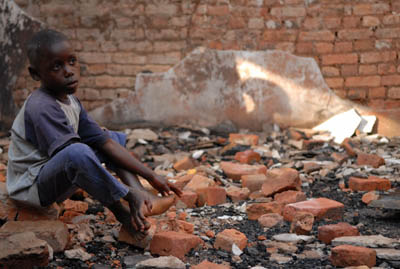
A boy sits in the ruins of a home destroyed by the Lord’s Resistance Army in Faradje, Congo. USHMM/Michael Graham

A team from the U.S. Holocaust Memorial Museum recently traveled to eastern Congo, where they collected testimonies from survivors of the ongoing conflict. In a powerful recent post on World Is Witness, Michael Graham profiled Joseph, a Congolese teenager who was abducted and enslaved for six months by the Lord’s Resistance Army. Joseph told Michael his story, which is described in this second post of a two-part series. Click here to read the first post.

The pilot dips the plane’s wing under the horizon as we circle Faradje to get a better look at the destruction below. Dozens of blackened huts line the road cutting its way across the forest from Dungu, empty circles scorched black inside.

It is at the Catholic Parish here in Faradje where I first meet Joseph, a 19 year old Congolese teenager captured by the Lord’s Resistance Army (LRA) near Dungu six months ago. He sits quietly across from me in a wooden chair and continues the story that began with him being captured and taken to Joseph Kony’s base in Garamba National Park. Today Joseph is free; the last time he was in Faradje was as a slave to the LRA, and an unwilling witness to the horrors that were brought to a quiet village on Christmas day.

In the aftermath of the operation against the LRA at their base in Garamba Park on December 14th, Kony ordered his soldiers to send a message to the world and the Congolese people, who he accused of supporting the attacks against him. The message was simple. If you want war, we will do it on our terms. We will bring it straight to the people.

A group of a hundred rebel soldiers and a dozen porters including Joseph marched east from the park until they came to the outskirts of Faradje. The rebels split up and fanned out, moving towards the center of town, burning homes and killing quietly as they went. They used machetes and clubs to save bullets and maintain the element of surprise. It was here on the outskirts they tried to kill Roger, a farmer and carpenter with dull scars on the top of his head, who described to me the moment he saw the LRA enter the village:

At about 4:00PM I was at my house and saw a column of soldiers splitting up into groups, one going on the road and the other arriving right behind my house. A soldier knocked on the door. I came out and said hello, asking them what they wanted.

He hit me in the head with wood from behind my house until they thought I was dead. A neighbor saved me, crying out “stop, you have already killed him!” They left after hitting my father and also leaving him for dead.

When the LRA arrived to the center of the town, while Joseph and the others were tied together under guard, they turned the celebrating village into a killing field.

Click here to continue reading.

To learn more about Joseph Kony's Lord's Resistance Army and find out how you can take part in helping to end the LRA's long and brutal reign, visit Enough's special page."

Sunday, June 7, 2009

Lord's Resistance Army (LRA) rebels in Uganda kidnapped around 135 villagers, including children

TO BE NOTED: From ReliefWeb:

"
Uganda's LRA rebels kidnap 135 Congolese villagers


- Ugandan LRA fighters abduct 135 Congolese villagers

- Rebels roaming despite Ugandan and Congolese offensive

By Joe Bavier

KINSHASA, June 5 (Reuters) - Lord's Resistance Army (LRA) rebels in Uganda kidnapped around 135 villagers, including children, in two attacks this week in Democratic Republic of Congo's north, a church official said on Friday.

LRA fighters raided the village of Dakwa around 200 km (125 miles) south of Congo's porous border with Central African Republic on Tuesday as residents gathered for a funeral, before returning to mount a second attack the following day, he said.

This week's attack is the latest in a series by the LRA, one of Africa's longest-running rebellions, which abandoned northern Uganda several years ago but continues to roam around Congo and Sudan despite the countries operations against them.

"They surrounded the village. The people were in mourning. They were taken away into the bush," said Marcel Kumbonyeki, the local Catholic priest in Bondo, some 200 km away, who was contacted by Dakwa's village priest soon after the attack.

"They carried out a second attack at 1400 (1200 GMT) on Wednesday. At that time a policeman was shot then stabbed to death, and they kidnapped the rest," he said.

Kumbonyeki said 138 people were kidnapped by the rebels in all, though three later escaped.

The local mission of the Swiss chapter of medical charity Medecins Sans Frontieres was attempting on Friday to verify details of the attack.

"People are starting to come south from Dakwa to where they feel safer. They are coming in small groups," Pierluigi Testa, MSF's local coordinator, told Reuters.

The LRA was pushed out of northern Uganda in 2005 after its two-decade bush war killed thousands of people and displaced 2 million, but has continued to mount raids in remote corners of Central African Republic, Congo and Sudan.

Uganda led an offensive also involving Congolese soldiers against LRA strongholds in Congo's isolated Garamba National Park on Dec. 14 after LRA leader Joseph Kony again failed to sign a deal to end his rebellion.

LRA fighters fleeing the assault on their bases killed at least 271 people in a series week massacres that forced tens of thousands to flee their homes.

Coalition forces failed to locate Kony, and the majority of Ugandan troops deployed in Congo for the operations have left.

But the rebels have continued to attack villagers in a region that straddles Congo's borders with Sudan and Central African Republic, killing some 1,000 civilians since late December, according to Human Rights Watch.

Kony and several of his commanders are wanted for war crimes by the International Criminal Court in The Hague.

(Editing by David Lewis)

For more humanitarian news and analysis, please visit www.alertnet.org"


General Map of Democratic Republic of the Congo

Map of 'General%20Map%20of%20Democratic%20Republic%20of%20the%20Congo'

  • Source(s):
    - United Nations Cartographic Section

Monday, April 13, 2009

the Ugandan army didn't really want to capture Kony. After all, it would mean an end to the army's cash cow

TO BE NOTED: From Peter Eichstaedt:

"War on Kony can be profitable

A story in the Daily Monitor reveals that, as many have suggested, the army is profiting from the recent three-month operation in the Democratic Republic of the Congo against the Lord's Resistance Army.

This information only supports speculation that the Ugandan army didn't really want to capture Kony. After all, it would mean an end to the army's cash cow.

Enjoy this story by Chris Obore.

KAMPALA -- The revelation that the army spent Shs390 million a day during the three-month Garamba operation against the LRA, has divided some top army officers, Saturday Monitor has learnt.

The antagonism has also been worsened by the discovery that some junior army officers in collusion with their superiors had been stealing money meant for pensions and benefits for fallen and retired soldiers. Sources say the army chiefs are now trading accusations against each other over the leakage of that information to the public.

President Museveni, who is also Commander-in-Chief, has also demanded answers to what in military circles has been labelled “abnormal expenditure”.

Our sources said after Daily Monitor reported recently that the Garamba expedition against LRA’s Joseph Kony had drawn Shs35 billion ($17 million USD) from the public coffers, Mr Museveni reportedly called his top commanders and asked them to explain the huge expenditure.

“The President was furious with the Shs390 million a day bill, saying it is abnormal; the man was really hard on the army,” the source said.

Presenting a balance sheet of the Garamba operation to Parliament’s Defence and Internal Affairs Committee, the Chief of Defence Forces, Gen. Aronda Nyakairima, justified the expenditure, saying although Kony was not captured, killed or forced to sign the agreement, the overall operation was a success as it had significantly impaired the rebels’ capacity to return and destabilise the country.

Defence Minister Crispus Kiyonga, who appeared with the CDF, said the “little” money for the operation was not catered for in the budget, the reason his ministry was forced to ask for supplementary funding. MPs did not get details on how the money was spent.

But sources say Mr Museveni was not amused by the expenditure and accused some army officers of financial impropriety.

Apparently, the President was not aware of the huge expenditure until the story was carried by the Daily Monitor.

According to sources, on learning of the President’s dissatisfaction, a blame game at the defence ministry ensued, leading to the sudden transfer of the Undersecretary, Mr Fred Ogene.

Sources say some sections wanted Mr Ogene fired or interdicted but being a civil servant, it was not possible, considering the stringent laws governing his appointment.

But Defence and army spokesman Felix Kulayigye told Saturday Monitor: “He has been requesting for transfer for a long time, so I don’t believe he was forced out.”

Mr Ogene confirmed by telephone yesterday that he had been moved.“I don’t think the transfer has anything to do with Garamba; it might be but I was not told,” he said, adding: “I have been transferred to the President’s Office.”Mr Ogene, however, said what was given about Garamba expenditure was not the accountability but the highlights.

Pension scamMeanwhile, Dr Kiyonga, has reportedly put more pressure on the army chiefs to explain why there was delayed detection of how money for pensions and benefits was stolen by paymasters.

Sunday Monitor reported recently that the army was investigating a racket involving officers who have been stealing money meant for retired soldiers and families of dead servicemen in a scandal that could eclipse the infamous ghost soldier scam that led to the sacking and prosecution of a former army commander.

Soldires celebrating after arriving at Entebbe Airport from Garamba.
The racket was being perpetrated through a chain of soldiers working in the Directorate of Records, Manpower Audit and Army Strength Management sections.

When the story was reported, Mr Kiyonga, who was then in South Africa attending to his ill relative, reportedly instructed his military assistant to dig into the matter.

When the military assistant swung into action, top army chiefs reportedly refused to cooperate because the investigation could end up at their doorsteps.

The Chief of Staff Land Forces, Brig. Charles Angina, who had instigated a covert fact-finding operation using a combination of military intelligence and staff officers to establish the facts; and later arrested some culprits, reportedly got furious that the information had leaked to the media.

Now Brig. Angina has reportedly deployed operatives to find out how his confidential information ended up at Daily Monitor.

When Kiyonga returned from South Africa, sources say he wrote asking for more information regarding the Mafia-like racket that had been fleecing widows and orphans of fallen fighters but he is reportedly getting lukewarm response from top army chiefs.

Maj. Kulayigye said he was not aware that Mr Kiyonga had asked for answers to the pension graft in the army but promised to reach to his military assistant.
He, however, later called back saying: “All phones are off, so I can’t help you.”But Joint Chief of Staff, Brig. Robert Rusoke, said yesterday that when the matter first came up, “he ( Kiyonga) was not around.”“But the PS will brief him,” Brig. Rusoke said.

Asked what the army had done so far, Brig. Rusoke accused Saturday Monitor of trying to sabotage investigations.“What do want us to say? The matter is under investigation,” he said.He said the Defence permanent secretary “has been in contact with Ministry of Public Service” because “we are working together with Public Service to investigate the matter.”

Last financial year alone, while Shs53 billion was released for payment of benefits and pension, not more than Shs10 billion was actually paid out to beneficiaries. The rest disappeared.

Sunday, February 8, 2009

the U.S. military admits it was involved in the training of the special forces that attacked Kony's camps

From Peter Eichstaedt:

"U.S. helpled plan botched attack

The New York Times today confirmed what I have reported for weeks now, that the Ugandan army attack on the camps of rebel leader Joseph Kony and his brutal band of killers, the Lord's Resistance Army, was botched.

New, however, is that finally the U.S. military admits it was involved in the training of the special forces that attacked Kony's camps in the Garamba National Park of the Democratic Republic of the Congo and the planning of the operation.

However, the comments made by the U.S. forces are very reserved, as if they are trying to distance themselves from a poorly executed plan that has resulted in a bloody rampage by the LRA that has killed some 900 people.

It is the first time the United States has helped plan such a specific military offensive with Uganda, according to senior American military officials, the Times reported.

They described a team of 17 advisers and analysts from the Pentagon’s new Africa Command working closely with Ugandan officers on the mission, providing satellite phones, intelligence and $1 million in fuel, the Times reported.

However, the newspaper reports, no American forces ever got involved in the ground fighting in this isolated, rugged corner of Congo, but human rights advocates and villagers rightly complained that the Ugandans and the Congolese troops who carried out the operation did little or nothing to protect nearby villages, despite a history of rebel reprisals against civilians.

As I have written and told to the BBC, which interviewed me on the topic several weeks ago, "the troops did not seal off the rebels’ escape routes or deploy soldiers to many of the nearby towns where the rebels slaughtered people in churches and even tried to twist off toddlers’ heads," the Times reported.

Further, the Times explained that American officials conceded that the operation did not go as intended, and that villagers were left exposed.

“We provided insights and alternatives for them to consider, but their choices were their choices,” said one American military official who was briefed on the operation, referring to the African forces on the ground, according to the Times.

“In the end, it was not our operation.”

That doesn't sound like a whopping endorsement for the results.

Maj. Felix Kulayigye, a Ugandan military spokesman, declined to discuss the American involvement and simply said, “There was no way to prevent these massacres,” according to The Times.

If there is any good to come to light, it is that in fact the U.S. has become involved actively in some of Africa's most important tragedies. However, the new AfriCOM which lead the way here, hopefully learned a lesson that planning is only the first step.

Ensuring proper execution of such missions must be also integral to the mission, or as we have seen, the results are catastrophic."


Me:

Don said...

Since the LRA has been pushed into another country, is there any chance that this was Uganda's real goal?

Don the libertarian Democrat

February 8, 2009 3:14 PM