Showing posts with label SOLR. Show all posts

Friday, January 9, 2009

"On the contrary, among the biggest supporters of both have been the world’s investors, at least insofar as their collective judgment "

Another good James Surowiecki post:

"
Libertarians Against the Market

Tyler Cowen, in his ongoing effort to ensure that the government spends as little as possible in its attempt to stimulate the economy, cites approvingly a post by Arnold Kling arguing against a big fiscal-stimulus package, because the risks vastly outweigh the potential rewards (actually, Kling doesn’t really think there are any potential rewards from a stimulus plan). Kling enumerates those “risks” in a list. This is not a very useful list, because it contains absolutely no evidence for any of his assertions—he simply assumes the existence of his risks to be a fact—and no assertion about how likely any of these “risks” are, which makes it a little hard to do a cost-benefit analysis. Kling says that “on close examination,” the case for stimulus is weak, but, in this post, at least, he offers no such “close examination,” merely a laundry list of familiar (and unproven) criticisms of government spending.

The most curious thing about Kling’s post, though, is the way he closes—namely by complaining that even though he and his side “have logic on their side,” they will be “mocked and vilified in the media” for their opposition to a big stimulus package, and that that package will be pushed through as a result of “elite groupthink”—the same groupthink, in fact, that pushed through the Paulson rescue plan. The implicit assertion here is that the support for a stimulus package, as for the rescue plan, is driven by this élite group of interventionist economists and politicians, who are overriding what would otehrwise be commonsense economic policy.

What’s odd about this is that the support for the stimulus package, as well as support for the Paulson plan, hasn’t just come from liberal economists or Democratic politicians. On the contrary, among the biggest supporters of both have been the world’s investors( TRUE ), at least insofar as their collective judgment is reflected in market prices. As I showed yesterday, investors overwhelmingly supported the Paulson plan: it was only when it was killed, that stock prices really started their downward spiral( I AGREE ). And it was only after Obama unveiled his economic team and made clear how big his stimulus plans were that the market began its sharp recovery( I AGREE ) (the S. & P. 500 is now up twenty-five per cent since Nov. 20th). And as The Economist’s mystery blogger noted yesterday, anyone’s who’s paying attention to the stock market knows what would happen if Obama announced today that he was abandoning his plans for a major stimulus package:

Markets would plummet, with significant knock-on effects, based on the actual news that government spending would not nearly close the American output gap, but also given the signal that America was no longer committed to serious stimulus.( TRUE )

The point is that it isn’t just some group of pointy-headed Keynesians saying that a big stimulus package will be good for the economy: the collective wisdom of the market is saying the same thing( TRUE ). And it seems peculiar for a supposed believer in the efficiency and intelligence of markets—which, as a libertarian economist, I assume Kling is—to simply disregard what the market is saying in this case. In effect, libertarian economists are saying that they have a better sense of what’s good for the economy than the aggregated wisdom of investors does. And that makes them sound peculiarly like the Platonic economic planners that they typically decry( TRUE ).

There is no doubt that our Investor Class wants a government bailout large enough to stop both the Calling Run and the Proactivity Run. TARP and other various government actions have tried to stop the first, while the stimulus is an attempt to stop the second. Only explicit government guarantees and actions are believed to be sufficient enough to stop these runs. Leaving the two Runs to run their course could lead to extreme losses of wealth and jobs, large enough to effect social stability. This outcome must be avoided at all costs.

The Investor Class had no Plan B. They believed, quite correctly, that the government would have to intervene in a financial crisis. Investing has been done for at least the last twenty years with this understanding, as well as the understanding that government has an important role in funding and helping the Investor Class. They do not believe in limited or no government, and would have no idea to do business in such an environment. As Wittgenstein said, "If a lion could talk, we could not understand him". I say, "If the free market showed up, the Investor Class would not know how to do business in it". They are the ones with the money, not theoreticians.

In the future, we will need a LOLR and SOLR to undergird our financial system. The explicit conditions of these guarantees will be meant to prevent Calling and Proactivity Runs. This can work. In other words, the intent is to keep the government from having to actually spend money, by allowing time for financial knots to unwind at minimal cost and disruption. Only the government can do this. In order to keep moral hazard from being a consequence, a strict application of Bagehot's Laws and a strict regime of supervision, not regulation, which focuses on aims and methods, as opposed to relying on particular laws, can keep moral hazard from becoming a problem. For one thing, by the end of the process, the Investor Class members which need a bailout will essentially be bust. It will not be a pleasant experience for them, as opposed to TARP.

The current political culture is a result of compromises over time. It cannot be easily changed, and should not be quickly changed. But, over, time, the system can be made fairer and freer for most people. Starting out with the changes listed above would be an excellent down payment.

"what I consider to be a plausible range of economic outcomes is, at the moment, quite wide indeed"

From Felix Salmon:

"
Can We Really Guide the Economy?

Ryan Avent says that he thinks the "plausible range of economic outcomes is, at the moment, quite wide indeed", and wonders whether "the size of this conceivable range is actually reflective of potential outcomes, rather than simple ignorance":

If it seems like things could go really well or really poorly, is it because outcomes are very dependent on our actions( TRUE ) or because we have no idea what's going on( BOTH ARE TRUE )? And I suppose that if you want to understand the different approaches to policy advocated by liberals relative to libertarians, that question, and its answer, is key( HOW SO? ).

The easy answer is that this is not "simple ignorance". Studies have shown repeatedly and convincingly that the range of possible outcomes is nearly always greater than you think, not smaller. Economically speaking, actual results regularly come out quite far away from even pretty near-term forecasts, which is one reason why asking economists (or journalists, for that matter) to predict when we're going to come out of recession is an exercise in futility( I AGREE ).

On the other hand, that doesn't necessarily mean that outcomes are very dependent on our actions. What action, for instance, did we take to send the price of oil plunging by $100 a barrel in the space of a few short months? That's the kind of thing which can only happen in a highly complex and therefore wholly unpredictable system( TRUE ).

So I don't think of liberals' policy approach as being deterministic( MECHANISTIC ) -- if we do this, then the economy will do that. Instead, I think of it as working the other way around: if the economy does this, then we should do( TRY ) that. Right now, the economy is tanking( A PROACTIVITY RUN), and so we should apply a large dose of stimulus( SPENDER OF LAST RESORT ). We can't predict with any accuracy what the results will be, but there's a very high chance that they will be better than if we did nothing( WE CAN'T DO NOTHING. A PROACTIVITY RUN NEEDS TO BE STOPPED BECAUSE THERE IS NO WAY OF TELLING HOW MUCH WEALTH COULD BE LOST OR HOW MANY JOBS COULD BE LOST UNTIL IT ENDS ON ITS OWN. WE CAN'T CHANCE THAT CATASTROPHIC OF A POSSIBILITY, WHICH COULD LEAD TO SERIOUS SOCIAL DISLOCATIONS AND DISRUPTIONS. ONLY THE GOVERNMENT HAS THE RESOURCES BEHIND IT STAND UP TO A CALLING OR PROACTIVITY OR BANKING RUN IN THIS AGE. NO OTHER INTERVENTION WOULD BE BELIEVED SUFFICIENT TO STOP THE RUN. )., which is the default libertarian position."

Here's Avent on The Bellows:

"Knife Edge

Watching Obama’s speech, it occurred to me that what I consider to be a plausible range of economic outcomes is, at the moment, quite wide indeed( I AGREE ). I can envision scenarios in which recovery is fairly rapid, believe it or not( THIS IS MY POSITION ). A number of economic statistics were trending positively toward late summer of last year — before the dramatic intensification of the financial crisis laid waste to the economy. If we’re able to get banks functioning again, then a quick, large stimulus might jolt us rapidly back to something near trend growth. I can also imagine some very dire scenarios, many of which involve instability abroad and negative feedback loops to the global economic system( VERY TRUE )."

I see Mechanistic Thinking in terms of the Democratic proposals in the specificity of the amounts chosen. In other words, if we plug in this number, this will be the consequence. The usual reason seems to be that we want to replace a recent consumption figure or some number like that. I don't see the problem that way at all. To me, the stimulus is intended to stop the Proactivity Run. The amount we should spend should be enough to accomplish that, as best we can tell. It might be more than some people want or less than some people want in the end. The stimulus should be spent over two years in order to assess how it is functioning. Otherwise, why not just spend enough money to happily employ everyone. Obviously there's a limit to the sense of this amount. As well, the amount we spend could have adverse consequences by spooking our creditors. Prudence here is necessary, as well as speed. Getting bogged down in debating the enormity of the eventual size of the stimulus doesn't seem wise to me.

Thursday, January 8, 2009

"So if stimulus is partly a game of psychology"

Barbara Kiviat finds someone on my side:

"Obama talks stimulus. He hopes you are listening

The spate of retailers reporting devastating December sales this morning provided a nice backdrop for President-elect Obama's speech in Virginia about why we need to spend another $775 billion to fix the economy. About 40% of that sum comes in the form of tax cuts, but the bulk of the fiscal stimulus would go to pay for new programs and projects—everything from the greening of federal buildings to the computerization of medical records.

The idea, just to be really basic about it, is that American consumers and companies aren't spending enough, so the government has to. There was a great article in the New York Times yesterday about how pretty much all most economists now agree that it's go-time on this count. Even Marty Feldstein, the champion of conservative economic thought who was a top adviser to President Reagan, has noted that lower interest rates aren't getting the job done because credit markets are screwy and that tax cuts only get you so far, so the "heavy lifting" will have to be done by increased government spending. (Quick historical recap: this hasn't been the consensus in the field of economics since the 1960s.)

But most economists also agree that fiscal stimulus shouldn't be an open-ended thing. This morning I was chatting with Andrew Dilnot, an economist at Oxford University who used to run the U.K's Institute for Fiscal Studies—what he described as a cross between the Congressional Budget Office, the National Bureau of Economic Research and the Brookings Institution. He argued that fiscal stimulus should be geared toward priming the pump—that is, getting private players to start spending again. "The strongest argument for doing these sorts of things is that it's a way of the government demonstrating that they're not going to allow the economy to slide into a depression, that they'll spend the money necessary ( THAT'S MY POSITION. IT'S THE EQUIVALENT OF THE GOVERNMENT GUARANTEES NEEDED TO STOP A CALLING RUN, ONLY THIS IS A PROACTIVITY RUN. HERE, THE GOVERNMENT NEEDS TO BE A SPENDER OF LAST RESORT, AND, ONCE AGAIN, ONLY THE GOVERNMENT HAS THE RESOURCES TO BE BELIEVED AS A SOLR. IT SHOULD ALSO BE CLEAR THAT I BELIEVE THAT HAVING THESE GUARANTEES WILL STOP CALLING AND PROACTIVITY RUNS IN THE FUTURE. THE POINT OF THE GOVERNMENT GUARANTEES SHOULD BE TO KEEP PEOPLE FROM PANICKING, THEREBY KEEPING THE NEED FOR GOVERNMENT ASSISTANCE TO A MINIMUM. )," he said. "If people believe it's going to be okay, then people who are putting off buying a new car or house will instead say, I shan't lose my job, I'll go ahead and do that( THAT'S THE WHOLE POINT. I AGREE. A HUMAN AGENCY EXPLANATION. )."

So if stimulus is partly( COMPLETELY. OTHERWISE, IT'S SIMPLY GOVERNMENT SPENDING AS OPPOSED TO PRIVATE SPENDING. ) a game of psychology, then it would make sense to ease off the extra spending once the economy picks back up( YES ). Get consumers and businesses confident enough to spend again, and then let them take over( YES ). In an interview on Wednesday, Obama nodded at that logic. "I'm not out to increase the size of the government long-term," he said. "My preference would be that the private sector was doing this all on their own( MY POSITION AS WELL. )."

I'm guessing that sounds pretty nice to most folks, especially considering the amount of money we've already spent on fixing the economy. But is it true? Jay Newton-Small has a piece up on Time.com that considers how Obama's stimulus package gives him a running start on a bunch of items on his long-term agenda. If we head down this road and GDP rebounds, do we suddenly cut funding? I know a lot more about economics than I do politics, but I'm guessing most legislation doesn't come with an easy on-off switch( THAT IS A CONCERN ).

Though that's not to say I'm against spending money to increase the energy efficiency of two million homes or to build broadband access to all corners of America so that small businesses, no matter where they're located, can be globally competitive. These are good ideas as far as I'm concerned.( GOOD IDEAS. I AGREE. )

All I'm saying is when we start buying computers for schools and paying people to put up windmills let's be clear about whether we're doing these things to save the economy—or if we'd be trying to do them in the long-term anyway.( FOR THE INFRASTRUCTURE PART OF THE STIMULUS, THIS IS ESSENTIAL. )

Here's one of my favorite parts of Obama's speech:

Instead of politicians doling out money behind a veil of secrecy, decisions about where we invest will be made transparently, and informed by independent experts wherever possible. Every American will be able to hold Washington accountable for these decisions by going online to see how and where their tax dollars are being spent. ( WONDERFUL )

I can't wait.

Barbara!"

My view of the importance and use of a stimulus is exactly the same, which is why I don't believe that we need to do as Paul Krugman says:

"More stimulus notes

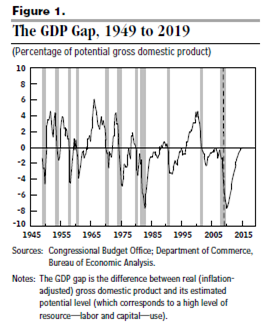
1. The new CBO budget and economic outlook is out. Above is its forecast( BS ) for the GDP gap — the hole stimulus has to fill( WHY DOES IT NEED TO FILL THE HOLE BY ITSELF? ). I’d guess( THAT'S WHAT IT IS ) that the CBO estimate, which has unemployment averaging 8.3 percent in 2009 and 9 percent in 2010, is actually too optimistic (see 3, below), but even so it puts the Obama plan in perspective: a 3% of GDP plan, with a significant share going to ineffective tax cuts( NOT CLEAR AT ALL ), to fill an 8% or more gap.

2. How ineffective? Howard Gleckman of the Tax Policy Center says Lots of Buck, not Much Bang.:

Here's his point:

"Refundable tax credits for hiring new workers promise to be an administrative nightmare and won't create many new jobs. It is tough to see how a company that is seeing its sales slaughtered in today’s recession is going to hire just because it gets a few thousand dollars per new worker from the government. Profitable firms would merely take the credit for bringing on workers they were already planning on hiring. ( IT'S AMAZING HOW PEOPLE CAN INTUITIVELY DIVINE WHETHER OR NOT AN ECONOMIC INCENTIVE WILL WORK. I HAVE NO IDEA WHAT HE'S BASING THIS VIEW ON. IT SEEMS LIKE A POSITIVE MOVE TO ME. )

I can’t begin to imagine how the variation on this idea--credits for not laying someone off--would work( HERE I AGREE ). My head throbs at the concept of the IRS trying to administer a rebate based on intentions. Worse, these breaks would never work unless they are refundable and, to be honest, giving such credits to failing business makes my skin crawl. In reality, it would become yet one more bailout—only this time taxpayers wouldn't even get stock for their trouble."

Back to Krugman:

3. The official BLS numbers won’t be out until Friday, but the ADP jobs estimate, based on private payroll data, is spectacularly grim. "( AND ACCORDING TO THE BIG PICTURE, NOT VERY USEFUL. )

Krugman's view is Mechanistic. The economy is like an engine. It needs a lot of oil. I don't credit this view at all. If there's one view that always wastes money, it's a mechanistic view of human behavior.

I would prefer an incentive for investment, but adding workers isn't a bad alternative. Let me explain something: We're fighting the fear and aversion to risk. One way to attack that is to target incentives to minimally effect this. The alternative is much more than spectacularly grim. There's no proof that any of these measures will be effective, least of all picking an enormous figure based on a graph of useful but inexact numbers. The idea that overspending poses no risk is beyond belief. It is itself a panicked reaction to our crisis. We've had a number of those recently, and, as of now, the record is mixed at best.











