Showing posts with label Rape. Show all posts

Friday, May 29, 2009

kept for one year as a slave during which time she was repeatedly raped and became pregnant

TO BE NOTED: From Enough:

Profiles in Congolese Courage

Printer-friendly version
Lee Ann De Reus

I want to you impress upon you the severity of what is happening here without sensationalizing the violence – and at the same time, speak to the hope that still lives in the hearts of Congolese women. I want you to know that while there are incredible atrocities committed against women, the majority of Congolese men are wonderful human beings. And even though so much attention is given to the women, the men are suffering too – when they are kidnapped by militias, or sexually violated, or killed protecting their families, or rendered helpless by perpetrators while they watch the abuse of their wives and daughters. And I want you to know that Congo is more than rape, war, corruption and danger around every corner. There is a rich culture that persists despite it all, and the country itself has a stunning beauty. It is unfortunate that what is right and good about Congo is unknown to most of us in the West. And so, it is in this conflicted space that I share with you one young woman’s story.

Mateso (not her real name), 13 years old, was walking to the market to sell cassava when she stumbled into an ambush and was kidnapped by the FDLR. She was taken to the bush and kept for one year as a slave during which time she was repeatedly raped and became pregnant. She spoke of a mass grave and her disbelief that she, too, was not killed, considering she was “no better” than those who had died. Because of difficulties with labor and delivery, the soldiers used a knife to increase the size of the vaginal opening. The baby was stillborn. Mateso was then locked in a room for days during which time she was forced to drink the urine of the soldiers and flies began to swarm around her injuries. Because she was so severely wounded, the soldiers never suspected that she might escape. But she found the strength to flee and managed to walk for three nights, hiding during the day. Eventually, she found help and was taken to Panzi. Mateso is 15 now, having lived at Panzi for two years. She suffers from a fistula and despite multiple surgeries, she continues to leak urine. She has family but they live far away so she stays on with the hope that the next surgery will be successful and that she can one day return to her village.

Mateso’s smile is broad and bright, set off by the brilliant blue African print dress she wore the day we met. She approached me with determination as I visited with other women in the hospital courtyard. I was struck by her assuredness and caught off guard when she launched into her story. When I asked her why she felt it was important to share this with me, she said, “I tell you my story because so many people don’t know! I want you to tell others.” Yes, Mateso. Others will know, I promise, and you will not be forgotten.
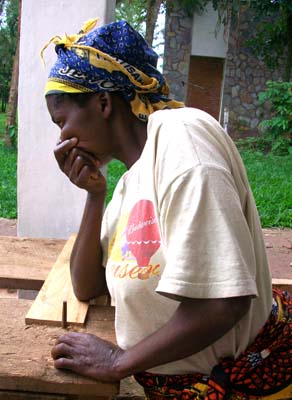
A woman at Panzi hospital in Bukavu, South Kivu. Courtesy of Lee Ann De Reus

Lee Ann De Reus is the 2009 recipient of the Carl Wilkens Fellowship, given by Genocide Intervention Network, and an associate professor of Human Development & Family Studies and Women's Studies at Penn State Altoona. She is currently in Bukavu, South Kivu in the Democratic Republic of Congo, where she is conducting interviews with survivors of sexual violence. This is the second in a series of posts."

Wednesday, May 20, 2009

Congolese army is responsible for widespread and vicious abuses against its own people that amount to war crimes

TO BE NOTED: From Reuters:

"Rights body accuses DRC troops of war crimes
19 May 2009 16:29:54 GMT
Source: Reuters
* Human rights body accuses DRC troops of rape, other abuses * Urges U.N. to put pressure on Kabila * Congolese government rejects charges (Changes dateline/by-line, adds details and Security Council) By Patrick Worsnip KINSHASA, May 19 (Reuters) - Human Rights Watch (HRW) accused Congo's army on Tuesday of war crimes against civilians including rapes and killings, charges the government rejected as "lies". Congolese soldiers and the U.N. peacekeeping force MONUC have been conducting joint operations in eastern Congo targeting Democratic Forces for the Liberation of Rwanda (FDLR) Hutu rebels, including leaders of neighbouring Rwanda's 1994 genocide. But New York-based HRW, whose report was published as U.N. Security Council envoys were visiting the region, said local troops were committing atrocities in the area's remote North Kivu province. "The Congolese army is responsible for widespread and vicious abuses against its own people that amount to war crimes," Anneke Van Woudenberg, senior researcher in HRW's Africa Division, said in a statement. HRW accused government soldiers of raping more than 143 women and girls since January -- more than half the total number of rape cases documented by HRW researchers in the country. The army has torched hundreds of houses, schools and health centres and civilians have been killed or arrested, often only being freed when they have paid soldiers, HRW said. "The government should take urgent action to end these abuses. A military operation that targets the very people the government claims to be protecting can only lead to disaster," it said, adding that local civilians had told them they feared government forces as much as the Rwandan militias. Government forces, already a messy collection of factions from Congo's 1998-2003 war that have long been accused of indiscipline, have swelled in the east to about 60,000 with the recent integration of former Tutsi rebels. A government spokesman rejected the charges as lies. "This is nearly word for word the statement of the FDLR. We now have proof that HRW works with the FDLR," said Information Minister Lambert Mende. "I think there will be consequences," he added without elaborating. KNOWN RAPE CASES U.N. Security Council envoys were in Congo's capital, Kinshasa, on Tuesday to bolster a U.N. drive to help resolve years of conflict in the region and ultimately allow the 17,000-strong U.N. force there to leave. "Security Council members should tell President Joseph Kabila that U.N. peacekeepers cannot support military operations in which war crimes are being committed," Woudenberg said. However, French U.N. ambassador Jean-Maurice Ripert called a HRW demand to withhold MONUC support for the army contradictory. "We know that there are some cases of known rapists in the ranks of the army. To be very frank with you, we even provided the government with names of people that we wish to see arrested, judged, and imprisoned," he said. "We, at the Security Council, don't think that MONUC support for the government of Congo and its authorities should be made conditional in the current situation where, above all, we must protect the civilian population and put an end to these rebellions." The FDLR largely melted into the bush when the government, backed first by Rwanda's army and then by the United Nations, launched its offensive earlier this year. But around 250,000 civilians have been displaced during the operations, and the FDLR have retaken much of the ground they initially lost. The FDLR have also been accused of atrocities, including a recent wave of massacres of civilians. (Additional reporting by Joe Bavier in Kinshasa, Frank Nyakairu in Nairobi, Editing by Jon Boy"

Monday, March 30, 2009

Women in villages around Korhogo, northern Côte d’Ivoire, dare not walk to their fields alone for fear of rape.

TO BE NOTED: From IRIN:

"
COTE D'IVOIRE: Rape a daily menace for rural women

Photo: Nancy Palus/IRIN
Women in Korhogo say they go to the fields in a group because of the risk of rape
KORHOGO, 30 March 2009 (IRIN) - Women in villages around Korhogo, northern Côte d’Ivoire, dare not walk to their fields alone for fear of rape.

“Women are attacked even with their babies on their backs,” said Fatoumata (real names not used). “The attacker just goes for what he is after and that is that. The baby could even die.”

Women gathered at a health centre in Korhogo, 630km north of the commercial capital Abidjan, told IRIN women are frequently raped as they walk to and from their fields.

Attackers often hide in karité or néré trees, whose fruit villagers harvest for lotions, food and other products, the women told IRIN.

“They shake the trees so some of the fruit will fall, to lure women to stop and gather it up,” Mariam said. “When the woman stops the man attacks her.”

The assailant is generally not armed; since the woman is alone it is easy for the man to overpower her, the women said.

“One day villagers found the body of an elderly woman who had been raped and died in the attack,” Salimata said.

Fanta Coulibaly, head of a committee to fight violence on women and children – part of the Ministry of Family, Women and Social Affairs – said people in several regions of Côte d’Ivoire have told her rape on the way to the fields is common.

“Women cannot even do their work in peace without the threat of rape,” she told IRIN in the capital Abidjan.

Since a coup attempt in 2002 rebels have controlled Côte d’Ivoire’s north. The conflict and proliferation of arms in the country have exacerbated poverty and crime, but the women in Korhogo said rape in rural zones has been common since long before the conflict.

The women said when someone is raped she reports it in the village and men go out to try to catch the attacker, but it is difficult to track him down.

Boua Diarrassouba, regional director in Korhogo for the Ministry of Family, Women and Social Affairs, told IRIN that in the rural setting when an assailant is caught, villagers usually take justice into their own hands.

''Women cannot even do their work in peace without the threat of rape''
“The dignity of a man is his wife,” he said. When a woman is attacked in this way, if the culprit is caught, the punishment is generally a beating or worse, he said. “These cases usually end in bloodshed. The local authorities are not contacted except perhaps later to examine the damages.”

Rapists are called tchétchan, in the local language, Senoufo, meaning one who has an innate and uncontrollable urge to have sex with women; not all rapists are tchétchan, women told IRIN, but this is the word used for rapists.

Women said when rapes happen in the town of Korhogo – which they said is also common – most victims are not motivated to go after their attackers because they have no confidence the process will lead to punishment. One described a recent case in which an accused rapist was detained for just hours then let go.

“Nothing happens to the men who do this,” Fati said. “That’s why they continue to carry out such acts.” All the women gathered nodded in agreement.

A lack of legal infrastructure in the north is part of the problem, activists against sexual violence say. More than six years after the rebellion the government in January held an official ceremony to mark the redeployment of justice officials to the north, but the process is yet incomplete.

When asked what could be done about the problem of attacks on the way to the fields, Mariam described her idea for a sting operation to catch assailants.

“A man should dress up as a woman – with a skirt, a stuffed bra under women’s clothes, a headscarf,” she said. “Then he would walk alone toward the fields. A group of villagers would follow him. If an attacker strikes, the man could fight him off until the villagers could come and capture him.”

“We suffer greatly from this threat,” Fatoumata said. The women said they are not free to work as they wish.

Women who have been raped are not marginalised by others in the village, those gathered at the health centre told IRIN. Several of them said at once: “We all know it could be us next time.”

Friday, January 23, 2009

Logan told IRIN rape continues to be a “serious post-war challenge.” Liberia emerged in 2003 from 14 years of civil war.

An ugly but important post on IRIN:

"
LIBERIA: Rape stokes HIV concerns

Photo: Prince Collins/ IRIN
A rape victim in Liberia who said an army officer raped her during the final days of the country's civil war
MONROVIA, 23 January 2009 (IRIN) - Health workers in Liberia report at least 100 people seeking care for rape and other forms of sexual violence each month, according to rights groups that compile government figures; the government is concerned that not enough survivors are receiving treatment to prevent HIV infection.

At the SGBV [sexual and gender-based violence] Duport Road Clinic in the capital Monrovia, director Joan Dalton said the situation is “still a nightmare” with the clinic treating five rape victims in January.

One of the government’s priorities is to increase the use of the antiretroviral post-exposure prophylaxis (PEP) treatment by survivors of sexual assault and rape to help avoid HIV infection, according to The Global Fund to Fight AIDS, Tuberculosis and Malaria grant coordinator David Logan.

He said he did not have estimates on how many victims of sexual violence who seek medical services start the PEP treatment.

Logan told IRIN rape continues to be a “serious post-war challenge.” Liberia emerged in 2003 from 14 years of civil war.( 5 YEARS ON )

Twenty government-run health centres across the country offer free services, including PEP, to victims of such violence, according to the Ministry of Gender and Development.

Grant coordinator Logan said part of the newly-awarded $78-million Global Fund grant will go toward counselling, PEP treatments and trainings on sexual and violence for health workers.

A nurse in the capital Monrovia’s John F. Kennedy Hospital told IRIN the hospital has had an increase in the number of rape victims seeking services in recent years. “Most the HIV-positive girls I am working with told me they were infected through rape,” said Kumbah Vincent.

A rape survivor who gave her name as Martha Flomo told IRIN she did not seek medical care after she was raped in 2003. “It was the final round of fighting in Monrovia. I was forced to go to bed with one of the generals. I am sure I contracted the [virus] from him. But HIV prevention? No, that was not on my mind.”

Flomo said that after her community learned about her HIV status, she felt she had to leave. “I had no alternative but to vacate the community and go elsewhere where people did not know I was HIV-positive.”

A 2008 government report identified stigma( NB ) as a “main obstacle" to victims' turning to PEP and SGBV services.

Flomo told IRIN her only friends are other HIV survivors. “We all meet and talk about whether we can still contribute to society. We are confident that we can play our part in helping to rebuild Liberia – if only we are accepted and allowed.”

The creation of a governmental commission in recent years to fight sexual violence and a soon-to-open court devoted to such crimes has encouraged survivors to step forward, said Deweh Gray, president of the Association of Female Lawyers of Liberia, known as AFELL. “But for all those who are reporting these crimes, there are others being treated in clinics and hospitals who do not want to file criminal charges. They prefer to stay silent.”