Showing posts with label Sinhalese. Show all posts

Thursday, June 11, 2009

United Nations officials estimate about 8,000 civilians died from the beginning of this year

TO BE NOTED: From the WSJ:

"
Sri Lanka Begins Painful Reconciliation

AMBEPUSSA, Sri Lanka -- Sinnathamby Raja, once a cog in this country's brutal war, is now trying to be part of its shaky peace.

When he was 26 years old and already a 13-year veteran of violence with the Tamil Tiger rebels, Mr. Raja led a hit squad that detonated a bomb inside the office of a political party allied with the government. Then he gunned down those who survived the blast.

Soon after the 2006 attack, which he says killed 10 people, he tossed out his cyanide tablet -- which all members of the rebel group were instructed to swallow to avoid capture -- and surrendered to government troops. He no longer saw the point of such massacres, he says.

Agence France-Presse/Getty Images

Sri Lankan police supervise new recruits in Colombo this week, as the government prepares to expand its security presence in Tamil areas.

Lately, he has been in a rehabilitation camp outside the capital, Colombo. "Now that there's a good government, I hope people can live in harmony," says Mr. Raja, who is training to be a plumber.

Such hope is a tall order for Sri Lanka. To defeat the rebels, the government revved up a war machine to match the ruthlessness of its foe. It is now confronting the fallout from that fight, as it challenges allegations of human-rights abuses and seeks to ease the fears and distrust that remain among ethnic Tamils after a war that has lasted three decades.

The rebels claimed to represent Hindu ethnic Tamils in an island nation dominated by a Sinhalese, mostly Buddhist, majority. United Nations officials estimate about 8,000 civilians died from the beginning of this year sought to finish off separatists who corralled thousands of Tamils to shield their retreat. About 300,000 people displaced by the war are now confined to camps as the government attempts to weed out separatist rebels.

Sri Lankan officials say they have rounded up more than 9,000 Tamil Tiger rebels, most of whom will be freed after periods in rehabilitation camps, where they receive vocational training and are instructed to leave behind any allegiance to the violent separatist movement.

Sri Lanka has been "very effective smashing Tigers and their support network, but they smashed a lot of people who aren't Tigers," said a Western political analyst.

Some Western governments and international organizations have called for an independent investigation into allegations of human-rights abuses.

"If communities that have been torn apart by decades of violence and impunity are to be reconciled, the Sri Lankan government should initiate internal reforms and seek international assistance to prevent ongoing violations and ensure real accountability," said Sam Zarifi, Asia-Pacific director of Amnesty International, which released a new report Thursday on what it says were government failures to protect human rights.

Sri Lanka has already shot down proposals at the U.N. for an outside human-rights investigation by rallying support among sympathetic Asian and Latin American countries.

Experts say an internal probe is unlikely. "The idea of a truth-and-reconciliation tribunal has never been popular across the political spectrum. People think it's much better to forget the past," said Rohan Edrisinha, who oversees legal and constitutional research in Colombo at the Centre for Policy Alternatives, an independent think tank.

In a sign of the kind of nationalism that surrounded the final war effort, Mr. Edrisinha's organization received a list of demands this month, "Notice to the Traitors," from a group called Sri Lankans Affectionate Toward the Motherland. The writers demanded the group shut its offices for a week, donate money for wounded and deceased veterans, and stop programs its critics said were detrimental to national sovereignty. Other groups critical of the government have received similar warnings.

In declaring victory, Sri Lankan leaders have sought to patch up ties with ethnic Tamils. "The war against the terrorists is now over," President Mahinda Rajapaksa, who is Sinhalese, said in the Tamil language. "The Tamil-speaking people should be protected. They should be able to live without fear and mistrust."

That has been difficult the past few years, however.

After a cease-fire between the government and the Tigers began to crumble in 2006, Sri Lanka saw a surge in violence. Some 2,000 people have "disappeared" in the past few years, according to the International Crisis Group, a Brussels think tank. The disappearances have been part of a wave of political assassinations, abductions and assaults that have targeted critics of both sides.

One of the conflict's chief casualties has been an independent press that could vent Tamil grievances. Sri Lanka's ranking in a press-freedom index has slid in recent years as prominent journalists have been assaulted, threatened and killed. In 2009, Sri Lanka was ranked 155 out of 195 countries in a survey by Freedom House, a Washington-based organization. In a sign the government is likely to keep the pressure on the press, Sri Lankan officials have warned through state media they are investigating links of journalists to Tamil Tigers.

The refugee camps have also become a sore point. Although the government has eased access for aid groups and journalists, some Tamil politicians complain they have been blocked from visiting -- a stance that has alienated would-be supporters.

Officials say they are needed to screen for terrorists, although that process remains opaque. Officials at camps outside the northern town of Vavuniya declined to explain how Tamil Tigers were identified -- other than those who stepped forward on their own. "There's a list from A to Z," said Amir Ali, a government deputy minister. "Everybody knows who they are."

Some of the youngest cadres have ended up in Ambepussa, a camp for child soldiers nestled in the lush forest northeast of Colombo. During a recent visit, there were about 100 residents, mostly rail-thin teenage Tamils who said they were forced to join the Tigers at gunpoint and blamed the rebels for separating them from their families.

While the rebel group is now defunct and many conscripts have laid down arms, there are no certain prospects for peace.

The barrel-chested Mr. Raja, the former rebel leader, says he hopes to put to use his new plumbing skills to get a job outside the camp. "I no longer want to be part of the violence. I want to be a good citizen," he says. "My mind-set has totally changed."

But Mr. Raja says his parents have warned him about returning home because he could be a target of a revenge killing. Given his history, he admits the list of his enemies would be long.

Write to Peter Wonacott at peter.wonacott@wsj.com"
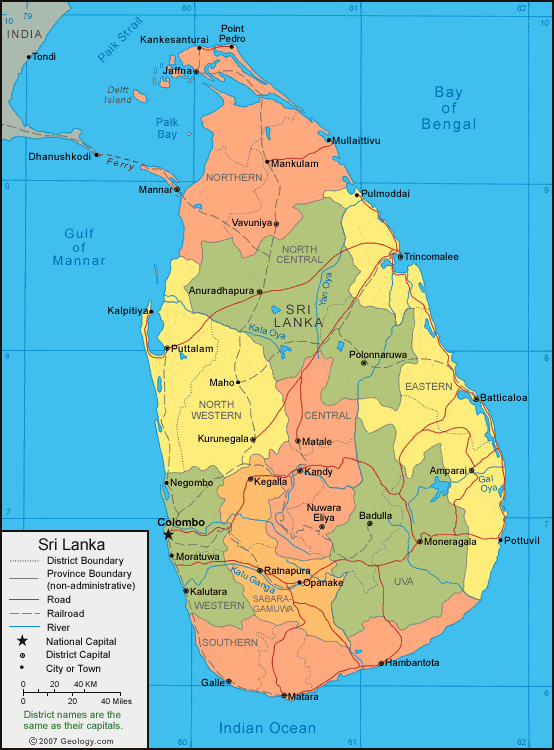
Sri Lanka political map

Friday, January 9, 2009

"The conflict has killed more than 70,000 people."

A Sri Lanka report:

"COLOMBO, Sri Lanka (AP) — Sri Lankan forces captured the strategic Elephant Pass base from the Tamil Tiger rebels on Friday, ousting them from their last stronghold on the Jaffna Peninsula and boxing them into a shrinking pocket of land in the northeast.( THEY ARE IN TROUBLE. )
Skip to next paragraph
The New York Times

The capture of the base gives the government nearly full control of the northern peninsula, the rebels’ cultural capital, for the first time since 2000. It also puts the country’s major north-south highway completely under its control for the first time in 23 years.

The rebels are now confined to a small area of jungle around their last remaining stronghold, Mullaittivu.

In a nationally televised address, President Mahinda Rajapaksa praised the victory. “Our soldiers by this evening have been able to totally liberate Elephant Pass” from the rebels, he said.

There was no comment from the rebels, also known as the Liberation Tigers of Tamil Eelam.

The government, which seized the rebels’ administrative capital, Kilinochchi, last week, has promised to crush the rebel group and end Sri Lanka’s 25-year-old civil war.

But in a reminder of the rebels’ ability to cause destruction even as they suffer conventional defeats, the rebels detonated a roadside bomb( THIS WILL BECOME THEIR STRATEGY AGAIN ) in the country’s east on Friday that killed three air force troops and four civilians, said a military spokesman, Brig. Udaya Nanayakkara.

The attack outside the eastern city of Trincomalee signaled a return to guerrilla tactics( YES ). The government captured the east from the rebels in 2007, but attacks in the area have increased in recent months.

On Friday, government forces marching from the north and south broke into Elephant Pass and fought heavy battles with the rebels, the military said. The base is on the isthmus connecting the northern Jaffna Peninsula with the rest of the island in the Indian Ocean.

Analysts said the guerrillas appeared to have withdrawn their artillery and heavy weaponry from the area and were sacrificing their bases on the peninsula to consolidate forces near Mullaittivu, where they will probably make a stand.

Human rights groups have warned that casualties among the hundreds of thousands of civilians living in the shrinking pocket of rebel territory were likely to mount as the government closed in on the insurgents.( THIS IS MY CONCERN )

The Tamil Tigers have been fighting since 1983 to create an independent homeland for ethnic minority Tamils, who have suffered decades of marginalization by governments controlled by the Sinhalese majority. The conflict has killed more than 70,000( 70,000) people.

Troops south of Jaffna were also fighting the rebels, pushing east from the Kilinochchi area, Brigadier Nanayakkara said. The troops found the bodies of seven insurgents from fighting Thursday, he said."

I would hope that the government reaches out to Tamils, to try and isolate the Tigers after this conflict winds down. Otherwise, Sri Lanka can expect a return of suicide bombings and terrorist attacks.

Monday, January 5, 2009

called on both sides ''to conduct their war in a way that the civilians are not affected or punished''

Checking in on Sri Lanka. From the NY Times:

"COLOMBO, Sri Lanka (AP) -- Sri Lankan forces overran another village Monday and moved closer to seizing a strategic base from the Tamil Tigers, but concerns are mounting for the hundreds of thousands of civilians living in the rebels' shrinking territory( THIS IS CRUCIAL ).

The government has chased the rebels out of much of their de facto state in the north in recent months -- taking their administrative capital of Kilinochchi last week -- but the offensive is complicated by the presence of an estimated 300,000 civilians in rebel territory.

The rebels now occupy a slice of jungle slightly larger than the city of Los Angeles.

As civilians increasingly get in the way of the battle, it could become difficult for the government to fight on without causing an unacceptable loss of life, human rights activists and some Western diplomats said.( I AGREE )

The government says it has no intention of giving up its recent momentum but will do everything it can to avoid civilian casualties.

''We are taking the utmost precautionary measures,'' said defense spokesman Keheliya Rambukwella. He declined to outline what those precautions where.( BS )

Government troops on Monday captured the rebel-held town of Oddusudan, which sits at an important crossroads leading to the Tamil Tiger stronghold of Mullaittivu, according to military spokesman Brig. Udaya Nanayakkara.

Troops also moved closer to capturing the Elephant Pass stronghold, a strategic chokepoint just south of the government-controlled Jaffna peninsula, the military said. Seizing Elephant Pass would cut off the rebels' heavily fortified front line on the peninsula from the rest of their remaining territory.

The rebels are fighting to create an independent homeland for minority Tamils, who have suffered decades of marginalization by governments controlled by the Sinhalese majority. Some analysts say this is the military's best chance ever of defeating the rebels and ending the 25-year-old civil war, which has killed more than 70,000( 70,000 ) people.( TRUE )

Mano Ganesan, an opposition lawmaker, called on both sides ''to conduct their war in a way that the civilians are not affected or punished'' and asked that a group of observers from all political parties be allowed in the war zone. ( PLEASE )

Last month, Human Rights Watch accused the rebels of preventing civilians from fleeing the area under their control. The New York-based group also accused the government of arbitrarily detaining and mistreating the estimated 1,000 civilians who fled across the front lines.

While the military has avoided large-scale civilian casualties in its latest offensive, reports of civilian deaths have grown in recent days.

The Tamil Tigers said in a statement that six civilians were killed and 20 injured in artillery attacks and air strikes in the Mullaittivu district Friday. On Sunday, artillery attacks wounded 14 more civilians, they said.

Independent confirmation of the casualties was not available because the government bars journalists from the war zone and from entering rebel territory.( BAD NEWS )

Despite the growing threat, there has been no mass movement of civilians out of the area.

Large-scale civilian casualties could spark pressure on Sri Lanka from neighboring India -- which has a large ethnic Tamil population of its own, said Paikiasothy Saravanamuttu, executive director of the Center for Policy Alternatives think tank.

''At the present moment (officials) are of the mood that, 'We've got them on the run let's finish it,''' he said. ''But they must be aware that 'finishing it' be done in a way that does not provoke outside intervention.''

We need to keep an eye on all these conflicts in order to ensure that the combatants are aware that War Crimes will not go unnoticed or unrecorded.

Wednesday, December 17, 2008

"There has to be a devolution package which goes beyond the stale token concessions which various Sri Lankan governments have offered"

Some wars never seem to end. Jonathan Steele in the Guardian:

"Behind a wall of censorship horrendous battles are under way in northern Sri Lanka. The details are unclear since no independent reporters have been allowed access, and both sides – the government army and the Liberation Tigers of Tamil Eelam – give out bombastic and unverifiable casualty figures.

But through the fog of war a dreadful outline emerges. According to international aid agencies about a quarter of a million people ( 250,000 ) have been made homeless by conflict in the area which the Tigers once controlled behind officially agreed ceasefire lines. The government repudiated the ceasefire a year ago, and its army has made major advances towards the Tigers' political capital, Kilinochchi, as well as its military stronghold, Mullaitivu, on the north-east coast.

The government's boast of finishing the Tigers off in this high-casualty war has not yet been fulfilled. The army was bogged down for several weeks in monsoon rains in October and November, and in a typical battle on Monday the military admitted losing 25 soldiers even as they claimed to have killed 120 Tiger troops.

With its back to the jungle, the Tigers are stepping up pressure on civilians to defend their dwindling area of control, according to a Human Rights Watch report this week. "Trapped in the LTTE's iron fist, ordinary Tamils are forcibly recruited as fighters and forced to engage in dangerous labour near the front lines" ( THIS SEEMS TO BE A WORLDWIDE PRACTICE ), Brad Adams, HRW's Asia director said on Monday. "It has recently gone beyond its longstanding 'one person per family' forced recruitment policy and now sometimes requires two or more family members to join its ranks. The LTTE claims to be fighting for the Tamil people, but it is responsible for much of the suffering of civilians" ( FIGHTING FOR THE PEOPLE. THEY JUST WANT PEACE ).

The government, meanwhile, urges civilians to flee the Tiger areas and houses them in so-called welfare camps, which independent sources describe as detention camps ( UNREAL ). There government-paid informers wearing masks walk through the ranks of the displaced, identifying people as alleged Tiger supporters who are promptly detained ( VERY DECENT ).

Caught in the middle politically, civilians are also suffering massive privation. Since September, all foreign aid workers with the exception of the International Committee of the Red Cross have been barred from Tiger areas. The government has only let a handful of food convoys in ( THEIR STARVATION IS NECESSARY FOR THEIR GETTING A BETTER LIFE, APPARENTLY ).

The government's military advance has changed the political balance in Colombo. A rising tide of Sinhalese chauvinism has led the army commander to claim the island belongs to the Sinhalese Buddhist majority, while leading members of the political party founded by Buddhist monks describe all non-Sinhalese as descendants of visitors. The long-accepted consensus that Sri Lanka is a multi-ethnic home for several communities – Buddhist, Hindu, Muslim and Christian, is becoming politically incorrect in the minds of the country's current power holders( SECTARIANISM ON THE RISE ). The United National Party, the official opposition that brokered the 2002 ceasefire which now lies in tatters, has succumbed to the dangerous new mood. It, too, supports the government's goal of "military victory".

Were it to be achieved, Sri Lanka's problems would not be solved. The Tigers have always turned to suicide bombings ( I DON"T THINK THAT RELIGION FIGURES IN HERE ) and other atrocities in times of trouble. Forcing them out of their areas of territorial control will not produce peace. It will only condemn Sri Lanka's towns and villages to terrorist reprisals. Moderate Tamils do not support the Tiger's methods but they share the Tiger view that the island's current constitution does not offer fairness to non-Sinhalese populations. There has to be a devolution package which goes beyond the stale token concessions which various Sri Lankan governments have offered over the past two decades

Ironically, the only constructive proposals made since the crisis started came from the LTTE in 2003. Their suggested Internal Self-Governing Authority is over-ambitious but it has never been matched by a detailed blueprint from the government side. Until the government comes up with a realistic offer, which will have to involve elements of a federation, there will be no cause for celebration and no chance of compromise and peace."

This war needs to end before there is no population left. Realistically, there does seem to need to be a compromise, with the Tamil areas having some sort of self-determination.