Showing posts with label Financial Innovation. Show all posts

Wednesday, June 17, 2009

Tyler Cowen seems to be concerned that the CFPA will limit the flow of financial innovation

From Free Exchange:

"Keeping financial products safe
Posted by:
Economist.com | WASHINGTON
Categories:
Regulation

THE administration's new regulatory plan also seeks to clean up some of the toxicity that developed in the area of structured finance. For starters, the bill would have originators of asset-backed securities keep 5% of the credit risk of their securitised exposures on their own balance sheets. Federal authorities can also dictate which slice of a security gets retained (for instance, no just holding on to the super senior tranche) and for how long it must be kept on a balance sheet.

There are some passages about improving ABS transparency, and improving reporting of conflicts of interest among ratings companies. Perhaps more importantly, the draft suggests that regulators ought to reduce their use of credit ratings when they can.

OTC derivatives, including credit default swaps, get some attention. They are to be brought within the regulatory fold, and will be cleared through regulated central counterparties. And then we have the creation of the much discussed Consumer Financial Protection Agency. The CFPA is designed in part to give consumers an independent voice in the regulatory process. It will also be intended to protect consumers from various kinds of abuse and to provide them with information about any financial product widely marketed to consumers.

Sounds lovely, but it remains to be seen how widely and vigorously such an organisation would use its authority in practice. Tyler Cowen seems to be concerned that the CFPA will limit the flow of financial innovation. I suppose I'm inclined to believe that its efforts to protect consumers will be overriden more often than not by those looking to safeguard "innovation", in its benign and malignant forms.

Much remains to be seen at this point."

Me:

Sort:
Newest first | Oldest first | Readers' most recommended

Don the libertarian Democrat wrote:

June 17, 2009 21:24

Any domain that is backed by government guarantees should limit innovation.

Any domain that allows significant innovation should not have government guarantees.

We should have a system that does not allow for problems in the non-guaranteed system to infect the government guaranteed system

Friday, April 17, 2009

Many of the poor underwriting practices in the subprime market were also potentially unfair and deceptive to consumers.

TO BE NOTED: From the Fed:

"
Chairman Ben S. Bernanke

At the Federal Reserve System's Sixth Biennial Community Affairs Research Conference, Washington, D.C.

April 17, 2009

Financial Innovation and Consumer Protection

The concept of financial innovation, it seems, has fallen on hard times. Subprime mortgage loans, credit default swaps, structured investment vehicles, and other more-recently developed financial products have become emblematic of our present financial crisis. Indeed, innovation, once held up as the solution, is now more often than not perceived as the problem. I think that perception goes too far, and innovation, at its best, has been and will continue to be a tool for making our financial system more efficient and more inclusive. But, as we have seen only too clearly during the past two years, innovation that is inappropriately implemented can be positively harmful. In short, it would be unwise to try to stop financial innovation, but we must be more alert to its risks and the need to manage those risks properly.

My remarks today will focus on the consumer protection issues raised by financial innovation. First, though, I want to say how pleased I am to join you for the sixth biennial Federal Reserve System Community Affairs Research Conference. We all want to see our communities grow and thrive, especially those that have been traditionally underserved. But the people in this room know as well as anyone that, when it comes to consumer protection and community development, good intentions are not enough. Hard-won knowledge, as exemplified by the empirical work presented here during the past two days, is required. I applaud your diligent and tough-minded research in analyzing what works and what doesn't. Only with such knowledge can efforts to spread prosperity more widely become increasingly effective.

Sources of Financial Innovation
Where does financial innovation come from? In the United States in recent decades, three particularly important sources of innovation have been financial deregulation, public policies toward credit markets, and broader technological change. I'll talk briefly about each of these sources.

The process of financial deregulation began in earnest in the 1970s, a period when stringent regulations limited competition and the range of product offerings in the markets for consumer credit. For example, Regulation Q, which capped interest rates on deposits, hampered the ability of depository institutions to attract funding and thus to extend credit. Restrictions on branching were a particularly significant constraint, as they limited the size of the market that individual depository institutions could service and thus their scope to reduce costs through economies of scale.1 The lifting of these regulations, especially branching restrictions, allowed the development of national banking networks. With national networks, the fixed costs of product innovation could be spread over larger markets, making the development and marketing of new products more profitable.

Many public policy decisions have affected the evolution of financial products and lending practices. One particularly important example was the Community Reinvestment Act of 1977 (CRA), which induced lenders to find ways to extend credit and provide services in low- and moderate-income neighborhoods. Another important set of policies was the government's support for the development of secondary mortgage markets, particularly through the government-sponsored enterprises, Fannie Mae and Freddie Mac. Secondary mortgage markets were rudimentary and thin in the 1970s; indeed, the Federal Reserve's Flow of Funds accounts do not even record private securitization activity until the early 1980s. As secondary mortgage markets--an important innovation in themselves--grew, they gave lenders both greater access to funding and better ability to diversify, providing further impetus to expansion into new markets and new products.

On the technological front, advances in information technology made possible the low-cost collection, processing, and dissemination of household and business financial data, functions that were once highly localized and, by today's standards, inefficiently managed.2 As credit reporting advanced, models for credit scoring gradually emerged, allowing for ever-faster evaluation of creditworthiness, identification of prospective borrowers, and management of existing accounts.

All these developments had their positive aspects, including for people in low- and moderate-income communities. Prior to the introduction of the CRA, as you know, many of these communities had limited access to mortgages and other forms of consumer credit. Subsequent innovations in financial products and services, processes, and technology helped at least some underserved consumers more fully enter the financial mainstream, save money, invest, and build wealth, and homeownership rates rose significantly.

Yet with hindsight, we can see that something went wrong in recent years, as evidenced by the currently high rates of mortgage delinquency and foreclosure, especially in minority and lower-income neighborhoods. Indeed, we have come almost full circle, with credit availability increasingly restricted for low- and moderate-income borrowers. And the damage from this turn in the credit cycle--in terms of lost wealth, lost homes, and blemished credit histories--is likely to be long-lasting. One would be forgiven for concluding that the assumed benefits of financial innovation are not all they were cracked up to be.

A number of factors explain the recent credit boom and bust, including problems stemming from financial innovation. From a consumer protection point of view, a particular concern has been the sharp increase in the complexity of the financial products offered to consumers, complexity which has been a side effect of innovation but which also has in many cases been associated with reduced transparency and clarity in the products being offered. I will illustrate the issue in the context of some familiar forms of consumer credit: credit cards, mortgages, and overdraft protection.

Credit Cards, Mortgages, and Overdrafts: Some Instructive Examples
The credit card is an example of financial innovation driven by technological advance, including improvements in communications, data management, and credit scoring. When the first general-purpose credit card was issued in 1952, it represented a way to make small loans more quickly and at a lower cost than the closed-end installment loans offered by retailers and finance companies at the time. Moreover, this form of credit doubled as a means of payment. Card issuers benefited by spreading fixed costs over multiple advances of credit, over larger customer bases, across geographic areas, and among many merchants.3 From the consumer's perspective, credit cards provided convenience, facilitated recordkeeping, and offered security from loss (by theft, for example).4 Their use gradually expanded among American families, rising to 43 percent in 1983 and to 70 percent by 2007. Among lower-income families, usage increased from 11 percent in 1983 to 37 percent in 2007.5

Mortgage markets saw similar product innovations. For example, in the early 1990s, automated underwriting systems helped open new opportunities for underserved consumers to obtain traditional forms of mortgage credit. This innovation was followed by an expansion of lending to borrowers perceived to have high credit risk, which became known as the subprime market. Lenders developed new techniques for using credit information to determine underwriting standards, set interest rates, and manage their risks. As I have already mentioned, the ongoing growth and development of the secondary mortgage market reinforced the effect of these innovations, giving mortgage lenders greater access to the capital markets, lowering transaction costs, and spreading risk more broadly. Subprime lending rose dramatically from 5 percent of total mortgage originations in 1994 to about 20 percent in 2005 and 2006.6

Innovation thus laid the groundwork for the expansion of credit card and mortgage lending that has taken place over the past 15 years or so, as well as some other forms of credit like auto loans. However, while innovation often brought consumers improved access to credit, it also brought increased complexity and an array of choices that consumers have often found difficult to evaluate properly.

Take the case of credit cards. In the early days, a card may have allowed the user to make purchases or obtain cash advances, with a single, unchanging annual percentage rate, or APR, applied to each feature. Card fees were typically limited to an annual fee, a charge for cash advances, and perhaps fees for making a late payment or exceeding the credit limit. In contrast, today's more-complex products offer balance transfers and treat different classes of purchases and cash advances as different features, each with its own APR. In addition, interest rates adjust much more frequently than they once did, and the array of fees charged for various features, requirements, or services has grown.

More-complex plans may benefit some consumers; for example, pricing that varies according to consumers' credit risk and preferences for certain services may improve access to credit and allow for more-customized products. Growing complexity, however, has increased the probability that even the most diligent consumers will not understand or notice key terms that affect a plan's cost in important ways. When complexity reaches the point of reducing transparency, it impedes competition and leads consumers to make poor choices. And, in some cases, complexity simply serves to disguise practices that are unfair and deceptive.

Mortgage products have likewise become much more complex. Moreover, in recent years, the increased complexity has sometimes interacted with weakened incentives for good underwriting, to the detriment of the borrower. The practice of securitization, notwithstanding its benefits, appears to have been one source of the decline in underwriting standards during the recent episode. Depending on the terms of the sale, originators who sold mortgage loans passed much of the risk--including the risks of poor underwriting--on to investors. Compensation structures for originators also caused problems in some cases. For example, some incentive schemes linked originator revenue to particular loan features and to volume rather than to the quality of the loan. Complexity made the problem worse, as the wide array of specialized products made consumer choices more difficult. For example, some originators offered what were once niche products--such as interest-only mortgages or no-documentation loans--to a wider group of consumers. And, we have learned, loan features matter. Some studies of mortgage lending outcomes, after controlling for borrower characteristics, have found elevated levels of default associated with certain loan features, including adjustable rates and prepayment penalties, as well as with certain origination channels, including broker originations.7 Although these results are not conclusive, they suggest that complexity may diminish consumers' ability to identify products appropriate to their circumstances.

The vulnerabilities created by misaligned incentives and product complexity in the mortgage market were largely disguised so long as home prices continued to appreciate, allowing troubled borrowers to refinance or sell their properties. Once housing prices began to flatten and then decline, however, the problems became apparent. Mortgage delinquencies and foreclosure starts for subprime mortgages increased dramatically beginning in 2006 and spread to near-prime (alt-A) loans soon thereafter. By the fourth quarter of 2008, the percentages of loans 60 days past due, 90 days or more past due, and in foreclosure were at record highs.8

Credit cards and mortgages are not the only product classes for which innovation has been associated with increased complexity and reduced transparency. I will cite one more example: overdraft protection.

Historically, financial institutions used their discretion to determine whether to pay checks that would overdraw a consumer's account. In recent years, institutions automated that process with predetermined thresholds.

Although institutions usually charged the same amount when they paid an overdraft as when they returned the check unpaid, many consumers appreciated this service because it saved them from additional merchant fees and the embarrassment of a bounced check. However, technological innovations allowed institutions to extend the service, often without consumers' understanding or approval, to non-check transactions such as ATM withdrawals and debit card transactions. As a result, consumers who used their debit cards at point-of-sale terminals to make retail purchases, for instance, could inadvertently incur hundreds of dollars in overdraft fees for small purchases. In response to this problem, the Board last December proposed regulatory changes that would give consumers a meaningful choice regarding the payment of these kinds of overdraft fees, and we expect to issue a final rule later this year.

Protecting Consumers in an Era of Innovation and Complexity
In light of this experience, how should policymakers ensure that consumers are protected without stifling innovation that improves product choice and expands access to sustainable credit? The first line of defense undoubtedly is a well-informed consumer. The Federal Reserve System has a long-standing commitment to promoting financial literacy, and we devote considerable resources to helping consumers educate themselves about their financial options.9 Consumers who know what questions to ask are considerably better able to find the financial products and services that are right for them.

The capacity of any consumer, including the best informed, to make good choices among financial products is enhanced by clear and well-organized disclosures. The Board has a number of responsibilities and authorities with respect to consumer disclosures, responsibilities we take very seriously. In the past year or so, the Board has developed extensive new disclosures for a variety of financial products, most notably credit cards, and we are currently in the midst of a major overhaul of mortgage disclosures.

In designing new disclosures, we have increased our use of consumer testing. The process of exploring how consumers process information and come to understand--or sometimes misunderstand--important features of financial products has proven eye-opening. We have used what we learned from consumer testing to make our required disclosures better. For example, our recently released rules on credit card disclosures require certain key terms to be included in a conspicuous table provided at account opening; we took this route because our field testing indicated that consumers were often already familiar with and able to interpret such tables on applications and solicitations, but that they were unlikely to read densely written account agreements.

We have also learned from consumer testing, however, that not even the best disclosures are always adequate. According to our testing, some aspects of increasingly complex products simply cannot be adequately understood or evaluated by most consumers, no matter how clear the disclosure. In those cases, direct regulation, including the prohibition of certain practices, may be the only way to provide appropriate protections. An example that came up in our recent rulemaking was the allocation of payments by credit card issuers. As creditors began offering different interest rates for purchases, cash advances, and balance transfers, they were also able to increase their revenues through their policies for allocating consumer payments. For example, a consumer might be charged 12 percent on purchases but 20 percent for cash advances. Under the old rules, if the consumer made a payment greater than the minimum required payment, most creditors would apply the payment to the purchase balance, the portion with the lower rate, thus extending the period that the consumer would be paying the higher rate. Under these circumstances, the consumer is effectively prevented from paying off the cash advance balance unless the purchase balance is first paid in full.

In an attempt to help consumers understand this practice and its implications, the Federal Reserve Board twice designed model disclosures that were intended to inform consumers about payment allocation. But extensive testing indicated that, when asked to review and interpret our best attempts at clear disclosures, many consumers did not demonstrate an understanding of payment allocation practices sufficient to make informed decisions. In light of the apparent inadequacy of disclosures alone in this case, and because the methods of payment allocation used by creditors were clearly structured to produce the maximum cost to the consumer, last year we put rules in place that will limit the discretion of creditors to allocate consumers' payments made above the minimum amount required. We banned so-called double-cycle billing--in which a bank calculates interest based not only on the current balance, but also on the prior month's balance--on similar grounds; we found from testing that the complexity of this billing method served only to reduce transparency to the consumer without producing any reasonable benefit. These actions were part of the most comprehensive change to credit card regulations ever adopted by the Board.

Similar issues have arisen in the mortgage arena. Many of the poor underwriting practices in the subprime market were also potentially unfair and deceptive to consumers. For example, the failure to include an escrow account for homeowners' insurance and property taxes in many cases led borrowers to underestimate the costs of homeownership. In this case, allowing greater optionality--which we usually think of as a benefit--had the adverse effects of increasing complexity and reducing transparency. Restricting this practice was one of the new protections in the residential mortgage market that the Board established in a comprehensive set of rules released in July. Banning or limiting certain underwriting practices, which the new rules do for the entire mortgage market, also helps to address the incentive problems I discussed earlier. For institutions that we supervise, these incentive issues can also be addressed by requiring that lenders set up compensation plans for originators that induce behavior consistent with safety and soundness.

Where does all this leave us? It seems clear that the difficulty of managing financial innovation in the period leading up to the crisis was underestimated, and not just in the case of consumer lending. For example, complexity and lack of transparency have been a problem for certain innovative products aimed at investors, such as some structured credit products.

Conclusion
I don't think anyone wants to go back to the 1970s. Financial innovation has improved access to credit, reduced costs, and increased choice. We should not attempt to impose restrictions on credit providers so onerous that they prevent the development of new products and services in the future.

That said, the recent experience has shown some ways in which financial innovation can misfire. Regulation should not prevent innovation, rather it should ensure that innovations are sufficiently transparent and understandable to allow consumer choice to drive good market outcomes. We should be wary of complexity whose principal effect is to make the product or service more difficult to understand by its intended audience. Other questions about proposed innovations should be raised: For instance, how will the innovative product or practice perform under stressed financial conditions? What effects will the innovation have on the ability and willingness of the lender to make loans that are well underwritten and serve the needs of the borrower? These questions about innovation are relevant for safety-and-soundness supervision as well as for consumer protection.

In sum, the challenge faced by regulators is to strike the right balance: to strive for the highest standards of consumer protection without eliminating the beneficial effects of responsible innovation on consumer choice and access to credit. Our goal should be a financial system in which innovation leads to higher levels of economic welfare for people and communities at all income levels.


Footnotes

1. For a listing of these rules, see Dean F. Amel and Daniel G. Keane (1986), "State Laws Affecting Commercial Bank Branching, Multibank Holding Company Expansion and Interstate Banking," Issues in Bank Regulation, vol. 10, no. 2 (Autumn), pp.30-40. Research indicates that non-interest expenses, wages, and loan losses all declined following the lifting of branching restrictions leading to lower loan prices. Also, the lifting of geographic restrictions lead to larger and more diversified banking institutions. See Randall S. Kroszner and Philip E. Strahan (forthcoming), "Regulation and Deregulation of the U.S. Banking Industry: Causes, Consequences, and Implications for the Future," in Nancy Rose, ed., Economics of Regulation, NBER Conference Volume. Return to text

2. Board of Governors of the Federal Reserve System (2007), Report to the Congress on Credit Scoring and Its Effects on the Availability and Affordability of Credit, (Washington: Board of Governors, August). Return to text

3. Dagobert L. Brito and Peter R. Hartley (1995), "Consumer Rationality and Credit Cards," Leaving the Board Journal of Political Economy, vol. 103 (April), pp. 400-33. Return to text

4. Board of Governors of the Federal Reserve (2006), Report to the Congress on Practices of the Consumer Credit Industry in Soliciting and Extending Credit and their Effects on Consumer Debt and Insolvency (Washington: Board of Governors, June). Return to text

5. See note 4, Report to the Congress on Practices of the Consumer Credit Industry, table 6; and Board of Governors of the Federal Reserve System (2007), 2007 Survey of Consumer Finances, Board of Governors. Return to text

6. See Chris Mayer and Karen Pence (2008), "Subprime Mortgages: What, Where, and to Whom?" Finance and Economics Discussion Series 2008-29 (Washington: Board of Governors of the Federal Reserve System, June); and Inside Mortgage Finance (2007), The 2007 Mortgage Market Statistical Annual vol. 1; The Primary Market (Bethesda, Md.: Inside Mortgage Finance Publications). Return to text

7. Lei Ding, Roberto Quercia, Wei Li, and Janneke Ratcliffe (2008), "Risky Borrowers or Risky Mortgages: Disaggregating Effects Using Propensity Score Models," Leaving the Board Working Paper (Chapel Hill, N.C.: UNC Center for Community Capital). See also Elizabeth Laderman and Carolina Reid (2009), "CRA Lending During the Subprime Meltdown (470 KB PDF)," in Revisiting the CRA: Perspectives on the Future of the Community Reinvestment Act, pp. 115-33 (San Francisco: Federal Reserve Bank of San Francisco, February). Other studies do not find evidence of consistent harm from stemming from certain practices or products. See, for example, Morgan J. Rose (2008), "Predatory Lending Practices and Subprime Foreclosures: Distinguishing Impacts by Loan Category," Leaving the Board Journal of Economics and Business, vol. 60 (January-February), pp. 13-32; and Christopher L. Foote, Kristopher Gerardi, Lorenz Goette, and Paul S. Willen (2008), "Just the Facts: An Initial Analysis of Subprime's Role in the Housing Crisis," Leaving the Board Journal of Housing Economics, vol. 17 (December), pp. 291-305. Return to text

8. Mortgage Bankers Association (2009), National Delinquency Survey, MBA, March. Return to text

9. See, for instance, materials on the Consumer Information portion of the Federal Reserve's website. Return to text"

Sunday, January 4, 2009

With an increased burden of regulation, financial innovation will probably provide new forms of regulatory arbitrage to circumvent the new rules

Good post by John Plender on the FT:

"For the late John Kenneth Galbraith, an acute observer of market folly, finance and innovation were fundamentally incompatible. Every new financial instrument, he said, “is, without exception, a small variation on an established design, one that owes its distinctive character to the ... brevity of financial memory”. The world of finance “hails the invention of the wheel over and over again, often in a slightly more unstable version”. ( I DON'T AGREE )

After the devastating collapse of a credit bubble that had seen explosive growth in new financial instruments, many politicians might feel Galbraith, if anything, understates the damage wrought by financial innovation.

So the post-bubble policy agenda is bound to address important questions. Is financial innovation a blessing or a curse? Given, at the very least, that it is double-edged, should innovation in finance be curbed, or kept far removed from the conventional commercial banking sector? And how possible is it anyway to control the inventiveness of banking’s rocket scientists on Wall Street and in London or the eagerness of their employers to make money from their ideas?( YOU CAN'T. IT'S A SILLY ARGUMENT. )

The extent of the detritus bears thinking about. Subprime mortgages( QUITE SIMPLY BAD LOANS ) that promised home ownership to millions on low incomes have inflicted the misery of repossession. Increasingly complex forms of mortgage-backed paper left the banks that invented them at the mercy of both a liquidity( A CALLING RUN ) and a solvency crunch( ALSO FROM A CALLING RUN ).

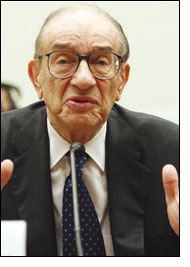
Those such as Alan Greenspan, the former chairman of the US Federal Reserve who claimed that financial innovation was distributing risk to the people in the system best able to shoulder it, have been proved comprehensively wrong( HE WAS CORRECT. IT'S THE GOVERNMENT. ). Instead, the dictum of Warren Buffett, the “sage of Omaha”, that derivatives were financial weapons of mass destruction has been vindicated as one bank after another turns to its government for support( THAT WAS THE PLAN ).

Alan Greenspan

Andrew Hilton, director of the Centre for the Study of Financial Innovation, a London-based think-tank, even argues that “you can make the case that banking is the only industry where there is too much innovation, not too little”.( SILLY )

Economic literature offers both passionate advocates and passionate opponents – which is understandable, given that the impact of financial innovation on social welfare is impossible to measure. Supporters say new instruments, technologies, institutions or markets lower transaction costs, make( THEY CAN ) markets efficient, help solve social problems and contribute to economic growth.

Sceptics highlight obvious costs. Galbraith, in A Short History Of Financial Euphoria (source of the earlier quotation) emphasised the pervasive role of debt: “All financial innovation involves, in one form or another, the creation of debt secured in greater or lesser adequacy by real assets ... All crises have involved debt that, in one fashion or another, has become dangerously out of scale in relation to the underlying means of payment( TRUE, BUT THAT'S THE NATURE OF INVESTING. ).”

From barter to Fuggers’ fall

The double-edged nature of financial innovation has been apparent throughout the ages. Coins improve on barter because they economise on information and transaction costs. Paper money has the additional advantage of being less cumbersome than metal. Yet, as the Chinese found between the 11th and 14th centuries, a paper currency carries inflationary risks.

The most inventive bankers of the 16th century were the Genoese, who developed the equivalent of interest rate swaps in their lending to the Spanish government. They also devised a form of securitisation to use inflows of silver into Spain to finance the delivery of gold in Antwerp to pay Spanish troops in the Low Countries.

According to the historian Fernand Braudel, the Fuggers, pre-eminent bankers of the day in Germany, were profoundly suspicious of this apparent financial sleight of hand. So innovation provided the Genoese with a competitive weapon that helped displace the Fuggers as financiers to the Spanish treasury.

In both these cases innovation was providing a solution to a problem – another long-standing pattern. In China a scarcity of bronze led to the introduction of iron coinage, which was so inconvenient to transport that paper provided an attractive alternative. As for Europe, economic historians William Goetzmann and Geert Rouwenhorst argue that it was the financing requirements of the Crusades that encouraged Italian city-states to develop bond markets.

The cost of hostility to financial innovation may be high. Some historians speculate that a lack of financial development helps explain why the Chinese, who discovered the steelmaking process in the 11th century, did not produce the first industrial revolution.

His verdict captures very precisely the shuffling of asset-backed paper and the slicing and dicing of risk that marked the credit bubble. A huge debt-powered financial superstructure was built on top of the real economy to the point where high-octane finance became increasingly out of touch with productive enterprise.( WRONG )

Yet Galbraith was too sweeping. The financial system does many things. Among others, it provides a means of payment and exchange; it transfers the spare cash of savers to those with investment opportunities; it allows assets to be traded; and it provides insurance, whether in conventional contracts or in such instruments as swaps, options and other derivatives.

In all these areas, innovation has provided tangible benefits( TRUE ). Computerisation has improved the payments system, while technology such as automated teller machines has been a huge convenience to retail bank customers. The internet is transforming the availability of financial information and is lowering transaction costs in broking. Like many other innovations in retail finance, these advances do not involve the creation of debt.

Even in those areas that do, the outcome can still be beneficial. The development of the swaps market, for example, led to the new disciplines of treasury and risk management whereby the banks’ ability to swap fixed for floating interest rates and vice versa allowed them to insure against rate volatility. Currency swaps fulfilled a similar function. With the huge increase in market volatility stemming from deregulation and the abandoning of fixed exchange rates in the 1970s, this ability to hedge was a boon to banks. At the same time, computerised trading increased the efficiency of markets.

More often than not, innovation is satisfying genuine demands( YES ). Where the curse comes in is that many innovations are double-edged. Plastic cards, in so many ways a benefit to bank customers, may lead to over-­indebtedness, a growing social problem. Derivatives can be used to punt as well as to hedge. Credit default swaps were developed as insurance to protect investors against a failure to honour loans or bonds. Then came the collapse of Lehman Brothers, which revealed the extent to which people had underestimated the risk( TRUE ) of their counterparties defaulting.

As the economist Burton Malkiel points out, a benign instrument( THAT'S WHAT IT IS ) designed to reduce risk turned into a monster that came close to destroying the entire financial system( NO. HUMAN BEINGS DID THAT. ).

During the credit bubble, innovation was in one sense satisfying urgent demands all too well. Low-income families wanted mortgages and the banking system provided them. Investors wanted income in the period where even junk bonds offered a diminishing premium over the yield on government bonds, as excess savings in Asia and the petro-economies drove yields down. Yet in the euphoria, would-be home owners overstretched themselves, while banks dropped lending standards( TRUE ) and fraudsters made hay( TRUE ).

Another recurring difficulty lies in assessing risk in innovations, which by definition have no lengthy record. By relying on inadequate historical data( TRUE ), credit rating agencies made asset-backed paper look better than it was. Risk was mispriced( TRUE ) as banks provided investors with a toxic solution to the problem of yield compression, whereby the spread between government bond yields and low quality corporate bond yields became absurdly narrow.

The Crusades

In recent testimony to a congressional committee by James Simons of Renaissance Technologies, a hedge fund, said fanciful ratings( COLLUSION ) of mortgage-backed securities facilitated the sale of “sows’ ears ... as silk purses”. As well as being mispriced, risk was mismanaged, because the underlying methodologies were fundamentally flawed( TRUE ).

The damage caused by bubbles can be greatly increased where innovation leads to information loss. Computerisation and the internet have improved the transparency of much of the financial system. Yet most of the asset-backed paper in the bubble was traded not on organised exchanges but on dealers’ screens and telephones. Instruments such as collateralised debt obligations helped make the system more opaque and more hostage to counterparty risk – the chance that the person on the other side of a transaction fails to deliver. That is because there was no centralised clearing and settlement in which all contracts were guaranteed( IT'S THE GUARANTEE THAT IS IMPORTANT ).

A more fundamental explanation of why innovation can be counterproductive reflects a desire to escape the heavy hand of the state( YES ). Merton Miller, the late Nobel laureate, declared in a 1986 paper that “the major impulses to successful financial innovations have come from regulations and taxes”.( I AGREE COMPLETELY )

If that makes innovation sound subversive, regulatory arbitrage (locating a trading business in a place that has the laxest local laws) can nonetheless have economic and social benefits if directed at bad policy( TRUE ). The US in the 1970s, for example, responded to rising inflation by reviving a Depression-era measure called Regulation Q, which put a cap on deposit interest rates in the hope that by keeping banks’ cost of funds down, mortgage loans would be less expensive.

This was a classic example of attacking the symptoms of a disease, not the causes. It victimised small depositors, who were left with negative real rates of interest as inflation soared. The markets’ response was to invent negotiable certificates of deposit that escaped the constraint of Regulation Q because they were a paper instrument rather than a conventional deposit. European banks internationalised this, offering unregulated deposit rates to larger investors via the new eurodollar market, which helped rejuvenate the City of London in international finance.

That illustrates how markets can act as an escape valve and an adjustment mechanism. Yet the outcome is not always so benign. In the credit bubble, much of the impetus for driving loans off bank balance sheets into securitised form came from the risk-weighted capital regime introduced by the Basel committee of international bank regulators( TRUE ). By encouraging off-balance-sheet activity, the regime turned banking into a shorter-term, more transactional business.

This “originate and distribute” model – in which banks turned conventional loans into fancy securities and sold them on to a pool of investors – reduced the incentive( NO EXCUSE ) for banks to monitor the creditworthiness of those to whom they lent. It was a case of churn out the loans and let the devil take the hindmost.

The latest Basel bank capital accords, which failed to avert financial crisis, have been criticised for:
A poor focus on liquidity.( TRUE. NO IDEAS ABOUT A CALLING RUN ) )
Internal risk rating that allowed banks a high degree of discretion.( INEVITABLE )
Encouraging pro-cyclicality in the system. ( OK )
Giving an excessive role to credit rating agencies.( TRUE )

In addition, banks had an incentive to increase leverage( THAT'S THE CAUSE ) – identified by Galbraith as a recurring cause of systemic damage( YES ) – as they piled more liabilities on to a very slender capital base.

Measures of leverage based on Basel’s “tier one” capital ratio, which were the main focus of analyst attention, appeared less frightening than those based on conventional accounting, which revealed a more disturbing picture that went largely unobserved. The outcome was that banks ended up more highly leveraged( TRUE ) than most hedge funds. Nothing illustrates better how the law of unintended consequences can contribute to financial blow-ups.

An endemic difficulty also arises with insurance, whether conventional contracts or hedging instruments such as credit default swaps. It relates to moral hazard, whereby the existence of a safety net causes people to adopt more risky behaviour( LIKE GOVERNMENT GUARANTEES ). The result is that while insurance reduces the risk to the individual, it increases the risk to the overall system.

Perhaps the most dangerous examples of moral hazard are deposit insurance and the readiness of central banks to act as market makers or lenders of last resort. Owners of insured deposits have little incentive to monitor the creditworthiness of banks where they place their money. Large depositors exercise little discipline over banks they see as too big to fail( THAT'S MY MAIN CAUSE ). After the bubble, the Fed’s role as lender of last resort was extended to investment banks and to AIG, the insurer. So moral hazard is now more widely entrenched across the financial system.( IT ACTUALLY ALWAYS WAS )

Many of these drawbacks can be addressed to ensure that the blessings of innovation outweigh the curses. This is certainly true of the opacity that prevails in over-the-counter markets for securitised financial instruments, where little information about transactions is made public. Banks now see it is in their own interest to shift securitised business to exchange traded markets with centralised clearing houses backed by capital from trading members( A GOOD IDEA ). This will introduce transparent pricing and volume information while reducing counterparty risk, which is what the regulators want.

But moral hazard can be addressed only by regulation, by penalising management and shareholders when banks are bailed out( YES ), or by allowing big banks to go bust( YES ). More regulation almost certainly has implications for the rate of innovation( I AGREE ), which tends to go in waves. With politicians and watchdogs now preoccupied with the curses rather than the blessings of financial ingenuity, an innovation slowdown is probably inevitable( YES ). New and risky financial products may attract higher capital penalties under a revised Basel regime.

Yet there are those, such as Robert Shiller of Yale University, who argue that much of the damage could have been avoided if finance had been democratised and innovation used to manage individual home owners’ risks through, for example, house price futures markets that allow home owners to insure against falls in prices( I AGREE ). Others say derivatives could help address problems such as water shortages, since futures markets can smooth imbalances of supply and demand.( I AGREE )

Certainly the urge to innovate will not go away( NO WAY ). For bankers, it offers huge advantages. In retail banking, patented inventions such as Merrill Lynch’s cash management account in the 1970s allowed what was then a securities house to make a big dent in the deposit base of the conventional banking system with a genuinely attractive product. At the wholesale end, producing a new financial mousetrap gives banks an entrée to corporate clients and institutions.

Yet the biggest spurs to innovation in future may be those identified by Miller. The cost of bailing out banks will put big pressure on public finances( TRUE ). It would be surprising if governments do not look to increase the tax take from companies to relieve some of that pressure( PROBABLY ). Companies will look to banks, lawyers and accountants to find novel instruments to mitigate the damage.( THAT'S IT )

With an increased burden of regulation, financial innovation will probably provide new forms of regulatory arbitrage to circumvent the new rules, just as it did after the introduction of Basel One in the early 1990s.( VERY TRUE )

Miller found, after predicting a lower rate of innovation back in 1986, that it is always dangerous to forecast any slowdown in what financial ingenuity can bring about( I AGREE ). The backlash to today’s financial crisis will inevitably provide tasks for the next generation of regulatory arbitrageurs( I AGREE )."

As for innovation, what's needed is supervision, done by reviewing the practices of all investments that:

1) Increase Leverage

2) Shift Risk To Third Parties

3) Magnify Risk

In other words, focus on the broad outlines and purpose of the investments. In the case of CDOs and CDSs, the desire was to lower capital requirements, for example.

In the end, government guarantees and fraud will be seen as the main culprits, not innovation.

Monday, November 24, 2008

What's A Hedge Fund?

A good explanation of Hedge Funds by Timothy P. Carney on Heckanomics:

"But what the heck is a hedge fund? Who owns them? Are they really unregulated? Are they really undertaxed?

The meaning of “hedge fund” is broad and fluid, and they don’t necessarily involve hedging. The two closest things to defining traits would probably be: (1) by law, they are not open to the general public; (2) the manager of the fund is compensated mostly by claiming a portion of the fund’s profits. Also, hedge funds typically multiply their gains by borrowing heavily (also known as leveraging). Another common trait is that they often employ short-selling (positioning the fund to benefit from a downturn in a stock, commodity, etc.) or creative investments that move in ways uncorrelated to the stock market."

Okay:
1) Not open to general public
2) Manager paid from profits
3) They borrow a lot ( Leveraging )
4) They short sell a lot ( Bet on stock, etc. going down )
5) Use assorted ways of not moving with the market

"Hedging is an investment practice whereby you protect yourself against risk, often by betting on both sides, so to speak. For example, if you’re a business that is vulnerable to increases in the price of gasoline — say, a trucking company — you might hedge your exposure to oil prices by investing in oil futures. If oil goes up and your costs increase, at least you can cover some of the cost with the increased value of your oil futures.

There are hundreds of ways to hedge an investment or hedge against a vulnerability. Hedging reduces both risk and potential reward — an unhedged trucking company might suffer more when oil prices climb, but they also are better off when oil prices drop. It’s kind of like an insurance policy: you pay to ward off uncertainty."

This is kind of like hedging your bets.

"The first hedge fund was all about hedging. Its creator, Alfred Winslow, called it a hedged fund. The fund took a long position on some stocks (betting on their going up), and a short position on others (betting on their going down). This strategy meant his fund lagged the market when the market was climbing, but it also meant his fund climbed when the market sagged. But by leveraging — investing mostly borrowed money — you can turn steady, but earthly growth into huge returns.

(If you invest $2 million of your own money, borrow $20 million and invest it all, earn 10%, and pay 5% interest, you just made more than a million dollars with only $2 million in seed money. A 50% return, by some measures.)"

The same thing. The details will vary, but you're investing on going up and going down at the same time. The trick is to make this counter investment make you money.

"Today, some people think of hedge funds not as being hedged, but as being a hedge against other investments. In other words, because they often get more creative in their investing, a hedge fund is a way to hedge against more traditional investments."

It's actually the same thing, you're trying to counter invest.

"But neither hedging or short-selling are not at the heart of hedge funds — those are investment strategies that one can engage in outside of a hedge fund. A hedge fund, at its heart, is a business model. It is a limited partnership in which the manager is rewarded proportional to the fund’s performance — a model crafted largely to avoid the regulations and taxes that constrain other forms of investment."

Main Objective: Manager paid for performance
To avoid regulations and taxes of other investments

This is why people invested in CDSs and CDOs in my opinion. In other words, to avoid capital requirements.

"Eager congressmen and much of the media describe the hedge fund industry as “unregulated.” This, of course, is an exaggeration, but at the heart of the “unregulated” claim is an important truth: hedge funds do not operate under the jurisdiction of the Securities and the Exchange Commission, they are not subject to Sarbanes-Oxley or the slew of reporting regulations the SEC imposes on publicly traded companies or mutual funds. Also — and this is key — they are not limited in how much they can leverage their position."

Now, I'm saying that CDOs and CDSs answer the same question: namely, how can we invest using less capital= increase our leverage. ( I should say that one can use them otherwise. One could simply keep more capital, and yet write a CDS. Whether it would be worth it is another question )

"Well, consider the purpose of SEC regulation of publicly traded companies and funds. It’s not as if the SEC polices these companies in order to make sure nobody’s getting too rich — or losing too much money. The SEC’s stated goal is to erect protections for investors, thus making Joe the Plumber believe he is less likely to be ripped off by whichever corporation, brokerage, or mutual fund is asking for his business.

But Joe the Plumber can’t invest in a hedge fund. If the hedge fund were to let Joe invest, they would therefore be subject to SEC regulation. And so, hedge funds evade most SEC regulation by making themselves open only to “accredited investors.”

Hedge Funds allow only Accredited Investors.

How does one become “accredited”? Basically, you have to be rich.

"A corporation or charity can be an accredited if it has more than $5 million in assets. An individual is “accredited” if he has net worth of more than $1 million, or has earned more than $200,000 each of the last two years (or if he and his wife combined for $300,000 each of the last two years).

The idea is, these people don’t need the protection of the SEC. If rich people want to blow their money on some dumb investment, or in some shady scheme, why should the taxpayers pay to protect them from their own errors?"

Accredited Investor= A wealthy investor who can afford to lose money and not be indigent

"A hedge fund, then, is a limited partnership, in which every partner must be an accredited investor. Most partners in hedge funds are investment banks or non-profit institutions such as foundations or pension plans. A minority are wealthy individuals.

When Alfred Winslow Jones wanted to launch his hedged fund, he didn’t want limits on how much he could leverage himself, and he didn’t want to run his every move past the SEC. So, he couldn’t just launch a mutual fund. He had to make a limited partnership, and that was the first half of making the modern hedge fund.'

This is financial innovation.

"If you have heard complaints about how filthy-rich fund managers are under-taxed, well, that’s kind of the point.

Before we get to the taxation of hedge fund managers, it’s important to explain the business model of hedge funds. The manager of a fund gets most of his compensation based on the performance of the fund. That gives investors bit more faith in the fund manager — both of them have their wealth riding on the fund’s growing. But just how the fund’s growth translates into the manager’s wealth is at the heart of the current debates over hedge-fund manager-taxation.

You may know that the top tax rate on capital gains is 15%, while the top income tax rate is 25%. That means the money you make when you sell your stocks for a profit is taxed less than the paycheck you bring home. You can imagine why a trader, possibly earning millions each year, would try to find a way to replace all his “income” with “capital gains.”

This is the other essential aspect of a hedge fund. The fund manager may receive some compensation in the form of straight-up fees, but the managers are compensated mostly through what’s called “carried interest.”

“Carried interest” is not interest like the interest you pay on your mortgage or collect on your savings account. It’s an interest in the fund — as in, a stake in the fund. In the business, they call it the carry.

As the fund increases in value, the manager, who very well may not have invested a single dime, gains an interest in the fund. If the fund stays stagnant or shrinks, the manager gets paid only the nominal fees. Sometimes there is an agreed-upon rate of return (for example, inflation, or the gains in the stock market) before which the manager gets no carried interest. Once that threshold is crossed, though, 20% of all gains are credited to the manager."

The manager gets paid with part ownership of the fund.

So, if all the investors combined put in $50 million, the manager might collect $500,000 in fees (much of which goes to expenses), and then he will gain a 20% interest in all earnings over 2% per year. If, after one year, the fund is worth $75 million, $4.8 million of that money is the manager’s stake, while the rest is divided among the partners proportional to their investment."

Fine. He can sell the interest or proceedings at a lower tax rate.

"Hedge funds, then, are the fancier versions of the mutual funds or investment schemes you and I get to play with. Because their managers have the opportunity to make huge gains, hedge funds attract much of the best talent. Because they are not regulated as tightly as stocks and mutual funds, they have opportunities to correlate their profits to things other than the stock market.

From one way of looking at it, it’s odd that Congress should want to impose SEC-style regulation on hedge funds. Why should our government pay to protect rich people from losing money? Shouldn’t folks with millions of dollars to invest be left to their own as far as deciding who is a worthy trustee of their wealth?"

Good question.

"One factor advancing hedge fund regulation: existing hedge funds will benefit from any regulations that make it harder to enter the business."

Raising the entry fee. If they're lucky, they'll become a cartel like Ratings Agencies.

"Another: all this talk by politicians of regulating and increasing taxes on hedge funds has driven a huge a boom in hedge funds’ contributing to these politicians’ campaigns — and hiring the politicians up as lobbyists."

They're citizens just like everybody else. Why shouldn't they.

To be honest, I think that they should pay regular tax rates on carried interest. To the extent that certain investments are regulated, the Hedge Funds should play by those rules. But the basic lesson to be learned out of all this is that financial innovation means taking or adding risk by avoiding laws and regulations.

If you want to keep track of this, you're going to have to have broad principles that can funnel all risky investments, say ones that extend leverage, or involve third parties, or magnify risk, to an agency that can look them over. Whether or not to regulate should be secondary to making sure that they're following basic sound rules of investing.

Friday, November 21, 2008

"We need new safe-fail policies to prevent inevitable institutional failures from snowballing into economic crises.

Here's a pretty good argument for putting Derivatives on an exchange or Clearinghouse from Benn Steil in the FT:

"The global financial crisis is rightly prompting calls for a rethink of how we regulate financial institutions and markets. Most such calls are focused on what might be called “fail-safe” regulations, designed to reduce the risk that institutions will make reckless lending and investment decisions. Even libertarian-leaning policymakers and thinkers, such as Alan Greenspan, are now concerned with the capacity of our globally connected financial system to spread failures of risk management from one institution to another."

I hadn't heard them called Fail Safe Regulations until now, but the point is well taken. We want regulation to keep these kinds of financial crises from occurring. A global approach makes sense to me. No, it's not global government.

"In this crisis, institutions that bought up buckets of complex mortgage-linked securities found themselves facing huge losses as house prices fell. Their counterparts and clients, fearing the worst, provoked the worst by ceasing to do business with them. Others who wrote insurance against their failures-to-pay (credit default swaps) then lost huge sums as well, fuelling the fires of system-wide panic and default. But better regulation of lending standards and risk management, the argument goes, will prevent such systemic problems in the future.

History does not provide much comfort here. In financial markets, there are always new risks to take and new ways for risk management models and procedures to break down. Fail-safe approaches can also go too far: witness Japan in the early 1990s, when heavy-handed government intervention effectively shut down financial innovation. Furthermore, government policy promoting imprudent risk-taking – witness long-standing US congressional support for failed mortgage giants Fannie Mae and Freddie Mac – can overwhelm regulations intended to control it."

I think that the cause of the problem was the search for investments that needed less capital requirements, not the investments themselves.

His two main points I agree with:

1) It's hard to stop financial innovation, since its intent is to evade current regulations

2) Over-regulation is a serious problem

"The key is to supplement prudent fail-safe interventions with safe-fail ones: interventions that recognise that institutional failures will continue to occur and that focus on limiting the systemic damage after they do."

Here's "prudent" again, meaning nothing specific, but it will work.

"A case in point is the mammoth global derivatives markets. Despite wild swings in prices, derivatives exchanges have not contributed one iota to market instability. This is because exchange-traded contracts are centrally cleared and trader defaults – which are rare because of continuously adjusted margin requirements – are absorbed by well-capitalised clearing houses. Compare the 2006 collapse of hedge fund Amaranth, whose derivatives exposures were on-exchange, with the 2008 collapses of Lehman Brothers and AIG, both of which had large exposures in non-cleared, over-the-counter CDSs. Amaranth’s derivative defaults had trivial systemic ripples, while those of Lehman and AIG created major shockwaves. AIG invisibly built up huge under-collateralised sell positions on the back of a faulty credit rating. Yet if those contracts had been transacted on a trading platform with central clearing, margin calls would have short-circuited the strategy well before the company’s September collapse. US and European regulators (whose institutions comprise the vast bulk of OTC trading) should require central clearing once volume barriers in a contract are breached. This will not prevent an institution from losing large sums in derivatives trading, but will stop its default from spreading big losses to others that may be far removed from the original transactions."

This is the argument for an Exchange or Clearinghouse. It's pretty convincing to me.

"There are safe-fail macroeconomic counterparts as well. In August 2007, former Salvadoran finance minister Manuel Hinds and I spoke out at a Reykjavik conference in favour of Iceland unilaterally “euroising”. At the time, the country had more than enough foreign exchange reserves to redeem all the krona in the country for euros at the then-current exchange rate. This would not have stopped the three large Icelandic banks from overextending, but it would have prevented national financial catastrophe. Countries that have adopted one of the two main internationally accepted currencies – the dollar (Panama, El Salvador and Ecuador) or the euro (think in particular of Italy, Portugal and Greece) – have effectively eliminated the risk of currency crisis (that is, not being able to pay short-term foreign debts for lack of access to “hard currency”)."

That's interesting. It seems that the choice is between the Dollar and Euro. But eliminating a currency crisis is important.

"If we are wise and fortunate, in the future we will have corporate governance, capital standards and monetary policy regimes that better constrain the dangerous build-up of excessive leverage among consumers, banks and governments. But that is not enough. We need new safe-fail policies to prevent inevitable institutional failures from snowballing into economic crises."

Notice the focus on excess leverage. That's the main point, I believe.

Wednesday, November 12, 2008

“We are in the midst of very difficult times for world financial markets and economies,” Kohn said.

Wise words from the Fed's Kohn. Just not in this WSJ post:

"Kohn did say that certain Fed programs including currency swap arrangements with other central banks as well as credit auction facilities “might be part of our permanent toolkit.”

Much of Kohn’s remarks dealt with past innovations in the financial sector and their effect on productivity and macroeconomic stability.

“Certainly, as financial innovations accelerated, we had solid reasons to believe that those advances were contributing to the pickup in overall productivity and, possibly, to the moderation in fluctuations of economic activity,” Kohn said.

While those innovations “did produce lasting gains,” Kohn noted that “these gains were clearly accompanied by increasing vulnerabilities,” especially in the housing market and the mispricing of risk.

“Ironically, an important contributor to these misalignments in spending and lending was the long period of economic expansion and low inflation over the past 25 years, interrupted only a few times by mild recession,” Kohn said.

“This good economic performance provided skewed data and bred complacency,” Kohn said.

Meanwhile, economic models used by central banks “are clearly inadequate” when it comes to the economic effect of the expansion and contraction of credit, Kohn said.

He also said it is unclear whether higher official interest rates a few years ago would have done anything to prevent the speculative bubble in housing or the erosion of lending standards. –Brian Blackstone

Here's my comment:

“This good economic performance provided skewed data and bred complacency,” Kohn said.”

For all I know this is true, but it sounds to me like saying we drove for miles and miles and miles and then we hit a wall. The skewed data bred complacency and so we stopped looking out the windshield.

Most of the proposed solutions like higher capital standards, etc., are very basic. I just don’t buy this line of explanation.

Comment by Don the libertarian Democrat - November 12, 2008 at 11:41 am