Showing posts with label Amount Of Stimulus. Show all posts

Wednesday, April 15, 2009

fix a system that broke when our animal spirits got out of bounds.

TO BE NOTED: From Bloomberg:

"Depression Lurks Unless There’s More Stimulus: Robert Shiller

Commentary by Robert Shiller

April 15 (Bloomberg) -- In the Great Depression of the 1930s the U.S. government had a great deal of trouble maintaining its commitment to economic stimulus. “Pump- priming” was talked about and tried, but not consistently. The Depression could have been mostly prevented, but wasn’t. Ultimately, the reason for this policy failure was inadequate understanding of the relevant economic theory.

In the face of a similar Depression-era psychology today, we are in need of massive pump-priming again. We appear to be in a much better situation due to the stronger efforts to date. Still, there is a danger that, because of a combination of faulty economic theory and inadequate appreciation of human psychology, as well as deep public anger, we will not continue with such stimulus on a high enough level.

We desperately need to be persistent, keeping our government response adequate for the problem at hand on a sufficient scale and for sufficient time.

George Akerlof and I lay out how economic theory needs to be changed in “Animal Spirits: How Human Psychology Drives the Economy, and Why It Matters for Global Capitalism” (2009). It shows that the most basic questions can only be answered if we take into account how psychology affects fundamentals such as our sense of fairness or corruption in our economic transactions, which helps determine how trusting or wary we are at any given time.

Following John Maynard Keynes, we call such motivations animal spirits.

Confidence is Key

Our theory of animal spirits is centered on confidence, and the vicious downward cycle of loss of confidence leading to decline in economic activity and then to more loss of confidence. This cycle is fed by the proliferation of stories of failure that spread like a virus by word of mouth over months and years. Moreover, our theory emphasizes that the sense that our society is basically fair can become wounded, and if that happens will not heal for many years.

In our analysis of the current economic crisis, we conclude that the government should have two targets. One would be a joint fiscal-monetary policy target. The same kind of expansionary policies embodied in the government expenditure stimulus and tax cuts that are already being tried have to be done on a big enough scale and for a long enough time in the future.

Gauging Success

Following this target, aggregate demand should be sufficiently high that firms producing good products at a price the public would want to pay will be able to sell them. And if this target is met, skilled labor willing to work at a wage that makes it profitable to sell such products will be able to get a job.

The government should also have a credit target. Once again, we are calling for more of the same kinds of existing policies, but there should be an explicit measure of their success, and until that is reached, the scale and time frame of such policies need to be extended.

The Federal Reserve has to be the lender of last resort and to provide credit in circumstances like we have today. Businesses and consumers, who in normal times would be good credit risks with legitimate needs, should find credit available at reasonable terms. Achieving this requires new approaches, like those announced by the Bernanke Fed and the Obama administration, but on a continuing and even larger scale.

Outrage Creates Dangers

But we have lived for years in a system that tolerated the high-flying inequalities of the current financial system to play itself out, without protest. Where was the outcry then? Why should it not be much more generally targeted? We had two large tax cuts at the federal level that gave highly disproportionate tax advantages to those at the very top. It even gave special provision for extremely low tax rates, much lower than you or I pay on our regular wage income, to managers of hedge funds.

In this crisis, acceptance of these measures is being replaced with outrage. It is increasing the blood pressure of the public, and that can’t continue without damage to our system. Compensation practices in the U.S. need to be made fairer. Vast earnings shouldn’t go virtually untaxed, while the middle class is paying a sizable fraction of each extra dollar in taxes. Only then will the government have the mandate to restore our banking and securities institutions to their proper strong role in our economy.

Shutting Hoovervilles

It is now time to stimulate demand. It is also time to repair the credit system. Those are the two targets that must be hit to get us out of the current economic slump, and to restore confidence. It will be costly to meet both of these targets, and it will require new legislation to give enhanced regulatory powers to deal with a greatly changed financial system, now in a systemic slump.

It is time to face up to what needs to be done. The sticker shock involved will be large, but the costs in terms of lost output of not meeting either the credit target or the aggregate demand target will be yet larger.

It would be a shame if we are so overwhelmed by anger at the unfairness of it all that we do not take the positive measures needed to restore us to full employment. That would not just be unfair to the U.S. taxpayer. That would be unfair to those who are living in Hoovervilles in Sacramento and Fresno, California, and elsewhere; it would be unfair to those who are being evicted from their homes, and can’t find new ones because they can’t find jobs. That would be unfair to those who have to drop out of school because they, or their parents, can’t find jobs.

It is now time to keep our eye on the ball and set clear targets to fix a system that broke when our animal spirits got out of bounds.

(Robert Shiller is the Arthur M. Okun Professor of Economics and Professor of Finance at Yale University, and Chief Economist at MacroMarkets LLC. The opinions expressed are his own.)

To contact the writer of this column: Robert.shiller@yale.edu"

Thursday, April 9, 2009

Taro Aso told Kaoru Yosano

TO BE NOTED: From the FT:

"
Japan prepares record fiscal stimulus

By Michiyo Nakamoto in Tokyo

Published: April 7 2009 03:00 | Last updated: April 7 2009 03:00

Japan's prime minister told his government yesterday to prepare a record fiscal stimulus package to lift the world's second-biggest economy from its deepening gloom, with real spending exceeding 2 per cent of gross domestic product or more than Y10,000bn.

Taro Aso told Kaoru Yosano, the finance and economy minister, to work on a stimulus plan focused mainly on five key issues: a new social safety net for non-regular workers, full use of government financial institutions to ease the credit crunch, a big expansion of solar energy, improvements to healthcare and medical services, and subsidies to local governments for the revitalisation of regional economies.

The government plans to unveil details of the package on Friday, and aims to submit necessary legislation to the Diet before the Golden Week holidays in late April and early May.

Japan has already implemented a range of stimulus measures totalling Y12,000bn ($119bn) in actual government spending under Mr Aso to combat the impact of the global recession,as recommended by the International Monetary Fund.

However, the Japanese economy has remained under severe stress, with exports plunging by record amounts over the past few months.

GDP fell by 3.3 per cent quarter on quarter in the last three months of 2008, and the most recent business sentiment survey by the Bank of Japan, released last week, showed that optimism had deteriorated to a record low.

The measures come amid mounting suggestions that Mr Aso may be preparing for a general election.

The prime minister must call an election for the powerful lower house of parliament by the end of September. But popular discontent with his ruling Liberal Democratic party has made the timing of the election difficult for him.

The latest stimulus package "stops things from getting worse . . . [but] it doesn't necessarily make things better", said John Richards, head of research at Royal Bank of Scotland in Tokyo.

The gap between Japan's potential and actual output was about Y20,000bn, so the government was filling about half of that, said Mr Richards. "It's big [but] it certainly isn't too much."

The measures to provide a safety net for non-regular workers and to improve medical and healthcare services were likely to be effective in stimulating economic activity, although "the devil is in the details", he said.

However, measures to support local government to revitalise regional economies could end up simply increasing unnecessary public works projects, said Masaaki Kanno, the chief economist at JPMorgan in Tokyo.

"Japan has been doing the same things since the 1990s. They should do things that they can't normally do, which require strong leadership," said Mr Kanno.

In addition to the five pillars of the new stimulus package, the LDP is finalising proposals for a temporary relaxation of Japan's so-called gift tax, which is aimed at spurring a transfer of wealth from older to younger people.

The LDP is proposing to increase the amount that is exempt from the gift tax if wealth transferred from the older to younger generation is used to buy real estate.

www.ft.com/asia-pacific

Japanese government is to provide Y50,000bn in loan guarantees to government affiliated financial institutions to buy stocks in the market

TO BE NOTED: From the FT:

"
Japan unveils $154bn stimulus plan

By Michiyo Nakamoto in Tokyo

Published: April 9 2009 03:46 | Last updated: April 9 2009 11:27

The Japanese government is to provide Y50,000bn in loan guarantees to government affiliated financial institutions to buy stocks in the market as part of a record stimulus plan that will cost the government Y15,400bn.

The size of the new package, which amounts to 3 per cent of GDP, highlights the government’s intention to act aggressively to combat the debilitating impact of the global recession on the Japanese economy.

It will give “a large stimulus to the domestic economy”, said Richard Jerram, chief economist at Macquarie in Tokyo.

The package also includes a tax break on up to Y40m of “gift” money parents provide their children to buy a house.

Details of the new stimulus plan, which also includes measures to stimulate solar energy, encourage more lending to corporations and support the unemployed, will be unveiled on Friday.

Using fiscal policy aggressively “will damage the already poor fiscal position but tolerating extended deflation and recession would probably be worse for the path of government debt,” he said.

Takeo Kawamura, chief cabinet secretary told the Japanese media the government would likely have to issue construction bonds and deficit bonds of Y11,000bn to pay for the additional spending.

The new stimulus package comes as core machinery orders rose for the first time in five months, posting a 1.4 per cent month-on-month increase in February.

Tokyo shares surged on hopes the stimulus package would help lift economic activity, with the Nikkei average rising 3.74 per cent to 8,916.06, but bonds slumped over concerns of a flood of new government debt.

Separately, prime minister, Taro Aso, unveiled a mid-to-long-term growth strategy to boost Japan’s real gross domestic product by Y120,000bn, or 24 per cent up from 2008, and create 4m new jobs.

Mr Aso also pledged to provide financial assistance to help double Asia’s economy by 2020 through infrastructure and other investments.

“Asia is the “growth centre of the 21st century.” One of Japan’s major advantages is that it is located in Asia. When thinking about Japan’s new strategy for growth it is important to make the best of this strength,” Mr Aso said.

Under the new growth initiative, the Japanese government will aim to create 2m jobs in the next three years and stimulate demand worth a cumulative Y40,000bn to Y60,000bn.

This will be done through bold institutional reforms and public and private investment focused on increasing the use of environmentally friendly products, creating a society that is “elderly-friendly,” and promoting Japan’s inherent attractiveness, such as its anime cartoons and fashion.

Under the plan, Japan will seek to regain its number one position in solar energy by increasing solar energy production levels 20-fold by 2020, subsidizing the use of solar energy in homes and turning schools “green.”

To make life easier for the elderly, the government will increase the number of nursing care workers from 1.3m today to 2.2m by 2020 and improve medical services in regions among other initiatives.

By improving infrastructure, Japan will also aim to boost its tourism market from Y2,5000bn today to Y4,300bn in 2020.

The government will support “soft power” industries, such as manga comics and fashion to create an industry of Y20,000bn to Y30,000bn, Mr Aso said."

Friday, March 27, 2009

They realize that their economy is driven by exports, and therefore they are planning to free ride off of the U.S. stimulus package.

From The Baseline Scenario:

"Payback Time

with 15 comments

Once upon a time there was a president named George. He liked to do things his own way, which annoyed some of his “friends” in Europe. But then a new president named Barack was elected, who not only promised to be nicer to his friends, but was actually very popular in most parts of the world. And the people of the world thought we would see a new era of international cooperation, at least between the U.S. and Europe.

Not so much.

On this side of the Atlantic, the Obama administration and the Fed have been working night and day in an attempt to turn around the economy: Fed funds rate reduced to zero, $800 billion stimulus package, new plan to aid struggling homeowners, new plan for buying toxic assets, new budget, decision by the Fed to buy long-term Treasury bonds, new domestic regulatory framework outlined this week, etc. We’ve been plenty critical of various aspects of the U.S. response, but at least they’re trying.

(Continental) Europe, by contrast, has decided they’ve done enough and it’s time to sit back and watch.

First, in an interview for Monday’s Wall Street Journal (no-subscription-required summary here), Jean-Claude Trichet, head of the European Central Bank, said that no new measures are needed to combat the global economic crisis. Then Mirek Topolanek, the prime minister of the Czech Republic and the president (in this rotation) of the European Union called the U.S. emphasis on fiscal stimulus “the way to hell.” And all of this is coming in the week leading up to the next G20 summit. What happened to diplomacy?

While it is relatively easy to write off a prime minister whose government collapsed on Tuesday night, there is a very real divide between the United States and, in particular, Germany, the heavyweight in the European economy. And it’s very clear that the Germans (and the French) do not want to spend more money, increase their budget deficits, or do anything except talk about international financial regulation.

I think there are three possible reasons for this attitude.

  1. The Germans believe that the economy will recover on its own from this point. Given that not even the optimists in the Treasury Department believe this, I don’t see how this could be the case.
  2. They are so afraid of any risk of inflation that they would rather suffer through an extended recession and high unemployment. This could be possible, although misguided, especially since Germany is already in worse shape than the U.S., with its economy expected to shrink by 3.8% this year (vs. 2.5% for the U.S.).
  3. They realize that their economy is driven by exports, and therefore they are planning to free ride off of the U.S. stimulus package. In this scenario, Germany gets to contain its national debt and minimize the risk of inflation, while letting other countries turn the global economy around.

Now, we’re not blameless here, what with our “Buy American” provision in the fiscal stimulus. But at least our government isn’t closing its eyes and assuming the problem will go away.

Written by James Kwak

March 27, 2009 at 5:00 am"

Me:

“They realize that their economy is driven by exports, and therefore they are planning to free ride off of the U.S. stimulus package. In this scenario, Germany gets to contain its national debt and minimize the risk of inflation, while letting other countries turn the global economy around.”

I’ve been assuming that it’s this, but, since they can’t come out and say this, they’re throwing out any other plausible reason that they can. Whether they can resist the pressure to spend a lot more is an open question, but they’re really working at it.

donthelibertariandemocrat

27 Mar 09 at 10:40 am

Tuesday, March 3, 2009

Liquidity, you might say, always finds its level.

From Felix Salmon:

"
Will Obama's Stimulus Leak Abroad?

Justin Fox has an interesting breakdown of global stimulus packages by country: the US, China, and Spain have big ones, while the rest of the world just doesn't seem to be trying so hard. He writes:

The concern is that if we in the U.S. do lots of stimulating and other economies don't, much of the money will just leak out overseas as we spend on imports but others don't buy our exports.

He's right, and no amount of "buy American" provisions in the bill will prevent money from leaking overseas in a globalized economy. Liquidity, you might say, always finds its level. At the margin, it does seem that countries such as the UK are freeloading on the US bailout -- both in terms of the stimulus package and in terms of the bank bailout.

Here in London, the streets are still vibrant and the restaurants still full: there's lots of talk of massive pain, and the stock market is down a whopping 64% or so from its highs, in dollar terms. But somehow none of this is obvious, at least to my eyes: the main thing I'm feeling here is just relief that finally I can afford to visit my home country again, after being priced out for years when the pound was worth about $2: it's now $1.40.

At those levels, Brits aren't going to be buying much in the way of US exports with or without a stimulus package. On the other hand, it's worth noting that the main British export of late has been financial services, and there's not a huge amount of demand for that Stateside at any exchange rate. But maybe Britain can start working on its tourist trade: I can highly recommend Wheelers Oyster Bar in Whitstable if you want to eat some astonishingly wonderful seafood at a quintessentially English seaside town. Make sure to reserve in advance: it fills up quickly, and the pound is weak!"

Me:


Aren't the US and Spain Spender Countries? At least China is a Saver/Export Country. We might want to at least acknowledge that they're doing their part.

This doesn't look like Beggaring Your Neighbor so much as Let Them Beggar Themselves.

By the way, can you check and see if they're making Chocolate Olivers again? If the are, pick me up a few tins, if you don't mind.

China seems to be doing its part, but most of the developed world is not

From Justin Fox:

"Outside the U.S. and China, there's not all that much stimulating going on

The International Labor Organization has put together a useful compendium of economic stimulus efforts around the world (click here to download the Word file). I know this not because they announced it or anything but because a former student of Harvard economist Dani Rodrik works at the ILO and wrote in to Rodrik point out some flaws in a different stimulus spending compendium put together by some folks at Boston University that had previously been discussed on Rodrik's blog. Don't you just love how information gets disseminated in the 21st century?

Anyway, the bottom line, according to the ILO, is that stimulus plans announced so far amount to about 3.3% of global GDP per year over the coming two years. But what really struck me were the differences in stimulus spending among the world's major economies. Here's a sampling from the report, with the stimulus expressed as a percentage of GDP per year:

Australia 0.9%

Brazil 0.2%

China 6.9%

France 1.3%

Germany 1.6%

Italy 0.3%

Japan 2.3%

Russia 1.1%

Spain 8.1%

United Kingdom 0.9%

United States 5.5%

The concern is that if we in the U.S. do lots of stimulating and other economies don't, much of the money will just leak out overseas as we spend on imports but others don't buy our exports. China seems to be doing its part, but most of the developed world is not. (Neither is most of the developing world, but that's largely because it's hard for them to borrow the money to stimulate with—that is, it's not really up to them.)"

Me:

  1. donthelibertariandemocrat Says:

    I thought that Saver/Export Countries were supposed to spend now, while Spender Countries were supposed to save now. The new plan must be for everybody to spend, but except for Spain, a Spender Country, it looks like the European countries are making sure that they spend less, and other countries are following their lead, not ours.

    It's also possible that everybody else blames the US and China for this mess, and expect us to do the heavy lifting. For better or worse, it looks like we are.

Sunday, January 4, 2009

"Economic policy is based on a collection of half-truths."

This has been Buiter's view all along:

"
Can the US economy afford a Keynesian stimulus?
January 5, 2009

Economic policy is based on a collection of half-truths. The nature of these half-truths changes occasionally. Economics as a scholarly discipline consists in the periodic rediscovery and refinement of old half-truths. Little progress has been made in the past century or so towards understanding how economic policy, rules, legislation and regulation influence economic fluctuations, financial stability, growth, poverty or inequality. We know that a few extreme approaches that have been tried yield lousy results - central planning, self-regulating financial markets - but we don’t know much that is constructive beyond that.( I AGREE )

The main uses of economics as a scholarly discipline are therefore negative or destructive - pointing out that certain things don’t make sense and won’t deliver the promised results. This blog post falls into that category.

Much bad policy advice derives from a misunderstanding of the short-run and long-run impacts of events and policies. Too often for comfort I hear variations on the following statements: “the long run is just a sequence of short runs, so if we make sure things always make sense in the short run, the long run will take care of itself.” This fallacy, which I shall, unfairly, label the Keynesian fallacy, compounds three errors.

The first error is( 1 ) the leap from the correct assertion that a long interval of time is the sum of successive short intervals of time to the incorrect impact that the long-run impact of a policy or event is in any sense the sum of its short-run impacts. The second error is( 2 ) the failure to recognise that our models (formal or implicit) of how the economy works are inevitably incomplete( TRUE ). Parts of the transmission mechanism - positive or negative feedbacks and other causal links between actions today, future outcomes and anticipations today of future outcomes and future actions - that can safely be ignored when we consider the impact of a policy over a year or two can come back to haunt us with a vengeance over a three-year or longer horizon. The third error is that, ( 3 ) when economic agents, households, firms, portfolio managers and asset market prices are even in part forward-looking, the long run is now. More precisely, the long-run consequences of current policies can, through private sector expectations ( YES )and through forward-looking asset prices influence consumption behaviour, employment and investment decisions and asset prices today( TRUE ).

Matching the Keynesian fallacy is the view that just because a certain set of policies is not sustainable, in the sense that it cannot be maintained indefinitely, such policies should not be implemented even temporarily. I will call this the sustainability fallacy. It rests on the simple error that identifies a sustainable policy rule or programme, with a specific constant policy action. A sustainable, sensible or even optimal contingent policy programme, or contingent sequence of policy actions, will in general involve specific actions that will be undone, reversed or even neutralised by later contingent policy actions in the opposite direction. These specific actions may be eminently sensible, even from a long-run perspective, provided they are not maintained indefinitely and are, and are expected to be, reversed in due course, according to the rule, when the state of the economy has evolved or when a new unexpected contingency arises.

US fiscal policy: the Keynesian fallacy on steroids

How does this apply to the macroeconomic stabilisation policy and the financial stability support policies being pursued in the US today?

First, the fiscal policy actions pursued thus far by the Bush administration, but even more so the policy proposals leaked by Obama’s proto-administration are afflicted by the Keynesian fallacy on steroids. They appear to exist outside time, with neither the long-run consequences of the actions like to be implemented over the next couple of years, nor the history that brought the US to its current predicament, the initial conditions, being given any serious attention.

A nation in fundamental disequilibrium: the disappearance of American ‘alpha’

Even before the crisis erupted, around the middle of 2007, the US economy was in fundamental disequilibrium. The external primary deficit (the external current account deficit plus US net foreign investment income) was running at around five or six percent of GDP. The US was also a net external debtor( SPENDER COUNTRY ), Its net external investment position (at fair value, or the statisticians best guess at it) was somewhere between minus 20 percent and minus 30 percent of annual GDP. The US economy managed to finance this debt and deficit position quite comfortably because it gave foreigners an atrocious rate of return on their investment in the US - a rate of return much lower, when expressed in a common currency, than the rate of return earned by US-resident investors abroad.

Some of this lousy ex-post average return on foreign investment in the US was no doubt unexpected and one-off. If risk premia on foreign investment in the US and on US investment abroad were the same, the appearance of excess returns to US investment abroad relative to foreign investment in the US may simply have been an example of the ‘peso problem’ - a ‘small-sample bias’ in expected returns. Assume expected returns are equal using the true distribution of returns. The true distribution may, however, have fat or long tails, with extreme negative values that occur infrequently (e.g. the collapse of a currency peg). The term ‘peso problem’ came from observations on realised returns on US dollar-denominated securities and Mexican peso-denominated securities during the 1970s. The forward premium on the Mexican peso relative to the US dollar was positive through 22 years of a pegged exchange rate, until August 1976, of eight Mexican pesos to the US dollar. On September 1, 1976, the peso devalued by 45 percent vis-à-vis the US dollar.

The term peso problem was, according to Paul Krugman, invented by a bunch of MIT graduate students of the late Rudi Dornbusch. William S. Krasker published the first paper using the expression (”The ‘peso problem’ in testing the efficiency of forward exchange markets”, Journal of Monetary Economics, Volume 6, Issue 2, April 1980, pages 269-276), long before fat tails, black swans and related regurgitations of the same phenomenon became current. The attribution of the expression ‘peso problem’ to Milton Friedman is almost certainly incorrect.

When the disaster scenario (a collapse of the currency peg) materialises, the roof caves in for peso investments. Before the collapse, statisticians, unlike market participants, don’t know the true distribution but base their calculation of the expected return on a sample during which the extreme event has not (yet) materialised. The result is that statisticians overestimate the expected return on the peso (there has been no depreciation of the peso during my sample, therefore the future expected depreciation rate is zero) and attribute the positive (risk-adjusted) rate of return differential on the peso to ‘alpha’. It is, of course, ‘false alpha, as the September 1, 1976 collapse of the peso (repeated a number of times since then) made clear.

Some of the excess returns on US investment abroad relative to foreign investment in the US, may have been anticipated, and may have reflected a low or even a negative risk-premium on US investment. In that case, if risk-adjusted rates of return to foreign investment in the US and on US investment abroad are the same, we would expect that the so far unrealised risk will in due course materialise and blow a large hole in the US external asset position( YIKES ). Even with a very long enough sample, ex-post realised average rates of return on investing in the US will still be lower than ex-post realised rates of return on investment abroad, but the (ex-post) positive correlation between the return on foreign investment and consumption growth could be stronger for foreign investment in the US than for US investment abroad.

Some of the excess returns on US investment abroad relative to foreign investment in the US may have reflected true alpha, that is, true US alpha - excess risk-adjusted returns on investment in the US, permitting the US to offer lower financial pecuniary risk-adjusted rates of return, because, somehow, the US offered foreign investors unique liquidity, security and safety( YES ). Because of its unique position as the world’s largest economy, the world’s one remaining military and political superpower (since the demise of the Soviet Union in 1991) and the world’s joint-leading financial centre (with the City of London), the US could offer foreign investors lousy US returns on their investments in the US, without causing them to take their money and run( YES. THAT'S HOW IMPORTANT GUARANTEES ARE. ). This is the ‘dark matter’ explanation proposed by Hausmann and Sturzenegger for the ‘alpha’ earned by the US on its (negative) net foreign investment position ....

Now, from H and S:

"In short, the US is a net provider of knowledge, liquidity and insurance( GOVERMENT GUARANTEES. YOU KNOW HOW IMPORTANT THAT THIS IS IN MY OPINION. ). As the world became more global financially, the increasing asset value of these services underlies the spectacular increase in dark matter over the last two decades."

Back to Buiter:

" If such was the case (a doubtful proposition at best, in my view), that time is definitely gone. The past eight years of imperial overstretch, hubris and domestic and international abuse of power on the part of the Bush administration has left the US materially weakened financially, economically, politically and morally ( TRUE ). Even the most hard-nosed, Guantanamo-bay-indifferent potential foreign investor in the US must recognise that its financial system has collapsed. Key wholesale markets are frozen; the internationally active part of its financial system has either been nationalised or underwritten and guaranteed by the Federal government in other ways( TRUE ). Most market-mediated financial intermediation has ground to a halt, and the Fed is desperately trying to replace private markets and financial institutions to intermediate between households and non-financial operations. The problem is not confined to commercial banks, investment banks and universal banks. It extends to insurance companies (AIG), Quangos (a British term meaning Quasi-Autonomous Government Organisations) like Fannie Mae and Freddie Mac, amorphous entities like GEC and GMac and many others. ( TRUE )

The legal framework for the regulation of financial markets and institutions is a complete shambles. Even given the dismal state of the legal framework, the actual performance of key regulators like the Fed and the SEC has been appalling, with astonishing examples of incompetence and regulatory capture.( FRAUD, ETC. )

There is no chance that a nation as reputationally scarred and maimed as the US is today, could extract any true ‘alpha’ from foreign investors for the next 25 years or so. So the US will have to start to pay a normal market price for the net resources it borrows from abroad. It will therefore have to start to generate primary surpluses, on average, for the indefinite future. A nation with credibility as regards its commitment to meeting its obligations could afford to delay the onset of the period of pain. It could borrow more from abroad today, because foreign creditors and investors are confident that, in due course, the country would be willing and able to generate the (correspondingly larger) future primary external surpluses required to service its external obligations. I don’t believe the US has either the external credibility or the goodwill capital any longer to ask, Oliver Twist-like, for a little more leeway, a little more latitude. I believe that markets - both the private players and the large public players managing the foreign exchange reserves of the PRC, Hong Kong, Taiwan, Singapore, the Gulf states, Japan and other nations - will make this clear. ( HERE I DISAGREE. THE SAVER COUNTRIES ARE TEMPTED, FOR SOCIAL STABILITY REASONS, TO TRY AND KEEP THE SAVER COUNTRY/SPENDER COUNTRY SYMBIOSIS GOING. )

There will, before long (my best guess is between 2 and 5 years from now) be a global dumping of US dollar assets, including US government assets. Old habits die hard( IT CAN LEAD TO SOCIAL DISLOCATIONS ). The US dollar and US Treasury Bills and Bonds are still viewed as a safe haven by many( TRUE ). But learning takes place. The notion that the US Federal government will be able to generate the primary surpluses required to service its debt without selling much of it to the Fed on a permanent basis, or that the nation as a whole will be able to generate the primary surpluses to service the negative net foreign investment position without the benefit of ‘dark matter’ or ‘American alpha’ is not credible. ( PROBABLY TRUE )

So two things will have to happen, on average and for the indefinite future, going forward. First, there will have to be some combination of higher taxes as a share of GDP or lower non-interest public spending as a share of GDP( I AGREE ). Second, there will have to be a large increase in national saving relative to domestic capital formation. ( GRADUALLY, YES )

The need for a massive resource transfer towards the public sector

As regards the required massive transfer of resources from the public to the private sector in the US, it has long been recognised by those who look at long-term prospects for taxes and public spending in the US, that a combined permanent increase in the tax share/reduction in the share of public spending in GDP of around ten percentage points would be required to fund existing Medicare and Medicaid commitments (and to a lesser extent Social Security commitments). In the past decade the US has legislated for its citizens (though Medicare, Medicaid and Social Security retirement) a West-European-style welfare state( TRUE ). Obama’s proposals for universal health care will complete this process. The US has done so with a general government public expenditure share in GDP that is about 10 percentage points below the West-European average (in the mid-thirties for the US, in the mid-forties in for Western Europe. Evolving demographics and entitlement will drive US welfare state expenditure towards the West-European levels, in the absence of political decisions in the US to limit coverage and entitlements( TRUE ).

This resource shift from the private to the public sector would only manifest itself gradually however, and no doubt, there will be changes in (whittling down of) these commitments before their full impact is felt. ( I AGREE )

The US Federal government has taken on massive additional contingent liabilities through its bail out/underwriting( GUARANTEES ) of the US financial system (and possibly other bits of the US economic system that are too politically( TRUE ) connected to fail). Together will the foreseeable increase in actual Federal government liabilities because of vastly increased future Federal deficits, this implies the need for a future private to public sector resource transfer that is most unlikely to be politically feasible without recourse to inflation( A BAD CHOICE ). The only alternative is default on the Federal debt( I SAY THAT SAVER COUNTRIES MIGHT GO FOR THIS. ). There is little doubt, in my view, that the Federal authorities will choose the inflation and currency depreciation route over the default route.

If I can figure this out, so can anyone in the US or abroad who follows recent economic developments. The dawning of the realisation( INFLATION ) will lead to the dumping of the assets.( BECAUSE THEY WILL BE WORTH LESS IF HELD. AN INFLATION RUN. )

Even if the US Federal government decides to go the inflation route for ‘paying off’ public debt is would be too politically difficult to service through tax increases or spending cuts, it is unlikely that some, not insignificant, resource transfer from the private to the public sector will have to take place. And there we have the short run-long run conundrum. If the economy were at full employment and a high rate of capacity utilisation today, it would still require a permanent resource transfer from the private sector to the public sector, that is, higher taxes or lower public spending. But for cyclical purposes( OUR CURRENT RECESSION ), lower taxes and higher public spending are indicated - provided the authorities have the credibility to commit themselves to future tax increases and/or spending cuts that would not just take care of the existing obligation, but also of the additional debt that would be incurred as a result of the Keynesian stimulus.( I'M FOR THIS SOLUTION. )

The latest gurgling about the magnitude of the Obama fiscal stimulus are certainly impressive: $775 bn or so (around five percent of GDP) over two years. This on top of a Federal deficit that even absent these stimuli could easily top $750 bn. I now anticipate a Federal deficit of between $1.5 trillion and $2.0 trillion for 2009 and something slightly lower for $ 2010. With both the Fed and the Treasury exposed to trillions of private assets and institutions of doubtful quality and solvency, the stock of US Federal debt could easily increase by many more trillions of US dollars during the next couple of years.

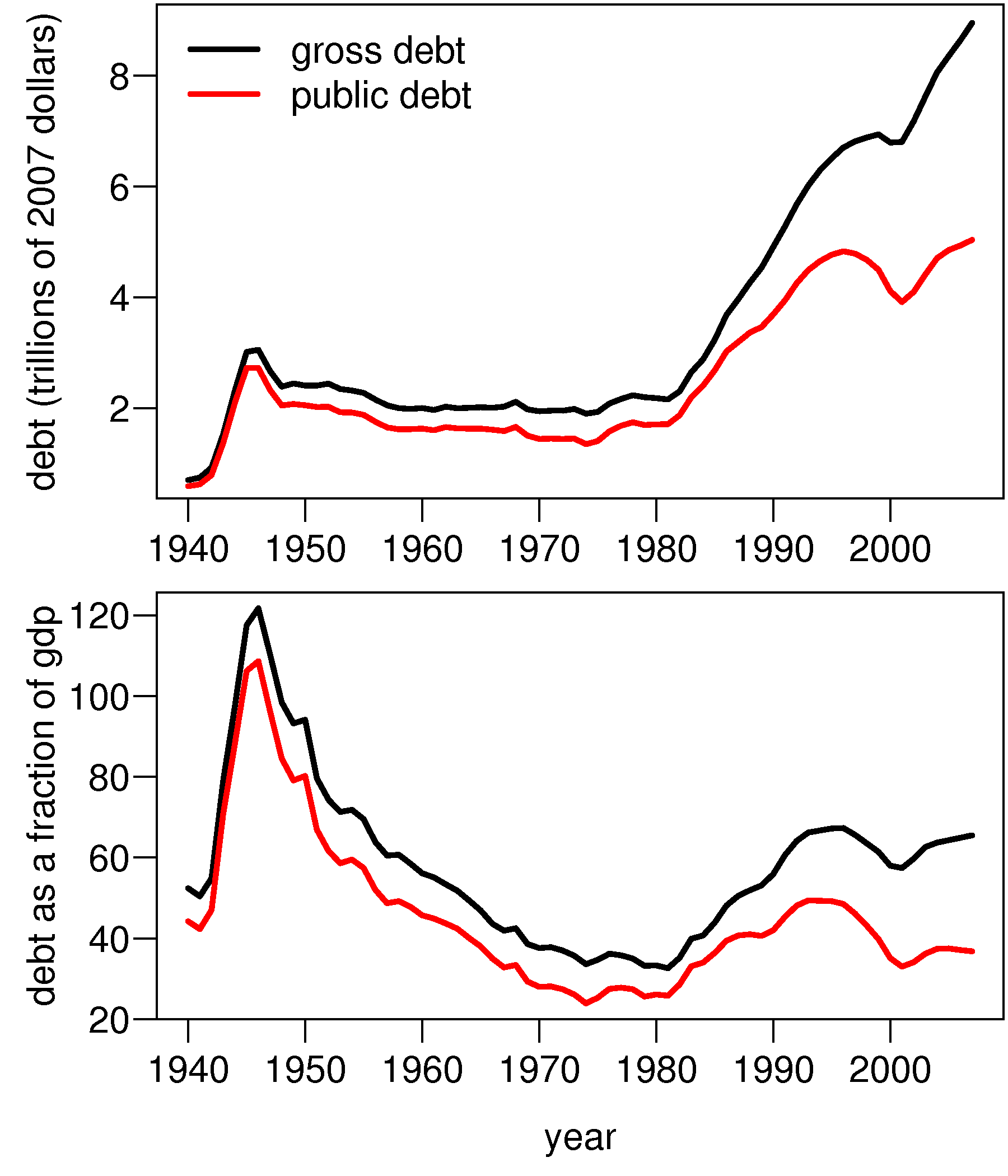
Those familiar with the post World War I and post-World War II public debt levels will not be impressed with even a doubling of the public (Federal) debt held by the public as share of GDP, from its current level of around 40 percent of annual GDP (gross public debt, including debt held by other government agencies, like the Social Security Trust Fund, stands at around 70 percent of GDP). Chart 1 is taken from Wikepedia. Following World War II public debt stood at more than 100 percent of annual GDP.

Chart 1

usdebt.png

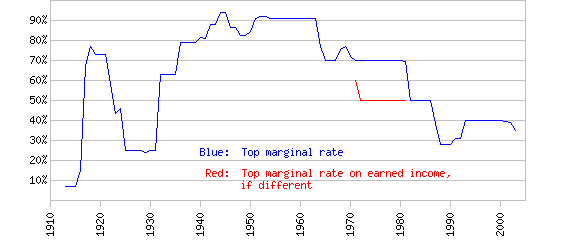
A simple (coarse?) indicator of ‘tax tolerance’ - willingness to pay taxes or to make others pay taxes( YES ) - is the highest marginal rate of personal income tax. For the US this is shown in Table 2 below. It is taken from the website of TruthAndPolitics.org.

Chart 2

top-rates-graphphp.png

That, however, was then. The debt was incurred to finance a temporary bulge in public spending motivated by a shared cause: defeating Japan and the Nazis. The current debt is the result of the irresponsibility, profligacy and incompetence of some( FRAUD, ETC. ). Achieving a political consensus to raise taxes or cut spending to restore US government solvency is going to test even the talents of that Great Communicator, Barack Obama.

If you add to the Keynesian fiscal stimulus package Obama’s ambitions for increasing infrastructure investment to stimulate growth, to fund (not quite) universal healthcare and to stimulate alternative energy production and use, the incompatibility of US public spending ambitions and the political capacity to raise the necessary revenues is glaring. So the government would borrow. From whom? Not from the domestic private sector. They are saving rather little and are being discourage from saving what little they are saving by the fiscal stimulus package. So the US government will borrow abroad to finance its infrastructure, health ambitions and green agenda? Some day perhaps. But not during Obama’s presidency.

So will the Keynesian demand stimulus work? For a while ( a couple of years, say) it may. When the consequences for the public debt of both the Keynesian stimulus and the realisation of the losses from the assets and commitments the Fed and the Treasury have taken onto their balance sheets become apparent, the demand stimulus will fade and may be reserved as precautionary( A PROACTIVITY RUN ) behaviour takes over in the private sector. My recommendation is to go easy on the fiscal stimulus( I AGREE ). The US government is ill-placed financially and fiscally, to engage in short-term fiscal heroics. All they can really do is pray for a stronger-than-expected revival of global demand, without any major stimulus from the US.

The need for a massive resource transfer towards the rest of the world

Beggars can’t be choosers. The US has been able to get away with decades of private sector improvidence because of two unique and time-limited factors. The first is a sequence of capital gains on household assets (stocks and real estate) that provided a lovely substitute( TRUE ) for saving to provide for retirement, old age and a rainy day. The second was the excess returns earned by the US on its net foreign investment (its ability to borrow at an unbelievably low rate of interest/rate of return, because of the unique position of the US as the ultimate source of liquidity and security( GUARANTEES ).

Both rational drivers of a low US saving rate are gone. The US housing market and global stock markets have imploded. It will take years, even decades, to restore household financial wealth-income ratios to levels that don’t guarantee retirement in poverty for much of the US population. The rest of the world will also no longer lend to the US at a negative nominal (and real) interest rate, as it has done for years.( AGAIN, I'M NOT SO SURE. )

So the US has to shift aggregate demand from domestic demand to external demand. And it has to shift production from non-tradables to tradables - exportable and import-competing goods and services. By how much? At full employment, probably at least six and more likely by around eight percent of GDP.

As regards shifting production towards tradables, this will not be easy( NO IT WON'T ). And policy is pushing in the wrong direction. The Bushbama administrations have decided to bail out the US car industry( FOR SOCIAL REASONS ). That industry does not produce cars the rest of the world wants. If and when the global economy recovers and oil prices rise to $150 per barrel again, US consumers also won’t want the cars produced by Detroit. Sure they can change. They could have changed in 1973, in 1980 and at any time since then. If they could change, they probably would have by now.

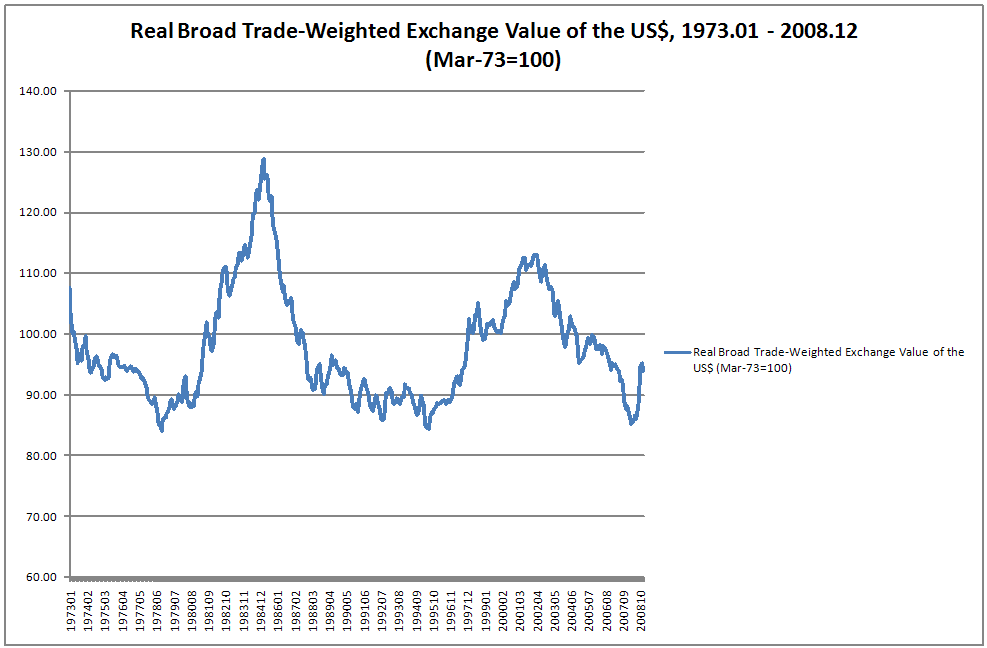
Other US industries are more competitive internationally. But shifting resources towards tradables and away from non-tradables will require re-training and re-education as well as a significant depreciation of the US dollar’s real exchange rate - which amounts to a significant cut in real wages( FOREIGN GOODS WILL BECOME MORE EXPENSIVE ). Chart 3, which shows the US broad real effective exchange rate index, provided by the Fed, shows the behaviour of one measure of the real exchange rate since 1973.

Chart 3

chart3.gif

In the past year, the effective real exchange rate of the US dollar has in fact strengthened rather than weakened, thus impeding the necessary external adjustment. With the short risk-free nominal interest rate effectively at the zero floor, conventional expansionary monetary policy cannot be used any longer to weaken the exchange rate. The effect of quantitative easing and qualitative easing on the exchange rate are ambiguous. If they succeed in stimulating spending by credit-constrained businesses and households, it could well strengthen the currency and weaken the trade balance.

In the decades since I first lived in the US, the quality of secondary education and of vocational training appears to have worsened. Despite the excellence of some institutions, including the wide range and variety of community colleges that give a second chance to so many Americans, the educational system of the US increasingly resembles that of the UK: islands of excellence in a sea of mediocrity. This means that, to become competitive, if you cannot compete on quality and innovation, you will have to compete on price. A larger real exchange rate depreciation and cut in real consumer wages will be required to achieve a given shift of resources to the external sector.

With all the talk about investing in the future, improving infrastructure and creating a dynamic competitive economy, I don’t think the Obama administration will want to achieve the necessary shift of resources towards the rest of the world by reducing domestic investment. In fact, in the one area where domestic investment could and should be reduced (residential construction), there is bipartisan support for boosting investment in residential housing( REALLY ? ). That leaves an increase in national saving as the only way to achieve the required primary external surplus. The government is, however, planning to boost its spending and cut taxes. No increase in public saving therefore can be anticipated for many years( A FEW YEARS ) to come.

The private sector in the US is, at last, saving. We have gone from a declining growth rate of private consumption to a declining level of private consumption. But what do the policy authorities do? Rising household saving equals falling household consumption equals declining effective demand equals longer and deeper recession. Can’t have that. Here is a tax cut. If you can no longer borrow from your bank, we may guarantee your mortgage so you can borrow after all( NOT A GOOD IDEA ). Everything that is desirable from a short-run Keynesian aggregate demand perspective (assuming these measures are indeed effective) is a step in the wrong direction from the perspective of restoring external equilibrium and raising the US national saving rate. ( THAT'S TRUE )

One obvious response to this opposition between what is desirable now and what is necessary in the longer run is to say: let’s do now what is desirable now and let’s take care of what is necessary tomorrow. That might be viable if the US private sector and the US policy makers had the necessary credibility to head south when the destination is north, because they can commit themselves to a timely reversal. If the authorities go ahead with the short-run Keynesian stimulus without having convinced the global capital markets and domestic producers and consumers that there will be a timely reversal, the policies will not work. ( TRUE )

This failure of expansionary fiscal policy is not for Ricardian reasons (Mr. Jean-Claude Trichet gets this wrong all the time - the Ricardian model has as one of its key assumptions that the government always satisfies its intertemporal budget constraint, that is, the government when it cuts taxes or raises spending today, is believed to raise taxes or cut spending by the same amount, in present discounted value, in the future; the second key assumption is that postponing taxes, while keeping their present discounted value constant, does not stimulate consumer demand. There either is no redistribution (from the young to the old, from those currently alive to the unborn and from those who are constrained by permanent income to those constrained by current income) or this redistribution does not have aggregate spending effects. Instead the failure of expansionary fiscal policy is because of the fear, uncertainty and higher risk premia ( TRUE )caused by the higher risk of sovereign default caused by expansionary policy.

If the government is believed to be fiscally continent (future taxes will be raised and/or future public spending will be cut by enough to safeguard the solvency of the state) but turns out not be so after all, the Keynesian fiscal policy will be effective in the short run (as long as the public believes in the fiscal virtue of the government) but will become highly contractionary once the truth dawns. ( TRUE )

Conclusion

Given the bad fiscal position of the US Federal government and given the vulnerability of the external position of the US and its growing reliance on foreign funding, the scope for expansionary fiscal policy in the US is much more limited than president-elect Obama’s advisers appear to realise. Underneath the effective demand problem is a deep structural rot, especially in household sector and financial sector balance sheets. Keynesian cyclical policy options that would be open to more structurally sound economies should therefore not be tried on anything like the same scale by the US authorities. "

I believe that the stimulus should not be more than:

Infrastructure: $100 Billion

Social Safety Net: Whatever is needed

Tax cuts: Sales Tax Cut and Targeted Investment Cuts: $300 Billion

Hopefully: $750 Billion

However, under my definition of stimulus, the figure is $400 Billion.

We should also make sure to keep repeating that we will in the future:

1 ) Raise taxes

2) Cut spending

3) Encourage saving

Finally, about the Saver Countries, I simply believe that it is going to be very hard for them to change.

Sunday, December 14, 2008

She is sceptical of strategies aimed primarily at boosting consumption, given Germany’s high savings rate and low unemployment."

Let's start the German Problem with Willem Buiter in the FT:

"Confessions of a crass Keynesian
December 13, 2008

The German federal minister of finance, Peer Steinbrueck, does not like anything that increases government deficits. He does not like them, Sam-I-Am. I believe he is wrong - very wrong and dangerously wrong. In the interest of Anglo-German harmony and ever-closer cooperation, I have written this post.

It explains that there are bad deficits and good deficits. Or, in the words of Ecclesiastes: “To every thing there is a season, and a time to every purpose under the heaven:” a time to cut taxes and a time to raise taxes, a time to borrow and a time to refrain from borrowing.

Today is a time, even Ecclesiastes would agree, made for increased government borrowing, provided a few key conditions are satisfied.

Mum, the government are running a deficit again!

Government deficits have to be financed by selling assets, by borrowing from the domestic private sector, from the rest of the world or from the central bank. Asset sales by the government can be ignored as a financing option for the governments of the USA, the UK and the nations that constitute the Euro Area. Quite the opposite has been happening lately, with governments acquiring large stake in domestic banks and other financial institutions.

Borrowing from the central bank

Borrowing from the central bank (selling Treasury debt to the central bank) requires the central bank either to increase its monetary liabilities (currency or bank reserves held with the central bank), or to increase its non-monetary liabilities, or to run down its stock of official foreign exchange reserves or other central bank assets. The USA, the Euro Area and the UK all have floating exchange rates, and foreign exchange market intervention has not been a significant pastime for the monetary authorities of these countries. Under current economic circumstances, financing the acquisition of additional Treasury debt by running down central bank holdings of private securities would not make sense. True non-monetary liabilities of the central bank (Central Bank Bills or Central Bank Bonds) are common in developing countries and emerging markets but have not been a common sight on the balance sheets of the Fed, the ECB and the Bank of England - until recently.

The Federal Reserve System today holds a large amount (more than $400 bn) of Treasury deposits on its balance sheet , the result of the Treasury selling Treasury securities to the public and depositing the money with the Fed. The Fed has used these funds to acquire additional private securities. Instead of borrowing from the Treasury (through the Treasury’s deposits with the Federal Reserve System), the Fed is currently considering the possibility of issuing non-monetary, interest-bearing securities directly to the market. Assuming Treasury and Fed securities of the same maturity are perfect substitutes for private investors, this would give the Fed another, economically equivalent mechanism for expanding its balance sheet without increasing the monetary base. Why the Fed would want to increase the size of its balance sheet by issuing non-monetary liabilities rather than monetary liabilities is unclear to me. Liquidity preference remains unbounded from above. Further quantitative easing is not inflationary for as long as current economic conditions last.

Once the official policy rate is at its zero floor, quantitative and qualitative easing are the main instruments of monetary policy, which becomes inextricably intertwined with liquidity management. By acquiring longer-dated government securities and financing these purchases by expanding the base money stock, central banks can bring down the risk-free nominal rate of interest at longer maturities than overnight. Such purchases of longer-maturity government securities reinforce the expectations mechanism - long-term risk-free nominal yields are tied to current expectations of future overnight rates, give or take a term premium. By acquiring private securities, including illiquid private securities, whether through outright purchase or as collateral in repos or at the discount window, the central bank can influence a range of term spreads and liquidity spreads on these private securities.

For simplicity and to put the issue as sharply as possible, let’s assume that when the government (the Treasury) borrows from the central bank, the central bank monetises its acquisition of the Treasury securities, that is, it increases the sum of currency and banks’ deposits (reserves) with the central bank. In practice, the increase in base money is likely to take the form mainly of larger bank reserves with the central bank.

As long as the economy is in the doldrums, with a large (or even large and growing) amount of spare capacity and extreme risk-averse behaviour of banks, other financial institutions and individual investors, the increased quantity of central bank money will be absorbed willingly at the current price level and at the current (near zero) level of the short-run nominal interest rate. Fear and loathing in the financial markets have created a near unbounded liquidity preference - a willingness to hold a humongous quantity of real base money. Such injections of base money are therefore not inflationary.

When the economy recovers, as it will, and private investors recover their bottle, the demand for real base money normalises and the private sector finds itself with excessive real base money balances at the current official policy rate and price level. The private sector will try to reduce its holdings of real money base money balances partly by switching their portfolio allocation towards non-monetary assets and partly by spending them. In the aggregate, of course, the private sector cannot reduce the nominal stock of base money, unless the central bank plays ball and de-monetises the public debt it had monetised earlier. If it does not do so, monetary equilibrium will have to restored through a higher general price level.

This de-monetisation of the public debt (the reversal of the earlier monetisation) will be automatic if, when the economy recovers, the official policy rate rises again above its zero lower bound and quantitative easing comes to an end. When the official policy rate is set (pegged) above its lower bound, the demand for real base money balances becomes finite again. With the general price level pre-determined (given/sticky in the short run because the world is crass-Keynesian in the short run, that is, in real time), the nominal base money stock becomes endogenous. Given the central bank’s balance sheet, the counterpart of the endogenous (and lower) stock of base money is the endogenous (and lower) stock of Treasury securities held by the central bank.

When the economy normalises, the public debt issued by the Treasury to finance any deficits incurred during the slump leaves the central bank and comes back home to mama. Mama will have to convince the markets (the domestic private sector and/or the rest of the world) that it wants to hold this public debt. If the interest rates at which the markets are willing to hold that debt are high, or if there is no interest rate level, however high, at which the markets wish to hold the additional public debt spewed out of the central bank’s balance sheet, we have a problem. Either the government forces the central bank to hang on to the Treasury debt or the economy will have to live with very high interest rates or, in the most extreme case, with default on the public debt.

The first scenario - permanent monetisation of public debt issuance - means that, when the economy recovers, the central bank is forced to engage in whatever amount of monetary issuance may be required to finance the government deficit. The result will be inflation, when the economy recovers - quite possibly inflation in excess of the explicit or implicit inflation target of the central bank

While it is therefore true that the government can always, if it has the power to tell the central bank what to do, monetise the outstanding stock of government debt and any amount of new issuance of government debt, no matter how large, as long as the debt is denominated in domestic currency, there is a limit, for most base money demand functions, to the amount of real resources the government can extract though the inflation tax. This implies that there is a limit to the real value of the government deficit that can be financed through the inflation tax and also to the amount of index-linked government debt and foreign-currency-denominated government debt that can be monetized and inflated away.

The nastiest alternative is that the real value of the government deficit is larger than the real value of the additional issuance of money balances that the private sector is willing to absorb at any constant rate of inflation: the maximum long-run inflation tax at a constant rate of inflation is less than the real value of the government deficit. In that case hyperinflation will result.

It is a long way from the current threat of deflation (negative inflation) to hyperinflation, but it is never to soon to start worrying about the next crisis.

Borrowing from the market

Now consider the case where the government deficit is financed by borrowing from the markets rather than from the central bank. Like every other economic agent, the government is subject to an intertemporal budget constraint. A government is solvent if the value of its net stock of outstanding debt does not exceed the present discounted value of its current and future primary surpluses. The government’s primary surplus is its conventional financial surplus plus net interest paid on its outstanding stock of debt. Since the government here excludes the central bank, among the government revenues that are included in the government’s primary surplus are the taxes paid by the central bank to the Treasury. These contributions of the central bank to the government budget are not usually referred to as ‘taxes’.

Central bank operating profits (net interest income and other income minus the cost of running the show) are usually split between a contribution paid into the government budget and an addition to the central bank’s reserves. The contribution of the central bank to the government budget (called taxes on the central bank in the previous paragraph) increase one-for-one with any increase in interest paid by the government to the central bank on the central bank’s holdings of government securities. At the margin, therefore, borrowing from the central bank is free to the government.

As regards the solvency of the central bank, it makes no difference whether base money is non-interest-bearing (the case of currency) or interest bearing (often the case with banks’ reserves with the central bank). Ultimately, the central bank can settle any domestic-currency denominated claim on itself by paying in currency, which is both non-interest-bearing and irredeemable.

When the government violates its ex-ante intertemporal budget constraint or solvency constraint (its outstanding debt is larger than the present discounted value of its planned/expected primary surpluses) there are but three options for closing this ‘solvency gap’. (1) it cuts current and/or future public spending; (2) it raises current and/or future tax revenues; or (3) it defaults on part or all of the sovereign debt.

When will the future spending cuts or tax increases have to be implemented? The solvency constraint and intertemporal budget constraint are silent on this matter. They only assert that the present discounted value of current and future spending cuts and tax increases has to be at least equal to the solvency gap. It does not tell you when this has to happen. So could we wait until the years 3125 before spending is cut or taxes are increased? Market realities imply the answer is no. Markets are doubting Thomases. To them seeing is believing. They want to put their fingers in the wounds. In practice, spending will have to be cut and/or taxes will have to be increased as soon as this is sensible from a conjectural or cyclical point of view. As soon as a tax increase or public spending cut would be counter-cyclical rather than pro-cyclical, it will have to be implemented. Failure to do so at the first opportunity would weaken the credibility of the government. Markets will entertain steadily stronger doubts about the sustainability of the fiscal-financial programme of the government. Default risk premia will be added to the interest rates at which the government borrows. As the perceived likelihood of a sovereign default increases, the default risk premia will rise and, ultimately, the government will be rationed out of the primary debt markets: it will become impossible to add to the government’s net indebtedness and even to roll over maturing debt.

So is Steinbrueck right in condemning proposals for deficit-financed fiscal stimuli in Europe and elsewhere to counteract the contraction of effective private demand? This question has two parts: (1) does a temporary tax cut or spending increase, followed by a future tax increase or spending cut that restores government solvency stimulated demand? Can governments credibly commit themselves to raise future taxes or cut future public spending by enough to maintain government solvency if they deliver an immediate tax cut or public spending increase?

Does a temporary tax cut boost consumer spending?

For the moment, let’s assume that the answer to the second question is ‘yes’ and let’s address the first. I will focus on a temporary tax cut. Will a temporary tax cut today resulting in a larger budget deficit and increased government borrowing stimulate demand, if future government taxes are raised again by the same amount, in present discounted value, as the current tax cut? Or, in other words, does postponing taxes, holding constant their present discounted value, boost demand?

I will focus on cuts in household taxes, like the personal income tax or VAT. The argument that deficit-financed tax cuts don’t boost consumption demand is known as Ricardian equivalence or debt neutrality. For it to be true, the aggregate consumption demand of consumers has to behave in the same way as would the consumption of a representative infinite-lived consumer with perfect foresight. This consumer knows, when his taxes are cut, that he will pay higher taxes in the future and that the present value of current and future taxes has not changed. His permanent income or wealth have not changed. He will not feel better off as the result of the tax cut. He will save all of the tax cut to pay the higher future taxes.

The demographics of the Ricardian equivalence model are not convincing. People are born, live for a while and die. While they are alive, they overlap with earlier generations (the old) and with generations born since their own generation arrived (the young). Postponing taxes will therefore shift the burden of paying the taxes from the older generations to the younger generations, and possibly even to the (as yet) unborn. The usual life-cycle arguments suggest that the old (who have fewer remaining years to live) will have a higher marginal propensity to consume out of a temporary tax cut than the young. The old certainly will have a higher marginal propensity to consume than the unborn. So cutting taxes today and raising them again in the future by the same amount in present discounted value raises aggregate consumption demand.

It is important that the current tax cut and the future tax increase don’t affect the same people equally in both periods. For the fiscal stimulus to work through a life-cycle mechanism, the current tax cut would primarily have to benefit today’s old and working generations. The future tax increase would be paid mainly by today’s young and working generations, or by those who today are still unborn (future generations). This will be the case if the tax is a tax on labour income or a capitation or head tax. It would not be true if the future tax increase were on the income from an asset that is already in existence and fully owned today (land or physical capital). In that case, both the current tax cut and the future tax increase will be reflected in the value of the assets, which will not change. Taxes on future labour income are not, however, capitalised in the value of any asset owned by anyone currently alive. This is because we have abolished hereditary slavery: the human capital of future generations is not owned by anyone currently alive today. Postponing labour income taxes therefore redistributes resources from the young and the unborn to the old. The life-cycle For life-cycle reasons, the old have a higher marginal propensity to consume than the old, and the unborn don’t consume at all.

If current generations care about their descendants, they may be planning to leave bequests for them. Should the government then try, by cutting taxes today and raising them in the future, to redistribute towards parents and grandparents and away from their children and their grand children, the parents and the grand parents would simply offset this involuntary intergenerational redistribution by the government with voluntary intergenerational redistribution towards their descendants. Lower taxes today would be saved and left as increased bequests. Since most people don’t leave bequests in the first place (most retirement wealth is annuitized), this ingenious argument in favour of Ricardian equivalence even in a world of overlapping generations with finite life spans, is a theoretical curiosum, not a useful empirical benchmark.

In addition to life-cycle reasons for current tax cuts boosting aggregate consumption, there are liquidity reasons. If some consumers are liquidity-constrained (unable to borrow more or sell assets) a cut in current taxes will relax a binding liquidity constraint on current spending, even if the consumer were to be fully aware that he would have to pay higher taxes in the future. Of course, not all households can be liquidity-constrained, otherwise there would be no-one to purchase the securities the government is issuing to finance the increased government deficit.

In the current liquidity crunch there is bound to be a significant increase in the number of liquidity-constrained households. If they could be targeted through the tax cuts, the consumption effects would be strengthened. Liquidity constraints are especially likely among those with large debts, no liquid assets and no collateralisable assets who suffer a temporary interruption in their labour income, due to unemployment, say. They are also likely to affect those with rising age-earnings profiles who have few liquid and collateralisable assets. This would include yuppies and other upwardly mobile groups.

It is hard to believe that, provided a government has the fiscal-financial credibility to be able to commit itself to future tax increases or public spending cuts when it implements immediate tax cuts or public spending increases, that this would fail to stimulate aggregate demand through the usual life-cycle effects and liquidity constraint effects.

The VAT cut rubbished so emphatically by the German minister of finance is in fact quite a clever tax cut, precisely because it is temporary. By cutting the price to the consumer today and raising it again tomorrow, there is an incentive to shift the timing of consumption of non-durables and services, and the timing of the purchases of consumer durables, toward the present, when consumer prices are temporarily low. The neo-classical substitution effect reinforces the Keynesian current disposable income effects.

Mr. Steinbrueck is not impressed and provides variations on the ‘who would cross the road for a 2.5 percent VAT cut when there are 20 percent to 50 percent discounted sales on everywhere’ argument. I think Mr. Steinbrueck underestimates the German and British shopper. But even if he were right and the substitution effect of the temporary VAT cut is negligible, there still is the income effect.

Would the income effect have been stronger if, instead of a VAT cut worth, say £14 bn, the same amount of money had been sent directly to British households in the form of a cheque with the same amount of money for each tax-paying or benefit-receiving adult? This is not at all obvious to me. Assume households spend the same amount following the VAT cut as they did before. If prices come down by the full 2.5 percent cut in the VAT rate, they will buy a larger amount of real commodities with the same amount of income. This stimulates the demand for real goods and services. If prices were to come down by less than the cut in VAT, after-tax profits would increase for the sellers, which could boost the consumption demand of their owners or the demand for investment or working capital inputs by the enterprises themselves.

If none of this sounds convincing to the German minister of finance, he could always implement a temporary investment credit or a similar temporary subsidy to or tax cut on investment on fixed assets. Precisely because it is temporary, it would shift the timing of investment spending toward the present.

So Mr. Steinbrueck’s outburst appears to be rooted in faulty logic and sloppy thinking.

Who can afford even a temporary tax cut or spending increase?

Until further notice, I will assume in what follows that the central banks in the countries or monetary union I am discussing stick to their price stability or dual price stability and full employment mandates. That means that they will monetise government debt and deficits only up to the point where they perceive such actions to undermine the effective pursuit of price stability.

Not all nations in the north Atlantic region are equally well positioned to implement a fiscal stimulus that would result in a significant increase in the government deficit. The decision of the EU to call on all EU member states to implement a 1.5 percent of GDP stimulus to GDP therefore appears to be ill-advised. The magnitude of the stimulus should be modulated (a) according to the needs of the country (how deep is the recession, how open is the economy) and (b) according to the fiscal-financial sustainability of the government and the credibility of the government, that is, the likelihood that it will act in a determined counter-cyclical manner during the next economic upswing, raising taxes and/or cutting public spending.

Italy’s fiscal-financial sustainability and the credibility of its government were it to announce a pleasure today - pain tomorrow temporary fiscal stimulus are close to zero. The UK’s fiscal-financial sustainability is poor and the credibility of its government is severely impaired after years of pro-cyclical fiscal policy during the age of excess that preceded the current bust. The UK government, by de facto or de jure underwriting the liabilities of the UK banking system has assumed debts worth over 400 percent of GDP. Of course there are assets on the other side of the banks’ balance sheets, but the liabilities are firm and clear, while the assets are dodgy and of uncertain value. The same applies to the United States of America, where the Federal government is not only up to its neck in actual and contingent liabilities through its underwriting of the banking system, GSEs like Fannie Mae and Freddie Mac, insurance companies like AIG and non-specific partly financial enterprises like GE, but is about to have the water rise even higher as it bails out the three domestic automobile manufacturers.

Germany’s Maastricht gross general government debt as a percentage of annual GDP was about 20 percentage points higher than that of the UK at the end of 2007. However, the cyclically adjusted budget deficit in Germany is far smaller than that of the UK. In addition, the exposure of the German government to its banking sector, while non-trivial, is much smaller than that of the UK government to its over-developed banking sector. Most important, the German authorities have demonstrated both the willingness and the capacity to engage in countercyclical fiscal policy during the most recent boom period.

This means that reasons of national self-interest and as a constructive member of the global community, Germany can and should engage in a significantly larger fiscal stimulus (relative to the size of its economy) than the US and the UK. Spain and France also should deliver an above-average fiscal stimulus, while Italy cannot afford much of a stimulus at all.

Sovereign default versus inflation levies

For the first time since the German default of 1948, a number of countries in the north Atlantic region (North America and Western Europe) face a non-negligible risk of sovereign default. The main driver is their governments’ de facto or de jure underwriting of the balance sheets of their banking sectors and, in some cases, of a range of non-bank financial and non-financial institutions deemed too big to fail. Unfortunately, in a number of cases, the aggregate of the institutions deemed too large, too interconnected or too politically connected to fail may also be too large to save. The solvency gap of the private institutions the authorities wish to save exceeds the fiscal spare capacity of the sovereign.

The clearest example of the ‘too large to save’ problem is Iceland. Iceland’s government did not have the fiscal resources to bail out their largest three internationally active banks. The outcome was that all banks went into insolvency. The government then nationalised some key domestic parts of the three banks out of the insolvency regime, decided (under massive pressure from the British, Dutch and German governments) to honour Iceland’s deposit guarantees and left the rest of the unsecured debt to be resolved through the insolvency process.

Other countries face the problem of the inconsistent quartet ((1) a small open economy; (2) a large internationally exposed banking sector; (3) a national currency that is not a major international reserve currency; and (4) limited fiscal capacity). They include Switzerland, Sweden, Denmark and the UK. Ireland, the Netherlands, Belgium and Luxembourg have all but the third of these characteristics.

There can be little doubt that, faced with the choice between sovereign default and an unexpected burst of inflation to reduce the real value of the government’s domestic-currency-denominated debt, the US government would choose inflation. It would simply instruct the Fed to produce the required burst of inflation. The Fed is the least independent of the leading central banks. The Fed regained a measure of operational independence in the conduct of monetary policy in 1951 through the US Treasury Federal Reserve Accord. This accord does not have the force of law, and can be revoked at any time by the Treasury.

In the UK too, I believe that, given the choice between sovereign default and a burst of unanticipated inflation, the UK Treasury would choose inflation. The Treasury could repatriate the rate setting powers of the Monetary Policy Committee of the Bank of England under the Reserve Powers clause of the Bank of England Act 1998.

Things are different in the Euro Area. The independence of the ECB is embedded in the Treaties. A unanimous decision by all member states is required to change the Treaty. Given this operational independence ‘on steroids’ of the ECB, it is unlikely that any Euro Area national government or coalition of governments could bully the ECB into engaging in a burst of public-debt-busting unanticipated inflation. Perhaps Mr Peer Steinbrueck’s intemperate expostulations about the horrors of increased public debt are due to his recognition that he, unlike his fellow ministers of finance in the UK and the US, does not have the option of inflating away the public debt, unless Germany were to decide to leave the Euro Area.

If instead we accept as an axiom that every German finance minister worth his salt would emulate the stance taken by Ludwig Erhard in 1948 and would therefore never choose the inflation option, even if the only alternative would be government default, then Peer Steinbrueck’s eruption is hard to rationalise. Perhaps it cannot be rationalised because it was an emotional outburst rather than a thought-through argument. Surely not…."

Now Wolfgang Munchau in the FT:

"Over the past three years, I have closely followed the German finance minister with a growing sense of disbelief. Peer Steinbrück’s lack of diplomacy is remarkable only insofar as that it has now become known to a wider audience. He has been talking like this forever. His bashing of the “Anglo-Saxons” goes down very well in Germany for now. But at the time of the general elections in September 2009, Germany and the rest of the eurozone will be in the middle of an economic depression. Then people will be asking why their chancellor and their finance minister have been so extraordinarily complacent.

Given the extreme economic deterioration in the past few weeks, I actually expected they would have done something by now. But they are digging in. Angela Merkel, the chancellor, held a domestic summit in Berlin to discuss the economic situation. I suspect another stimulus package will come eventually, sometime next year. But I doubt it will come in time to help the economy in 2009. Whatever is eventually decided will have no economic effect until well after the elections. Germany is thus entering 2009 with a total stimulus of 0.5 per cent of gross domestic product, in other words, with essentially no fiscal support. Since monetary policy has little traction when credit markets are dysfunctional, there is hardly any support at all.

Two weeks ago, I forecast that the German economy would contract between 2 and 4 per cent in 2009. What looked to some like an eccentric forecast has now become mainstream. Last week, two of Germany’s large economic institutes forecast a decline in growth for 2009 of 2 and 2.2 per cent respectively. Norbert Walter, chief economist of Deutsche Bank, said a contraction of 4 per cent in 2009 was possible. The Ifo institute predicts that the contraction will continue in 2010.

Expect all those forecasts to get progressively worse throughout the winter, especially if global trade continues to contract at current rates. Germany ran a current account surplus of 7.6 per cent of gross domestic product in 2007. This means that a global trade crisis will hit Germany disproportionately hard. Last week’s most shocking economic news was the 2.2 per cent year-on-year fall in Chinese exports in November, which is a bellwether of global trade volumes. To make matters even worse, the real effective exchange rate of the euro is beginning to rise again.

What about Germany’s domestic consumption? The optimists say this is providing some support. This is true for now, since total unemployment is low. But consumption is sensitive to changes in unemployment. By next spring, exports, investment, employment and consumption will all be falling. And with Germany, the rest of the eurozone will also go down.

What about the €200bn European Union stimulus package that was agreed in a watered-down form by EU leaders on Friday? Unfortunately, it is a public relations exercise first and foremost, designed to dupe people into believing that the EU is finally doing something. The headline figure of 1.5 per cent includes some new money, but mostly expenditures that were already committed before the crisis, as well as guarantees.

Ms Merkel now claims that the German stimulus is not a meagre €12bn, but an impressive €32bn ($47.8bn, £28.6bn). Italy provides an even more comic example of fiscal stimulus accounting. Tito Boeri, professor of economics at Bocconi University in Milan, has noted* that the Italian stimulus programme has a negative cost. It includes more taxes than expenditures.

The recently announced €26bn French stimulus is a useful package of structural expenditures, which might even raise the country’s potential growth in the long run. But unfortunately, it is not a stimulus. European politicians simply cannot get it into their head that the sole purpose of stimulus should be to stop a dangerous, self-fulfilling economic slump. This is not about bridges and canals, or structural reforms.

Last week, at a debate in Brussels organised by the Financial Times and Friends of Europe, a think-tank, André Sapir, professor of economics at Université Libre de Bruxelles, made an astute observation. He said we should not try to avoid 1929. We have already failed. The best we can do now is to avoid 1930, 1931 and 1932. It will depend on the quality of our policy response whether we succeed.

At the present rate, I fear, the effort is not going well. The electoral timetable in the US has delayed an effective policy response and I fear that the new economics team of President-elect Barack Obama will be too much focused on domestic stimulus and not enough on global co-ordination. The Europeans and Asians, meanwhile, are unbelievably complacent. Even a US stimulus at 10 per cent of GDP will not miraculously pull the world economy out of recession. It will most likely focus on domestic infrastructure investment rather than private consumption. US households, meanwhile, will continue to adjust their balance sheets, which will take some time.

So our financial crisis is on the brink of turning into a policy crisis. People will blame not only bankers, but increasingly politicians as well. I would expect that Mr Steinbrück will be one of those politicians. He seems to be enjoying his crisis so far. But just wait a few months."

Now, Paul Krugman in the NY Times:

"European macro algebra (wonkish)

I’ve been on the warpath over Germany’s refusal to play a constructive role in European fiscal stimulus. But what does the math look like? Here’s a simple analysis — well, simple by economists’ standards — of the reason coordination is so important for the EU.

We start from the proposition that Europe is, or soon will be, in a position where interest rates are up against the zero lower bound. This means both that fiscal policy is the only game in town, and that we can use ordinary multiplier analysis.

Let m be the share of a marginal euro spent on imports — either for an individual county, or for the EU as a whole (I’ll explain in a minute). I’ll assume that m is the same for government spending and for domestic demand. Let c be the marginal propensity to consume. And let t be the share of an increase in GDP that accrues to the government in increased taxes or reduced transfers.

Consider the effects of an increase in government purchases dG. This will raise GDP directly, to the extent that it falls on domestic goods and services, and indirectly, as the rise in GDP induces a rise in consumer spending. We have:

dY = (1-m)dG + (1-m)(1-t)c dY

or dY/dG = (1-m)/[1 - (1-m)(1-t)c]

Since governments are worried about debt, it’s also important to ask how much the budget deficit is increased by an increase in government spending. It’s not one-for-one, because higher spending leads to higher GDP and hence higher tax revenue. We have

dD = dG - tdY

A crucial number is “bang for euro”: the ratio of the increase in GDP to the increase in the deficit. After a bit of grinding, it can be shown to be

dY/dD = (1-m)/[1 - (1-t)(1-m)c - t(1-m)]

OK, some numbers. The average EU country spends about 40 percent of GDP on imports, and collects about 40 percent of GDP in taxes. Let me cut corners and assume that the marginal rates are the same as the average, and also assume that the marginal propensity to consume is 0.5. That is, for an average EU country, m = 0.4, t= 0.4, c = 0.5.

We can represent a coordinated fiscal policy by looking at the numbers for the EU as a whole. The only difference is that m falls to 0.13, because two-thirds of the imports of EU members are from other EU members.

And we get the following results:

UNILATERAL FISCAL EXPANSION

Multiplier = 0.73
Bang per euro = 1.03

COORDINATED EXPANSION

Multiplier = 1.18
Bang per euro = 2.23

The bang per euro is what matters: the tradeoff between increased debt and effective stimulus is MUCH better for the EU as a whole than it is for any one country.

You can play with these numbers, but I don’t think that conclusion is very sensitive to the details as long as you keep the large intra-EU trade effects in there. The lesson of this algebra is that there are very large intra-EU externalities in fiscal policy, making coordination really important. And that’s why German obstructionism is such a problem."

I don't know what to make of this problem. Forcing Saver Nations to be Spender Nations seems like a hard task, although look at this in the FT:

"It has become a cliché in political Berlin that of all the ministers in chancellor Angela Merkel’s cabinet, the one she gets along with best is Peer Steinbrück, holder of the finance portfolio and, as a Social Democrat, a political rival to the chancellor.

Yet as they have joined forces to rebut mounting criticism of their economic policy abroad, a subtle division of labour has developed between the two, with Mr Steinbrück, it seems, all too happy to play bad cop to the more soft-spoken Ms Merkel.

This was obvious in Mr Steinbrück’s assertion, in an interview with Newsweek this week, that Gordon Brown, the British premier, was pursuing “crass” Keynesian policies and “tossing around billions” by cutting value-added tax in a move that would burden British taxpayers for generations.

This was tougher stuff than anything Ms Merkel has said. Though the chancellor expressed “serious concern” recently about attempts to tackle the crisis by injecting cheap money into the economy – a comment aimed mainly at US fiscal and monetary policies – officials say she sees the VAT cut as a valid decision for the UK, albeit one that would not work in Germany.

This is not the first time Mr Steinbrück has breached the rules of diplomacy. In a speech in the Bundestag held in the immediate aftermath of the Lehman Brothers collapse, he proclaimed “the end of the US as a finance superpower.”

In a more recent, deeply sarcastic interview, he accused other European leaders of acting like “lemmings” – a species of rodents with an undeserved reputation for committing mass suicide - by following the UK in raising their deficits to battle the crisis.

That the German finance minister does not take outside advice graciously is a gross understatement. Indeed, European counterparts have long grown wary of his lengthy lectures at European meetings about the alleged superiority of German economic management and its three-pillar banking system.

And although the tandem with Ms Merkel has worked well so far, even the chancellery has become slightly uncomfortable with the minister’s verbal outbursts.

One factor in Mr Steinbrück’s boldness, however, is the perception within Germany that he has indeed been largely successful in managing a financial crisis that originated in the US and has affected the UK in a more graphic way than it has the rest of Europe.

A passionate chess player – he spends idle moments confronting his Mephisto chess computer and once played, and lost, against world champion Vladimir Kramnik – Mr Steinbrück is not as impulsive and short-sighted as his public comments may suggest.

The first test of his strategic skills was the near-collapse of Sachsen-LB and West-LB, two state-owned regional banks, just after the outbreak of the subprime crisis last year, followed by the rescue of IKB a Düsseldorf-based lender, and its eventual sale.

He then engineered the state-sponsored €50bn bailout of Hypo Real Estate, a property and public sector lender, wrapped up over two weekends of intensive talks.

For all his love of chess, his behaviour throughout these talks was more akin to that of a poker player. By insisting that the government would not deploy a UK-modelled rescue package for the financial sector and would never resort to nationalisations, he persuaded the country’s assembled top bankers to foot a large part of the bill for the HRE rescue.

Only once this rescue was sealed, did the government launch a €500bn rescue fund for Germany’s banks and insurance companies, exposing Mr Steinbrück’s bluff.

Many of the reforms of the world financial system members of the G20 agreed to in Washington last month were championed by Mr Steinbrück as far back as 2007, when Germany, then holder of the G8 presidency, tried and failed to rein in the under-regulated sector.

Despite the high regard he enjoys at home, the minister has had little ground to rejoice lately. Politically, he looks likely to get few rewards from his performance in the crisis since opinion polls show at least a third of respondents do not know he is a Social Democrat – a legacy of his image as a moderate right-winger in a centre-left party.

And the economic crisis has robbed him of what would have been the crowning achievement of his career as minister, namely his goal to balance the federal budget by 2011."

And this in the FT:

"Germany will wait to launch its next fiscal stimulus until it has a clearer view of the economic plan of Barack Obama, who is to be sworn in as US president on January 20, say German officials.

Michael Glos, economy minister, said – after a meeting of government officials and business leaders on Sunday night – the government would decide late next month whether to adopt more measures to stimulate the economy, Reuters reported.

That would mean Berlin would not top up its €12bn ($16bn, £10.7bn) growth-boosting package at an extraordinary meeting of leaders of the governing coalition on January 5, as many economists and international leaders had hoped.

“We will probably know what Obama is going to sign before January 20 but I would be surprised if any decision were made on January 5,” said an official before the meeting.

European Union leaders agreed on co-ordinated fiscal action worth 1.5 per cent of the region’s gross domestic product on Friday and urged Mr Obama to join them in a “transatlantic economic recovery plan”.

The German chancellor and several ministers met on Sunday night with 32 economists and trade union, business and bank leaders summoned to the chancellery.

Germany has come under pressure from experts and other governments to beef up its steps to combat the threatening slump.

Angela Merkel, the chancellor, has long acknowledged that more muscular measures would be required but she insisted more time was needed to measure the scale of the downturn and draft an appropriate plan.

She is sceptical of strategies aimed primarily at boosting consumption, given Germany’s high savings rate and low unemployment.

“We will assume our responsibility and we will keep working on stabilising the situation,” said Ms Merkel in an interview in Bild am Sonntag on Sunday. “We will work hard on a co-ordinated approach over the next few weeks.”

Sunday night’s meeting was “less about policies than about trying to get some clarity about the economic picture”, the official said beforehand, pointing to the wide range of estimates for growth next year.

The German economy will shrink 0.8-2.2 per cent in 2009 while unemployment shoots up, according to economists, most of whom see the government’s prognosis of 0.2 per cent growth as hopelessly outdated.

Berlin may soon be forced to modify its €500bn bank rescue package, adopted in October, which has failed to revive the interbank lending market and prevent lending to companies drying up.

“We designed the fund so that its rules could be modified by decree,” the official said. “This means we can change them very quickly if we have to, though I am not saying we have to.”

Politicians led by Ms Merkel and Peer Steinbrück, finance minister, have lambasted the banks for parking their cash with the European Central Bank at very low interest rates instead of lending it to each other or to companies for higher fees".

I can't help feeling that Germany is committed to a larger stimulus but is bluffing its way towards some unstated goals. Maybe these bluffs are directed at the German People in order to prepare them for a stimulus. Just a hunch.