Showing posts with label Credit spreads. Show all posts

Tuesday, January 20, 2009

"this does put the current crisis into the correct context."

From EconomPic Data, some support for my call to help corporations:

"Real Yields Matter

Paul Krugman comments:

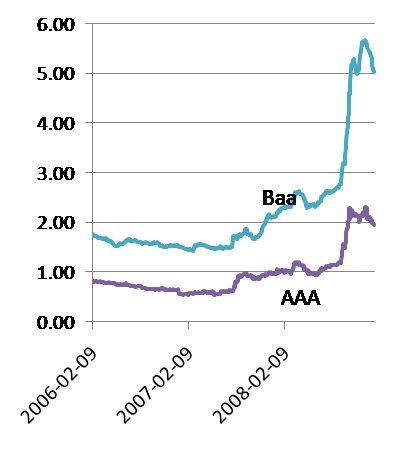
The really striking thing about corporate borrowing rates isn’t that they’re high by historical standards, although they are, but the fact that they’re high even though interest rates on government debt are very, very low. Below I show the spreads on AAA and Baa debt against 30-year Treasuries: they really have spiked.

Also bear in mind the decline in expected inflation: real corporate rates are very high.
That last sentence is key. Even though Treasury rates have rallied significantly in nominal terms over the past 1 1/2 years, they still yield more in real terms than when the financial crisis began. Corporates, as Paul points out, are the greater issue. Real yields on Investment Grade Corporate Bonds are now 2.5x higher than they were just six months ago.


Throw in a declining economy and the diminished end-user demand we are witnessing across industries, and it is very easy to see why corporations are having such a difficult time.( I AGREE ) "

And here:

"Spreads: Not Seen Since the Great Depression

JG provided an interesting insight in the comments section of my "Real Yields Matter" post. Credit risk premium, as defined by the difference between the yield of the Moody's Baa and Aaa rated indices (more detail regarding Moody's here), recently moved above 3%. What is the significance?

As of Nov. ‘08, the Baa-Aaa risk premium moved above 3.0%, to 3.07%; in December, it was 3.38%.
When were the last times that the Baa-Aaa risk premium rose above 3.0%? August ‘31, October ‘32, October ‘33, and March ‘38, in the depths of the Lesser Depression (first two) and its protracted recovery (last two).

We are one year into The Greater Depression.


In plotting the data, JG is correct. Although we were awfully close in the early 1980's and 338 bps is a a lot smaller than the 560+ bps we saw in 1932, this does put the current crisis into the correct context.( YES )

Source: St. Louis Fed (BBB) / St. Louis Fed (AAA)"

These are signs of the fear and aversion to risk, which still needs to be attacked with full force. Hence, we need an incentive for investment. It's gotten better, but we're not there yet by any means.

Monday, January 19, 2009

"The condition of the banks is very much a secondary issue"

As with James Surowiecki, I've been agreeing a lot lately with Dean Baker. How about here?:

"Credit Crunch? Look at the Chart, Skip the Article

The NYT has an article promoting the credit crunch story whereby credit worthy businesses are supposedly unable to get credit. Readers would be well-advised to skip the article and just look at the accompanying chart. The chart tells readers that the interest rate on the debt of investment grade corporate debt was pretty much the same in the fourth quarter as it was earlier in the year, and in fact only a small amount higher than it had been in the three preceding years. In other words, investment grade companies are paying pretty much the same interest rate as they always have and probably expected in their planning.

The chart also shows volumes of debt issuance. There was a falloff in issuance of investment grade debt in the third quarter (after a big surge in the second quarter), but the fourth quarter levels are pretty much in line with prior years.

There has been a serious falloff in the issuance of high yield debt as well as surge in the interest rates payable on this debt. That is what happens in recessions. The survival of companies whose survival was always questionable becomes far more questionable in a severe downturn. These companies are in reality far higher risks, so it is understandable that banks would be reluctant to lend to them even if the banks had plenty of capital.

The credit system is undoubtedly facing considerable stress because so many banks are effectively bankrupt, but the economy is not in a downturn because banks aren't lending. It is in a downturn because we have just lost $6 trillion in housing wealth and $8 trillion in stock wealth. The expected effects of this loss of wealth is the huge falloff in consumption that is driving the downturn. The condition of the banks is very much a secondary issue.( HERE'S WHERE I DISAGREE. THE CALLING RUN DOES EFFECT EVERYTHING BECAUSE IT CAUSES A CONTINUING LOSS OF WEALTH, AND EFFECTS THE PROACTIVITY RUN. IN OTHER WORDS, CAUSES PROACTIVE JOB LOSSES. )

--Dean Baker

Here's the chart:

Debt Hangover


Here's Krugman:

"
Spreads

I don’t usually disagree with Dean Baker, but I think he’s wrong here. The really striking thing about corporate borrowing rates isn’t that they’re high by historical standards, although they are, but the fact that they’re high even though interest rates on government debt are very, very low. Below I show the spreads on AAA and Baa debt against 30-year Treasuries: they really have spiked.

Also bear in mind the decline in expected inflation: real corporate rates are very high.

So yes, we do have a credit crunch. It’s not the whole story, but it’s part of the story.

INSERT DESCRIPTION
The main point to notice is that the spread has been getting better after the spikes caused by Fannie/Freddie, Lehman, TARP's not passing, et al. There has been a diminution in the fear and aversion to risk. That's why Baker and Krugman are both correct. It's a problem, but not the whole story.

Where I differ with both Krugman and Baker is in being for a tax incentive for investment, which the Obama team had the sense to include on my advice in their stimulus package. Remember, I've been for it since October. Why? We need to attack the fear and aversion to risk. We need people investing in corporate bonds. Unlike Baker, I believe that we want that left chart going up even more. Frankly, it's not a good sign that it's been so flat during this housing boom. I need to look and see if the diversion of investment into housing was a disaster on corporate investment. I don't know off hand.

Saturday, December 27, 2008

"By this policy of ‘quantitative easing’ the central bank increases the money supply even when interest rates hit their zero-bound."

A couple of good posts on Quantitative Easing ( Love that name. It sounds like measuring a...well, you get it ). First, via Greg Mankiw:

"A Primer on Quantitative Easing

There is no doubt that buying disturbed assets can be viewed as an investment. However, for me, investing is what Graham, Buffet, Gross, Rogers, and Grant do. In other words, do a lot of research about a particular investment before buying it. When TARP and the Fed do this investing though, it reminds me of buying a grab bag or Japanese Lucky Bag, which always turned out to be a poor investment for me.

Now, via Emre Deliveli's Blog On Economics, from the FT:

"Central banks are worried about falling rather than rising prices. By early next year, it is possible that central banks’ target policy interest rates will all be reduced to their minimum possible level of zero( ZIRP). Does this mean that central banks will then have lost control over monetary policy and be unable to prevent a cumulative debt deflation( NO )?

Many, including Ben Bernanke, US Federal Reserve chairman, point out that central banks can then use further unorthodox tools( NOT GENERALLY NEEDED ) to further loosen monetary policy.

Once interest rates are at zero, the central bank is relieved of the responsibility for draining reserves to stop overnight interest rates falling below the policy target rate.

It loses control over interest rates but gains control of the quantity of reserves and can use this to increase its balance sheet to an almost unlimited extent( PRINTING MONEY ), buying securities( 1 ), matched by increases in both wholesale deposits with commercial banks and commercial bank reserves at the central bank. By this policy of ‘quantitative easing’ the central bank increases the money supply even when interest rates hit their zero-bound.

Here is an illustration. To conduct a quantitative easing, a trader employed by the central bank buys a government bond for £1000 from an investor such as a pension fund. To settle the trade, the pension fund’s cash account with a commercial bank is increased by £1000 from the central bank, and to settle this payment the commercial bank’s reserve with the central bank is in turn increased by £1000, matching the £1000 increase in central bank assets.

But it is doubtful if this particular transaction does much to increase bank credit( WHICH IS THE POINT OF QE ). The commercial bank has more short- term deposits, so monetary aggregates have increased, but it is unlikely to lend this money out, when as now banks have too many short-term liabilities and too many illiquid and undervalued long-term assets.

When quantitative easing was attempted in this way in Japan from 2001 until 2005, the main impact was to increase reserve assets rather than bank credit( NO GOOD ).

The central bank has, though, changed the composition of net public sector debt, broadly defined to include the debt of the central bank. There is less long-term and more short-term debt in the market and long-term interest rates fall somewhat( GOOD ).

The central bank is then likely to lose money, buying bonds at a premium high price and then, when the easing is unwound, selling them at a discounted low price( OK ).

This has economic effects because the loss-making trade subsidises( YES ) long-term borrowing by the private sector. The effect is similar to that achieved when government subsidises long-term borrowing.

Quantitative easing will be much more effective if the central bank uses its balance sheet to buy not government bonds but better quality illiquid and undervalued structured and mortgage-backed securities. This eases bank funding constraints and so directly expands the stock of credit. Moreover, as the economy recovers, credit spreads will fall and so the central bank can make a profit.( SINCE IT'S A SUBSIDY, YOU CAN SAY "WHO CARES WHAT THESE ASSETS ARE GOING TO BE WORTH"? FINE. SAY THAT. )

Quantitative easing will be more powerful still if the central bank takes pure credit spread exposures, using interest rate swaps to remove its exposure to fluctuations in nominal interest rates( A HEDGE ).

It can also conduct equivalent synthetic transactions, purchasing government bonds alongside an interest rate swap and the acquisition of negative net worth credit default swaps. Unlike a private sector participant, as the monopoly supplier of outside money it can always meet margin calls( THIS WAS THE PROBLEM WITH AIG AND OTHER INVESTORS. I'M CALLING IT A "CALLING RUN", WHICH IS SIMILAR TO A BANK RUN. BOTH LEAD TO A FLIGHT TO SAFETY, WHICH IS WHAT WE HAVE ) and so cannot be squeezed out of credit default swap trades.

Finally, to guide expectations( IMPORTANT ), it should set forward targets for credit spreads.

Perhaps the clearest way to present this point is to put the question in another way: what is the most appropriate alternative instrument of monetary policy, during the period when money market interest rates are reduced to their zero floor?

Aggregate bank reserves or money stock are poor choices, since in present circumstances they can increase by huge amounts without impacting credit or expenditure. A better choice is market credit spreads( THIS WOULD BE GOOD ). The Bank of England’s monetary policy committee can use its regular meetings to announce its preferred levels for average market credit spreads( RISK ). Bank monetary operations can enforce this decision.

By setting credit spreads at appropriate levels the bank will put a floor under market values( I AGREE ), restore credit market liquidity and economic activity and make a handsome profit to boot.

A potential problem is the transition back to positive nominal interest rates, but this can be handled by a more permanent but less generous government-backed scheme for systemic credit insurance, such as been proposed by Laurence Kotlikoff and Perry Mehrling and myself on this forum.

Alistair Milne is reader in banking, Cass Business School, City University, London"

I think that these are worth a try.

Friday, November 21, 2008

"I am no expert on swaps (to put it mildly) but it sure seems like the current move is driven by something other than fundamentals."

Brad Setser hits the Trifecta:

"Treasury yields aren’t hard to calculate. But they are still my favorite indicators of the scale of the current crisis. The fact that so many are willing to lend so much to the US Treasury for so little is a clear indicator of a lack of confidence in other financial asset. Dr. Krugman is right. Market analysts are more or less saying the same thing: ““Where the credit markets are trading, it’s all but implying a 1929 scenario,” said Joe Balestrino, fixed income strategist at Federated Investors”

That's right. Investors are buying bonds with basically no interest in order to avoid risk, and hedge against deflation. Make sense?

"Suffice to say that surge in Treasuries — and rise in credit spreads — isn’t a good sign. Investors (including central banks) aren’t willing to accept anything that just has an implicit government guarantee — let alone debt with real risk. Right now they want nothing less than the full faith and credit of the US government."

That's right, they won't lend money to corporations ( Buy bonds ), slowing the economy, by reducing lending and causing the interest rates that these corporations need to offer to get a loan to skyrocket.

"I am no expert on swaps (to put it mildly) but it sure seems like the current move is driven by something other than fundamentals. A negative swap spread — according to the FT – implies that “investors are somehow reckoning that they are more likely to be paid back by a private counterparty than by the government.” That doesn’t seem consistent with what the rest of the market is telling us …"

I agree. There's a total disregard for fundamentals because of the Fear and Aversion to Risk. It's a downward bubble, if you will.

Now we need to figure out how to combat it. One way, according to Buiter, is to force banks to lend, however fearful they are. Rebecca Wilder and I favor cutting taxes. We'll see.