Showing posts with label Kiwanja. Show all posts

Monday, January 26, 2009

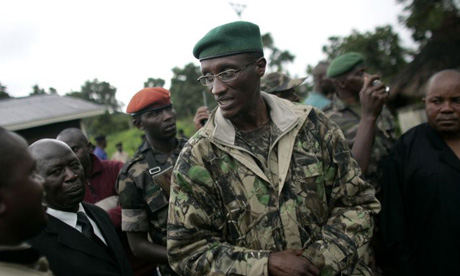
Nkunda, once Rwanda's tool in keeping Hutu militias at bay, had become an embarrassment.

From Stop The War In North Kivu, some context:

"
Diplomatic pressure and unknown deals In Analysis, News on January 25, 2009 at 3:43 pm

Last Friday, Chris McGreal provided a very comprehensive analysis of the recent events in The Guardian. Together with Foreign Policy, the Guardian points to diplomatic pressure pushing the deal, specially after Kiwanja and the Stearns report:

Kagame’s closest allies overseas, the US and Britain( ABOUT TIME ), which provide the bulk of Rwanda’s foreign aid and a lot of diplomatic cover, quietly made clear that the conflict in eastern Congo had to be brought to an end.

However, as Jason Stearns said last Friday on the NYT, Nkunda’s arrest is part of a broader realignment. As he underlines, the unknowns and risks over the horizon are many."

Here's the Guardian:

Rwanda: why former military hero was disowned after rampages in Congo
The arrest of Laurent Nkunda reflects a dramatic diplomatic shift after tiny but ambitious state found itself on receiving end of international criticism
Laurent Nkunda

Laurent Nkunda: had become an embarrassment to Kigali Photograph: AP

Tony Blair happened to be in Rwanda at the time the Tutsi rebel general, Laurent Nkunda, was slaughtering his way through eastern Congo late last year.

Blair – who has taken on saving Rwanda as another of his post-premiership missions, inserting people into the offices of the president, prime minister and cabinet in Kigali to help run the government – was keen to talk up the prospects for the tiny central African nation that has made remarkable strides since the 1994 genocide that left about 800,000( 800,000 ) Tutsis dead.

But the world's attention was on a different aspect of Rwanda entirely. This time Rwanda was on the receiving end of international criticism for backing Nkunda amid the continuing horror of massacres, mass rape and perpetual refugees in Congo, where about 5 million( 5 Million ) have died as the result of more than a decade of war and its effects.

Nkunda, once Rwanda's tool in keeping Hutu militias at bay, had become an embarrassment. The rebel general had already spilled a lot of blood before the crisis flared again last October when his forces marched to the edge of Goma in eastern Congo. But on that occasion the world, for once, took notice when Nkunda's men went through the town of Kiwanja systematically killing hundreds of the remaining men, and some families.

In Rwanda President Paul Kagame's government was alarmed. His minority Tutsi-led administration, which drew much of its foreign support from the moral authority of having ended the genocide, was now seen more as perpetrator than victim.

Kagame's grand scheme to project his country as a rapidly modernising state embracing Anglo-Saxon liberal capitalism – even to the extent of switching the education system from French to English( WOW. OF COURSE, HE'S PROBABLY NOT FOND OF THE FRENCH. ) – was threatened by its support of Nkunda. Its involvement in Congo sent out the message that Rwanda was really run by another bunch of bloodthirsty warlords.

At that point Nkunda became more of a liability than an asset. His arrest yesterday, as he fled into Rwanda with large amounts of cash, gold and diamonds( HOW NICE ), is one part of a dramatic diplomatic shift as Kigali tries to detach itself from direct involvement in Congo that used to pay dividends in securing its frontier and vast profits from the plunder of minerals but which has become a political burden.

Nkunda's close ties to Rwanda go back to his days fighting in the rebel army, the Rwandan Patriotic Front (RPF), that overthrew the genocidal regime and took power in 1994. He returned to Congo – or Zaire as it then was – and was again drawn in to collaboration with the RPF after it invaded Congo twice in the second half of the 1990s to fight the Hutu militias that had fled there after leading the genocide.

After Rwanda pulled out of Congo in 2003, it saw Nkunda's National Congress for the Defence of the People (CNDP) as a buffer force against the Hutu force, the Democratic Front for the Liberation of Rwanda (FDLR), which had gained control of swaths of territory on Rwanda's border and kept up the mantra of genocide, threatening to exterminate Tutsis.

But Nkunda, in the name of defending Tutsis, was increasingly bloodthirsty. His forces rampaged through cities such as Bukavu, murdering and raping. They also got into the mining business, getting rich out of plundering gold, diamonds and coltan, a crucial but rare component of mobile phones.

Much of the world turned a blind eye to Rwanda's backing for Nkunda. Officially it had stopped because Kigali was embarrassed by his excesses but there was no doubt that links remained. Nkunda's soldiers included English-speaking Tutsis most likely drawn from Rwandan exiles who grew up in Uganda. The UN observed weapons being shipped through a triangle of land that linked Rwanda, Uganda and Congo. Above all, for a long time Nkunda served Rwanda's interests and Kigali declined to condemn him.

No more. Rwanda is trying to reshape itself as a modern, forward-looking country, far from the semi-fascist state that took hold during the three decades from independence to the genocide. The government's successes can be seen in how the capital has boomed since the genocide. Millions of dollars flowed in to build new hotels now filled with tourists and conferences. Kagame is talking up his country's prospects as a regional information technology hub.

But Congo increasingly threatened to wreck the new image, and Nkunda – who, as he grew more powerful, took to greeting visitors to his hilltop headquarters dressed in flowing white robes, like some messianic figure, with his white pet goat in tow – went from being an asset to a problem.

The political capital that the minority Tutsi-led government of Rwanda could draw on because of western guilt and sympathy after the genocide was increasingly overshadowed by the crimes being committed in Congo.

In December a UN report accused the Rwandan government of fuelling the conflict through covert support to Nkunda. The report also accused the Congolese government of ties to the Hutu militias threatening Rwanda, but that attracted less attention.

Rwanda vigorously denied the accusations but they were well documented and a further embarrassment after the crimes of Nkunda's forces a few weeks earlier. In response, some European governments cut off aid to Rwanda, emphasising to Kigali that it was now no longer viewed as the victim.

Kagame's closest allies overseas, the US and Britain, which provide the bulk of Rwanda's foreign aid and a lot of diplomatic cover, quietly made clear that the conflict in eastern Congo had to be brought to an end.( AT LAST )

Last week saw two dramatic and complementary developments. Nkunda faced a revolt within the CNDP, with some of his officers saying they had removed him from command and would no longer fight the Congolese government. At the same time, thousands of Rwandan troops moved across the border in agreement with the Congolese government to purse the Hutu militias controlling swaths of territory.

The deal was in place. Rwanda would neutralise Nkunda and the CNDP so long as the Hutu militias were also confronted. Tellingly, the rebel general fled across the border after he was confronted by a joint Rwanda-Congolese force. Nkunda's benefactor was allied with his enemy in pursuit of him.

Eastern Congo has been here before, and there is unlikely to be a complete halt to the violence for some time. There are still too many armed groups and mining groups with a vested interest in continued instability.

But dealing with the Hutu militia and Nkunda does confront the root causes of the conflict in eastern Congo for the first time, and gives its long suffering people the prospect of hope they have not had for many years."( GOOD )

From the NY Times:

A Congolese Rebel Leader Who Once Seemed Untouchable Is Caught

Uriel Sinai/Getty Images

Gen. Laurent Nkunda, shown in November 2008, was apprehended late Thursday by Rwandan troops. Rwandan authorities on Friday were tight-lipped about what they would do with him.

Published: January 23, 2009

KIGALI, Rwanda — Overnight, the battle in Congo has suddenly shifted.

Skip to next paragraph
Benedicte Kurzen/VII Mentor

Gen. Laurent Nkunda, the leader of a group of rebels, with his pet goat Betty in the mountains of Congo in November.

Benedicte Kurzen/VII Mentor

Mr. Nkunda at a training camp in North Kivu Province for the group of rebels that he leads.

General Nkunda was cornered near Bunagana.

Gen. Laurent Nkunda, the Congolese rebel leader whose brutal tactics and Congo-size ambitions have threatened to bring about another catastrophic war in central Africa, was arrested late Thursday, removing an explosive factor from the regional equation.

According to United Nations officials and Rwandan authorities, General Nkunda was captured by Rwandan troops as he tried to escape a Congolese-Rwandan offensive that has taken aim at several rebel groups terrorizing eastern Congo.

General Nkunda had seemed untouchable, commanding a hardened rebel force that routinely humiliated Congolese troops and then calmly gliding through muddy villages in impossibly white robes. But he may never have anticipated that his old ally, the Rwandan Army, would take him away.

The surprise arrest could be a major turning point for Congo, which has been mired in rebellion and bloodshed for much of the past decade. It instantly strengthens the hand of the Congolese government, militarily and politically, right when the government seemed about to implode. But it could also empower other, even more brutal rebel figures like Jean Bosco Ntaganda, General Nkunda’s former chief of staff, who is wanted by the International Criminal Court in The Hague for war crimes.

Still, analysts and politicians say they hope that General Nkunda’s capture at the hands of Rwanda means that the proxy war between Rwanda and Congo is finally drawing to a close.

A United Nations report in December accused high-ranking Rwandan officials of sending money and troops to General Nkunda, a fellow Tutsi who claimed to be protecting Congolese Tutsi from marauding Hutu militias. This cross-border enmity has been widely blamed for much of the turmoil, destruction, killing and raping that has vexed Congo for years.

John Prendergast, a founder of the Washington-based Enough Project, which campaigns against genocide, called it a “massive turn of events.”

“Finally the two countries are cooperating,” he said.

Kikaya bin Karubi, a member of Congo’s Parliament, said General Nkunda’s arrest “could be the beginning of the end of all the misery.”

“Look what happened at Kiwanja,” he said, referring to a small Congolese town where United Nations officials said General Nkunda’s forces went door to door, summarily executing dozens of civilians in November.

Now, if Congo gets its way, General Nkunda will have to face the consequences. The government is urging Rwanda to extradite General Nkunda so he can stand trial in Kinshasa, Congo’s capital, where he could face a war crimes tribunal and treason charges, punishable by death.

But Rwandan authorities were tight-lipped on Friday about what they would do with General Nkunda. “I can’t speculate,” said Maj. Jill Rutaremara, a spokesman for Rwanda’s Defense Forces. All he would say was that General Nkunda was “in the hands of Rwandan authorities.”

Though General Nkunda never controlled more than a handful of small towns in eastern Congo, he was Congo’s No. 1 troublemaker. His troops have been accused of committing massacres dating back to 2002. General Nkunda recently began cultivating national ambitions to overthrow Congo’s weak but democratically elected government, which threatened to draw in Congo’s neighbors and plunge central Africa into a regional war, something that has happened twice before.

General Nkunda’s confidence may have been his undoing. On Thursday night, hundreds of Rwandan troops cornered him near Bunagana. Congolese officials said he refused to be arrested and crossed into Rwanda, where he was surrounded and taken into custody. It is not clear how many men he had with him at the time, but it appears he was taken without a shot.

Just a few days ago, Rwanda sent several thousand soldiers into Congo as part of a joint operation to flush out Hutu militants who had killed countless people in the 1994 Rwanda genocide and were still haunting the hills on Congo’s side of the border.

Few expected the Rwandan troops to go after General Nkunda. Not only is he a Tutsi, like Rwanda’s leaders, but he had risen to power by fighting these same Hutu militants. Several demobilized Rwandan soldiers recently revealed a secret operation to slip Rwandan soldiers into Congo to fight alongside General Nkunda. He had been trained by the Rwandan Army in the mid-1990s and was widely believed to be an agent for Rwanda’s extensive business and security interests in eastern Congo.

But it seems that the Rwandan government abruptly changed its tack, possibly because of the international criticism it has endured for its ties to General Nkunda. Several European countries recently cut aid to Rwanda, sending a strong signal to a poor country that needs outside help. Rwanda may have figured the time was ripe to remove General Nkunda, analysts said.

Earlier this month, some of General Nkunda’s top commanders split from him, saying they were fed up with his king-of-the-world brand of leadership. One of those commanders was Mr. Ntaganda. Prosecutors at the International Criminal Court have accused him of building an army of child soldiers, a war crime.

But Mr. Ntaganda suddenly switched sides, denouncing General Nkunda and saying that he and his men were now eager to join the Congolese Army, which they had been battling for years. Many analysts believe that the Congolese government promised to try to protect Mr. Ntaganda from being sent to The Hague.

According to Jason Stearns, an analyst who recently served on a United Nations panel examining the conflict: “It’s fairly clear that Kigali and Kinshasa have struck a deal. Kinshasa will allow Rwanda onto Congolese soil to hunt down” the Hutu militants, “and in return Rwanda will dethrone Nkunda.”

Congolese officials are now talking about restoring full diplomatic relations with Rwanda, which had been suspended for years, and reinvigorating economic ties. But many uncertainties remain, including a possible power scramble by other militant groups hoping to fill the vacuum.

“Nkunda’s arrest is part of a larger, radical realignment,” Mr. Stearns said. “There are, however, many unknowns and risks.”

From Enough Said:

Printer-friendly version
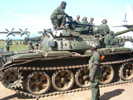
Congo tank

In a dramatic reversal of fortune for one of Central Africa’s most powerful warlords, Congolese rebel leader Laurent Nkunda was arrested by Rwandan authorities last night along the Congo-Rwanda border. When my colleague Rebecca and I met with Nkunda in the town of Rwanguba on Thanksgiving Day, he seemed on top of the world. His rebel movement, the National Congress for the Defense of People, or CNDP, had routed the Congolese army, embarrassed UN peacekeepers, consolidated control of a large swath of North Kivu province, and threatened the regional capital of Goma. Nkunda shrugged off allegations that his lieutenant, Bosco “The Terminator” Ntaganda, had directed a massacre of civilians in Kiwanja, and confidently demanded direct negotiations with Congolese President Laurent Kabila. Journalists flocked to his compound, diplomats had him on speed dial, and the UN appointed a former president of Nigeria to mediate a solution. This morning, Nkunda was in Rwandan custody, and it sounds like he is already back in Congo and headed for detention in the capital, Kinshasa. What happened?

The power play orchestrated by the Congolese and Rwandan governments has been brewing for weeks. As Nkunda’s power and ambition grew, the governments of both Rwanda and Congo came to see him as a serious problem, albeit for different reasons. Unable to defeat Nkunda militarily and unwilling to treat him as a legitimate political actor, President Kabila needed Rwanda’s help to neutralize him. Rwandan President Paul Kagame was stung by Nkunda’s increasingly bold pronouncements (particularly his ambition to take his fight all the way to Kinshsa) and a U.N. panel of experts report documenting Rwandan support for CNDP and involvement with conflict minerals in eastern Congo. European donors began to threaten aid money and Rwanda no longer had plausible deniability that it was not involved with Nkunda.

Congolese officials sought Rwandan help to get rid of Nkunda. The quid pro quo: the Rwandan military would be allowed to re-enter eastern Congo to hunt down the Democratic Forces for the Liberation of Rwanda, or FDLR, a Rwandan Hutu rebel group led by commanders responsible for the 1994 Rwanda Genocide. In a fantastically cynical move, the two sides also agreed that indicted war criminal Bosco Ntaganda would replace Nkunda as head of CNDP, and that his forces would join in the offensive against the FDLR.

A week ago in Goma, Ntaganda announced that he had taken control of CNDP and would collaborate with the Congolese and Rwandan armies against the FDLR. As reported on this blog earlier this week, more than 3,000 Rwandan troops crossed into eastern Congo this past weekend, isolating Nkunda and ultimately arresting him. My colleague John Prendergast noted in the New York Times today, “Now the hard part begins.”

While the move to take more aggressive action to remove the FDLR from eastern Congo and arrest of Nkunda are welcome developments and could contribute mightily to a lasting peace in eastern Congo, there are lots of reasons to be profoundly apprehensive.

  • The planned operations against the FDLR have the potential to be catastrophic for Congolese civilians. The Congolese army and Rwandan armies have abysmal track records in protecting civilians, and the FDLR will almost certainly not stand their ground and fight. As they have done in the past (and as the Lord’s Resistance Army has done in northeastern Congo), the FDLR may well melt into the bush, leave civilians to bear the brunt of the offensive, and return with a vengeance when the operation is over. Moreover, Congo and Rwanda have clear economic motive to assert control over valuable mines in FDLR controlled areas. This could be why the UN peacekeeping force charged with protecting civilians in eastern Congo has been kept deliberately in the dark and is now restricted from traveling to certain areas.
  • The role of Bosco “The Terminator” Ntaganda sends a chilling message about the lack of accountability for crimes against humanity. Ntaganda is wanted for war crimes by the International Criminal Court, and the Congolese government, a signatory to the Rome Statute that established the ICC, is in full violation of international law by failing to arrest him. Human Rights Watch has documented his role in recent massacres.
  • Even though Nkunda has been arrested, allowing Rwandan troops back onto Congolese soil is a dangerous gamble for Congolese President Kabila. Many people in eastern Congo loathe Rwanda for its behavior during the wars that ripped the country apart from 1996 to 2002, when they failed to dislodge the FDLR while looting substantial mineral wealth. The Rwandan military has been able to inflict substantial casualties on the FDLR on the past, but never to the point where they were able to break them as a force. The longer Rwandan forces remain in eastern Congo, the more vulnerable Kabila will be to internal challenges.
  • Lastly, and as Enough has consistently argued, even a successful operation against the FDLR must be accompanied by a process to deal with the other major root causes of conflict in eastern Congo: the fight for control over lucrative natural resources, access to land, economic and physical security of ethnic minorities (particularly Tutsis), and contentious debates over citizenship and identity.

Events are unfolding rapidly on the ground, and Enough is preparing on a statement with recommendations for policymakers on how to help avoid the situation from spiraling downward. We will release the statement next week, but as a first step the Obama administration should immediately appoint a special envoy to the Great Lakes region. The administration has not yet named its Africa policy team, but the people of eastern Congo cannot wait another day for the United States to get engaged at a high level."( THIS POST IS MORE WORRYING )

In a related post from Reuters:

Photo
1 of 1Full Size

By Aaron Gray-Block

THE HAGUE (Reuters) - Congolese militia leader Thomas Lubanga trained child soldiers to kill, pillage and rape, a prosecutor told the International Criminal Court at the start of its first war crimes trial on Monday.

Lubanga, 48, pleaded not guilty on the first day of the historic trial, which opened more than six years after the ICC was set up as the world's first permanent war crimes court.

Lubanga, an ethnic Hema, is accused of enlisting and conscripting children under 15 to his Union of Congolese Patriots (UPC) in Congo's eastern Ituri district to kill rival Lendus in a 1998-2003 war in the Democratic Republic of Congo.

ICC prosecutors say child soldiers recruited by the UPC were involved in hostilities between October 2002 and June 2003, and that some of them were forced to kill, while others lost their lives in combat.

In an opening address to the Hague-based court, chief prosecutor Luis Moreno-Ocampo said Lubanga committed the most serious crimes of concern to the international community -- crimes against children.

"Lubanga's armed group, recruited and trained hundreds of children to kill, pillage and rape. Hundreds of children still suffer the consequences of Lubanga's crimes. They cannot forget what they suffered, what they did, what they saw," he said.

"They cannot forget the beatings they suffered, they cannot forget the terror they felt and the terror they inflicted. They cannot forget the sounds of the machine guns, they cannot forget that they killed. They cannot forget that they raped, that they were raped."

Some of the children were now using drugs, some had become prostitutes, and others were jobless, Moreno-Ocampo said.

He said he intended to demand close to the maximum sentence, which court officials say is life imprisonment.

Moreno-Ocampo showed the court a map indicating where hostilities took place and videos he said showed Lubanga with child soldiers.

"At this stage, our client would like to plead not guilty," Catherine Mabille, lead defence lawyer, told the court.

Dressed in a dark suit and red tie, Lubanga looked impassively ahead as his charges were read aloud to him.

BUNIA LINK-UP

Some 400 people in Congo's eastern town of Bunia -- at the heart of the Hema-Lendu violence -- were watching the trial via video-link, including many UPC supporters, a Human Rights Watch official said.

She said the start of the trial is a signal to the world that there will be accountability for war crimes, but also urged the court to look into officials in Uganda and in Rwanda who armed and supported groups operating on the ground.

More than 30,000 children were recruited during the conflict in Congo, many given marijuana and told they were protected by witchcraft, according to Bukeni Waruzi, the Africa and Middle East coordinator for human rights group Witness.

Lubanga's trial had been due to start in June 2008, but judges postponed because the defence was unable to view some evidence against him.

The matter was resolved in November when prosecutors began releasing documents to the defence that had been provided on condition of confidentiality to protect sources in war zones.

But some procedural measures are still pending.

The three-judge court has allowed 93 victims to take part in the case and give evidence. They can also seek compensation.

Four of the victims are among the 34 witnesses that prosecutor Moreno-Ocampo will call during the trial, which is expected to be completed before the end of the year.

Ethnic violence in the Ituri region between the Hema and Lendu, and clashes between militia groups vying for control of mines and taxation, have killed 60,000( 60,000 ) people since 1999.

Lubanga was handed over to the court in 2006 after Congo referred the case to the ICC prosecutor in March 2004.

The defence will make its opening statement on Tuesday."

In case you want to hear him speak. From the Hub:

DR Congo rebel chief justifies his fight - 21 Nov 08
As the UN agrees to deploys more forces to halt the DR Congo conflict, Laurent Nkunda, the rebel chief, acknowledges partial responsibility for the upheaval in an interview to Al Jazeera's Yvonne Ndege at a secret location in eastern Congo. But insisting that there is "no life, no economy, no administration, no justice", he says "you cannot destroy what is not there".

Wednesday, January 14, 2009

there are many informations regarding an acute increase of human rights violations in three territories under CNDP control

An update from Stop The War In North Kivu:

"
Kiwanja: threats and extortions increasing In From the field on January 13, 2009 at 5:07 pm

According to relevant sources, CNDP´s pressure towards Internally Displaced People (IDPs) in Kiwanja has severely increased. In the last two weeks, soldiers have been asking IDPs to pay 2 U$ per day as a “tax to remain in the IDP camp”. Things are going far beyond. CNDP soldiers are threatening men, women and children to occupy their homes if they do not return home. Some of the houses have been seized, and padlocks have been placed in some visible door entrances to increase pressure. ( TERRIBLE )

As readers of this blog know, IDPs remain in the camp of Kiwanja because they fear for their lives.

Meanwhile, there are many informations regarding an acute increase of human rights violations in three territories under CNDP control: Kitchanga, Mweso and Kirolire. According to sources, the lack of discipline showed by CNDP soldiers in these areas is related to the leave of high ranking CNDP officials towards Rutshuru."

This is turning into a chaotic mess of rampaging war criminals.

Monday, January 12, 2009

"a serious rift in the C.N.D.P., and it’s clear that it will compromise the Nairobi peace talks.”

The Congo in the NY Times:

Published: January 11, 2009

DAKAR, Senegal — Disagreements over tactics and power have split the once seemingly invincible Congolese rebel group that has played havoc across the eastern side of the country over the past year and has brought the weakened government to the edge of collapse.

Skip to next paragraph
Benedicte Kurzen/VII Mentor

Gen. Laurent Nkunda last fall in eastern Congo, where his thriving rebel group has humiliated Congolese troops in the past year.

Related

Times Topics: Congo

Lionel Healing/Agence France Presse — Getty Images

Jean Bosco Ntaganda, a rebel known as the Terminator and shown on Sunday near Goma, has split with General Nkunda.

Gen. Laurent Nkunda, the leader of the Tutsi-dominated rebel group known as the C.N.D.P., is fighting off an attempt to topple him by Jean Bosco Ntaganda, his chief of staff, a ruthless fighter known as the Terminator who is wanted by the International Criminal Court in The Hague for war crimes, according to accounts from both camps.( HE'S A WAR CRIMINAL )

The rebel group has humiliated Congolese troops in battle after battle in the past year, growing in momentum and ambition to the point where it has directly threatened the regional capital, Goma. The result has been hundreds of thousands of people displaced, and a serious undermining of the government, the country’s first freely chosen one in four decades.

Although there have been no accounts yet of actual combat between General Nkunda’s and Mr. Ntaganda’s camps, the split is likely to complicate efforts to win peace in the troubled region. Olusegun Obasanjo, the former president of Nigeria, has been shuttling between the Congolese government and General Nkunda’s rebels in their jungle hide-outs as the United Nations envoy to the faltering peace talks aimed at ending the fighting with the government.

Jason Stearns, an independent Congo analyst who recently served on a United Nations panel examining the conflict there, said that it was unlikely that Mr. Ntaganda’s decision to split from General Nkunda came lightly, and that the split would have serious repercussions for faltering peace talks taking place in Nairobi, Kenya.

“Nobody has been able to say where the senior command stands,” he said. “We are all trying to see what will emerge. What is clear is this has produced a serious rift in the C.N.D.P., and it’s clear that it will compromise the Nairobi peace talks.” ( TRUE )

Mr. Ntaganda declared himself the leader of the C.N.D.P. last Monday and claims to have taken a significant portion of the group’s fighters with him. General Nkunda insists that he remains in control and has tried to play down the disagreement. He told Reuters in an interview that Mr. Ntaganda had been “disrespectful” but remained a member of the rebel group, and that a commission of rebel leaders had been sent “to listen to him, to bring him back to his senses.”

The fracture seems to have been building for some time as the two men disagreed over how far the rebellion should go to achieve its aims — and in some ways over what those aims actually were, according to diplomats and analysts in the region. Mr. Ntaganda wanted to push harder and overrun Goma last year, and he told some of the rebellion’s backers that he was disappointed when General Nkunda heeded United Nations demands to hold back, according to human rights investigators.

General Nkunda, meanwhile, was dismayed by the barrage of international criticism that came after a massacre by his troops in November that was led by Mr. Ntaganda, according to a close ally of the general who spoke on condition of anonymity.

At least 150 people were killed in about 24 hours in the town of Kiwanja in early November. A report in The New York Times and an investigation by Human Rights Watch based on witnesses’ accounts found that fighters went door to door, killing mostly unarmed boys and young men, accusing them of being enemy fighters.

The faction loyal to General Nkunda discussed the possibility of handing Mr. Ntaganda over to the International Criminal Court, contacting at least one international organization about how this might be achieved, according to a person at the organization who was briefed on the matter( NOW WE KNOW WHY HE'S DOING THIS. TOO BAD THEY DIDN'T GET HIM. ).

General Nkunda’s group has rung up a series of military victories, routing the Congolese Army in an offensive late last year, reaching the outskirts of Goma and taking several other important towns.

But the dispute between the two most powerful men in an insurgency that has until now seemed unified and unstoppable creates the first cracks in the invincible image General Nkunda has cultivated.( I WAS FOOLED BY NKUNDA'S REMARKS )

It could also offer the government some breathing room for the first time in months, said Alison Des Forges, a senior adviser for Africa at Human Rights Watch.

“If it comes to military conflict, we could potentially see the situation dissolve into even further combat,” she said. “But it also offers an opportunity for Congo’s forces to get themselves together and gives more time to find a political solution while the two factions argue it out.”

General Nkunda and Mr. Ntaganda share similar histories. Both are Congolese Tutsi who fought alongside the Rwandan Tutsi rebels who overthrew Rwanda’s Hutu-led government in the aftermath of the genocide there in 1994. They both found their way back to Congo by fighting in Rwandan- and Ugandan-backed rebel groups there as Congo descended into a broad regional conflict set off by the genocide’s aftermath. Both men have been accused of serious human rights violations( TO ME, NKUNDA IS NOT CLEARLY ANY BETTER. HE'S A BETTER BSer. ), though the International Criminal Court has named only Mr. Ntaganda so far.

But they differ profoundly in both style and tactics. General Nkunda is well educated and a fiery and articulate speaker( BS ARTIST ). He has refused virtually every attempt to settle his differences with the Congolese government, and in the wake of his military triumphs has essentially refused to recognize the legitimacy of the first elected government that Congo has known in more than four decades. But Mr. Ntaganda is much more pragmatic, and in the past few days has accused General Nkunda of blocking peace efforts in eastern Congo.( THIS IS WHAT SURPRISES ME )

Ms. Des Forges said Mr. Ntaganda was “somebody who has made his career out of being a useful military person regardless of the cause.”

“I don’t think he has the kind of aspiration of Nkunda,” she said, “but I think he is someone who can transfer his loyalties and adapt his position depending on his interests.”

What a mess. Did I mention Ethnic Conflict?

Tuesday, January 6, 2009

"The fate of hundreds of thousands of men, women and children living as IDPs will lie tomorrow on that table of negotiations."

An interesting situation in the Congo. From Reuters:

Photo
1 of 1Full Size

By John Kanyunyu

GOMA, Congo (Reuters) - A split emerged on Tuesday in Congo's eastern Tutsi rebellion after the movement's top military commander openly challenged founder General Laurent Nkunda in an apparent power struggle.( WOW )

Senior military and political representatives of the rebel National Congress for the Defence of the People (CNDP) rejected an announcement by its military chief of staff, General Bosco Ntaganda, that he had deposed Nkunda as the group's leader.

Signs of a split emerged as the Tutsi rebel movement, whose attacks in east Democratic Republic of Congo in recent months have displaced a quarter of a million civilians, was preparing to resume peace talks this week with Congo's government.

In a statement to the BBC late on Monday, a spokesman for Ntaganda, who is wanted by the International Criminal Court for war crimes, said the CNDP's military commanders had decided to oust Nkunda because of his "bad governance".

This was quickly denied by other CNDP spokesmen.

"General Bosco Ntaganda does not have the authority to depose the chairman Laurent Nkunda. The CNDP remains one movement and one army," Col. Sultani Makenga, the group's military second in command, told Reuters. He said he did not know why Ntaganda had made the announcement.

Attempts to contact Ntaganda, known as "the Terminator" and popular among the rebel rank and file, were unsuccessful.

After launching a renewed offensive in late August, Nkunda's battle-hardened rebels routed President Joseph Kabila's army and captured large swathes of Congo's eastern North Kivu province before declaring a unilateral ceasefire in late October.

The fighting triggered a fresh humanitarian emergency in the border province, where conflict between rival rebels, militias and the government army has raged on despite a formal end to a wider 1998-2003 war in the former Belgian colony.

United Nations officials and human rights campaigners said the CNDP leadership may have planned to discipline Ntaganda over the massacre of around 150 civilians in the North Kivu town of Kiwanja, shortly after it was seized by the rebels in November.

Up to now, the CNDP has denied its fighters slaughtered civilians, blaming rival pro-government Mai-Mai militiamen.

U.N. PEACEKEEPERS ON ALERT

Officials from Congo's 17,000-strong United Nations peacekeeping force (MONUC) said they were monitoring the situation closely in case of fighting within the CNDP.

"To the extent these events threaten to aggravate the situation on the ground, we are very concerned," said Kevin Kennedy, a MONUC spokesman.

Talks between the CNDP rebels and government representatives are due to restart on Wednesday in the Kenyan capital, Nairobi, under U.N. and African Union mediation.

CNDP political spokesman Bertrand Bisimwa said Ntaganda's announcement had no impact on the group's leadership structure, and negotiators still planned to attend the talks in Kenya.

"If an officer has demands, he must address them to the movement itself and not the media," he said. "Our disciplinary body is being activated to deal with this situation."

A spokesman for Congo's government said its negotiators were also planning to go ahead with the talks on Wednesday.

In April last year, the ICC issued an arrest warrant for Ntaganda, accusing him of recruiting children under 15 to fight in a bloody ethnic-based conflict in northeast Ituri district.

Ntaganda is a former associate of Ituri militia leader Thomas Lubanga, who is in ICC custody in The Hague ahead of his own trial on charges of recruiting child soldiers.

Ntaganda returned to his native North Kivu in 2006, where he joined the CNDP led by Nkunda, who says his rebels seek to defend Congo's Tutsi minority against persecution by the government and by Rwandan Hutu militiamen in the east.

Nkunda has so far refused to hand over Ntaganda to Congolese or international authorities, demanding that the ICC first share evidence with the CNDP proving his guilt of war crimes."

Here's the take of Stop The War In North Kivu:

"According to different sources, Bosco Ntagana has replaced Laurent Nkunda as head of CNDP. It still has to be confirmed at the official webpage of this armed group.

Some Congolese media talk about Rwanda choosing Ntagana in order to harden peace negotiations, while other stress that his replacement is a consequence of the recent UN report released by a panel of experts on the DRC.

It is a worrying move taking place in a key moment. The replacement at the head of CNDP happens just before the beggining of the third round of the current peace talks.

The fate of hundreds of thousands of men, women and children living as IDPs will lie tomorrow on that table of negotiations. Unfortunately, I am afraid that none of the speakers sitting on both sides of that table will truly care about them."

It's hard to see how a war criminal taking over can help things.

Saturday, December 20, 2008

“Democracy is not elections. Democracy is legitimacy. And legitimacy comes from what you are doing to your people.”

Here's a portrait of a War Criminal:

"BUNAGANA, Congo — At the entrance to this bustling border town is a most unusual sight: a speed limit sign. In fresh red, white and blue paint, it is a rare manifestation of order in a nation better known for chaos.
Skip to next paragraph
Benedicte Kurzen/VII Mentor

Mr. Nkunda at a training camp in North Kivu Province for the group of rebels that he leads.

Multimedia

Lydia Polgreen on Congolese rebel leader Laurent Nkunda

Related

Times Topics: Laurent Nkunda | Congo

Benedicte Kurzen/VII Mentor

Gen. Laurent Nkunda, the leader of a group of rebels, with his pet goat Betty in the mountains of Congo. His aims include the removal of President Joseph Kabila, whose power has been waning.

Benedicte Kurzen/VII Mentor

Gen. Laurent Nkunda after a meeting with the news media in November in the town of Kichanga in Congo.
The seemingly innocuous signpost is emblematic of the growing might and wider ambitions of Laurent Nkunda, the renegade Congolese general and warlord who now holds part of Congo’s future in his grip.

“I am fighting for the destiny of this country,” said Mr. Nkunda, offering up the orderly streets and neatly terraced farms of the surrounding countryside as evidence of what Congo might be like if he ran things. “What we want is to restore the dignity of this country and these people.”

But beneath the veneer lies a ruthlessness of a piece with Congo’s unbroken history of brutality. With a military campaign in October and November that was met with a feeble response( THIS IS A DISGRACE ) from both the Congolese government and United Nations peacekeeping forces here in eastern Congo, General Nkunda has pushed the nation to its most dangerous precipice in years.

Many here fear a new regional war or that an alliance of convenience between General Nkunda and other enemies of the president could lead to the ouster of Congo’s first democratically elected government in four decades.

That General Nkunda, who is suspected of committing a litany human rights violations, could be a leading figure in such a move is a chilling thought for many Congolese. A recent journey through territory he controls revealed a host of contradictions between the image he puts forward and reality, including evidence of mass killings, the extraction of onerous payments from residents, illegal profiteering from the mineral trade and the conscription of child soldiers.

General Nkunda’s campaign began as a local insurgency aimed at redressing the grievances of a Tutsi minority that felt threatened by the aftershocks of the Rwandan genocide. But it has grown into a rebellion with a broad set of aims that include the removal of President Joseph Kabila, who was elected in 2006 after more than 40 years( 40 YEARS ) of tyranny and war in this country. “We have national ambitions,” General Nkunda declared, a hint of triumph in his voice. “We are talking about Congo.”

Some of this talk may be grandiose bluster from a man fond of referring to himself in the third person( WHO'D WANT TO BE HIM ) and who prefers to be photographed holding a scepter capped by a silver-plated eagle’s head. General Nkunda is despised by many in eastern Congo for his brutal tactics. He is also widely perceived as a proxy for Rwanda, a country whose meddling is largely detested by Congolese citizens. The general claims that he does not want to replace Mr. Kabila, merely to sit down and have direct talks.

But his forceful new challenge poses grave risks for Mr. Kabila, who is weaker than ever. The national army was routed on the battlefield, retreating virtually without a fight, pillaging and raping as it went.

The country’s economy, once fast-growing, is in shambles as the prices of minerals have plummeted in the global recession, and Mr. Kabila is increasingly unpopular. In eastern Congo, many people are unhappy at his failure to halt General Nkunda’s relentless military advance. In the west, where he has never been popular, he is under threat from political opponents who see his government as intolerant of dissent.

One by one, those who oppose him have felt the violent wrath of his security forces, according to human rights investigators and political analysts. A Human Rights Watch investigation found that 500 people had died and 1,000 had been detained in these crackdowns.

In the face of Mr. Kabila’s plummeting stature, General Nkunda has cultivated an image as a disciplined crusader bent on bringing order to the country. He dresses in sharp uniforms or flowing, immaculate white robes. He has claimed to be an evangelical minister and at times wears a pin that reads, “Rebels for Christ.” General Nkunda and his top commanders say their fighters have a commitment to discipline as well: drunkenness, looting and rape are offenses punishable by imprisonment and possibly death, according to senior rebel officers.

But in 2002, when General Nkunda was a commander in a different rebel group, he participated in the mass killing of 160 mutineers in the city of Kisangani, human rights groups say. According to Human Rights Watch, “Forces under Nkunda’s command bound, gagged, and executed twenty-eight persons and then put their bodies in bags weighted with stones and threw them off a Kisangani bridge.”

Two years later, his men took the city of Bukavu, and days of killing and rape followed, investigators say. Since 2005, when he formed his own rebel group, known as the National Congress for the Defense of the People, or C.N.D.P., his forces have carried out a number of massacres, according to human rights investigators, most recently at Kiwanja, in early November, where 150 people were executed.

In Nkunda territory, the general says, civilians are never harmed and live without fear of violence or looting. His men offer up the endless, Eden-like valleys around this town as proof. Terraced into rows as tidy as seats in an amphitheater, the land bespeaks a kind of ordered plenty.

But farmers here say they are forced to hand over a precious portion of their harvest to feed the fighters: 45 pounds of beans or grain, and as much as $20 a season in taxes, an enormous sum in a place where most people live on far less than a dollar a day.

General Nkunda said his rebellion was not motivated, like so many others fighting here, by plunder of Congo’s natural resources.

“I am not here for minerals,” he said. Indeed, there are almost no mines in the areas under his control, and General Nkunda has avoided getting directly involved in mining, fearing the taint of blood minerals that has stained virtually every group fighting here, including Congo’s own army.

But his fighters collect taxes on virtually every commercial vehicle and bushel of crops that come out of territory they control, according to residents and a United Nations report released last week. They even take a cut of the $300 permits sold to tourists wishing to see Congo’s rare mountain gorillas.

“The money goes to the rebels,” said one of the park rangers who monitors the animals. “None of it comes to us( UNREAL ).”

General Nkunda’s men also profit from Congo’s minerals. Thousands of tons of tin ore, coltan and other minerals pass through the border crossing here to Uganda, headed to Kenya’s Indian Ocean port, and the rebels take a slice of the duties and taxes collected here, United Nations officials say. General Nkunda denied this, saying his men sent all taxes to the government.

According to rebel officials, in Nkunda territory children are never made to wield Kalashnikov rifles and kill. But boys like Eric, who is now 16 but says he has been fighting with armed groups since he was kidnapped by Hutu militiamen at the age of 9, say General Nkunda’s rebellion forces hundreds of children to fight.

“The strategy they use is this,” he explained. “When they met children on the road, they ask them to help them carry their goods.”

The boys are then taken to training camps, given guns and taught to fight, Eric said. His eyes are wide in permanent surprise, and he said he had headaches that did not respond to medicine. Loud noises terrify him.

“Too many bombs,” he explained in a soft voice.

For two years, from 13 to 15, he said he fought with General Nkunda’s troops.

“Many of us were boys,” he said. “They would send us out first, then the men.”

He lives in a shelter for boys separated from their parents by the war. In the next bunk is his friend Fabrice, a 14-year-old former Mai Mai fighter who used to do battle with General Nkunda’s forces.

“I always felt bad to kill other children, because I knew they had been forced to fight just like me,” he said.

General Nkunda seems to have little trouble drawing new recruits, because each man is issued a uniform, a gun and training, unlike Congolese soldiers, who can go months without salaries. Some fighters are drawn to the rebels for ethnic reasons, but many others simply want to fight on the side that wins. His force is more disciplined, General Nkunda says, because they are fighting for a cause they believe in.

General Nkunda seems determined to play the role of statesman in waiting, receiving visiting diplomats and emissaries like a chief of state. He rejects the legitimacy of the Kabila government, so the United Nations appointed the former president of Nigeria, Olusegun Obasanjo, to cajole General Nkunda back to the negotiating table.

“What is democracy?” he mused, worrying his scepter, which has grown brassy over the years as his rebellion has flourished. “Democracy is not elections ( HERE WE GO ). Democracy is legitimacy. And legitimacy comes from what you are doing to your people( TERRORIZING THEM ).”

General Nkunda is all but certain to face an arrest warrant from the International Criminal Court for atrocities committed during his years fighting here, human rights investigators say, most recently in Kiwanja, where his men executed civilians and torched camps that housed 30,000 displaced people.

“Nkunda destroyed my life,” said Anorite Zawadi, 27, whose 8-year-old daughter disappeared when General Nkunda’s troops razed the camp in which her family lived. The girl has not been seen since.

“He has no mercy on us,” she continued. “He brings only death and sorrow.”

Thursday, December 11, 2008

"Mr. Ntaganda, whose nom de guerre is the Terminator, is wanted by the International Criminal Court for war crimes "

I suppose we can pretty much write off the Congo as getting any real help. From Lydia Polgreen in the NY Times:

"KIWANJA, Congo — At last the bullets had stopped, and François Kambere Siviri made a dash for the door. After hiding all night from firefights between rebels and a government-allied militia over this small but strategic town, he was desperate to get to the latrine a few feet away.

“Pow, pow, pow,” said his widowed mother, Ludia Kavira Nzuva, recounting how the rebels killed her 25-year-old son just outside her front door. As they abandoned his bloodied corpse, she said, one turned to her and declared, “Voilà, here is your gift.”

In little more than 24 hours, at least 150 people would be dead, most of them young men, summarily executed by the rebels last month as they tightened their grip over parts of eastern Congo, according to witnesses and human-rights investigators.

And yet, as the killings took place, a contingent of about 100 United Nations peacekeepers was less than a mile away, struggling to understand what was happening outside the gates of its base. The peacekeepers were short of equipment and men, United Nations officials said, and they were focusing on evacuating frightened aid workers and searching for a foreign journalist who had been kidnapped. Already overwhelmed, officials said, they had no intelligence capabilities or even an interpreter who could speak the necessary languages.

The peacekeepers said they had no idea that the killings were taking place until it was all over.

The executions in Kiwanja are a study in the unfettered cruelty meted out by the armed groups fighting for power and resources in eastern Congo. But the events are also a textbook example of the continuing failure of the world’s largest international peacekeeping force, which has a mandate to protect the Congolese people from brutality.

In this instance, the failure came from a mix of poor communication and staffing, inadequate equipment, intelligence breakdowns and spectacularly bad luck, said Lt. Col. H. S. Brar, the commander of the Indian peacekeepers based in Kiwanja.

But the killings and the stumbling response to the rebel advance were symptomatic of problems that have plagued the United Nations peacekeeping force in Congo for years, said Anneke Van Woudenberg, a senior researcher for Human Rights Watch, who investigated the slayings this month. The rebel onslaught was even led by a commander who is wanted on war crimes charges by the International Criminal Court.

“Kiwanja was a disaster for everyone,” Ms. Van Woudenberg said. “The people were betrayed not just by rebels who committed terrible war crimes against them but by the international community that failed to protect them.”

This is one war we don't have time for.

"In the past year alone, hundreds of thousands of people have been forced to flee their homes as the rebels, led by a renegade army general, have waged a fierce insurgency against the government and its allied militias.

In an interview, the rebel general, Laurent Nkunda, denied that his troops had executed civilians here, accusing militias allied with the government of trying to make his rebel movement look bad.

“We cannot kill the population,” he said. “It is not in our behavior to kill and to rape.”

But extensive interviews with victims, aid workers and human-rights investigators showed that Mr. Nkunda’s men carried out a door-to-door military operation over two days in which young men and others were executed. "

That's exactly the behavior.

"The trouble began on Oct. 28, when Congolese Army troops fled the town, fearful of the advance of Mr. Nkunda’s troops.

The soldiers, who had already been routed by Mr. Nkunda’s men farther south, looted and raped as they ran, taking everything of value and even forcing some residents to help them carry the spoils, according to witnesses and investigators. Fearful residents had to choose between two bad options: follow the rampaging army or wait to see what the rebels might bring.

With the soldiers long gone, Mr. Nkunda’s troops took the towns of Kiwanja and Rutshuru without firing a shot. Immediately, they ordered the residents who remained to torch sprawling camps that held about 30,000 people displaced by earlier fighting, proclaiming that it was now safe for the camp dwellers to return to their villages, witnesses said.

“They said there was security, so everyone should go home,” said François Hazumutima, a retired teacher who had been living in a nearby camp. “But none of us felt safe.”

A week later, on Nov. 4, a group of militia fighters known as the Mai Mai carried out a surprise attack on Kiwanja. But the rebels soon routed the Mai Mai — and ordered all residents to leave.

The soldiers then went house to house, saying they were searching for militia fighters who stayed behind to fight. But many residents who stayed were scared their houses would be looted or were too old or infirm to flee, according to witnesses. Others had simply not gotten the message to leave.

The rebels came to the door of a 25-year-old trader, banging and threatening to shoot their way in.

“There were gunshots everywhere,” he said, speaking on condition of anonymity for fear of retribution. “They asked for money. I gave them $200.”

He then watched in impotent horror as the rebels went to his 22-year-old brother’s house next door. The man, a student, had no money to offer them. The soldiers ordered him to lie on the ground. They stabbed him in the neck with their bayonets and shot him in the head, he said.

“They said, ‘If you don’t have money, you are Mai Mai,’ ” he said. “Everyone who was young was destined to die.”

Muwavita Mukangusi said she was out in the fields farming with her husband when the shooting started. Their three young daughters were at home, so Ms. Mukangusi ran back. Her husband hid in the fields, returning only at nightfall. The next morning the rebels came.

“They took my husband,” she said, her eyes rimmed in red. “Because I had $50 in the house, I took $25 to them. But it was not enough. I added $25. It was still not enough. They accused him of being Mai Mai.”

The rebels beat him, she said, then forced him to the ground and shot him in the back of the head.

According to witnesses and clips of video shot at the time, Jean Bosco Ntaganda, Mr. Nkunda’s chief of staff, commanded the troops that carried out the killings. Mr. Ntaganda, whose nom de guerre is the Terminator, is wanted by the International Criminal Court for war crimes committed while he was commanding a different armed group earlier in the war.

Meanwhile, confusion reigned at the nearby peacekeepers’ base. The company of soldiers sits in a spot that is decidedly not strategic, nestled in a valley that is highly vulnerable to incoming fire and has a poor vantage point from which to keep tabs on the surrounding area.

The company’s only translator left the base on Oct. 26 and was not replaced until more than two weeks later. But even in normal times, communications are limited. To make logistical arrangements, the peacekeepers depend largely on civilian staff members who work normal business hours and have weekends off. Unable to speak to most of the population and with almost no intelligence capabilities, Colonel Brar groped his way through a fog of rumor, speculation and misinformation.

“During this whole time, there was an informational vacuum,” Colonel Brar said.

With just one company of soldiers and three armored vehicles, the colonel’s peacekeepers were overmatched, he said. Patrols had to be aborted because rebels and militia fighters opened fire with heavy weapons that could pierce the vehicles’ cladding. The peacekeepers said they could not tell the difference between the different armed groups and were fearful of firing on civilians.

The colonel said he was juggling orders from headquarters in Goma to rescue stranded aid workers and search for a kidnapped foreign journalist. Sending out too many patrols would leave no one to protect the thousands of civilians gathered around the base, trapped in the vulnerable valley.

Making matters worse, the peacekeepers’ armored vehicles are largely unable to handle the muddy terrain of the neighborhoods hit hardest by the violence. It was not until the fighting was over that the full horror of the killings was discovered in houses stuffed with dead bodies.

“We launched patrols in areas we thought there would be clashes,” he explained. “But we could not be everywhere at once.”

As the shooting died down, residents said they found streets littered with bodies. Most, but not all, were young men and boys. One health care worker, who spoke anonymously for fear of reprisals, helped the Red Cross recover the bodies.

“Some were killed with bullets, others bayoneted,” the worker said. Among the injured sent to the regional hospital, the worker said, were “two women, one small girl of 9 years and one boy of 11 years.”

Witnesses said the rebels ordered that the bodies be buried quickly and far from the cemetery, to avoid leaving evidence for war crimes investigators.

“They did not want any mass graves,” said another man, who participated in the burials.

The worker said that by the end of Nov. 6, they had collected 150 bodies, the same toll reached by Human Rights Watch. The count could be higher still, he said, since the rebels have hampered efforts at a fuller accounting of the dead and missing.

Mr. Nkunda’s men continue to hold the town, as well as neighboring Rutshuru. Outwardly, calm has returned to the streets. But mothers have sent their sons packing because the rebels have been forcing men and boys to join them.

Mujawimana Nyiragasigwa said her 15-year-old son Jimia was snatched by soldiers in broad daylight last month. He had been out looking for work when the soldiers rounded him up, she said, and he has been missing for two and a half weeks.

“If I ever see him again, it will be by the grace of God,” she said.

Colonel Brar was clearly troubled by what happened here but said he and his troops did their best in an awful situation.

“We did what we could,” he said. “Imagine if we had not been here. Many more could have died.”

Ms. Kavira Nzuva, whose son François was killed, said his death had hollowed out her life. Gaunt and hobbled at 67, she was forced to return to the fields to farm.

François had supported her with his photography business. He had wired her mud-walled house for electricity and paid the monthly bill. He had built her a new kitchen. She kept a thick album of pictures of him, a tall man always eager to strike a pose for the camera.

“He was my youngest child,” she said. “I don’t know how I will live without him.”

These UN Peacekeeper missions need to be investigated. All too often, they seem like abettors.