Showing posts with label Chad. Show all posts

Friday, May 29, 2009

30/May/2009 WEST AFRICA: IRIN-WA Weekly Round-up 480 for 23 - 29 May 2009

TO BE NOTED:

IRINnews logo
humanitarian news and analysis
UN Office for the Coordination of Humanitarian Affairs


NIGERIA: Displaced out of aid workers' reach

lead photoDAKAR, 25 May 2009 (IRIN) - Aid agencies are unable to access an area in the Niger Delta where more than 2,000 people are believed to be hiding in the bush after a military offensive against militants forced families to flee their homes.
full report

In Brief: Nigeria’s Cross River state passes child rights act

lead photoDAKAR, 26 May 2009 (IRIN) - As violence continues in Delta and Rivers states in the Niger Delta region, international community members welcomed the passing into law of the Child Rights Act on 26 May in nearby Cross River state.
full report

In Brief: Polio campaign to target ‘at-risk’ Liberia

lead photoMONROVIA, 26 May 2009 (IRIN) - Liberia – declared polio-free since 2006– will be among 11 West African countries covered in a vaccination campaign to be launched 29 May by the World Health Organization (WHO).
full report

CHAD: Scores of children among rebels rounded up in east

lead photoN'DJAMENA, 27 May 2009 (IRIN) - At least 85 minors are among 212 suspected rebels imprisoned by the Chadian government after recent clashes between rebels and the army in eastern Chad, according to UN Children’s Fund officials, who have visited the children.
full report

WEST AFRICA: Protecting children from orphan-dealers

lead photoACCRA, 27 May 2009 (IRIN) - The recent rape of an eight-month-old boy in an orphanage in the Ghanaian capital Accra revealed conditions that child rights advocates say are rampant across West African orphanages. When the authorities investigated the incident they discovered 27 of the 32 children living in the home were not orphans.
full report

WEST AFRICA: West Africa faces yellow fever vaccine shortage

lead photoDAKAR, 27 May 2009 (IRIN) - Up to 150 million people in Côte d’Ivoire, Ghana and Nigeria could be at risk of contracting yellow fever says the World Health Organization, as the International Coordinating Group (ICG) on Yellow Fever Vaccine says it has just a quarter of the US$186 million it needs to vaccinate people in 12 at-risk countries.
full report

NIGERIA: Relief workers slowly access conflict-hit Delta creeks

lead photoDAKAR, 28 May 2009 (IRIN) - The Nigeria Red Cross says conflict-hit areas it has been able to access in the Niger Delta are in better condition than anticipated, but that continued restrictions on aid workers’ movement leaves many questions unanswered.
full report

NIGERIA: Timeline of recent events in Niger Delta

lead photoDAKAR, 28 May 2009 (IRIN) - Thousands of people are displaced in the Niger Delta region after the military stormed the area in pursuit of militants it said had attacked government troops. The move comes two months after President Umaru Yar'Adua said he would consider amnesty for some militants. Yar'Adua and his predecessors have battled for years with the local groups - perpetrators of regular violent attacks and kidnappings - who say they are fighting for the people's rights in the oil-rich region. IRIN highlights some of the events leading up to the latest clashes.
full report

LIBERIA: First birth registrations in Liberia for 19 years

lead photoMONROVIA, 29 May 2009 (IRIN) - The Liberian government says it has resumed registering births following a 19-year interruption due to the civil war.
full report

BENIN: Polio vaccine drive suspended by health sector strike

lead photoDAKAR, 29 May 2009 (IRIN) - Benin has suspended indefinitely a polio vaccination campaign because of a health workers’ strike, as polio re-emerges in several West African countries.
full report

Friday, May 8, 2009

Armed Sudanese and Chadian groups roam freely across the border, targeting aid agencies as well as villagers.

TO BE NOTED: From Reuters:

"REBELLION THREATENS AID OPERATION


An escalating insurgency and refugee influxes from conflicts in neighbouring countries have turned Chad into a humanitarian hotspot, with aid agencies struggling to help around half a million people.
  • 320,000 refugees from Sudan and Central African Republic
  • Armed attacks displace 180,000 Chadians
  • Aid agencies face logistic and security nightmare
President Idriss Deby has health problems and is holding on to government by a thread, under regular attack from rebels with a range of regional ties who want to oust him. Tens of thousands of Chadians are displaced by violence near the border with Sudan. And massive numbers of refugees from Sudan's Darfur region and Central African Republic lead a harsh existence in camps in eastern and southern Chad. The presence of refugees has put added pressure on scarce water and food resources in the semi-desert east. Armed Sudanese and Chadian groups roam freely across the border, targeting aid agencies as well as villagers. The insecurity makes it hard for agencies to operate in the area, and violence has escalated since the collapse of a short-lived October 2007 peace deal between the government and four rebel groups. Some experts say Chad's conflict is part of a competition for regional dominance in which Central African Republic, Democratic Republic of Congo, Eritrea, Libya, Rwanda and Uganda are all vying for influence.

KEY FACTS


Refugees in Chad 56,000 refugees from Central African Republic, mostly in south
265,000 Sudanese refugees, most in eastern border camps (Source: U.N. Consolidated Appeal 2009)
Internally displaced in Chad 180,000 (Source: U.N. Consolidated Appeal 2009)
Average life expectancy 50.4 (Source: U.N. Development Programme, 2007/2008)
Children dying before the age of five 209 per 1,000 live births (UNICEF, 2009)
Doctors 4 per 100,000 people (Source: U.N. Development Programme, 2007/2008)
Children under five underweight for their age 37 percent (UNICEF, 2009)
Population with access to improved sanitation 9 percent (UNICEF, 2009)
Adult literacy rate 25.7 percent (Source: UNDP, 2007/2008)


Tuesday, May 5, 2009

70,000 the number of Central Africans fleeing to Chad to escape armed conflict over the past six years

TO BE NOTED: From Irin:

"
CENTRAL AFRICAN REPUBLIC-CHAD: Violence continues to drive out CAR families


Photo: Celeste Hicks/IRIN
Children from Central African Republic who are among the some 18,000 people who have fled to southern Chad since the beginning of the year
DAHA, SOUTHERN CHAD, 5 May 2009 (IRIN) - Aid agencies are racing to position food and other relief supplies for some 18,000 men, women and children from Central African Republic who fled to southern Chad, most of whom have taken refuge next to the border. Rains due in the coming weeks will cut access to the refugees, aid workers say.

Up to 100 Central Africans continue to pour into Chad each day, fleeing armed attacks on civilians and fighting between rebels and government forces in northern CAR.

“The rainy season has almost started and many of these roads [leading to the refugee sites] will become impassable,” Annette Rehrl, spokesperson for the UN Refugee Agency (UNHCR) in Chad, told IRIN. “This basically means the refugees will be cut off.”

The UN Office for the Coordination of Humanitarian Affairs (OCHA) said in a recent bulletin: “The situation is currently under control but access problems during the rainy season remain a worry for everyone.”

More on CAR unrest
Remote refugees pose logistical hurdle
CAR refugees not ready to return home
Think-tank warns of heightened risk of violence as talks open
UNHCR officials say the refugees will not be moved, despite the agency’s policy that a refugee camp should be at least 50km from a border. The village of Daha, where about 11,000 of the 18,000 refugees are living, is just metres from the Awok River, which forms the border between Chad and CAR.

The refugees will not be relocated, UNHCR’s Måns Nyberg told IRIN. The government has not agreed to designate a site for them and most of the refugees have said they want to stay close to the border, he said.

Mahamat Nour Abdoulaye, coordinator of the government National Commission for the Reception and Reinsertion of Refugees (CNAR), told IRIN that during CNAR missions to the area, refugees have said that they do not want to move.

“For now there is no plan to move the refugees. Were we to move them it would have to be to another department, some 200 kilometres away; they have said they prefer to stay where they are.”

He noted that currently the refugees are secure even with their proximity to the border.

Many refugees told IRIN they do not want to move farther inside Chad and leave behind relatives who are hiding in the bush in CAR.


Photo: Celeste Hicks/IRIN
Many of the refugees say they want to stay near the Chad-CAR border so as not to lose contact with relatives hiding in the bush in northern CAR
Refugees are also living in the border village of Massambagne, some 100km northeast of Daha. The UN Children’s Fund (UNICEF) interim head of office in Daha, Ahmat Issa Outman, told IRIN: “We are most worried about Massambagne, where there is only one well for 1,000 locals and more than 1,000 refugees.”

The remaining refugees are in Betimera and Koi, farther north.

UNICEF and the NGO Solidarité are rushing to build wells before the rains come, aid workers told IRIN.

The UN World Food Programme has begun to pre-position food so it will be available when the rains arrive. Families recently received a two-month supply of maize flour, pulses and cooking oil, according to Jacques Baikita, UNHCR assistant protection officer in Daha.

Central Africans at Daha told IRIN that civilians have been caught in crossfire, with some accused by the government of supporting rebels.

The 18,000 refugees – who have fled in waves since January – bring to about 70,000 the number of Central Africans fleeing to Chad to escape armed conflict over the past six years.

ch/np/aj


Theme(s): (IRIN) Conflict, (IRIN) Refugees/IDPs"


Reference map of Central African Republic
Map of 'Reference%20map%20of%20Central%20African%20Republic'

Sunday, April 19, 2009

On paper rebels and the military in Chad are in agreement: a child should not be part of any armed forces

TO BE NOTED: From IRIN:

"
CHAD: Instability threatens demobilisation of child soldiers


Photo: Anne Isabelle Leclercq/IRIN
Young men removed from armed forces and rebel groups take literacy courses at a transition centre in the Chad capital N'djamena
N'DJAMENA, 16 April 2009 (IRIN) - On paper rebels and the military in Chad are in agreement: a child should not be part of any armed forces. But renewed insecurity over the last few months has triggered an increase in child recruitment, humanitarian workers say.

In May 2007, during a return to calm following a peace accord between the government of Chad and various rebel groups, the government signed an agreement with the UN Children’s Fund (UNICEF) to end the use of children in armed forces or groups.

UNICEF says in 2007 the programme, supported by UNICEF and Spanish and Japanese aid organisations, enabled 496 children to leave the armed forces and armed groups.

But since the end of 2007, with renewed attacks on President Idriss Déby’s regime the demobilisation movement has come to a halt. "Suddenly there was a feeling of war and preparation for war, and collaborative efforts [with the forces and armed groups] turned sour,” one aid worker told IRIN.

In 2008 just 59 children were freed from the armed forces and rebel groups and none so far in 2009, according to UNICEF.

Many aid workers in Chad told IRIN the recruitment of children has increased in recent months. "Armed groups continue to recruit child soldiers freely”, the international organisation Oxfam said in a recent statement.

Recruitment campaigns, carried out by "unidentified" entities, often target refugee camps in eastern Chad, where more than 250,000 people who have fled Darfur are living.

Hidden recruitment

Despite widespread accounts of child recruitment and the presence of children in armed groups, the subject remains taboo within rebel groups and the national army in Chad (ANT).

Gen Béchir Ali Haggar, commander of the inter-army military schools group and representative of the Ministry of Defence working with humanitarian actors, told IRIN “officially” there are no longer children in the army. "When [rebel groups] integrated into the army [in 2007] they took many children and some [military] leaders tried to keep them. But the children were not paid by the army.”

Children eager to reintegrate

Efforts to remove Chadian children from the army and rebel groups have been effective, which makes it all the more regrettable that progress has halted, Désiré Mohindo from UNICEF said.

Older children received professional training. Some were eventually hired on and now work as tailors, chefs, mechanics or carpenters. Others received support to set up income-generating activities such as farming or small-scale business. They all had the opportunity to take literacy classes, which were carried out at ‘transition and orientation centres’ (CTO).

The younger children were integrated into schools, with particularly encouraging results, said Mahamat Ali Zenal Abidine, director of the CTO in the capital N’djamena, which is managed by the organisation CARE and houses 38 children. "Nearly all of them are among the best students in the class. Some of them are even top of the class.”

The children also receive psychological care. "Some of them were involved in ‘tribal’ wars, and they grew up surrounded by hatred for other people,” explained Abidine.

This is the case for Yaya (not his real name), who arrived at the centre in 2007. He recognised that while he wanted to make a fresh start and become a driver/mechanic, he did not want to return to his region in Dar Tama. "I am sure if I go, I will see the injustices, which will push me back into the rebellion.”

The staff training the children are seeing progress, particularly in the drawings that cover the walls of the centre in N’djamena. "When they arrive here the children often have violent reactions and they draw scenes of
war. Then they [calm down] and start to draw the school benches,” Abidine said.

The centre continues to monitor the children once they have left to "stop them from slipping into delinquent ways, drugs or alcohol, because they are still very young,” he said.

Reintegrating children who have been removed from armed groups is a long process, but it deserves to be supported, said Jean-François Basse, chief of the child protection section of UNICEF in Chad. "If donor countries had not invested in [
the programme to remove and reintegrate these children], the community would have lost 555 children.”


But a senior army officer recognised that there "could be some children". And a soldier who recently worked in the east of the country told IRIN: "There are children, but not just in the army, the rebels have them [too]. This is a war, we need everyone."

Makaila Nguebla, a member of the armed opposition and former Africa coordinator for the national alliance of armed groups in Chad, rejected the idea that rebellion would lead to further child recruits. "We are very careful with that. We cannot allow ourselves [to use children] as we are looking for international credibility,” he told IRIN.

Of the 555 children removed from armed groups since 2007, 87 percent came from rebel groups who had signed a peace agreement with the government and the rest were from the national army.

Recruitment of children is often a problem of ignorance, Désiré Mohindo, child protection specialist at UNICEF, told IRIN. "Some leaders are not well educated. When you say ‘child’ they think of children of seven or eight and they think that at 14 one is no longer a child.”

UNICEF estimates that today there are around 10,000 children under age 18 who work for the armed forces or rebel groups in the country. Child recruitment, which previously happened mainly in the east of the country, is starting to spread to other regions such as the south, aid workers say.

Three of the five transition and orientation centres set up in 2007 to house the demobilised children have closed. The two remaining centres – one in the main eastern town of Abéché and one in the capital N’Djamena – house 80 children. It has not yet been possible to reunite these children with their families; most are from eastern Chad, where insecurity is still a major concern, so returning would mean risking recruitment again.

UNICEF started training officers and soldiers in the army in 2008 about the need to keep children out of the army. There are currently 20 trained peer educators and UNICEF intends to increase efforts in 2009 in collaboration with the UN mission in the Central African Republic and Chad, MINURCAT.

But funding is a challenge. Currently 35 percent of the 2009 requirements, estimated at US$900,000, are covered by UNICEF, and a contribution from the US government is expected in the next few days, said Jean-François Basse, chief of the child protection section of UNICEF in Chad.

"There is still interest from donors,” Basse told IRIN. But he said the continued presence of children in armed groups could put donors off. "The fact that minors can still be seen in the armed forces or groups could be seen as lack of political will to release children.”

ail/ci/lc/np


Theme(s): (IRIN) Children, (IRIN) Conflict, (IRIN) Governance, (IRIN) Human Rights"

Tuesday, February 17, 2009

the tens of thousands of Chadians who have been forced from their homes due to ongoing violence in the East.

TO BE NOTED: From Enough:

"It's Coup Time
Printer-friendly version
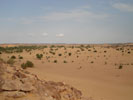
Darfur desert

The writing is on the wall, the pieces are in place, and Déby’s mercenaries are landing attack helicopters in Abéché. All this can only mean one thing: rebellion season is fully underway in Chad.

Enough Said reported recently on the developments of the Khartoum-backed Chadian rebel coup plot. Since then, it has become increasingly likely that there will be coup attempt on N’Djamena in the coming weeks. Chad expert Roland Marchal suspects that Khartoum might encourage the Chadian rebels to attack if the ICC issues an arrest warrant for President Bashir. This move may be Khartoum’s best way to counter an assault from the Darfur rebels, who may feel emboldened by the ICC’s decision.

Meanwhile, an independent United Nations expert has called on the Chadian government to bolster its protection efforts for the tens of thousands of Chadians who have been forced from their homes due to ongoing violence in the East."