Showing posts with label Tsvangirai. Show all posts

Thursday, June 11, 2009

despite an order by a tribunal established by the 15 nations of the region that the government halt evictions of white commercial farmers

TO BE NOTED: From the NY Times:

"
Zimbabwe Divisions Pose a Quandary for West

JOHANNESBURG — President Obama has offered to extend a hand to repressive rulers who unclench their fists. On Friday, he will meet Morgan Tsvangirai, the Zimbabwean politician who is trying to loosen the grip of an autocrat whose party’s very symbol is the clenched fist: Robert Mugabe, 85, in power now for 29 years and counting.

Mr. Tsvangirai, Zimbabwe’s prime minister, received more votes than President Mugabe in an election last year but was pressured by regional leaders into an unsatisfactory power-sharing deal four months ago. It left Mr. Mugabe in control of the police, the spy service, the media and the criminal justice system, and he has used his power to countermand Mr. Tsvangirai’s recent efforts to re-establish the rule of law and freedom of the press.

Therein lies the puzzle for Mr. Obama and the leaders of other wealthy Western democracies whom Mr. Tsvangirai is meeting during a three-week tour of the United States and Europe: How do they help Mr. Tsvangirai and Zimbabwe without bolstering Mr. Mugabe?

Mr. Tsvangirai has insisted that he is not walking around with a begging bowl, but clearly he and his party hope that the United States and other Western democracies will provide more aid to help rebuild Zimbabwe’s devastated health, education and sanitation systems. If they are successful, they would be strengthened for the next election.

Most acutely, Mr. Tsvangirai needs to find a way to pay teachers and other civil servants more than the $100 monthly allowance that is all the government can now afford. The teachers have been threatening to quit, and public employees have talked about going on strike.

“There’s more need to move from humanitarian to recovery support for the government,” Mr. Tsvangirai said Wednesday in a telephone interview. “The government needs resources to fulfill its obligations.”

Diplomats from the rich Western democracies have said recently that they want to help but remain reluctant to directly aid a government in which Mr. Mugabe still retains so much power.

For his part, Mr. Mugabe, who has for decades won plaudits in Africa for poking a finger in the eye of the West, seems determined to belittle Mr. Tsvangirai and sabotage his international tour.

The Herald, the state-owned newspaper Mr. Mugabe still controls, reported this week that the president had “tasked” Mr. Tsvangirai with getting the United States and Europe to lift travel and financial sanctions on Mr. Mugabe and his inner circle, a report that Mr. Tsvangirai said misrepresented the facts.

“The removal of restrictions depends on what we do back home,” Mr. Tsvangirai said. “We have to earn the confidence of the international community.”

Since Mr. Tsvangirai left the country, Mr. Mugabe has flaunted his affinity for autocrats. The Herald published a two-part defense of North Korea’s nuclear tests. And Mr. Mugabe welcomed Sudan’s president, Omar Hussan al-Bashir, charged with war crimes by the International Criminal Court, to an summit meeting attended by African heads of state.

The government then blocked Zimbabwean journalists from covering the meeting, though they were armed with a High Court order that they be allowed to attend — and despite Mr. Tsvangirai’s own insistence that journalists no longer needed government accreditation.

In recent months, journalists have continued to be arrested after writing articles that Mr. Mugabe’s allies did not like. And despite an order by a tribunal established by the 15 nations of the region that the government halt evictions of white commercial farmers — a ruling Mr. Mugabe dismissed as nonsense — the government has proceeded with prosecutions of the farmers, some of whom have been subjected to violent land invasions. On Friday, the same tribunal ruled that Zimbabwe’s government had breached its order.

Some months ago, shortly before he joined Mr. Mugabe in the government, Mr. Tsvangirai mused in an interview on the confounding question of how to deal with Mr. Mugabe and what Mr. Obama could do to help. He essentially acknowledged that he had not found the answer — and expressed a hope that Mr. Obama might have some ideas.

“The choice is, do you re-engage Robert Mugabe, or do you continue to alienate him?” he said. Neither had worked, he conceded.

Mr. Tsvangirai himself has been beaten, jailed, subjected to assassination attempts and tried on treason charges during the long years of Mr. Mugabe’s rule. He is now trying to get along with Mr. Mugabe. But that comes with risks to Mr. Tsvangirai’s credibility.

Civic leaders, journalists and some diplomats are increasingly critical of Mr. Tsvangirai for trying to be nice to Mr. Mugabe instead of speaking out more boldly and consistently when the repressive state security forces Mr. Mugabe controls abuse their power.

They also say his Movement for Democratic Change, which has a majority in Parliament, needs to use that power more aggressively to try to repeal laws that suppress the freedom of the press and the right to assembly.

“There are energetic measures he could be taking and instead he seems to be propitiating Mugabe,” said Iden Wetherell, a senior editor at two of Zimbabwe’s few independent newspapers, The Standard and The Independent.

But analysts here also say that despite Mr. Tsvangirai’s tactical missteps as he tries to outmaneuver Mr. Mugabe, one of Africa’s most cunning political survivors, he benefits from a reservoir of support and even devotion from Zimbabweans.

That sympathy has only deepened since his wife of 30 years was killed in car crash not long after he became prime minister, followed by the drowning of his 2-year-old grandson, who had come to Zimbabwe with his parents to attend his grandmother’s funeral.

“He’s clearly seen as a savior,” said Eldred Masunungure, a political scientist at the University of Zimbabwe. “And the deaths of his wife and grandson have raised his profile as someone who can endure suffering and still try to assist those he serves.”
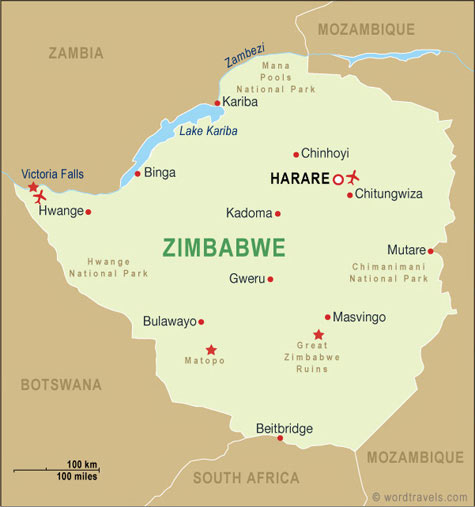
http://www.wordtravels.com/images/map/Zimbabwe_map.jpg

Monday, May 18, 2009

We would work with anybody who wants to push the national agenda forward

TO BE NOTED: From FP Via Freakonomics:

"Exclusive Interview with Morgan Tsvangirai


Posted May 2009
Zimbabwe's former opposition leader explains what it's like to share power with Robert Mugabe -- the man who (probably) tried to have him killed.


DESMOND KWANDE/AFP/Getty Images
Unlikely bedfellows: Zimbabwe's hopes rest on the uneasy relationship of two bitter enemies, Tsvangirai and Mugabe.

Imagine yourself working side by side each day with a man who -- for the last decade -- has repeatedly arrested you, charged you with treason, detained and beaten your friends, and may have plotted your assassination just a year earlier. You are prime minister and he is president, even though your party won elections to oust him from power last year. The fates of an entire country and 11 million people depend on your having a good working relationship. And now imagine that the country has multi-million-percent inflation, hundreds dying from cholera, and a pattern of political violence that has chased thousands out of the country in recent years.

Welcome to the life of Morgan Tsvangirai, prime minister of Zimbabwe and leader of the opposition Movement for Democratic Change (MDC). Since September, Tsvangirai has endured grueling negotiations to set up a power-sharing government with President Robert Mugabe and his party, ZANU-PF. Three months into its operation, the pace of progress is slow, Tsvangirai told Foreign Policy's Elizabeth Dickinson. Remaining disagreements over the appointment of ministers, the ongoing arrest of activists and journalists, and basic day to day operations have plagued the arrangement. Donors in the West have refused to send aid to the broke Zimbabwean government so long as Mugabe is still at the reins. Still, Tsvangirai is thinking big about how to get the country back on track. An economic plan will aim to get the country functioning again over the next 100 days -- tackling even the contentious issue of land redistribution. In short, Tsvangirai says, "Ours is the transformative challenge: to transform old habits and introduce a new governance culture, and you know it's difficult in a coalition government."

Foreign Policy: How did it feel on day one, walking into the position of prime minister knowing all the challenges before you? What did it feel like?

Morgan Tsvangirai: It is obvious the level of economic degeneration that just hit us in the face when we went into government. There was a sense of euphoria, which was very short-lived because the decision to go in was influenced by a number of factors, one of which was that we could not be authors of chaos, and that if there was chaos in the country the outcome would be unpredictable; it would engulf us all. So, yes, there was a sense that we have made the right decision, but we didn't know what we were going into.

FP: You said yesterday that elements of ZANU-PF are holding up the progress of the unity government. Can you update us on the status of talks to resolve these remaining issues -- for example, the position of the Central Bank governor?

MT: The discussions amongst the principles are going very well; we certainly hope that tomorrow we'll be making an announcement on the outstanding issues. You must be conscious that this is a coalition government. There are sensitivities and emotions that need to be navigated and negotiated. One would be a bit overambitious to expect everything we're grappling with to be resolved within three months.

It's frustratingly slow, in our assessment, that we have gone this far without at least indicating how the outstanding issues will be resolved. But I'm glad to say that we have made progress. The issues that we have agreed upon -- and those we are still in disagreement about -- will be announced to the nation so that the nation is able to make an assessment as to if there has been progress or not.

FP: You have shown an incredible spirit of reconciliation -- saying on Friday, "Robert Mugabe was part of the problem but he is also part of the solution, whether you like it or not." But are Zimbabweans ready for that kind of reconciliation?

MT: There is a sense of cautious optimism that this inclusive government will be a successful experiment because no one wants to go back to the November, December, January, situation. So therefore, when you present national union as one of the democratic challenges, people accept that there is need for national healing for progress. But of course, there has to be a process of that national healing, otherwise people will continue to [have] that frustration.

FP: President Robert Mugabe has a sinister reputation in the United States and elsewhere. But are there things that the West is failing to understand about Mugabe?

MT: I'm sure this perception is what has been built up over the years -- some of which is a reality. But one of the underlying things is that I am prepared to work with President Robert Mugabe -- not because he's right but because of the national interest: We would work with anybody who wants to push the national agenda forward. But instead of [the international community] taking a cue from us as to how to proceed, it would appear that people have made this judgment [not to help], and they have thrown out the baby with the bath water.

FP: How do you react to donors when they tell you that they can't give aid to Zimbabwe yet, until more democratic progress is made?

MT: My beef with all the international community and diplomats is that, look, those of us who are pushing the democratic reform agenda should be supported so that we can sustain this experiment.

I was saying to somebody this morning that it would appear that by raising the bar every time there is progress -- or every time there is an attempt [by the international community] to ignore the progress that has taken place because of one or two [outstanding] issues [unresolved in the coalitional government], you are invariably becoming a part of the [internal government] negotiations. And for the negotiating parties who are actually on the field, who are negotiating with ZANU-PF, you actually go to the extent of undermining the influence that we are trying to build among those skeptics [of international aid] inside the country.

FP: You've announced a new 100-day economic recovery plan. Can you tell us some of the things that will be happening as part of that plan?

MT: I'm sure that you know that we've just completed the first three months of this inclusive government, and the first phase was to try and consolidate the government, which I believe has now been achieved.

Now we go to the second phase in the next three months. It's a short-term program to try to intervene in various areas of our economy. And there are really five clusters: economic, social, infrastructure, rights, and security. We have done [this division] in order to build the priority programs in each ministry with the key results areas in target -- the milestones. So I would say that the next 100 days, the key priorities are to set the policy framework in various ministries; to ensure that we are able to rehabilitate some of the dilapidated infrastructure; and to ensure that the education and health delivery systems are on their feet. But above all, we need to mobilize the resources so that we can support these programs. So the 100-day plan is a test of the synergies within ministries -- across ministries -- to ensure that the whole government is working as a cohesive team.

FP: Where does land reform fit into this plan?

MT: In the 100 days, what we would expect from the Ministry of Land is first and foremost to do an assessment -- a country-wide assessment on the so-called land invasions [that occurred under Mugabe's previous government] -- if there are still any. The second part is to set up a land audit in terms of the global political agreement, a land audit that is meant to reveal whether the independent land commission is the basis to do proper land reform. We've got a plan on the land, and I think this is the only way that this issue will be finalized.

FP: In spite of your own resolve, is it difficult to motivate other members of the MDC in light of so many challenges?

MT: We have to keep focused. We know that from time to time, some of the old habits of violence will remain. But we don't lose focus on the need to create a democratic playing field so that when the new constitutional dispensation is created -- we can hold free and fair elections down the line. That's still the objective.

In other words, ours is the transformative challenge: to transform old habits and introduce a new governance culture, and you know it's difficult in a coalition government. But we know that within the transitional phase, it is important to unlock some of these mindsets that have taken us this far down. So how do I motivate our people? Our people know that we have not yet arrived as a full democratic Zimbabwe. But we are on the journey.

Morgan Tsvangirai is prime minister of Zimbabwe."

Wednesday, April 29, 2009

The authorities in Zimbabwe have continued their persecution of two officials of the Prime Minister Morgan Tsvangirai's party

TO BE NOTED: From AI:

"
Zimbabwean authorities continue persecution of political activists
© Private">Gandhi Mudzingwa

Gandhi Mudzingwa

© Private


29 April 2009

The authorities in Zimbabwe have continued their persecution of two officials of the Prime Minister Morgan Tsvangirai's party, the Movement for Democratic Change (MDC). Gandhi Mudzingwa and Kisimusi Dhlamini have been detained under armed police guard in a Harare hospital since 20 April, despite having been released on bail on 17 April.

The two men are receiving medical treatment at the Avenues Clinic in Harare following alleged torture by Zimbabwean security agents. On Monday, their lawyers made an urgent High Court application to remove the armed police guards posted at the hospital.

Amnesty International has written to the Zimbabwean authorities calling for the immediately withdrawal of the armed police.

"Their presence amounts to unlawful detention of people who have been granted bail by a Zimbabwean court," said Erwin van der Borght, Director of Amnesty International's Africa Program, in a letter to the Commissioner-General of Police in Harare.

A High Court judge reserved judgment on the matter to 30 April. Prior to the hearing which took place on 27 April, the State made a court application on 25 April in which it argued that the three accused persons were improperly released and should be sent back to Chikurubi Maximum Security Prison.

The police are reported to be searching for freelance journalist Andrison Manyere, who was released on bail at the same time Gandhi Mudzingwa and Kisimusi Dhlamini. The police have so far failed to locate him.

All three men were released on bail by the High Court on 17 April 2009 after the State did not lodge a notice to appeal against the bail order within the prescribed seven days, as required by law. Their lawyers deposited bail with the Magistrate’s Court in Harare.

Following the payment of bail, their lawyers were issued with “warrants of liberation” on the basis of which Gandhi Mudzingwa, Kisimusi Dhlamini and Andrison Manyere were released from custody.

Read More

Last of activists abducted in December released by Zimbabwe's authorities (Good News, 20 April 2009)
Zimbabwe independence celebrations overshadowed by human rights abuses (News, 17 April 2009)
Zimbabwe activists including Jestina Mukoko bailed (News, 4 March 2009)
New Zimbabwe government urged to prioritise human rights (News, 10 February 2009)"

Tuesday, April 21, 2009

It was a political problem and not an economic one that drove us into the difficulties this nation experienced,

TO BE NOTED: From Reuters:

"Is Zimbabwe’s Gono going?
Posted by: Matthew Tostevin
Tags: Africa, Zimbabwe crisis, , , , , , , , , , ,

The acknowledgement by Zimbabwe’s central bank governor that it raided the private bank accounts of companies and donors to fund President Robert Mugabe’s government during the economic crisis has increased speculation over his fate under the new national unity government.

Central Bank Governor Gideon Gono said the central bank took foreign currency from private accounts to help pay for some $2 billion in loans to state-owned companies and utilities and for power and grain imports. He said the government still had to repay about $1.2 billion, so the bank could repay the money it owes.

Heading the central bank at a time Zimbabwe was suffering economic collapse and hyperinflation that touched at least 231 million percent a year (according to official figures) was never going to be a badge of honour for the governor, but as he made clear in his statement, Zimbabwe’s problems went beyond economics.

“It was a political problem and not an economic one that drove us into the difficulties this nation experienced, and quasi-fiscal operations were a response to those political challenges we have now resolved through the inclusive government,” the statement said. “Our call is to let bygones be bygones and for everyone and every entity to start anew and open a new page.”

Gono has come under pressure from Prime Minister Morgan Tsvangirai’s Movement for Democratic Change (MDC) to resign since the former opposition party joined Mugabe in a unity government in February. Western diplomats have also said Gono’s departure could help bring a resumption of badly needed aid.

Are his days numbered now Tsvangirai and Mugabe seem to be working together more closely than many might have expected?"

Saturday, February 14, 2009

Bennett, arrested little more than an hour before Zimbabwe swore in 36 cabinet ministers from across the political spectrum

TO BE NOTED:

"ZIMBABWE: Abduction threatens unity government

Photo: Movement for Democratic Change
Roy Bennett
HARARE, 13 February 2009 (IRIN) - The future of Zimbabwe's 48-hour-old unity government may hang in the balance after a leading member of the Movement for Democratic Change (MDC) was abducted by police outside the capital, Harare, on 13 February.

MDC leader Morgan Tsvangirai was installed as prime minister on 11 February, while President Robert Mugabe retained the executive post he has held for 29 years in a deal designed to heal the political divisions that have brought the once prosperous country to its knees.

The MDC said in a statement on 13 February: "Roy Bennett, MDC Treasurer General and Deputy Minister of Agriculture designate, has just been abducted by police from the Law and Order section at Prince Charles airport, just outside Harare. The police were led by one Assistant Commissioner Nyongwe."

Bennett, arrested little more than an hour before Zimbabwe swore in 36 cabinet ministers from across the political spectrum, was expected to be installed as a deputy minister next week.

Richard Cornwall, a senior researcher at the South Africa-based think-tank, the Institute for Security Studies, told IRIN the abduction bore the hallmark of "hardliners" attempting to "scupper this deal [unity government] before it gets off the ground."

He said the focus has been on the divisions between Mugabe's ZANU-PF and Tsvangirai's MDC, but recent developments showed "what sort of divisions exist within ZANU-PF, not all of who agree with the unity government." The next few days would determine Mugabe's "ability to bring the hardliners to heel," he commented.

Cornwall said it was understood that the "hardliners" were from the Joint Operations Committee (JOC), which comprised security chiefs of the army, police, Central Intelligence Organisation and the prisons department, and was coordinated by Emmerson Mnangagwa, at one time a presidential pretender.

The appointment of Bennett, a white farmer whose land was taken during the government's fast-track land reform programme in 2000, may have been seen as "a signal" to ZANU-PF hardliners that the MDC would renegotiate land ownership in Zimbabwe, Cornwall said.

Bennett fled his homeland and spent three years in exile after being accused of plotting to kill Mugabe, and only returned to Zimbabwe a few days ahead of Tsvangirai's inauguration.

Signs of tension

Indications that the unity government was facing severe challenges came within 24 hours of Tsvangirai assuming office, when he visited detainees ahead of their release from Harare's high-security Chikurubi prison.

A few hours earlier on 12 February, the Harare Magistrate's Court ordered the release of Jestina Mukoko, a veteran journalist and human rights activist, and two MDC activists accused of undergoing military training in neighbouring Botswana in order to topple Mugabe's government.

Harrison Nkomo, one of the lawyers representing the more than 30 detained activists, including Mukoko, told IRIN the three detainees had initially been taken to a private hospital in Harare after their release was ordered.

''There is no doubt that they need urgent medical attention. For example, when Justina [Mukoko] was abducted on December 3 in 2008, she weighed 70kg but now she weighs 52kg''
"Prison officers later came during the afternoon on Thursday [12 February] and returned them to the high-security prison complex before [taking] them [back to the hospital] at midnight. A private doctor and a government medical officer have examined the three, and they both agreed that they needed urgent medical attention."

Nkomo told IRIN the government was opposed to the three detainees receiving medical attention. "There is no doubt that they need urgent medical attention. For example, when Jestina was abducted on December 3 in 2008, she weighed 70kg but now she weighs 52kg, meaning she has lost 18kg in the two months that she has been detained."

At his inauguration, Tsvangirai said the jailed activists would not "remain in those dungeons any day or any week longer". Bennett's whereabouts remained unknown at the time of writing.
"

Wednesday, January 21, 2009

"The southern African country is battling hyperinflation and has endured food shortages since 2000"

Checking in on Zimbabwe. From Reuters:


Photo


1 of 1Full Size

By Paul Simao

JOHANNESBURG (Reuters) - Graca Machel, the wife of Nelson Mandela, on Wednesday described Zimbabwe's government as illegitimate and said regional leaders had allowed hundreds of thousands of people to die needlessly in the African nation.( THANK GOD )

Zimbabwe is facing a humanitarian catastrophe as President Robert Mugabe and the opposition bicker over a stalled power-sharing deal. Rights groups say scores of opposition activists have been murdered, tortured and beaten.( TRUE )

"Any government that goes out and assaults its people, its citizens, it has lost completely any kind of legitimacy," Machel said at a news conference where Zimbabwean activists launched a hunger strike to pressure Mugabe and the SADC regional body.( GREAT )

Asked if the veteran Zimbabwean ruler, in power since independence in 1980, should step down, Machel said: "The people of Zimbabwe have already said so ... the ballot has spoken."( WOW )

The Mozambican-born Machel joined a growing list of prominent Africans who in the past year have criticised Mugabe's authoritarian rule or called for the removal of his government.

Mugabe lost the first round of a presidential election last year to MDC leader Morgan Tsvangirai, but he won the second round overwhelmingly after Tsvangirai pulled out of the race, citing violence against his supporters.

For almost a decade South Africa and other nations in SADC (Southern African Development Community) have used quiet diplomacy to try to nudge( WITHOUT EFFECT ) Mugabe toward democratic reforms and halt Zimbabwe's meltdown.

An apparent breakthrough was reached last September when Mugabe and Tsvangirai agreed to form a unity government, but the deal has unravelled over control of key ministries and many doubt it can be salvaged.

In the meantime, food shortages have worsened and the healthcare system has all but collapsed, exposing the population to diseases such as HIV/AIDS and cholera, which has killed more than 2,100( 2100 ) people in recent months.

Machel, who was barred from entering Zimbabwe on a humanitarian visit late last year, said hundreds of thousands of lives could have been saved had the leaders of SADC taken stronger action to end the crisis.( YES )

"We trusted too long. It's time to tell our leaders we lay the lives of all those who passed on ... in the hands of the SADC leaders because they took responsibility to stop the mess there," she said.

Machel, however, said she would not join the hunger strike and rotating fasts, which are due to last for three months.

A total of 55 activists have joined the protest, according to Kumi Naidoo, one of the hunger strikers.

The protesters are demanding, among other things, that SADC recognise that Mugabe's government is illegitimate and a transitional authority be set up to implement the power-sharing deal if the deadlock continued past the end of February."( YES )

And more bad news:

Photo
1 of 1Full Size

HARARE (Reuters) - Zimbabwe faces another huge food deficit in 2009 due to continued falls in farm production, mounting political uncertainty and economic instability, a report by a farmers' union said on Wednesday.

The southern African country is battling hyperinflation and has endured food shortages since 2000, when President Robert Mugabe's government began seizing farms from whites to resettle landless blacks.( A TERRIBLE POLICY )

A power-sharing deal signed by Mugabe and opposition leader Morgan Tsvangirai last September looks fragile due to bickering over control of key cabinet posts, dimming hopes the ruined economy will be rescued.

The Commercial Farmers' Union (CFU), which represents most of the few remaining white commercial farmers, said agricultural output would continue to fall sharply until the country's political crisis was resolved.

"Investment in agriculture is long-term and its risk factor very high, therefore under the present unstable conditions prevailing in Zimbabwe at the moment, production in all sectors is expected to be extremely low this season," the CFU said in a report.

The CFU added that the economic meltdown had also hit farm operations.

"The super-hyperinflation prevailing in the country and the unavailability of cash from the banks has also impacted negatively on any meaningful production this season," the union said.

The last official inflation rate, for July last year, stood at 231 million percent.

Donor agencies say more than 5 million Zimbabweans, almost half the population, currently rely on food handouts and expect the number to rise following another poor agricultural season.

The United Nations' World Food Programme (WFP) says its $140 million emergency food aid appeal for Zimbabwe has come up $65 million short.( NOT GOOD )

The CFU said continued disturbances on farms, where some white farmers are still being forced off land or prosecuted for failing to do so( THIS NEEDS TO BE CONDEMNED ), had also hit production.

Less than 500 white farmers remain active on their farms, down from over 6,000 before the land seizures began.( THIS HAS WORKED WELL )

Mugabe's government has said it would press on with the prosecution and eviction of white farmers still on land earmarked for acquisition, despite a ruling by a regional Southern African Development Community (SADC) tribunal stopping such action( UNREAL ).

Critics say Mugabe's land policies have ruined Zimbabwe's once prosperous economy, but the veteran ruler says the seizures were meant to reverse colonial land imbalances."( WHAT A DISASTER MUGABE HAS BEEN. )

Mugabe should be condemned by the entire planet.

Sunday, January 11, 2009

Someone appeals for bolder regional action, saying: "Please SADC take our problems seriously, don't neglect us."

From Africa Can...End Poverty:

"
Letter from Zimbabwe
I received this missive from a friend:
December 11, 2008
Harare, 1.00am
It is just after midnight in Harare. I have just returned from a midnight tour of the ATMs in Harare with a cousin. There are queues of people still waiting to get their weekly cash withdrawal limit of $100,000,000,000 (US$2.50). I saw the queues this morning when I went for my first meeting at 7.45am. I did not know then that I would be seeing them throughout the day. Most of the ATMs had run out of money. Rather than go home, people saved their precious place in the lines by lying down where they stood and taking a nap. Covering themselves with sacks, newspapers and whatever warming clothing they had. Those ATMs that were still paying out cash had queues of policemen and soldiers. I dared not pull out my camera then( YIKES ). When I did pull out my camera, it was of people too tired to care. Needless to say, picture quality from a moving car using a micro camera is not the best. This is not a normal interpretation of 24-hour banking; seven days a week.
Three hours earlier, I had gone to one of the cholera infected areas where my aunt lives. I had not intended to stay long. It is a way out of town and I did not want her worrying about my safety getting back into the city. There was a power outage from 6 p.m. and it had taken us two hours to find a house I last visited 20 years ago as a boy. But I did ask how she was coping in Harare; and to her nephew she poured her heart out. No clean water for weeks on end, no food in the shops and constant power cuts. She drives an hour and half across the township in search of clean drinking water, which she brings back in plastic containers. When the city council water does run through the taps in the house, the water is discolored with sewer water. The shops in the neighborhood are empty of basic necessities including mealie meal. Her husband now lives at their farm in another town so that he can plant, guard and harvest the maize that they will live on next year. There are groceries in some shops in the city, but they are sold in US$ and priced beyond her means. I am glad I brought her a suitcase of groceries. Groceries that, 20 years ago, my parents once drove from Lusaka to Harare to buy when Zambia was going through similar madness in the 1980s.( UNREAL )
December 12, 2008
Today the Reserve Bank increased the cash withdrawal limit from $100,000,000 to $200,000,000 (US$4). It also introduced two higher-denomination notes, $200,000,000 and $500,000,000. As expected there was a mad rush to withdraw and spend the cash before it loses value( A RUN OF ANY KIND IS SERIOUS. HERE, IT CAN BE LIFE OR DEATH. ). It is widely expected that retailers will increase their prices in line with the higher withdrawal limits. There were long (and I mean l…l…o…o…n…n…g…g) queues at every single working ATM. Offices were abandoned. I took pictures of the lines outside Barclays bank by walking to the first floor offices of government labor department. In a large pool office with at least 20 desks there was a lone clerk who looked up at me for all of two seconds. As I walked across the room to the window facing the bank, the files lay unattended on people’s desks…probably untouched for weeks. With civil service wages eroded by hyperinflation, people necessarily spend more time in the parallel economy trying to make ends meet. Interestingly, there are no runs on banks. The value of the withdrawals is so meaningless that the banks will be able to meet depositor demands with ease.( I GUESS THIS IS A WAY TO END RUNS. )
More from the Zimbabwean:

"The Media Monitoring Project of Zimbabwe (MMPZ) is an independent Trust that works to promote freedom of expression and responsible journalism in Zimbabwe.
MMPZ notes with disappointment the punitive US-dollar-denominated fees to be paid by foreign correspondents and news agencies operating in Zimbabwe for applications, accreditation and registration to practice their profession, as reported in the January 6 issue of The Herald. This new fees structure, published pursuant to the provisions of the draconian Access to Information and Protection of Privacy Act, clearly represents an intensification of the Zimbabwean authorities’ sustained campaign to block access to the foreign media seeking to cover the Zimbabwean story, thus depriving Zimbabweans (and the world community) of a variety of alternative sources of information to the output of the government-controlled media( THIS MUST BE PUBLICIZED. ). In fact, MMPZ believes that all such registration and licensing regulations that exist under the Act constitute a clear violation of regionally and internationally recognised guarantees safeguarding freedom of expression and of the media and should be condemned( YES ). Such regulation of the media and prohibitive fees structures also contravene the spirit of the global political agreement signed on 15th September 2008. ( YES )
MMPZ therefore calls on the Zimbabwean authorities to immediately revise any fees charged for the registration of any journalist or media organisation to no more than a token administrative cost.
Most importantly, MMPZ urges any new government to commit itself to the following:
• Ensure that any media activity is not rendered dependent upon any form of statutory registration or admission and that mechanisms promoting media self-regulation are created and strengthened;

• Encourage a diverse and independent print and electronic media, including foreign media;

• Repeal of the Access to Information and Protection of Privacy Act as a matter of urgency, and remove all those clauses in the Broadcasting Services Act, Public Order and Security Act, and all other pieces of legislation that hinder the right to seek, receive and impart information and ideas without hindrance, as guaranteed under Zimbabwe’s Constitution and the Universal Declaration of Human Rights. Such repressive laws have no legitimate purpose and are not necessary in a democratic society."( ABSOLUTELY )

And here:


"HARARE, Zimbabwe - Opposition members accused of being involved in a bomb plot in Zimbabwe told a court Thursday that they were tortured into making false confessions( THIS IS HOW TORTURE REALLY WORKS ). The allegations were made a day after the seven were formally charged with terrorism, banditry and insurgency. All pleaded not guilty. They face the death penalty if convicted.( UNREAL )

The seven are among a number of rights activists and opposition party members detained in recent weeks in what the opposition calls a crackdown on dissent.( IT HAPPENS EVERY TIME )

In a separate case, another group of detainees has been accused - but so far not formally charged - of attempting to recruit fighters to train in neighboring Botswana to overthrow President Robert Mugabe.( EVERY TIME )

The arrests have raised tensions in Zimbabwe, where Mugabe and the opposition are locked in a long dispute over allocation of cabinet posts under the power-sharing agreement, seen as the best chance of easing a deep economic crisis.

Morgan Tsvangirai has threatened to pull his Movement for Democratic Change party out of negotiations over the issue. Many of the activists in custody are MDC members and the party has said they were abducted.

Tsvangirai won the first round of voting in March elections, but fell short of the majority needed to become president, triggering a run-off which Mugabe won after the MDC leader pulled out, citing violent attacks on his supporters. - msnbc.msn.com"

And here:

"CIVIL society organisations in SA are to press the government and the Southern African Development Community (SADC) to hasten resolution of the crisis in Zimbabwe.( PLEASE )


Helping to co-ordinate the campaign, expected to start in the next 10 days, is Kumi Naidoo, honorary president of the global alliance for citizen participation, Civicus.

Naidoo said Archbishop Emeritus Desmond Tutu had committed himself to a weekly fast, together with Bishop Paul Verryn of the Central Methodist Church. Tutu is a member of the Elders, whose delegation was denied entry into Zimbabwe late last year.( A GREAT MAN )

"We need to up the ante a bit in terms of the types of activities that put pressure on the government," said Naidoo, who is also co-chair of the Global Call to Action Against Poverty.

Together with Pastor Raymond Motsi of the Bulawayo Baptist Church, Naidoo has committed himself to a hunger strike.

The planned campaign is expected to impress upon the continent, as well as South African society, including members of the African National Congress, the wider implications of the crisis in Zimbabwe.( PLEASE )

Naidoo was part of a delegation that spent Christmas in Zimbabwe where he met scores of Zimbabweans and compiled some of the testimonies into a film, Time 2 Act . Copies of the film will be given to President Kgalema Motlanthe, to other SADC heads of state and to the African Union .

In the film are descriptions of the humanitarian crisis. For instance, a woman speaks of overcrowding in the mortuaries, which has pushed the cost to $300 a body. Someone appeals for bolder regional action, saying: "Please SADC take our problems seriously, don't neglect us."

Naidoo said many of those interviewed could not understand SA's position on Zimbabwe, especially its stance at the United Nations Security Council, where it voted against tougher action on the authorities in Zimbabwe( IT'S NOT ISRAEL ).( A DISGRACE )

"Overall we were struck by how much worse it (the Zimbabwe situation) actually was in terms of the humanitarian crisis and on the political repression again significantly worse."( EVERY DAY IT GETS WORSE )

The team found a breakdown in the school system. Garbage collection had also come to a standstill in the major centres, further contributing to the cholera outbreak.

Even respect for the dead had gone. "One of the mortuaries was closed while we were there and what it means is that families have to put some sand inside the house, put some water in that sand and put the (deceased) family member there," Naidoo said. - businessday.co.za"

This is another disgrace that we allow to happen through simple indifference.

Sunday, January 4, 2009

"it is local and international aid workers and non-political social activists who will likely be the real agents of change in Zimbabwe in 2009."

Checking in on Zimbabwe. From the Guardian:

"
What does 2009 hold for Zimbabwe?

Will a government of national unity, if finally formed, be the solution to the country's problems?

As Zimbabwe limps agonisingly into 2009, there is one immediate question which the MDC has to answer; will they join the still notional government of national unity, or not? Morgan Tsvangirai stated that unless well-known activists Jestina Mukoko and other civil society and opposition figures are released, he will ask the MDC's national council to suspend negotiations.

After the tumultuous silence following their abductions, Mukoko and her co-accused were suddenly produced, rabbit–style, out of the police hat. Allegedly, the accused were involved in the recruitment and training of saboteurs to overthrow Robert Mugabe from bases in Botswana. Even if this were true( COME ON ) – and there is as yet no wisp of evidence to support the state's case – the inhuman treatment of the activists is utterly unconstitutional and goes far beyond any crimes they have supposedly committed( IS THIS A SURPRISE ? ). If the MDC wish to give force to their ultimatum, they should not allow themselves to be steamrollered by Zanu-PF, South Africa and Southern African Development Community (SADC), into joining a Government of National Unity (GNU) just so they can all feed from the same trough.( AMEN )

"Operation Chimumumu"

Here's what that is:

"MARONDERA – Zanu (PF) has launched “Operation Chimumumu” - a nationwide campaign aimed at eliminating MDC officials and activists and some staff of targeted NGOs – in a desperate attempt to force MDC President, Morgan Tsvangirai, into a marriage of inconvenience.
The MDC has continued to resist being pressurized into the formation of an inclusive government in which Robert Mugabe continues to wield all the power – in contravention of the letter and spirit of the agreement signed in Harare on September 29.
Thirty armed men are reportedly being accommodated at a house owned by a senior Zanu (PF) politburo member in Winston Park, Marondera. The gunmen are allegedly dressed in riot gear and have been arresting locals before whisking them away to killing zones.
Mugabe and his military junta continue to thwart the legitimate power-sharing demands of the MDC - with the connivance of former South Africa president, Thabo Mbeki, and other undemocratic regional leaders."

The post continues:

"– the late 2009( 2008-DON ) assault on opposition and civil society activists by the Police and Central Intelligence Organisation (CIO) – is part of the carrot and stick strategy; the carrot is the shiny new passport for Tsvangirai (and the promise of a seat at the edge of the high table as Prime Minister if he plays ball). The stick is the inevitable arrests, abductions and torture of opposition and civil society activists and the threat of worse to come if the MDC does not co-operate( YES ). Oddly enough, Zanu-PF may have given the opposition succour in making their choice. High court judge Yunus Omerjee ordered the immediate release of most of the accused. He also ordered that they be given access to proper medical treatment (many of them bear the signs of torture( TORTURE ) ), full access to lawyers, and normal visitation rights. Instead, the state has placed them in the notorious Chikurubi maximum security prison – a facility originally designed for the most violent criminal offenders.

There are other issues which need to be resolved – the ministerial posts, the governorships and the question of who will control the finances. But both MDC groups should insist on an unconditional end to political violence as a precursor to a GNU. Zanu-PF has alleged that the MDC is training military recruits in Botswana. If this is the case, then indeed the MDC has a case to answer; but Zanu-PF has not yet produced any proof. There is currently a SADC investigation into these claims. The MDC should insist that the findings be published before any GNU is formed, otherwise it will simply be yet another stick that they will be beaten with( LITERALLY ). The state is also making a distinction( UNREAL ) between humanitarian politics and human rights politics. Humanitarian aid organisations have been allowed ingress into Zimbabwe's blighted communities; human rights activists, in contrast, have not been spared the rod. The MDC then, if it were to join a GNU, would need to be aware of what it was getting into. It can hardly be part of a coalition government while civilians are being abducted and killed. There is no "acceptable" level of political violence, and the GNU cannot be Zimbabwe's redemption if the drums are beaten on human skin.( TRUE )

And what of military intervention? I don't see it happening. The most common suggestion is a military invasion of Zimbabwe from, or by, a neighbouring country (possibly Botswana)( I'D BE FOR IT ). Idi Amin's removal by Tanzania's Julius Nyerere in 1979 is cited as a useful precedent. There are many similarities between Mugabe's Zimbabwe and Amin's Uganda; a brutal leadership, a broken economy, the flight of millions, and a restive military. But there are some vital discrepancies – Amin provoked Tanzania and sent Ugandan forces into his neighbour's country in a hunt for Ugandan "dissidents". Mugabe has been very careful not to overstep the mark in his war of words with Botswana, and it would be difficult for the Botswana Defence Forces or other neighbouring country to justify invading Zimbabwe, other than in self-defence( A FAIR POINT ).

That leaves the UK and the United States to mull the challenge of direct intervention( NOT A GOOD IDEA ). This won't happen; UK and US forces are at full stretch in Iraq and Afghanistan, and the Caucasus and Middle East will always be considered more important than Africa; there is also little public or state appetite further military adventures in far away places. It would be a huge operation and there is little indication that anyone is willing to pay the costs. In addition, humanitarian military intervention is best applied when civilians are clustered in readily identifiable camps or zones which can be cordoned off and protected by an international mission. This is not the case in Zimbabwe at the moment – although there has been tremendous dislocation, most people are still in their rural or urban homes, and this makes it difficult to imagine how an operation such as this would work. More importantly, at the first intimation of a major military offensive against it, the security sector in Zimbabwe would target the opposition leadership for elimination or for use as hostages.

This is not to say that Zanu-PF will not face a military threat. Growing dissatisfaction within the rank and file of the security establishment, increasing indiscipline and possible small-scale mutinies might be complemented by a possible "third force" of anti-state military operatives beginning a campaign of violence if the politics remain unresolved. This third force, if it comes into being, would be a threat to both Zanu-PF and the MDC. It would not be an MDC organisation, but its existence would be used by Zanu-PF to justify further repression. For Zanu-PF, an open military challenge would bind supporters together, but it would also widen the fissures in the security sector periphery and lead to overstretch.

The year 2009 will start the way 2008 ended; with the Zimbabwe question unresolved. Zimbabwe will be on the SADC agenda in its January meeting, and it will also feature at the UN Security Council meeting early in 2009. Although the regime v opposition polemic will continue, for ordinary people what really matters is how their daily lives can be transformed for the better. In this regard, it is local and international aid workers and non-political social activists who will likely be the real agents of change in Zimbabwe in 2009."

A sad but realistic appraisal. We could do more. Certainly South Africa could.

Thursday, January 1, 2009

"If convicted they could face the death penalty."

Mugabe has been using this same tactic of arresting the opposition for years. When will it end? From the FT:

"
Zimbabwe activists to stay in jail

By Tony Hawkins in Harare

Published: December 31 2008 10:23 | Last updated: December 31 2008 10:23

In a decision which could put an end to months of on-off negotiations to establish a coalition government in Zimbabwe, a magistrate on Wednesday ruled that 16 human rights campaigners and opposition supporters must remain in custody pending a Supreme Court hearing of their case.

Prominent human rights campaigner Jestina Mukoko and 15 others are charged with recruiting people to undergo military training in Botswana with the aim of toppling President Robert Mugabe’s government. If convicted they could face the death penalty.( THIS HAPPENS EVERY ELECTION )

Last week a High Court judge ruled that the detainees be transferred to a hospital for medical treatment, but government lawyers are challenging his ruling and police have refused to obey the order to take the prisoners to hospital.

The police were supported on Wednesday when at a brief hearing in Harare magistrate Mishrod Guvamombe said “This matter remains to be decided in the Supreme Court and the accused cannot be released.” Two other activists facing lesser charges were freed.

The decision could have far-reaching political consequences because three weeks ago opposition leader Morgan Tsvangirai gave an ultimatum that he would break off coalition talks with President Robert Mugabe’s ruling Zanu-PF party if appropriate legal procedures were not followed by December 31.

Mr Tsvangirai’s Movement for Democratic Change is deeply divided over the issue of whether to participate in the unity government agreed in September.

In recent days party opinion appears to have hardened against the deal, largely because numerous actions by the Mugabe government cast doubt on its sincerity.

These include the abductions of more than 30 opposition supporters and human rights campaigners, only some of whom have been brought to court, the charging of five MDC officials on counts of terrorism and sabotage, including the head of the party’s security department and a senior adviser to Mr Tsvangirai, the re-appointment of the unpopular governor of the Reserve Bank of Zimbabwe Gideon Gono, and the repeated use of the security forces against opposition and civil rights groups.

If he sticks to his word, Mr Tsvangirai will abandon the talks, but he is under intense pressure from the South African government( SHAMEFUL ), which is desperate for a deal that would leave Mr Mugabe in effective control.

The opposition leader also has a long record of flip-flopping on key issues, issuing numerous threats and ultimatums and then backing away from them.

Were the opposition to withdraw from the talks, President Mugabe has said he would call fresh elections which neither party wants and the outcome of which would not be recognised internationally.

Mr Tsvangirai, who has been out of the country for the last 10 weeks is understood to be considering returning, now that the Zimbabwe authorities have issued him a new passport, but there are serious concerns that he could be arrested, or worse, should he fly back to Harare.

He is under pressure also to agree to the deal because of the rapidly worsening humanitarian situation in Zimbabwe with the World Health Organisation estimating that 1608 people have does from the cholera epidemic afflicting the country. The WHO warned this week that the situation could get worse in the weeks ahead."

Mugabe really knows how to use the suffering of his country's citizens to keep himself in power. In essence, they're hostages.

Sunday, December 28, 2008

"she wanted their farm and intended to get it through the government’s land redistribution program."

More on Zimbabwe from the NY Times by CELIA W. DUGGER:

"CHEGUTU, Zimbabwe — Edna Madzongwe, president of the Senate and a powerful member of Zimbabwe’s ruling party, began showing up uninvited at the Etheredges’ farm here last year, at times still dressed up after a day in Parliament.
Skip to next paragraph
The New York Times

Several farms in Chegutu have come under assault.

Mr. Freeth circulated photographs of his injuries online after the invasion of his farm.

And she made her intentions clear, the Etheredges say: she wanted their farm and intended to get it through the government’s land redistribution program( I DO NOT AGREE WITH THIS POLICY AT ALL. THIS ARTICLE GIVES ONE REASON. CRONYISM. IF THERE NEEDS TO BE REDISTRIBUTION, IT SHOULD COME THROUGH TAXES ON THE FARMERS WHICH THEY CAN AFFORD ).

The farm is a beautiful spread, with three roomy farm houses and a lush, 55,000-tree orange orchard that generates $4 million a year in exports. The Etheredges, outraged by what they saw as her attempt to steal the farm, secretly taped their exchanges with her.

“Are you really serious to tell me that I cannot take up residence because of what it does to you?” she asked Richard Etheredge, 72, whose father bought the farm in 1947. “Government takes what it wants.”

He dryly replied, “That we don’t deny( WELL PLAYED ),” according to a transcript of the tapes.

Mr. Etheredge this year became one of dozens of white farmers to challenge the government’s right to confiscate their land, and they sought relief in an unusual place: a tribunal of African judges established by the 15 nations of the Southern African Development Community regional trade bloc.

The case is rooted in one of the most fraught issues facing not just Zimbabwe, but other nations in the region, especially South Africa: the unjust division of land between whites and blacks that is a legacy of colonialism and white minority rule( AGAIN, USE TAXES ).

But the tribunal’s recent ruling, in favor of the white farmers, is also a milestone of particular relevance to Zimbabwe. It suggests that a growing number of influential Africans — among them religious leaders and now jurists — are confronting Robert Mugabe, Zimbabwe’s 84-year-old liberation hero and president, for his government’s violations of human rights and the rule of law( FINALLY ), even as most regional heads of state continue to resist taking harsher steps to isolate his government.

Zimbabwe’s handling of the land issue has had disastrous consequences. Since 2000, when Mr. Mugabe began encouraging the violent invasion of the country’s large, white-owned commercial farms — once the country’s largest employers — food production has collapsed, hunger has afflicted millions and the economy has never recovered( WELL DONE ).

Mr. Mugabe presents this redistribution as a triumph over greedy whites( THAT DESTROYED FARMING IN THE COUNTRY. A GOOD TRADE-OFF? ). But it set off a scramble for the best farms among the country’s ruling elite, who often had little knowledge or interest in farming, and became a potent source of patronage for Mr. Mugabe. His own relatives, as well as generals, judges, ministers and members of Parliament, were beneficiaries, farmer and human rights groups say.

By this year, the number of white-owned commercial farms dwindled to about 300 from 4,500. Even many of the remaining ones came under assault in this year’s bloodstained election season.

Among those singled out were farms here in Chegutu, where some owners had dared to take their cases to the S.A.D.C. tribunal, challenging Mr. Mugabe before judges he could not entice with gifts of land.

In March, the tribunal ordered the Zimbabwean authorities not to evict any farmers seeking legal protection, pending resolution of the case. But as with other international efforts to influence Mr. Mugabe and his allies, Zimbabwean authorities apparently decided to ignore the tribunal’s order( OF COURSE ).

On June 17 — just 10 days before the discredited presidential runoff between Mr. Mugabe and his rival, Morgan Tsvangirai — dozens of youths led by a man named Gilbert Moyo surrounded Mr. Etheredge’s son, Peter, 38, at the main gate of the farm, family members said.

“Moyo told me he’d been sent by Edna,” Peter recalled, referring to Mrs. Madzongwe, the Senate president. Peter said Mr. Moyo threatened to kill him if the Etheredge clan did not clear off the farm immediately.

Peter, his twin, James, and their families fled.

Mrs. Madzongwe denied hiring Mr. Moyo and his gang. “If a farm is acquired, there are rules,” she said in a recent telephone interview. “I go by the book.”

But Jason Lawrence Cox, a local farmer, swore in an affidavit that he saw her on June 21 drive past piles of the Etheredges’ belongings, dumped at the side of the road, and onto their farm.

The gang had looted the three family homes on the farm of all but the large mounted heads of an eland and a kudu, according to photos taken before and after the invasion. They used a jackhammer to break through the foot-thick wall of the walk-in safe. The haul from the homes and the farm included 1,760 pounds of ivory, 14 handmade guns, 14 refrigerators and freezers, 5 stoves, 3 tractors, a pickup truck and 400 tons of oranges, the family said.

Eleven days later, a far more violent farm invasion occurred at the home of Mike and Angela Campbell, also here in Chegutu. Mr. Campbell, 76, was the first farmer to take on Mr. Mugabe before the tribunal.

A gang came that Sunday afternoon, pouring out of a pickup truck and a bus, Mrs. Campbell said. Her son-in-law, Ben Freeth, 38, said that he was bludgeoned with rifle butts and that his skull and ribs were fractured. Mike Campbell was also severely beaten.

Mrs. Campbell, 66, said she was dragged by her hair, after her arm was broken in multiple places, and dumped next to her husband. The doctor who treated them in the capital, Harare, signed affidavits confirming the severity of their injuries.

“Mike was so battered, I hardly recognized him,” Mrs. Campbell said. “I didn’t know he was alive until he groaned.” The three of them were loaded into the Campbells’ truck and driven to a nighttime vigil of youth loyal to the ruling party at Mr. Moyo’s base camp, she said.

It was cold, and men poured freezing water over them. Mr. Campbell drifted in and out of consciousness. By the flickering light of bonfires, the youths denounced the Campbells as white pigs, Mrs. Campbell said, and ordered her to sing revolutionary songs. She remembers singing a children’s song instead, which enraged one of her intoxicated tormentors. He charged at her, she said, trying to thrust a burning stick into her mouth.

Later that night, the Campbells and Mr. Freeth were again stuffed into the back of the Campbells’ truck. Before they were dumped, Mrs. Campbell said, the kidnappers insisted that she sign a paper promising not to press the tribunal case.

Within days — just as the international outcry mounted over the state-sponsored beatings of thousands of opposition supporters — photographs of the grotesquely battered faces of the Campbells and Mr. Freeth circulated on the Internet.

By July 4, the police informed the farmers here who were part of the tribunal case that they could go back to their land. Peter Etheredge speculated that the authorities might have relented because the photographs were spreading online just as Mr. Mugabe was meeting with Africa’s leaders about his country’s political crisis.

On Nov. 28, the farmers gathered in Windhoek, Namibia, to hear the final ruling of five judges of the S.A.D.C. tribunal. As Justice Luis Antonio Mondlane of Mozambique read the full 60-page decision aloud, it dawned on the farmers that they had won.

The tribunal found that the government had breached its obligations under the trade bloc’s treaty, which committed it to respecting human rights, democracy and the rule of law, by denying the farmers compensation for their farms and court review of the government’s confiscation of them.

More broadly, it rejected the government’s claim that the land redistribution program was meant to right the wrongs of a colonial era when a white minority ruled what was then Rhodesia. Instead, the court found that the government had itself racially discriminated against the white farmers.

In a stinging rebuke, the tribunal, citing an earlier legal case, said it would have reached a different conclusion( THIS IS SAD. LAND EXPROPRIATION DOESN'T WORK ) had the government not awarded “the spoils of expropriation primarily to ruling party adherents.”

The usually stoic farmers wept. “We burst into tears, the whole lot of us,” Mr. Freeth said.

The reaction of the government was defiant. Didymus Mutasa, the minister who oversees the distribution of seized land, told the state media that the judges were “daydreaming” if they thought Zimbabwe would heed the ruling.

The government would take over the rest of the white-owned farms, he vowed. And the state has since moved to prosecute four Chegutu farmers, though not yet the Etheredges or the Campbells, for illegally occupying land they owned before the government claimed it, the farmers’ lawyer, Dave Drury, said.

Perhaps it was a banner at the recent funeral of a ruling party boss that best captured the government’s rejection of those who question its righteousness, even a panel of distinguished African jurists.

The banner said: “The Rhodesian Tribunal Can Go to Hell( SAY HELLO TO MUGABE WHEN YOU GET THERE ).”

These Land Expropriations are a disaster. A tax, which farmers can afford, could have been used to provide a social safety net, loans to small businesses, education, etc. By the way, this historical righting of wrongs can easily spread to tribal conflicts, if it isn't humanely and legally dealt with.

Monday, December 22, 2008

"This largely man-made crisis, occasionally worsened by drought and erratic rains"

I don't know what to think when I read stories like this:

"
In Zimbabwe, Survival Lies in Scavenging

NZVERE, Zimbabwe — Along a road in Matabeleland, barefoot children stuff their pockets with corn kernels that have blown off a truck as if the brownish bits, good only for animal feed in normal times, were gold coins.( UNREAL )

In the dirt lanes of Chitungwiza, the Mugarwes, a family of firewood hawkers, bake a loaf of bread, their only meal, with 11 slices for the six of them. All devour two slices except the youngest, age 2. He gets just one.

And on the tiny farms here in the region of Mashonaland, once a breadbasket for all of southern Africa( SO SAD ), destitute villagers pull the shells off wriggling crickets and beetles, then toss what is left in a hot pan. “If you get that, you have a meal,” said Standford Nhira, a spectrally thin farmer whose rib cage is etched on his chest and whose socks have collapsed around his sticklike ankles.

The half-starved haunt the once bountiful landscape of Zimbabwe, where a recent United Nations survey found that 7 in 10 people had eaten either nothing or only a single meal the day before.( DEAR GOD )

Still dominated after nearly three decades by their authoritarian president( HE'S AMONG THE WORST RULERS EVER ), Robert Mugabe, Zimbabweans are now enduring their seventh straight year of hunger. This largely man-made crisis( TRUE ), occasionally worsened by drought and erratic rains, has been brought on by catastrophic agricultural policies( TRUE ), sweeping economic collapse and a ruling party that has used farmland and food as weapons in its ruthless — and so far successful — quest to hang on to power( SUCH A DISGRACE ).

But this year is different. This year, the hunger is much worse.

The survey conducted by the United Nations World Food Program in October found a shocking deterioration in the past year alone. The survey, recently provided to international donors, found that the proportion of people who had eaten nothing the previous day had risen to 12 percent from zero, while those who had consumed only one meal had soared to 60 percent from only 13 percent last year.

For almost three months, from June to August, Mr. Mugabe banned international charitable organizations from operating, depriving more than a million people of food and basic aid after the country had already suffered one of its worst harvests.

Mr. Mugabe defended( PEOPLE STARVING IS LESS IMPORTANT TO HIM THAN HIS STAYING IN POWER ) the suspension by arguing that some Western aid groups were backing his political rival, Morgan Tsvangirai, who bested him at the polls in March but withdrew before a June 27 runoff. But civic groups and analysts said Mr. Mugabe’s real motive was to clear rural areas of witnesses to his military-led crackdown on opposition supporters and to starve those supporters( OF COURSE ).

The country’s intertwined political and humanitarian crises have become ever more grave — with a cholera epidemic sweeping the nation, its health, education and sanitation systems in ruins and power-sharing talks at an impasse. Meanwhile, Mr. Mugabe has blamed Western sanctions, largely aimed at senior members of his government, for the country’s woes( UNREAL ).

His information minister even charged last week that Britain, Zimbabwe’s former colonial ruler, had started the cholera outbreak — spread by water contaminated with human feces — as an act of “biological chemical war force,” a charge widely derided as paranoid or cynical( DISGRACEFUL ).

But for all Mr. Mugabe’s venom toward the West, a central paradox rests at the heart of his long years in power. It was the failed policies of Mr. Mugabe and his party, ZANU-PF, including their calamitous seizure of commercial farms, that made this nation so utterly dependent on aid from the European and American donors he so reviles. And the same applies to Western leaders: Despite their scathing denunciations of him, it is their generous donations that have helped him survive by preventing outright famine among his people( A TOUGH CHOICE ).

“You’re acting to save lives, knowing that by doing so you are sustaining this government,” said one aid agency manager, speaking on condition of anonymity for fear of reprisals. “And unfortunately, ZANU-PF is good at exploiting this humanitarian imperative.”

American-financed charities and the World Food Program have been feeding millions of Zimbabweans since late 2002, at a cost of $1.25 billion over the years. After a slow start this year because of the aid suspension, the United States and the United Nations are feeding almost half of Zimbabwe’s population this month( UNREAL ).

But the World Food Program is short of nearly half the food needed for January, said Richard Lee, a spokesman.

“You’re not looking at mass starvation yet,” said Sarah Jacobs, of Save the Children, adding that without an urgent infusion of food, “we may be reporting an even scarier, more horrible situation by January.”

No food aid has reached the village of Jirira in Mashonaland, near Harare, the capital. So each morning, people rise before the sun and stumble from their huts, beneath the arching canopy of a starry sky, to fill metal pails with the small, foul-smelling hacha fruit. Those who arrive as dawn breaks find the fruit has already been picked clean.

The sweet, fibrous, yellow pulp of the fruit has become the staple of the villagers’ diet. The fruit is now infested with tiny brown worms. Nevertheless, the women peel it, crush it and soak it in water. Some of the worms float to the surface and can be skimmed off. The mashed ones they eat.

Parents search for other sources of food as well. Bengina Muchetu tries to quiet her 2-year-old daughter Makanaka’s pangs with a dish of tiny, boiled wild leaves.

Maidei Kunaka grinds the animal feed she earns in exchange for her labor on a nearby ostrich farm — an unappetizing amalgam of wheat, soy bean, sand and what she calls “green stuff” — to nourish her three children.

“It’s not tasty, but we at least have something in our stomachs,” she said.

Villagers around here date the onset of Zimbabwe’s decline to the year 2000. It was then that Mr. Mugabe first felt the sting of political defeat, when a referendum that would have given him greater executive powers was defeated.

He took his vengeance, unleashing veterans of Zimbabwe’s liberation war and gangs of youth to invade and occupy highly mechanized, white-owned commercial farms that were then the country’s largest employer and an engine of export earnings. In time, thousands of farms were taken over. Farm workers and their families — about 1 million people altogether — lost their jobs and homes, according to a 2008 study by Zimbabwean economists for the United Nations Development Program( THIS REMINDS ME OF STALIN ).

Land redistribution often turned into a land grab by the political elite, and frequently poor farmers who received land did not get necessary support. The annual harvest of corn, the main staple food, has fallen to about a third of its previous levels, the Development Program reported.

The narrow roads that threaded this part of Mashonaland used to be lined with beautifully tended farms, residents say. Now, much of the land is overgrown with grasses. Trees sprout in the fields.

In Nzvere, a group of scrawny men sat under a Musasa tree, rolling cigarettes in bits of newspaper and chewing over the central fact of life in rural Zimbabwe: It is impossible to make a living as a farmer anymore.

In the 1990s, these men said, they harvested a cornucopia of vegetables on their small farms and sold the surplus in Harare. Now their land doesn’t yield nearly as much. With the formerly white-owned, large-scale farms no longer productive, the economies of scale that kept prices low for hybrid seed and fertilizer are gone. These small farmers cannot afford the higher prices.

The dollars and cents of farming simply do not add up, they said. The government monopolizes the buying and selling of corn through the Grain Marketing Board. With inflation running officially at hundreds of millions of percent, anything the board pays them is worthless by the time they get it out of the bank.

The farm redistribution has done them no good, they said, instead benefiting those who helped the ruling party grab the land. Even when food aid has come, only those in the ruling party hierarchy have gotten any, the farmers said.

So they have become scavengers, living off the land and surviving on field mice and wild fruit, white ants and black beetles.

The story is much the same in Jirira. Hacha fruit has mostly sustained the villagers, but soon the season will be over. And then what? “Only God knows what will happen,” Gloria Mapisa, the mother of a 1-year-old girl, said.

The suffering is not limited to the countryside.

This month, the Mavambo Trust, a small charitable group that works in a suburb of Harare, had its Christmas party, with a lavish feast of cornmeal porridge, chicken, vegetables and soft drinks. It was ample for 250 children, but more than 500 showed up. As word spread, famished children arrived early in the morning to wait by the steaming, fragrant pots of food. “So many came we couldn’t even shut the gates,” said Sister Michael Chiroodza, a Catholic nun.

Mavambo also runs a daily lunchtime feeding program for children on the grounds of a Catholic church. One recent afternoon, Annah Chakaka drifted into the church courtyard with her orphaned grandsons, Bhekimuzi, 13, and Bekezela, 10. They had come to beg for cornmeal to take home.

The boys, their handsome faces chiseled by hunger, said they do little now but help their grandmother with chores — fetching water, washing clothes, sweeping the floor. That, and hunting for food. They usually walk three miles to a muhacha tree to collect its hacha fruit.

But on this morning, Mrs. Chakaka said it had been difficult to wake the boys. They just lay there, too weak to get up. “Today we were just too hungry to look for wild fruit,” she said.

They drifted from the church’s courtyard as they had come, empty-handed."

We have to find effective ways to deal with leaders like Mugabe. I know it's tough, but we can't give up.