Showing posts with label Consumption. Show all posts

Thursday, May 14, 2009

while the sharp decline in trade flows might be over, I'm not so sure that we'll see trend increases soon

TO BE NOTED: From Econbrowser:

"
Additional Reflections on the March Trade Release

My views on the short term prospects for GDP growth at home and abroad were little changed (relative to this post) by the information in the March trade release. Goods imports are collapsing, albeit at a slower but still substantial rate, and goods exports are declining, with high volatility.

First consider the growth rates of real goods imports ex.-oil and real goods exports.

martraderel1.gif
Figure 1: Month-on-month annualized growth of real goods imports ex.-oil (bold red), and of real goods exports (bold blue); and year-on-year growth rates (respectively teal, purple); all in Ch.2000$, calculated as log differences. NBER defined recession dates shaded gray, assuming recession has not ended by May 2009. Source: BEA/Census, March trade release, NBER, and author's calculations.

Note that imports seem to be recovering. But it's important to look closely at the vertical axis; month-on-month annualized growth rate is minus 10.9%, and the year-on-year growth rate is minus 24.8%.

Goods exports month-on-month annualized growth rates have dropped back into negative territory -- at minus 22.3%. But even the year-on-year rate is -15.4%. So here, I'm in agreement with Brad Setser's observations [1], [2] -- trade has collapsed and there's little evidence that there's an incipient recovery.

Now, turning to the implications for future growth -- I believe that a recorded decline in imports implies (conditional on observing other data) an increase in contemporaneous GDP, but a decrease in future growth prospects (holding all else constant).

It turns out that updating the advance release figures for imports with the actual March import numbers changes the implied GDP for 2009Q1 (to -5.9% SAAR, as opposed to -6.1% [3]), but does not change the overall picture regarding imports in a perceptible manner (see for instance Figure 1 in this April 27th post).

martraderel2.gif
Figure 2: Log GDP (blue, left scale), log goods import ex.-oil from NIPA (red, right scale), estimated from trade release (purple, right scale), all in Ch.2000$, SAAR. 2009q1 estimate is based on actual January-March data, rescaled to match in 2008Q4 NIPA data; 2009Q1 GDP number is edited to reflect -5.9% growth, rather than officially reported -6.1%. NBER recession dates shaded gray. Source: BEA, GDP advance release of 27 April 2009, March trade release, NBER, and author's calculations.

Lower imports implies lower future GDP to the extent that lower imports are associated with lower exports (vertical specialization), and lower consumption (since at least 22% of imports -- if one includes cars -- are for consumption, as of last year). On the other hand, the inventory channel works in the other direction -- if inventories have fallen along with imports, then rebuilding of inventories in the future will have to be done in part with greater production. I'm betting this latter channel is not as big as the first two, as I argued in this post.

In addition, I'll observe that some observers must be assuming some persistence in the trade balance, and assuming a smaller April trade deficit implies higher GDP in 2009Q2 [4], conditioning on everything else (consumption, investment, government spending) in that quarter.

So, while the sharp decline in trade flows might be over, I'm not so sure that we'll see trend increases soon (although Deutsce Bank believes trade flows in dollar terms might increase in the near future), especially given the downside surprise in retail sales reported today.

Posted by Menzie Chinn"

Wednesday, May 13, 2009

"We don't normally use the word plummet but that is the operative word right now,"

TO BE NOTED:

Need a Real Sponsor here

State tax collections continued to fall in the first quarter as muted consumption, falling incomes and weak profits plunged states into a deeper financial hole, the Nelson A. Rockefeller Institute of Government at the State University of New York said in a report to be released Wednesday.

The 47 states that have reported first-quarter revenues saw total tax collections fall 12.6% -- about $20 billion -- compared with the first three months of 2008, the institute said.

The steepest drops were in income taxes: Corporate income taxes declined 16.2% in the latest quarter, reflecting weaker profits. Personal income taxes fell 15.8%. Sales taxes were down 7.6%. Forty-five of the 47 states saw revenues decline.

Robert Ward, deputy director of the institute, said he expects tax collections to fall further in the second quarter, with weak consumer spending, rising unemployment and stock-market turmoil almost certain to reduce income taxes from earners large and small. "We don't normally use the word plummet but that is the operative word right now," said Mr. Ward.

Tax returns filed in April likely contain unwelcome news from high-income earners. "The expectation is that April income tax collections will be very weak," he said.

The worst recession in a generation is forcing municipalities of all sizes to furlough employees and cut programs in areas such as public safety and education. To cope, state and municipalities are scrambling for federal stimulus money, and some are raising tax rates.

Write to Conor Dougherty at conor.dougherty@wsj.com"

Thursday, December 11, 2008

"We should not count on any inducement of higher consumption from the infrastructure stimulus "

Woodward and Hall on a Stimulus:

"The Obama administration’s focus on infrastructure spending raises the natural question of the effect of government purchases on total GDP. Does government spending stimulate other categories of spending, especially consumer spending? Or does government spending displace other categories, so GDP rises by less than the amount the government spends?"

I say it marginally helps. Sometimes. Let's see.

"Valerie Ramey has written a paper with the results of her recent work on the question and with a full bibliography of earlier work. Her answer is that consumption and other categories stay about the same when the government spends more. In other words, the increase in GDP is about equal to the increase in govenment spending. To focus on changes in government spending that are not themselves responding to conditions in the economy, she considers military spending. She finds that GDP rises by about the same amount as an increase in military spending."

Now I've got to look at this other paper. Hold on.

"Abstract
Do shocks to government spending raise or lower consumption and real wages? Standard VAR identification approaches show a rise in these variables, where as the Ramey-Shapiro narrative identification approach finds a fall. I show that a key difference in the approaches is the timing. Both professional forecasts and the narrative approach shocks Granger-cause the VAR shocks, implying that the VAR shocks are missing the timing of the news. Simulations from a standard neoclassical model in which government spending is anticipated by several quarters demonstrate that VARs estimated with faulty timing can produce a rise in consumption even when it decreases in the model. Finally, I introduce a new variable that is based on narrative evidence that is much richer than the Ramey-Shapiro simple military dates. Shocks to this variable also lead to declines in consumption and real wages.

The theoretical analysis shows that timing is crucial in determining the response of the economy to news about increases in government spending.

Thus, the composition of government spending appears to matter significantly of the effects of shocks.

The results of the previous sections support the neoclassical model in its predictions about the effects of news of pure government spending shocks on consumption and real wages. A key part of the explanation is that consumers react quickly to news. One might be skeptical, however, that consumers could be so rational.
In fact, the results presented do not require consumers to be “too” Ricardian. After most of the military dates, Business Week talked of either planned tax increases or a delay in a proposed tax cut. The narrative made it clear that most of the public believed that at least part of the increase in spending would be financed by tax increases in the near future.

The graphs show that for both identification schemes, taxes rise after a government spending shock. However, they rise by significantly more after a war date than after a VAR shock. Thus, it is possible that the neoclassical response of consumption could be due to the immediate rise of taxes.

Thus, this evidence supports the notion that consumers can respond very quickly to news.

My theoretical results show how timing can account for all of the difference in the results across the two methods. Because the VAR approach captures the shocks too late, it misses the initial decline in consumption and real wages that occurs as soon as the news is learned.

Moreover, I have argued that for testing between competing theories of the effects of pure government spending shocks, U.S. defense expenditures are the best measure to use. I have shown that most nondefense spending occurs at the state and local level, and that much of it is productive spending. When I substitute defense spending for government spending in the baseline VAR, I show that even standard VAR identification implies that consumption and real wages fall in response to a positive spending shock.

Shocks to this variable produce results that are qualitatively similar to those obtained from the simple war dates variable: in response to an increase in government spending, consumption and real wages fall."

Okay. These are a few quotes to orient me. Let's go on.

"The picture below shows GDP and government military spending during World War II, both adjusted for price changes, detrended, and rescaled to the level of the U.S. economy today. If you think that the Obama administration is ambitious in spending a trillion dollars over several years on infrastructure projects, note that military spending maxed out at $7 trillion per year

during the war, rescaled to the current size of the economy. During the expansion, GDP rose pretty much the same amount as did military spending. Consumption and other components of spending neither rose under the military stimulus nor fell because of displacement by military spending. The two forces offset one another. Notice, however, that when military spending fell after the victory, GDP did not fall nearly as much. Consumption and other components expanded rapidly to take up the resources freed from military activities and there was little sign of adverse effects from the lower military spending.

ww2

The second picture shows the same variables for the buildup at the beginning of the Korean war. The story is much the same-equal increases in military spending and GDP.

kor

Although military spending expanded in three other episodes-Viet Nam, the Reagan buildup, and post 9/11-none of these expansions was large enough to give much additional evidence on the response of GDP to increases in military spending

We believe that the one-for-one rule derived from wartime increases in military spending would also apply to increases in infrastructure spending in a stimulus package. We should not count on any inducement of higher consumption from the infrastructure stimulus but we should also not worry that infrastructure spending might displace consumption and other categories of spending."

They are making an assumption about non-defense spending that the paper found that it could not address. However, it does make a case for doubting the stimulating effect of infrastructure spending, other than the infrastructure spending itself. But isn't infrastructure spending supposed to be an investment that will have payoff effects in the future?

Here are my questions:

In the Ramsey Paper, was the amount of defense spending outside the country taken into account?

Is there a difference between spending money on Sea-Tac and McCord Air Force Base, say? In other words, mightn't infrastructure spending have more of an effect on the general economy?

Thursday, November 13, 2008

"John Maynard Keynes called it the Paradox of Thrift, but most economists I know don't talk about it much for fear of being labeled a Keynesian."

I can think of worse things to be called. In fact, I've been called them. Repeatedly. Bob McTeer on The Paradox Of Thrift:

"The economy is facing quite a dilemma-or paradox. Actually, John Maynard Keynes called it the Paradox of Thrift, but most economists I know don't talk about it much for fear of being labeled a Keynesian. The paradox is this: most of us need to save more, i.e., consume less of our disposable income. Yet, if all or most of us try to save more at the same time, income will fall. The paradox comes in because out of the lower income we will likely end up saving less, not more.

The problem for the economy is this: consumption makes up about 70 percent of total spending, and consumption has been supporting the economy for years even though the personal saving rate is close to zero. The reason is that individual consumers who have experienced capital gains in their homes and in their stock or mutual fund portfolios (including those in their pension funds, 401Ks, IRAs, and the like) have thought of those capital gains as saving and thus have been willing to consume virtually all of their current income. (This is legit for individuals, but not for the nation as a whole since resources aren't being made available by capital gains.)"

Now, I see this as a problem of incentives for individuals, not a paradox. The incentives must be re-balanced to motivate individuals to spend and invest.

Here's my response:

Don the libertarian Democrat Says:
  1. “Second, and perhaps more important, “savings” represent loanable funds; an increase in the supply of loanable funds tends to lower interest rates and stimulate borrowing, so a decline in consumable goods with a short time horizon is offset by an increase in production in sectors with longer time horizons. For example, the demand for personal electronics might decline, but the demand for such things as real estate would be stimulated by favorable borrowing conditions.”

    I was going to write this, but Wikipedia says it better than I would have. During a recession, one can pass laws to increase long term investment and infrastructure spending, using tax breaks or government investment.

    As well, use loans and spending to help people start businesses. I actually started a business during a recession as I recall. I got a great deal on my rent at the time.

    By giving benefits to people who aren’t able to spend, with targeted tax cuts and investment, saving can be a good thing at all times. Of course, as a follower of Maimonides, moderation in most things is the wise course.

    The Paradox of Thrift seems more a problem of group versus individual behavior, which can be overcome with countervailing incentives for individuals.

Saturday, November 1, 2008

"This led me to correctly predict that as the housing bust picked up steam in the U.S., the trade deficit would peak as a percent of GDP."

From Calculated Risk, an interesting chart:

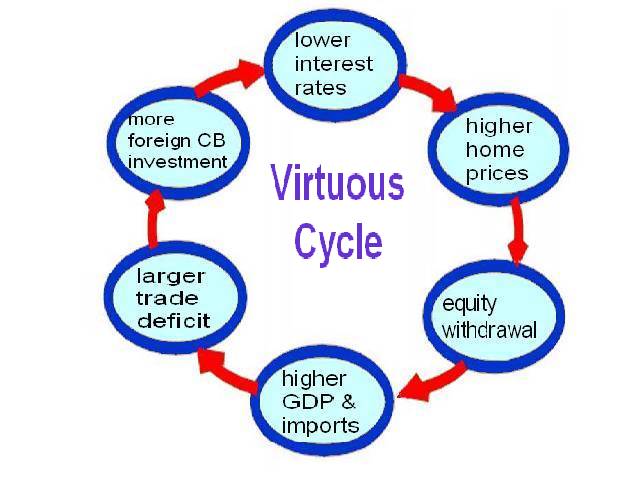
"Perhaps we have seen a Virtuous Cycle as depicted in the following diagram:
Virtuous Cycle Click on graph for larger image in new window.Starting from the top ... lower interest rates have led to an increase in housing prices. And those higher housing prices have led to an ever increasing equity withdrawal by homeowners. ... it is reasonable to assume that a large percentage of this equity withdrawal has flowed to consumption, increasing both GDP and imports over the last few years. ... it appears mortgage equity withdrawal has been a meaningful contributor to the ever widening trade and current account deficits.

To finance the current account deficit, foreign Central Banks (CBs) have been investing heavily in dollar denominated securities. Some analysts have suggested that these investments have lowered interest rates by between 40 bps and 200 bps (Roubini and Setser: "Will the Bretton Woods 2 Regime Unravel Soon? The Risk of a Hard Landing in 2005-2006")

If these analysts are correct, and foreign CB intervention is lowering treasury yields, then this has also lowered mortgage interest rates ... and the cycle repeats. The result: a Virtuous Cycle with higher housing prices, more consumption and lower interest rates.

As a result of the rapidly increasing housing prices, we are now seeing significant speculation, excessive leverage and poor credit quality of new homebuyers; all the signs of an overheated market. ... What happens if the housing market cools down? "

It's very informative, and there's a counterclockwise one as well called the Vicious cycle.

It's truly informative as to the what and why, but not the who. Here's my comment:

Don the libertarian Democrat
writes:

Are there any human agents in these cycles, or is this like a mechanism? At what point do individual human decisions pass over from possible to inevitable in this schema, or do humans even matter? Or only the movement of money and other financial products?

Thursday, October 9, 2008

Roubini On A Stimulus

Via Greg Mankiw again, Roubini on a stimulus package:

"Since the private sector is not spending, and since the first fiscal stimulus plan (tax rebates for households and tax incentives to firms) failed miserably as households and firms are saving rather than spending and investing, it is necessary now to boost public consumption of goods and services via a massive spending program (a $300 billion fiscal stimulus).

The federal government should have a plan to immediately spend on infrastructure and new green technologies; also unemployment benefits should be sharply increased, together with targeted tax rebates only for lower income households at risk; and federal block grants should be given to state and local government to boost their infrastructure spending (roads, sewer systems, etc.).

If the private sector does not spend and/or cannot spend, old-fashioned traditional Keynesian spending by the government is necessary. It is true that we already have large and growing budget deficits; but $300 billion of public works is more effective and productive than spending $700 billion to buy toxic assets."

Add this to Reich, Summers, Obama, Kuttner, and Krugman.