Showing posts with label Buying Power. Show all posts

Thursday, May 14, 2009

The paradox of high inflation is that it can make stocks, claims on productive assets very cheap

TO BE NOTED: From ducati998:

"Liquidity, velocity and stocks

snoopytyping_800x600

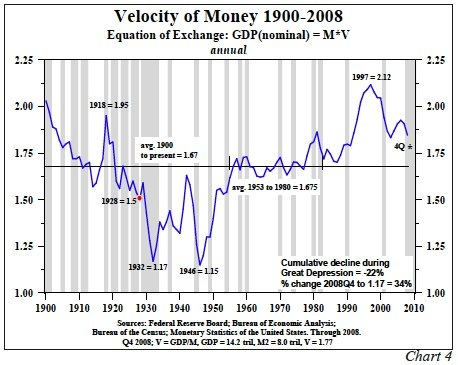
M2_velocity

The function of money is to facilitate exchange, and eliminate barter, thus speeding up, and expanding trade. The demand for money is increased by the following two conditions:

*Increase in productivity
*Increase in prices

The demand for money falls when the opposite conditions are operant:

*Fall in productivity
*Fall in prices

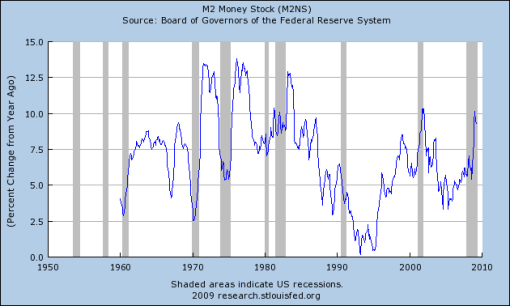
The Federal Reserve and Treasury have been increasing the volume of money within the system. Productivity has been falling, curtailed by falling demand for products & services that have excess capacity. The money supply has continued to grow.
fredgraph

Who are the recipients of the increased money supply? One of the rules of inflation is that the early recipients of new money, are allowed to buy assets with the new money thus essentially buying at a discount. The later you enter the chain, the greater the expropriation of your wealth that you will suffer.

The banks, auto-makers, and any other lame ducks that you can think of. Essentially anyone who was profilgate and stupid in combination.

What will they do with the new money? Hoarding will take place in some instances, but, many will buy assets with the money, to take advantage of a small window of opportunity of increased buying power that the new money affords.

Stocks have been rising, but the common concensus would seem to indicate that it is not Mutual Fund Managers, Pension Fund Managers etc who are driving the market. However, the banks have on aggregate, have been simply hoarding, rebuilding their capital ratios via Federal Reserve interest payments on said reserves.

Surplus money, or liquidity, needs to find a home. Rising asset prices, provide such a home. Rising prices remove liquidity, and by definition drive an increase in the demand for money.

The surplus money or liquidity, in pushing prices higher therefore eliminates the surplus supply of money, creating in time a deficit. A money deficit can be corrected through selling products/services.

What happens though when money is continuously pumped into the system? Prices will continue to rise. The Federal Reserve and other Central Banks, have not yet considered slowing the creation of new money, as, the economy, and particularly unemployment remain critical issues to their re-election, albeit, for Obama, 2.5yrs away.

Time will play a factor within the advent of an increase in liquidity and rising prices, as it takes time for the increased liquidity to leak out. Banks, as previously alluded, are not buying, rather, they are hoarding, rebuilding Balance Sheets.

Treasury paper, for psychological reasons, has been a recipient of much liquidity, although, with a failed auction last week, this asset class may well start leaking liquidity back into alternate assets. Banks, Pension Funds and Sovereign holders constitute major players.

China, is not happy. China has already made noises with regard to replacing the US dollar as the Reserve Currency. China will not be blind to the threat of increased liquidity within the Banks and what it must eventually mean. As a country in surplus, as opposed to a US deficit, China can withdraw liquidity, at no discount, due to US liquidity provision via Quantitative Easing, and reallocate this liquidity, [this holds true for Petro-dollars etc]

Where would this liquidity flow to?

The paradox of high inflation is that it can make stocks, claims on productive assets very cheap. Asia and South American inflations of recent times bear this out.

Although the official inflation rate is negligible, the creation of so much new money has created the potential of a serious inflation should it be released, highly possible."

Friday, January 16, 2009

the estimate of expectations for six month's hence, which purportedly is a better indicator of future consumer spending, rose as well.

Free Exchange champions two of my theories:

"The already stimulus
Posted by:
Economist.com | WASHINGTON
Categories:
Business cycles

SO HERE is a piece of information that's somewhat at odds with broader trends—according to a common, University of Michigan index, American consumer sentiment rose in January, which makes two consecutive monthly increases. And the estimate of expectations for six month's hence, which purportedly is a better indicator of future consumer spending, rose as well.

What's the deal? There does seem to be a Barack Obama effect( THIS IS ONE MY PREDICTIONS. ONCE BUSH IS OUT OF OFFICE, THERE WILL BE A DIMINUTION OF THE FEAR AND AVERSION OF RISK. ). Americans seem to anticipate better policy ahead and expect positive results from the president-elect's large stimulus plan. But there's something else that might be at work. Prices for food and energy have plummeted in recent months. Consumer prices fell in December for a third straight month. And while core prices have been largely flat through that time, food and energy costs have tumbled. Energy prices in December were some 21% below their level a year ago—remarkable considering the growth in prices between December of 2007 and the summer of 2008.

While a deflationary spiral would be extremely negative for the economy, a large negative shock to food and energy prices acts to give consumers significant new room to manoeuvre. This leeway quite obviously failed to contribute to increased spending in December, it's true, but that's doesn't mean it was entirely unhelpful. Consumers may have taken the opportunity to reduce debt( YES. AND REFIS. ) or to avoid loan defaults. And if the added income( ADDED BUYING POWER ) only served to improve consumer sentiment( THIS IS MY THESIS THAT REBECCA WILDER ASKED ME ABOUT. ), then that might nonetheless be good. Sunnier consumers might be more likely to utilise stimulus tax rebates or take advantage of low mortgage rates.

Obviously the housing collapse and financial crisis have been the principle stories of this recession, but when all is said and done, and more interesting and subtle story about the rise and fall of energy and food prices may be told. In a debt-saddled society, such large swings in disposable income are quite enough to produce some macroeconomic fireworks"

As I say, both points were made here a while back. Too bad no one reads my blog.

Saturday, January 3, 2009

Economists say a short period of deflation would be beneficial to the economy since it would raise people's purchasing power and confidence

From the Guardian:

"
Explainer: Why is stuff getting so cheap?

News that pubs around the country are offering lunch for £1, shops are slashing prices and Wetherspoon's are offering a pint for less than a pound may look like good news for consumers but it is causing a headache of another sort for policymakers: deflation

Britons have been used to the price of some items such as flat-screen televisions and clothes falling for years, as cheap imports flood in from China. But usually other products were increasing in price. In the past year, food and petrol were rising and this has kept overall inflation at around 2% or 3%. Now, however, the price of just about everything seems to be coming down.

This has pulled inflation on the consumer prices measure down sharply from September's peak of 5.2% and the retail price index (RPI), which includes falling house prices and interest rates, down to just 3%. In his recent letter to the chancellor, Mervyn King, the Bank of England's governor, said it was possible the RPI would fall into negative territory, or deflation, this year. Economists say a short period of deflation would be beneficial to the economy( I AGREE ) since it would raise people's purchasing power( THIS IS MY BUYING POWER ) and confidence( A DIMINUTION IN THE FEAR AND AVERSION TO RISK ). But if deflation persists, people hold off buying things, leading to falls in demand and output( TRUE. WAITING FOR BETTER DEALS. ). Then firms, selling less, cut what they pay staff. They have less to spend and the deflationary spiral kicks off( YES ). The spiral is exacerbated as debt deflation kicks in. If inflation is negative, the real value of debt rises, increasing the pain for mortgage holders and reducing further their willingness to spend, since they face a higher debt burden( TRUE ). Since 1945, deflation has been considered yesterday's problem( LET'S HOPE IT IS ). The last time the published inflation rate went negative in the UK was 1947."

This post agrees with me that a short period of falling prices increases Buying Power and helps in the Diminution of the Fear and Aversion to Risk.