President Obama: World Has "Obligation to Act" To Stop Genocide


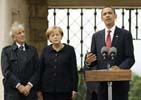
Following up on his speech in Cairo yesterday, President Obama, speaking at the Nazi Concentration Camp Buchenwald, today addressed the genocide in Darfur and his administration's behind-the-scenes work to address Sudan's immediate humanitarian needs and broader, long-term efforts to end the conflict.
In a response to a reporter's question, here's what the president said:
…On the issue of genocide, I think “never again” means that the international community has a obligation, even when it’s inconvenient, to act when genocide is occurring. So on the issue of Darfur, for example, I didn’t simply mention it in a speech yesterday before a Muslim audience, talking about genocide that’s taking place within a majority Muslim country, but I also raised it in discussions with President Mubarak of Egypt, who has strong diplomatic relations with the country of Sudan.
And I’ve assigned one of my closest national security advisors, General Scott Gration, as a special envoy who has been traveling throughout the region trying to not only solve the immediate humanitarian crisis that exists and that was made worse when President Bashir kicked out many of the international non-governmental organizations that have been providing humanitarian assistance. We’ve been working diligently to solve that immediate problem and get humanitarian assistance back on the ground. But what we’ve also been doing is to try to reactivate the possibilities of a peaceful — a peace settlement between Khartoum and some of the rebels in Darfur that would allow the internally displaced people from Darfur to start returning to their homes.
So we’ve been very active on this issue. It may not have received the attention in the press that some of the other issues have, but we are spending a lot of time trying to make sure that we make progress and that the people of Darfur are able to return to their homes and live in peace.
It is promising to see that President Obama knew it was insufficient to address ongoing genocide in just one line of his speech; it was imperative that President Obama discuss with Egyptian President Mubarak the role Egypt should play, as an important ally of Sudan, in resolving the conflict. Coming on the heels of a high-profile speech, with international headlines still buzzing about what the president did and didn't say, the public is more tuned into his subsequent remarks, which is helpful for keeping a spotlight on Sudan. It’s also noteworthy that while the president avoided using the word ‘genocide’ yesterday to describe the conflict in Darfur, today he didn’t shy away. Against the backdrop of the site of unimaginable suffering, the president's words are a powerful call to action.
But as we have been saying, along with editorial boards, activists, and U.S. leaders, President Obama's strong rhetoric must be followed up with concrete action. This high-profile verbal commitment to ending the genocide in Darfur is very welcome, but we -- and certainly the people of Darfur and Sudan as a whole -- are waiting to see the tangible results.
N.B.: To listen to a powerful radio broadcast by Edward Murrow from 1945, reporting on the liberation of Buchenwald, click here.
Photo: President Barack Obama delivers remarks at Nazi concentration camp Buchenwald, alongside German Chancellor Angela Merkel and Holocaust survivor Elie Wiesel. AP/Ina Fassbender"
"President Barack Obama called “for all of us to redouble our efforts” toward separate Israeli and Palestinian states. Alongside German Chancellor Angela Merkel one day after his trip to the Middle East, Obama said: “The United States can’t force peace upon the parties.” But he said America has “at least created the space, the atmosphere, in which talks can restart.” Here, the remarks from their news conference in Dresden.
10:30 A.M. (Local)
CHANCELLOR MERKEL: (As translated.) We are delighted to have the American President here this morning with us, after having met the last time at the NATO summit. We will visit a little bit of Dresden and later on we go on to Buchenwald, to the former concentration camp. I think that this is, indeed, a trip of a highly symbolic nature. Let me just remind all of us of the visit to Buchenwald that we will take later in the day. It is so important that the American President, Barack Obama, makes his first stop here in Dresden. This is a highly symbolic city. It is a city that was almost completely destroyed during the Second World War, was then rebuilt after Germany unification. It has again turned out to be a jewel of German culture and civilization. The people here are so glad that you’ve come to see them because it shows that you also pay tribute to the tremendous efforts they made in those 20 years after the fall of the wall.
We have made very good use of that time, talking about the political agenda, pressing issues. President Obama yesterday gave a very important speech in Cairo, which I think will be an ideal basis for a lot of action of a positive nature, particularly as regards speeding of the peace process in the Middle East. We also talked about a possible time frame for possible progress to be made. I said on behalf of the Federal Republic of Germany that we would like to try and be helpful in this peace process to the extent that this is possible to us. We need a two-state solution; we need a viable Palestinian state and a viable state of Israel, side by side. And whatever we can do in order to constructively accompany this along the way we will gladly do.
The status of negotiations with Iran on the nuclear program was also at the very top of our agenda. Here, too, we agreed to work closely together. Germany will try its utmost with its contacts, with its expert knowledge to give a positive contribution to this issue.
We also obviously debated the situation on world markets. We exchanged views on the different stimulus programs that we pursue in our countries. And we also talked about what we feel is necessary in order to prepare the next G20 meeting, then also the upcoming G8 meeting. What is important is to implement what we decided on in London. The European states are now doing that; the United States are doing that. You have a very ambitious plan that you outlaid. So we will keep a close eye on developments. And then in the autumn when we meet at G20 we will also state very clearly that strengthening the multilateral system is also one that we consider to be important.
This year negotiations on climate change, on a post-Kyoto regime are also on the agenda. We very much welcome the very, very hard work that the United States has done in order to see to it that the necessary answers are found for this phenomenon of climate change. We know that it’s very much an uphill battle; we’re very familiar with that from the debate that we have here in our country. And we are keeping a close eye on legislation that is passed. We, I think, are at one in saying we need an ambitious program, we want to have successful negotiations in Copenhagen, and we want to make the best possible use of our time leading up to this.
Once again, a very warm welcome to you, sir, and we are so glad that you and the members of your team have taken the trouble to come here.
PRESIDENT OBAMA: Well, thank you very much, everybody. Good morning. It is wonderful to be in the beautiful city of Dresden, which obviously is steeped in history and, as Chancellor Merkel discussed, has overcome great tragedies and is now this beautiful city full of hope. And so I’m very grateful to not only Chancellor Merkel but to the German people for their hospitality.
Germany is a close friend and a critical partner to the United States, and I believe that friendship is going to be essential not only for our two countries but for the world if we are to make progress on some of the critical issues that we face, whether it’s national security issues or economic issues or issues that affect the globe like climate change.
Chancellor Merkel, as she mentioned, and I had a very productive discussion. We continue to work closely together to confront the global economic crisis and to restore growth and prosperity for our people. The downturn knows no borders and it will take some time and sustained action by all of us to move forward.
At the G20, we successfully laid out the parameters for collective action. And we’ve seen, I think on both sides of the Atlantic, some progress in stabilizing the economy, but we’re far from done in the work that’s required. I mentioned to her that, in the United States, we are working diligently to strengthen financial regulations to ensure that a crisis like this doesn’t happen again, and it’s going to be very important to coordinate between Europe and the United States as we move to strengthen our financial regulatory systems. We affirmed that we are not going to engage in protectionism. And as all of us do what’s required to restart our economy, we have to make sure that we keep our borders open and that companies can move back and forth between the United States and Europe in providing goods and services to our respective countries.
I’m very pleased to see the resolution of the Opel situation here. We are very sympathetic towards each other, that it’s not easy to help auto companies restructure, and it’s not always popular, but it’s also, we are convinced, the right thing to do. And I’m hopeful that not only are we going to see these companies stabilize, but also that they’re going to emerge even stronger and more competitive in the international marketplace.
Chancellor Merkel and I discussed a range of security challenges. Germany has been a very strong NATO partner. As all of you know, we have great challenges in Afghanistan and increasingly in Pakistan, but our collective commitment to making sure that we are not seeing the kinds of terrorist bases that could pose harm to all of our people, that we maintain that commitment.
We also discussed the issue of Iran — and not in isolation, but in a broader context of avoiding a nuclear arms race in the Middle East that could be profoundly dangerous. And I’ve said publicly that I’m committed to engaging in serious dialogue and negotiations with Iran. That can’t be done in isolation, it has to be done in conjunction with the P5-plus-1 or the E3-plus-3 process, and Germany is going to be a critical partner in that process.
Later in the summer I will be traveling to Russia to discuss how we can reduce U.S. nuclear stockpiles and Russian nuclear stockpiles. And so as I said, our concern is not just Iran, but a broader effort to strengthen nonproliferation so that the threat of nuclear weapons is greatly reduced in our lifetime.
And as the Chancellor mentioned, we discussed my recent trip to the Middle East and the need for all of us to redouble our efforts to bring about two states, Israel and a Palestinian state, that are living side by side in peace and security. I think the moment is now for us to act on what we all know to be the truth, which is that each side is going to have to make some difficult compromises; we have to reject violence. The Palestinians have to get serious about creating the security environment that is required for Israel to feel confident. Israelis are going to have to take some difficult steps. I discussed some of those in the speech.
Ultimately, the United States can’t force peace upon the parties. But what we’ve tried to do is to clear away some of the misunderstandings so that we can at least begin to have frank dialogue. And we’re not going to be able to do that by ourselves; we’re going to require strong partners like Germany in that process. And I know that Chancellor Merkel is very much committed to that.
So, again, it is a great pleasure to be here. It is a great pleasure to be with my friend once again, who I always seek out for intelligent analysis and straight talk. And I’m looking forward to continued partnership between our two countries to deal with the wide range of issues that we confront at this time.
So thank you very much.
CHANCELLOR MERKEL: Well, I believe you have the possibility to ask questions. Maybe we ought to — do we start with a German question?
Q Christiane Meier, from the First German Television. Mr. President, did you have the opportunity to also address the issue of Guantanamo and do you feel sufficiently supported by Europe and here, in particular, by Germany, in accepting prisoners, former prisoners? And does this perhaps overshadow your relationship with the Chancellor or perhaps not — there has been certain mild, sometimes even wild speculation over the course that your trip took, that you left certain venues open until the end and that this had something to do with your relationship with the Chancellor.
And Chancellor, did you make an offer or were you actually able as regards Guantanamo to give certain assurances to the President and accommodate him?
PRESIDENT OBAMA: I think your characterization of wild speculations is accurate — they are very wild and based on no facts. The truth of the matter is, is that the relationship not only between our two countries but our two governments is outstanding. Most of the speculation around my schedule here in Germany doesn’t take into account simple logistics: traveling, trying to get from one place to the other, coming off a Middle East trip, having to go to Normandy tomorrow. There are only 24 hours in the day. And so there’s nothing to any of that speculation beyond us just trying to fit in what we could do on such a short trip. That’s all that there was.
So stop it, all of you. (Laughter.) I know you have to find something to report on, but we have more than enough problems out there without manufacturing problems.
In terms of the issue of Guantanamo, look, this is a very difficult issue. It’s difficult in my country; it’s difficult internationally. We have a facility that contains some people who are very difficult to deal with. Some of them probably should not have been detained in those facilities in the first place. They should have been processed and tried and convicted. If they weren’t convicted, then they should not have been languishing in a facility like that, that became a symbol for many around the world of us not sticking to our ideals and our traditions and rule of law.
But it was done. And that’s the past. And now we have to move forward. We have spoken to the European Union about the possibilities of working with us and helping us in managing the closure of Guantanamo. Chancellor Merkel has been very open to discussions with us. We have not asked her for hard commitments, and she has not given us any hard commitments beyond having a serious discussion about are there ways that we can solve this problem. And I don’t anticipate that it’s going to be resolved anytime in the next two or three months. I think it’s going to be a longer process of evaluation.
But I’m very appreciative of the openness, not only of Chancellor Merkel but other European countries to work with us, because I think they recognize that we have a shared interest in battling extremists and terrorists at the same time as we have a shared interest in upholding broader principles of international justice; and that those things are compatible, but it’s going to take some time.
We’ll be looking at individual cases; seeing are there people who can safely be transferred; if they are safely transferred, where would they be transferred to. And this is a conversation we’re not just having with Germany but the broader European Union. And I very much appreciate the constructive manner in which Chancellor Merkel has approached the issue.
CHANCELLOR MERKEL: Allow me, if I may, to, as regards that one part of the question, say that it’s fun to work together with the American President because very serious, very thorough analytical discussions very often lead us to draw the same conclusions. And I think we proved that in London, we proved that on previous meetings. I think that’s part of our job, isn’t it, that you exchange views, different views that you may have also. And wherever it was necessary, we have come to common solutions. So I very much look forward to our future cooperation.
On Guantanamo, Germany has always come out in favor, in particular my government, for closing down this facility. This has been a long-standing issue. We very purposefully at the time accepted Mr. Kurnaz, who has some sort of relation to Germany. And we also said that when there is a solution in the offing we will constructively contribute to it. Now there are talks going on of the Minister of the Interior with the American side, very intensive discussions, which we wish to continue. And at the very end I am absolutely confident that we will find a common solution.
I believe a question from the American side maybe.
PRESIDENT OBAMA: Just pick on somebody or —
Q Mr. President –
PRESIDENT OBAMA: You know, Jennifer has got the mic; sorry, Jake. (Laughter.)
Q He handed it to me, so I’m going to keep it.
PRESIDENT OBAMA: There you go.
Q Thank you, Mr. President. You challenged — on Mideast peace, you challenged all the parties yesterday and again here in your opening remarks to take actions. The Israelis, the Palestinians, the Arab states, things they’ve been asked to do for years, actually agreed to do, but still today remain even — perhaps even more unwilling or unable to do them. What are your specific next steps to try to break this stalemate? And why do you think your approach is realistic?
And then to Chancellor Merkel, if I could, you talked about a timeline that the two of you discussed on Mideast peace. Can you be more specific about that, please?
PRESIDENT OBAMA: As I said at the outset of my speech, yesterday was just one speech and it doesn’t replace all the hard work that’s going to have to be done — that was done before the speech and is going to have to be done in the years to come in order to solve what has been a 60-year problem. And I’m under no illusions that whatever statements I’ve put forward somehow are going to supplant the need to do that work.
I think that what is different now is, number one, you’re seeing a U.S. administration and American President engage this issue almost on the day that I took office. We’ve only been in office five months, and yet we’ve seen extraordinary activity already on this issue. And that’s sent a signal to all the parties in the Middle East that we are serious. I’ve assigned George Mitchell, my special envoy, who has met repeatedly with all the players in the region and who is going to be going back next week in the wake of my appearance in Cairo to follow up with each of the individual parties on a whole host of negotiation points and potential confidence-building measures that can be taken.
And I’ve already met with Prime Minister Netanyahu. Our governments are in close contact and communication about how we can move forward on some of the items that might be inhibiting restarting talks. I’ve had Abbas in the White House to do the same.
And so you’ve probably seen more sustained activity on this issue in the first five months than you would have seen in most previous administrations. The reason we are doing that is because not only had talks ground to a halt, but there was a sense that all sides were getting so dug in and so cynical that you might reach a point where you could never get the parties back at the table. And I think given what we’ve done so far, we’ve at least created the space, the atmosphere, in which talks can restart.
Now, I just have to say one more time, the United States can’t solve this problem. The United States can be a partner in solving the problem, but ultimately the parties involved are going to have to make a decision that the prosperity and security of their people is best served by negotiations and compromise, and we can’t force them to make those difficult decisions. What we can do is to provide them a framework and a forum and the support for such an outcome to be achieved.
And I’m sure that — one of the things I very much appreciate was Chancellor Merkel’s willingness to put the prestige and the resources of the German government behind that same effort. I think the entire international community is going to have a responsibility to help these parties achieve a hard-won peace that will ultimately be good for everybody’s security interests.
CHANCELLOR MERKEL: Well, I believe that with the new American administration, with President Barack Obama, there is actually a unique opportunity now to see to it that this peace process — or let’s perhaps be more careful — this negotiation process to be revived again.
Yesterday’s speech in a way opened up also the door to the Arab world again. And in the way that it was described just now you have sort of made steps along the way. And when steps are made along the way then we feel as Germans we can perhaps be helpful to accompany this. For historical reasons we have a very close and very special relationship with Israel. We have a very great interest in the safety and security of Israel. And on the other hand we also have a very fervent wish a Palestinian state be built.
This agenda needs to be worked on step by step, but it is certainly true the parties, themselves, have to show a readiness, a willingness to do something for the peace and security of the world as a whole. I see this as a core issue, and an essential and crucial issue. And this is why we all have the wish and the willingness to bring this matter forward. The historical opportunity I think is there, even though looking at many, many countries in the Arab world — even looking at many countries in the Arab world, they have a very great interest in progress there because for the economic development as well they need peace there, they need security. And we should have every interest in seeing this bring about and we will give our contribution to it.
Q You will later on, Mr. President, visit the former concentration camp, Buchenwald. Tell me now already, if possible, what is your personal motivation, what drives you to this? We were told here in Germany that because you know Elie Wiesel, the Nobel Peace Prize Winner so well, because he told you about his periods in the camp where he suffered great hardship that this sort of made you do it.
And another political issue, if I may. Madam Chancellor, climate change. Germany, Europe are putting concrete targets on the agenda, concrete reduction targets. Will America in the post-Kyoto process be willing to commit itself to concrete reduction targets? Or are you pursuing a different kind of approach, Mr. President, similar to you predecessor in office?
PRESIDENT OBAMA: Well, first of all, one of the main reasons for me being in Europe this week is to commemorate the 65th anniversary of the landing in Normandy. And this is a moment that obviously is of great importance to the United States, so many lives were lost during this period; it marks the beginning of the end of World War II, and many of the veterans of World War II are in the sunset of their years. And so having an opportunity to acknowledge them once again and the sacrifices they made was very important to me.
As part of that trip we thought it was very important for me to visit Buchenwald. First of all, I’ve never traveled to one of the concentration camps, but this one has a personal connection to me. It’s not only that I know Elie Wiesel and have read about his writings, it’s also that — and I’ve stated this before — that my grandfather’s — my grandmother’s brother was one — was part of the units that first liberated that camp. And I’ve talked about this before in the United States, perhaps not in Germany, the shock for this very young man — he couldn’t have been more than 19, 20, 21 at the time, was such that he ended up, when he returned, having a very difficult time readjusting to civilian life, and it was a memory that burned in him for quite some time.
And that, you know, was something that I learned about as a young person, and for me then to be able to come and reflect on this very difficult history and to not only reflect on the dangers of when peoples are in conflict and not acknowledging a common humanity; but also to celebrate how out of that tragedy you now have a unified Europe, a Germany that is a very close ally of Israel, and the possibilities of reconciliation and forgiveness and hope. All those things I think are part of why this visit is very important to me.
In terms of climate change, ultimately the world is going to need targets that it can meet. It can’t be general, vague approaches. We’re going to have to make some tough decisions and take concrete actions if we are going to deal with a potentially cataclysmic disaster. And we are seeing progress in Congress around energy legislation that would set up for the first time in the United States a cap and trade system. That process is moving forward in ways that I think if you had asked political experts two or three months ago would have seemed impossible.
So I’m actually more optimistic than I was about America being able to take leadership on this issue, joining Europe, which over the last several years has been ahead of us on this issue.
As I told Chancellor Merkel, unless the United States and Europe, with our large carbon footprints, per capita carbon footprints, are willing to take some decisive steps, it’s going to be very difficult for us to persuade countries that on a per capita basis at least are still much less wealthy, like China or India, to take the steps that they’re going to need to take in controlling carbon emissions.
So we are very committed to working together and hopeful that we can arrive in Copenhagen having displayed that commitment in concrete ways.
CHANCELLOR MERKEL: Allow me, if I may, to say, as to a visit to Buchenwald, that this is for me deeply moving, to see an American President, in this case President Barack Obama, as a visitor in Buchenwald. And he talked about his personal background as regards this question.
Look at Buchenwald. Buchenwald is one example of these horrible concentration camps, liberated by American troops. Later on it was turned during the Soviet period again, and it also, in the time when Germany was divided, it again became somewhat symbolic. People in that part of the country were not able to enjoy freedom and security.
Now, after the end of the Cold War, we go there after Germany has been reunited, after Europe has been reunited, now that we also enjoy freedom and democracy, as the United States does. That is very moving, and it shows you that actually history makes things possible if a sufficient number of people believe in the dream of freedom.
Q Thank you, Mr. President. A couple questions, one just to follow up on Jennifer’s. What are some of the gestures of good faith that you’d like to see from the Israelis and Palestinians? But then regarding your visit to Buchenwald, since the Holocaust, a constant refrain in the United States has been “never again,” but U.S. President after U.S. President has sat back and let genocides happen over and over, whether Cambodia or Rwanda. What does “never again” mean to you as a U.S. President, especially given the fact that genocide is going on right now in Darfur? There were accusations of genocide in Sri Lanka a few weeks ago. What does it mean to you? And are you doing everything you can to make sure “never again” is not a hollow refrain?
And then for Chancellor Merkel, does Germany not have an extra obligation to take action to prevent genocide from happening in other parts of the world? Thank you.
PRESIDENT OBAMA: With respect to confidence-building measures or next steps, again, I’m going to be sending George Mitchell back into the region next week. He’s going to be meeting with all the various parties involved. I think I’ve said publicly and I repeated in the speech some things that are going to have to be done.
You know, a lot of attention has been given to my statement that the Israelis need to stop settlement construction, and I recognize that it’s received a lot of attention in Israel, as well. Keep in mind that all I’ve done there is reaffirm commitments that the Israelis themselves had already made in the road map. And I recognize the very difficult politics within Israel of getting that done, and I’m very sympathetic to how hard it will be.
But as Israel’s friend, the United States I think has an obligation to just be honest with that friend about how important it is to achieve a two-state solution — for Israel’s national security interests, as well as ours, as well as the Palestinians. And that’s an area where steps can be taken.
They’re not the only steps, by the way, that Israel can take and will need to take in order to advance movement towards peace. And I mentioned some of the other issues that I’ve discussed with Prime Minister Netanyahu’s office, for example, increasing freedom of movement within the West Bank, dealing with the humanitarian crisis in Gaza and allowing reconstruction to proceed more aggressively.
What’s been interesting is that less attention has been focused on the insistence on my part that the Palestinians and the Arab states have to take very concrete actions. When it comes to the Palestinians, we know what they’re supposed to be doing. They have to continue to make progress on security in the West Bank.
They have to deal with incitement issues. There’s still a tendency, even within — among Palestinians who say they are interested in peace with Israel, to engage in statements that are — that incite a hatred of Israel or are not constructive to the peace process. Now I think, to his credit, President Abbas has made progress on this issue — but not enough.
We still have not seen a firm commitment from the Palestinian Authority that they can control some of the border areas that Israel is going to be very concerned about if there were to be a two-state solution. There are still problems of corruption and mismanagement within the Authority that have to be addressed.
So there are going to be a whole set of things having to do with the Palestinians’ ability to govern effectively and maintain security. And if they’re not solved, Israelis are going to have trouble moving forward.
And the Arab states, what I’d like to see is indicators that they are willing, if Israel makes tough commitments, to also make some hard choices that will allow for an opening of commerce, diplomatic exchanges between Israel and its neighbors.
Now, all these things are going to take time. They’re not going to happen immediately. But I’m confident that if we stick with it, having started early, that we can make some serious progress this year.
On the issue of genocide, I think “never again” means that the international community has a obligation, even when it’s inconvenient, to act when genocide is occurring. So on the issue of Darfur, for example, I didn’t simply mention it in a speech yesterday before a Muslim audience, talking about genocide that’s taking place within a majority Muslim country, but I also raised it in discussions with President Mubarak of Egypt, who has strong diplomatic relations with the country of Sudan.
And I’ve assigned one of my closest national security advisors, General Scott Gration, as a special envoy who has been traveling throughout the region trying to not only solve the immediate humanitarian crisis that exists and that was made worse when President Bashir kicked out many of the international non-governmental organizations that have been providing humanitarian assistance. We’ve been working diligently to solve that immediate problem and get humanitarian assistance back on the ground. But what we’ve also been doing is to try to reactivate the possibilities of a peaceful — a peace settlement between Khartoum and some of the rebels in Darfur that would allow the internally displaced people from Darfur to start returning to their homes.
So we’ve been very active on this issue. It may not have received the attention in the press that some of the other issues have, but we are spending a lot of time trying to make sure that we make progress and that the people of Darfur are able to return to their homes and live in peace.
CHANCELLOR MERKEL: Well, first, experience — part and parcel of our history, of our past experience here in Germany is obviously the Shoah. And out of that comes an everlasting responsibility for the safety and security of the state of Israel. If you like, this has been the (inaudible) of every German government, ever since the Federal Republic came into being, and it will always be that case.
As regards genocide all over the world, we have an international responsibility that we need to shoulder here. And here, too, we work very closely together. We, all of us, have made the experience I think along the way that this quite often takes much longer to resolve than one would like it to be and can be satisfied about.
But military intervention alone, without any political framework that we put on these issues, is also not always successful. We’ve made that experience, as well. This is why the European Union — actually during the EU-Africa Summit established very close links with the African Union, trying also to win over African countries to shoulder their responsibility or helping them shoulder their responsibility, for example by providing them with the necessary material, the equipment, but also through political discussions.
I think that due to the experience we’ve made over the years as European Union members that we were able after the Second World War to live together peacefully. We have an obligation not only to create peace within Europe, because we’ve been able to do that, but to actually share with others the knowledge how we managed to get that to happen. Dignity of man is inviolable. This is what is inscribed in the German constitution. And this goes not only for the Germans, not only for the Europeans, but for every human being all over the world. It means we can solve problems of this kind. We as Germans, after the Second World War, have made an experience that was certainly not a matter of course. The Allies actually extended a helping hand to us, to our neighbor France, the United Kingdom, but also the United States of America. We need to share this experience in order to prevent further cases of tragedy occurring. And we will always be at your side, at the side of the Americans.
Thank you very much.
PRESIDENT OBAMA: Thank you.
END 11:12 A.M. (Local)
Source: The White House"

















 Posts
Posts