Showing posts with label Spender Country/Saver Country Symbiosis. Show all posts

Wednesday, June 10, 2009

They cannot have both safe foreign assets and huge surpluses. They must choose between them.

TO BE NOTED: From the FT:

"
It is in Beijing’s interests to lend Geithner a hand

By Martin Wolf

Published: June 9 2009 19:06 | Last updated: June 9 2009 22:52

pinn

Creditor countries are worrying about the safety of their money. That is what links two of the big economic stories of last week: Chancellor Angela Merkel’s attack on the monetary policies pursued by central banks, including her own, the European Central Bank; and the pressure on Tim Geithner, US Treasury secretary, to persuade his hosts in Beijing that their claims on his government are safe. But are they? The answer is: only if the creditor countries facilitate adjustment in the global balance of payments. Debtor countries will either export their way out of this crisis or be driven towards some sort of default. Creditors have to choose which.

Germany and China have much in common: they have the world’s two biggest current account surpluses, at $235bn and $440bn, respectively, in 2008; and both are also powerhouses of manufactured exports. They have, as a result, suffered from the collapse in demand of overindebted purchasers of their exports. So both feel badly done by. Why, they ask themselves, should their virtuous people suffer because their customers have let themselves go so broke?

Germany and China are also very different: Germany is a highly competitive global producer of manufactures. But it is also a regional power that has shared its money with its neighbours since 1999. Its problem is that its surpluses were offset by its neighbours’ largely private excess spending. Now that the borrowers are bankrupt, their countries’ domestic demand is collapsing. This is leading to a huge expansion in fiscal deficits and pressure for easier monetary policies from the ECB. So Ms Merkel is driven towards undermining the independence of Germany’s central bank, in order to protect the still more vital goal of monetary stability.

Germany may be Europe’s pivotal economy. But China is a nascent superpower. Without intending to do so, it has already shaken the world economy. Incorporating this dynamic colossus into the world economy involves huge adjustments. This is already evident in any discussion of a sustained exit from the crisis.

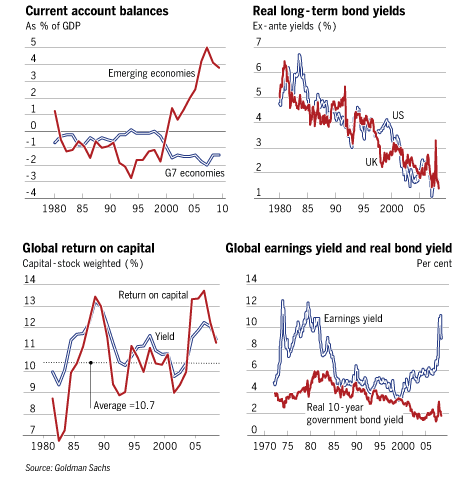
A recent paper from Goldman Sachs – unfortunately, not publicly available – sheds fascinating light on the impact of China’s rise on the world economy.* In particular, it broadens the analysis of the role of the “global imbalances”, on which I (and many others) have written.

Chart

The paper points to four salient features of the world economy during this decade: a huge increase in global current account imbalances (with, in particular, the emergence of huge surpluses in emerging economies); a global decline in nominal and real yields on all forms of debt; an increase in global returns on physical capital; and an increase in the “equity risk premium” – the gap between the earnings yield on equities and the real yield on bonds. I would add to this list the strong downward pressure on the dollar prices of many manufactured goods.

The paper argues that the standard “global savings glut” hypothesis helps explain the first two facts. Indeed, it notes that a popular alternative – a too loose monetary policy – fails to explain persistently low long-term real rates. But, it adds, this fails to explain the third and fourth (or my fifth) features.

The paper argues that a massive increase in the effective global labour supply and the extreme risk aversion of the emerging world’s new creditors explains the third and fourth feature. As the paper notes, “the accumulation of net overseas assets has been entirely accounted for by public sector acquisitions ... and has been principally channelled into reserves”. Asian emerging economies – China, above all – have dominated such flows.

The huge capital outflows were the consequence of policy decisions, of which the exchange-rate regime was the most important. The decision to keep the exchange rate down also put a lid on the dollar prices of many manufactures. I would add that the bursting of the stock market bubble in 2000 also increased the perceived riskiness of equities and so increased the attractions of the supposedly safe credit instruments whose burgeoning we saw in the 2000s. The pressure on wages may also have encouraged reliance on borrowing and so helped fuel the credit bubbles of the 2000s.

The authors conclude that the low bond yields caused by newly emerging savings gluts drove the crazy lending whose results we now see. With better regulation, the mess would have been smaller, as the International Monetary Fund rightly argues in its recent World Economic Outlook. But someone had to borrow this money. If it had not been households, who would have done so – governments, so running larger fiscal deficits, or corporations already flush with profits? This is as much a macroeconomic story as one of folly, greed and mis-regulation.

The story is not just history. It bears just as heavily on the world’s escape from the crisis. The dominant feature of today’s economy is that erstwhile private borrowers are, to put it bluntly, bust. To sustain spending, central banks are being driven towards the monetary emissions of which Ms Merkel is suspicious and governments are driven towards massive dis-saving, to offset higher desired private saving.

Today, Germany wants to preserve the value of its money, while China is desperate to preserve the value of its external assets. These are understandable aims. Yet, if this is to happen, debtor countries have to stabilise their economies without another round of profligate private borrowing or an indefinite rise in government debt. Both paths will ultimately lead to defaults, inflation, or both and so to losses for creditors. The only alternative is for debtors to earn their way out. At the level of an entire country that means a big rise in net exports. But if indebted countries are to achieve this aim, in a vigorous world economy, the surplus countries must expand demand strongly, relative to supply.

China’s decision to accumulate roughly $2,000bn in foreign currency reserves was, in my view, a blunder. Now it has a choice. If it wants its claims on the US to be safe, it must facilitate an adjustment in the global balance of payments. If it and other surplus countries wish to run huge surpluses and accumulate vast financial claims, they should expect defaults. They cannot have both safe foreign assets and huge surpluses. They must choose between them. It may seem unfair. But whoever said life is fair?

martin.wolf@ft.com
More columns at www.ft.com/martinwolf
Read and post comments at Martin Wolf’s blog

*The Savings Glut, the Return on Capital and the Rise in Risk Aversion, May 27 2009"

It seems to me that there's a big difference between China and Germany in this crisis. China has taken a proactive and, I would argue, positive approach to this crisis. On the other hand, Germany has taken a wait and see approach, hoping to avoid as much effort as possible and allow other countries to make the hard choices. Of course, for well understood reasons, Germany dresses up it's flaccid response with high sounding and principled rhetoric, ready to be shed at an instant's notice if necessary.

In that sense, I think that China has already proven its readiness to work with the US, within the boundaries of its own situation and context. I also believe that they're pleased with Geithner, since he was the one US official calling for a total guarantee of assets, which China said that it believed was the responsible thing for the US to do.

I agree with your alternatives, but believe that there's no way to figure out how this will work out in practice as of yet. But I do believe that the US and China will work it out. The massive responses of each country to this crisis make evident to me that the necessary goodwill is already in place.

I wish that I could read the paper that you quote, but one thing stands out to me in your summary: If anyone, anyone at all, is desperate to lend money, then they should assume that some portion of it will not be paid back. There is still no good reason to make these factors seem mechanical in nature, since they can more plausibly be explained by human foolishness, the one true constant in the universe, at least as it manifests itself to us. Posted by: Don the libertarian Democrat

Sunday, June 7, 2009

So if everybody is saving more, who will be dissaving?

TO BE NOTED: From the FT:

"
Down and out for the long term in Germany

By Wolfgang Münchau

Published: June 7 2009 19:03 | Last updated: June 7 2009 19:03

Let me attempt, perhaps foolhardily, to map out a scenario of how the global economic crisis could evolve in continental Europe.

Even if we assume a recovery elsewhere, Europe’s economy may be stuck at low growth for some time. To understand why, it is perhaps best to look at sectoral balances for households, companies and the public sector.

The current account can be expressed as the difference between national savings and investments. Of the world’s 10 largest economies, the US, the UK and Spain used to run the largest current account deficits before the crisis. The US household sector has been shifting from a negative savings rate before the crisis to a positive rate of 4 per cent of disposable income now. The US corporate sector used to have a large negative savings rate, but this has almost disappeared. So far, the increase in net savings in the US private sector has been balanced by increased borrowing from the US government.

I am making three assumptions: the first is that the return to a positive US household savings rate is permanent – even under a scenario of a strong economic recovery. US households will take time to repair their balance sheets after the housing and credit disaster. Second, I also expect US companies not to return to the high level of borrowings that prevailed before the crisis. Third, I expect the US government to reduce its deficit after 2010. The recent rise in long-term bond yields should serve as a reminder that deficits cannot go on rising forever.

Taking all three factors together, the US will shift from a strongly negative current account balance towards neutrality, perhaps even a small surplus for a short period. I expect similar shifts in the UK and Spain at different magnitudes.

Among countries with large current account surpluses, the three biggest are China, Japan and Germany. I am focusing on Germany here. The German household sector will maintain its high savings rate. The German government increased its deficit during the crisis, but is now looking for a quick fiscal exit strategy. The Bundestag has recently voted through a constitutional balanced-budget clause, which requires cuts in the deficit almost right away. Japan will probably maintain its larger fiscal deficit for longer, but if we take Germany, China and Japan together, we will not see a sufficient and sustained fiscal expansion to compensate for the sectoral shifts elsewhere.

Global current account surpluses and deficits add up to zero. So if everybody is saving more, who will be dissaving? It will have to be the corporate sector in the countries with large net exports. So if the US, the UK and Spain are heading for a more balanced current account in the future, so will the surplus countries.

The current account balance can also be expressed as the sum of the trade balance, net earnings on foreign assets, and unilateral financial transfers. In several countries, including the US and Germany, the gap between exports and imports serves as a good proxy for the current account. A fall in the trade deficit in the US, UK and Spain implies a fall in the combined trade surplus elsewhere. And as some of the shifts in the US and the UK are likely to be structural, this will have long-term effects on others. In particular, it means the export model on which Germany, China and Japan rely, could suffer a cardiac arrest.

What about the argument that a large part of German exports goes to the rest of the eurozone? This is true, but there are imbalances within the eurozone too. Spain has been running a current account deficit of close to 10 per cent of gross domestic product. As that comes down, so will Germany’s equally unsustainable intra-eurozone surplus.

Through what mechanism will this export-sector meltdown come about? My guess is that in Europe it will happen through a violent increase in the euro’s exchange rate against the US dollar, and possibly the pound and other free-floating currencies.

Exchange rate devaluation would greatly help the US and others to reduce their current account deficits, but it will impair the economic recovery in countries with large trade surpluses and free-floating exchange rates. Last week’s remarks by Angela Merkel, who criticised the Federal Reserve and other central banks for running inflationary policies, sharpened investor perceptions of transatlantic policy divergence and decoupling. Many investors are now starting to bet on a strong appreciation of the euro – the last thing Ms Merkel wants.

Neither Germany nor Japan is politically equipped to deal with an exchange rate shock. China may continue to manage its exchange rate, but the Europeans are much less likely to intervene in foreign exchange markets. For the time being, the governments of the classic export nations cling on to their export-based economic model, the model they know best. Their only strategy, if you call it that, is to hope for a miraculous bail-out from the US consumer – which is not going to happen this time.

If my predictions prove correct, Germany will be down and out for a long time with a huge and still unresolved banking crisis, an overshooting exchange rate and lower net exports, presided over by politicians who panic about domestic inflation. This will not end well.

munchau@eurointelligence.com"

Wednesday, May 20, 2009

they have abruptly turned their back on the market for securities issued by government-sponsored enterprises

TO BE NOTED: From the NY Times:

"
China Grows More Picky About Debt

HONG KONG — Leaders in both Washington and Beijing have been fretting openly about the mutual dependence — some would say codependence — created by China’s vast holdings of United States bonds. But beyond the talk, the relationship is already changing with surprising speed.

China is growing more picky about which American debt it is willing to finance, and is changing laws to make it easier for Chinese companies to invest abroad the billions of dollars they take in each year by exporting to America. For its part, the United States is becoming relatively less dependent on Chinese financing.

China has actually bought Treasury bonds at an accelerating pace over the last year — notwithstanding Chinese officials’ complaints about American profligacy. But the borrowing needs of the United States government have grown even faster. So China represents a rapidly shrinking share of overall purchases of Treasury securities. “China’s demand for Treasuries has increased over the past year, but it hasn’t increased at anything like the pace of the Treasury’s sale of new Treasury bonds,” said Brad W. Setser, a specialist in Chinese financial flows at the Council on Foreign Relations.

Americans and investors elsewhere are buying Treasuries instead. They are saving more and have been shifting out of other investments — including equities until the past two months — and into Treasuries.

China bought less than a sixth of the Treasuries issued in the 12 months through March. Less than two years ago, by contrast, Chinese purchases of Treasuries, which included purchases in the secondary market as well as newly issued securities, briefly exceeded the entire borrowing needs of the United States.

Financial statistics released by both countries in recent days show that China paradoxically stepped up its lending to the American government over the winter even as it virtually stopped putting fresh money into dollars.

This combination is possible because China has been exchanging one dollar-denominated asset for another — selling the debt of government-sponsored enterprises like Fannie Mae and Freddie Mac in a hurry to buy Treasuries. While this has been clear for months, new data shows that China is also trading long-term Treasuries for short-term notes, highlighting Beijing’s concerns that inflation will erode the dollar’s value in the long run as America amasses record debt.

So China’s rising purchases of Treasuries do not represent the confident bet on America’s future that they might seem to be on the surface. For instance, China does not appear to be dumping euros or yen to buy Treasuries, economists said.

That said, recent Chinese and American data suggest that an astounding 82 percent of China’s $2 trillion in foreign reserves is in dollars, according to calculations by Standard Chartered.

The development has caught the attention of the leaders of both countries.

“The long-term deficit and debt that we have accumulated is unsustainable — we can’t keep on just borrowing from China,” President Obama said last Thursday.

Wen Jiabao, prime minister of China, also has expressed concern.

“We have lent a huge amount of money to the U.S. Of course we are concerned about the safety of our assets. To be honest, I am definitely a little worried,” Mr. Wen said earlier this year.

China now earns more than $50 billion a year in interest from the United States, Mr. Setser at the Council on Foreign Relations calculated.

China’s leaders were able to buy more Treasuries in recent months without buying more dollars because they have abruptly turned their back on the market for securities issued by government-sponsored enterprises.

China was the world’s biggest buyer of these securities a year ago, splashing out more than $10 billion a month.

But in the 12 months through March, it actually had net sales of $7 billion, and ramped up purchases of Treasuries instead.

China has also changed which Treasuries it buys. It has done so in ways calculated to reduce its exposure to inflation or other problems in the United States. As recently as a year ago, China actively bought long-dated bonds, seeking the extra yield they could bring compared to Treasury securities with short maturities, of which China bought virtually none.

But in each month since November, China has been buying more Treasury bills, with a maturity of a year or less, than Treasuries with longer maturities. This gives China the option of cashing out its positions in a hurry, by not rolling over its investments into new Treasury bills as they come due should inflation in the United States start rising and make Treasury securities less attractive.

The big question now for policy makers and economists alike lies in whether the Chinese government’s purchases of American securities will rise or fall in the coming months.

Two big forces are at work — but they are pushing Chinese investments in opposite directions and might cancel each other out.

The first big shift is that Chinese foreign exchange reserves might start growing again, after shrinking early this year.

A senior Chinese economic policy maker, Xu Lin, expressed concern here on Monday that the reserves might grow faster if speculators started pushing more foreign exchange into China in the months ahead.

China is strongly opposed to any significant appreciation or depreciation of its currency, Mr. Xu said at a press conference. But if international investors conclude that the Chinese economy has stabilized ahead of economies elsewhere, they may start pumping more money into the Chinese economy, he said.

To keep its currency at the same level, the Chinese government buys foreign currency flowing into the country in excess of China’s needs. If overseas demand for Chinese exports recovers, then China’s trade surplus could start widening again as well. This would also tend to fatten Chinese reserves.

But the countervailing trend is that the Chinese government is trying to foster channels for foreign currency to be pumped out of the country without the involvement of the central bank. The government has been buying a wider range of assets and encouraging the private sector to invest more money overseas.

“That’s part of a strategic move by the authorities to diversify,” said Wensheng Peng, the head of China research at Barclays Capital. “The reserves growth should accelerate because of inflows, but it will not be as large as what we observed in 2007 and the first half of 2008.”

The State Administration of Foreign Exchange, which is part of the central bank, issued draft regulations on Monday that would make it considerably easier for private companies to raise dollars in China to spend on overseas investments — a step that would lessen the need for the Chinese government to buy up those dollars.

This spring China has also been stepping up its purchases of commodities, which are usually bought in dollars. Iron ore has been piling up on Chinese docks, government stockpiles of crude oil and grain are being expanded and stockpiles are being started for products like gasoline, diesel and sugar.

After six years of silence, China unexpectedly disclosed last month that it had been gradually buying gold from domestic producers. The country’s reserves had climbed from 600 tons in 2003 to 1,054 tons, worth $31.8 billion at prices late Wednesday.

The disclosure, which produced a frisson of excitement in gold markets, may have been aimed at reassuring a domestic audience that the Chinese government was not putting all the nation’s savings into American dollars. But the actual investment was tiny compared with China’s foreign exchange reserves — and showed that China was accumulating gold at a much slower rate than foreign currency.

A person in periodic contact with China’s central bank, who insisted on anonymity to preserve his access, said that a Chinese central banker complained to him last year that “we have so much money and there’s so little gold, we can’t buy much without driving up the price.”

Wednesday, April 15, 2009

“China and the U.S. have a symbiotic relationship,” Thin said. “We need each other.”

TO BE NOTED: From Bloomberg:

"China Bought More U.S. Securities Even Amid Concerns (Update1)

By Vincent Del Giudice

April 15 (Bloomberg) -- China, the U.S. government’s biggest creditor, increased its purchases of American securities in February just weeks before the country’s officials questioned whether such investments were safe.

While China’s purchases slowed and most were in short-term Treasury bills, the country remained the largest foreign holder of Treasuries after its holdings rose 0.6 percent to $744.2 billion, according to a monthly report released in Washington.

“It still comes down to holding the most valuable stuff,” said Richard Yamarone, chief economist at Argus Research in New York. “If you have a baseball card collection, and times get bad, you don’t sell the Honus Wagner or the Mickey Mantle rookie card,” he said, referring to two of the game’s biggest historical stars. “They have always been, and will always remain, the most desirable holdings.”

Still, the governor of the People’s Bank of China, Zhou Xiaochuan, last month urged the establishment of a “super- sovereign reserve currency” after Chinese Premier Wen Jiabao said he’s “worried” a weaker U.S. dollar may hurt China’s investment. The U.S. needs China to sustain its purchases to fund billions’ worth of programs aimed at reviving the economy, about 70 percent of which reflects consumer spending.

Devil’s Bargain

“If they are going to boost their economy by selling consumer goods to the U.S., accepting U.S. Treasuries is part of their bargain with the devil,” said Chris Rupkey, chief financial economist at Bank of Tokyo-Mitsubishi UFJ Ltd. in New York. U.S. Treasury bills, notes and bonds are considered the safest and most liquid, he said, and “February was a big safe- haven buying month given the stock market’s troubles.”

According to an analysis by Win Thin, a senior currency strategist at Brown Brothers Harriman & Co. in New York, today’s report shows “we are not seeing any wholesale dumping of dollar assets by China.”

In an interview, Thin said the smaller increase in holdings of Treasury securities reflects a slowdown in capital flows between investors in China and other emerging markets rather than deliberate efforts on the part of the Chinese authorities.

“China and the U.S. have a symbiotic relationship,” Thin said. “We need each other.”

Foreign Investment

Foreign direct investment into China fell for a sixth month from a year earlier. Investment dropped 9.5 percent to $8.4 billion in March, the Chinese commerce ministry said at a briefing in Beijing today. That marked the first time since 2000 that investment from abroad has fallen for six straight months, according to Bloomberg data.

Worldwide foreign direct investment fell 21 percent last year to $1.4 trillion because of the global recession and falling profits, according to estimates from the United Nations Conference on Trade and Development, and it’s likely to decline further this year, the agency said.

Phone calls and an e-mail message to China’s embassy in Washington were not returned by press time.

Separately today, U.S. Treasury Secretary Timothy Geithner refrained from labeling China as a currency manipulator, backtracking from an assertion he made during his confirmation hearings in January.

In its first semiannual report on foreign-exchange policies since Geithner became secretary, the Treasury said that while the yuan remains “undervalued,” no country “met the standards” for illegal currency manipulation during the period of the report, from July 2008 through December 2008.

The conclusion clashes with Geithner’s January 22 statement to a Senate panel that “President Obama -- backed by the conclusions of a broad range of economists -- believes that China is manipulating its currency.”

To contact the reporters on this story: Vincent Del Giudice in Washington at vdelgiudice@bloomberg.net"

Friday, April 10, 2009

The solution is to expand demand, but with surplus countries doing more than the deficit countries

TO BE NOTED: From the FT:

"
Currency squabbles are set to worsen

Published: April 10 2009 19:05 | Last updated: April 10 2009 19:05

As in the 1930s, complaints about “beggar-thy-neighbour” trade and exchange rate policies pollute the global atmosphere: eurozone member countries complain about the falling British pound; Americans complain about China’s “manipulation” of the renminbi; deficit countries complain about excess supply in surplus countries; and surplus countries complain about protectionism in deficit countries.

So who is right? Everybody and nobody. We are hearing the results of a mutually destructive struggle over slices of the dwindling global demand cake. That way lies competitive devaluations and trade wars. The solution is to expand demand, but with surplus countries doing more than the deficit countries.

In the fourth quarter of 2008, nominal gross domestic product shrank at an annualised rate of 4 per cent in the UK, 4.2 per cent in the eurozone, 4.6 per cent in Germany, 5.8 per cent in the US and 6.4 per cent in Japan. This, then, is a world of grossly deficient demand.

This is also a world of huge current account surpluses and deficits. From the point of view of countries in deficit, surplus countries are stealing “their” domestic demand. But countries with strong currencies regard devaluation by others as cheating, since it hurts the exports on which they depend so much.

The eurozone’s concern about sterling’s slide is understandable. But it is unreasonable. Sterling is a floating currency that fell sharply at the end of last year, when it became evident how badly the UK’s financial sector and economy would be hit by the crisis. Since UK domestic demand is weak and last year’s trade deficit was 6.5 per cent of GDP, a depreciation is what any economic doctor would order. A rise in net exports is essential for sustained recovery. It is not the UK’s fault that eurozone member countries in the same plight chose to tie themselves to the euro mast.

More objectionable would be attempts by countries with large trade surpluses to protect themselves against adjustment by over-indebted deficit countries. Yet the currencies of a number of countries with robust external positions have had large real devaluations since the crisis became severe early last autumn. On the list are several east Asian countries, though not China.

More fundamentally, complaints about beggar-thy-neighbour policies are inevitable so long as the world economy suffers from deficient demand. The solution is to pursue fiscal, monetary and, where necessary, structural policies likely to promote expanded demand in the medium term. But surplus countries need to understand that it is they who are in a better position to expand demand safely, not those with the large structural deficits.

The alternative to currency conflict and trade war is demand expansion. Complaining about the bitter fruit of refusals to understand this is as absurd as it is pointless."

Wednesday, April 8, 2009

It was the reserve status of the dollar that permitted the US to run the massive trade deficits it has during the past decade.

TO BE NOTED: From China Financial Markets:

"Is Governor Zhou a closet Bernanke-ite? April 8th, 2009 by Michael Pettis | Filed under Balance of payments, Currency regime, Money growth, Savings glut.

I have recently finished reading Martin Wolf’s latest book, Fixing Global Finance, and I strongly recommend it for its very clear laying out of the global balance of payments issues behind the global crisis. I should warn my readers that Wolf and I have come to very similar conclusions about the underlying root causes of the crisis – we are both in agreement, for example, about the distorting effect of Asian policies to constrain consumption and boost investment in manufacturing output – but I am mostly impressed by the fact that we come to the same conclusion from such different angles.

Wolf begins with a model based on analyzing the financial architecture of the past forty years and brings to his analysis a very US-centric view of the world, whereas my conceptual model is based on my obsessive reading in the history of financial flows between rich and poor countries and starts with a China-centric view. Somehow we end up in almost exactly the same place, which suggests to me that we may be right or, at the very least, onto something important.

I won’t try to summarize the book but I do want to set out two paragraphs in which Wolf explains, far more clearly than I have ever been able to, how it is that reserve accumulation in Asia “forced” US households into overconsumption. One of the most common fallacies in popular economic analysis is to assume that countries are somehow analogous to households, and the factors that lead a household to consume “beyond its means” are similar to those that cause a country to do so. In that case if the US over-consumed, it is no different than if a stereotypical welfare family maxed out on its credit cards, and while we can fret at the stupidity of the bankers who gave them their credit cards, ultimately the blame for the mess must rest with the innate profligacy of mom and dad.

But this is not true at all when we are talking about overconsumption at a country level. As I have tried to argue many times, the global balance of payments must balance, and significant change in any component of the balance necessarily requires adjustments elsewhere. If Country A enacts trade policies that result in a surging current account surplus, for example, Country B must see its current account deficit surge by the same amount, and the way that happens will reflect a number of factors including the structure of its financial system. Country B could try to resist the growing deficit by engineering a recession and so causing total demand to drop, but this can be very painful for both countries.

Let us assume, then, that a group of countries, perhaps in response to the 1997 crisis, decide that in order to protect themselves from a repeat of that disaster decide to engineer polices aimed at accumulating reserves and limiting external debt. The most obvious way would be to put into place policies that constrain consumption and boost savings (keep wages and interest rates low, limit credit availability to consumers, limit credit availability to small and medium enterprises and especially to the service sector, maintain an undervalued currency, etc.) and direct credit to the investment and manufacturing sector. As a consequence growth in production would exceed growth in consumption and the balance would represent the trade surplus. Trade surpluses, of course, have to be recycled as investment flows (or reserve accumulation) back to the country against which they are running these surpluses. This is not a choice, or even a real lending decision. It is the automatic and necessary consequence of running a trade surplus.

Since the US is the largest and most flexible economy in the world, and since the primary world reserve currency is the dollar (more on this later), in practical terms only the US can be the deficit country for any period of time, and so the surplus countries must accumulate US dollar assets as the obverse of their trade surplus. Martin Wolf explains what happens next:

The rest of the world’s capital outflow supports the dollar. At the resulting elevated real exchange rate for the United States, the output of the sectors in the US economy that produce tradable goods and services shrinks, other things being equal. The Federal Reserve cuts interest rates to expand the economy, thereby preventing excessive unemployment. As it does so, a large excess demand for tradable goods and services emerges in the United States. This finally, appears in the trade and current account deficits.

One consequence of all this is that US domestic demand has had to grow faster than real GDP, to ensure that the latter grows in line with potential. The difference between the two is, of course, the increase in the current account deficit, in real terms. With trend growth in GDP between 3 and 3.5 percent a year, domestic demand has to grow even faster. That is precisely what has happened. US real demand (or gross domestic purchases) grew faster than real GDP in 1993 and 1994 and then again every year from 1996 to 2004 inclusive. Cumulatively, between 1993 and 2004 US real GDP grew by 46 percent, while gross domestic purchases rose by 53 percent. That is how the current account deficit emerged. It is also how the United States absorbed the supply of excess capital from abroad.

In the face of a sharp contraction in those sectors of the US economy that compete with Asian manufacturers, in other words, the Federal Reserve must either permit a rise in US unemployment, in which case US consumption will decline and with it imports from Asia will decline too, or it must prevent the rise in unemployment by putting into place monetary policies that are consistent with rapid GDP growth. This argument, by the way, is not at all affected by the very common (and incorrect) argument that the main cause of the US trade deficit with China is the fact that China produces things that the US doesn’t want to produce, which I have tried to address in a March 9 blog entry.

Global savings glut

In either case US consumption must grow faster than US GDP, and the choice for the Fed is whether to target a “normal” growth in consumption, and permit rising unemployment, or a “normal” growth in GDP, and so permit rising indebtedness. The Fed must use US unemployment, in other words, as a tool to prevent Asian trade policies from leading to excess US indebtedness.

All this would have been bad enough if it hadn’t been for the need for the US to finance a very unpopular war, the Iraq invasion, in the way that unpopular wars have traditionally been financed – irresponsibly, through borrowing and money creation rather than taxes (remember that the Vietnam War was also associated with a credit bubble in the US). Asian policies, according to this view, definitely helped create the monetary distortions, but we must remember that there were plenty of bad domestic policies compounding the problem.

At any rate for the Fed to use US unemployment as a tool to prevent Asian trade policies from leading to excess US indebtedness is obviously politically very difficult, and it is also obvious that for the past ten year the Fed chose excess indebtedness. Since the 1997 crisis we have seen both household savings and the US trade deficit break out of their normal ranges and either collapse (household savings) or surge (trade deficit). This is a necessary consequence of the process that Wolf describes.

In that light, as U.S. fiscal spending surges in response to the crisis, increased attention will be placed on the way that U.S. fiscal spending leaks out through the current account to boost employment in China and elsewhere. And just as the Chinese complain bitterly, and rightly, that the West outsources polluting activity to China via the trade account, the U.S. will complain, as Martin Wolf pointed out in a March 31 editorial in the Financial Times, that China is outsourcing fiscal indebtedness to the U.S., also via the trade account. Surplus countries, he argues, “relied on the private sectors of deficit countries to do their irresponsible borrowing for them.” In response to the contraction in the borrowing among US households, the U.S. government, in other words, is currently choosing to borrow and spend the proceeds in order to generate job growth in the U.S. as well as in China. This can’t go on forever.

All of this is, of course, a variation on Ben Bernanke’s “global savings glut” hypothesis, and as everybody knows, Beijing wholly rejects this hypothesis as an explanation for the current global imbalances. For Chinese policymakers, the cause of the crisis lays firmly and totally within US monetary and financial policies (or lack thereof), and absolutely no blame can be apportioned to Asian trade policies.

Or is this really Beijing’s view? The extraordinary thing to me is that while Beijing has insisted almost desperately that any attempt to apportion blame to China is completely dishonest, they have nonetheless more or less welcomed Bernanke’s hypothesis, perhaps without realizing it, through the back door. I say this because the widely-discussed essay by PBoC Governor Zhou last week, in which he assailed the reserve status of the US dollar as being the main cause of global imbalances, is as far as I can tell nothing more than Ben Bernanke’s hypothesis viewed from a slightly different angle.

Why? Because Governor Zhou makes the claim that the reserve status of the US dollar gives the US an unfair advantage in that it can borrow nearly unlimited amounts simply as consequences of the need for foreign countries to accept dollars as reserves and for the purpose of international trade and investment. Of course he is almost certainly right, and he is just as certainly not the first person to make this claim. I think it was De Gaulle’s favorite economist, Jacques Rueff, who first discussed this “exorbitant privilege” as far back as the 1960s (NB: Martin Wolf corrects me — it was Valery Giscard D’Estaing who first said it — but I leave the mistake, and the correction, because it is one so commonly made).

But remember that if we make the very simple (and necessary) assumption that the ability of a country to run current account deficits is constrained mainly by a country’s ability to finance those deficits, then the ability to borrow unlimited amounts also means the ability to run unlimited trade deficits. It was the reserve status of the dollar that permitted the US to run the massive trade deficits it has during the past decade.

Had the US dollar not been the reserve currency of choice (in other words had Asian trade surplus countries not recycled their trade surpluses into purchases of US government bonds), the dollar would have had to decline against world currencies as a consequence of the rising deficit – Asian currencies too, and not just European – and the US trade deficit would have stabilized at much lower levels. This is also another way of saying, as Martin Wolf’s piece directly implies, that the Fed would not have had to choose between unemployment and indebtedness and that the binge borrowing that characterized US household behavior would have been much, much lower.

The world loves dollars because the US seems to love deficits

In fact I would go further. Because of the dollar’s reserve status, only the US could have possibly run the deficits necessary to absorb the huge surpluses that Asian trade policies were generating. Without the dollar’s status as a reserve currency, the Asian development model that stresses expanding production while constraining consumption – which among other things results in trade surpluses and net investment abroad (which of course is the same thing) – would have either required another reserve currency, or it would have failed.

Could there have been another reserve currency – and could it be that the dollar’s “exorbitant privilege” is something that Washington has enforced? Yes and no. The US economy comprises about one-quarter of the world’s economy and one-third of the rich-country economies. In principle it would have been very easy for any country to accumulate reserves of other rich countries – nearly all of whose currencies are easily convertible – so that there is no reason why the dollar portion of all developing-country central bank reserves might not have exceeded roughly one-third of the total, instead of the two-thirds or more that it currently occupies. Another third could be euros, and the rest a combination of the currencies of Japan, the UK, Switzerland, Canada, Australia, South Korea, and so on.

But it can’t just rest there. When a central bank chooses which currency to buy, unlike when you or I make our own portfolio decision, it is also determining the direction of net trade flows. Those other countries would have had to match the investment surplus (net inflows on the capital account) with an equally large current account deficit. If China had followed this balanced policy of reserve accumulation, in other words, the only thing that could possibly have stopped them, and a very big impediment it would have been, was the political or economic willingness and ability of those countries to run the corresponding trade deficits with China.

That, of course, is the problem. Given their much more limited economic flexibility and their less ebullient financial systems, those other countries probably would have never been able to sustain the necessary levels of trade deficit, and they would have almost certainly moved aggressively against China to limit the development of unfavorable trade balances. China, in other words, chose to hold US dollars not because the US government has somehow enforced reserve status on the US dollar and denied it to other currencies (Washington could never have prevented China from buying euros or yen or anything else), but simply because no other country is able to run deficits of the necessary magnitude.

The argument, then, that the dollar’s status as the reserve currency and brings an exorbitant privilege is simply the other side of Ben Bernanke’s savings-glut coin. Without the dollar’s reserve status, the global savings glut would have never occurred, or rather it would have never resolved itself in the way it did, and Asian development models aimed at engineering trade surpluses would have had to fail.

So is Governor Zhou a closet Bernanke-ite? He would probably be surprised at this question, and even more surprised at my answer, I think, but I cannot see how you can separate the two arguments – his on the perils of the dollar’s dominant reserve currency status and Bernanke’s on the impact of high Asian savings on the US balance of payments. He and Bernanke agree fundamentally on the roots of the imbalance.

By the way, the model I have been using to explain the imbalances also addresses another contentious question between the US and China which I did not really think about until I read a fascinating short piece by MIT’s Simon Johnson on his blog, more in reference to Europe but relevant nonetheless. China, as we know, is very worried that the US will resort to monetary policy rather than fiscal policy to address collapsing demand in the US. The former hurts China (supposedly because it might cause an erosion in the value of the dollars the PBoC holds), whereas the latter helps by slowing the contraction in US net demand and giving China more time to adjust its overcapacity problem.

It turns out that there may be another reason, even more powerful, and as soon as I read this paragraph by Johnson I had one of those “Aha!” moments that means I am going to have think much more seriously about the implications:

Remember this. If you run an expansionary fiscal policy (building bridges), I have an incentive to free ride (selling you BMWs) and not engage in a similar fiscal stimulus. But if you run an expansionary monetary policy, your exchange rate will tend to depreciate, putting pressure on my exporters and I’ll be pushed - by BMW-type producers - towards providing a parallel monetary stimulus.

This may be why monetary rather than fiscal stimulus makes sense for the US, and less sense for trade surplus countries. It prevents, or at least reduces, the leaking-out of employment generation effects of US borrowing and spending.

The other China

Talking about BMWs, my argument, of course, is not so much about China and the US as it is about trade surplus and trade deficit countries. In that light there was a very interesting article in Monday’s Financial Times about the difficulties Germany is facing in adjusting to the changes in the global balance. Many people assumed that Germany, which was in a very “strong” position (high savings, large trade surplus, low debt – which are all more or less the same thing, really), would weather the crisis easily, but of course it should have been self-evident that a crisis that affects the deficit sides of the global balance of payments must also affect, by the same amount, the surplus sides:

The risk is that – like Japan in the 1990s – Germany faces a “lost decade”, or a protracted period of economic malaise as it waits for the global economic tides to turn and struggles to find domestically generated sources of growth. “I am convinced it is going to be a slow recovery,” says Mr Staake. “Who is going to be buying anything?”

This downfall is all the more galling because, even a year ago, the country could have expected to weather the global economic storms. There was no danger of a housing crash; prices had been flat for a decade. Consumers had saved; companies had not increased leverage dramatically. “From a structural point of view, this recession should never have happened,” says Commerzbank’s Mr Krämer.

With hindsight, however, Germany was a sitting target after the collapse of Lehman Brothers investment bank in mid-September. Its exports were equivalent to more than 47 per cent of GDP last year – compared with less than 20 per cent in Japan and about 13 per cent in the US. Its industrial base is skewed towards producing machinery and equipment – “investment goods” account for more than 40 per cent of its exports – and towards emerging European and Asian economies.

While the crisis was focused on US housing and capital markets, Germany was unaffected. But after Lehman’s failure paralysed banks, and confidence nosedived globally, companies around the world shelved investment plans – leaving German factories turning out goods nobody wanted to buy. Industrial production in January was more than 20 per cent lower than a year before; overseas orders for investment goods had almost halved.

“Who is going to buy anything?” Good question, and one that must be answered by policymakers planning to export their way out of the crisis.

I especially love the statement “From a structural point of view, this recession should never have happened.” One of my standard complaints about most economists, especially those who focus on a single country or group of countries, is that they ignore balance-sheet and balance-of-payments effects. Of course it should have been obvious that a crisis in the deficit countries would affect the surplus countries – in fact it should have been obvious that the impact on the latter should have been worse.

Meanwhile, and as a continuing part of how the crisis will evolve, there is an interesting article in today’s Bloomberg about one of the ways in which the Chinese fiscal response to the crisis risks making the imbalance, and China’s long-term adjustment, worse.

China’s shipbuilding industry may be about to get a bailout — from its customers. The government may force state-owned shipping groups to buy more vessels as foreign carriers scrap orders, according to Steve Man, an HSBC Holdings Plc analyst in Hong Kong. That risks increasing costs and overcapacity among shipping lines grappling with a collapse in global trade.

“They ‘encourage,’ but my thinking is it’s more of a directive,” said Man. “It hurts every player in the industry and creates excess capacity that will take longer to absorb after an upturn.”

As I have argued many times, the constraints of the Chinese development model and limitations in the financial system mean that it will be very hard for China to shift its behavior quickly enough to match the possible adjustment in the US and elsewhere. Bailing out the ship-building industry is one way in which Beijing’s fiscal reaction – while understandable from an employment point of view – may exacerbate the adjustment. Washington’s bailing-out of the automobile industry is the same sort of mistake, I think, but in the US case it is much easier to justify. The US must reduce its net consumption, and if boosting production is economically inefficient in the long term, at least it fits within the overall adjustment in the short term. This is not the case with China – it should be boosting consumption directly, and not indirectly by boosting capacity.

There is a lot more I wanted to discuss today, but this blog entry is getting to be way too long. But just one quick thing, yesterday I was having coffee with some visiting friends from Goldman when one of them received a notice that there were credible rumors on the March increase in new loans. We had all been expecting a very big March number – between RMB 1.3 and RMB 1.6 trillion.

It turns out that the true number may have been an astonishing RMB 1.9 trillion.

That means that for the first three months of the year we have had loan increases of RMB1.6 trillion, RMB 1.1 trillion, and RMB 1.9 trillion. This amounts to RMB 4.6 trillion for the first quarter of 2009, compared to RMB 4.5 trillion for all of 2008. Notice to my students: learn more about how to resolve and restructure bad loans. This will be a great career option for you over the next few years."
Friday, April 3, 2009

More people should read Zhou.

TO BE NOTED: From The Stash:

China to the World on Trade Imbalances: Get Real

Amid all the jostling in London, Martin Wolf ordered the great powers to quit arguing over trifles and focus on the real imbalances in the global economy: the massive current account surpluses that China ($372 bn), Germany ($253 bn), and Japan ($211 bn) have accumulated in recent years (2007 figures), which supported cheap credit and over-borrowing on the part of the U.S. government and private lenders. Wolf thinks structural adjustment can and must happen, and that London’s G-20 meeting should have been dominated by that question.

Zhou Xiaochuan, the Chinese Central Bank governor who made headlines recently with his musings on the dollar’s status as the international reserve currency, has an answer: Ain’t gonna happen—not now, and maybe not ever.

More people should read Zhou. He is the rare technocrat who cares to communicate his ideas in simple and supple language, and the rare economist who enjoys grappling with the historical and cultural ambiguities of modern economies. That he is an important central banker doesn’t hurt either.

His argument is that East Asian savings rates shot up primarily because of these countries’ experiences during the Asian economic crisis. Since then, they’ve built up surpluses as “defensive reactions against predatory speculation [that] caused large capital inflows and subsequent reversal … which exacerbated their economic woes. People in these countries were shocked, and disgusted by these speculative attacks.”

The better solution, Zhou argues, would have been to restrict international capital flows at the time—perhaps something like Chile’s requirement that foreign investors leave 30 percent of their money in non-interest bearing accounts at the central bank for one year, a kind of tax on short-term investors. This would have discouraged foreign speculators from rushing into an emerging market like Thailand or Indonesia, then rushing out at the first sign of trouble, and leaving a financial crisis in their wake.

Zhou says these reforms never came about because “some countries were against such regulations, and failed to see the need to adjust the regulatory frameworks.” Instead, the preferred solutions were “excessive and stringent conditionalities,” which required “the crisis-stricken countries adopt tight fiscal and monetary policies, raise interest rates, cut fiscal deficits and increase foreign reserves.” This is clearly a jab at Treasury under Robert Rubin, who worked with the IMF to impose a series of belt-tightening responses to the East Asian turmoil.

Zhou argues that the approach was counterproductive: “In the decade thereafter, the East Asian countries learnt the lessons, and increased foreign reserves and domestic savings in order to beef up their defense against financial crisis.” China’s savings ratio increased from 37.5% in 1998 to 49.9% in 2007, helping to foster the cheap credit that underlay the recent bubble.

Of course, this is an argument for why savings rates in Asia are so high now, not an argument for why they can’t fall in the future. For that, Zhou invokes tradition, culture, and demographics. The big question, he says, is why Japan, an extremely developed country with high per capita income and a reasonable social security system, has not been able to transform itself into a consumer-driven economy. His answer—that cultural forces are at work—is a direct challenge to Wolf’s view that a day-long political summit can begin to untangle the issue.

--Sahil Mahtani"

Wednesday, April 1, 2009

“It is not something we even want to change.”

TO BE NOTED: From the FT:

"
Why G20 leaders will fail to deal with the big challenge

By Martin Wolf

Published: March 31 2009 19:10 | Last updated: March 31 2009 19:10

Ferguson illustration

The summit of the Group of 20 leading high-income and emerging countries in London on Thursday seems set to achieve progress. But achievement must be measured not just against past performances, but against “the fierce urgency of now”. Unfortunately, it will come up short.

The Organisation for Economic Co-operation and Development now forecasts a 4.3 per cent contraction in the economies of advanced countries this year, followed by stagnation in 2010. In advanced member countries, joblessness may rise by 25m by 2010. Meanwhile, the International Monetary Fund forecasts that the global economy will shrink by between 0.5 and 1 per cent this year. This would be an increase in the “output gap” (gap between actual and potential output) of some 4 per cent.

Will the G20 rise to  these exceptional challenges? No, is the answer. What is needed is a large increase both in aggregate demand and a shift in its distribution, away from chronic deficit countries, towards surplus ones. On both points, progress will be far too limited.

The OECD argues that the discretionary stimulus measures taken by governments in response to the crisis will on average boost gross domestic product by just 0.5 per cent in 2009 and in 2010. In addition, the extra demand is coming at least as much from deficit as from surplus countries. This is not a recipe for resolution of global imbalances, but for their indefinite prolongation.

Unfortunately, no consensus exists on the underlying causes of this crisis or on the best ways to escape from it. The US and UK agree that the excesses of the financial sectors have their roots not just in deregulation, but also in the massive excess supply of surplus countries, of which China, Germany and Japan (with respective current account surpluses of $372bn, $253bn and $211bn in 2007) are the most significant. But China and the continental European countries, led by Germany, argue it is all the fault of profligate deficit countries. Yet China also hopes that the world will soon be able to absorb its excess supply again.

In last week’s FT interview with Angela Merkel, the German chancellor said that: “The German economy is very reliant on exports, and this is not something you can change in two years.” Moreover, “It is not something we even want to change.” To paraphrase: “The rest of the world needs to find a way of absorbing our excess supply, but sustainably, please.” Yet what happens if that cannot be achieved for the excess potential supply of all surplus countries together? In 2007, the three countries ran current account surpluses of $835bn (€629bn, £585bn). Logically, counterpart deficit countries must spend that much more than their incomes. Yet today deficit countries have run out of willing and creditworthy private borrowers.

That change is what this crisis is all about, as the charts show. Between 2007 and 2009, the crisis-hit private sectors of the US, UK and Spain will, on these forecasts, shift their financial balances (the difference between their incomes and expenditures) massively towards surplus, as savings rise and spending is cut. In Spain, the shift is forecast to be 11.7 per cent of GDP. The main offsets in these deficit countries will be huge jumps in fiscal deficits, although the current account deficits are also, inevitably, shrinking.

Surplus countries, which relied on the private sectors of deficit countries to do their irresponsible borrowing for them, show a very different pattern: their private sector balances will change rather little and, in all cases, will be in large surplus throughout: big current account surpluses nearly always mean private sector excess savings. But, as their external surpluses shrink, fiscal deficits will grow, partly because of deliberate policy but also because of the automatic consequences of recessions.

So fiscal positions are deteriorating and current account surpluses and deficits are dwindling everywhere, as the private sectors of deficit countries cut back their spending dramatically. But the expected fiscal deterioration is bigger in the deficit countries than in the surplus ones. With the exception of Japan, the fiscal deficits will also be bigger in the deficit countries. The small size of the expected shift in China’s fiscal deficit, the modest level of its 2009 fiscal deficit and the persistence of the massive surpluses of its private and state-owned enterprise sector is striking. This is a country expecting (or at least hoping for) a recovery in external demand.

What this analysis is telling us is quite simple: next to no adjustment in underlying structural imbalances is occurring. In particular, the non-fiscal sectors of the three big surplus countries are expected to continue to run huge surpluses. The change – temporary, the surplus countries surely hope – is that domestic fiscal expansion is modestly offsetting the decline in demand coming from deficit countries with over-leveraged private sectors. But that decline in private demand is also offset by massive fiscal boosts in deficit countries.

This is not a path towards a durable exit from the crisis. It is a path on which the fiscal deficits needed to offset persistent current account deficits, and collapsing private spending in external deficit countries, continue indefinitely. Unless and until surplus countries recognise that this cannot continue, no durable escape from the crisis will be achieved. Understandably, but foolishly, they are unwilling to do so.

So what is to be done? That must be a central agenda item of the next G20 summit. The world economy cannot be safely balanced by encouraging a relatively small number of countries to spend themselves into bankruptcy. The answer lies partly in changing the policies of surplus countries. But it lies as much in rethinking the international monetary system. The case for sizeable and ongoing allocations of special drawing rights – the IMF’s reserve asset – is powerful, as, among others, Zhou Xiaochuan, governor of the People’s Bank of China, has argued in a fascinating recent paper*. I hope soon to return to this huge challenge and opportunity. In the meantime, the G20 summit is largely dealing with the immediate symptoms of the illness. Finding a longer-term cure for chronic global excess supply still lies ahead.

* Reform the International Monetary System, www.pbc.gov.cn/english

martin.wolf@ft.com"

Thursday, March 26, 2009

At some point, the countries with a deficit realize that they are not as rich as they thought and they are forced to cut their spending.

TO BE NOTED: From Antonio Fatas and Ilian Mihov on the Global Economy

"Yet another paradox of thrift

The most recent IMF projections for the world economy indicate that in 2009 we will see world output contracting for the first time in the last thirty years. The global nature of the crisis has come as a surprise to some. A few years ago as we witnessed an increasing divergence of growth rates between advanced and emerging economies (see chart below) there was much talk about the “decoupling theory”. While for many decades advanced economies and emerging markets had displayed very similar growth rates, after the mid-90s, partly driven by the fast growth rates of the largest emerging countries, there was an increasing gap between the two. It was this increasing gap that led to the "decoupling theory" and the assumption that a slowdown in advanced economies would not affect emerging markets.

Why is this recession global? Why is it that problems originating in some (not even all) of the advanced economies that were on a path of unsustainable spending, current account deficits and asset price bubbles has spread everywhere? How can it be that countries that prior to the crisis had a current account surplus, limited appreciation in asset prices, no subprime mortgages are also being dragged into a recession?

The global nature of the current recession is clearly a consequence of the increases in trade and capital flows that we had witnessed in previous decades. But, more importantly, it is also a reminder that imbalances (such as current account imbalances) always have two sides. When adjustments are needed they require changes not only in countries with deficits but also in those with surpluses. In fact, under some circumstances, the changes can be as dramatic for those who were seen as the cause of the problem (the countries with a deficit) than for those who seemed to be doing everything right.

Here is the intuition: Let’s split the world into countries with current account deficits (the ”spenders” (US)) and countries with current account surpluses (the “producers” (Germany, Japan, China)). The countries with deficits were, of course, financing their excess spending by borrowing from those who had a surplus. At some point, the countries with a deficit realize that they are not as rich as they thought and they are forced to cut their spending. They were the ones with a problem, with an imbalance to solve but what happens to the “producers”?Clearly they will see the demand falling for their products (their exports). What is interesting is that, under some circumstances, they might see a drop in GDP which is as large as the countries that “were in trouble”. In fact, and what might look like a contradiction, it is likely that the larger the initial imbalance, the more the countries with a surplus will suffer, in terms of GDP (think about an extreme case where the spending countries do not produce anything, all the fall in GDP will happen in the producing countries). So for the countries with large current account surpluses, their apparent position of strength before the crisis has turned against them when the crisis takes place and they might see larger drops in GDP than the countries that started with a deficit. In addition, if their exports were in goods that are highly cyclical (durable goods, cars, equipment, IT), the effect can be even more dramatic, and this is an important factor for Japan, Germany or some of the Asian exporters. Finally, how much of the necessary adjustment of spending in the US will fall on imports versus domestic goods will be a function of the exchange rate.

Let me be clear that this does not mean that the countries that started with a deficit are not suffering the consequences of the crisis, what I am looking at here is the evolution of GDP, a measure of production. What we have is a very different pattern of adjustment when it comes to spending or consumption. In a country like the US we have consumption falling at a rate similar to GDP while in countries like Germany or Japan, consumption is not falling that much. So if we take the perspective of consumers we can say that consumers in Germany or Japan are not feeling the pain of the recession as much as the Americans. But when we look at GPD and because of the collapse of their exports, German of Japanese GDP are expected to contract at a similar or even faster pace than in the US (the most recent IMF forecasts for 2009 are -5.8% for Japan, -3.2 for the Euro area and -2.6% for the US).

In summary, generating current account surpluses and accumulating reserves as protection against the possibility of a future crisis cannot be seen as a a guarantee against a global recession, especially if it is caused by the need to adjust global imbalances. The accumulated savings will serve as a buffer to avoid a fall in domestic spending but we might still see a significant slowdown in GDP growth or even a recession.

"

Tuesday, March 3, 2009

Liquidity, you might say, always finds its level.

From Felix Salmon:

"
Will Obama's Stimulus Leak Abroad?

Justin Fox has an interesting breakdown of global stimulus packages by country: the US, China, and Spain have big ones, while the rest of the world just doesn't seem to be trying so hard. He writes:

The concern is that if we in the U.S. do lots of stimulating and other economies don't, much of the money will just leak out overseas as we spend on imports but others don't buy our exports.

He's right, and no amount of "buy American" provisions in the bill will prevent money from leaking overseas in a globalized economy. Liquidity, you might say, always finds its level. At the margin, it does seem that countries such as the UK are freeloading on the US bailout -- both in terms of the stimulus package and in terms of the bank bailout.

Here in London, the streets are still vibrant and the restaurants still full: there's lots of talk of massive pain, and the stock market is down a whopping 64% or so from its highs, in dollar terms. But somehow none of this is obvious, at least to my eyes: the main thing I'm feeling here is just relief that finally I can afford to visit my home country again, after being priced out for years when the pound was worth about $2: it's now $1.40.

At those levels, Brits aren't going to be buying much in the way of US exports with or without a stimulus package. On the other hand, it's worth noting that the main British export of late has been financial services, and there's not a huge amount of demand for that Stateside at any exchange rate. But maybe Britain can start working on its tourist trade: I can highly recommend Wheelers Oyster Bar in Whitstable if you want to eat some astonishingly wonderful seafood at a quintessentially English seaside town. Make sure to reserve in advance: it fills up quickly, and the pound is weak!"

Me:


Aren't the US and Spain Spender Countries? At least China is a Saver/Export Country. We might want to at least acknowledge that they're doing their part.

This doesn't look like Beggaring Your Neighbor so much as Let Them Beggar Themselves.

By the way, can you check and see if they're making Chocolate Olivers again? If the are, pick me up a few tins, if you don't mind.

Wednesday, February 4, 2009

Depressions, and severe recessions, attract protectionism

From the Aleph Blog:

"Depressions Attract Protectionism

Depressions, and severe recessions, attract protectionism. It’s the nature of the beast. So long as political pressures are “to do whatever it takes to create prosperity” at home in the short-run, governments will target spending to domestic firms (an increasingly squishy concept in a global world). What politician would defend to local constituents a bailout package where foreign firms directly benefit from the expenditure of domestic tax dollars?

Though I did not vote for him, I appreciate the principled approach that President Obama is taking here. He is taking a longer view, and wants to avoid trade wars. Few politicians take the longer view; that is why they not statesmen.

By their nature, economic crises make people short-termers. They look to what will help themselves survive amid volatility. The long-term good of many would involve patience, and a willingness to not press for short-term advantage. Perhaps Kings could do that, though often they didn’t, but democratic officials are on a short leash from their electorates.

Even Authoritarian places like China tend toward protectionism, though. Their legitimacy is based on their ability to deliver continued prosperity. There is increasing unrest in China during this slowdown; expect the Chinese government to do what it can to appease its populace, including measures that protect local businesses.

That’s why I am not surprised at protectionist impulses at this time. They are short-term rational for politicians, while long-term irrational for economies. This is just another reason why we are foolish to trust in politicians to assure our economic well-being. Their short-term orientation is out of sync with what it takes to manage an economy.

We will be best off if after this crisis we realize that the government played a starring role in creating it, and mismanaging it. Were there businessmen to blame? Yes, but they took their cues from financial regulators that stopped regulating, and an accomodative monetary policy. The government did not do its job right, assuring the value of currency/credit.

=–=-=-==–=-=-=

Additional Notes:

1) Now Barney Frank wants to hand over oversight of systemic Risk to the Federal Reserve. As if they can do their current job well — the Peter Principle is in action here. I was joking about it last year, but why not create the Federal Office for Oversight of Leverage [FOOL]? After all, the tasks of monetary policy are considerably different from those of containing systemic risk, even though they are related.

2) Speed really benefitted us during the original passage of the TARP, right? No, it didn’t. So where does Timothy Geithner get off urging speed at this point? Speed does not eliminate bad debts. Speed does allow for many venal legislators to push their own pet projects, and use a crisis to disguise their efforts.

3) Read Yves Smith’s piece:The Bad Bank Assets Proposal: Even Worse Than You Imagined. Our government resists letting banks fail, and then letting the FDIC/RTC2 reconcile them. They would rather intervene to let marginal or defunct entities live."

Me:

  • Don the libertarian Democrat Says:

    I have a slightly different reading on this. There is a major problem with the Saver/Export Country /Spender Country Symbiosis. One way to ease this would be for the Spender Countries to increase exports to Saver Countries. I see this proposal as a trial balloon to see how this policy might go. In other words, we can export more goods to you, or you can export less goods to us. Which would you prefer?

  •