Showing posts with label Printing Money. Show all posts

Monday, June 8, 2009

Policy of the last 12-18 months has been all about eliminating a Great Depression style debt deflation.

TO BE NOTED: From Accrued Interest:

"SMACKDOWN WEEK: Epiloge: At that speed are you sure we'll be able to pull out in time?

So Accrued Interest has settled it once and for all. Inflation risk is low. The Poll proves it! I posted a new poll asking if readers like the SMACKDOWN format, where I spend several posts on the same subject in greater depth. If you liked it, vote. If you hated it, vote.

As a final point on the inflation subject, I wanted to look forward, to the future, the horizon. Obviously the dire consumer situation isn't going to last forever. Even though much of the wealth destruction I mentioned last week isn't going to recover in a V-shape, we will reach some sort of equilibrium in housing eventually. Even given a L-shaped recovery in housing, consumers eventually get back on their feet. Maybe they can't spend their home equity but they'll still spend their earnings. We will also reach some sort of equilibrium in personal savings, which I think will wind up in some relatively low, but still elevated level.

So inflation isn't dead. Not yet. And thus the Fed will eventually have to pull way back on its current policy accommodation. How and when will this happen, and what are the risks.

The biggest risk is Fed independence. You want to know what really worries me for the long-term? Fed independence.

I believe firmly that the men and women who are responsible for normal Fed policy actually learned the lessons of the 1970's. That inflation is an insidious problem, and once it takes hold, its is painful to wrench out of the system. I realize many readers will disagree, given the aggressive policy of the last 12 months, but spend a day going back and reading Ben Bernanke's old speeches, and I think you'll agree. Policy of the last 12-18 months has been all about eliminating a Great Depression style debt deflation. Once that battle is won, I believe the Fed's policy makers will want to wind down their non-traditional policy maneuvers. ( NB DON )

There are those who say they can't remove these policies in a timely manner. I don't get this argument, as it seems to be merely based on the sheer size of the programs. Remember that inflation is a rate of change, therefore stock measures aren't terribly relevant. Its all about marginal changes.

To see what I mean, consider the Fed's MBS purchase program. As of June 3, the Fed had $428 billion in MBS on their books. To simplify, let's call that $428 billion in incremental demand in period 1. If they Fed just held their position, no new buys or sells, what's the inflationary impact in period 2? None right? No marginal demand for MBS from the Fed, no money printed. So execution of the exit is relatively easy.

To me its all about timing and will. The timing is a bit of a guessing game. I think we have seen some legitimate green shoots since January of this year. Consumer spending is way down, but no longer seems to be collapsing. Thus there should be some commensurate slowdown in the pace of the Fed's policy actions. Its also clear that the Treasury buying program has been a major failure, in that it spooked foreign investors. I expect the Fed to let the Treasury program die a quiet death, and let that be their first removal of some accommodation.

But do they have the will? There are those that say the Treasury has made the Fed its padawon. The Fed is creating inflation to help solve the Treasury's debt problem. I don't think this is the case, but its a scary thought. It would represent a return to Nixon-era central banking, where the Fed was highly political and thus unwilling to tackle inflation with the steady hand necessary.

Consider this. Will a Fed with an expanded mandate, as the primary regulator of banking and possibly other elements of the financial system, becomes more political? Probably. Will Congress get more oversight of the Fed-as-regulator? Certainly. Will that translate into less independence on the monetary policy side? Its a very big risk."

Me:

Don said...

I prefer to think of Bernanke as a Sith, who will unleash Darth Drawdown when the time comes. That's why I've become a fan of his.

Don the libertarian Democrat

Thursday, May 7, 2009

Equity investments are preferable to debt, a contributor to the current financial crisis, Taleb said.

TO BE NOTED: From Bloomberg:

"Global Crisis ‘Vastly Worse’ Than 1930s, Taleb Says (Update1)

By Shiyin Chen and Liza Lin

May 7 (Bloomberg) -- The current global crisis is “vastly worse” than the 1930s because financial systems and economies worldwide have become more interdependent, “Black Swan” author Nassim Nicholas Taleb said.

“This is the most difficult period of humanity that we’re going through today because governments have no control,” Taleb, 49, told a conference in Singapore today. “Navigating the world is much harder than in the 1930s.”

The International Monetary Fund last month slashed its world economic growth forecasts and said the global recession will be deeper than previously predicted as financial markets take longer to stabilize. Nouriel Roubini, 51, the New York University professor who predicted the crisis, told Bloomberg News yesterday that analysts expecting the U.S. economy to rebound in the third and fourth quarter were “too optimistic.”

“Certainly the rate of economic contraction is slowing down from the freefall of the last two quarters,” Roubini said. “We are going to have negative growth to the end of the year and next year the recovery is going to be weak.”

Federal Reserve Chairman Ben S. Bernanke told lawmakers May 5 that the central bank expects U.S. economic activity “to bottom out, then to turn up later this year.” Another shock to the financial system would undercut that forecast, he added.

‘Big Deflation’

The global economy is facing “big deflation,” though the risks of inflation are also increasing as governments print more money, Taleb told the conference organized by Bank of America- Merrill Lynch. Gold and copper may “rally massively” as a result, he added.

Taleb, a professor of risk engineering at New York University and adviser to Santa Monica, California-based Universa Investments LP, said the current global slump is the worst since the Great Depression that followed Wall Street’s 1929 crash.

The Great Depression saw an increase in global trade barriers and was only overcome after President Franklin D. Roosevelt’s New Deal policies helped revive the U.S. economy.

The world’s largest economy may need additional fiscal stimulus to emerge from its current recession, Kenneth Rogoff, former chief economist at the International Monetary Fund, told Bloomberg News yesterday.

“We’re going to get to the point where recovery is just not soaring and they’re going to do the same again,” he said. “We’re going to have a very slow recovery from here.”

Fiscal Stimulus

The U.S. economy plunged at a 6.1 percent annual pace in the first quarter, making this the worst recession in at least half a century. President Barack Obama signed a $787 billion stimulus plan into law in February that included increases in spending on infrastructure projects and a reduction in taxes.

Gold, copper and other assets “that China will like” are the best investment bets as currencies including the dollar and euro face pressures, Taleb said. The IMF expects the global economy to shrink 1.3 percent this year.

Gold, which jumped to a record $1,032.70 an ounce March 17, 2008, is up 3.6 percent this year. Copper for three-month delivery on the London Metal Exchange has surged 55 percent this year on speculation demand will rebound as the global economy recovers from its worst recession since World War II.

Commodity prices are also gaining amid signs that China’s 4 trillion yuan ($585 billion) stimulus package is beginning to work in Asia’s second-largest economy. Quarter-on-quarter growth improved significantly in the first three months of 2009, the Chinese central bank said yesterday, without giving figures.

Credit Derivatives

China will avoid a recession this year, though it will not be able to pull Asia out of its economic slump as the region still depends on U.S. demand, New York University’s Roubini said.

Equity investments are preferable to debt, a contributor to the current financial crisis, Taleb said. Deflation in an equity bubble will have smaller repercussions for the global financial system, he added.

“Debt pressurizes the system and it has to be replaced with equity,” he said. “Bonds appear stable but have a lot of hidden risks. Equity is volatile, but what you see is what you get.”

Currency and credit derivatives will cause additional losses for companies that hold more than $500 trillion of the securities worldwide, Templeton Asset Management Ltd.’s Mark Mobius told the same Singapore conference today.

“There are going to be more and more losses on the part of companies that have credit derivatives, those who have currency derivatives,” Mobius, who helps oversee $20 billion in emerging-market assets at Templeton, said at the conference. “This is something we’re going to have to watch very, very carefully.”

Taleb is best known for his book “The Black Swan: The Impact of the Highly Improbable.” The book, named after rare and unforeseen events known as “black swans,” was published in 2007, just before the collapse of the subprime market roiled global financial institutions.

To contact the reporters on this story: Chen Shiyin in Singapore at schen37@bloomberg.net; Liza Lin in Singapore at Llin15@bloomberg.net."

Tuesday, May 5, 2009

The US can disregard its creditors’ concerns for the time being without worrying about a dollar collapse

From Naked Capitalism:

"Andy Xie: "If China loses faith the dollar will collapse"

Listen to this article. Powered by Odiogo.com
It's easy for Americans to pooh-pooh bearish talk about the dollar. Yet the sterling was once the reserve currency, and has fallen, what, by 80% since it lost its standing.

With increasingly dubious accounting and lax enforcement, the US capital markets no longer stand out by virtue of being better regulated. Yes, they still may be deeper and more liquid. But overseas buyers have to look hard at foreign exchange risk. The direction for the dollar in the long term is certain to be down. Overextended debtors trash their currencies (see the Great Depression, the Nordic and Swedish banking crises, and the Asian crisis for a few of many examples).

What is interesting about the Xie piece is that even the stalwart Chinese retail investor has become leery of the dollar. Despite th logic of "oh if you sell, you only hurt yourself", the flip side is if you become certain you are indeed holding a depreciating asset, it makes sense to exit. You want to be early, not late, out.

And that logic, if it starts to take hold, in classic run on the bank fashion, could lead to a disorderly fall in the dollar. It isn't clear what the trigger might be, but Bob Shiller contends that sudden flights from markets don't necessarily require an event to kick them off. And given that Willem Buiter, who though fond of colorful writing, is hardly an extremist, foresees a collapse in dollar assets if the US fails to contain its fiscal deficit, talk of a dollar plunge isn't a a radical view.

From the Financial Times:
Emerging economies such as China and Russia are calling for alternatives to the dollar...Because the magnitude of the bad assets within the banking system and the excess leverage of its households are potentially huge, the Fed may be forced into printing dollars massively, which would eventually trigger high inflation or even hyper-inflation and cause great damage to countries that hold dollar assets...

....emerging economies...have amassed nearly $10,000bn (€7,552bn, £6,721bn) in foreign exchange reserves, mostly in dollar assets. Any other country with America’s problems would need the Paris Club of creditor nations to negotiate with its lenders on its monetary and fiscal policies to protect their interests. But the US situation is unique: it borrows in its own currency, and the dollar is the world’s dominant reserve currency. The US can disregard its creditors’ concerns for the time being without worrying about a dollar collapse.

The faith of the Chinese in America’s power and responsibility, and the petrodollar holdings of the gulf countries that depend on US military protection, are the twin props for the dollar’s global status. Ethnic Chinese, including those in the mainland, Hong Kong, Taiwan and overseas, may account for half of the foreign holdings of dollar assets....

The Chinese love affair with the dollar began in the 1940s when it held its value while the Chinese currency depreciated massively. Memory is long when it comes to currency credibility. The Chinese renminbi remains a closed currency and is not yet a credible vehicle for wealth storage. Also, wealthy ethnic Chinese tend to send their children to the US for education. They treat the dollar as their primary currency.

The US could repair its balance sheet through asset sales and fiscal transfers instead of just printing money. The $2,000bn fiscal deficit, for example, could have gone to over-indebted households for paying down debts rather than on dubious spending to prop up the economy. When property and stock prices decline sufficiently, foreign demand, especially from ethnic Chinese, will come in volume. The country’s vast and unexplored natural resource holdings could be auctioned off. Americans may view these ideas as unthinkable. It is hard to imagine that a superpower needs to sell the family silver to stay solvent. Hence, printing money seems a less painful way out.

The global environment is extremely negative for savers. The prices of property and shares, though having declined substantially, are not good value yet and may decline further. Interest rates are near zero. The Fed is printing money, which will eventually inflate away the value of dollar holdings. Other currencies are not safe havens either. As the Fed expands the money supply, it puts pressure on other currencies to appreciate. This will force other central banks to expand their own money supplies to depress their currencies. Hence, major currencies may take turns devaluing. The end result is inflation and negative real interest rates everywhere. Central banks are punishing savers to redeem the sins of debtors and speculators. Unfortunately, ethnic Chinese are the biggest savers.

Diluting Chinese savings to bail out America’s failing banks and bankrupt households, though highly beneficial to the US national interest in the short term, will destroy the dollar’s global status. Ethnic Chinese demand for the dollar has been waning already. China’s bulging foreign exchange reserves reflect the lack of private demand for dollars...

America’s policy is pushing China towards developing an alternative financial system. For the past two decades China’s entry into the global economy rested on making cheap labour available to multi-nationals and pegging the renminbi to the dollar. The dollar peg allowed China to leverage the US financial system for its international needs, while domestic finance remained state-controlled to redistribute prosperity from the coast to interior provinces. This dual approach has worked remarkably well. China could have its cake and eat it too. Of course, the global credit bubble was what allowed China’s dual approach to be effective; its inefficiency was masked by bubble-generated global demand.

China is aware that it must become independent from the dollar at some point. Its recent decision to turn Shanghai into a financial centre by 2020 reflects China’s anxiety over relying on the dollar system. The year 2020 seems remote, and the US will not pay attention to something so distant. However, if global stagflation takes hold, as I expect it to, it will force China to accelerate its reforms to float its currency and create a single, independent and market-based financial system. When that happens, the dollar will collapse."
Me:

Don said...

"America’s policy is pushing China towards developing an alternative financial system."

China has two main complaints against the US:
1) We're using our currency to help us get out of this crisis
2) We don't guarantee assets, such as bonds
They have already taken numerous steps:
1) Swap lines in their own currency
2) A regional bailout fund
3) Telling everyone that we're unreliable, and it's working

Although we are still a flight to safety port, the flight from agencies to treasuries, from implicit to explicit guarantees, was not a good deal for us. It was a deflationary move of some magnitude, and showed the beginnings of lack of trust in us.
Oddly, Geithner's mocked total guarantee is exactly what the Chinese wanted and expected. China believes that being the economic powerhouse brings with it certain responsibilities. In the Asian Crisis, for example, China believes that it never used its currency for its benefit, or reneged on deals. The Chinese claim that this is acting responsibly, while we, in this crisis, are not.
The threat of defaulting on bonds, loans, especially if we are de facto running or backing these companies, is very irresponsible from the Chinese perspective.
Truly, the Chinese are making headway in this crisis worldwide in portraying us as irresponsible, and not worthy of having the position in the world financial system that we do. It will matter going forward because of foreign investment, and the desire for US goods.
But hey, let's keep telling ourselves that we have the upper hand, right up until the point that we don't. If people don't believe that much of the world blames us for this crisis, they're going to be in for a rude awakening. Solving our crisis at the expense of foreign countries and investors seems a really poor move.

Don the libertarian Democrat

May 5, 2009 10:33 AM

From the FT:

"
If China loses faith the dollar will collapse

By Andy Xie

Published: May 4 2009 19:28 | Last updated: May 4 2009 19:28

Emerging economies such as China and Russia are calling for alternatives to the dollar as a reserve currency. The trigger is the Federal Reserve’s liberal policy of expanding the money supply to prop up America’s banking system and its over-indebted households. Because the magnitude of the bad assets within the banking system and the excess leverage of its households are potentially huge, the Fed may be forced into printing dollars massively, which would eventually trigger high inflation or even hyper-inflation and cause great damage to countries that hold dollar assets in their foreign exchange reserves.

The chatter over alternatives to the dollar mainly reflects the unhappiness with US monetary policy among the emerging economies that have amassed nearly $10,000bn (€7,552bn, £6,721bn) in foreign exchange reserves, mostly in dollar assets. Any other country with America’s problems would need the Paris Club of creditor nations to negotiate with its lenders on its monetary and fiscal policies to protect their interests. But the US situation is unique: it borrows in its own currency, and the dollar is the world’s dominant reserve currency. The US can disregard its creditors’ concerns for the time being without worrying about a dollar collapse.

The faith of the Chinese in America’s power and responsibility, and the petrodollar holdings of the gulf countries that depend on US military protection, are the twin props for the dollar’s global status. Ethnic Chinese, including those in the mainland, Hong Kong, Taiwan and overseas, may account for half of the foreign holdings of dollar assets. You have to check the asset allocations of wealthy ethnic Chinese to understand the dollar’s unique status.

The Chinese love affair with the dollar began in the 1940s when it held its value while the Chinese currency depreciated massively. Memory is long when it comes to currency credibility. The Chinese renminbi remains a closed currency and is not yet a credible vehicle for wealth storage. Also, wealthy ethnic Chinese tend to send their children to the US for education. They treat the dollar as their primary currency.

The US could repair its balance sheet through asset sales and fiscal transfers instead of just printing money. The $2,000bn fiscal deficit, for example, could have gone to over-indebted households for paying down debts rather than on dubious spending to prop up the economy. When property and stock prices decline sufficiently, foreign demand, especially from ethnic Chinese, will come in volume. The country’s vast and unexplored natural resource holdings could be auctioned off. Americans may view these ideas as unthinkable. It is hard to imagine that a superpower needs to sell the family silver to stay solvent. Hence, printing money seems a less painful way out.

The global environment is extremely negative for savers. The prices of property and shares, though having declined substantially, are not good value yet and may decline further. Interest rates are near zero. The Fed is printing money, which will eventually inflate away the value of dollar holdings. Other currencies are not safe havens either. As the Fed expands the money supply, it puts pressure on other currencies to appreciate. This will force other central banks to expand their own money supplies to depress their currencies. Hence, major currencies may take turns devaluing. The end result is inflation and negative real interest rates everywhere. Central banks are punishing savers to redeem the sins of debtors and speculators. Unfortunately, ethnic Chinese are the biggest savers.

Diluting Chinese savings to bail out America’s failing banks and bankrupt households, though highly beneficial to the US national interest in the short term, will destroy the dollar’s global status. Ethnic Chinese demand for the dollar has been waning already. China’s bulging foreign exchange reserves reflect the lack of private demand for dollars, which was driven by the renminbi’s appreciation. Though this was speculative in nature, it shows the renminbi’s rising credibility and its potential to replace the dollar as the main vehicle of wealth storage for ethnic Chinese.

America’s policy is pushing China towards developing an alternative financial system. For the past two decades China’s entry into the global economy rested on making cheap labour available to multi-nationals and pegging the renminbi to the dollar. The dollar peg allowed China to leverage the US financial system for its international needs, while domestic finance remained state-controlled to redistribute prosperity from the coast to interior provinces. This dual approach has worked remarkably well. China could have its cake and eat it too. Of course, the global credit bubble was what allowed China’s dual approach to be effective; its inefficiency was masked by bubble-generated global demand.

China is aware that it must become independent from the dollar at some point. Its recent decision to turn Shanghai into a financial centre by 2020 reflects China’s anxiety over relying on the dollar system. The year 2020 seems remote, and the US will not pay attention to something so distant. However, if global stagflation takes hold, as I expect it to, it will force China to accelerate its reforms to float its currency and create a single, independent and market-based financial system. When that happens, the dollar will collapse.

The writer is an independent economist based in Shanghai and former chief economist for Asia Pacific at Morgan Stanley"

And:

Don said...

Walter,

Yes. That's why I said 'believe'. Let me get you the best place that they've argued this:

http://www.pbc.gov.cn/english//detail.asp?col=6500&ID=138

"2. The role and contribution of China, as a responsible big country, in Asian financial crisis

In order to mitigate the impact of Asian financial crisis and help crisis-stricken Asian countries walk out of the plight, then China's Premier Zhu Rongji promised, on behalf of the Chinese government, to the world that the RMB would not depreciate, followed by a series of active measures and policies.


(1) China made vigorous efforts to participate in the IMF's rescue operations to help related Asian countries. After the outbreak of financial crisis, under the arrangement framework of the IMF, the Chinese government provided a total of over US$4 billion assistance to Thailand, as well as export credit and emergency free medicine assistance to Indonesia and other East Asian countries, although China had inadequate foreign exchange reserves at that time.


(2) China actively cooperated with relevant parties to participate in and advance regional cooperation. At the sixth ASEAN informal leaders' meeting, then China's President Jiang Zhemin unveiled three proposals of strengthening regional cooperation to refrain the crisis from spreading, reform and improve international financial system, and respect self-selected measures of relevant countries and areas to overcome financial crisis. At the second informal ASEAN+China, Japan and Korea leaders' meeting and the informal ASEAN+China leaders' meeting, then Vice President Hu Jintao emphasized that East Asian countries should vigorously engage in reform and adjustment of financial system, with the most pressing need to intensify the management and supervision over short-term capital flow. He called on the East Asian countries to strengthen exchange on macroeconomic issues such as financial reform, have dialogue between deputy finance ministers and deputy governors of central bank, and form expert team at appropriate time to launch in-depth research on specific measures on managing short term capital flow. The above measures adopted by the Chinese government received positive response and support from most crisis-stricken countries.


(3) China promised that the RMB would not depreciate. Being a highly responsible country, the Chinese government made the decision of no depreciation of the RMB with an aim of safeguarding regional stability and promoting development, which played a pivotal role in maintaining economic and financial stability of the Asian countries and the world at large, as well as Asian countries' economic recovery and regaining of rapid growth in later years.


(4) China implemented policies to boost domestic demand and stimulate economic growth. While sticking to no depreciation of the RMB, the Chinese government took a wide range of measures to boost domestic demand and stimulate economic growth, which safeguarded health and stability of domestic economic growth, mitigated difficult situation in the Asian economies, and fueled recovery of Asian economy.


The adoption of these measures by the Chinese government embodied that as a part of Asia, China had a full awareness of collective interests and responsibility and has made its due contribution to the rapid recovery and regaining of growth momentum of the Asian economy."

Now, of course, there's something amusing about China saying that it doesn't use currency considerations in its planning. However, they're making a more salient point, which is that they did not use their currency for their own advantage during a crisis.

Bottom line, whether true or not, China is getting very good at playing the capitalist game very fast. They have problems, but, even so, they do make some at least plausible sounding criticisms against the US in this crisis.

Take care,

Don the libertarian Democrat

Thursday, April 30, 2009

stocks will go up because of the money printing

TO BE NOTED: From Marc Faber:

"
April 29, 2009

The FED Will Keep Printing Money

The Swine Flu is a problem. In the next 20 years we will have goepolitical porblems, social problems and pandemic problems. They will all weigh in asset prices.

But don`t forget the worst things become, more money will be printed by Mr. Bernanke. He will print endlessly. Even if things are very bad economically, companies with no revenues and no earnings, but stocks will go up because of the money printing. "

Sunday, April 26, 2009

provide the banks and CMBS borrowers with the massive capital they will need to plug the value gap either during a CRE loan's term or at maturity

TO BE NOTED: From Zero Hedge:

"The One Trillion Commercial Real Estate Time Bomb

Imminently, Zero Hedge will present some of its recently percolating theories about some oddly convenient coincidences we have witnessed in the commercial real estate market. However, for now I focus on some additional facts about why the unprecedented economic deterioration and the resulting epic drop in commercial real estate values could result in over $1 trillion in upcoming headaches for financial institutions, investors and the administration.

When a month ago I presented some of the projected dynamics of CMBS, a weakness of that analysis was that it did not address the issue in the context of the CRE market's entirety. The fact is that Commercial Mortgage Backed Securities (or securitized conduit financings that gained a lot of favor during the credit bubble peak years for beginners) is at most 25% of the total commercial real estate market, with the bulk of exposure concentrated at banks (50%) and insurance companies' (10%) balance sheets.

But regardless what the source of the original credit exposure, whether securitized or whole loans, the core of the problem is the decline in prices of the underlying properties, in many cases as much as 35-50%. When one considers that with time, the underlying financings became more and more debt prevalent (a good example of the CRE bubble market is the late-2006 purchase of 666 Fifth Avenue by Jared Kushner from Tishman Speyer for $1.8 billion with no equity down), the largest threat to both the CRE market and the bank's balance sheet is the refinancing contingency, as absent yet another major rent/real estate bubble, the value holes at the time of maturity would have to be plugged with equity from existing borrowers (which, despite what the "stress test" may allege, simply does not exist absent a wholesale banking system nationalization).

The refinancing problem thus boils down to two concurrent themes: The first is the altogether entire current shut down in debt capital markets for assets, which affects all refinancings equally (for the most immediate impact of this issue see General Growth Properties which was not able to obtain any refinancing clemency on the bulk of its properties). The government is addressing this first theme through all the recently adopted programs that are meant to facilitate general credit flow. Readers of Zero Hedge are aware of our skepticism that these are working in any fashion, especially with regards to lower quality assets. The second theme is the much more serious and less easily resolved issue of the negative equity deficiency on a per loan basis, which is not a systemic credit freeze problem, but an underwater investment problem. This analysis focuses on the second theme. The reason for this focus is that there seems to be an unfortunate misunderstanding in the market that lenders will simply agree to roll the maturities on non-qualifying loans, and that the expected percentage of loans that need special lender treatment is low, roughly 5-10% of total loans. In reality the percentage of underwater loans at maturity is likely to be in the 60-70% range, meaning that refi extensions could not possibly occur without the incurrence of major losses for lenders.

In order to demonstrate the seriousness of the problem it is important to first present the magnitude of the refinancing problem. To quote from an earlier post as well as data from Deutsche Bank, and focusing on the CMBS product first, there are approximately $685 billion of commercial mortgages in CMBS maturing between now and 2018, split between $640 billion in fixed-rate and $45 billion in floating rate. The figure below demonstrates the maturity profile by origination vintage. As noted previously, vintages originated in the pre-2005 bubble years are likely much less "threatening" as even with the recent drop in commercial real estate values, the loans are still mostly "in the money".


As Zero Hedge has pointed out previously, the biggest CMBS refi threat occurs in the 2010-2013 period when 2005-2007 vintaged loans mature. These loans, originated at the top of the market, of which the Kushner loan for 666 Fifth Avenue is a brilliantly vivid example, have experienced 40-50% declines in underlying collateral values, and the majority will have material negative equity at maturity (if they don't in fact default long before their scheduled maturity). Of these loans, only a small percentage will qualify for refinancing at maturity.

At this point cynical readers may say: well even if all CMBS loans are unable to be rolled, it is at most $700 billion in incremental defaults. Is that a big deal - after all that's what the government prints in crisp, brand new, sequentially-numbered dollar bills every 24 hours (give or take). Well, the truth is that CMBS is only the proverbial tip of the $3.4 trillion CRE iceberg. To get a true sense for the problem's magnitude one has to consider the banks and life insurance companies, which have approximately $1.7 trillion and roughly $300 billion in commercial loan exposure.

Banks have $1.1 trillion in core commercial real estate loans on their books according to the FDIC, another $590 billion in construction loans, $205 billion in multifamily loans and $63 billion in farm loans. The precise maturity schedule for these loans is not definitive, however bank loans tend to have short-term durations, and the assumption is that all will mature by 2013, exhibiting moderate increases in maturities due to activity pick up over the last 2-3 years.

Adding the life insurance company estimate of $222 billion in direct loans maturing through 2018 per the Mortgage Bankers Association, increases annual maturities by another $15-25 billion.

In summation as presented below, the total maturities by 2018 are just under $2 trillion, with $1.4 trillion maturing through 2013.


Combining all sources of CRE asset holdings demonstrates the true magnitude of this problem. The period of 2010-2013 will be one of unprecedented stress in the CRE market, and a time in which banks will continue taking massive losses not only on residential mortgage portfolios but also on construction loan portfolios, the last one being a possible powder keg: Foresight Analytics estimates C&L loan losses at a staggering 11.4% in Q4 2008.

And the bad news continues: there is a risk that commercial mortgages will under-perform CMBS loans, and delinquency rates for bank commercial mortgages will be magnitudes higher than those for comparable CMBS. The figure below demonstrates the undperformance of bank commercial mortgages: as of Q4 2008 the delinquency rate for CMBS was less than half of bank CRE exposure.


Reflecting on this data should demonstrate why the administration is in such full-throttle mode to not only reincarnate credit markets at all costs (equity market aberrations be damned) but to boost credit to prior peak levels, explaining the facility in providing taxpayer leverage to private investors who would buy these loans ahead of, and at maturity. Absent an onslaught of new capital, there is simply nowhere that new financing for commercial real estate would come from and the entire banking system would crash once the potential $1 trillion + hole over the next 4 years become apparent, as there is less and less capital left to fill the ever increasing CRE cash black hole.

An attempt to estimate the number of loans that would not conform for refinancing, based on two key criteria of cash flow and collateral presents the conclusion that roughly 68% of the loans maturing in 2009 and thereafter would not qualify. The amount of refinanceable loans is important because borrowers will either be unwilling or unable to put additional equity into these properties. Instead borrowers will be faced with either negotiating maturity extensions from lenders or simply walking away from properties. And despite the banks' and the administration's promise to the contrary, loan extensions will not provide the way out (see below), meaning losses taken against CRE is only a matter of time.

For the purposes of the refi qualification analysis, the criteria that have to be met by an existing loan include a maximum LTV of 70 (higher than current maxima around 60-65), and a 1.3x Debt To Service Coverage Ratio (equivalent to a 10 year fixed rate loan with a 25 year amortization schedule and an 8% mortgage rate).


The simple observation is that nearly 68% of loans in the next 4 years will not qualify for a refinancing at maturity putting the whole plan to merely delay the day of reckoning indefinitely at risk of massive failure.

The underlying premise of maturity extension as a solution to a loan's qualifying problem is that during the extension period the lender is either able to increase the amortization on the loan by some means (i.e. increasing the interest rate and using the extra cash flow to accelerate the loan's pay down), or achieve value growth sufficient to allow the loan to qualify by the end of the extension period. As the equity deficiency for many loans is far too large to be tackled by accelerating the amortization over any period of time, and as for "value growth", with hundreds of billions in distressed mortgage building up over time via these same extensions (even if successful), the likelihood of property price appreciation is laughable: the flood of excess supply of distressed mortgage to hit the market is about to be unleashed.

Then there is the logical aspect: maturity extensions merely delay the resolution and push the problem down the road. And as for CMBS, the issue of extension may be dead on arrival - not only are CMBS special servicers limited to granting at most two to four year maturity extensions, but AAA investors are already mobilizing to stanch any more widespread extensions as a means of dealing with the refi problem.

And, at last, there is the view that the refi problem could fix itself, based on the argument that CRE cash flows are likely to rebound quickly as the economy begins to improve due to pent-up demand. This argument is nonsense: even if cash flows recover to their peak 2007 levels, values would still be down 30% as a result of the shift in financing terms. Ironically, it would require cash flows rebounding far beyond their peak levels to push values up sufficiently to overcome the steep declines. This is equivalent to predicting (as the administration is implicity doing) that the market will be saved by the next rent and real estate bubble, which the U.S. government is currently attempting to generate.

In this light, anything that the government can try to do, absent continuing to print massive amounts of dollars, is irrelevant. The equity market can easily go up indefinitely, short squeezes can be generated at will, TALF can see 10 new, increasingly more meaningless permutations, the administration can prepare worthless stress tests that are neither stressing nor testing, and talk up a storm on cable TV to convince regular investors that all is well, yet none of these will do one thing to provide the banks and CMBS borrowers with the massive capital they will need to plug the value gap either during a CRE loan's term or at maturity. The multi-trillion problem is simply too massive to be manipulated and is also too large to be simply swept under the carpet for the next administration and generation. It is inevitable that the monster hiding in the closet will have to be addressed head on, and the sooner it happens, the less the eventual destruction of individual and societal net worth (however, it still would be massive). Delaying the inevitable at this point is not a viable option: Zero Hedge hopes the administration realizes this, ironically, before it is too late.

Gratitude to Deutsche Bank for data. Sphere: Related Content"

Sunday, April 12, 2009

You can survive deflation; you can survive debt; but Irving Fisher taught us in his 1933 treatise "Debt Deflation...two together will eat you alive

TO BE NOTED: From the Telegraph:

"
Ireland is ECB's sacrifical lamb to satisfy German inflation demands

Put bluntly, Ireland is being forced to roll back the welfare state and tighten fiscal policy in the midst of a savage economic contraction in order to uphold the deflation orthodoxies of Europe's monetary union.

If Ireland still controlled the levers of economic policy, it would have slashed interest rates to near zero to prevent a property collapse from destroying the banking system.

The Irish central bank would be a founder member of the "money printing" club, leading the way towards quantitative easing a l'outrance.

Irish bond yields would not be soaring into the stratosphere. The central bank would be crushing the yields with a sledge-hammer, just as the Fed and the Bank of England are crushing yields on US Treasuries and gilts.

Dublin would be smiling quietly as the Irish exchange rate fell a third to reflect the reality of trade ties to Sterling and the dollar zone.

It would not be tossing away its low-tax Celtic model to scrape together a few tax farthings – supposedly to stop the budget deficit exploding to 13pc of GDP this year, or 18pc says Barclays Capital. If the tax raises were designed to placate rating agencies, they made no difference. Fitch promptly booted Ireland from the AAA club anyway.

Above all, Ireland would not be the lone member of the OECD club to compound its disaster by slashing child benefit and youth unemployment along with everything else in last week's "budget from Hell".

Depression buffs will note the parallel with Britain's infamous budget in September 1931, when Phillip Snowden cut the dole and child allowance to uphold the deflation orthodoxies of the Gold Standard – though in that case the flinty Pennine rather liked hair-shirts for their own sake.

Though few had any inkling at the time, Snowden's austerity drive would soon push British society over the edge. It set off a mutiny – a Royal Navy mutiny at Invergordon over pay cuts, in turn triggering a run on sterling. The pound was forced off Gold within days. Irish deliverance from EMU will not be so easy.

Brian Lenihan, Ireland's finance minister, said the economy would contract 8pc this year on top of the terrifying 7.1pc drop in the final quarter of last year.

But what caught my ear was his throw-away comment that prices would fall 4pc, which is to admit that Ireland is spiralling into the most extreme deflation in any country since the early 1930s. Or put another way, "real" interest rates are rocketing.

This is torture for a debtors' economy. You can survive deflation; you can survive debt; but Irving Fisher taught us in his 1933 treatise "Debt Deflation causes of Great Depressions" that the two together will eat you alive.

Don't blame the victim. Ireland has been betrayed twice in this saga. Once by New Labour, which led Dublin to believe that Britain would join EMU at the same time – covering Ireland's dangerously exposed flank of Sterling trade.

It was betrayed again by the European Central Bank, which opened the monetary floodgates early this decade to nurse Germany through a slump, holding rates at 2pc until late 2005, despite flagrant breach of the ECB's own M3 money targets. Fast-growing Ireland and the Club Med over-heaters were sacrificed to help Germany. They were left to cope with credit bubbles as best they could.

Ireland struggled. Construction reached 21pc of GDP – a world record? – compared with 11pc in the US at the peak. Mr Lenihan hopes to shield banks from the calamitous consequences by creating a buffer agency. It will soak up €80bn to €90bn in toxic debt – or 50pc of GDP.

He borrowed the plan from Sweden's bank rescues in the early 1990s, but overlooks the key point – it was not the bail-out that saved Sweden's financial system, the country recovered only by ditching its exchange peg and regaining its freedom of action.

Without that sort of liberation, Ireland's property slump will grind on for years and more multinationals will join Dell in decamping to cheaper plants in Poland. Ireland risks a deflationary slide into bankruptcy.

Of course, it is not the job of the ECB to set policy for Dublin's needs. But it would at least help if Frankfurt began to set policy for Europe's needs. Has the ECB noticed the collapse of industrial output in Spain (-24pc), Germany (-23pc), Italy (-21pc), France (-14pc)?

Simon Johnson, the IMF's former chief economist, said the ECB is pursuing a "ruinous policy" by disregarding the clear and present danger of deflation. "If they wait until deflation is 'fully in the data', it will be too late," he said.

Spain is already tipping into deflation. Unemployment has reached 3.5m or 15.5pc, and is rising very fast. Finance minister Pedro Solbes – ex-Mr Euro and lately the Torquemada of Madrid life – was toppled last week in a bitter dispute over spending plans. He said the kitty is empty. Quite. But is his fall a sign that Spain is no longer willing to follow the Frankfurt deflation script?

France too is fraying. The over-valued euro – fruit of ECB doctrine – is hollowing-out core industry. This week ArcelorMittal mothballed its historic foundries in Lorraine in what looks like the final demise of French steel. Workers are taking matters into their own hands everywhere, holding managers hostage in what amounts to low-level terror tactics.

No doubt, Germany will recover. Its export machine is heavily geared to the global cycle. Southern Europe will not recover. The cost gap between North and South has grown too wide. Which is why the ECB's deflation policies must prove so destructive.

If the ECB continues to serve as the instrument of German tastes, keeping German inflation near zero, then Club Med and Ireland must necessarily deflate into Hell with all their debts. Unless Germany accepts inflation of 4pc, 5pc or 6pc for a while, the only way the South can claw back lost competitiveness is through outright wage cuts, and that is not a macro-economic option for debtors. Is anybody facing up to this core reality in euroland?

Ireland prides itself on a nimble workforce and flexible practices that make it different from Club Med. It can adjust faster to ups and downs, goes the story. For those of us who feel a duty to Ireland, let us hope this, at least, is true."

Friday, April 3, 2009

My view is that, eventually, we will see a much higher inflation rate than in the '70s.

TO BE NOTED: From Marc Faber:

April 3, 2009

We Will Have Higher Inflation Then in the 70`s

There is no other way for the US but to inflate. It's not a desirable policy, and it has in the end disastrous social consequences. But given that we have a money-printer at the Fed and an Administration that wants to expand the role of government as a percentage, the result will be, unfortunately, inflation.

My view is that, eventually, we will see a much higher inflation rate than in the '70s. In the short term, because of the collapsing asset market and increased savings rate in the US, we will see deflationary pressures. But in the long run, we'll have a much higher inflation rate. That will be negative for US bonds and equities. "

Monday, January 12, 2009

"Get out of Treasuries. They are very, very expensive,"

Another Bond Bubble theorist on the Telegraph:

The bond bubble is an accident waiting to happen
The bond vigilantes slumber. As the greatest sovereign bond bubble of all time rolls into 2009, investors are clinging to an implausible assumption that China and Japan will provide enough capital to keep the happy game going for ever.( ACTUALLY, THEY ARE TRYING. )

They are betting too that debt deflation will overwhelm the effects of near-zero interest rates across the G10 and nullify a £2,000bn fiscal blast in the US, China, Japan, Britain, and Europe.

Above all, they are betting that the Federal Reserve chief Ben Bernanke will fail to print enough banknotes to inflate the US money supply, despite his avowed intent to do so.

Yields on 10-year US Treasuries have fallen to 2.4pc – a level that was unseen even in the Great Depression. This is "return-free risk", said bond guru Jim Grant.

It is much the same story across the world. Yields are 1.3pc in Japan, 3.02pc in Germany, 3.13pc in Britain, 3.26pc in Chile, 3.47pc in France, and 5.56pc in Brazil.

"Get out of Treasuries. They are very, very expensive," said Mohamed El-Erian, the investment chief at the Pimco, the world's top bond fund, in a Barron's article last week.

It is lazy to think that China, Japan, the petro-powers and the surplus states of emerging Asia will continue to amass foreign reserves, recycling their treasure into the US and European bond markets.

These countries are themselves bleeding as exports collapse. Most face capital flight. The whole process that fed the bond boom from 2003 to 2008 is now going into reverse.

Woe betide any investor who misjudges the consequences of this strategic shift.

Russia has lost 27pc of its $600bn reserves since August. The oil and metals crash has left the oligarchs prostrate. China's reserves fell $15bn in October. Beijing has begun to fret about an exodus of hot money – disguised as foreign investment in plant. The exchange regulator is muttering about "abnormal" capital flows out of the country.

China's $1,900bn stash of foreign bonds is a by-product of holding down the yuan to boost exports.

This mercantilist ploy is no longer necessary, since the currency is weakening. Beijing needs the money at home in any case to prop up the Chinese economy – now in trouble. Even Japan has slipped into trade deficit.

Clearly, the US and European governments cannot rely on Asia to plug the $3,500bn hole in their budgets this year.

Asians are just as likely to be net sellers of their bonds. Which implies that central banks may have to "monetize" our deficits.( TRUE )

James Montier, from Société Générale, has examined US bonds back to 1798. Yields have never been this low before, except under war controls in the 1940s when the price was set by dictate.

That episode is not a happy precedent. The Fed drove the 10-year bond down to 2.25pc, much as it is doing today with mortgage bonds. It helped America win World War Two, but ended in tears for bond holders in 1946 when inflation jumped to 18pc.

Mr Montier said yields have averaged 4.5pc over two centuries, with a real return of around 2pc. By that benchmark, the market is now banking on a decade of deflation.

Investors have drawn a false parallel with Japan's Lost Decade, when bond yields kept falling, forgetting that Tokyo waited seven years before resorting to the printing press. Mr Bernanke has no such inhibitions. He has hit the nuclear button in advance.( I AGREE )

"Today's yields are woefully short of the estimated fair value under normal conditions. There maybe a (short-term) speculative case for buying bonds. However, I am an investor, not a speculator," he said( I POSTED ON THIS )

Of course, we may already be so deep into debt deflation that bonds will rally regardless( TRUE ). Fresh data suggest that Japan's economy contracted at a 12pc annual rate in the fourth quarter of 2008; the US, Germany, and France shrank at a 6pc rate, and Britain shrank at 5pc.

If sustained, these figures are worse than 1930, though not as bad as the killer year of 1931. The UK contraction from peak to trough in the Slump was 5pc. Gordon Brown will be lucky to get off so lightly.

The Fed's December minutes reek of fear. The Bernanke team is no longer sure that stimulus will gain traction in time.

The Fed's "Monetary Multiplier" has collapsed, falling below 1. This is unthinkable. We are in a liquidity trap.

So yes, printing money is not as easy as it looks, but to conclude that the Fed cannot bring about inflation is a leap too far.( I AGREE )

The Fed has only just started to debauch in earnest, buying $600bn of mortgage bonds to force home loans down to 4.5pc. US mortgage rates have dropped 150 basis points in two months.

My tentative guess is that Bernanke's blitz will "work" – perhaps later this year. Markets will start to look beyond deflation. They will remember that the Fed is boosting its balance sheet from $800bn to $3,000bn, and that it sits on an overhang of bonds that must be sold again.

"The euthanasia of the rentier" will wear off, to borrow from Keynes. That is when the next crisis begins."

Sad to say, that's how I see it.

Sunday, January 11, 2009

"a deliberate denial of an obvious fact, perhaps because the words “printing money” have unfortunate Weimar or Zimbabwe connotations."

Buiter on Easing again in the FT:

"Quantitative and qualitative easing again
January 11, 2009

The UK Chancellor, Alistair Darling, has been busy repudiating the notion that the British government was planning to ‘print money’ to prevent deflation and stimulate the economy. He was reported in the Financial Times (January 9th, 2009) as saying :“Nobody is talking about printing money. There’s a debate to be had about what you do to support the economy as interest rates approach zero, as they are in the US. But for us that is an entirely hypothetical debate”.

This statement of the Chancellor either represents a major manifestation of profound ignorance about what central banks do and how monetary policy is conducted, or a deliberate denial of an obvious fact, perhaps because the words “printing money” have unfortunate Weimar or Zimbabwe connotations. Yet ‘printing money’ - that is, creating base money, either through the issuance of currency or by increasing the stock of commercial bank reserves held with the central bank - is what central banks do in a fiat money world. They do this not just in Zimbabwe, but also in the US, in the Eurozone and in the UK.( TRUE )

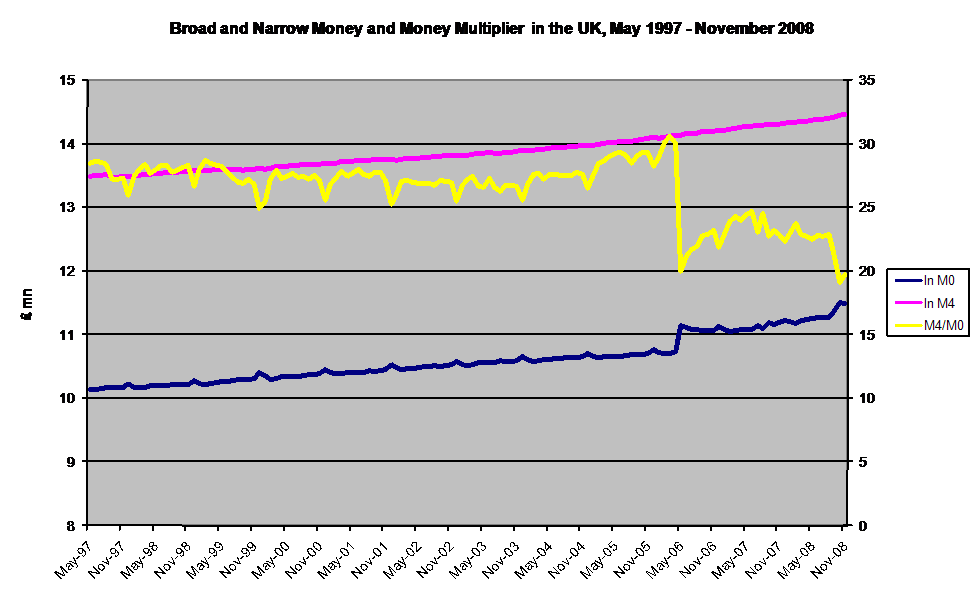
Even without the zero floor on the Bank of England’s official policy rate (Bank Rate) having been reached yet (it currently stands at 1.5 percent), the Bank of England has in fact be printing quite a lot of money. By no means enough in the period since September 2008, I would argue, but certainly quite a bit( TRUE ). This is clear from Charts 1 and 2 below, which show the behaviour of central bank money, also called base money or the monetary base, and its two components, currency (notes and coin held outside the Bank of England) and commercial bank reserves held with the Bank of England. Chart 2 also shows the behaviour of the monetary base, or narrow money, relative to a broad measure of money, M4, which includes sterling bank deposits held by the private sector and some close substitutes. The ratio of broad money to narrow money (here M4 to M0) is sometimes called the (base) money multiplier. Note that in Chart 2, both M0 and M4, but not the ratio of M4 to M0, are drawn on the log scale.

Chart 1

Chart 1

Chart 2

chart-2.gif

Until May 2006, UK monetary policy was unusual in that (a) there were no meaningful reserve requirements for banks (commercial banks only had to hold 0.25% of eligible reserves as non-interest-bearing reserves with the Bank of England under the Cash Ratio Deposit Scheme, an arrangement designed not for monetary policy purposes but to provide the Bank of England with another source of income) and (b) reserves in excess of this minimum required amount were subject to a financial penalty. Excess reserves did not earn interest at all until March 2005. From March 2005 until 18 May 2006 they earned Bank Rate minus 50 basis points. Since May 18, 2006, they earn Bank Rate.

You can see the effect of the May 2006 change in reserve arrangements clearly in Charts 1 and 2. The resulting increase in M0 reflected an increase in the demand for reserves by banks (holding constant everything except the interest rate on reserves). It was therefore not inflationary. The second rapid increase in reserves started in September 2008, when the UK banking system was on the edge of collapsing and, in the US, Lehman Brothers filed for bankruptcy protection on September 15, an event that triggered a state of cardiac arrest in most of the world’s money and capital markets( A CALLING RUN ). Again, this jump upwards in the stock of base money was driven by an increase in liquidity preference by banks. As long as the fear, risk-aversion, and partly irrational despondency that have the banks in their grip persist, the increase in M0 since September 2008 will not be inflationary( TRUE ). It reflects the central bank leveraging up to counteract the otherwise excessively rapid, sudden and destructive deleveraging( CALLING RUN ) of the commercial banks.

When fear and panic eventually desist, however, it is essential that the central bank stand ready to take back the injection of liquidity provided since September 2008( TRUE ). Indeed, as I hope and expect that the Bank of England will, during the rest of this year, engage in ‘printing money’ on a much larger scale than it has thus far( I AGREE ) , the need for an eventual massive contraction in the monetary base when the private financial sector rediscovers its poise and confidence( THAT WHAT THE SOLUTION IS ), will be paramount if the UK is to avoid a major burst of inflation a few years down the road( TRUE ).

How does all this connect with quantitative and qualitative easing? In an earlier post I offered the following definitions:

Quantitative easing is an increase in the size( AMOUNT ) of the balance sheet of the central bank through an increase it is monetary liabilities (base money), holding constant the composition of its assets. Asset composition can be defined as the proportional shares of the different financial instruments held by the central bank in the total value of its assets. An almost equivalent definition would be that quantitative easing is an increase in the size of the balance sheet of the central bank through an increase in its monetary liabilities that holds constant the (average) liquidity and riskiness of its asset portfolio.

Qualitative easing is a shift in the composition( TYPE ) of the assets of the central bank towards less liquid and riskier assets, holding constant the size of the balance sheet (and the official policy rate and the rest of the list of usual suspects). The less liquid and more risky assets can be private securities as well as sovereign or sovereign-guaranteed instruments. All forms of risk, including credit risk (default risk) are included.

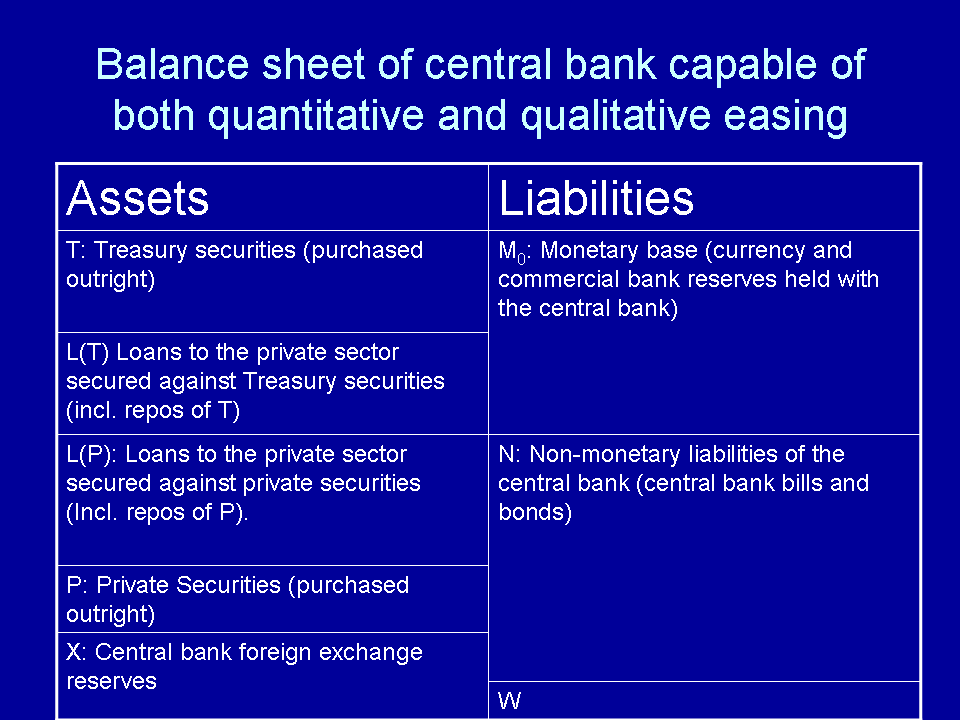
Let me expand on these two concepts with the help of the two central bank balance sheets in Tables 1 and 2.

Table 1
some-comments-on-quantitative-and-qualitative-easing.png

Table 2

table2.png

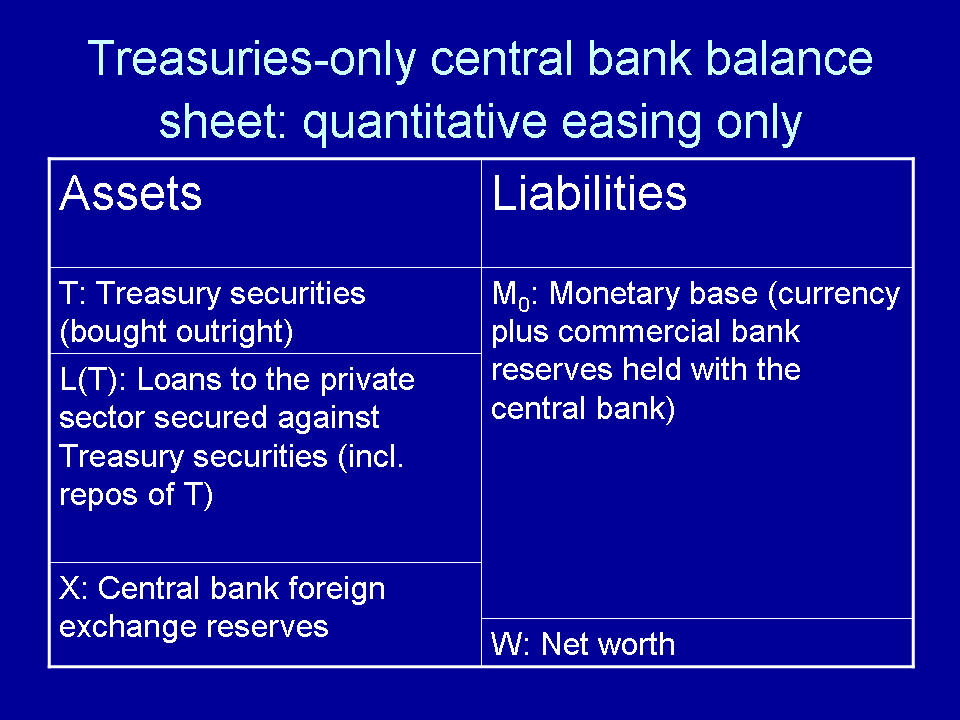
Table 1 shows the balance sheet of a central bank that today’s besieged central bankers can only dream of. Apart from foreign exchange reserves (X), it has on the asset side of its balance sheet only sovereign debt instruments (T, for Treasury securities) or loans and similar claims on the private sector collateralised against sovereign debt instruments, L(T). On the liability side of its balance sheet it has base money, M0 (currency plus commercial bank reserves) and net worth, W.

This central bank can engage in quantitative easing but not in qualitative easing: even when it lends to the private sector, it requires government securities as collateral, so it engages only in default risk-free lending (more precisely, in lending subject to default risk no greater than the default risk of the sovereign( TRUE )). Quantitative easing would mean expanding the monetary base by buying government securities, or by engaging in an increased volume of lending (or in an increased amount of repos of government debt) to the private sector.

The purpose of the exercise would be, presumably, to lower the interest rate on government securities of maturities longer than overnight. Bank Rate - the official policy rate - sets the risk-free overnight nominal interest rate. Longer-term risk-free nominal interest rates can be influenced by the central bank through two mechanism. The first mechanism is expectations of future official policy rates - of future values of Bank Rate in the UK. If arbitrage is possible on a sufficient scale, confident expectations that the future official policy rate of the central bank over, say, a 3-month horizon, will be equal to its current level, say 1.5 percent, will drive the 3-month risk-free nominal rate to 1.5 percent also. Only the equilibrium risk premia and term premia consistent even with fully efficient financial markets would stand between the expected value of the central bank’s future policy rates over a three month horizon and the 3-month risk-free interest rate (those of you who wonder about a risk-premium with risk-free interest rates should recall that risk is defined in terms of real consumption, or the utility of real consumption, while what the central bank sets is the risk-free nominal interest rate).

In principle, the central bank can, by credibly committing itself to keep the official policy rate at its current level for the next 10 years, bring down the risk-free 1o-year nominal interest rate to something close to the current value of the official policy rate. This does, however, require that arbitrage is possible on a sufficient scale. This is a necessary condition for efficient markets. Events since August 2007 should have convinced even the most foaming-at-the-mouth true believers in the efficiency of financial markets, that they have been worshiping a false god. The idol has feet of clay and has now been toppled so convingly, that the last believers are being whisked away by men in white coats making soothing noises.

So, if expectations and the reality or threat of arbitrage does not drive future risk-free rates down to a suitably weighted average of future expected official policy rates, the central bank can lend the process a hand by purchasing risk-free securities of the relevant maturities whose yields exceed the average expected future official policy rate over the relevant horizon( AS AN INCENTIVE ).

In the US, for instance, quantitative easing is not over until the nominal yield on all government securities of any and each maturity equals zero. But note that quantitative easing can, in principle, occur at any level of the official policy rate. It does not have to wait till the zero floor is reached. At the zero floor, of course, quantitative easing (and qualitative easing) are all the central bank can do.

Any central banker who argues, as some do, that “we set the overnight rate on reserves and we simply accommodate the demand for reserves at that (official policy) rate; therefore, until the official policy rate hits the zero floor there is no quantitative easing as a separate policy instrument” is delirious. This is because the demand for reserves depends not just on the official policy rate, but also on other interest rates and spreads (on public and private assets of different maturitities), some of which can be influenced by the central bank even when the official policy rate is kept constant. This is especially true during times when financial markets are illiquid and disorderly.

When markets are functioning properly, the central bank can really only set one nominal interest rate. When it pegs the risk-free overnight rate, it can influence longer-term risk-free rates only through expectations of its future policy rates( TRUE ). Term premia and default risk premia are not subject to monetary policy influence to any significant degree and liquidity premia are not a major factor. When markets are disorderly and illiquid, the arbitrage required for the expectations hypothesis to do its job cannot take place( MAKES SENSE. NO CLEAR FIGURES. ). There is a term structure of liquidity risk premia that can, in principle, be influenced by central bank liquidity injections (lending) at longer maturities. Liquidity premia and default risk premia are not independent, and central bank policy can even have a material influence on default risk.

All these factors also influence the demand for reserves and the stock of base money. A central bank can accommodate the demand for reserves at its official policy rate and influence that quantity demanded through the effect of its actions on other rates of returns and on market liquity at longer maturities and for a wide range of financial instruments.

Today’s central banks are, however, operating with a balance sheet more like the one shown in Table 2. The key difference is that on its asset side, the central bank now lends to banks (and perhaps to other private entities) against private collateral as well as against sovereign debt instruments; L(P) includes repos of private securities. The Bank of England was a late convert to this, but does now accept private debt instruments in repos and collateralised lending. The ECB always did, and so did the Fed, although it got out of the habit before August 2007.

In addition, the central bank can purchase private securities outright. This is the item P on the asset side of the balance sheet. The Fed does this on quite a large scale now, when it began to purchase commercial paper (CP) and Asset-Backed Commercial Paper (ABCP). If central banks make unsecured loans to private banks or other private sector entities, that too would be part of P.

The Fed’s proposed outright purchases of mortgage backed-securities issued or guaranteed by Fannie Mae, Freddie Mac and Ginnie Mae do not fall into this category, as Ginnie Mae is a government agency and both Fannie and Freddie are 100 percent government-owned( BUT ONLY IMPLICITLY GUARANTEED ). It is just a tiny bit silly to have one state entity (the Fed) acquire debt instruments issued or guaranteed by another state entity or state-owned entity. Much easier to slap a Federal guarantee directly on all these mortgage-backed instruments and leave the Fed to do monetary policy( I AGREE COMPLETELY ). But that would be too fiscally transparent and too easy( I AGREE ). Neither the Bank of England nor the ECB have thus far acquired private securities outright or lent unsecured to the private sector.

There is also a potential addition on the liability side of the central bank’s balance sheet. Central banks can issue non-monetary liabilities, instruments effectively the same as Treasury Bills or Treasury Bonds - let’s call them central bank bills and central bank bonds. In many developing countries and emerging markets this is a common practice. Quite often the credit of the central bank is better than that of the government, and open market operations are conducted entirely through the purchase and sale of central bank bonds and bills. We may see this emerging market phenomenon in the the submerging market economies of the West before long.

The balance sheet of Table 2 permits us to discuss various ways of implementing qualitative easing, and combinations of quantitative and qualitative easing.

Qualitative easing means the central bank either making loans to the private sector that are not collateralised against sovereign debt instrument (L(P) increases) , or lending unsecured to the private sector or purchasing private securities outright (P increases), but without changing the quantity of base money ((M0) is constant). This means that these loans or purchases are either financed by the central bank selling sovereign debt instruments it holds (T falls), or by the central bank reducing the amount of lending secured against sovereign debt instruments (L(T) falls) , or the central bank increasing its issuance of central bank bills and bonds (N increases).

By expanding its acquisition of private instruments or by lending to the private sector either unsecured or secured against private collateral, the central bank can directly target the spreads of these private debt instruments and private lending over the expected average future official policy rate (as measured, say, by the OIS rate - the Overnight Indexed Swap rate). Clearly, even in fully efficient markets these spreads will be non-zero because of equilibrium term premia, equilibrium inflation risk premia and equilibrium default risk or credit risk premia. But the liquidity risk premia, and the fear-and-panic premia could be much reduced or even eliminated.( I AGREE )

So I expect that our central banks will do quite a bit more quantitative and qualitative easing - expanding the size of their balance sheets, mainly by increasing the monetary base on the liability side, that is, by printing money, and on the asset side by increasing lending to the private sector secured against private securities (or unsecured) and increasing outright purchases of private securities.

The Fed is doing so already, and with gusto. It can do so without fear for its balance sheet, despite taking on a lot of private credit risk (default risk), because the Treasury explicitly guarantees the Fed’s outright purchases of private securities and other non-standard taking on of private default risk.

The Bank of England already has some credit risk on its balance sheet, through its repos of private securities. It has therefore engaged in qualitative easing. The sharp increase in the size of its monetary liabilities since September 2008 is evidence of considerable quantitative easing also. I expect it to increase the scale of its rediscounting of private securities and its repoing of private instruments during the coming year and beyond, until this crisis is over. I also expect it may have to lend outright and unsecured to banks and other private agents and that it will buy private securities outright and in volume before this is over.

Quantitative easing, through the acquisition of Treasury securities or through increased repos of Treasury securities and matching expansion of the monetary base, should be none of the Treasury’s business - it remains the province of the Monetary Policy Committee of the Bank of England. This is because the Bank of England does not take on any additonal credit risk other than that of the sovereign itself through these operations.

Qualitative easing or a combination of qualitative and quantitative easing does increase the credit risk the central bank is exposed to. Conceivably, the central bank could suffer a capital loss on its exposure to private securities that would be so large, that it could only restore its solvency without external assistance through monetary issuance of a magnitude that would threaten its price stability mandate( TRUE ). Indeed, if the exposure of the central bank were to foreign-currency-denominated securities, it might not be able to salvage its solvency through any amount of domestic currency issuance. In both these cases, the central bank (or its inflation mandate) would have to be rescued by the tax payer, through a non-inflationary recapitalisation by the Treasury. This means that qualitative easing, or any combination of qualitative and quantitative easing that increases the credit risk on the central bank’s balance sheet, should require the consent of the Treasury, and cannot be decided by the central bank alone( A GOOD POINT ).

I believe it would be best, operationally and to preserve central bank operational independence over monetary policy, if the Treasury were to set an upper limit to the amount of credit risk (by some metric) the central bank can take on, with the central bank being given the discretion to manage the composition and size of its balance sheet up to that limit.( A GOOD POINT )

Today, central banks and Treasuries appear to be conspiring to hide from the public the magnitude of the credit risk exposure they are taking on. In the UK, for instance, the SLS (the special liquidity scheme that swaps private securities like mortgage- backed securiteis for Treasury bills of less than one year maturity) is, as far as I can tell, neither on the balance sheet of the Bank of England nor on that of the Treasury. The Bank of England manages the facility as agent of the government, but does not carry the credit risk. Since the Treasury bills are of less than one year maturity, they are, for some obscure accounting reason, not counted as public debt in the UK. So I doubt they are recorded as Treasury liabilities - which of course they are. The assets, of course, are not counted either, but the liabilities are known and certain while the assets are illiquid, of unknown value and quite possibly dodgy( TRUE ). Accountability for the use of public resources is the first victim of a financial crisis( YES ).

I expect that we will see all three central bank, the Fed, the ECB and the Bank of England, continue to engage in qualitative and quantitative easing, expanding the size of their monetary liabilities (’printing money’) to finance acquisitions of private securities and to increase the scale and scope of lending to the private sector, both unsecured and secured against private securities. The Fed clearly has the bit between its teeth and is hot to trot further and farther. The Bank of England has not yet engaged in either unsecured lending to the private sector on in outright purchases of private securities, but I anticipate we will see both types of interventions before long.

The ECB/Eurosystem is the most interesting case. It has historically repoed against a wider range of private securities that the other two central banks, and it accepts a similarly broad range of private securities as collateral at its discount window - the marginal lending facility.

It is also, however, the central bank that appears to be most anxious about credit risk on its balance sheet. And one can appreciate the reason for that. Who, after all, backs the ECB/Eurosystem fiscally? The US Department of the Treasury backs the Fed. HM Treasury backs the Bank of England. Do the national Treasuries of the 16 member states that make up the Eurozone back the ECB/Eurosystem if it needs aggregate recapitalisation? Do the national Treasuries of the 27 EU member states whose national central banks (NCBs) are the shareholders of the ECB back the ECB/Eurosystem fiscally? There is a sharing rule among the 16 NCBs that, together with the ECB, make up the Eurosystem. But this sharing rule concerns only the sharing of losses incurred in the conduct of the common monetary and liquidity management policy. It does not change the total amount of capital of the Eurosystem, only its distribution.

This glaring hole in the construction of the ECB/Eurosystem - the absence of a clear, credible fiscal back-up for the ECB/Eurosystem - must be plugged forthwith. The long-term solution is an independent supranational Eurozone fiscal authority with independent tax and borrowing powers. The interim solution is a Fund of, say, €3 trillion, created by the governments of the Eurozone member states, that can be accessed, with the consent of a qualified majority of the Eurogroup member states, to recapitalise the ECB/Eurosystem, should its capital be depleted to the point that its ability to fulfill its price stability mandate is under threat. This Eurofund fund could be administered by the European Commission, or even by the European Investment Bank. The 16 Eurozone governments could seed the Eurofund with national sovereign debt, in proportion to their countries’ share of the ECB’s existing capital (normalised by the share of the Eurozone member states in the total capital of the ECB). Alternatively, the Eurofund could issue Eurozone debt instruments (Eurozone Bonds) guaranteed jointly and severally by the Eurozone national governments. During normal times, the profits from the Eurofund would be paid out to the governments providing the guarantees. If the guarantee is joint and several, the Eurofund should be able to borrow more cheaply than the most creditworthy national government, provided national sovereign defaults are not perfectly positively correlated).

Without a credible fiscal back-up for the ECB/Eurosystem, there is a material risk that the current crisis will expose the limitations of a central bank construction that does not underpin the ability of the central bank to act as market maker of last resort( LOLR ) with appropriate contingent fiscal support mechanism.

Let me be clear: there is no potential problem when a Eurozone NCB assists a private bank in its jurisdiction in a specific lender-of-last-resort operation. According to the Treaty, the NCB in question can only provide any financial support of this kind after the national Treasury involved has provided a comprehensive commitment to indemnify that NCB for any losses involved as a result of the lender-of-last-resort-operation. The problem arises when, as a result of ‘normal’ monetary policy or liquidity operations, the NCB (or even the ECB itself, were it to engage in such operations directly) incurs exposure to credit risk. The NCBs of the Eurosystem do so routinely. In the past, the credit risk involved - the probability of a joint default of the bank borrowing from the NCB and of the issuer of the collateral - was deemed small. That is no longer a safe assumption to make even in the case of repos of private securities. It certainly is not a safe assumption to make were the ECB to engage in unsecured lending or in direct purchases of private securities.

Unless a way is found soon to plug the fiscal black hole behind the ECB/Eurosystem, the ECB/Eurosystem may either have to take on excessive credit risk or it may have no choice but to abstain from participation in the next stage of quantitative and qualitative easing: direct unsecured lending by the central bank to the private sector and direct purchases of private securities by the central bank."